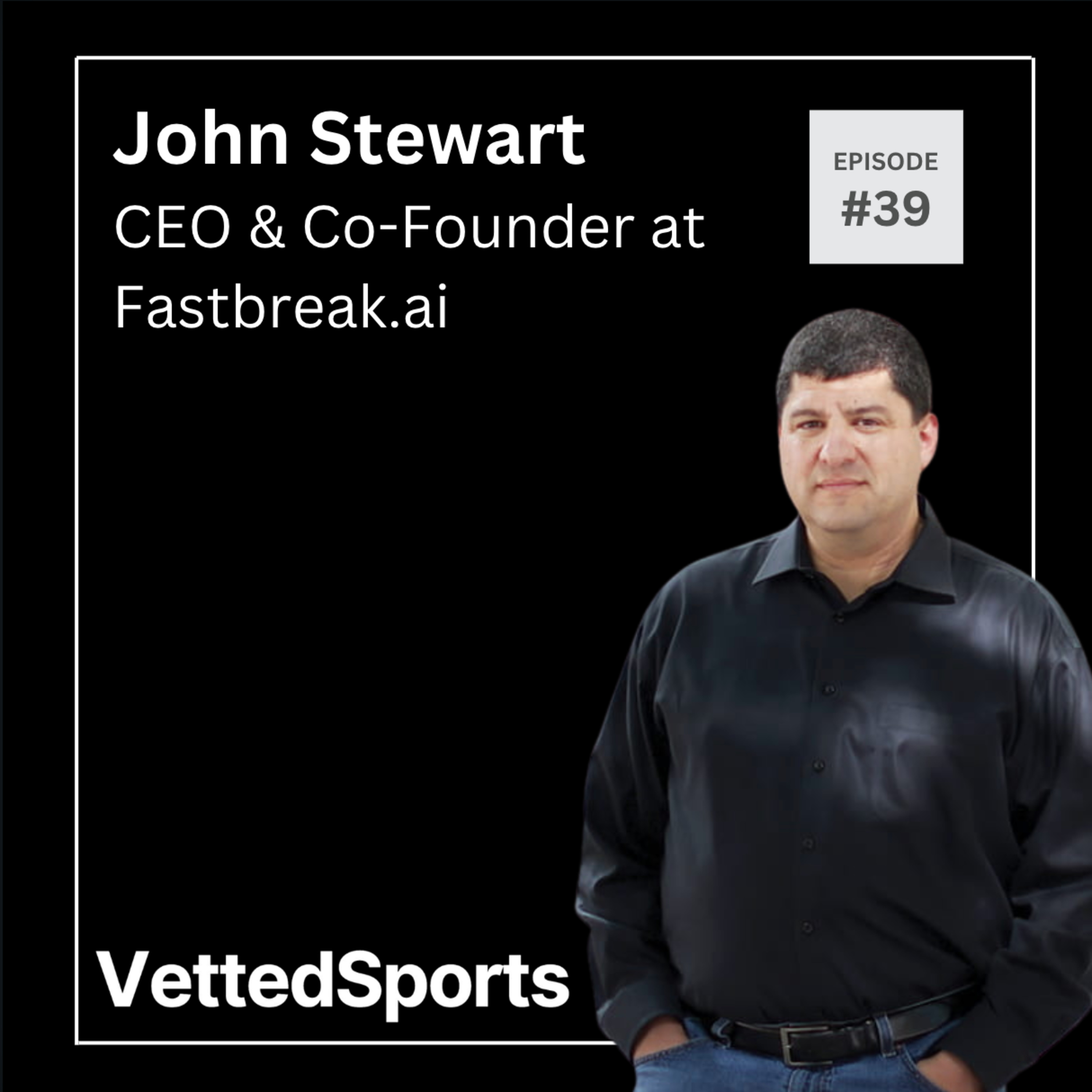
John Stewart is the CEO & Co-founder at Fastbreak.ai.Fastbreak.ai is a SaaS company transforming how the world of sports operates. Its AI-powered platforms deliver the intelligence behind scheduling, tournament management, and sponsor activation for professional, amateur, and youth sports organizations worldwide.John is a serial entrepreneur who founded his first company, an engineering services in 2003. After successfully exiting that business in 2009, he co-founded Saber Business Solutions, which evolved into MapAnything, a geospatial mapping and scheduling software company, acquired by Salesforce in 2019. Follow John:LinkedIn: https://ww...
Transcription
3949 Words, 21885 Characters
(upbeat music) - Y'all, I appreciate the time, man. First and foremost, man, it's been an incredible building relationship with you over the past couple of years, watching Fast Break, grow, and excited for all the things to come, but I wanna start back at the exception, the beginning for people who might not understand the story behind Fast Break AI. Talk about what inspires you to start the company, because you've had a couple of successful X-XC. You could have chilled out, kicked your feet up, and called it quits, but you decided to tackle this problem. So what was the emphasis behind that? - Sure, well, first and foremost, like most people, I love sports. I think it's one of the best things in society. It's something that brings us all together. You know, I have five sons. They all played travel sports or sports or some type. When I was running my prior company, well, still supporting like travel across and travel hockey and baseball, you know, I saw how technology backward the entire youth sports space really was. There were some big players, certainly no one truly at scale, but it wasn't, it was archaic, it was pretty poor, because we had unique technology around schedule, know how we should say around schedule optimization, from because of my prior company that we sold to the sold, we were able to leverage that knowledge to attack the scheduling problem. Now, one thing that I noticed from technology players is a lot of times they get trapped in whatever niche they first attack. And by going after professional sports first and refining our technology at the pro sports level, that sort of gives us the brand Rabatoss and the halo that made it a lot easier to transition and going after the youth, but you know, from day one, the plan was always to go after sports as a whole. It wasn't just to be in a single segment or a single section, it was to go after all of it. And, you know, so, but it was those two combined factors, understanding the massive opportunity that was you sports given the way Americans spend on it, having unique intellectual property and the ability to create scheduling and then having, of course, the brand Rabatoss as a result of working with the largest professional sports leagues in the world. - Why do you feel like someone hasn't tried to solve this problem yet in sports? - Well, which problem are we referring to or referring to? - Specifically around scheduling professionally or even if you look at down strength 'cause a lot of it, I guess previously, was run on spreadsheets and done manually, so. - Well, it's a really hard problem to convert to a math problem, meaning that it's growth and it's exponential, right? So, tons of people have tried solving this before, doing this by hand in the late from 2006 to '09. You know, technology and computer started coming along to try to do it, they tried to use off-the-shelf optimization techniques. The techniques that we use would not have been possible before the day and age of all the massive compute that's available as a result of, honestly, cryptocurrency before AI, but now AI, right? And that high, you know, that availability to the type of compute and the, you know, how much of it is available at a very economical price, you know, lets us, you know, apply our approaches, our proprietary approaches and techniques to solving these problems. So, some of it was literally a limitation of hardware and compute. Some of it was, you know, just in terms of optimization engines, my team have been the people that have probably built the, you know, the last four or five commercial grade optimization engines, they've built all of them. And the last, you know, starting in 2014. So, you know, I think it's sort of specialized areas. So, you have to have the expertise, the compute had to be available in those factors come together. So, I think what gives us a unique positioning? What's been the hardest part about, or I guess, the unexpected challenges about building fast brick, if anything, whether that's like the technological, technological innovation, the sales cycles, the slow to mover, you know, the ecosystem in the sport space. Like, what would you say is the one challenge that was unexpected when you first started the company? - At least in the youth space, I think, you sort of knew, but you didn't really realize until you actually started living in it. Just how fractured and fragmented the space is. It is incredibly fragmented. And that produces a whole bunch of challenges. It produces technology challenges, go to market motion challenges, brand development challenges. And you sort of had to embrace the chaos of that space, you know, to really get, you know, really understanding it, your hands around it, to be able to build and develop. And I think I really wasn't, although I sort of instinctively understood, until you actually lived it and experienced it, you really don't know. And, you know, it's highly personal, highly local. I know there's a lot of PE firms coming in, trying to roll everything up. But sports is still hyper local. And, you know, you're dealing with the cast of thousands and the cast of characters. And I think that's probably, was, has been the biggest challenge. - Before we get too far, I want to talk about some of the products that are within fast break. 'Cause a lot of people see you guys as scheduling, but when you really look at the roadmap, you guys are really building a robust platform and solution for a lot of challenges within sports. So you got to talk about, you know, some of the offerings that you guys have outside of scheduling. - Sure, so let's talk. I segmented by basically professional amateur, for the purposes of this conversation, let's all agree that co-sports is professional. Just everybody's on a one year deal, that's all. So, you know, we have our course scheduling product, at the professional level, we have two other products that are now in market as early, basically not generally available, but targetly available from target standpoint. One of them is what we call true view. It's a ratings prediction capability. So we license all the data that comes off these smart television sets. And we use that to create very, very precise prediction models for the value of a piece of inventory, inventory being something that is super important to the leagues with respect to their meteorite steels, and then we incorporate that into the schedule. So that's a prediction capability, and we're starting to apply our techniques of things like attendance models, ticket sales models, things that are really, really important as it becomes more critical for people with, who own meteorites to monetize it as effectively as they can, right? The second thing we're doing at a professional level is a first product for teams, professional sports teams. And this is schedule optimization, travel management, basically data, think about it as like an entire OS for sports teams. We have that right now in Betamo with four MBA clubs in one English Premier League club, but it won't be generally available. We call that fast break reform until summer next year. So that's common. Using a combination of our optimization capability or data analytics capability, the communication tools that we've developed for youth, but applied to professional sports teams and organizations. And then on the use side, we have our compete platform, which is basically the operating system for an event operator. The person running a large-scale volleyball or a use style basketball tournament or stock crypto tournament. And that does everything for them. It does their registration, their e-commerce, their website, scorekeeping, scheduling, payments, ticketing, travel management. It's also a channel for both our pulse and our connect products, which are brand and brand sponsorship capability. So, and we also have three more products coming out next year. So we have this idea of what we wanna do is for both the operator and the parents go from five logins down to one login. It was what we're trying to do. That idea that single source of truth, single source of data. So we're gonna continue to add things into our stack to give a better experience to the end users. Hopefully, and also lower the costs for them to participate. All these different data stacks and all these different technologies just raises the cost of operating these sports leagues or teams or leagues. And that cost gets passed along to the parents. - I love it. Specifically taking the youth sports industry, which I believe is the 30 billion plus right now and rapidly growing year over year. - It's a lot harder than that if you include the travel piece of it, it's twice that. So, and we do because travel is a key part of what we're doing on youth sports. - What do you think is gonna drive the youth sports economy in the future, whether that's tournaments, facilities, you know, obviously we're saying a lot of new development is it data and the media portion? Like you guys are kind of tackling all these different sub-sectors, if you will. So what do you really think is gonna push that space forward over the next, let's say, decade? - You know, I guess the expression that comes to mind is to a hammer everything's in now. So it depends who you ask. If you talk to one of these real estate developers, they're gonna tell you that is the verticalization of the facilities within bed and entertainment, restaurants, et cetera. If you talk to a PE firm rolling up event operators, they're gonna tell you it's these events, if you talk to the league. So I think the one constant is the travel piece of it, mostly because, you know, the way people treat the travel with youth sports is they treat it like many vacations, which is why so many parents actually do it. That's what a lot of people don't get, where while the travel's become a big part of youth sports, you know, the people you travel with become your friends, you sit in the hotel, you know, you sit at the hotel bar or the pool and you socialize and it's like a mini vacation every weekend when you do that. So I think you're gonna continue to see a lot of that and more of that, you know, but again, I could be biased because we're travel heavy on the east side, right? So it's hard to nail down. That's the problem of saying like amateur youth sports. It's so broad. Like, you know, what category are you talking about? Are you talking about, you know, the scholastic-based sports or rec league type sports like the YMCA or Little League or is it club or elite travel or academy sports, is it basketball, baseball, volleyball? Not fragmentation, which is starting where we started this conversation. It's so extreme. It really depends what second you're going after. - Yeah, that's a good point. You know, one thing as an investor in Fast Break that I've admired is the vision, the long-term vision and the focus. Can I talk about the opportunities that you've intentionally said no to versus the one that you said yes and actually align where you're trying to go long-term? - Well, the one that I said no to is easy. It's the video streaming and the video streaming wars that are going on in your sports because there's two models. One is the hardware focused model and damn, that's capital intensive and doing hardware is hard, right? And you still can't solve for the bandwidth issue because okay, you have the streaming that you're responsible for, but when you put 2,000 people in a gym Saturday, it never really works all that great. And then you've got the solutions that people are using their cell phones to stream it. And so I'm not sure where the monetization falls in that. I know everyone's chasing it. There's been a huge investment from the huddles and the game changers and all that. But I'm not sure how that plays out and who wins on that. And then you even see some stories recently that you have private equity firms that own some of these distribution channels, the video streaming, telling parents they can't film their own kids. That doesn't make for a good PR. So I've been very intentional about avoiding video streaming. I mean, we'll integrate with it. We'll integrate with what will be agnostic of the streaming provider but we won't go after that ourselves. That'll be a partner type of situation. And then where we've been very intentional is on the travel piece because we think the way state of play has been done is criminal. That you have got traditional providers in the space taking $150 holiday in and selling it for $220 and making it more expensive versus our model because we're actually a certified, we're actually having our own IAT number. This is an internationally credit travel agency. We have direct connections with these brands and we make sure that our rates are always lower than what they can find in an Expedia price line. So it's an opportunity to partner with the brands and lower the cost of participation for the families. And so we've, you know, leading in heavily to that. - Obviously there's a lot of talk about AI in sports and you guys use a lot of AI capabilities. Where do you think it actually adds value as opposed to it just being noise? - Well, on the schedule inside of it, we couldn't actually do the scheduling problems that we take on with that AI. So let's just put that aside and talk more generally about the use space. - Yeah, all right. - And with regards to that, I, we believe that basically AI is your user experience of the future, right? Your UI of the future, your interaction of the future is basically you talking to your interface or you basically, and I'm not going through and filling out forms or picks and clicks, the user experience of the future should just be a dialogue if we're doing it right. So we do think there's a good use for it there. I know there's a lot of people down trying to use AI to break down film to create stats. I love that use case. I still think we're a generation or so away from that, though. At least for the high movement sports. And not for hockey or basketball, but certainly for baseball, you can do that slow moving. You can do that for football too. But I think like, you know, I think using AI to break down film with basketball to auto stat, like, you know, what is a steal, what is a rebound, what is an assist. I think we're still a little bit away from that. - Got you, understood. - But that's a great use case. - Yes, a lot of that, by the way. Like that's, there's tons of companies working on that right now. - I want to talk about the culture and the team around Fast Break. Cause I think you guys, you know, obviously I'm biased, but having a chance to spend some time with people on the team and in that environment. You know, I think it's an incredible culture. And so, you know, it's very hard as you scale to maintain that culture. So can you talk about talent? Why it's so important and advice that you would give to another founder specifically within sports on how to cultivate that? - Right, I mean, I have some certain pillars, if you will, for our culture. Right? You know, the number one thing with regards to talent is this, right? And we're very careful about this. Because yeah, especially when we have a team like we have and you're bringing new people in, which we have to do. I constantly ask people, you know, what makes an A plus player? Like if I was to ask you, what is the definition of an A plus player? What would you tell me? I would say first and foremost, somebody who is a team player and aligns with the mission of the company and is just overall a good person. - Bingo, like a lot of times I get the conversation, you know, I get people telling me that it's, you know, highly skilled, it works extra hours, right? Delivers or work on time. I would tell you, my definition of A player is somebody who makes everyone else better, right? Michael Jordan was truly a superstar and he would probably disagree, but until he was figured out to make Scottie Pippin better and then he started winning championships, right? And that's the definition of a superstar for us. The mantra here is, if you come in here, again, you gotta be a good teammate, you gotta figure out how to elevate everyone else's game. Everybody brings something of their true selves to the table. You have to be willing to contribute that, you have to be able to lift everybody up. And that's like the number one thing for us here is you gotta be an A plus player. Like, you know, you see this in sports all the time. Like without naming names, but I'm a huge Charlotte Horns fan, but there's players on the team that they have the skills, the speed, the experience, the know-how, but they can't make their team better so they'll never win a championship around those players, right? So that's the number one thing. The second thing that we focus on is we have a very simple mantra around here called not fast enough. Now, that is not a reflection on the productivity of my team. They're very, very productive. They put in the extra time. They do things great, right? Not fast enough simply means in this day and age and era, right? We have to be moving as quick as possible because there's someone on our heels or someone trying to do this faster or better. And we can't afford not to be moving out of pace we need to move. Now, it doesn't mean you cut quarters or do it wrong. It means if something needs to take six weeks to do, that's fine. If to do it correctly, take the six weeks, but it better not take six weeks in one day, right? And that's sort of a mindset that you get into, right? That idea of not fast enough. You've got to execute and perform because honestly, in this day and age of AI, technology's no mode anymore. Your mode is your brand, your distribution channels and your speed, right? So, you know, that's very, very important to us. You know, we have an environment of, you have to be opinionated to work here, have a point of view and be willing to share it. This is sort of this leadership mindset. Everybody has to have that mindset. Again, everybody brings something to table that's part of themselves. Super important to our culture. And there's a few other things that are specific to us at Fast Break. But that's generally what we try to foster as a culture here. - I love it, great insight. And then briefly touch on the rays that you all just closed. I mean, obviously like your high growth company doing very well, you probably have investors beating down your door, trying to get involved. How do you think about the partners that you align with and the right investors to bring, you know, to partner with Fast Break? - Well, first of all, it's about alignment on vision, right? Are they willing to, if they're putting their money in, are they willing to take the ride with me? And that means to take it all the way. So you need, you need first and foremost, people that are aligned that way. After that, you want to align on, you know, personality. I often would tell first time founders, they ask about picking their VC partner. I'm like, it's basically a marriage. You know, let's pretend you had to take a flight to Australia. Would you be willing to sit next to that guy? Or girl, girl, for the entire flight to Australia? The answer is no. You probably shouldn't take money from the person. - Yeah. - Like, so, you know, so there's some of that. And then obviously we put a value on strategic. Like, do you have special domain knowledge? Do you have special technical skills? Do you have special access to distribution channels? And so there is definitely something as such as a strategic investor. - Yeah, absolutely. Last couple of questions before we wrap up. On a personal level, what keeps you excited about working on this company and solving these challenges? - Oh, I love it, man. I'm in at 730, I'm out at 780 at a clock at night. And what keeps me energized is just this stage of growth. I've got, you know, my wife and I kid, I've got a kindergarten out there, right? A lot of employees are younger than my oldest son. So it's so exciting to be able to put the team together and see their energy, that gives me energy, mentor them along, help them be successful in their career. And that's really the most exciting thing. And then collectively have that mission and to be, you played sports, you know that. When you're all in that locker room, you've got that collective mission. You put the work and you put the reps in. And then to see it come to fruition with the wins, you live for that, right? You know, it's all that hard work, right? It's that that sometimes sucks doing, but you're doing collectively and you're working on towards something. I would have, what a professional athlete, so you say, you know, you pay me to practice, you pay me to practice, you get Sunday for free. - Hmm, I love it. - It's that mentality. - Yeah, nothing like it, man. And then when you look like, let's say, five to 10 years out, what would equal success for you in fast break? This is easy. Five years out that we were, have made an impactful, meaningful enough company that when people think of sports tech, it's synonymous with fast break AI. That's what I want. Then we'll know we were successful. If we're one and the same, right? When you, if you're gonna go search something and then you're googling it, aren't you? - Yep. - You're googling it. It's become synonymous, right? With, you know, with search. That's how we'll know we were successful with fast break. - Beautifully put, man. - Appreciate the time, John Lastic, you let people know where they can learn more about fast break as well as connect with you. - Sure, www.fastbreak.ai and my email address is easy. It's John and that fastbreak.ai. - Well, man, appreciate you. - All right. (upbeat music) [BLANK_AUDIO]
Podcast Summary
Key Points:
Summary:
Chat with AI
Loading...
Pro features
Go deeper with this episode
Unlock creator-grade tools that turn any transcript into show notes and subtitle files.
 PodcastTranscript AI