Airlines Confidential with Scott McCartney is made possible with support from RTX. RTX has the vision expertise and scale to see the future of flight and build it.
RTX.com
Infinity Flight, the leader in cadet academy flight training programs, infinityflight.com
Ontario International Airport in Southern California, so cal so easy fly Ontario.com
The executive MBA in aviation at the University of Colorado Denver, business.ucdenver.edu
and by Sirium, the world's most trusted source of aviation analytics, Sirium.com
We also welcome your businesses support contact us at airlinesconfidential.com
Welcome to Airlines Confidential. I'm Scott McCartney, hoping everyone will take a moment to celebrate the 113th anniversary of the first successful flight across the Mediterranean.
Frenchman Rowan Garros flew 450 miles from the French Riviera to Tunisia. It took him 8 hours and no it was not that long because of an air traffic control equipment failure.
He landed with only minutes of fuel remaining and he became one of the most famous aviators of the time.
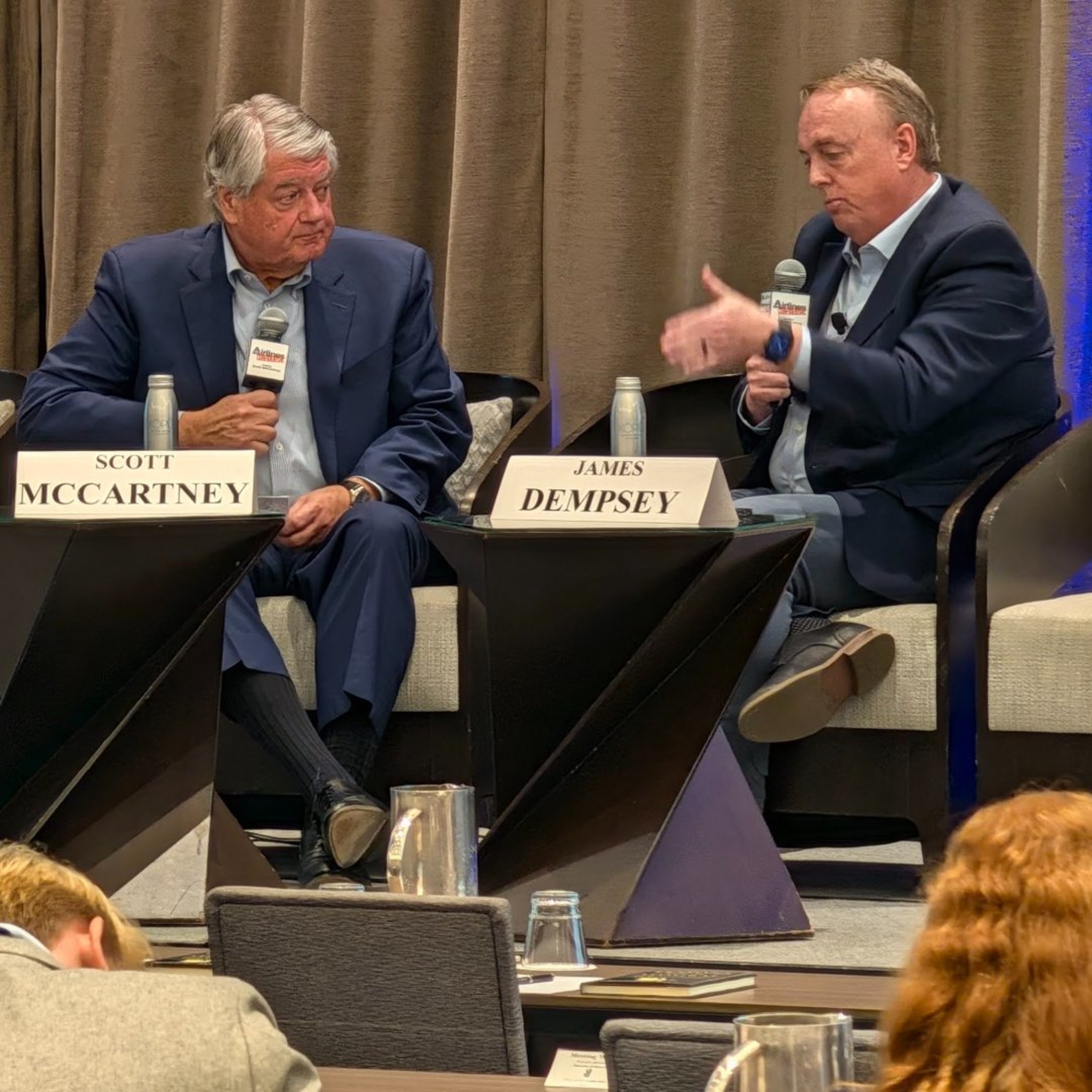
Like Rowan Garros, I'm flying solo this week. That's because most of this podcast will be an in-depth fireside chat I had with Frontier Airlines CEO Jimmy Dempsey at the American Bar Association Aviation and Space Forum.
Jimmy's been in the CEO job less than a year and he is one of the bright, dare I say, younger leaders in the airline industry.
Perhaps not well known to many of you, but you need to get to know more about him and you need to hear from him. He is dramatically reshaping Frontier in what seems like record time and it's exciting to see.
We'll talk about where Frontier is in its transformation, what's ahead for the low-cost carrier, what kind of future there is for low-cost airlines in the US and so much more.
The session included questions from a room full of aviation lawyers and I think you'll enjoy that as well.
Before we get to that, some news of the past week. I happen to live in Dallas, Texas where we haven't seen rain clouds in more than 60 days.
But there are storm clouds forming around the airline industry and some of the news this week points to a possible stormy winter for some airlines because of high fuel prices.
Meteorologists tell us a super El Nino has formed in the Pacific affecting actual weather. I'd say this is starting to look like a super L-fuel low for weaker airlines.
Case in point, Air Baltic filed for Chapter 11 bankruptcy reorganization in New York. Air Baltic is majority owned by the Latvian government, Wolf Tonsa has a 10% minority stake. It voluntarily went to bankruptcy court in the US to shed some debt, get rid of 20 of its 54 Airbus A220 300 airplanes and lower costs because of the financial pressure of high fuel prices caused by the warrant with the RAN.
Air Baltic, by the way, had fuel hedges but sold them in March to raise cash. The airline has secured about 350 million Euros in debtor and possession financing. Fletz continue.
Why file in the US? Few other countries allow a company to restructure while it continues to operate. In bankruptcy courts in most of the rest of the world if you can't pay your bills, you're done. Not here.
It'll be tough for Air Baltic. The interest rate on the debtor and possession financing is currently 12% according to Bloomberg, "ouch."
Rival airline Ryanair almost immediately proposed doubling its Latvian base over the next five years and significantly building up air service there. What's more, this may be a warning shot for weaker airlines around the world. Air Asia posted a large second quarter loss in Tony Fernandez has been dismissing doom and gloom while the company stock has lost more than 60% of its value this year.
That story will be repeated over and over. For most airlines as this period of high fuel prices stretches longer and longer, we will likely see capacity cuts. Scrapping routes that can't make money when fuel is twice as expensive as it was a year ago.
This past week, several airlines presenting at the Morton Stanley Conference in California talked about reducing capacity this winter if prices stay high. American United and Southwest also had pretty much the same thing, sharply higher fuel prices are prompting them to reduce or reconsider plan flying particularly marginal routes later this year and in 2027.
American estimates that its fourth quarter fuel bill will be roughly a billion dollars higher because of the higher fuel prices United has already removed some December flights.
That doesn't mean demand isn't strong and further fare increases aren't possible. It was interesting to note that airfares in August measured by the consumer price index were 23% higher than August 2025. That's a big increase. Also interesting to note that changes such as increased premium buy-up opportunities continue to work.
Southwest said 60% of its customers are paying add-on fees and by the way business travel on Southwest is way up.
Changes such as seat assignments and extra legroom rows have made Southwest more attractive to business travelers and spoiler alert. You'll hear Jimmy Dempsey talking just a minute about what frontier is seeing in terms of passengers paying for more room. Yes, premium is working at frontier as well.
Speaking of money troubles the government accountability office says the FAA's air traffic control overhaul needs billions more and still lacks a firm master schedule.
The FAA now says the first phase of air traffic control modernization will cost about 16 billion versus 12.5 billion provided by Congress. Administrator Brian Bedford is seeking another 10 billion for phase two. Meanwhile the GAO says the FAA underestimated costs and has yet to produce a comprehensive schedule covering more than 11,000 projects.
The telecommunications replacement alone has risen from an estimated 4.75 billion to 5.91 billion. The FAA wants obsolete copper communications lines replaced by September 2027.
Look, it's no surprise this is going to cost more than originally planned. That's how this works. But we have to get this done and Congress has to step up with the money. There should be no pushback on well you said it was going to cost this but it's costing more. Yes, it's going to cost more but you haven't fully funded phase one. You haven't funded any of phase two and you got to get on with it. It's got to happen.
Okay, time now to thank our sponsors for making this podcast possible. Thanks to Ontario International Airport. Ontario International Airport is wrapping up major upgrades in both terminals with additional TSA screening lanes, welcoming exit corridors and modern family restrooms to make your journey smoother and more accessible than ever.
Getting from parking to your gate quickly and back again at the end of your journey is part of what makes ONT so cal so easy. And by the way, for the second year in a row, Ontario International Airport ranked number two among all medium size airports in the JD power 2026 North American airport satisfaction study.
Congrats to ONT on that visit fly Ontario dot com to learn how the airport is keeping wait times low and creating a better travel experience even as more passengers choose to fly through ONT.
Thanks as well to the executive MBA and aviation at the University of Colorado Denver, the executive MBA and aviation at CU Denver is the first degree of its kind in the world taught by industry experts and designed for ambitious leaders from across the aviation ecosystem.
With classes located at Denver International Airport and week long residencies in Washington DC and at airports around the world, students experience a hybrid flexible course structure that balances in person and online classes without career interruption go to business dot UC Denver dot EDU to learn more.
We also want to thank RTX for its support of airlines confidential at RTX a century of aerospace and defense innovation shapes a unique perspective takes more than technology alone to rapidly advance the future of flight and strengthen global security.
It takes the vision to see what's next adapting expertise and scaling manufacturing capability to deliver where and when it matters most perspective is everything RTX visit RTX dot com to learn more.
Okay, let's turn to my conversation with frontier airline CEO Jimmy Dempsey. Good morning everybody. It is my pleasure to introduce Scott McCartney, one of the most respected voices and aviation journalism for a live episode of the airlines confidential podcast joining Scott on stage is Jimmy Dempsey, president and CEO of Frontier Airlines. Please join me in welcoming Scott and Jimmy.
(audience applauds)
Thank you Chris, it is great to be here with all of you.
I used to somewhat regularly go to this meeting 20, 30 years ago
when no one partied like airline lawyers.
So I assume nothing's changed.
But it's great to see some familiar faces and big new friends
and just been wonderful to be here with you.
Thank you Chris very much.
Thanks to Husk Blackwell for making this happen.
We really appreciate it.
And thank you Jimmy for being here.
Jimmy Dempsey, as I think everyone probably knows,
became CEO of Frontier Airlines in December.
He had already been president of Frontier,
the largest low-cost carrier in the US.
And before that spent nine and a half years
as Frontier's chief financial officer.
Jimmy had been at Ryanair in Ireland for 11 years
before that. He's to-do list is extensive.
And we're going to talk about that.
Improve the operation, find ways to thrive
and a consolidated airline world where low-cost carriers
have struggled and returned Frontier to profitability.
So it is a pleasure to have you join us today.
The ABA's forum on air and space law.
Well, it's a real honor to join you on your podcast
and appreciate everybody listening to us today.
Hopefully, we make it interesting for you guys
and tell the story of Frontier and how
we're adapting the airlines to today's environment.
So Jimmy, before we get that, we always start with
what I affectionately call the Ben Baldance a question.
Because Ben taught me it was usually an interesting question.
And I don't think you knew Ben, brilliant guy,
very committed to making travel affordable
and building profitable airlines.
And co-founder, along with Charlie Shapiro,
who is here of Airlines' confidential podcast.
And the simple question he always loved to start with
was how did you get into this crazy business?
Well, I'll answer that in a second.
I never actually met Ben, but Barry talked about him a lot to me.
And obviously he had a big involvement in the Indigo Airlines
and Spirit Airlines when Indigo was involved in it.
So it's a pity I never crossed.
But I heard many, many stories about him
and what a great guy that he was.
And it's a terrible shame that he's no longer with us.
How did I get into the industry?
I really fell into it.
My background, I'm obviously Irish.
My brother actually is an aeronautical engineer.
He was big into aviation and aerospace
and works in aerospace and defense today.
But I had no really interest in aviation.
I became a chartered accountant in Ireland,
which is one of the paths that you would follow
as a student and progressing your professional career
in Ireland.
And I ended up in Pricewaterhouse Coopers.
And I was pretty bored, quite counting, quite frankly.
And I was looking for an exit.
I was a manager in PWC at the time doing audits
and some transaction services.
And I had two jobs that I was applying for.
One was with an advertisement in like a broadsheet newspaper
called the Irish Times in Ireland and a quarter-page ad
for the head of investor relations in Ireland.
And the other one was in sort of a small venture capital
firm in Dublin.
And so I had two jobs on the go that I took interest in.
I really didn't know what working in an airline was,
what working in the airline industry was.
And I certainly didn't know what the head of investor relations
did in an airline.
And so I applied for that job, eventually got it,
chose that over the venture capital role,
and then fell into the industry.
And literally, I think I was in the job for two days.
And I was like, I said to my girlfriend at the time,
but my wife now, you know, this is a crazy place to work.
I mean, Ryanair was worked in this building
that they called the White House in Dublin Airport.
Everybody was crammed in.
It was like a trading floor you see in an investment bank
in New York, where there's constant noise and activity.
And I stayed there for nearly 11 years and really, really
enjoyed it and learned to hell of a lot in the industry.
So I kind of fell into the industry,
as opposed to desire to go straight into the airline business.
Yeah, interesting, interesting.
OK, Frontier and Spirit spent years proving
that there was a large market for ultra low cost model
in the US.
But Spirit's collapse has raised questions about that model.
What does Frontier understand about the business today
that Spirit got wrong?
I mean, it's not that Spirit got something wrong, per se.
I mean, the environment has changed.
If you looked at the airline business
in the United States pre-COVID, both Frontier and Spirit
were very successful in very profitable airlines,
among the most profitable airlines in the world.
And, you know, COVID changed that.
You know, what you saw post-COVID was the ability of the big
airlines to take advantage of their loyalty programs
and grow two things.
One was basic economy in great scale
and subsidized that through the cash flows
generated from customer loyalty and the use
of their credit card programs.
And the second thing was the two ULCCs
grew quite quickly, post-COVID.
And so Frontier's case, we grew from,
I think we had like 94-95 aircraft coming into COVID.
To the end of last year, we had 175 aircraft in the fleet.
So we grew really rapidly and nearly doubled
in size in the airline.
Actually, more than doubled in the context
of passenger volume and growth in the business.
And so that rapid growth with an environment
where basic economy had developed quite strongly
from the legacy airlines and the loyalty programs
and the strength of the loyalty programs
across the rest of the industry really became prevalent.
And so your environment changed.
And so, you know, we ended up in a situation
where our loyalty program was quite immature,
needs to mature.
And the airline itself, you know,
because of the competitive environment that existed,
needed to change for that environment.
And so that's where I got appointed earlier this year.
And I set up a plan which was like literally a four-point plan.
That's right size of the fleet.
The airline got larger in terms of aircraft numbers
than the actual assets that existed in the airline
like pilots, flight attendants, and fundamentally customers.
And so we had about 175 aircraft.
We had enough pilots to fly about 140 aircraft
if you flattened the week.
And so we set about right sizing the fleet.
And obviously, we're very focused on costs.
We wanted to take some costs out of the business
and make the airline much more productive.
And so by right sizing the fleet,
it enabled us to flatten the week in terms of the flying
during the week and make the airline a lot more productive.
And so those two things have been progressing really, really well.
The other two parts of the plan that we developed
was fixing the operation,
making the airline more reliable in the customer's eyes.
And that's a multi-year project.
And we've made some progress on it this year.
But that will take time.
And so when I say reliable, I mean,
fix the completion factor issues in the airline,
fix the on-time performance of the airline.
And these things will take time.
And there's a huge amount of projects going on
in the background to put the airline in a condition
that the customer sees us as reliable.
And so that's really, really important.
And then that feeds our desire to drive loyalty
and improve the loyalty program
and drive credit card cash flows into the business
where customers are coming back for repeat traffic flows
and creating a much more stable revenue base.
And so that's progressing very well.
And like if you look across this year,
our revenue base has improved quite dramatically this year,
which is really healthy.
I want to ask, a little more about operation.
Fixing the operation because I always find this fascinating.
I think a lot of people think you can do that
by throwing money at it.
You throw a block time at it, you increase the number
of spare airplanes, gets expensive.
But you're talking about a multi-year project.
What's involved in fixing the airline?
Well, it's all across the operations of the airline.
For the flying public, they see the aircraft
throughout the day when they fly.
And they have little patience for delays
or cancellations, which we understand.
But what happens overnight with that aircraft
is you do a variety of maintenance checks
and other things that happen in the airline.
What I'm trying to establish and what we're pushing
very strongly internally is getting the airline
in a position where you have your spare aircraft
available at the beginning of the day.
You actually have your on-time departures
on time at the beginning of the day,
so that the rest of the day tends to flow very successfully
if you do that.
If you're delayed getting the aircraft out of maintenance,
it tends to cause a cascade effect across the airline
for that day.
And that has an impact on the following day and the day after.
And so getting the coordination of those tasks
right is very, very important.
And so it may sound simple to do.
But if you look at an airline,
you have substantial amount of tasks
that you have to perform every day for the airline.
The tasks themselves are not that complicated to do,
coordinating those tasks across 175 aircraft in 13 bases.
That's where there's a substantial amount of complication
that we need to fix.
And that's what we're working on.
What's the biggest assumption that Frontier's management
is making today about Frontier about the industry
that could turn out to be wrong?
What do you worry about the most?
Well, I'm tickling.
we'd be wrong on many things, right?
I mean, I think we have to accept that there's things
that we'll do that will be wrong.
If we get the vast majority of things,
like if you follow the 80/20 rule,
if you get 80% of the things right,
and recognize the things that we're doing wrong
and adapt to that, I think that's very, very important.
And so, like, look, if you follow our plan
that we're doing at the moment,
right-sizing the fleet has been very successful.
We're largely complete on that.
We've got some tinkering with our fleet
that we're doing at the moment,
but we're largely complete.
We have the cost and productivity on a good track.
And clearly, the Iranian conflict has led us
not to bring as much productivity back,
and we've trimmed some capacity across the summer
to manage the exposure to oil,
but in terms of the path on our 200 million cost saving plan,
we're in really, really good shape.
And the productivity is coming back into the airline,
which is very, very healthy.
But we're a little bit behind on that.
So we need to work on that going through 26 and 27.
You know, one of the things that I've been very focused on
is keeping the number of aircraft units flat
over 2026 and 2027, so that the airline,
because it grew so fast, post-COVID,
needs to grow into itself and stabilize its revenue base,
but also stabilize the operational footprint of the airline.
Before we start growing again
from an aircraft unit's perspective in 2829.
- I had talked about this before in the podcast.
I think at one point,
your aircraft utilization was like eight hours a day,
and it seemed really hard to be a low-cost airline
if the plane's only eight hours a day.
Has that improved?
- Yeah, that's like one of the core parts
of introducing or reintroducing productivity in the airline.
- Yeah.
- We, if you take a word in September,
this time last year, on Tuesdays and Wednesdays,
we were flying about 200 flights a day,
but on the other Thursday, Friday, Sunday, Monday,
we're flying over 700 flights a day, yeah.
And so that disconnect between that day of week flying
puts the airline in a very unproductive place.
We've brought that back,
and so we've probably, as opposed to being 200 flights a day,
we're somewhere between five and 600 flights a day,
in September, so we've brought that productivity back,
and what's really encouraging for our business
is it's really working.
And so the cash loan revenue generation,
in spite of high oil prices,
is actually pretty positive on those days of the week.
So we feel really good about the strategy
to bring productivity back into the airline,
and get us back to like, we've a state of gold
of somewhere between 11 and 11 and 1/2 hours utilization,
in the airline every day.
Last year, I think the low point was just under nine hours.
This year, we're gonna be close to 10 hours
across the full year, and then next year,
in the year after, we'll be moving towards 11 to 11 and 1/2 hours.
- Let's talk about the premium push.
You've introduced first-class product,
blocked middle seats, extra leg room rows,
and like everyone else, lots of things to get people
to buy up, pay more.
I'm curious if the idea here is,
get frontier customers to pay more,
or win-back customers from American, Southwest, United, Delta.
And also with that, is it a hard sell
for a discount airline to pivot to selling premium?
Do people understand that logic?
- Well, we introduced a product called Up From Plus,
nearly two and a half years ago,
which is effectively, like European business class,
it blocks the middle seat,
and the first two rows of the aircraft.
What we've seen, as we've learned how to optimize it
and sell it, and what our customers like,
we've seen a significant increase in the revenue
that comes for that real estate at the front of the aircraft.
And so that encourages you to have more premium offerings.
And so that was really the reason why we've moved to,
to add and replace those two rows with first-class seats
at the front of the aircraft.
We'll retain Up From Plus behind first-class seats,
because it resonates really well with our customer base,
and it's very profitable for the airline.
And one of the things that we're doing at the moment
is trying to figure out the lope of the rest of the aircraft.
And it's interesting, like the 321 Neo,
we delivered it at 240 seats.
But the interior cabin is a little bit bigger than the 320.
And it gives you a lot of utility to play with the interior cabin,
to add more premium offerings in the airline,
without disturbing the average seats per departure of the airline.
And so we're working on something at the moment.
We think that that will be helpful if we add more space
into the cabin over the coming months.
And so we're doing a retrofit or a modification of the airline
to add those first-class seats across this winter.
And then we're also adding Starlink.
And in my opinion, Starlink is going to be a game changer
for us in terms of its offering on the airline.
Like if you look at across the industry,
most of their airlines have connectivity.
You can argue whether it works all the time
or is it really good or not.
They're moving from--
Pretty clear it doesn't work all the time.
Right.
But they're moving from having connectivity
to having high-speed connectivity to the Starlink
or Amazon or whoever.
We're going from no connectivity to having a high-speed connectivity.
And so that will widen the aperture
for the customer base for the airline
or the addressable market that we're looking at.
Because we're not in people's decision set
today if they need connectivity.
Like if you look across this room--
I don't know, there's about 150 lawyers in the room--
how many of you guys need to travel with connectivity?
Like put your hands up, right?
And so if you--
If you're unanimous.
So if you look at that, you think about it,
you say, OK, well, would you fly frontier?
Probably not, because we have no connectivity.
And so we do enter into the decision set.
And we've got to do other things to ensure
that they make a positive decision towards us,
which is be reliable for them.
Be on time, complete the journey, make every flight count
for the customer.
I think that's very, very important.
And then have a product offering.
Because we provide real value at the fair levels
that we operate at.
We're always the lowest fair in each of the markets
that we operate.
What we need to do is to drive loyalty and repeat traffic
flows, is to add premium products that people want.
And also do that in a reliable fashion.
And we think that that's a really good formula
for the airline going forward.
So with Starlink, are you going to sell it?
Your previous employer, Ryan Air, has rejected it.
Is it going to make money for you?
Or is it going to be a cost?
I genuinely think it's a game changer for frontier.
We haven't fixed the commercial program yet.
So we're still working on that.
We're actually working on trying to get as many of the aircraft
installed with Starlink across this winter.
As we modify the aircraft for first class seats,
we'd like to just install Starlink at the same time.
So when you roll into next summer,
you have a really high proportion of the fleet
with Starlink and first class seats
and more premium offerings in the airline.
All right, since we are here with a room full of lawyers
and regulators, I'm curious if there's
one area of airline regulation in the US
that you think needs changing.
You've got both a long tenure in Europe and the US.
So an interesting broad perspective.
What needs fixing?
I mean, competition within the airport community,
I think is very important.
You have access or gate hogging or significant airlines
who dominate major airports across the country.
I think it's very important to introduce competition
or private investment into the airports world.
I think that would be very healthy for the industry
in the United States.
I mean, Europe is a bit different.
You have a lot of post-World War II runways
that were on former US air bases
that were converted into airports.
And so you have a significant amount
of secondary airports to cities.
The same level of secondary airports doesn't exist.
You have regional airports that exist around the United States.
But I think introducing some private investment
into the airport world will be very healthy
and create competition within the airport world,
as opposed to competition within the airline community.
So it sounds like you're talking about privately funded
new airports as opposed to public-private partnerships
to build a new terminal or that kind of thing.
Both, both, okay.
Both, but that increases access to airports
throughout the United States for growth airlines like us.
Where, in particular, would you like to have access
that you can't get today?
I mean, look at any major, look at all the major population
that's at these across the United States.
And they all have pretty, pretty full airports.
So pick any city.
I mean, this isn't a specific city issue
that you have.
You have access, accessibility issues
across the United States, that's interesting.
- So I wanted to talk about markets.
You've found a lot of new opportunities
after the spirit shutdown, right?
Filling in behind that.
So I'm curious how that's working for you.
And also curious, how long do you try a market
before you pivot and decide it's not working?
- Yeah, I mean, look, we positioned the airline
at this time last year rolling into last winter
to take advantage of reducing capacity in spirit.
We didn't anticipate that they would see
operations in May.
And so, but the airline was positioned
take advantage.
as they reduce capacity.
So we've seen that across the US.
If you look at spirits capacity, about half of it
has been replaced by airlines.
We've replaced about half of that capacity.
There's probably another 25% of their capacity
that we would look at in terms of replacing over time
and pivot into.
What we've chosen to do is slow the growth in the airline
overall in order to create a more stable revenue base.
If you're growing the airline by, say, 20%, 25% a year,
and then the following year you grow again by 20%, 25%.
You're redeploying probably about 30% to 35%
of the capacity that doesn't work.
And diligently redeploying that puts you
in a position where you've immature capacity of over 30%.
We've decided to take the airline down
to a growth rate of less than 10% in order
to minimize that redeployment issue that you have in the industry,
because you do try a lot of new root development
and some of it works, some of it doesn't work,
and then you've got to redeploy.
And so trying to keep that down so that you have a more stable,
overall revenue base, really important for the airline
for the coming years.
Do you typically want to give a root six months, nine months?
What does it take?
I mean, you can tell certain roots before you even
start operating that it's going to work.
Some roots, yes, you'll give it time, 12 months, up to 12 months.
And if it's not rolling into its second season,
we'll probably move on from this.
One of the things that I've always been curious about frontier
is significant operations in airports
that are big airline hubs.
Denver, of course, your home, but also highly competitive
with United and Southwest.
Both running hubs here.
Atlanta is right up there in size with Denver
in terms of departures for frontier.
And you're growing in Dallas Fort Worth again,
where frontier in the past has been number two to Americans.
So talk about what it's like operating under the nose
of fortress hub carriers.
Well, we provide value to the customer base.
We don't compete with the legacy airlines,
their corporate contracts, their road warriors,
their frequent travelers.
We're typically relatively low frequency in most markets
that we operate in.
And so, but we do provide real value to the customer base.
And widen the addressable market in those airports.
We typically incentivize people to travel,
as opposed to take market share from other airlines
in the marketplace.
And that works very, very well in the major airports.
The major airports are located
where the big population densities are.
And so, you've got a variety of customer types
in those cities.
And so, we're largely chasing visiting friends and relatives,
leisure traffic flows, empty nesters,
all that type of stuff, students traveling.
And so, we've designed products
that are really attractive to those types of people.
Like, if you look at Go Wild,
which is a product that we've launched in the airline,
this is actually something that Barry and one of the guys
internally, James Fanner, created about three years ago,
which is effectively an all you can fly pass,
it's like a ski pass, that's been very, very successful.
It's taken us time to learn how to market it very, very well,
but it's effectively an all you can fly pass
that you can book a ticket on,
and you get confirmed on the day before you travel.
I mean, that's quite unique in the industry.
Nobody else offers a pass like that in the industry,
and we've seen it resonate very, very successfully
with our customer base.
And we think that's something that we're learning how to use
as the marketplace changes around us right now.
- So, essentially, you've got the Go Wild pass,
you're essentially flying standby, right?
You confirm 24 hours in advance or whatever.
So you're selling otherwise empty capacity,
most likely, right?
- Yeah, you're fitting, yeah.
- You're filling the airplane.
- Yeah, it's like a flight benefits program
that exists for airline employees,
but you actually do get confirmed,
you have, it's not that's positive space,
but you get confirmed the day after.
- So is it financially successful for a frontier
because of the revenue from the pass itself
or is it more about winning new customers
in loyalty to frontier?
- Well, it's both, right?
- Yeah.
- And the pass itself is very successful,
the structure of the pass,
and we're adopting the structure of the pass,
but we've seen it become extremely successful
in our business.
- Uh-huh, when you, I took a look at schedules upcoming,
February, 2027, next February,
compared to this past February,
your biggest city in terms of departures
will be Orlando, where you're growing considerably.
Is that part of the post-spirit leisure push
or something else going on there?
- Yeah, I mean, part of it is, part of it's seasonal as well.
I mean, it's a very, it's a high season in Florida,
in March next February, March next year.
And so we are taking advantage, as I said earlier,
you know, we've replaced about 25% of their capacity
that we like, some of that is in Orlando.
We've looked at Las Vegas as well.
We were at a capacity into Las Vegas
in a meaningful fashion across this winter.
- Uh-huh.
- And so yeah, we're adding capacity
where we think it makes sense
to bring capacity into the airline.
Orlando is ideal for frontier.
I mean, it focuses very much on the leisure traveler
or people with a destination into Orlando,
where you're going to all the theme parks
and heading to the rest of Florida.
- Mm-hmm, okay.
Let's pivot a bit.
I want to ask about labor costs.
Labor costs have risen dramatically across the industry.
You don't yet have a new pilot contract
that'll eventually presumably bring you up
to more industry standard wages.
I think it's same for fight attendance and mechanics.
So I guess the question is,
is there a sustainable cost advantage to be had
once you get through the next round
of labor negotiations?
- I mean, we think so.
We're in negotiations with the pilots
and the flight attendants through the NMB at the moment.
That process will play out.
We actually just concluded a mechanics contract
and that's been ratified actually just yesterday.
And so that's really, really good.
We'll go through the process with the pilots
and flight attendants.
I don't see our cost base being disturbed by a new contract.
We clearly have to pay more to our pilots
and flight attendants,
but we've got to get through the negotiating process
to do that.
But our overall cost base is not just a differentiator
just because we don't have a pilot contract
and new pilot contract in place.
The way we operate the airline,
the bringing back the productivity in the airline
is very important.
Adding gauge to the fleet with 321 NEOs,
that's very, very important to the airline
to keep the productivity of the overall airline in place.
And so we think we will continue to have a big differentiator
in terms of cost and for the foreseeable future.
- I'm curious too about,
there was a whole lot of focus on pilot shortage.
All seemed to go away.
The high oil prices led to some capacity cuts
around the industry and all.
Are you able to hang on to your pilots?
Are you able to hire the pilots you need?
Is there any kind of shortage still?
- I mean, it goes in waves.
We have pilots that are retiring.
The airline is now well over 30 years old.
And then we also have pilots who choose a career somewhere else.
And that happens.
We're continuing to hire pilots for the growth of the airline
that exists like the airline will grow around 10%
in the medium term each year.
And that requires you to hire a bunch of pilots
in order to satisfy that growth.
And we have a really good hiring machine to do that.
I mean, you've seen some hiring earlier this year
than the Iranian crisis crops up.
Hiring stops in the industry.
Then you see relief from oil prices.
You see some hiring again.
And then you've got high oil prices again.
And that may cause it to stop.
So it's quite cyclical but dependent on
what's going on in the wider marketplace.
We feel pretty good about our pilot numbers at the moment.
We actually in a slightly surplus position
from a pilot perspective
because we've trimmed capacity to manage
through the Iranian or the oil prices at the moment.
And with all of that transformation plan, everything else.
When do you expect the airline will return
to consistent profitability?
As soon as possible.
Look, we have a multi-year plan in place in the airline.
I mean, the airline hasn't really made material.
We've had some years where we've broken even since COVID.
And we haven't had a year where we've made
meaningful profit in the airline since COVID.
We're moving the airline back into a much more sustainable
place.
If you looked at our second quarter earnings,
our rise in our unit revenues were up 28% in the quarter.
Our focus on discipline around revenue management.
We were actually, if you rolled into March this year,
we were actually up close to 20% in Rasm.
As you're rolling into March before the Iranian conflict erupted
and you had higher oil prices.
We've seen then oil prices drive an appetite across the industry
to pass on the higher oil prices in higher fares
to customers.
We're performing really, really well in that.
And then you also had the change in structural change
[BLANK_AUDIO]
Spirit and Seizing Operations, which has put us in a really good position to take advantage
of that.
And so we feel really good about the revenue base of the airline.
And we got pretty close to break even in Q2, in spite of like record high oil prices
in the industry.
So we think we're on a really good path.
We've got to do it through cycle and through a full year or multiple years.
And so, you know, our focus on fixing our operational issues and also driving customer loyalty
is really, really front and center in terms of the changes we're making in the airline.
I think rolling into 2027 and 2028, you know, we want to get the airline back to a sustainable
profitable position, which is very important.
So five years from now, what would have to be true for you to say frontier succeeded
under your leadership?
Well, a couple of things we've got to make the airline sustainable from a profitability
perspective, build a balance sheet with strength across the industry and get the airline back
to modest but growing business.
That's very, very important.
I think for me and for everybody in the airline, it's actually to have fun and enjoy going
to work and be very proud of the airline.
You know, we offer a value proposition to the customer, which is quite compelling.
We need to do that and be very proud of doing that and have a reliable airline in the
customer's eyes.
I think if we can do that over the next four or five years, put the airline in a very
strong financial position while it's also actually driving real loyalty from customers,
I think that would be a very good place to be.
Nice.
All right.
Questions from the audience?
I'm sure this is an inquisitive bunch.
You must have questions.
Scott, I will start here and I'll admit that you took most of my best questions, but
I did want to ask Jimmy, you know, Frontier is part of the sort of the broader Indigo
partner's ecosystem, right, that includes whizz and velaris.
Can you talk about that relationship and how it impacts your operation and how you run
Frontier?
Yeah, sure.
Look, Indigo has investments in over the years, five or six airlines at any particular
point in time.
Today they have velaris in Mexico, Jetsmark in Chile, Peru, and Argentina.
They have Cebu Pacific and also whizz in Europe and clearly Frontier.
We meet up every year, we talk all the time.
What we've done over the years, very successfully, is run a joint purchasing program where the Indigo
portfolio uses its scale and so you've over a thousand aircraft in the Indigo portfolio
across the world, and so from a purchasing power, you're similar to one of the legacy
airlines in the US, which are among the biggest fleets in the world, in terms of purchasing
power.
We've been actually very good at using that in order to actually garner really good
deals with manufacturers and suppliers, and like the most recent deal we've done with
Starlink was a portfolio deal across Indigo partners, which was really successful, which
we're really excited about.
I'm curious with that, do you learn from them or do they learn from you?
Are there ideas that do--
Among the airlines?
Yeah.
I mean, look, you have the same issues that exist in different jurisdictions in the world.
You're still turning aircraft as fast as you can.
You're trying to get the productivity in the airline up.
You're trying to establish a customer base and repeat traffic blows.
There's a lot of things that resonate across the airlines in the world.
Every year, we actually go to Montana to Bill Franky's ranch, and we trade information
and stories, and so like I've been part of Frontier Airlines for 12 years, I've been going
to that for 12 years, and you learn a lot, yeah, and people have experiences either here
in the US or elsewhere that you can actually bring back that makes sense, and so like take
our, some of our commercial initiatives like Go Wild or our discount end program, the
other airlines in the portfolio have tried that in different fashions around the world,
and some of its works, depending on the customer base, some of what doesn't, and so I mean,
that happens all the time.
Yeah.
Cool.
All right.
What else?
Ron Solomon with American Airlines.
Scott, first of all, thank you for the show.
It's fantastic, and you know, listen to it regularly, and it's a happy, built it part
of my routine, and it's amazing to see you here in Denver, and thank you, Ron.
And thank you, James, for joining us today.
It's a real honor to have you at the forum and exploring some of the ideas.
I want to follow up on a question that Scott raised or a discussion that you had in terms
of how the market place has changed, and how the environment has changed, and I think
as you all noted, in the 2010s, you know, the low-cost carrier model was ascendant, and
then we had COVID, and the dynamics seems to have changed, where the premium product
is now, you know, a lot of the focus of what's happening, and it seems like you're trying
to thread the needle between what you're offering in the cabin, as you discuss on the
A321 and other things, and then yet, you know, having that low-cost carrier model, and
those customers you want to continue with, the leisure travel.
And I guess, you talked about COVID and how that changed things, and I'm curious as to
why that change happened and what the nature of that change was, because we didn't have
an air travel rebound that started in about March of 2021, and we saw that progress in
the carriers rushed to grow capacity to kind of capture that, and a lot of that was, you
know, as it learned later term, revenge travel, and of course, I think that's changed
a bit, but, you know, what was it about the pandemic, or the nature, the consumer that
we've seen that's changed since the 2010s to now, because loyalty programs and other things
have existed for a while, so like, what, something changed in the American public, or what
happened?
I mean, I'm not sure something changed in the American public.
I think what happened is that the legacy airlines, the big airlines, learned how to use
their loyalty programs to their advantage in a meaningful fashion, and if you look at
the cash flows that have been driven from the loyalty programs of the big guys, they've
just exploded in the last four or five years.
And just like we educated the industry over many years on basic economy, and how you sell
basic economy, and the adoption of that by Delta, America, and the United, and elsewhere
around the world, you're now seeing us learning from the legacy airlines on how to run
a premiumized cabin, and so we're late to the game in terms of putting premium products
on border aircraft, but we're learning from the rest of the industry today, in terms
of what things resonate with the customer base.
Do you want more space post-code, clearly they do?
Do you want connectivity, absolutely, and so those are products that we haven't typically
had in the airline, and we're moving towards it, like, one of the things that we did with
the introduction of Up Front Plus, you saw that the real estate, the revenue for that real
estate in the front of the aircraft double, with the introduction of that while we optimized
it, and that encouraged us to drive for more premium products on our business, something
that the rest of the industry was doing very, very successfully, and more successfully
post-COVID than we were doing.
And so we've learned from that, and so you have to adapt the airline for the environment
that exists at that time, and I think our loyalty program is quite immature, and certainly
our premium product offering is quite immature, and so we will radically change that over
the course of the next 12 months, and we think that that will be very positive for
Frontier.
We think it resonates with the customer base, as I said, widening the addressable market
that we have as an airline offering, and then doing that at a fair level, that's very
attractive to the traveling public, and so we think that that's a really good building
block for the airline over the next couple of years.
But we've learned from the legacy airlines.
So can I add to that, and I'm curious what you think, I've said this before, I think
there is a permanent change in the American consumer, and I think it started one before
the pandemic, sort of the mid-2010s, you know, I think Gwen Houndstein and Richard Anderson
started seeing this at Delta when they started their premium push five, six years before,
and started doing things like, okay, we need to be on time to be more reliable, we'll attract
premium customers.
We need to build a hub at LaGuardia, which I did in 2015, I thought that was insanity,
but they made it work.
They started seeing that, I think COVID accelerated it, but I think there are generational changes.
My kids do not want to buy a new couch or whatever, they want trips, they want experiences,
and I think that has resonated, I think COVID really accelerated that, I think COVID also
accelerated the idea that people were more than willing to pay for a better experience
on the airplane.
And that was something radically different, right?
Before, it was cheapest price to get there, and what really pissed you off was when you
paid $2,000 for a last-minute ticket, and the person next to you paid $200 for a ticket
bought 60 days in advance.
Now I think you feel really smug.
When you got the extra leg room seat and you paid 100 hours more than the other person
or whatever, people are willing to more readily open the wallets to improve their experience.
That was very much accelerated by COVID, but I think it existed before that.
So I'm curious, is there a permanent, until the next recession or whatever change in consumer
behavior where travel is just more important in their lives?
I mean, I think what you're seeing today in the industry is, you know, you're seeing
high oil prices, airlines trying to pass on higher fares to customers and customers are
not pushing back.
And they can do it.
And it's remarkable.
And so whether that's premium products or other products that exist, there is certainly
a real demand for air travel that exists today.
I mean, there's a supply demand balance that exists in the industry right now, which is
really healthy, but we're certainly seeing a demand for premium products.
That's encouraging us to do more, and we'll see where this goes.
Yeah.
Okay.
Good.
Hi.
Tim Polly with Beverage and Diamond.
Also a big fan on the show.
Great to have you here, and thanks for being here.
I have a question about the burgeoning loyalty program.
It's interesting because that itself is an extremely competitive industry on its own.
So could you talk a little bit about some of the challenges you might have competing with
quote the big boys and their loyalty programs and the ability to build a program that's
actually going to be able to really build that foundation you talked about building?
Yeah.
I mean, I think in your question, you kind of answered a little bit of it.
You're competing with the big boys, right?
We don't have the long haul aspirational travel, and we certainly are not as big as them,
right?
The scale of those airlines is significant.
And so having a target of chasing where they are from a loyalty perspective is unrealistic.
But there's a lot of things that we can do to add value to our loyalty program and the
retention of our customer base that actually will drive an improvement in our performance
from a loyalty or from a cash flow or credit card perspective.
The credit card program plus go wild, I think, will set us apart a little bit from the
industry because there's nobody else in the industry in the US that is deploying a go wild
type product.
And that's becoming quite successful within our portfolio of products.
And then it's about actually getting our customers to appreciate the reliability that
we provide.
And we've got to do more in terms of actually getting the airline in a position operationally
where the customers appreciate the reliability we provide.
And so there's a lot of work to be done to do that.
But, you know, my view is if we add Starlink and high speed connectivity plus premium seating
options on board the aircraft and a reliable service and don't disturb the overall cost
base of the airline, I think we'll have a very, very attractive fair offering in the
marketplace to customers.
And I think that's really, really important.
And so this will take time.
It is not a, hey, in six months, I click my fingers and I can get something done.
It is a multi-year program to develop loyalty within frontier airlines that resonates
with the customer base across the US.
We are probably number two, number three in a lot of the airports that we operate in
in terms of market share and a distant number two or number three in terms of the scale
of the airline because the dominant position of some of the airlines across the US, I'm
plotting ourselves in front and center and people's eyes in terms of value, I think is
very, very important.
And doing that reliably.
Joanne Young and Scott, first of all, it's great to see you here and thank you both
for coming to the ABA conference.
And Scott, congratulations, especially for how you continue to keep Ben Baldanza involved
in the program with AI and, you know, just his will to go on.
Yes.
Absolutely.
And Joanne, thank you.
You may not, you all may not know.
Joanne was instrumental in nominating Ben for the Wright Brothers Award, which was so
special for him and great recognition for all he did to the industry and so I'm very
grateful to you for that.
Thank you, Scott.
And Mr. Jones, I wonder if you could comment on your international markets, how they've
been performing and where you see potential growth for Frontier.
Yeah, I mean, it's actually doing really, really well.
I mean, international has been relatively small portion of the business.
We actually launched last week Orlando to three airports in Columbia, so that'd be cool.
That starts in December.
We've had like, you know, less than 10% of the business, maybe 6%, 7% of the business
in international markets.
So it's been a relatively small portion of the airline.
And it's near international, right?
It's Caribbean, Mexico, and now Columbia.
So you know, we're quite excited about launching into Columbia.
We think that'll be a very attractive market for Frontier out of Orlando.
We'll see how that develops and whether we expand that across our base network.
You know, we've 13 bases in the United States, so Orlando is one of them.
So we'll see how that develops, but we're pretty excited about it.
We think it gives resonance to the loyalty program as well.
Dave, it's got a question.
Hi, thank you.
Dave Sumanicic, ALPA, airline pilots association.
Long time listener, first time caller.
Thank you.
Excellent podcast.
I was hoping that I could draw upon your European experience and contrast your experience
in running a low cost carrier in Europe versus in the US, particularly with respect
how the legacy or network airlines are able to compete or not against the LCCs.
It seems very different in the US versus in Europe.
Thank you.
Yeah.
I mean, I mean, I didn't run an airline in Europe.
I was a cog in a wheel of a very successful airline in Europe.
Look, Europe is very different.
Although the European Union is one big block and there's 650 million people and multitude
of cities and destinations to go to, you have very country-specific airlines that operate
across Europe, and so when you're booking a flight in London to go to Spain, you're unlikely
to go through, I don't know, Munich to go to Spain from London.
You're likely to take a direct flight, whereas in the US, the hub and spoke nature of the
marketplace and everyone prices, everyone's flights is very, very different.
So the marketplace here is far more open from a competition perspective where everybody
prices every flight effectively among the big airlines, and obviously we play our part
and role in that.
In Europe, it's more isolated by country, and so that's very, very different.
So, if you looked at the evolution of like Ryanair, EasyJet, and that wizard, their point-to-point
traffic flows are very different to the way airlines operate here in the United States.
And so that country-specific allowed a Ryanair to develop pretty aggressively, and EasyJet,
over the last 25, 30 years, and it's just different.
The other thing that's different in the United States is you had Southwest doing this 40
years ago, 50 years ago, and developing that marketplace, that Ryanair effectively copied
in Europe.
Good.
Jimmy, thank you so much.
This has been grand, really appreciated.
And I'll say it, we will be right back with more on the airline's confidential.
Promotional support provided by the Ultimate AvGeek website, the AirCive.net, a vast collection
of airline memorabilia, timetables, route maps, rare cabin and airport photos, special flights,
and more all at theairCive.net, the hub of AirTransport History.
Thanks again to Jimmy.
I thought just an enlightening conversation really was great to be at the ABA event, terrific
event every year, and great to get to know Jimmy a little bit more.
I think he's an airline leader, we're going to hear lots more about in the future.
So good luck to him with all that is on his plate.
And as you heard, it is a very full plate.
One of the things I thought was most interesting was the speed at which he feels like he needs
to move.
I think that's a good reminder for all of us.
I've been thinking a lot about Delta Success United Success versus other airlines and the
speed at which they have moved really pre-pandemic but certainly post-pandemic has really set
them apart.
And speed is very important in this industry, and it was interesting to hear Jimmy articulate
just how quickly he got the CEO title, how quickly he wanted to make changes.
All right, before we get to the mailbag, thanks to Infinity Flight Academy.
Infinity Fighters.
Academy is helping build the next generation of professional pilots.
Airline hiring may move in cycles, but developing skilled professional pilots takes years.
Infinity provides structured airline-focused training designed to develop pilots with
the skills discipline and professionalism needed for today's flight deck.
From individual career pilots to large-scale cadet in university programs, Infinity is
helping build the aviation workforce of tomorrow learn more at infinityflight.com.
And thanks to Serium. Serium offers the most accurate and precise data and analytics
to enable airlines to optimize planning, operations, and passenger services.
The right intelligence drives operational efficiencies, enables you to predict market shifts
and helps airlines respond quickly to maximize revenue, manage costs, and seize commercial opportunity.
Visit serium.com for more. Okay, the mailbag. Several items.
Gerard from Eldersburg had this idea. In episode 352, you discussed renaming
Nashville International Airport, the Dolly Parton International Airport,
and question-changing the airport code. How about NTF 9-5?
Looks like it's not being used. Well, thanks for that Gerard. Interesting idea.
The airport board in Nashville did approve changing the name.
So I think it's definitely happening and will officially change soon.
I don't think they're going to look to change BNA as the airport code,
but NTF is interesting. And I love the American flight to Nashville that's 9-2-5.
Great tribute to Dolly. Okay, Mark from Florida offered this regarding the Miami accident.
I talked about last week on my soapbox. E-Mass is great, but only certified to stop aircraft
at 70 knots or slower. Maybe 21 air wouldn't have made it to the road, but they still would have
gone beyond the E-Mass. You're still right that E-Mass is a low-cost safety measure. However,
MIA does have the FAA mandated 1,000-foot safety area after the runway ends. Thanks for the great
podcast. Keep it up. Thanks for that, Mark. Good points on that. You know, as you note,
it would have slowed the aircraft significantly. Even if the aircraft, the 767 ran past the E-Mass
pad, didn't fully stop there, it certainly would have shortened the journey lessened the impact
and most likely saved lives. And yes, Miami International has 1,000-foot mandated safety area,
but that's where it's required. And as I noted, it can be installed as an optional and safety
enhancement. I was talking to a friend recently about safety plans. Airlines are required to
have safety plans, operators, everybody else, what's your safety master plan. Airports are not
required. And that's kind of a fascinating aspect to this. I think there needs to be a lot more
airport focus on safety. I think sometimes airports have, you know, the FAA controls the airfield
and the FAA pays for a lot of improvements on the airfield. But as we've seen, there are issues
off the airfield. When planes run off the end of runways, there's certainly issues with airport
equipment. There are all kinds of safety issues that airport does manage and perhaps we should
start looking at requiring airports to put forward their plans so that operators can look at them
and know if the fire truck has a transponder on it that can be picked up by the ground radar system
in the tower. Or obviously you can go out and look and see if E-masses there yourself,
but it would be great to see more focus on safety at the airport. Okay, I'll be back next week
with Oscar Munoz and yet another airline CEO, three weeks in a row for the CEO chair. Next week
will be Ben Minikuchi, CEO of Alaska Airlines. Ben has brought so much dynamic change to Alaska,
the merger with Hawaii and the Long Hall and the national expansion. It's a great time to check
in with him on how things are going. Worth noting he'll be the fourth major U.S. airline CEO
on airlines confidential since Ed Bastion's August 19th appearance and more to come this fall.
So thrilled to be able to bring all this to you. Thanks for listening, everyone. Have a great week.
This podcast is produced by Mass Media,
[email protected].
 PodcastTranscript AI