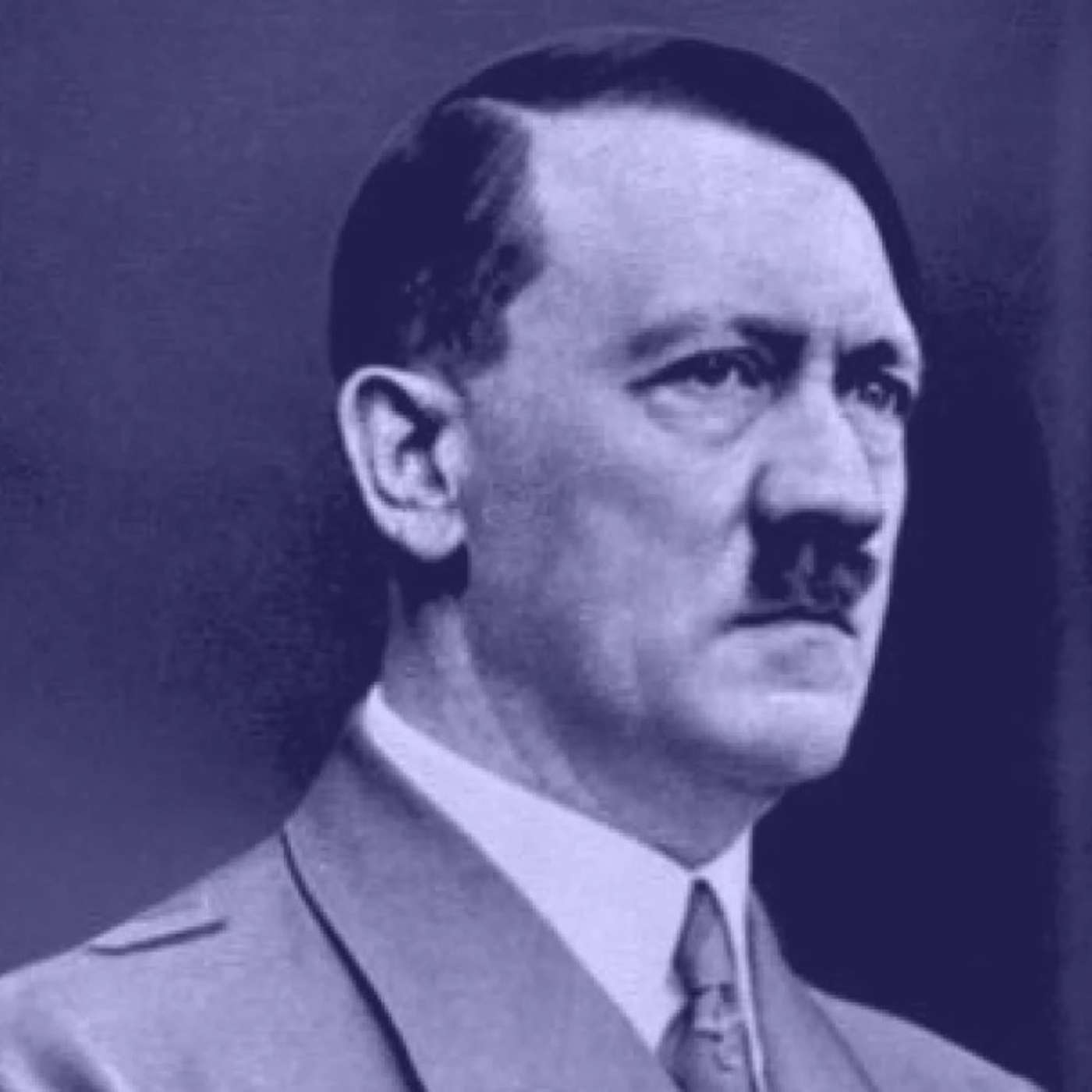
The transcription is part of a podcast discussing Adolf Hitler in a mini-series on European Dictators. It covers Hitler's rise to power through the Nazi Party, his dictatorship, and significant events such as the Beer Hall Putsch and the Enabling Act. It delves into Hitler's personal life, including his art background, early life, and relationships. The text also touches on Hitler's foreign policy, preparation for war, and mass persecution of minority groups, leading up to the Holocaust. Additionally, it mentions an assassination attempt on Hitler and discusses a theory about his alleged drug use. The podcast provides insights into Hitler's character, actions, and the events that shaped his legacy as a dictator responsible for genocide and World War II.
Transcription
4189 Words, 24574 Characters
Hello, hello, hello, and welcome to English Learning for Curious Minds by Leonardo English,
the show where you can listen to fascinating stories and learn weird and wonderful things
about the world at the same time as improving your English.
I'm Alistair Budge and today it is part 3 of our 3-part mini-series on European Dictators.
In part 1 it was The Grey Blur, Joseph Stalin.
In part 2, which was one of our member-only ones, it was Il Duce, Benito Mussolini.
And in part 3, well, you can probably guess, it is the most infamous of them all.
The man most synonymous with fascism, and the fascist with the most warped of all the world
views.
A man who almost conquered Europe, and whose genocidal rage left millions dead.
The Führer, Adolf Hitler, a man whose name alone is enough to send shudders down the
spines of hundreds of millions of people around the world.
Now obviously it would be incredibly difficult to give a thorough account of Hitler's entire
life, and it certainly wouldn't be possible in this episode.
So today I'm not going to be going into detail with a blow-by-blow account of them, Second
World War or the horrors of the Holocaust. I'll give a broad overview of Hitler, focusing
on his rise and the key events in his life, but also some insight into the lesser-known
style, who Hitler really was as a man, and some of the more unusual things about him.
But before we get right into today's episode, I want to remind you that you can become a
member of Leonardo English, and follow along with the subtitles, the transcript, and its
key vocabulary over on the website, which is leonardoenglish.com.
Membership of Leonardo English gives you access to all of our learning materials, all of
our bonus episodes, so that's more than 300 different episodes now, as well as two new
ones every week, plus access to our awesome private community, where we do live events,
challenges, and much, much more.
So if you are ready to take the next step on your English learning journey, the place
to go is leonardoenglish.com. Okay then, let's get right into it and talk
about Adolf Hitler.
On the 30th of April, 1945, the Third Reich was in its final hours. Gunfire and explosions
filled the air. Berlin was burning. The streets a battle zone. Waves of Soviet Red Army soldiers
poured into the city. But they weren't hoping just to deliver the decisive blow and finally
end the war that had destroyed Europe for five years. They were looking for someone.
Nazi Germany's leader, the Führer, Adolf Hitler, hid in a secret underground bunker,
16 metres beneath the German Chancelry, the Führerbunker as it was known in German. Actually,
it wasn't a bunker so much as it was a complex that contained 18 rooms and was fully self-sufficient
with its own water and electrical supply.
As the Soviets advanced through Berlin, street by street, getting closer to the Führerbunker,
Hitler continued to give orders and hold meetings with high-ranking Nazis.
The day before, on April 29th, he had married his longtime mistress Eva Braun and put together
his will and political testament, outlining who he wanted to take over when he died. But
when and how would that be? Was he sure that the Soviets would capture and likely torture
and kill him? Or was it the news of his ally Benito Mussolini's gruesome death just hours
before that convinced him to do something else?
After putting his affairs in order, on the afternoon of the 30th, Hitler enjoyed his
last lunch, shook hands with his staff, and retired to his private quarters of the complex
with Eva Braun.
Sometime that afternoon, Adolf Hitler, the man who destroyed mainland Europe and organised
the slaughter of millions of Jews, sat down on his suburb with his new wife and swallowed
a cyanide capsule. To make sure, he shot himself in the head. The Führer was dead.
As the Red Army closed in, Hitler and Braun's bodies were quickly cremated or burned in
the garden. And just eight days later, on the 8th of May 1945, the Germans surrendered.
Much like the subjects of part one and two of this miniseries, it didn't have to be
this way. Adolf Hitler was born on the 20th of April, 1889, in Braunau Amin, a small town
in modern-day Austria, then part of the Austro-Hungarian Empire. He was the fourth of six children
born to Alois Hitler and Clara Poltso, though three of his siblings died in infancy. Both
his parents came from poor peasant backgrounds, but by the time they were married and had
started a family, they lived a comfortable middle-class existence. His father, Alois,
was a customs official, a civil servant, and his mother, Clara, a housewife and devout
Catholic. His father was said to be harsh and distant with the children, but his mother
was more loving towards them. When Hitler was just three years old, the family moved
to Passau in Germany, and it's thought that Hitler picked up his distinctive Bavarian dialect
there. The family returned to Austria in 1894, and Hitler attended Woldschkule, a state-funded
primary school. Though the young Hitler was clearly able or intelligent, he showed little
interest in education and left school with a poor academic record. He had a tense, difficult
relationship with his father, who wanted him to follow in his footsteps and become a civil
servant. In fact, Alois Hitler was a violent man who beat his children, and Hitler's
mother often intervened to try and protect them. In 1900, his younger brother Edmund
died from measles, and his brother, the 11-year-old adult, became an increasingly quiet, detached
boy who got into conflicts with his father and teachers. But when his father died suddenly
on the 3rd of January in 1903, when Hitler was 13 years old, his mother allowed him to
change schools and forget about a career in the civil service. The young Hitler was able
to study what he really wanted to, art, and he moved to art school and began to think
of himself as a bit of an artist. In 1907, when he was 18 years old, he moved to Vienna,
filled with dreams of winning a place at the Vienna Academy of Arts, but he was rejected.
Traditionally, historical accounts of Hitler's time in Vienna depict him as a struggling
artist with no income that moved from hostel to hostel. But the truth wasn't quite as
simple as that. After all, his father had been a civil servant, he came from a middle-class
family, and so he was by no means poor. It's thought that he blew through, he got through,
quite a large inheritance while he tried to make it as an artist. By the end of 1909,
however, he was genuinely running out of money. He sold postcards and drawings to survive,
but even then, one of his aunts introduced him to a wealthy business partner, and he
was paid to paint watercolour scenes. Now, believe it or not, one of Hitler's watercolours
sold for €130,000 at an auction in Nuremberg back in 2014. The price tag, it has to be said,
comes from the subsequent reputation of the man who held the paintbrush, rather than the
artistic quality of the canvas. And back in Vienna, his paintings weren't worth quite
that much, but the watercolours earned Hitler enough money to live to survive.
Like many young Austrians at the time, Hitler identified strongly with a sense of German
identity, and he likely shared the 'casual' antisemitism that was common to middle-class
German nationalism. However, Hitler probably had business and personal relationships with
Jews in Vienna, and his antisemitism in those early days was likely a reflection of the
general antisemitism common in society at the time. That's to say, still completely
unacceptable by any standards, but nothing like the genocidal antisemitic ideology he
developed after the First World War. And in 1913, he moved to Munich in southern Germany
to avoid military service for the Habsburg Empire. This was made possible due to another
inheritance from his father's estate, and in Munich, Hitler's life largely continued
as it had in Vienna, drifting around, surviving on paintings and postcards. That is, of course,
until the following year, 1914, when world events changed not only Hitler's life, but
the direction of European history forever. When the First World War began, Hitler volunteered
for service in the German army, and joined the 16th Bavarian Infantry Regiment. He served
as a runner on the Western Front, a particularly dangerous job that involved passing messages
between different army units on the front line, and he was awarded an Iron Cross.
At the time of the Armistice, when the First World War officially ended, Hitler was in
hospital with temporary blindness caused by a British gas attack. Keying to stay in the
army even after the war had ended, Hitler joined the Intelligence and Propaganda section where
he had his first political training and became an army informer, spying on smaller political
parties. He made speeches to the troops, championing German nationalism and anti-socialism, and
he developed his oratory, his public speaking skills. In 1919, he also joined the German
Workers' Party, a far-right anti-Semitic, anti-communist organisation. When he left
the army in 1920, he took over the publicity and propaganda for the German Workers' Party,
and he changed the party's name to the National Socialist German Workers' Party – Nazi
for short. A year later, in 1921, he challenged Anton
Drexler for the leadership of the Nazi Party, and eventually Drexler agreed. A couple of
years later, on the 8th of November, 1923, Hitler and the Nazis attempted to overthrow
the Bavarian government in a coup d'etat that became known as the Beer Hall Putsch.
After being inspired by Benito Mussolini's March on Rome the year before, Hitler and
2,000 Nazis marched through Munich to the Beer Hall, determined to take over a meeting
chaired by important figures in Bavarian politics, and ultimately to overthrow the government.
However, unlike Mussolini, who was one of his early political heroes and the man many
consider to be the father of fascism, Hitler's coup didn't work.
The next day, as Nazis marched in the streets, police opened fire. Hitler managed to escape,
but was captured and served nine months in Landsberg Prison.
Now, while in prison, he wrote his famous autobiographical book of political ideology,
"Mein Kampf" or "My Struggle in English". But what many people don't know is that
Hitler didn't actually write the book himself, or at least he wasn't sitting down at a desk
writing it down on endless sheets of paper. Rather, he paced around his cell and dictated
it, meaning he said it out loud to Rudolf Hess, the man who would later rise the Nazi
ranks to become the deputy Fuhrer.
As you probably know, in "Mein Kampf" Hitler expanded on or explained his twisted theories
on race and ethnic purity, that there was a racial hierarchy, and the so-called Aryan
race was superior.
"In order for the Aryan race to fulfil its destiny," Hitler's logic went, "they
would need Lebensraum, a living space."
"Germany must," he wrote, "invade the land to the east, occupied by the inferior
Slavic peoples, including the Sudetenland or the Czech Republic as is now called, Poland
and Russia."
By the time Hitler was released from prison, the German economy had picked up or improved
little after a period of terrible economic growth and hyperinflation, and support for
more extreme right-wing groups like the Nazis began to die down.
As Germans began to trust the Weimar Republic again, Hitler got to work reorganising the
Nazi Party.
In 1925, he established the Hitler Youth to organise youngsters, and he created the Schurzstaffer,
which is the SS, his own paramilitary organisation.
Members of the SS wore black uniforms, which was likely inspired by Mussolini's black
shirts, and they swore a personal oath of loyalty to Hitler.
Over the next couple of years, the Nazi Party was banned several times, but continued to
ramp up to increase its anti-Semitic and anti-communist rhetoric.
After the failed Beer Hall push, the Nazi Party would, Hitler promised, win power through
democratic means, and in the late 1920s, the Nazi Party began building up its propaganda
machine, and tried to establish a base in northern Germany.
Now, it's around this time that things start to get a little strange in Hitler's personal
life, and there's even a hint of murder mystery.
In 1928, Hitler's half-sister, Angela Aubel, and her daughter, Galey, moved into Hitler's
home.
Hitler, who was 19 years older than his half-niece, developed something of an obsessive relationship
with Galey.
He was so obsessive that historians have debated for decades, and it has been strongly implied
or suggested that their relationship was a romantic one.
Whatever the truth, historians have described Galey as the only true deep love affair of
his life.
And as if that wasn't strange enough, Hitler's obsessiveness had tragic and deadly consequences.
On the 18th of September, 1931, at the age of 23, Galey was found dead in the apartment
she shared with Hitler in Munich.
By her side was Hitler's pistol.
But what had happened?
Well, the official version of events was that Hitler and Galey had argued over her plans
to go to Vienna, and that after Hitler had refused to let her leave, she committed suicide.
But it's a little more mysterious than that.
At the time, the Munich press reported that Galey's nose was shattered and that she had
other injuries to her body.
Had he killed the young girl?
Now, we must remember that in 1931, Hitler was on the cusp of political power.
The 1929 Wall Street crash had plunged the Weimar economy back into crisis, and the
political landscape was ripe.
It was ready for extreme views.
Hitler wanted to take advantage of this, and a murder scandal would have likely ruined
his career and rise to power.
In fact, we now know that Nazi officials even discussed a replacement for Hitler should
the scandal get out of hand.
So it's little surprise, therefore, that the Nazi party pressured the public prosecutor
not to investigate, and that Galey's body was given a very quick post-mortem.
The incident was quickly ruled suicide, and Galey's body was taken down the back stairs
of the police station, and taken to Vienna to be buried before the press even got wind
of it, before they heard the news.
Very mysterious indeed, and one can't help but wonder how different Hitler's career
and German and European history would have been if there had been a proper investigation
into Galey Ravel's death.
Now, regardless of what happened, the incident sent Hitler into a depression so bad that
one historian believes that, with the exception of his mother's death, no other event in
his personal life had hit him so hard.
Clearly, it's hard to have any compassion for the man when one knows what he would go
on to do, and this event wouldn't have any effect on his political career as his Nazi
party continued its rise to power.
Around a year before Galey's death in September of 1930, the Nazi party had enjoyed large
electoral gains, and increased its number of representatives in Parliament from 14
to 107, making Hitler the leader of the second biggest political party in Germany.
In 1932, Hitler came second in the presidential elections, and the Nazis were firmly established
in the political mainstream, benefiting from political instability and another spike in
unemployment.
In July of that year, the Nazis became the largest party in the Reichstag, and after
political negotiating and manoeuvring throughout the rest of 1932, Hitler emerged as Chancellor
in January of 1933.
The Nazis now had a third of the seats in the Reichstag, and with more elections coming
up in February of 1933, the German Reichstag was destroyed by a fire.
Now, historians are almost certain that the Nazis organised the blaze, but the fire allowed
them to blame the Communists and tighten their grip on power.
And Hitler wasted no time.
The Enabling Act, which was passed in March of 1933, effectively made Hitler a dictator,
and all other political parties and trade unions were banned.
Adolf Hitler, the shy Austrian boy who painted watercolours, had risen to the very top of
German politics and stolen power.
And he had ambitious, deadly plans.
Now, clearly the 1930s and lead up to the Second World War was a period of intense activity,
far too much to do justice to here, so we are going to skip over the key events.
Instead, we'll deal with a couple of interesting points about Hitler the man from this period.
One is an assassination attempt, and the other a theory about Hitler's drug use.
The most important thing to underline about Hitler's foreign policy during the 1930s
was that he was immediately on a war footing, that is to say he was preparing Germany for
war.
In October of 1933, Hitler withdrew Germany from the League of Nations and cast aside
or ignored the restrictions placed on the German military by the Treaty of Versailles,
and he tripled the size of the army.
In June of 1934, he further tightened his grip on the Nazi Party, and eliminated his
remaining enemies with a move that became known as the Night of the Long Knives.
In 1935, he began re-arming Germany, and military conscription was introduced.
Hitler, it became clear to everyone across Europe, was ready for war.
Domestically, he was also setting the wheels in motion for his mass persecution of Jews,
homosexuals, Roma, and anyone who didn't fit into his idea of the perfect Aryan society.
In November of 1938, the infamous Kristallnacht took place across Germany.
Jewish shops and synagogues were burnt down, and 30,000 Jewish men were rounded up and
taken to concentration camps.
This was just the start of what would become known as the Holocaust, which is clearly far
too important a subject to try to do justice to in a short section of this episode.
Internationally, he was itching for war.
Despite signing agreements not to, he sent his army abroad.
Nazi forces occupied part of modern-day Czech Republic, called the Sudetenland, in 1938.
And then in September 1939, Germany invaded Poland, which resulted in a full declaration
of war between the UK and France on Germany.
The Nazis went on to occupy Denmark, Norway, Holland, Belgium, France, Romania, and Yugoslavia.
And in 1941, they invaded Russia, a mistake that would prove to be the beginning of the
end for the Nazis and Hitler.
Now, as we heard in Part 1 on Stalin, after sacrificing as many as a million men at the
Battle of Stalingrad, the Soviets pushed the Germans all the way back to Berlin and
the Fjörnbanken in 1945.
Now, the details of the war and the Holocaust are well known, but I want to touch on two
elements of life within Hitler's personal circle.
As Hitler's genocidal rage wreaked havoc across Europe, killing millions and slaughtering
Jews, some in the Nazi party thought things, and Hitler specifically were getting a bit
out of control.
That's why, in July of 1944, a German army officer named Klaus von Staufenberg placed
a bomb in a briefcase under a table in Hitler's headquarters, with the aim of blowing the man
to smithereens.
During a meeting between Hitler and top Nazis, the bomb exploded, killing one person, but
Hitler survived.
As you might expect, Hitler purged the party of anyone even remotely suspected of being
involved.
Though the assassination attempts, which became known as Operation Valkyrie, wasn't successful,
it highlights the fact that there were those in the Nazi party that felt Hitler had lost
control.
Now, why might that be?
Well, the obvious answer is that he was clearly a brutal genocidal maniac, but in recent years
another interesting theory about Hitler has emerged, and it concerns his drug use.
Was the Fuhrer a drug addict?
In autumn of 1941, as the war began to turn against the Nazis, Hitler had fallen ill.
He was so ill, in fact, that he couldn't go to a military briefing.
This was something that never happened.
That day, his doctor gave him an opiate and a hormone injection for the first time.
Unsurprisingly, Hitler felt much better, and he was able to attend the briefing.
And he was very impressed by this magical recovery drug, which was an opiate called
Delantin.
From then on, Hitler asked his doctor for more and more of it.
And between 1941 and the winter of 1944, Hitler's drug abuse increased massively, with him reportedly
relying on a cocktail of opiates and cocaine.
His dependence got so bad, in fact, that he developed a severe tremor or shake.
You can actually see this if you look at footage of Hitler in the latter stages of the war,
where his hands and entire body are shaking so violently that even the Nazi propaganda
machine couldn't hide it.
Some historians believe that Hitler could have been suffering from Parkinson's disease.
But severe tremors are also a symptom of drug withdrawal.
We already know that some Nazis felt Hitler was out of control.
But was this partly down to drug addiction?
Was he making war decisions while high on cocaine and opiates?
It's certainly an interesting theory, and could partly explain Hitler's manic behaviour
and refusal to stop the war until the last moment, preferring to destroy Europe than
make peace.
There are clearly many other reasons for his behaviour and downfall, and one that I should
mention is his extreme paranoia, and his refusal to trust his generals to make military decisions
without consulting him first.
When you are fighting literally a World War, you can't do everything yourself, and this
is believed to be a major reason why the German army was eventually defeated.
So all of this takes us back to Berlin in 1945.
In January, the Soviets began their assault on Germany, and by April they reached Berlin.
As we know from the start of this episode, Hitler stayed in the Führerbunker until the
very end.
After hearing of Mussolini's gruesome end, with the Soviets just streets away, Hitler
committed suicide on the 30th of April, 1945.
Adolf Hitler, the man whose name has become synonymous with 'evil', was dead.
Unlike the subjects of Parts I and II of this miniseries, Stalin and Mussolini, the death
of Hitler offered more of a 'clean break' with the past, an acknowledgement of the horrors
that had been committed under his command, and a shared resolve to never allow them to
happen again.
Clearly as with any warped belief, there are still those who look back on this man's life
with some form of admiration, but for the vast majority of mankind, the life of Adolf
Hitler is looked back on with utter repulsion, hate and disgust.
He is a man who organised the industrial slaughter of at least 6 million Jews, oversaw the deaths
of millions of soldiers and civilians across Europe, and left a deep scar on world history.
It is a truly vile legacy indeed.
Okay then, that is it for today's episode on Adolf Hitler, and with that comes the end
of our miniseries on European dictators.
I hope it was an interesting one, and whether you knew a lot about Hitler, Stalin or Mussolini,
or this was the first time you'd really dived into their backstories, well I hope you learned
something new.
As always, I would love to know what you thought about this episode, what particular set of
circumstances allowed Hitler to come to power?
Do you think a Hitler-like figure could ever come to power again?
Of the three dictators we've discussed in our miniseries, who would you say was the
worst or most consequential?
I would love to know, so let's get this discussion started.
For the members among you, you can head right into our community forum, which is at community.learnadoenglish.com,
and get chatting away to other curious minds.
And as a final reminder, if you enjoyed this episode, and you are wondering where to get
all of our bonus episodes, plus the transcripts, subtitles and key vocabulary, then the place
to go for that is leonadoenglish.com, and if you aren't yet ready to become a member,
but you would like to do something to support the show, then I would love for you to think
about leaving a review or a star rating on your favourite podcast app.
It takes less than 30 seconds to do, but they are super helpful, and each one brings a smile
to my face.
You've been listening to English Learning for Curious Minds, by Leonardo English.
I'm Alistair Budge, you stay safe, and I'll catch you in the next episode.
Podcast Summary
Key Points:
Mini-series on European Dictators covering Joseph Stalin, Benito Mussolini, and Adolf Hitler.
Hitler's rise to power through the Nazi Party and events leading to his dictatorship.
Hitler's personal life, art background, early life, and relationships.
Summary:
The transcription is part of a podcast discussing Adolf Hitler in a mini-series on European Dictators. It covers Hitler's rise to power through the Nazi Party, his dictatorship, and significant events such as the Beer Hall Putsch and the Enabling Act. It delves into Hitler's personal life, including his art background, early life, and relationships.
The text also touches on Hitler's foreign policy, preparation for war, and mass persecution of minority groups, leading up to the Holocaust. Additionally, it mentions an assassination attempt on Hitler and discusses a theory about his alleged drug use. The podcast provides insights into Hitler's character, actions, and the events that shaped his legacy as a dictator responsible for genocide and World War II.
FAQs
Adolf Hitler was a dictator synonymous with fascism who almost conquered Europe and orchestrated the Holocaust, leaving millions dead.
Adolf Hitler was born on April 20, 1889, in Braunau am Inn, a town in modern-day Austria.
Adolf Hitler rose to power through the Nazi Party, winning elections, becoming Chancellor in 1933, and consolidating his dictatorship with the Enabling Act.
The Night of the Long Knives was a purge in June 1934 where Hitler eliminated his remaining enemies within the Nazi Party.
Yes, in July 1944, an assassination attempt named Operation Valkyrie was made on Hitler, but he survived.
There are theories that suggest Hitler was a drug addict, especially as the war turned against the Nazis in 1941.
Chat with AI
Loading...
Pro features
Go deeper with this episode
Unlock creator-grade tools that turn any transcript into show notes and subtitle files.
 PodcastTranscript AI