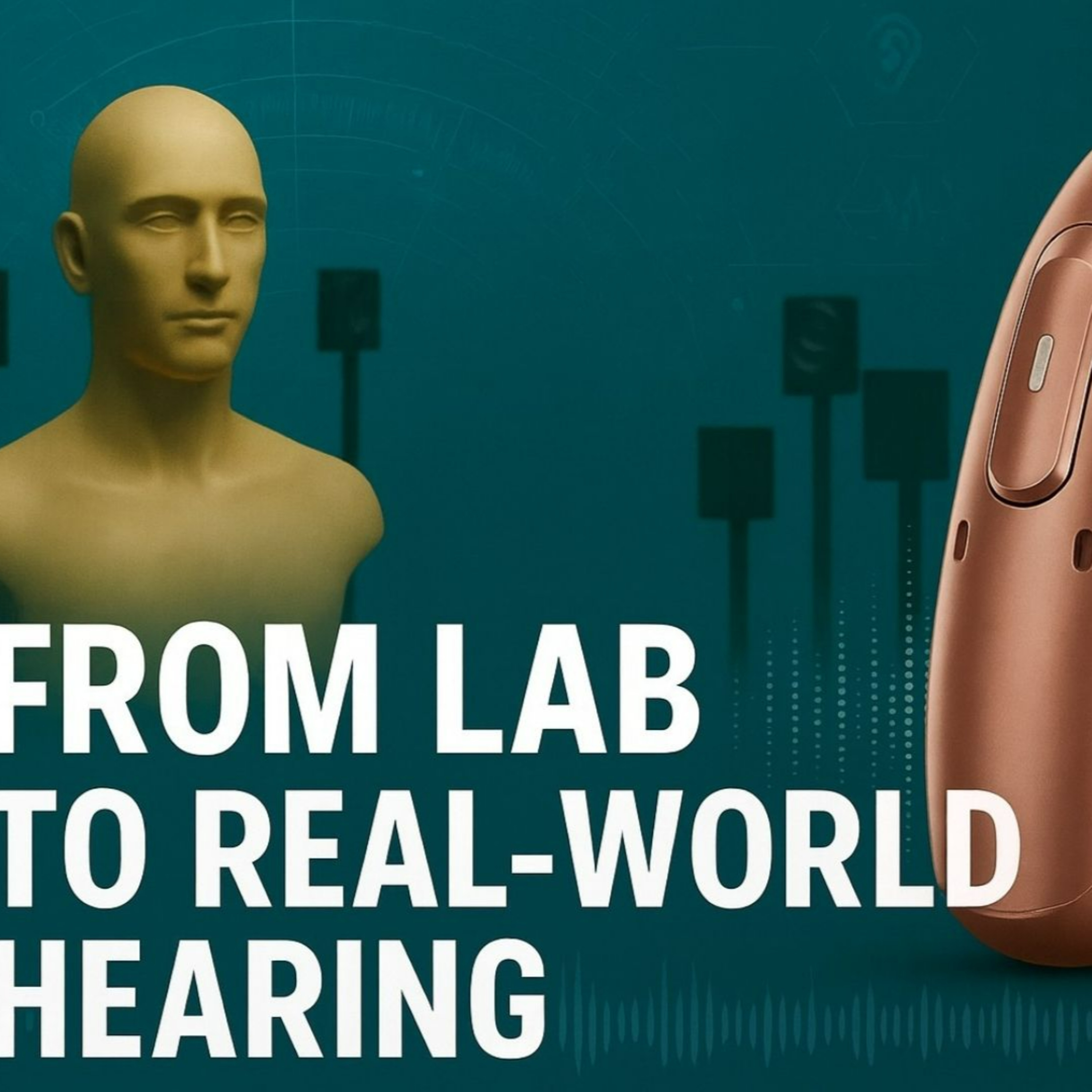
323 - How Hearing Aid Innovation Happens: Jason Galster on Turning Research Into Real-World Technology
26m 49s
In this interview, Dr. Jason Goster, Vice President for Clinical Research at a hearing aid company, discusses his career journey and the structured approach to hearing aid research. His path from engineering to audiology was motivated by a desire to merge technical interest with direct human impact, underscoring the value of clinical experience in informing research. The company's clinical research is divided into three phases: initial feasibility studies, technology development for clinical application, and post-market hypothesis-driven investigations, often involving global academic collaborations. Project selection is managed by a governance board that evaluates proposals based on strategic value, timing, and resources. Research is conducted across four international centers, allowing for diverse participant recruitment and cross-cultural validation of technologies. A significant innovation highlighted is the use of ecological momentary assessment through mobile apps, which enables real-time, environment-specific feedback from users, vastly expanding data collection beyond traditional lab settings. Ultimately, a core focus is translating complex research outcomes into clear, practical benefits for clinicians and patients, helping to advance audiology practice and reduce the stigma associated with hearing aid use.
[MUSIC] Welcome to this week in hearing. I'm Bob Trader, your host for this most interesting discussion on hearing aid research. Now, don't go to sleep on me because we're talking about research. This is going to be an enlightenment for all of us on how we go about learning and finding out the most interesting projects that are really lead to great benefits for us as clinicians, as well as for our patients. My guest today is Dr. Jason Goster, who is the Vice President for Clinical Research at Sinova. Thanks for being with us today, Jason. We really appreciate the time, energy, and effort that goes into these discussions, and Tim, but wait from your very interesting research projects. Thanks, Bob. Good to be here. We're good to see you again. I feel like we just saw each other in here. Yeah, we had a very nice time down at the Johnson Space Center, and I had never been there. So to me, it was a very, very special time where I actually read into old friends and colleagues on the media side, as well as the research side, as well as clinical side. But you know, most people that are in research and a lot of us that have been around a while know you and know of your career and your research projects and so on, could you give us just a little bit of an idea of your journey through audiology for those of you who may not know your background? Yeah, I'm absolutely happy to tell you my story. Your story is good. Well, it was a cold winter day in 1970s. No, I'm very lucky that as soon as I found audiology, my career path was illuminating. I had been in a constable engineering at Purdue for a while, and I always felt like something was missing. What was missing was the connection to people. And for me, audiology was this wonderful blend between sound, which had a passion for and helping people, which is just a great thing that I think drives me a bus. Well, I was at Purdue. I finished my undergraduate, my clinical degree, and before going on to my PhD, my research degree at Vanderbilt, I did take a detour into the clinic. I worked at RaiWoi Children's Hospital, seen cubes and adults and really understanding what it meant to hear the voice of the patients in your day with daily work. And I knew even at that time that if I didn't take a moment and experience the clinic, that would always be a gap for me and my research. And I think that you can do clinical research. You can do research as an audiologist better if you know what it means to work in the clinic and to engage your patients. So that carried me carried me through my academic career. And then when I finished at Vanderbilt and I was making decision about academia or industry, one of the things that really motivated me was giving back to audiology and trying to help as many patients as possible. And I realized that if I took a path into industry, that it would be an opportunity for me to help the dog acknowledging, see clinical outcomes at a scale that in academia, I could play a fantastically important role in and try to help audiology and students and educate. But there was something about being in industry and being able to help bring the technology to the world that would help thousands of thousands of people down the world. And I have to admit that once you've done that, it's literally dictated. And you want to keep doing technology development and helping people at that scale. So that's really what brought me into the world of technology development in research and in clinical research in industry. Cool. Well, I understand that when you're actually beginning, you know, a research project at the concept level, you have some criteria that you go through a certain flood process before anybody even does more than just talk about it over a couple of cups of coffee. That you're exactly right. I think the easiest way to understand this and maybe the most logical way to understand this is to break our clinical research into three phases. There's one phase when we're developing a technology that is about understanding the feasibility of the technology. There's another phase that is really the true technology development. We know that it's clinically feasible, but we want to make sure that the technology that the hearing aid and all of its features are going to be ready for the clinic, for the audiologist and patient. And then there's this entire other phase of research that once a hearing aid once that technology is commercially available and it's in the clinic, that's when we get to do the deep research on it. And that's where we start to work with academic partners at universities, at medical centers to really start asking hypothesis-gerting questions. And I think to do the research that we all think of more traditional visualized anecdotes. So thinking about these issues, what among those? And I guess one of the things that I always wondered is how does a research project actually get the VP of clinical research's attention? Well, I would say it's certainly not my attention alone. We have a whole, we have a wonderful team of people all around the world that are getting requests and bringing them in. But you know, as Snowba, we are primarily working on full-knock technology. We also are thinking about unitron technology. There's work going on within Vance Bionics. So we really are a group of the whole family of companies, of course one at getting the majority of the attention. Before I mentioned that we have work looking at technology, feasibility, we have this technology development phase, getting your rate for the clinic as well. And as you can imagine with any product development in any field, there's a roadmap. And so as we look at our technology roadmap and we're developing basically hearing aids for tomorrow, that means that lays out for us a plan to say, okay, well, we'll mean to run clinical studies at certain times to prove the feasibility of a technology that may be three or five years out. We need to plan the clinical studies, maybe that will introduce hearing aid with men just two or three months instead of three or three years. So technology roadmaps and product roadmaps set a really set a specific plan for some of our. But at the same time, we're getting requests from academic partners, research partners, collaborators all around the world. And then sometimes we have ideas for research that are not projects that we should run in our own labs. And so we'll go out and work with research partners to develop novel research questions and do studies with them. So some of its pre-planned based on technology development and some of it is people bringing really innovative and exciting research questions to us. And a lot of those are you start at the bottom line. They start running at the bottom. Nick, you'd have a clinical question coming from a clinician in India or from China or some, or even here, maybe even here in the US. So it's a great point though that these research questions, they don't need to start with a researcher or professor. It's amazing how many wonderful ideas we do here from clinicians. They say, "Oh, I've seen this with three or 30 of my patients. What do you think about me?" And you'd be surprised to be held off and I will be a study to ask questions. And now, once you've kind of looked at the concepts and something has your attention, there's probably five or six things that might get your attention at one time. How do you choose one versus another project that versus another project that maybe have different implications in all these different things? That's a tough question. Probably not just you, it's probably a committee of some kind that you may chair or whatever, but at least I'm thinking that's something to do with it. Yeah, so you're exactly right. We have a governance process where all of these requests and all of these ideas, they come into a board and the board reviews all of the ideas, they prioritize them and we approve them based on can we do the work? Is there clear value in the work? Is it being done at the right time? Do the resources exist? So very standard business decisions in some sense, but also we want to look at the impact of this of this research as if something that will elevate audiology. Is it something that will show something that is something that will say elevate our understanding of a phone accurately? Well, and of course, there's always the research, not the research, but the return on investment that goes along in some of these projects as well, because as much as we all think that that's in all of this is great big company up in the pie in the sky, there's realism in every business, of course, and so but I understand that that you can do research not just here in the US, but you do some at Stafa, you do some in in Singapore, you do some in here and there and everywhere around the world. And how how do you decide where one goes versus another one versus another one? Yeah, so that's a very good point for anyone watching us that didn't know. Our headquarters is in Stafa, Switzerland, just outside of Zurich, and we have four audiology research centers are arcs located around the world. So one of those is in Stafa, Switzerland at our headquarters, where we have our most engineering resources. We have another one in Chicago, in the US, where we have labs there. We have an audiology research center in Toronto, and an audiology research center in Shanghai as well. And each one of these locations offers some some very unique opportunity for us. So obviously we have different people working there. We have research audiologists and scientists at each location that have different skill sets, which is very valuable, so they can do different work. But at the same time, we have our headquarters in Stafa, for example, we have another research and development facility outside of Toronto. And the two research centers there are positioned perfectly to do clinical research on the technology collaboration with the engineers. Here in the US, we have access to a very large participant population. We can recruit easily and move very quickly to our clinical studies. We're also in the US, so we hear the voice of US audiology cloud and queer. And then our team in China in Shanghai has access to a very large participant bulls making recruit really quickly. But you can look at the cultural differences between what people's lives in Shanghai and Chicago, for instance. And this really opens the door to interesting opportunities to do the research and what to do. And just as one example, recently I was reviewing a data set, and we had used the same outcome measure that was translated into Mandarin, Chinese, English, and German. And now we're essentially collecting the same data about a hearing aid technology in three different languages, which is just tremendous cross validation. And it's not something we're really used to doing in audiology. So it really gives us this extra confidence and reinforces our understanding that this future technology I can tell you about it today. But this future technology is when they have a really queer clinical benefit because we've seen it be so impactful in all of these different environments. Well, and I remember the day when we just had a single amplifier and we had one frequency response or two. We had to calculate how much we want here and there, write it all down, and then we'd send it to the manufacturer. Of course, I so am glad those days are gone. However, when now you can even set different types of possibly firmware for Chinese who speak Mandarin Chinese versus those that speak English versus those that speak German and all these different kinds of utterances that come out of different languages. Absolutely. The firstly days hearing aids are so much more complex than they were 10 years ago or 20 years ago. It's a different world for hearing aid technology. And we can and we have thought about and implemented some regional organizations for languages. And I think as we look at more AI applications in the future, we'll see even more environmentally specific training opportunities for future technology. One of the things that I'm particularly excited about is that the wireless and data infrastructure that we have in our modern hearing aids is allowing us to bring some of our data collection activities outside of the lab or we're used to doing so many measurements in audiology. Now we have tools, methods, ecological momentary assessment or EMA where we can send research participants home with the mobile app. And now when they go out to dinner, the hearing aid can detect the environment. And based on classifier classifiers like Autosense OS, we can say, oh, well, this is a speech and noise background and we can prompt questions about the specific background and the listening experience. We're even at the point now where through these research interfaces, we can collect the state of it. We could also have people be paired comparisons and say, which one of these programs or settings do you like more? Well, you're sitting in a restaurant and we and this is all based on, of course, one, does participate once to do that at the time. But we don't need to base this on a clock or have it randomly delivered. We can now look at the acoustic environment and respond to it and interact with the research participants. So this is super exciting. Over going from a time where we had 10 participants in the study and 10 people completed 10 questionnaires or 10 questions so you had 100 responses. Now we're thinking about 100 people, 1000 responses and we're really seeing outcomes at a different scale than what we're accustomed to. Show that it's always been, as I'm sure you in your research capacity always, it's always been an issue that our ideological studies are only done on very small populations and how can you take this minute group and extract it into something that's going to go on for thousands of people. And with this process, this is absolutely one of those things you can in real time, in real place, not only can you find out how they're doing but you can tell how the environment is changing. You can tell how this person on this side and this side and in the oblique and behind and walking around in this particular situation using that little mobile app. Now that's a true innovation, I would think, specifically in hearing aid research. It really is. If you think about understanding patient outcomes, we need to understand some outcomes in the lab but ultimately understanding outcomes during daily life. That's sort of the whole thing. That's where we live. Yeah. Exactly. Those are the outcomes where we really do want to measure it and see that what we're developing in the lab, the research that we do that begins in the lab that also connects and extends to the real world. So it means to be a continuum. It's a continuum for us and everything we do. But this is one of these really clear examples for technology is and able to approach to looking at patient outcomes. Yeah. Now, so you're going to take that results, the results of those things. Then what are you going to do with that? Once you get those results, how is that actually implemented into into products? Absolutely. So depending on I knew earlier, I mentioned three phases of clinical clinical research. So depending on the phase, it will teach us something different. At one point, they teach us about is this technology that's feasible for the future? Is this and then in second phases, this technology that's ready for the audiologist and ready for the clinic. And then sometimes it's simply about understanding an outcome that we haven't been able to investigate before in this third post market phase. And we're seeing that now, for instance, one topic that's really interesting to me is looking at social behavior change. And this is it hasn't been a rich area of research and audiology because it's very difficult to do. We're starting to see some really exciting data coming out from a number of clinical trials around the world. But this is a really good example where now measuring people's outcomes during day with life and having the tools to do that means that we can understand really ways that people benefit from the hearing aid technology that we haven't been able to understand. You know, and one of the things that back when technology wasn't was changing, but not quite as detailed as variable as you guys deal with. I remember having to digest the things that the researchers found that was digested into the product. And then how do you explain that to the people that are going to be working with the products and the patients? And taking these complex ideas and these actual complex situations, maybe even with the mobile fault and all this dynamic stuff that you're doing and digesting that into something that clinicians will want to understand is a concept of its own almost. I would say that that is fundamental to really doing the work that we give. And this is the case for all of the research audiologists at the research, at the audiology research centers around the world. Many of the people that work at SNOVA and bone app is thinking about translation. And it's something I'd say you never quite lose track of it. When we're thinking about the study design, we want to make sure that it can connect with the clinician. If we're sharing these are data that are going to be used to this purpose, then we want to make sure that it can be translated and digested easily. Ideally, it tells a good story. But yeah, what you're talking about is sort of the art that goes along with the suns. So making sure that it's something that is educational and again, something that is engaging that it also needs to clearly reflect the benefit that patients are experiencing from from the technology. Well, after all, that's exactly why the why the clinician show up. Well, I think maybe this last, this last, what they probably showed up a little bit because of rocket science and Johnson Space Center, just like they may have done it at the sphere when you guys were there. But really, the reason they come to these things is to find out what they can do for their patients and how can they help their patients more than what they already are using or how are we going to help that brand new person get used to hearing aids a whole lot easier. And of course, I've seen that over the over the years. And another one that that's still as a plague, not nearly as bad as it used to be, but it's still a plague is the stigma that goes along with amplification and the using the products and so on. And I mean, I remember when when I started in audiology, people were like 95 years old and couldn't hear anything. And they still didn't admit that they had a hearing loss. These days, it's quite different because we see a lot of people a lot younger with milder impairments. And we know we can do a lot more for those individuals than we knew at that time. So it's kind of like we're moving into a almost like when we went from monorel to binorel. Now we're moving into a whole generation where you guys are finding fabulous things, digesting them into something we can understand on the clinical side. And then we figure out how we're going to present that to our patients and to have a much better success. And so just the idea that there are people who can take what you tell them, digest that into something that turns out to be the slides and the discourse that go into a discussion about what it does. Although I have to say that sometimes these things are very obvious. And you put you put on the demo, it's like, whoa, there's a big difference there. Other times it's like, okay, well, I don't see a whole lot of difference here. But maybe when I go outside, I'll see some difference. Or maybe when somebody comes up alongside me one side or the other or when the environment changes, I'll see some of those things. So, but sometimes things are obvious and sometimes they're not so obvious. And that's the skill of the training individuals that end up come along and helping you guys take the things you've created and present them correctly so that they really actually are helpful to the patients. Right. We often do get asked, well, how did the trainers know what what to teach? And they are certainly the educational experts. Well, being a trainer, I could tell you that pretty easily, you know, but anyway, you were saying, so I interrupted there. I'm sorry. No, no, no, no, I was I was mentioning the the carriers of the educational experts. And very often we will rely on them to help with the translation of the data because they know the audience, they know how to educate and tell a, you know, exciting story around around our clinical data. So we have a very close partnership with them. But one of the questions I often have been asked over the years is, well, how do trainers know how to train on this information and this material, this technology, what it has just been into weeks. And the answer is that the clinical research teams are the first people who see the technology. They're the first they're the first teams of the first audiologists who see the actual early adopters, right? Yeah, exactly right. So so we're the ones that train the trainers and then the trainers will go out and spread the message and do the recommendations. I guess they're the innovators and then then then the innovators are going to go out and train the early adopters. That's I guess that's how how it works in the diffusion of information kind of system. We can probably go on all day talking about these things Jason and I'm very much appreciate your willingness to come in and talk to us about research. Something that a lot of us we know it's there. We know what it is. We don't understand it really how it how it applies to us in the clinic sometimes. But often we'll see some things in the products that come out of the research that are really really beneficial. And so today my guest has been Dr. Jason Gaulster vice president for research at Sinova. And thanks again for being with us Jason and those of you out there tune in another time to this week in hearing.
Podcast Summary
Key Points:
Dr. Jason Goster's career transitioned from engineering to audiology, driven by a desire to combine a passion for sound with helping people, and he emphasizes the importance of clinical experience for meaningful research.
Clinical research at his company is structured into three phases
Research projects are selected through a governance board that prioritizes based on value, timing, resources, and potential impact on audiology and patient benefit.
The company utilizes four global audiology research centers (Switzerland, U.S., Canada, China) to leverage diverse participant pools, cultural contexts, and language validations, enhancing the robustness of findings.
Innovations like ecological momentary assessment (EMA) via mobile apps allow real-time, environment-aware data collection from patients in daily life, enabling research at a much larger scale and relevance.
A key challenge and focus is translating complex research findings into digestible, clinically applicable insights that demonstrate clear patient benefits and support audiologists in practice.
Summary:
In this interview, Dr. Jason Goster, Vice President for Clinical Research at a hearing aid company, discusses his career journey and the structured approach to hearing aid research. His path from engineering to audiology was motivated by a desire to merge technical interest with direct human impact, underscoring the value of clinical experience in informing research.
The company's clinical research is divided into three phases: initial feasibility studies, technology development for clinical application, and post-market hypothesis-driven investigations, often involving global academic collaborations. Project selection is managed by a governance board that evaluates proposals based on strategic value, timing, and resources. Research is conducted across four international centers, allowing for diverse participant recruitment and cross-cultural validation of technologies.
A significant innovation highlighted is the use of ecological momentary assessment through mobile apps, which enables real-time, environment-specific feedback from users, vastly expanding data collection beyond traditional lab settings. Ultimately, a core focus is translating complex research outcomes into clear, practical benefits for clinicians and patients, helping to advance audiology practice and reduce the stigma associated with hearing aid use.
FAQs
The three phases are: feasibility testing of new technology, technology development to ensure readiness for clinical use, and post-market research to explore hypothesis-driven questions with academic partners.
Projects can come from a technology roadmap, requests from academic partners or clinicians worldwide, or internal ideas. A governance board reviews and prioritizes them based on value, timing, resources, and impact.
A committee evaluates projects based on feasibility, clear value, timing, available resources, potential to elevate audiology, and return on investment.
Different locations offer unique participant pools, cultural insights, and skill sets. This allows for cross-validation of data across languages and environments, enhancing confidence in clinical benefits.
Wireless and data tools enable ecological momentary assessment, allowing real-time data collection in daily life. This provides larger-scale, context-aware outcomes beyond traditional lab studies.
Research audiologists focus on translating complex data into digestible, educational content for clinicians, ensuring it clearly reflects patient benefits and is engaging for practical use.
Chat with AI
Loading...
Pro features
Go deeper with this episode
Unlock creator-grade tools that turn any transcript into show notes and subtitle files.
 PodcastTranscript AI