[Music] Hello and welcome to Leaders in Investment, an IPE and IPE Real Assets podcast. I'm Liam Kennedy, Editorial Director of IPE and in this podcast series, members of our editorial team speak to leading figures in the institutional, investment world in Europe and further a field. Our conversations with asset owners range across beliefs, objectives, investment philosophy, strategy, outlook and beyond. You're about to hear the latest addition to our library of downloadable insights into what motivates individuals, teams, boards and trustees as they set about achieving their long-term investment goals with a view to improving the retirement outcomes of hundreds of millions of pension holders. If you're an asset owner and want to take part in our podcast or if you have suggestions or feedback, please email us at
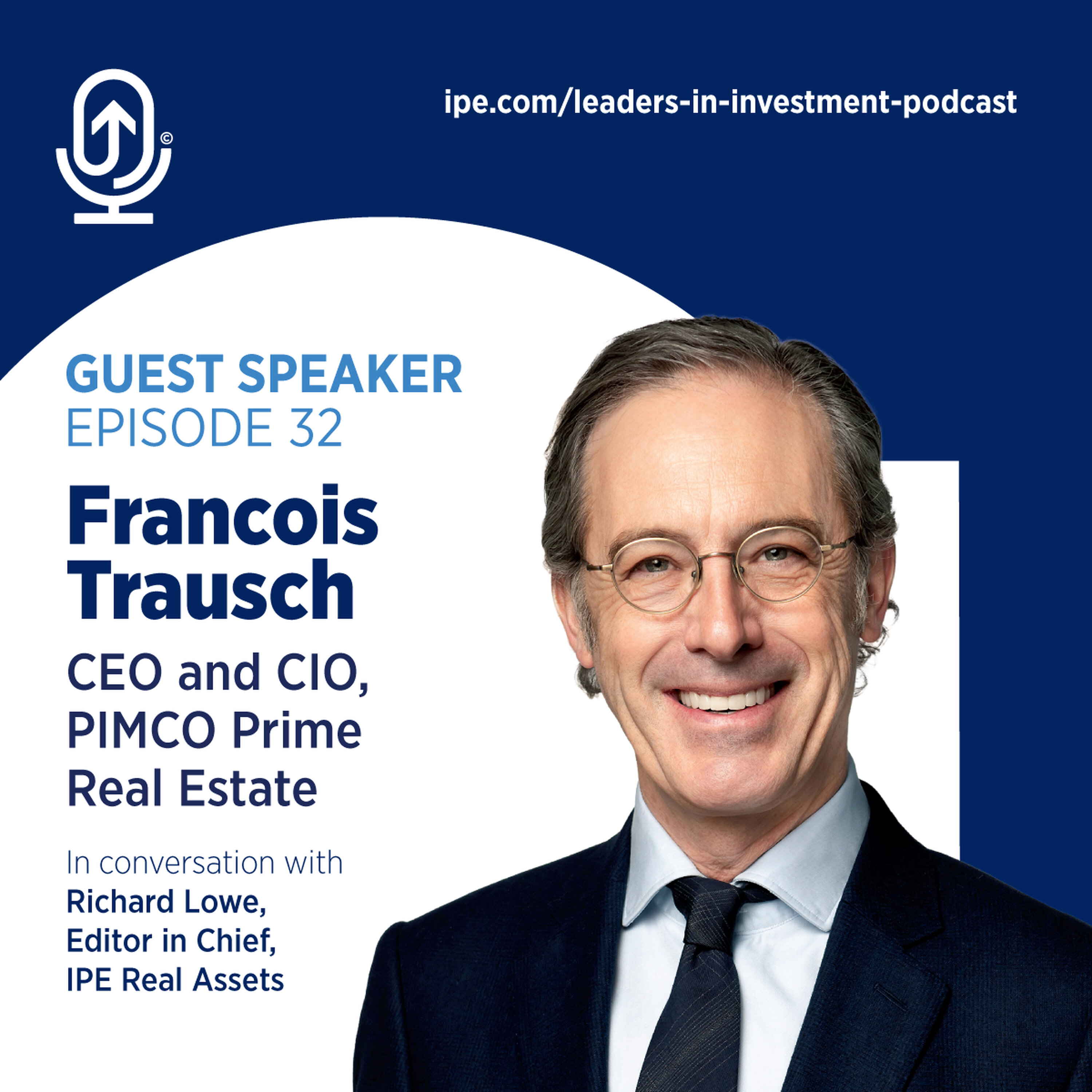
[email protected]. This episode of Leaders in Investment is sponsored by UBS Asset Management. Hello, I'm Richard Low, Editor in Chief of IPE Real Assets and in today's podcast, I'm in the London offices of PIMCO. I'm here to speak to Francois Trouch, the CEO and CIO of PIMCO Prime Real Estate. PIMCO Prime Real Estate was formerly known as Allianz Real Estate and it manages some 78 billion euros in assets, predominantly on behalf of Allianz Insurance companies. The Allianz Group's Real Estate mandate, which includes direct investments in properties as well as investments in funds and real estate debt, is one of the largest real estate portfolios in the world. Francois has been overseeing this portfolio for more than 10 years, his career in real estate before that includes nearly 20 years at GE Capital and Tishman Spare before that. The past 10 years has seen significant changes to real estate investment landscape, most obviously the effect of pandemic technology and working patterns in demand for offices. A more recently the rise of AI threatens to disrupt this space even more. How would you reflect back on those 10 years and summarize the lessons learned from that period? Richard, very nice to be together for this podcast. How much time do you have? You have to go through all this, could take a few hours, but yes. Not really, I think it has been quite a journey when I looked back 10 years ago. First of all, let's go back in time in 2015, most institutional investors were looking for yields. We were in an environment where rates were going down rapidly, even negative. Real estate was a perfect pay for that. For an insurance company to be quite frank, real estate has always been an investment. It's a long duration asset which they need to match long duration liabilities. It has been a natural investment. They probably rapidly dub more because they needed yield. The Allianz Group's new exception, they had as a target to get around 10% real estate allocation. You cover many pension funds across the world and in Europe. Most of them wanted to increase their allocation to real estate as real estate had become a full-fledged asset class. In that 10-year period, I would distinguish, as you mentioned, two blocks. The first five years has really been the ramp up phase. In the case of the mandate we manage for Allianz, we grew the assets we doubled and nearly above 45 billion to close to 90 billion. Very conducive to do it. We did it in a way where we ensure that while we grow, we diversify the portfolio. Not just Europe, but also try to get exposure to Asia and the US. Not just equity, but also developing that business. Not just office, although we still have a lot of office, but also try to get logistics, student housing, and other alternative asset classes. I think that has been the key of that. Of course, a second half of that 10-year has been more bumpy. You mentioned my long career in real estate. It's up my first cycle in crisis. I've seen a few, but we have had three crises in five years. For the COVID, then, of course, the Iran War and the rapid growth of interest rates, and now the Middle East crisis. I think it was a way for us to say, "We have support for you. The diversification helped that it performed quite well, but it's also an opportunity for our asset class to go back to fundamentals, meaning what is real estate, therefore, is there for inflation hatch? It's therefore long-term duration cash flows. It's therefore resiliency." And it doesn't have to promise a moon in terms of return. It just has to have consistent solid returns going forward. Is there a current reassessment, a review of real estate, the characteristics of its place in the portfolio today? Yeah, interesting question. If I look now at us as a business, you mentioned Pymco Prime and formerly Aliens Real Estate, I come back to the 10 years. Again, two periods. The first five years, we were a captive business, two Aliens. There, just to do one thing, invest in real estate. Second half, we became part of Pymco. And for the team and myself, it really has been a way to also assess what is a relative attractiveness of real estate, vis-à-vis asset classes, and indeed, that relative comparison was very helpful to see, "Okay, real estate is not the only game in town." Of course, fixed income came back in favor. Private credit grew a lot. You cover infrastructure real assets. You can see the blurring of the lines between the asset classes. And so I think real estate just has to work hard on our to ensure that it remains attractive. From an Aliens point of view, they reached a 10 percent target. They sold a few assets. I think our asset book, as you mentioned, is around 78 billion. Of course, now they can invest in fixed income, and that's of course what insurance company like most. Okay? They're still like real estate for the duration, which you can provide to them. So I think they have normalized a little bit how we fit into the global picture. I believe it's quite healthy. Maybe you could explain a bit about in a web Pymco brand six within the wider Pymco ecosystem and perhaps give a bit more of a context. Yeah, I mean, for the whole four-year, very big context. Pymco is one of two asset managers of the group. Okay? It is on a global scale. The largest investment manager in fixed income. And over the years, Pymco has diversified its fixed income focus to also include what they call alternatives, private credit, hedge fund solution and real estate. And they already had been in the real estate game for quite a while on the more high yield part of the market, covering both equity and debt, but also private and public, which we don't cover. And so once we grew to the number I gave you, Alan's Aliens said, well, I think maybe now is time for that captive business to also partner, who is other investors and going through the investment and business and say, there's no better place than Pymco to put it in because Pymco has a large group of investors, has been in the real estate business before and we're going to give it scale by moving our business over. So we really ensure that real estate became a big part of the alternative positioning of Pymco with the gold to not just invest for Aliens, but also invest for other investors. As a matter of fact, the way we started it was to say, why didn't you come and invest alongside Aliens? You know, Aliens puts half the money and you come with the other half and then together we invest in either single asset or portfolio. And then from there we moved into funds. That funds have been in the business for quite a while. I think co-mingled funds are coming back, diversified real estate funds are coming back and more recently we focused more on special situation or specialization funds like the data fund you mentioned. So we are basically part of Pymco to continue to manage as a mandate for Aliens, which happens to be the parent company and one of the largest global-reisted investors as well as use our footprints, our experience, our tenure to do that for other like-minded investors. Yeah, you mentioned data sensors and I guess AI and data sensors is probably sort of the biggest investment theme of the year. What is Pymco prime real estate role there within that space? There are two aspects to your question as well is one is maybe the topic of AI. Pymco is organizing what they call the circular form every year in May. What does circular means? It's basically a five-year outlook or super-secular tenure outlook. If you are in fixed income, your horizon could be quite short. So once a year though Pymco says, okay, let's think about his long-term trends which could affect the performance of the market and we participate in that form and have an additional day, just specialize on real estate. I remember discussing with the team saying, okay, we're going to speak about our asset classes, we're going to speak about how the Middle East crisis is impacting it and then discussing with some Pymco portfolio managers, they said, well, listen, you will have to speak about AI because that's going to be the biggest topic of the form. The entire form was really dedicated on what AI will do to basically the different asset classes but also in the way you manage the portfolio. And so for me, the lesson to learn from that is that we have to really spend time on AI and to see how will it affect the different asset classes which we manage. And of course, it goes without saying that data centers, of course, that seems obvious are going to be the wind out of that. You mentioned the data center fund which we have in Europe. The genesis of that fund started way before all the talk about AI and say, AI training it. It was really more a reflection to say, you know what, Europe is just five years behind the US in terms of its cloud infrastructure. Yes, the hyperscale has had an active in Paris in Frankfurt in Amsterdam but all the other big European cities, Milan, Madrid, Athens, Berlin had been left out in a way and they need infrastructure as well as as a matter of fact, the Sorbonne-Welts cloud at forces these countries to have their own infrastructure. And so we said, listen, just using the US playbook, applying it to this what we call tier two cities. Believe me, they're big cities but in data center terms, they were still small. Let's just build this infrastructure for these hyperscalers, mainly for the cloud. And then came the entire AI craze around it which just amplified it. It's
It just shows you that within a broad asset class, data center, there are different ways to play it. And we try to play it. What we believe is a very safe way, just to say, cloud is required. Inference with matters regardless of technology and having data centers close to the peak cities with regard. And time could not have been perfect as a fund raised around 2 billion. On the back of this investment thesis, but also probably on the back of investors saying, "I need some exposure to data centers at the minimum with a good head against my office assets," which are not as used as intensively as in the past. And there's a lot of discussion even within real estate. No, is data centers real estate or infrastructures? Yeah, I listen, I think the blurring of the lines between asset classes is real. The blurring of the lines between private credit and real estate credit. And within on the equity side, the blurring of the lines between real estate and infrastructure, what is social infrastructure, what is digital infrastructure. And I think data centers can fit in either of the two camps. We felt that when it's about data center development, finding the site, electrifying it, building the box, renting it to hyperscalers, it's probably closer to real estate. So it's real estate coming in. Once you assemble a big portfolio, release 15 years to hyperscalers on the way out, it's probably more infrastructure type. But more generally, I think, and that was also a big discussion at the secular forum, to say, if real estate wants to go back to its fundamentals, then looking at some of this successful characteristic of what represents an infrastructure, investment, meaning long term cash flows, into inflation, fairly resilient, corresponding to a need and a necessity, elements we would be well advised to imitate or take back from the infrastructure world and apply to it. It doesn't mean that we will be building antennas tomorrow. It just means let's take the characteristic of infrastructure and apply it to our asset class and maybe with data center, we push the envelope in that regard. You mentioned also the potential impacts of AI on master classes, including real estate, as well as this potential for more impacts on office demand and the sort of feature of work and things like that. Yeah, listen, I mean, it takes just common sense to say the search of AI will probably continue to drive logistics and assets or any assets which feed what we call the digital infrastructure of our economy. For sure, that's going to help out. I just don't see how it could impact negatively housing. On the contrary, housing is a scale game, so to the extent AI helps how to operate these residential assets in a more efficient way, because as you know, the management of residential is still fairly inefficient and expensive. So I think this can help residential as well. You have to ask some questions about student housing. I know it's a darling asset class of investors, but this could impact the educational market. And then office here, office, of course, is the obvious one. You know, we had the COVID, the working from home, now comes AI. I think the bifurcation which we have seen playing out in office is just going to be amplified. Two interesting things we discussed is basically, they're going to be winners and losers in terms of the nature of office building and why you go to your office. Are you going there for basically a mundane routine task where you can ask us if that's probably not going to be required as much going forward or you're going there for specialized need to congregate, to collaborate. UNI in the PIMCO office sitting in a recording studio, okay? So you came here, you won't be able to do that from home as easily because of the quality of the sound. That's a good example of some specialization which is going to about. And then more interestingly as well, I think AI could also reshape cities, which as a city, which you're going to attract talent related to AI and which are cities which maybe are not the talent cities or not the city which are more routine work cities and we're going to basically fall out a little bit. It's a trend which has been ongoing by the way because the very nature of organization is around talent cities but AI could maybe accelerate that. So again, we come back to the good old fashion location location, which will apply even more in our asset class, not forgetting that data matter as well and getting the two together is fantastic. I find it a fascinating period because it's really a period where cyclical mid-secular and for somebody coming into the real estate industry today, I would say there is no better time because we are anchoring some sort of real estate cycle after a fairly solid prize adjustments and then you have all this strategic cyclotopics coming around. As you mentioned, we've had a repressing probably entering into a new phase. What is your high level outlook for real estate and I guess that differs depending on which markets you're looking at with sorts of assets but are you able to give a sort of top-down outlook at the moment? Well, listen, I mean the entry point is probably, for sure, better now that it was four years ago. That's already a good starting point. Interest rates are maybe not quite what we want them to be because they have gone up a little bit but the PIMCO outlook on inflation and rates, yes, central banks will do what it takes to anchor inflation at the required level but then it will normalize again and I think interest rates will normalize again but of course at a higher rate. So if you take this to a single into account then I come back to what I said before, we have to go back to basics and focus on income. So I think most wheeler state strategies will focus on investments which gives income at a rate which is competitive with alternative investments. So I think you need to hit in core plus wheeler state between 4 and 5% to be competitive in today's world. So I think there has been a re-adjustment of cap rate which is not going to change. So cap rate compression is no longer a strategy which can be followed as we have done in the past and it's going to be about resilient cash flows and income strategies and PIMCO is pretty good at it because they did well in fixed income, focusing on income and they are plenty of opportunities and attractive opportunities for income in this world outside of real estate but there is no reason why real estate couldn't be part of it at its core you know, it is an income play. Yeah and I guess another element to real estate is Peps evolved in recent years is becoming arguably more operational or sort of more of a focus on operational platforms and that's I guess important for that income. I think you have to understand what's happening inside your assets. Let's say go first where maybe before you could just rely on the lease and then especially in the UK we have these 15 year long releases and you come back after 15 years, if the tenant wants to stay, I think now we work a lot with our tenants to put sandals in the building to really assess what is the true usage of your assets and of your space. With that in hand we can then engage with the tenant into discussion to say one, are you using your assets intensively or not? Do you plan to downsize or in the country, you know, if the insensit is too big you probably will increase and then you know as you know energy consumption is a big topic so the middle east war in my view has just reinforced how important the energy preservation and carbon reduction is and understanding what's inside the asset also from an energy point of view is just a good way to engage with your tenant and the line on common goals. What about geographical considerations? I'm sure you manage a global portfolio but I'm guessing with a very large European footprint, what's the view on Europe today with all the context of everything that's made on geopolitically etc. My generation is the generation of globalization, you know, we are the ones who discovered the world from a global point of view, from a global business point of view and I do believe that it has served investors well including European investors to have some form of diversification because companies are still global and so having exposure to the US or exposure to Asia served as well during the COVID and thereafter as well. At the same time no doubt investors are retreating somewhat towards Europe and listen for an insurance company let's take example of Aliens which is a long term co-investors. Europe has a lot of stability, stability of cities. We had some investments which we did for Aliens in San Francisco and we were surprised how the star city became really went from Prince to Pig you know in less than three years after COVID in the central core of San Francisco. Luckily as usually in the US you know Cycles come and go and San Francisco is improving. That type of volatility you would not find in Europe so that's one aspect I think where European investors feel you know our cities actually are good and solid investments and if you believe into what AI will do to talent and therefore seeking cities which are attracting their talent Europe has plenty of cities which I think will be well positioned. An interesting angle in Europe is also the enormous investments going to defense you know starting with Germany so speaking about brewing of the alliance there is an interesting in my view investment thesis around real estate and defense which I think European investors will feel compelled to look at it as European investors but also because of the investment thesis. I think the drive towards decarbonization driven by you know the asset owner alliance which at the beginning was bringing together most of the big European institutional investors and pension fund and some of the Canadian ones I think they got vindicated by what's happening with the Middle East crisis more than ever you know I think focusing on green energy focusing on our website.
reducing the energy footprint of the building and as a consequence, the carbon footprint of the asset is good investment. So I think there is plenty of ways to invest in it. And then, I think coming back to PIMCO and its root in credit, we were really quite excited to grow our debt business. You can see that, I mean, banks, European banks remain very competitive, of course. But you can see that there is room for non-bank, for insurance companies to play an active role in the European debt market. People speak about a common European banking union. I think the insurance company is already doing it. And we are doing it on the credit side, financing, pan-European portfolios across Europe. Yeah. And it's seen as a real estate player at that play from investors. It depends on investors. We are agnostic to it for some. It's real estate for some. But at the core though, I would say that we tend to lend an asset which we also own so that if we had to manage the assets ourselves, we could. So unlike a bank, we don't like to own the real estate. We know we can do it. So for us, understanding the underlying asset remains at the core of a recipient underwriting on the credit side. And just going back to the, you mentioned about the defense spending, with the opportunities there, would there be directly around, whether it's sort of military housing or infrastructure to support that or a more sort of broader real estate option? It is that might support the creation of certain hubs around around Europe. I think it's early days to be quite frank, but you can see that if defense spending, I increase in that stakes, the German army or the Germany which has decided that they want to double the army. So indeed, they need more housing. They need more warehouses. They need some educational and recruiting center. So it really, I would say, close to normal real estate to be quite frank. So I think it's more in that part where they probably need help. Probably capital wise, depends on the country. It's Germany maybe less so, but other countries don't necessarily have the budget room to do that. So I think the private sector can play a role to basically tell them you don't need to be such a big investor in it. You can just be a user as a tenant and we'll build it for you. And then also the delivery. The private sector has a more agility to deliver the box and to some extent it helps them as well because then we will simplify the box first. It's creating something more complicated. So I think lots of opportunities in my view to work with that sector and bring it closer to real estate. Right, we need investors who are interested in it and they want to make sure that they invest in something which can go through several cycles, which is not completely dependent on today's focus on which has maybe alternative views. So at the end of today, we are real estate investors above all. We've covered some of the big themes like AI geopolitics. I suppose that they are the big macro issue, arguably bigger than everything is the climate risk. You didn't mention about decarbonisation. There's also been some pushback in some quarters on sustainability. What's your current thinking that in terms of keeping that sustainability agenda going forward specifically with you and within real estate? First of all, I think the PIMCO view is that we have to listen to the investors. Don't try to push and invest to do something that investors don't want to do, but the majority of investors and who say the vast majority of European investors and for sure our parent company Aliens is very determined to follow the Paris Accord to decarbonise the portfolio. And decarbonisation goes through basically at the end, reducing your energy footprint. And as I mentioned before, the Middle East crisis just indicated that more than ever, reducing your energy footprint is going to become crucial. So I think that part of the journey we state the course. We really focus ESG to be quite frank on a technical approach to carbon reduction and stay away from something which could be reinterpreted as some sort of political view on it. So I think that served as well. But we also learned over that 10-year journey that we also have to already start on climate mitigation because the natural phenomena are becoming more extreme. We are active in Japan on residential, most of our project if there are any close to river, now we have floodgates looking specifically and using AI will be tremendous in that to assess subtle differences in one location. Now, one asset can be more exposed to another asset to maybe some of the climate phenomena. And, you know, of course, Aliens has an insurance company. You can imagine has lots of tools to analyze that. And they won't really state as diversifier, not that something would amplify that. So we spend a lot of time assessing on a very granular level this type of aspects. So I think, yeah, it makes a location aspect of really city even more important. Yeah. And I guess there's been a big focus on decarbonisation and net zero, perhaps there do you feel there's a shift to at least factoring as much the physical climate risk, which you just mentioned that it's a dual challenge for the real estate industry? Yes. Which honestly, they should have done from the onset. You know, real estate, you know, once it's built, it's not going away. So it better be resilient. Both in terms of the cash rose I was referring to and therefore comes with it. Also, it's physical integrity. It's in my view if somebody had overlooked that, I think they drew their job. I think at the same time getting to this decarbonisation aspect is important. I think it comes back to an aspect that it's expensive and I think the obsolescence factor has to be taken into account. We started that journey with decarbonisation. In my view, decarbonisation was a very good school to assess already the cat-backs required to reposition an asset. And I think AI just amplifies it. I'm grateful that we have been added already for a while. Yes, because sort of AI requires the power, but it will also potentially create some solutions. You need to assess what is the alternative views of the asset. Today, the bifurcation I mentioned before on office is a bifurcation. You can see by the way in many asset classes. And I think what we need to move investors away from is to say, am I really investing in an office, in a retail, in a logistics granted? That's how you start. But maybe over time, maybe that's not how it will finish. And therefore, thinking in different terms in maybe social infrastructure, digital infrastructure, nature of the cash flows, nature of the resiliency of different lands, which I think has to be put on. Any final thoughts? Biggest option is these challenges going forward. I know, as I mentioned before, it's cyclical, mid-secular. I think it's an interesting period. Assessing those, the cycle and rates and inflation and rental growth is the usual real estate topics. Mixing them up with the cyclat runs around decarbonisation for sure, but also now AI, I think, makes it for a very interesting time. And I think the more a real estate investor manager or a real estate investor can have a broad view so that they have a pigeon holding one narrow way to look at it, combined with a very disciplined approach to investment in a discerning way that makes investing our asset class so interesting. For it, well, Francois, thank you very much for your time today and for joining us. Thank you so much for the time as well. Thank you for listening to IPE Leaders and Investment, the podcast series from IPE and IPE Real Assets. We hope you enjoyed this episode. To access all of the episodes, please visit our website, IPE.com, or you can find us on leading podcast platforms. If you like what you've heard, these do tell friends and colleagues. And let us know what you think by contacting us on
[email protected].
 PodcastTranscript AI