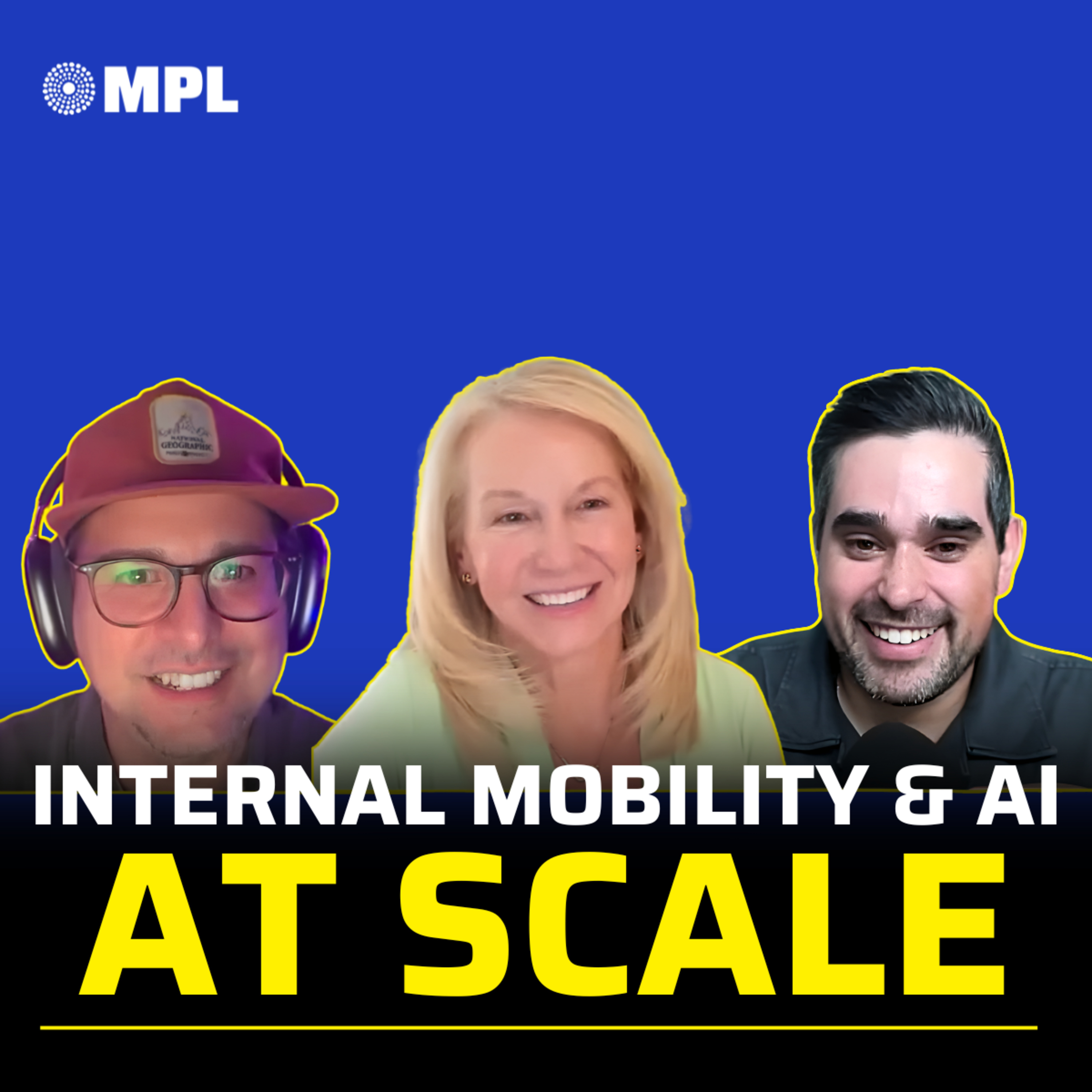
312 - How an Army General Mobilized a 30,000-Person Company to Build Talent from Within: Patricia Frost, Chief People & Places Officer, Seagate
65m 9s
The transcription features a discussion on AI’s impact on work, led by a chief people officer who rejects layoffs due to AI. Instead, she advocates for role redesign and upskilling, illustrated by a junior employee using AI to cut a task from 16 hours to 30 minutes. The conversation reframes AI from a threat to a tool that eliminates administrative work, enhancing critical thinking. Personal stories—team bonding at an HR conference, a baby’s first tooth-brushing, and a beach trip—reinforce the value of human connection. The speaker’s military background (32 years of service) shapes her people-centric leadership; she urges hiring veterans for their work ethic. Her transition to corporate life came through a coffee meeting with Seagate’s CEO, arranged by General McChrystal, after which she ensured cultural fit. Seagate, a data storage company enabling AI, has 30,000 global employees. The speaker emphasizes that talent and diversity drive innovation, and she stresses that AI evolution is continuous, not a finite program. Overall, the message is that AI should augment human potential, not replace it, with leadership fostering bottom-up innovation and continuous learning.
We had to get over the hump of all these companies saying they're laying off people because of AI. That was a lot of noise. Still a lot of noise that our employees here. And with the CEO's voice, my voice, the C-sweets voice, we will not lay off people because of AI. We're just telling everyone I want you to redesign your role. I want you to look at your workflow differently. And that has to be bottom up as much as top down. Because the work happens at the tactical edge. How does that work? It redesigned. How do you redesign those jobs? What are the skills you need? How do you build that upskilling, that upskilling repository of learning? What are the gaps that you're finding? I think we're all, this is not your traditional change management. This is not your traditional program where it has a start and an end date. Our lives have changed and this is going to be an evolution that I don't know who's going to turn the phrase, but what is this that we're in is just going to keep evolving. Because we don't know the end state. You're listening to the Modern People Leader podcast, where we go behind the scenes with today's top HR leaders and work experts. We talked to them about how they've been to where they're at, what they do every day, and what they see coming next for the future of work. Hope you enjoy. Patricia, welcome to the Modern People Leader. Thank you for having me. I always love to one meet new people and Texans, so this is a joy. You stole that from my mouth. I was about to say, I know this is going to be a good one because we're all neighbors here, Texans. And so this is going to be a lot of fun. We have a lot of great stories and your background that we want to get into, the innovative work that y'all are doing at C-gate. But before we do that, we have a few rituals on the show that we like to go through first. And what we kick things up with is what we call good news stories. And it's just a positive way to kick off a conversation. And we all share a work or personal related good news story. And we prefer our guests to go first. So, okay. So I just had one last night. So we had our all leaders call, or all hands call, our quarterly all hands call. And we had one of our most junior professionals talk about how she was using AI because we're redesigning workflows. And here's one of our most junior people who started off saying, I don't know how to code. I don't know software very well, but I'm saving myself 16 hours on a task. Wow. Like we just all stopped. And it was just one of those mundane tasks where she had to go look at all regulatory labor changes, a correct globally. And then just the hour she was spending. And it's now down to 30 minutes. Her using AI. And then just the joy on her face that one she redesigned it herself and she created that prompt. And now it's constantly sending her updates. But just seeing someone so junior say, I have none of these skills, but I taught myself how to do it, you know, through our training program and put herself out there. That was just joy to my ears to see someone also excited about it. And then last week I got to bring 22 people to LA. For an HR conference across people in places, not all of them were HR. The topic was AI, of course, and what our redesigning work. But that aha moment for me to see breaking bread together, that human connection that AI cannot do. We talked about AI all week, but just watching my team connect people meeting themselves for the first time. Again, I just kind of sat back and just said, those that's that perfect storm of bringing everyone together and sharing a moment. So those are my two that I just wanted to share with all of you. I love that. And I'm actually going to throw in a bonus one because inspired by what you just shared. So I'm advising a company. This is a new advisor ship. I'm helping with ops and strategy. And it's an AI company. And we I sit in their standups and this morning we're in standup. And the one engineer was essentially saying, Hey, I'm going to go I'm going on vacation for a week tomorrow. And you know, what do I do with this code? Like I'm like midway through this code. And another engineer says, well, why don't we you just give me what you have? And we can ask Claude how to extract like all of the things that are working here. And just see if it can complete the work. And she was like, Oh my goodness, like that is such a genius idea because I was going to have to go through review the code, tell you, leave my notes, what's complete, what's not, what challenges I ran into, what patterns we should follow based on other work that I've done. And we talked so much on this show about AI too much. But yeah, you know, it is what it is. And you know, the good news is for the last three years, I feel like the framing has been AI is a threat. AI is going to make us dumb. AI, we're going to lose all of our critical thinking. And in the last month, Daniel and I have we get the privilege of meeting with, you know, amazingly bright people like you, Patricia. And there's been a reframing that we're hearing. Yeah. And it is like that couldn't be further from the truth. Actually, it is actually the AI is going to take away this meat these tedious administrative things that we're getting so caught up on today, like this engineer taking all the notes, that's going to go away. And what's going to open up is more space for critical thinking, more space for ideating and all the things that humans really add value at. And that just was like a beautiful thing for me to see in the wild because we talk a lot about it here on the pod. So just to see that this morning and was was really, really cool. My second is personal and like a micro moment, I have a five month old son. My story is like I'm back in the saddle. So I have two teenage daughters. Never thought I would have another child. Definitely didn't think I would have a son. And it's been amazing. And he yesterday, he started brushing his own teeth on his own. He got the little, the little bat toy like fake toothbrush and just started brushing his teeth like unprompted. Oh, it's like you melted my heart. I want to see one of them walk in. Well, he wouldn't be able to walk in. But yeah. Oh, my God. I'll send you pics. Patricia, it is too much, too much cuteness. My good news is that I got to go on a little beach trip this weekend. So I went down to Port A. It was me, my wife, my 13 month old daughter and two of our really good friends. So a couple that we hang out with all the time. And lots of good news coming out of that weekend. So like one, it was the first time getting to see my baby, like go into the water, enjoy it. She's like totally a beach baby. You know, we brought like a little wagon that we would take to carry all of our stuff out there. And then whenever she needed to take a nap, we would just stack like towels and blankets. And she would take like a two and a half hour nap, pop up. And then all of a sudden, you know, just play for two and a half hours. And so that was so much fun for us as parents. And then separately, like I had this moment where I was sitting on the beach. And we were just like, you know, swapping life updates, talking about friends. And I had this moment where I realized like how capable a lot of my, you know, my my friend group is. And it's just been really fun to see the evolution of all of the people that I'm close with, both personally and professionally. People have kids now, they're married. And so, you know, I'm 32. I'm still young. And I feel like I'm in that phase of life where it seems like from one day to the next, like everything totally changed in a good way. And so, yeah. It was my so fast. So I'm bright. Oh my gosh. I think I think you're 30. And I'm like, okay, we won't talk age on this show, but it goes by so fast, but those life moments are so precious. Yeah. So great beach weekend. And I think we have like one or two more beach weekends coming up here in the next couple months. So I'm psyched. And that's like the Riviera of Texas, Port A. It's the best we have. Mustang Beach and Port A. So enough about us, Patricia. Today is really about you. And I call this a brain A brown question. Like, what is your story? Tell us everything. I was mentioning to you. And my our audience, you're probably sick and tired of me talking about this dossier that I created. But I was reading it and right before we hit record. I was just saying how like your story is fascinating. And so I'm not even like steal any of your thunder, but you've had an amazing journey from non-corporate to corporate life. And you've done a whole hopes of amazing things. And so walk us through your journey and how that led to you becoming a couple of officers. Let me ask you something. How often does coaching actually happen at the moment it's not an accordally review, not after something goes sideways, but right before a tough one on one or right after a meeting where something felled off. We had Diane Sadowski Joseph on the podcast and she said something that stuck with me. How do we actually change behavior and structure work to take advantage of AI while keeping humans at the center? That's the gap because on paper a lot of teams have invested in development. But in practice, managers are still guessing feedback comes late and most AI coaching tools still feel pretty generic. The real opportunity isn't more advice. It's better timed, more relevant coaching based on how people actually work together. That's where CloverLeave comes in. CloverLeave is an AI coaching platform built for how work really happens. It combines behavioral insights like disk and Clifton's strengths with real workplace content.
So instead of another destination tool for development, it shows up in the flow of work. Using CloverLeaf, teams can get coaching before key moments like one-on-ones or feedback conversations. Understand team dynamics, not just individual performance. Turn behavioral data into practical day-to-day actions, reinforce development without adding more HR overhead. In other words, it shifts coaching from reactive to built-in. Bottom line, if AI coaching is becoming a priority, the question isn't if it's what kind. You can learn more about CloverLeaf at cloverleaf.me/mpo. That's cloverleaf.me/mpo. Yeah, so I think really, you know, where do you come from? And I come from poor generations of military service, all army. So that really shaped me from a child. So we call it army brat. So you know, I grew up moving every two to three years with my family. Watching my dad's career, my brother served, I served, you know, uncles, grandfathers, great-grandfathers, just this whole lineage. And then on the female side, I still had great role models where all the women who weren't able to serve in the military back in the day. They were all nurses, teachers. So you really kind of look at an extended family of service, and that's what the Jones Frost, the whole family really just believed in. 32 years where I just have truly the privilege, the honor. And I say that in all sincerity to lead men and women and work with our allies and partners in the military, both in peace, time and war. There's no brighter privilege, and it's something I would never change. And now I get to just watch my daughter who I just swore into the army in May when she graduated from Notre Dame. So she's going to go be a second lieutenant in the army as a combat engineer. So again, legacy continues, right? And really that army background of just being people centric brought me to being able to excel in the role of chief people in places officer. It really has synergy with it, decades of leadership, accountability, mission, focus, right? And then for anyone who's listening or watching, I just beg you, take time to read a veteran's resume. It will not look like a corporate resume, but our veterans bring so much to the table. They may not be able to articulate it very well on paper, but their focus or ability to deliver. I just wish we would take a little bit more time, especially with AI that will skip over their credentials, which their credentials are really strong and their work ethic sound. So you won't be disappointed if you hire a veteran. I promise you you won't be disappointed and I just really have to do that shout out. And you know, I just have this great opportunity to continue to lead and now do it in the corporate side. I think it was a we had somebody named Kenneth Caesar come on to the podcast maybe like a year to go and he's the only other former military that went into like straight into a CPO role. Not true. We had another one Christopher Lee. Oh, we did was like in our very, very early. Yeah, and I only remember that because I recorded out of an air stream and it was like one of the few. That's right. I've done vacation. The Army's not was on platforms, centric and the army's people centric. It's about soldiers. And you're trying to motivate and influence them to do things that really aren't natural for most people. You know, to go fight and defend our nation, but those aren't things that you just pick up as a young child, right? I think I asked you this. Like when you made the transition from the military to civilian life. Like what was the biggest challenge? Were there any challenges? Did it feel like pretty seamless? How did that go? No, I think we all have challenges because you just go, especially I mean, I'll say this for women. I go from wearing a uniform every day where I know every day what I'm wearing to now having to figure out how to dress with the billion clothes. That's a big change. But no, I did leadership consulting. I did a startup. So I tried different things. We all try to kind of find our way and then had an opportunity through a network to meet with the CEO, C gate. And that just opened the store for me and it was the right fit at the right time. I did recognize right away and I think you learn this. And when I was doing the consulting gig, I miss being part of a team and developing and kind of having that influence and seeing it from the beginning to the end and just being part of that what I call that legacy right that delivery and watching things truly grow. Consulting you can walk away from a project and go, they're going to revert right back. And I just I knew I missed being part of that larger global team and C gate offered that to me. And so C gate, these are my words, not anybody else's, but like for me, it feels like one of those companies that is underneath so much of like everything that we use, but we're just not aware of it. So give us the, I guess, elevator pitch. Like how do you describe to a stranger what C gate does personally, professionally every individual is probably touched by a C gate product. So for people who don't know, we design and build mask capacity data storage and with the trending topic of AI, it makes AI possible. So I always say your critical data personally, professionally, probably is sitting most likely on a C gate drive. You just don't know it. Like you said, it's in the background. It's part of the infrastructure. But when I like to tell people it's really the talent behind the technology that makes C gate so incredibly special. Because the scale and diversity of our workforce, 30,000 of us globally. Plus we have, if you think about the supply chain that supports the hard drive industry, that's probably another 100,000 plus people that support our supply chain, but deep expertise that seven global manufacturing sites. That was really what drove me and kind of said, this is a place where I want to work diversity of thought, experience the culture, some of our greatest strengths, the innovation. To me, you know, early conversations with Dave, those were inspiring. That was the hook was those conversations I had with the CEO in the beginning. It really was having served in the military, being able to be stationed all over the world was being able to be in a global company that I could still be with that diverse workforce and contribute to something that I saw so meaningful and important about just our daily lives. I mean, the HDD sit behind every single company. It is driving the global economy like that data that data that's gold that every company says, do not let me lose my data right that's probably sitting on a C gate drive and that's something I think every employee at C gate is so proud of that word of part of this greater global economy. What a great aspect. Yeah, what a great place to find yourselves in arguably the biggest generational technology shift we will see and to be in this position where your business is data and protecting data and securing data and keeping data data integrity, all the things. And so I'm really excited that you joined us and I'm excited to dig into that story. But before we do that, there was a transition, you know, Daniel asked about your transition and there was a story that I want to come back to because again, I saw it in my prep notes. So general standard crystal calls you and you don't know who Dave Mosley is and your dad's right. Hey, I mean, I know who Dave looks. Look, you've been keeping the country safe and protecting lives. So you were you were you had some things going on, but your dad's voice in your head says never turn down a coffee or something to this. And his told me never turn down someone asking to meet you for a cup of coffee or a meet you for a drink because you never know where that connection is going to take you now. Stan, a crystal general crystal like and his team and general Nixon, who I serve with I've served with both of them and several duty assignments when they call and say, hey, you might want to go have coffee with the CEO. Okay, like I'm not going to say no, didn't know at the time why he was interested in meeting with me, but general Macrystal's team of teams had been doing leadership training with C. And they saw a gap and they saw a need and then the CEO asked general Macrystal, do you have people that you know that might be a good fit and they offered up my name. So you don't know if that's really going to pan out, but go have coffee coffee turned in about a three hour conversation and then a flight up to New York to meet the rest of the C suite that was doing an investor analyst day. And you know, and as I told you, I said at this point in my life, can I, I don't know if I can say bad words on the podcast. I said, at this point in my life, I will not work for assholes. We've all been under bad leadership. We have it in the military like I had served under not the greatest leaders in my time and at this point in my life, I wanted to be with people I was going to be spending a lot of time with and I needed it to be a good fit. So that was it was just as much them interviewing me, but me interviewing them and saying in this second part, the second chapter of my life, I want to make sure it's a good fit. That was a good way to interview. And what a beautiful thing and what I want to go back to is your dad's voice in your head and what great feedback and I, you know, anyone and everyone live.
listening, like a great reminder to never turn down the coffee. I in my career, I've never turned down the coffee and it's led to me getting a job at Goldman Sachs. It's led to me finding my seed investor when I wasn't even looking to start to launch a startup and there's so much power in the unknown. But yet I feel like as human beings, you know, we're programmed to be fearful of the unknown or maybe that's just how we're wired and, um, and you know, when you take the coffee, it's like you're opening that door and, you know, to new possibilities and what a possibility to be CHRO of C.G.A. technology. A whole moment, right? When you're going to meet someone you don't know, you're kind of trusting your network that says, take the time, right? But you really have to open yourself up. If you know you have a window in a time coffee, a drink, like, okay, not sure where this is going to go. You have to be somewhat vulnerable to say, I'm going to put myself out there. Absolutely. And may not go anywhere. Or maybe a call you get later on, right? That someone makes a connection later saying, oh, maybe you need to talk, go talk to Daniel. Maybe you need to go. And so I want to now start digging into some of the details of the conversation today. And you mentioned in the prep conversation, the military's focus on internal team development. And so I'm curious. I want to start here because this internal team development for HR, there's many layers to that, right? There's internal team development with the CEO in the executive team. When you're the size and scope of C.G.A., that's a big part of your job, I would imagine. There's the internal development in terms of programs the company has, you know, in resources to elevate your people to the level, you know, to where you're going and your North Star. And then there's internal team development for the people, the HR department. And you know, it kind of feels like it's stating the obvious now, but I can see so I can see how your experience in the military just like would prepare you for all of these layers. And so when you took this knowledge and these skills that you had and you meet Dave, you have the coffee, you get super inspired. It's like, yep, this is who we need as our people leader. You're onboarded. Where do you start? Like, walk us through that because, you know, I think that discipline, there could be some gold for our audience and kind of the discipline that you probably took from, you know, joining this new company. And so what did that look like in terms of team development? So it's battlefield circulation. It's go and listen. Don't talk. Just listen and go and tour the different parts of the company. Understand as a people leader, what is happening? What are the pain points? What are people willing? And you know, when you're new, people are much more willing to open up to you because I do a new person because you haven't heard it before, right? And so really going on that listening tour and understanding really what the pulse of employees are. And you have to remember, I'm a muddy boot, spent most of my time at the tactical level. It's at the tactical edge. That's what's running the company. That's what's bringing in the revenue. So understanding what the challenges are at the tactical edge, our just as important as working the strategic problems, but coming in as the chief people officer is really Dave, my CEO who said, I want to understand the pulse of the workforce. So that kind of sent me on that listening tour, that battlefield circulation. Now, COVID hit shortly after I became the chief people officer, which I say, probably my one benefit is I got to see the company react to crisis. And I got to meet people at scale because everyone was online and everyone was saying, this is happening at this site, this is happening at that site. You got to see people reacting in real time. I got to see who the true influencers and movers and shakers were that didn't have a title, but get things done versus someone who may have the title, but not actually getting to the outcome result that we need. So that was probably a benefit for me coming in, right at COVID. But and I know we'll get to it. But the number one thing that I was hearing from the employees and this was at all levels is that they were learning about opportunities and C gate via LinkedIn or job boards. That it was always going external. It was an external posting and then it would close. By the time they really had a chance to react to it. And that breaks trust. That breaks trust with management with the C suite. You don't value your workforce you have. And I would say upskilling really wasn't a program at C gate at that point in time. So those are things that I thought, wow, that these are things we could quickly fix. And I can go back to my military background as to why. We'll tell us a little bit more about the first thing that you found that there were opportunities that weren't visible internally. Because I know you've built something out now and I want to get to that. But you identify this problem. Like take us back to that moment. Like what do you do next? And how does that lead you to go back to the HR team and say, okay, what is our process? Why do the employees feel we're not being transparent? Do we not have an internal job board? Why can't they see it? And we are in a global company. We did not have the buzz word today, internal marketplace. We had no internal marketplace that could reach out globally to say, this is an opportunity because you don't have to physically sit at that site to be able to be a part of that opportunity. So we were missing out on an incredibly talented workforce we already had. So it's really going back to the HR team and going, okay, explain to me the process, explain to me the systems that we have and why are we very close network? And why can't employees find these opportunities? What's missing? And so then I'm guessing you identify four or five potential vendors and you end up selecting one. And I think you shared that you look at the globe, globe. Okay. And I think you call your internal marketplace career discovery. Is that right? That's what the first phase was career discovery. And now we call it talent link. So linking the right talent to the right opportunity to grow your career. We had a Steve Categan on the show. We've had him on several times, like at least two or three times. And he's the, he was the first CHO Roe at LinkedIn. And we had him on originally maybe like four years ago. We brought him back about a year and a half ago when chat GPT was taken off. And some of these generative AI tools. And we asked him like, what's the biggest opportunity with AI? And he said it's making the most of your internal talent. Like how can you grow your employees by giving them these different opportunities? And it sounds like that's exactly what you guys did. So you start, you know, you sign up for Glow, you build career discovery and walk us through that process. Is it, I imagine it's a lot more difficult than people think. Like you don't just like turn it on and it works right away. I imagine there was like, yeah, because you have to give your employees to import the data. But what Glow mastered was you could import your LinkedIn resume. So most people have very robust resumes on LinkedIn. And so that's the start point. You import that resume and that gets your engine going very quickly. So getting employees comfortable, hey, you don't even have to manually input data. Just import your resume and it will start as we post a job, start making those job matches. And because we had such a pent up need of people thinking, you know, they just wanted to move around the company. We were moving three people a day once we had it up and running. Wow. That is amazing. It's pent up. Like I want to stay at C gate. You know, how can I continue my opportunities here? And that continues today. We have 3% voluntary attrition and C gate has stayed between 3 and 5% over the years in a tech company. That's unheard of. And that that company's been around for, you know, 50 years, right? So, you know, it's to have that low attrition means we're doing something right. But I want to keep employees seeing that opportunity. I just celebrated a frontline worker on my team, engineering specialist runs one of our facilities, you know, 40 years of service as an hourly frontline worker. That means we're doing something right. That's just incredible. That's me. That's just let's celebrate that person. They've had incredible career at C gate. We've done something right. Great. We, and I know others that have had 54 years at C gate. That's incredible. Yeah. That is incredible. And so now you have your internal mobility marketplace for the lack of a better word and your, you know, and I think that's huge because I agree with C gate and your focus here. I agree with Steve Categan. You know, I think companies have notoriously been bad at maximizing the talent they have. And there is this propensity to, you know, the grass is greener. Oh, we don't have this expertise. We're going to go find it externally. And, you know, the, I think your trust point earlier is massive when it is so easy and so quick to lose an employees trust. And it's so hard to build that back. I mean, it can be a cultural exercise at the top of the company, requiring CEO to say, hey, we mess this up. But stay with us like we're,
Here's what we're doing to fix it. And so I'm just curious, were there other cultural shifts that you needed to work on in order to kind of support this new internal mobility approach? I'm just curious, what did that look like on the culture side? - One thing keeps coming up on the podcast, and that's leave. It's one of those processes that everybody has, but very few get right. And we just talked about this the other week with Kim Smith from Tilt. And she framed it in a way that really clicked for me. Not every employee experiences leave the same way. Someone every detail up front, others feel overwhelmed, and just want you to simply tell them what to do next. But most companies deliver the exact same experience to everyone. It's one thing to have a compliant leave program. It's another to have one that actually works for the human going through it. And that's where Tilt comes in. Tilt is a leave experience platform that helps teams move beyond one size fits all processes. Using Tilt companies can tailor the leave experience to each employee's needs, keep managers aligned on coverage and return to work, automate complex workflows like paying compliance, and give HR the space to focus on support and not spreadsheets. In other words, the tech handles the complexity so that the people team can show up where it matters most as a human. Leave isn't just an HR process. These are life changing moments that can make or break the employee experience. If you want to learn more about Tilt, go to hellotilt.com/MPL. That's hellotilt.com/MPL. Every C.I.T.R.O would tell you that people don't tell forward. I need the user word forward, but forward their best talent, right? It's Joe's team. It's Daniel's team. It's Patricia's team. I always found that interesting because in the Army, we never put a assigned a team to a person. We always talked about the unit. The units all had nicknames, the devils, right? Whatever the nickname was, if it was an airborne unit, but you never assigned it to a person's name. In a corporate, we seemed to say, Matt's team, Joe's team, that was hard for me to transition to. And I'm like, no, it's C.I.T. It's C.I.T.R. Workforce. It's C.I.T.R. talent, where is the best place for that talent to help us deliver on our objectives? And in C.I.T.R., which is highly specialized, it takes years for our engineers to be truly optimized in their role. And they come out of catalogs and go to graduate school. We have hundreds of PhDs. That doesn't happen overnight. So for us, when you know the rules, the roles take this advanced engineering degree to really get you optimized in that role. You don't want that person to leave. You put so much investment in them. And they really understand the industry and where we're trying to go. It took 20 years to deliver the hammer product. 20 years of investment of engineers trying to actually prove that hammer could work, where many people said it wouldn't. You know, the heat-assisted magnetic recording, it works. We're trying to go from a five-terabyte drive, right to a 10-terabyte per-distri. We can see it. The innovation's there. So I need that talent to move around the company and keep growing those skills. I mean, that's so, so important. And I think we're lucky we just have a huge bench. And I just need to make sure that they can keep pursuing opportunities inside the company and not outside the company. So when you compare the internal talent marketplace from the beginning to today, like what are some of the biggest tweaks that you've made that seem to have had the biggest impact on people applying for these roles? Like, at one point, were you seeing the three people per day moving? Was there like one specific change that you made that seemed to be the needle? It's settled down now because I think, you know, there's more planning and people are seeing kind of where the skills that matter the most and where do we need to have the talent. We still get young managers who don't necessarily, you know, they're a new manager. They really don't understand and we have to train our managers. This is our culture. This is our process. I always say, when we have a manager that says I'm not going to give up that talent, it's to go have the conversation to say why. And maybe there's an important development that they're working on that they can't afford to lose that person. They can say, well, in six months, can you afford to lose them? Because I still don't want that person to keep looking for an opportunity outside the company. Because they will leave. If they feel that they're being held back, they'll leave, right? They'll go seek an opportunity or more pay or for whatever reason outside the company. So once we see that, it's like, why are you holding on to them? There might be a legitimate reason. But again, there's those human discussions, right? Conversations that have to take place with management to say why. And are we looking at the bigger picture? Because depending on where you sit in the company, you might not see the bigger picture, right? Some of it may even be CEO directed or CTO directed and say, no, no, that person's going to move. Right? And I think it was Jason Everbrook that just coined this term. I don't know if he, I just heard it on one of his podcasts. He talked about the great reallocation of the workforce. And it's not a reorganization. It's not because of a downturn. It's not because you're laying off a bunch of people. It's the reallocation of the skills to get to the business outcomes. That means you need to know your team. You really need to understand the strengths of your team in order to have that acceleration. So I think now we're at a good moment of where we can move forward. And we had CEO buy-in to have the policy in place that forced everyone to look internally. I don't think a lot of companies do that. And so Patricia, what we've talked at length about AI implementation strategies. As we go back to our good news story, we don't often hear in good news that a team member just kind of took the initiative to develop their own AI app or, you know, a solution to a traditional problem. And, you know, saw huge benefits. And I'm guessing that there is a backstory to this. You just didn't wake up with employees that were testing, you know, the AI stack and really trying to push the envelope. And so I'm curious, like, what does that journey look like for Seagate? And, you know, if you could walk us through kind of the main kind of phases of how you implemented your company-wide AI strategy. I think knowing a little bit about what you did, I think they're, you know, our audience would love to hear the details and how y'all approach that. So tech company that's been around for decades. We've been using AI and machine learning for decades. We have very automated factories. So again, within certain R&D operations, very familiar with AI and M.I. ML applications. My CEO has taught me like he doesn't like to talk about AI is like, how can you talk about AI without saying AI? I haven't figured that one out yet. But then when Jen AI really came on to the scene, that's a game changer because now you can actually share that with the rest of the company. Right. And all the business functions. And so the approaches, do you give that to a small group of specialists or you democratize and you give it to all. And so that was where we sat down and we said we didn't want Jen AI and all the opportunities that it presented to sit in one function or at one level and then slowly kind of parse that out across the company. And we knew we needed to compete in the space and again, how companies are evolving this right is important. And we wanted to build capability at scale and remember a global company. So I can't have it this sitting in one area in one region. I need to think about this at scale globally. So we focus on putting AI into the hands of every single employee who is a kind of desktop worker or at least in a lab, right. And support them with the right guardrails. And so we're learning pathway and the use cases and what you can and cannot do. And people talk a lot about adoption. I don't like that word. I haven't figured out my next word. Maybe it's I want everyone to embody AI practices going forward. I want everyone to build their confidence going forward. I want people to experiment and apply. They're not going to break anything. And we knew that if we kept it tightly controlled and centralized, the impact would be less significant. So what we're seeing by democratizing AI across the company and people can pick the tool of choice, right. They're not just wed to chat GPT or co-pilot or Gemini, like what works best for you and depending on your function, like if you're in design creation, it may be something totally different that we do go get a group of licenses for. And I think that's really strengthened our collaboration globally and everyone has the same access to the tools we can use are highly capable engineers to help us on this journey. But now we're all kind of speaking the same language at the same time. And ideas are now moving cross function because we're a vertically functioned organization. We do the vertical line manufacturing so everything has it silo, but now this is cross functional ideation. Everyone gets to be an innovator. That impact is amazing, right. You just get so excited when you see those business cases come to life, right. The former founder, non technical person every day, it blows my mind that everyone can have a full stack engineer capabilities, like any everyone like this isn't.
unique to technical people, like it does require time to figure out and it does require, you know, the right stack to work with. - I'm curiosity, wanting to learn whether that's through you too. I don't care what medium you want to learn on. We'll give you access to all of it. Just how you learn will be different, but just experiment. I think that's so important. - And the another thing I love about, because we've heard democratizing can mean different things to different people. And we've heard stories of companies democratizing, but saying they're a version of democratizing was saying everyone at this company has copilot. And that's what you can use. Full stop. Where a designer may want to use cloud, cloud design, or you know, there are all these other things and they're weightless that people have to use. And that, again, when it comes to trust and velocity, like with an initiative like this, you need to move quickly. And I feel like, you know, not just not meeting employees where they're at has been a big challenge for a lot of companies. So I love that like you're like, you know what? Tell us your poison. And we'll do our best to give you that. If not give it to you. - Tell us what application you think would be best. And let's make sure we get it into the network safely. And we get it on-prem safely. Like I just I have to do a shout out for my IT and my info stack and say, there is a lot that you put at risk for the company. So once it's cleared to operate within our network, right? Run. Like once we have it and it's cleared and everyone's met the ISO requirements run. Right? Don't walk. - And so the last go ahead Daniel. - No, just to say over the last. - We're excited now. - Yeah. I mean, we've talked to at least a hundred people leaders of the last year from big companies, from small companies. It's incredibly hard to drive a transformation like this at a hundred person company. So I can't even imagine doing this at a 30,000 person company. I don't know what percentage of that is corporate, but I imagine it's still a big number. And so like what else has been a part of the I guess AI recipe? You mentioned democratizing tools and giving people access, whichever tools work best for them. I think in our prep, you also mentioned something about an AI collective. I don't know if I'm just making that up. - Yeah, we have the AI council, which is about five of us. C-suite as senior vice president level and much of the C-suite's in there. Then we have the AI collective. So that's about 40 business leaders across all the functions that really come in and they're operationalizing our strategy, looking at that governance model, security. What are the things the guardrails that people need to have? How do we look at resourcing? That's that collective that really kind of has the pulse, you know, director level, I would say, management level, right? There are a few executives and not collective. And then it's and I call them my AI business leads, right? They're the AI business leads of C-gate. It was 40 people. Then we have 400 AI champions, 400 and that number keeps growing. That means they've completed all the training. They are early adopters. They've shown proficiency. They're already redefining workflows. And then they're taking all those use cases and then just spreading that or they're hearing sales. They've just built an agent, right? HR, you could use that same agent. Don't reinvent the wheel, right? Go learn about that agent they built in the sales department. And it's also doing an AI central. All the resources are centralized. And then that, you know, what tool you want to use goes through management approval. We all have our own budget. We have to manage that budget by function. Okay, so I can decide where that priority is going to sit. But everyone has at least one Gen AI application that fits their need. That's available to every employee that has that need, right? So that to me, I think is really important going forward and then having those AI champions. And then of course we have our CEO who mandated. He first he called it a behag. You know, to be heck is right? Big carry out. It's just cool. Yeah, you love that. I love behags. But no one ever, people look at me funny whenever I talk about behags. Yeah. So in November, he said in the May, senior leadership team meeting, I want every SVP and above to come with a behag. Transformate. Now we call it that transformational initiative because behag people like behag that sounds really bad. What is that transformational initiative? You may not get it done in one year, right? Or it's some of it might be quick wins. That's really going to move the needle of the company. And so all of us, or this, you know, 22 of us came together and we all briefed of what those transformational initiatives are. And they could be very tactical to very strategic, really moving the needle of the company. And some could take time, some could take priority resourcing. But we all discuss what was what should be the priorities of the company moving forward. So that gets the engine moving. But that's not that C-suite getting that done. That's going down in the company saying, okay, take on this initiative. How do we move forward? Very exciting. And I'm just curious, Patricia. And this is off script. Sorry, I hope you're okay. One of the things that we found with companies that have followed similar playbooks is that you, okay, so you democratize, you give everyone access to the tech stack. You're responsible, though, and you only enable the tech stack grows over time. So it's like be patient with us. We have to do this in a responsible way. But when you get to that moment, you can kind of open the floodgates. You create a North Star. So we're not all like aimlessly meandering, building random things. This first came up in I think a year ago at MPL Live New York last year. This is June of 2025. The first time I hear the concept of HR tech debt and or AI debt. And the company that shared this with us was a well-known company that had mandated CEO publicly mandated AI usage. And the differences they didn't have the North Star and or maybe they did, but they just didn't maybe they weren't rigorous and kind of the follow through and follow up. And so what they found is, you know, the team had built all these great solutions. But over time, what you think is will be great may turn out to just be good. And or it may just be something that Steven uses his dossier to get himself ready. But it's not really practical for everyone else to use. But now you have all of this debt, right? These things that have been created did you encounter any challenges like that? I'm just thinking about your scale because you are probably a thousand x the size of the company that shared this with us last year. So I'm just curious, you know, was that at all a factor in the work that you did? And now because we have some very innovative people at every level. So now we created an agent management system where who created it for what purpose? Where does it reside? And then we're kind of trying to decide, it'll be the AI collective. What's the periodicity that you need to check on those agents? Are they still operating the way they should? You know, who's really using them? Is it something we keep, you know, within our agent management system? How far can that agent go? You know, what type of actions can that agent take? So that's a real part of the collective with our IT team and that function that's using it. So I think people need to really put some structure in place, as you know, because we were now planting 8,000 seeds. Everyone go forth. Grow your own flower bed, right? How do you control that? And so I think having that, recognize, you know, we had to get, we had to get over the hump of all these companies saying they're laying off people because of AI. That was a lot of noise, still has a lot of noise that our employees here. And with the CEO's voice, my voice, the C-suite's voice, we will not lay off people because of AI. As I said, we're going to redesign your job role. If you fail to be a curious and continue to learn and adapt, that's a different HR conversation. Because if you're not willing to start adapting in this new environment where we're giving all the tools and that's we need a conversation as to the why. We're just telling everyone, I want you to redesign your role. How does that work it redesigned? How do you build that upskilling, you know, the upskilling repository of learning? I mean, I think we're all this is this is not your traditional change management. Our lives have changed. And this is going to be an evolution that I don't know who's who's going to turn the phrase, but what is this that we're in is just going to keep evolving because we don't know the end state. None of us can stay. And I'm just curious. Patricia, as someone who has been a lifelong people developer, you know, in multiple contexts. We have a new set of problems. I'm glad you answered that was a great answer. And I love what you're doing. I knew that are problems. And what I'm hearing almost like in my head, this isn't how these aren't your words is how I interpret it what you said. But like, oh, we know how I have agents like, wow, we didn't foresee that this coming so soon.
but now they're agents that are doing work for the company that need to be managed. And I think that's like a perfect-- But they will not be on our org chart. But and they won't be on the org chart. They will not be on our org chart. You have a lot of people talking about. You're going to have Sally with an agent sitting right next to her on the org chart. At least right now, this is where I sit. And I may-- But come a year from now and I may look at it differently. I value what our humans bring to the company. I do not want to see agents on an org chart. Agents can be in a management system. I know exactly what they're executing on. They are not the value that we put on our human workforce and the value that those innovators bring that only humans can do. I lean with you on that. I think today I lean with you. But it does bring up questions like, well, what is performance now? Is performance Stevens performance? Or is Stevens performance also-- it's part him, but it's also part his interaction with these management systems that are AI enabled. And so I'm just curious at what your views are on some of the bigger-- so now that we've opened up this new door, what are some of these problems now that we're going to need to tackle? I'm just curious what's front of mind as you look at it. It was interesting. We were at this conference that was hosted at USC and the dean there spoke about this. And he said they've run pilots of students using AI and students doing it manually old school, right? To do papers, do research. And what they found is yes, the AI assisted group. It was cleaner, it was sharper, it was probably a better presentation. But the understanding and the context of really knowing the project was missing. So when I go to a performance of the individual, it's great that you're augmented by AI. You're assisted by these thought partners or these agents that can do some actionable work. Just like the young person I talked about at the very beginning. So AI has pulled together all these regulations. So the one thing I challenged her with is then take those eight hours and what does that mean to see gate? What is the impact to see gate? Which means you still have to go delve into the research and understand the impact to the company. What changes should we make? Where is that critical thinking to get around the curve? Right? And I think that's where you're going to measure performance. It's not just that you got through the work quickly. I think that kind of that that's great. You got to a faster result. What does that mean to bring value and revenue to the company? Something I've heard you say a couple times today is having people rewrite their role, rewrite their job description. Do you mean that literally? Like you're actually having people sit down and like rewrite what their job should be? Yeah, I'm just curious how you're getting people to think about that. When I think about our recent humans times machines, conversations that we're having with C-HROs, there's one theme that keeps coming up. The vision is clear, the pressure is real, but the roadmap is a little bit less clear. It's one thing to talk about the future of work. It's another to sit down with your CEO and say, here's how work, the workforce, and our organization really need to change. But I get it. There are a lot of difficult questions that you need to answer. Like what work should we redesign? How will AI reshape roles and careers? What kind of organization do we need to move faster? And these are exactly the questions explored in Deloitte's latest human capital trends report. There's some interesting findings in there. The report shows that we're no longer balancing tensions. We're at a tipping point. The report brings together insights from thousands of leaders and explores how organizations can build a human edge. It's about moving beyond simply having humans and machines to creating a system where their capabilities multiply. It looks at how companies are redesigning work for this new future, how to shift from a mindset of cost efficiency to one of value creation, and how to move from static plans to dynamic orchestration of talent and technology. In other words, it helps turn big future of work conversations into practical leadership questions for a world that won't sit still. If you're thinking about how your organization evolves and the age of AI, go check it out. It's a great read. I read it a couple of times. So if you want to learn more, you can find the link in the show notes. It's kind of an interesting where we are. So we're doing a complete 100% job architecture review right now in Seeking. But we're using a software company called Cobainer out of Germany. They're kind of best in class. They scrape every job that's out there on the market. This is current time, right? And they tell us what the job description should be, right? And then it's a skills taxonomy. So I tell everyone, don't look at the person. What are the skills skills needed today? What are the future skills that you could see that job evolving to, right? We're not getting some of the skills we don't even know what they are yet, right? So we're going to do 100% job architecture review over the next six months. But when I tell people to redesign their job role, I'm really thinking about those workflows that they're doing every day. Where do you spend your time? What work do you stop doing? Because now AI has been a game changer. Maybe there's work that we've processes. We shouldn't even be doing anymore. Now focus on what does that job role look like going forward? Well, we have seen, because we can see where we want to go for 100 terabyte drive, right? The 10 terabytes per disk. Amazing, right? We now recognize we need some more photonics engineers. Like we can see the skills that we need to go talk to universities about and say, are you growing? Are you doing this type of research? Are you putting people into these fields? We have a better line of sight to say we need to help grow this type of talent for the future. Even though we don't know what that actual job title is going to be, I don't know that actual maybe skill identifier, but I can see it. I can explain it. The engineers can go sit down with an engineering university and say, let's talk about what we're seeing where this technology is going. Physics, chemistry, material science, whatever it is, right? So to me, that's exciting, but we are going to do a whole 100% redo of our job architecture, just capturing where we are today. I'm willing to bet a lot of money that in the next 24 months, every company is going to have to go through this process. You're the first one that's brought this up, and I can't wait to go check out Co-Brainer. I'd never even heard of them, which is again, it's a sign of the times. It's moving so fast, right? It's moving so fast. It's moving so fast. And it's so exciting and also scary. Like it can multiple truths can exist, but the way you have described this journey, if I'm part of the C-8 team, I'm feeling pretty confident. Like I feel that there's been openness and transparency, but also clarity and enablement. These are all factors. These are some of the golden factors that will ultimately drive engage employees. And I don't think it's just about engage. You want to engage. You want people, that's like the table stakes these days. And I say that flippantly, but it's not easy. Engagement is at an all-time low. And so to hear that you're focused on these factors that are going to drive engagement. And that really-- I have a little story. I announced this at our director and above meeting. A CEO holds what he calls an all-leaders call. We just had one in June out of our R&D site in Minnesota. And I said, OK, this is coming. I'm in any champions from every business to help us with job architecture. Because it has to be granular. Like I really need to get down to the skills you say you need today. And where you're looking tomorrow. Usually when an HR person says that, everyone's like groans, right? Oh, I don't know. I don't know. I don't know. Another one. Several engineers came up to me afterwards and they were like, oh my gosh, we have gaps. We can see we need this. I was like shocked. And an engineer excited when I say job architecture. And we're going to redefine those job roles. They were actually embracing it, which I said that just shows there's a need and they see a gap already in the skill set. In the fact that they-- I believe-- I don't know who these people are, but I believe they may be your future engineering leaders. Because the people that want to roll their sleeves up and figure out the unknown. And there's a lot of unknown right now. Like that's something that I am so fascinated about. And I have talked about wanting to go back in-house just to see what is the informulant we get to. You know, are they in the orchard or the bot's out of the orchard? Are we-- You know, is it blended? Like what are all these things going to look like? And so Patricia, this has been an absolute joy. Unfortunately, we're at that point in the conversation where we need to turn a corner, bring it to a close. I feel like we could go on like this for a lot longer for the next-- I just give one little storyline though, real quick, for you to wear a rapid fire, probably. Just people think about this. And this is from my military background. In the military, you go to war with the team you have, not the team you want. So when you get assigned to a unit, you build the strength of that unit. You build that war fighting force. That is your team. You embrace that team. You know the team. You know their strengths. You know how to develop them. Don't be so quick to throw out this precious human asset that you have, because it costs the company money. Yes, there's always a time and place where you might have to let go of people. But really, just embrace the team you have. I think every person on your team has tremendous potential. And we just really need to dive into the teams that we have. What a perfect message to
wrap this conversation with. And I think that, I mean, 'cause we're talking livelihoods and families, we're all gonna be impacted by what's going on. And so yeah, we should all take the space to consider that. And so with that, I am gonna take a centerapid fire. You work her right. That is our next tradition. Same set of questions. - I'm not asking a podcast, so I knew this was coming. - Love it, love it. So you probably have a feel for what the questions are gonna be. We'll try to get through them as quickly as we can 'cause I think we're already a little over. You ready to do this? - Go for it. - All right, first question. What's one piece of advice you give to someone starting their career today? - Just gave this to my daughter. Be curious, be clear, be fast, be accountable, and above all, be easy to work with. - Yes. - Those are all great, great recommendations. Next question. If your team gave you a superpower nickname, what would it be? 'Cause I don't know a lot of the superpower folks out there. Tough one. I don't know what they would say. I would hope that they would say, 'cause I spend so much time building teams, that my superpower is really unlocking, unlocking the best, unleashing human potential, unlocking the best of everyone on the team. I would hope that they would see that as one of my superpowers. It is about the team, not necessarily just the individual. - Like the unleashes, something, I don't know. - Unleash, I don't know. - Yeah. - You unleashed everyone's potential. The team to be the best. - Love it, the unleasher. If you could steal one strategy from another company, what would it be and why? - Oh boy. So I don't know what everyone's company strategy. So I think Toyota kind of has continuous improvement. I think our culture is great. So I always say the journey of curiosity over uncertainty is so important right now. So just, our CEO is just a voracious learner. So that continuously, continuous learning. And then I continue some improvement because we have to challenge every assumption and build the next drive. - In last rabbit fire question, who do we need to have on the show next? - So many that you should have. Jeff was author of AI Driven Leader, Ryan Holiday, the obstacle is the way. Don't avoid the obstacles. Goes right through 'em. And then when you probably never heard of Lieutenant General Mark Hurtling retired, served with him in combat and he wrote a leadership guide. Memoir when he was in Desert Storm, then his children who are now veterans now, said, hey, dad, you really should publish that. It really is not only deep thoughts and fears of being deployed in combat, but just leadership lessons, which I think anyone in the people leading business could learn a lot from him. Like, maybe three, 'cause I'm really pretty. - All of those. - I am very proud of you. We have an A-Sync doc that we take notes in that day was fiercely captured all of that. We will look into all of it and they sound like amazing individuals. We'd be honored if-- - And Jeff Woods is your neighbor. He's out of Austin. - Oh, I'm off over AI Driven Leader. So he's right there, he's easy for you all. - We'll start right there. And so Patricia, that unfortunately brings us to the end. We have one final tradition. We call one word or phrase close. Just as we reflect on the last hour and change, a word or few that summarizes how we're feeling about the conversation. - Big night, and I said this at my all hands last night. I said, how can we ignite the best in our people? - Daniel. - I'm gonna say inspired. I don't know, something about your energy, Patricia. I feel fired up as a designer. - My team will either like slow down. - It's that general energy. I'm like ready to take your command. Like come here. - What do you mean to do? - Yeah, I like seriously Patricia. I'm gonna go with the most epic MPL four hours ever. And what I mean by that Patricia is this was like amazing, but we had another, we've never had back-to-back recording. Sorry for all the other back-to-backs if y'all knew it. But man, the last three hours, three or four hours have been great. We also had another recording with Kate, Rilton and Majury, the jewelry company. And this so different, but so amazing. And it just reminds me why I love my job and what we do. So thank you so much for joining us today, Patricia. I know it was a long time coming. And hopefully you'll come back and join us. - Let's have a talk with you the next time I'm in Austin. - Yes. - Please. - Face to face, that would be great. - Amazing. Well, have a great rest of your day and thanks again for joining us. - All right, thank you. - Bye guys. Thanks for tuning into another episode of the Modern People Leader. We really, really appreciate it. And if you enjoyed the show, please leave us a five star rating. It would mean the world to us. And connect with us on LinkedIn. We want to know what you think about the show. And you can find links to both of our profiles and the show notes. Thanks again for listening and see you on the next episode. (upbeat music)
Podcast Summary
Key Points:
The speaker emphasizes a commitment to not laying off employees due to AI, instead focusing on redesigning roles and workflows from the bottom up.
A junior employee successfully used AI to reduce a task from 16 hours to 30 minutes, highlighting the potential for upskilling and self-driven innovation.
The speaker contrasts AI as a threat narrative with a reframing
Personal good news stories include team-building at an HR conference, a baby’s milestone, and a beach trip, underscoring the importance of human connection.
The speaker’s military background shapes her leadership approach, emphasizing people-centricity, and she advocates for hiring veterans despite non-traditional resumes.
She transitioned from military to corporate life via a coffee meeting arranged by General Stanley McChrystal, leading to her role as Chief People Officer at Seagate.
Seagate designs data storage hardware, making AI possible, and the speaker highlights the talent behind the technology and global workforce diversity.
Summary:
The transcription features a discussion on AI’s impact on work, led by a chief people officer who rejects layoffs due to AI. Instead, she advocates for role redesign and upskilling, illustrated by a junior employee using AI to cut a task from 16 hours to 30 minutes. The conversation reframes AI from a threat to a tool that eliminates administrative work, enhancing critical thinking.
Personal stories—team bonding at an HR conference, a baby’s first tooth-brushing, and a beach trip—reinforce the value of human connection. The speaker’s military background (32 years of service) shapes her people-centric leadership; she urges hiring veterans for their work ethic. Her transition to corporate life came through a coffee meeting with Seagate’s CEO, arranged by General McChrystal, after which she ensured cultural fit.
Seagate, a data storage company enabling AI, has 30,000 global employees. The speaker emphasizes that talent and diversity drive innovation, and she stresses that AI evolution is continuous, not a finite program. Overall, the message is that AI should augment human potential, not replace it, with leadership fostering bottom-up innovation and continuous learning.
FAQs
The company will not lay off people because of AI. Instead, employees are encouraged to redesign their roles and workflows, with a bottom-up and top-down approach.
Junior employees can use AI tools to automate mundane tasks, as shown by a junior professional who saved 16 hours by creating a prompt to track global regulatory changes.
C-gate designs and builds high-capacity data storage, making AI possible. Their drives store critical data for individuals and businesses globally.
Hiring veterans is recommended because they bring strong leadership, accountability, and mission focus, even if their resumes don't look corporate. AI tools should not skip over their credentials.
The speaker's father advised never turning down a coffee meeting, as it can lead to unexpected opportunities, such as her becoming CHRO after a three-hour conversation with the CEO.
The speaker faced challenges like adjusting from uniform to civilian clothes and missing team-based work. She tried consulting and a startup before finding the right fit at C-gate through a network connection.
Chat with AI
Loading...
Pro features
Go deeper with this episode
Unlock creator-grade tools that turn any transcript into show notes and subtitle files.
 PodcastTranscript AI