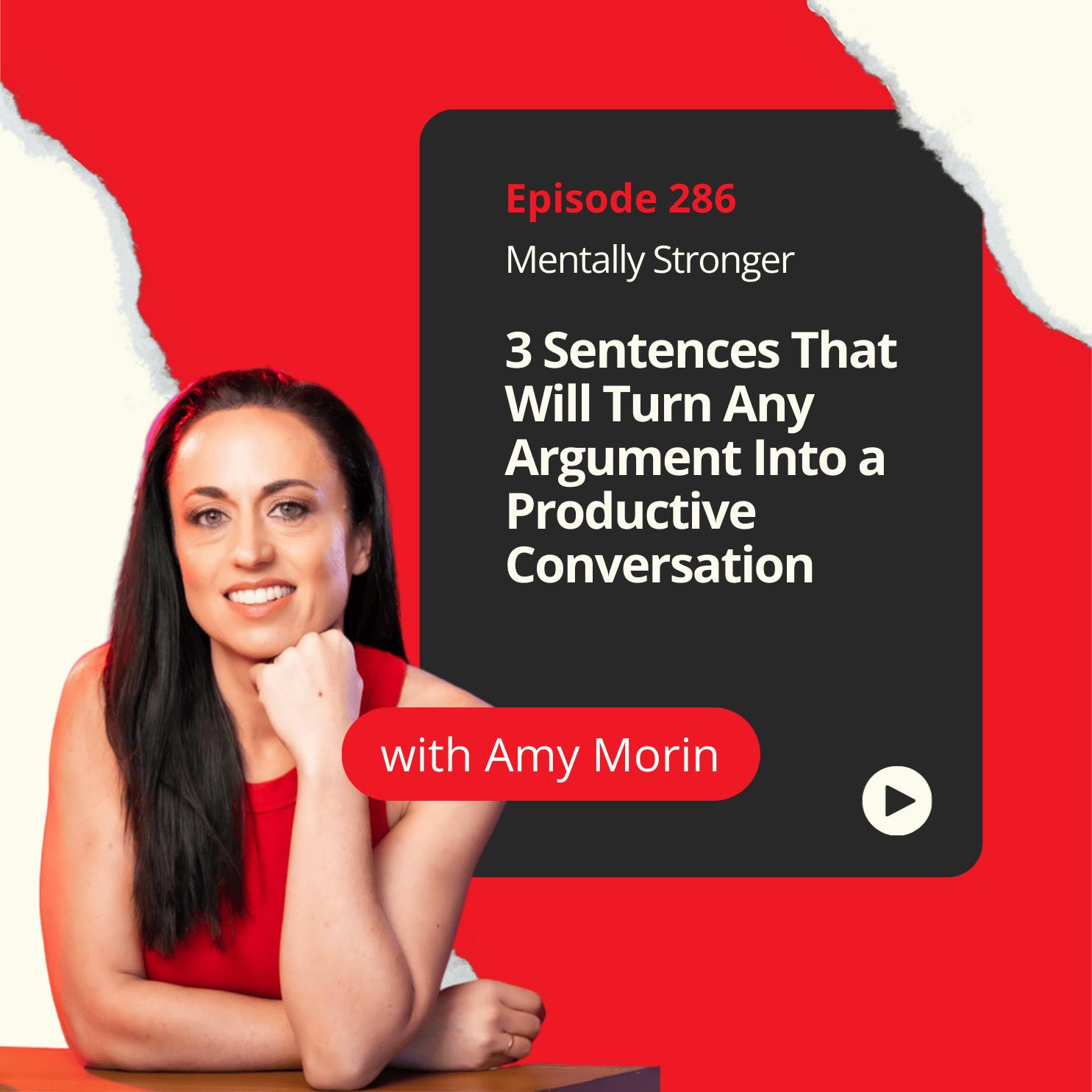
286 — 3 Sentences That Will Turn Any Argument Into a Productive Conversation
15m 34s
The episode discusses how arguments typically escalate because emotional flooding impairs logical reasoning and empathy, causing people to fixate on being right. To counteract this, three transformative sentences are recommended. First, "Help me understand your perspective" encourages active listening and clarifies the real issue. Second, "It makes sense that you feel that way" validates the other person's emotions without requiring agreement, which de-escalates conflict by making them feel understood. Third, "I'm sorry for my part in this" involves taking responsibility, even minimally, to break deadlocks and foster mutual accountability. Using these sentences together shifts the dynamic from adversarial ("me versus you") to collaborative ("us versus the problem"), enabling calmer, more productive conversations. This approach not only resolves conflicts but also strengthens relationships and builds mental resilience by prioritizing understanding over winning.
On today's episode of mentally stronger, think about the last argument that you had with someone. Maybe it was with your partner about the dishes, or with a coworker over a project deadline. How did it end? Did one person win and the other lose? Or did you both just walk away feeling exhausted, misunderstood, and the problem never got solved? Arguments are a part of life, but they often leave us feeling disconnected and drained. But when they're handled well, arguments can help you grow mentally stronger while also improving your relationship and solving a problem together. What if I told you that there are three simple sentences that can transform almost any argument into an opportunity? These aren't magic words, but they're powerful tools that can stop a conflict in its tracks and turn a battle into a conversation. They can help you de-escalate the tension, understand one another better, and even improve your relationship. That's what we're going to talk about on today's episode. Welcome to the "I Can't Sleep" podcast with Benjamin Boster. If you're tired of sleepless nights, you'll love the "I Can't Sleep" podcast. I help quiet your mind by reading random articles from across the web to bore you to sleep with my soothing voice. Each episode provides enough interesting content to hold your attention, and then your mind lets you drift off. Find it wherever you get your podcast. That's "I Can't Sleep" with Benjamin Boster. Not all darkness is dangerous. Sometimes it's the doorway to becoming whole. On the brand new podcast, the Shadow Sessions hosted by me, Hibba Belfake, a psychologist and trauma expert, we should light on the hidden corners of the human experience. Through raw, unfiltered conversations from the edge of healing, the Shadow Sessions invites you to do the deeper work that leads to real change. Follow the Shadow Sessions wherever you're listening now. Welcome to Mentally Stronger. I'm Amy Morin, a psychotherapist, mental strength trainer, and an international best-selling author of six books on mental strength. You're listening to the Friday Fix Edition. Every Friday, I share a quick mental strength strategy that can fix the thoughts, feelings, and actions that can hold you back in line. The fun part is, we record the show from a sailboat in the Florida Keys. Now, let's dive into today's episode. Most of us go into an argument with one goal, and that's to be right. We want to prove our point to the other person, and we want to defend our position. And the more emotional we get, the more convinced we are that we have to show the other person that they're wrong. During conflict, our brain gets flooded with adrenaline, and we enter this state called emotional flooding. When you're flooded, the logical part of your brain, which is known as the prefrontal cortex, essentially shuts down. Suddenly you can't listen, you can't really solve problems, and you certainly can't empathize with the other person. Instead, all you want to do is attack and defend. Anything else that's interesting happens when you're angry, too. When you feel angry, you activate the part of your brain where all of your angry memories are stored. It's the same for any emotion, like embarrassment or disappointment, too. But suddenly, when you feel that emotion intensely, all you can think about are the past times when you felt that same emotion. So that's why when you're arguing with your partner about something that they just bought, you didn't agree with the purchase they made. Suddenly, you bring up the fact that they haven't done the dishes lately, either. And that's because your brain is running through all the other things that your man about, and it becomes even harder to stay on topic or stay rational. So the goal of the three sentences that I'm going to share today is to stop that flood in your brain. No matter who you're arguing with, your neighbor, your partner, or your coworker, these three phrases will help you stay calmer, and then also help you find a resolution to your conflict. And the amazing thing about these statements is they won't only help you stay in your logical brain, they'll also help the other person do the same. And when you're calmer, it's easier to reach a solution. So essentially, these three sentences will shift the dynamic from me versus you to us versus the problem. And I've seen these three sentences transform not just arguments, but entire relationships in my therapy office. I teach them to couples. And when they start using them, they're much better at solving conflict, rather than letting those disagreements and resentments grow. But I've also seen that families use it with their children and with extended family. It changes their professional lives, too. Because you'll find that when you come across as calm and clear-headed, people become much more invested in working with you instead of against you. So let's get to these three sentences. Number one, the first sentence to say in any argument is this, "Help me understand your perspective." When we argue, we're usually so busy formulating our rebuttal that we don't listen to what the other person says. We assume we already know what they think, as well as why they're wrong. So this sentence forces you to pause that internal monologue. And it's a genuine request for information. It says, "Okay, I'm willing to step out of my own head for a minute and try to see the world a little bit through your eyes." When I teach this to couples and they start using it, they'll say, "Oh, suddenly I understand my partner's position a little bit more." Like maybe your partner's spending habits aren't because they don't care about the budget, maybe they just value making memories together. And that's why they want to do things that cost money. Or maybe your partner doesn't want to talk about something, not because they're not interested, but maybe they need some time to process the information by themselves before they're going to be ready to talk. Once you use this sentence, "Help me understand your perspective." It opens the door to really figure out what the real issue is. And it also lets you get clear on the other person's perspective and gives them the opportunity to explain it calmly to you. Because when they know that you're willing to listen, they're less likely to have to keep raising their voice or repeating themselves or even take a jab at you. So that's the first sentence. Help me understand your perspective. I'm going to pause right here for a quick word from today's sponsors. But don't go anywhere because when we come back, I'm sharing the other two sentences that will diffuse any argument. Okay, we're back. The second sentence is a follow-up, and it's just as powerful. Say this next. It makes sense that you feel that way. Now, this one's crucial because saying it makes sense isn't the same as saying I agree with you. And this is where a lot of people get stripped up because you're not conceding your point. You're just validating that their emotions are real. You're acknowledging that based on their perspective and that their feelings are logical based on what they're thinking. Neuroscience research shows that when we feel understood, our brains release oxytocin, the bonding hormone. And it calms our nervous system. It reduces the fear and aggression that often comes with conflict. Things start to de-escalate. Emotional validation is one of the fastest ways to de-escalate a conversation. Now, I worked with a mom who used to use this with her teenage daughter. She used to accuse her daughter of being a drama queen. She'd say stuff like, "Oh, there you go again. You're just being dramatic." Which of course made the situation worse. Her daughter was so upset every time mom said that. So the mom started saying, "It's understandable that you feel that way." And as soon as she did everything changed, whether her daughter was upset about a disagreement with a friend or something to do with her grades at school, her mom just validated how she felt. Now she didn't necessarily share those feelings. In fact, she would say, "If I were in those shoes, I'm not sure I would feel exactly the same way." But she spent time first listening to her daughter's perspective and then realized, "Oh, no wonder she's thinking in feeling this way." It was all about gating that understanding. She didn't try to calm her down or convince her that she was overreacting. She just assured her, "Yeah, your feelings are understandable." When she did that, something amazing happened. Once her daughter felt like her mom understood, she didn't have to waste energy, convincing her mom to listen or explaining the situation, running away to her bedroom and slamming the door just to prove to her mom that she was upset. Instead, they could move forward toward a solution. So that's the second sentence. Just say, "It makes sense that you feel that way." And that brings us to our third and final sentence. This one requires the most courage, but it leads to the biggest rewards. Just say, "I'm sorry for my part in this." Very few disagreements are 100% one person's fault. And even if you believe that you're 98% right, you can almost always find 2% of the disagreement that you can own. Maybe you just apologize for your tone of voice or for not listening well in the beginning. Or acknowledge, "Hey, I think I said that wrong. My words came out wrong." But when you apologize for your part, you break this stalemate. So that instead of trying to blame each other, everything shifts. And here's the interesting part. It becomes incredibly difficult for someone to keep attacking you when you've taken responsibility, even if it's just for that small share. Suddenly, they start to look at their own behavior. And before you know it, you are both taking some accountability. And then you have a productive conversation. And I saw this work with a couple that I was working with. They would always argue about the role that extended families should have in their lives. It's a common source of conflict, like what role should my parents and your parents play. In this situation that I'm thinking of, the husband helped out his parents a lot. And the wife felt like she and the kids were neglected. So whenever they argued, it was always the same thing. She'd say, "You don't help us enough," and he'd say, "You don't understand that my parents need help." Then they'd both get mad and they'd retreat. Well, one day she shifted and she just apologized for her part. She said, "I'm sorry that I yell a lot and that I blame you." And as soon as she did that, he just acknowledged that, "I'm sorry, I'm not always available." Once he said that, suddenly their conversation shifted and they were able to start talking about a solution, and they weren't just getting into an argument over who was in the toughest situation or who understood the least. It was a powerful shift that moved things forward, just that one sentence. Now you can use any of these sentences just by themselves, but they're more powerful when you use all three of them together. So let's run through them one more time. You start by saying, "Help me understand your perspective," and that invites the other person to give you some clarity. When they're done, you just say, "It makes sense that you feel that way." Then you're validating, however it is that they feel. And then you say, "I'm sorry for my part in this," which opens the door for accountability. Part of diffusing conflict is reminding yourself that you can't control the other person. You can't change their mind. You're not going to argue them into submission, but you can control how you respond to them. These three sentences will help you manage your emotions, push aside your ego, and ultimately you can prioritize the help of your relationship over the need to be right, because in the end, it doesn't really matter if you were a little more right than they were or vice versa. So the next time you experience conflict, just try those three sentences and see what happens when instead of trying to win the argument, you actually try to understand the other person. You might be surprised at how quickly a fight turns into a resolution. Not only will you preserve their relationship, but it's an opportunity for you to grow mentally stronger too. Thanks for hanging out with me today and for listening to Mentally Stronger. If you know someone who could benefit from learning more about how to diffuse an argument, share this show with them. Simply sharing a link could help someone feel better and grow stronger. And if you want even more tips for building mental strength, subscribe to Mentally Stronger Premium. You'll get weekly bonus episodes where I answer your questions on Mentally Strong, plus monthly extras you won't find anywhere else to help you grow stronger and feel better. To subscribe, just click on the link in the show notes. And if you enjoyed this show, don't forget to hit the subscribe button on your favorite podcast app and leave a quick review on Apple or Spotify. Your support helps more people discover practical tools for building mental strength. And as always, a big think into my show's producer who likes to get along with everyone. Nick Valentine.
Podcast Summary
Key Points:
Arguments often become unproductive due to emotional flooding, which shuts down logical thinking and empathy.
Three key sentences can transform conflicts
These phrases help de-escalate tension, validate emotions, shift focus from blame to shared problem-solving, and improve relationships.
Summary:
The episode discusses how arguments typically escalate because emotional flooding impairs logical reasoning and empathy, causing people to fixate on being right. To counteract this, three transformative sentences are recommended. First, "Help me understand your perspective" encourages active listening and clarifies the real issue.
Second, "It makes sense that you feel that way" validates the other person's emotions without requiring agreement, which de-escalates conflict by making them feel understood. Third, "I'm sorry for my part in this" involves taking responsibility, even minimally, to break deadlocks and foster mutual accountability. Using these sentences together shifts the dynamic from adversarial ("me versus you") to collaborative ("us versus the problem"), enabling calmer, more productive conversations.
This approach not only resolves conflicts but also strengthens relationships and builds mental resilience by prioritizing understanding over winning.
FAQs
The three sentences are: 'Help me understand your perspective,' 'It makes sense that you feel that way,' and 'I'm sorry for my part in this.' They help de-escalate tension, promote understanding, and shift the dynamic from conflict to collaboration.
Arguments often lead to emotional flooding, where adrenaline shuts down the logical part of the brain, making it hard to listen, solve problems, or empathize. This results in a cycle of attack and defense without resolution.
This sentence forces you to pause your internal monologue and genuinely listen. It opens the door to understanding the other person's viewpoint and clarifies the real issue, reducing the need for raised voices or repetition.
This phrase validates the other person's emotions without agreeing with them, which can release oxytocin to calm the nervous system. It de-escalates tension by making the other person feel understood, paving the way for productive conversation.
Apologizing for even a small part breaks the stalemate of blame and encourages mutual accountability. It makes it difficult for the other person to keep attacking, shifting the focus toward finding a solution together.
Using these sentences helps prioritize the health of the relationship over being right, fostering better conflict resolution and reducing resentment. They can transform dynamics in personal, family, and professional settings by promoting calm and collaboration.
Chat with AI
Loading...
Pro features
Go deeper with this episode
Unlock creator-grade tools that turn any transcript into show notes and subtitle files.
 PodcastTranscript AI