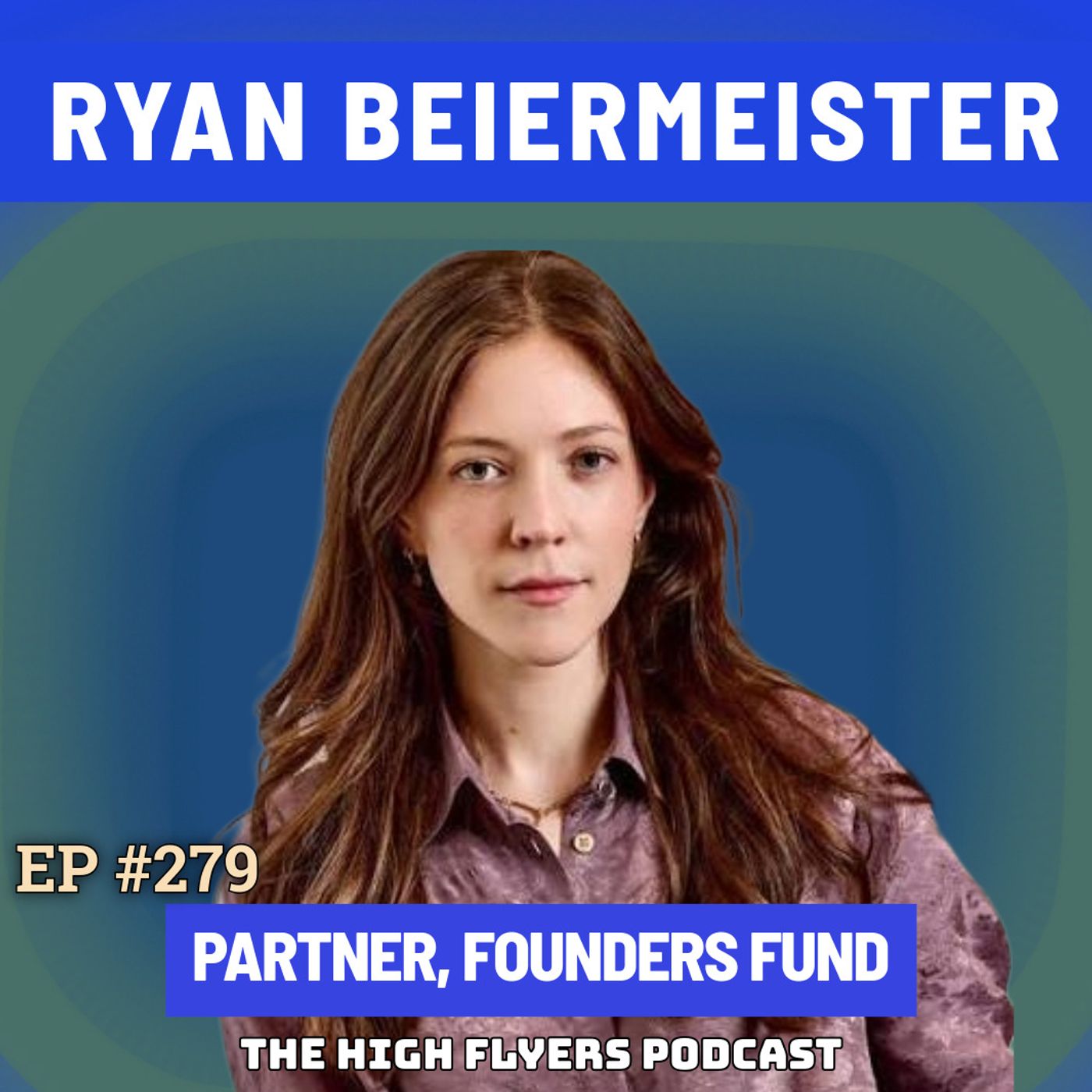
#279 Ryan Beiermeister: Founders Fund's Partner on Building for Billions, Human Judgement & How Debate Changed Her Life
68m 55s
Ryan Byron Myster’s career is a journey from debate and art in Houston to leading high-impact product and safety initiatives at Palantir, Meta, and OpenAI. Born into a loving, intellectually stimulating family, his early years were marked by artistic expression and a deep sense of empathy, which he attributes to his lifelong values. Though he initially saw himself as a builder, not an investor, a pivotal moment with Founders Fund partner Trey Byron led him to embrace investing as a new form of impact—where capital can drive meaningful, difficult change. Ryan’s career reflects a consistent belief in the power of human connection over automation, especially in areas like public safety, elections, and AI ethics. He emphasizes that while AI excels at efficiency, it lacks the imperfection, intuition, and emotional depth that human creativity brings. At every stage, he has prioritized purpose and social impact over accolades, viewing technology as a tool that must be guided by empathy, moral clarity, and human experience. His time at Meta, in particular, transformed him, as he witnessed firsthand how technology can both enable and threaten societal well-being. Now at Founders Fund, he brings a unique blend of experience, creativity, and humanistic values to invest in generational companies that solve hard problems. Ryan’s story is not just of professional ascent, but of evolving identity—from a competitive debater to a thoughtful, mission-driven leader who believes in the enduring value of human connection in an increasingly automated world.
Hi, I'm Vita, founder and host of this podcast, The High Flyers.
Hi, everyone. I'm Ryan Byron Myster. I'm a partner at Founders Fund.
Ryan, I'm nervous to do this. Everyone I spoke to tells me you're just good at everything.
So I'm a bit nervous.
Way too kind. I am definitely bad at many things, but I really appreciate that.
Thanks friends and fam for hooking me up.
I'm excited to do this because I don't think you've actually shared your
story and totality like our formats. I'll see how far I can get into it.
But hey friends, welcome back or welcome to The High Flyers Podcast,
where we do.
We imagine a high flyer showcased the brightest and most relatable role models
and companies and their journey from sunrise to today.
As one of the premier products in our curiosity center,
we'll line up providing on-demand intelligence to help you
be one percent better every single day.
Homey host, Virita Gowelle, and let's have some fun.
Our listeners have called this podcast as a meticulously researched
biography unveiling the extraordinary lives and decisions of the most
remarkable individuals and companies from around the world.
We hope you're enjoying our catalog of 200+ episodes.
Since we launched in 2020, with many of our guests appearing in rare public
interviews, it's now time to explore your curiosity.
Please enjoy.
Let's set the scene with some fun facts,
where are you born and where do you live now?
Okay, so I was technically born in Dallas,
but I'm a Houstonian, so I like to scratch that from the record.
I'm from Houston. Right now I live in beautiful San Francisco.
It's gorgeous outside, that reminding me of why I chose to be here.
And what was your first show been, what do you do now?
Technically, my first job was teaching debate at a summer debate camp for high schoolers.
One of my students actually went on to be a famous novelist,
so I cling credit, but my first real job was at Palantir when I was 22,
and then I went to Metta and OpenAI, and now I'm a partner at Founders Fund,
looking at the world through an investment lens.
I am so excited to unpack that career journey, because you've almost
collected all the logos, right?
But then your childhood is very different, telling that to be an interesting contrast.
Definitely. I would say that my younger self
were to know what my career ended up being.
I'd be shocked, and I think the people around me would be shocked as well,
so it's been a really interesting journey, and it's been awesome to find my footing in these
spaces as someone who's a little bit different from traditional tech buyers.
Totally, and I think particularly Founders Fund, because Founders Fund
thinks likes people like you who've got a variety of experiences,
and I think you've hit right in.
Totally. I've been at Founders Fund about two months now,
and I have never felt so free to be myself.
I feel like this job and investing, especially at Founders Fund,
the goal is to be me, and I was hired because I'm me,
and I think a variety of investing styles, and brain styles, and different experiences
produce really good outcomes when you're trying to get a really diverse,
but concentrated fund, and some of the best companies in the world.
And so far, I just felt like the goal is to figure out myself as an investor,
versus fit, any particular mold. It's been awesome.
And I'm really excited as we check today a bit of the transition from being a,
I guess, an operator, exact, to doing a VC as we were chatting the other day.
That is a very fascinating transition that people let go through.
I love asking that. So I think as we check today, we get back to that.
And Ryan, as you know, the purpose of this show is to reimagine an eye flyer,
to recognize some people on just their job title.
Is there someone you want to call out?
Do you know where you feel hasn't got the recognition that it deserves?
Ooh, I'm going to answer with my Northwestern debate coach, Daniel Fitzmire.
So I guess a PhD in political theory, and I think ancient Greek,
but he is the head coach of the winningest university debate program in the country.
Northwestern is one. I believe 15 national championships and no other university.
I think Harvard is second and is not close to that.
And he was my first real mentor. He's mentored hundreds of students.
And he didn't just help me win a debate.
He helped me become a better person at a really young age and identify what matters.
And also, through Aristotle, kind of teach taught me the value of hard work
and the pride that can come from habits of excellence versus the lows and the highs
and the trophies, he helped me become really proud of myself
for really the first time as an intellectual and student.
And the numbers speak for themselves on the champion outcomes.
That is such an interesting comment.
He made you feel proud about yourself.
Yeah, again, he kind of like had this phrase borrowed from Aristotle around excellence is a habit,
right? So a lot of people think about excellence as the trophy you win or the pinnacle achievement.
But his philosophy that really transformed me was that excellence is in the day to day.
Excellence is how you carry yourself, how diligent you are, how you show up to work.
Like all of those small things are something to be proud of intrinsically.
And that has really guided my life.
And I kind of live my principles and I live my values and I give my work my all.
And so no matter what happens, I can feel confident and I feel excellent.
And I feel really proud of myself intrinsically.
Back to the episode in a moment, something I've heard a lot from business owners and leaders
is that speed only matters if you still feel confident in the output.
And it's particularly an important point in this world of AI.
Zero's answer to that is accountable intelligence.
AI that shows you what it's doing and works from your own real data
and is designed to keep you in control before anything happens.
Has Zero puts it?
Most AI has you to trust it.
Accountable intelligence shows you why you can.
And that's how it works with Jax, Zero's in-platform AI finance partner.
So whether you're running the business, advising the client,
or working with your board, Jax ensures that you get the upside of automation
without giving up any of the control.
If you want to see this practice, head over to zero.com/iflies
for 90% off your plan for the first six months.
Terms apply and go to the website.
That's zero xearo.com/iflies.
Now back to the episode.
I want to cover how Ryan became Ryan.
Because I think everyone that I spoke to,
that's what they were curious about.
And that's why my show has been about unpacking the sunrise of the person,
the childhood and the early years.
You mentioned Houston.
Tell me about your memories of growing up in Houston.
So I grew up in the suburbs, technically.
It's now a big suburb called Sugar Land.
And I had just like really idyllic, normal childhood.
I think my parents are incredibly loving and incredibly proud of me.
My dad is quite analytical, charismatic, has an amazing memory,
history, econ, and was a natural gas trader in Houston.
And my mom is whip smart.
I think she is the brain of an engineer.
But she also has immense creativity and kind of joy and small things.
And so I actually had a really artistic childhood.
My favorite moments growing up were in the summers when my mom taught art classes
for the local kids in our neighborhoods.
Or we would have a birthday party where we're hot and gluing and making gem
kind of jewelry boxes with cheap plastic gems and gluing them.
And I was a theater kid.
I started local plays.
My mom made the costumes.
Like I had a really free childhood where I felt expressive and able to be myself.
And I also felt really loved by my parents.
They were really proud of me for both my intelligence.
And then also my kind of boldness as the older sister.
So it was great.
It was normal.
And then after kind of going to a public elementary school,
which I loved and taught me so much,
my parents knew that I was really smart and decided at great financial sacrifice
to send me to a private school in Houston, which was a commute for me.
And one of the fanciest in town.
And so that was kind of the moment coinciding with being 11 and being in middle school,
where I think a lot changed for me.
And I had to think about new things and new feelings of difference that I hadn't experienced before.
But all in all, my childhood was one of like games and play and costumes and art and was just wonderful.
I've been told about your parents' sacrifice.
I think in the speech you gave recently back when you went back to your school,
I think you talked about both Robin and Geoffrey.
I think your dad's name and you referenced the sacrifices.
How do you reflect on that now?
Like I joke to the start where people look at your resume today
and you've collected all the logos, right?
Like if you were playing Pokemon, you've won the game, but you've got them all.
But yeah, the reality of your childhood was quite different.
Yeah, it was different.
Again, I kind of grew up in a very normal middle-class environment
and going to this private school, it was a really elite school.
Like six graders are carrying Louis Vuitton handbags.
Like that's outrageous.
And what country club you belong to was important and your zip code.
And even just living, you know, no one else lived in the suburbs and I felt kind of a shame,
a sense of shame for the first time.
And I think that's always kind of given me a bit of a desire to be successful
and to kind of prove all of them wrong.
But what's really interesting is I feel like I have a wonderful resume.
I feel like it's super successful.
I feel like there's so many great things to say about it.
It actually doesn't feel as good on that metric as you think it would.
Like I've proven myself and I don't feel like I need to prove myself any further.
But I definitely don't feel like that resume-proof point has really means that much to me anymore.
Like there's so much more to achieve as a human being than getting accolades.
And I've reached my, you know, my dreams from that time period already
and my dreams are a bit different now.
And I think contributing to the world is what I care about now
versus collecting accolades that other people can understand.
It's interesting I was reflecting the other day on like some of the recent guests I've had on.
And for whatever reason, they've been female high performers.
And they've all like had very determined high school experiences.
But they've been very clear like I had a lady come on recently.
And she talked about how in grade six she wanted to go to this private school in New York.
And she convinced up.
parents to get her in and she got in and she did really well and she now does some really cool
stuff in tech actually and then your story and others and it got me wondering like maybe just
us as men just weren't that determined when we were kids and there's something about females being
determined because I think of my life as well she is just so determined and she had a very strong
schooling time where I was like the kid who didn't focus and was very like naughty in high school.
I think we just have less options as a woman like I kind of feel like I have to be
on paper incredibly successful and proven because sometimes I operate at a discount or the way
that I look and I think most senior executive women that I know almost all of them have really
grinded and really done the work to get where they are versus with maybe other genders not always
like it's a little easier to kind of prove yourself in different ways or to be the ideas person
or have other things about them that make them attractive in the workplace whereas I think most
women in senior positions would agree like we have to grind and I'm primed to do that and I think
like a lot of my career has been spent of course like executing at the highest level but then also
trying to deflate the part of me that is really people pleasing driven right like when you're a
little girl you're literally taught how to please and certainly there are young boys who are taught
that as well but I think the older I get the more confident I get in myself and the more I feel like
I have less to prove on paper and statistically and based on accolades other people think are worthy
and the only thing that matters is myself at the end of the day and my values and how much I
live up to them so I don't know I love getting older being wiser and being freer is all that's
happened to me my life has gotten better year by year and I am proud and glad and hope that continues
tell me about sport so people say you are obsessed with sport and
love sport tell me how do that love stop oh my dad so I was named after Nolan Ryan so that is if
any listeners confused on why her name is Ryan it's that reason ship it well that's we'll still do
that I think like one key part of my personality is I love competition and I love play and I feel
misinterpreted sometimes that the the competition and the competitive part of me is about me winning
and dominating it's actually just I like stakes I like emotion I like when things matter to people
and my dad is a die hard baseball fan he grew up listening to the tigers on radio from his bedroom
outside of Detroit and he converted to the Astros when he moved to Houston is a million years ago
but I love watching people do what they do best I get really emotional about it like a clip of a
random Yankees reliever retiring can make me saw because of just how much he they've achieved
and how the fans are there for them and I find it really fascinating I also find it really joyful
and really fun growing up my dad would always call me into the room when a dog pile was happening
on the pitcher's mound so like some amazing saver nightthending home run and everyone from the team
goes to the pitcher's mound and clobbers the person who did something amazing and yeah I kind of
live for those moments and I celebrate those in other people like I'll watch a spelling be I'll
watch bowling I'll watch anything where people are doing something great and something they've
worked really hard for and I find it an amazing aspect of the human spirit and something I'm really
interested in so yeah I grew up competitive and playful I love sports I love H town and I feel like
it's a really core part of who I am and it's emotional for me it's one of the greatest ways I
connect with my dad and I got to be the son you never had I mean one of the comments that came
up in my research as people said you're the Ryan GPT that's how they would describe you right and
I think the other side of this is debating that's been a true line I mean I think you would really
indulge in debating for most of your life and I think we saw that recently in some of the mafia
videos that came out I was not my interview that was I had not even talked to founders fun yet
about coming and we had been friends for years so but I love that Twitter thoughts that's how I got
this job yeah I would take that it's a good perception to have everything so again I kind of like
enter this private school I felt pretty alien and I've said in a lot of material things mattered
that I didn't want to matter and I started to debate in the eighth grade and started going to
local Houston high school tournaments with my partner it was 2v2 debate I'm kind of decent at it
I'm good at it and sort of decide to double down and my high school experience starts to open
me to this community of kids all around the country so we're going to debate tournaments
in outside of Chicago Boston California we're kind of going around the country the different weekend
tournaments and you make friends and then you go to debate camp with those friends and then all
of a sudden your social capital is a function of your intelligence and how good you are at debate
I would be cool if we read the Nietzsche critique and I knew XYZ philosopher or we had constructed
this new argument no one had heard or if I was top speaker of a tournament like that was what
was cool and that was really profound for me it's such a young age kind of struggling with the
doldrum of high school in general all of a sudden my intellectual strengths was social capital and
was what made me cool and I developed authentic friendships for the first time in a real way so I
fell in love with it with it it was a game it had competition a lot of people think of debate as
like purely kind of a speech activity and communicating and being persuasive really matters but it's
actually like high-speed chess there's a lot of different strategic types of arguments you make
and you intersect them with others and I just fell in love with the game and fell in love with a
community that saw me for something other than my zip code so it's so interesting because it's
sport there's arts there's creativity there's debate these are the four things that don't already
come up in our conversation I mean we can go back and forth to you but I'm curious out of all the
roles you did in your career which role allowed you to bring all those different parts of your
brain to work I'm actually gonna say my career is palentier opening eye meta and I could say great
things about all three I'm gonna say meta actually I've loved my role in work fit meta so I was a
product director responsible for a lot of social issue areas and the kind of content ecosystems
that play out on Instagram and Facebook and so that meant things like politics and elections both
integrity and safety but also good information around elections the health teams and COVID
misinfo I had a climate team roll up to me and then I also did a bunch of kind of youth well-being
work in the last year there and these were all heavy topics and places that the company needed
to do better and it also just had real meaning and import toward the world and for people's lives
for better or for worse that was an inevitability and I felt like all of my creative and intellectual
talent went into finding ways to make even one percent changes right at the scale of 4 billion
users if you make a tiny change that makes the platform more safe for better information quality
or better for communities you're achieving a lot for the world and I'd take these very complex
highly sensitive domains that of all these stakeholders and I define creative ways to make a
difference within that company and to get alignment across internal stakeholders that hold a
variety of different use and so it leveraged my clinical science background the substance
of where my brain has been at over the last couple years but then also my creativity because I was
operating within credible constraints that forced creative solutions while also communicating
and getting alignment and knowing what data science to grab and to capture to make the argument sound
and I felt like there were few people in the world who could do what I was doing by the end and
I felt an obligation to that work I've actually been told I think a common thread of my research
was people said social justice predates your career are you interested in social justice I'm curious
what was the earliest example of your curiosity about that field well I think the best answer
actually is literature for me so I'm going to I'm going to say that the earliest signal was just
I have a lot of empathy and I'm kind of a much ball deep down and my earliest memory of that and
I read a lot of fiction and I love reading and I'm worried about the state of reading in their
worlds and when I was probably 11 or so I read this book called The Chosen which is like a 1967 book
about Jews in Brooklyn and it's a friendship between a super orthodox hecetic Jew and a slightly
less but still orthodox Jewish friend and the main character is brilliant and I just loved him and
he kind of was met with silence from his father growing up his father would never speak to him
and his father had like his own reasons and was an act of love is trying to teach him something
but I just remember crying and just feeling such emotion towards this character and also I was
a kid who was dropped off at Sunday School in the middle of Texas in the suburbs and I'm reading a
book about hiscetic Judaism and trying to understand that and just feeling so much for people
whose world was completely different than mine and I say that only because again I think that like
reading has been a big part of my education my empathy my understanding of why life can be hard
for other people and I feel like that foundation and knowledge base makes it impossible for me not
to care about others and care about improving the world for others I'm a big fan of Rawls the
Democratic theorist and very simply kind of is like our politics should be informed by what helps
the least advantaged and if you help the least advantage you raise the floor you probably make
everyone's lives better and that really sticks with me and it's something that I'm constantly
thinking about like how does my work contribute to other people and you know I've carried that
throughout my career and it's something I'm really proud of and it shapes my whole interest area
and focus. Yeah and I mean as a bit of a career I think we cannot back some of these interesting
journeys tell me about when you were 18 so if I met you at that age with all these ambitions you've
had and influences to that point what would I have assumed you do with your life? My parents gave me
and million incredible gifts I'm obsessed with them, but I was kind of
of in a different league at this point. I didn't have a ton of adults who are thinking or advising
me to think about my career. So I wouldn't have had an answer for you. I probably would have said
law school question mark because of my interest in politics and debate and that seemed like a natural
path. But I was a kid kind of living in the moment and I didn't have any financial literacy,
for example. I didn't realize that the most important thing I could be doing with my adolescence
is preparing for the journey that is a career. And I got really lucky. I focused on being smart
and following my interests in the moment and that made me really interesting and got me the job
at Palantir. But I can't say that I've had a master plan besides being ambitious, caring about
things, caring about myself, caring about the world, seeking success and intelligence and knowledge
and right place, right time. I'm incredibly grateful for the way my career has unfolded. I'm
probably not giving myself enough credit. But I also think that and I tell a lot of young people this
that my commitment to debate really made me stand out. Like I had a thing. I had a career before
I had a career. I had to go through all the highs and the lows of that. I failed. I succeeded. I
worked hard. I got promoted. And so 18 year old Ryan would also said I'm focused on winning debates
and luckily that priority and interest coincided with a career before I had a career that made me
I think even better at my work today. So you went to Northwestern and then I want to ask about
the post-Northwestern to Palantir because Ray actually told me in the research for this that
they have this experiment to try and recruit debating champions into Palantir in the early days.
And it was a risk and apparently you were one of the people that worked out. Can you reflect on that?
That's interesting. I think what's cool about Palantir and his very cool about Founders on Today
is that the hiring strategy is just remarkable people. And so I'm 22 years old. I zero experience
working for a tech company. I'm a political science and English person. I don't know anything about
Silicon Valley or software or really much at all. But I stood out and Palantir miraculously offered
me a job on the basis of my debate accomplishments. I was the number one week debater in the country
my senior of college. I was top speaker at the National Championship. The fourth woman since 1946
on that and that just made me stand out and they're willing to take a bet on my intelligence and my
promise versus my experience. And for what it's worth, I remember someone else starting with me who
was a champion boulder. It was really a strategy of higher remarkable people and assume that they do
great things. I really benefited from that. I would say it was definitely probably the peak debate.
There was a couple of other actually great debaters who went to Palantir but I think like taking a
bet on someone or like including a founder based on their intellectual caliber. And you know,
again, I had a career before I had a career. I'd worked hard before for something totally unrelated
to my grades. Yeah, I was lucky to like intersect with the companies I was thinking that way at that
time. So you were penalty for seven years. I believe it just just over seven years, right?
Just over seven. Yeah, what's that? It is incredible. And this was before Palantir became Palantir.
I think it was a mainstream, right? How do you reflect on those seven years? Because I was also
the first professional job. Is that right? 100% reflect on how do you reflect on that? Like,
I love asking what were the foundational skills you developed? Because when I think of my early
jobs, like I learned a ton about me, about the world, about what not to do and like really challenge
me on, I'm curious how do you reflect on your first seven years of Palantir? I kind of think about
it as the place I grew up, right? So obviously I've grown up before those years, we just talked about
that, but it was a phenomenal place to become a real professional. And I think for a couple reasons,
I think one, it truly had the vibe of meritocracy. Like, you could be a 25-year-old with an incredible
amount of responsibility and you got that responsibility by just being good and having that be noticed.
And so for a young person where there's so much work happening, the company's growing so quickly,
there's not enough people to do and the things that need to be done. I was just granted a lot of
responsibility, young, that I frankly wasn't qualified for. But it's a good feeling when you're
not qualified for something because you have to rapidly learn and sink or swim. And so I just was able
to kind of get exposure and real experience on a faster curve than if I had worked at a large
company or even in meta and just kind of boxed into a junior role. I also think Palantir gave me a
lot of exposure to the challenges in the world. So I worked closely in my, especially my first
couple years there with the Secret Service on anti-money laundering work. I worked with the Department
of Justice on fraud. I worked with the Securities and Exchange Commission on insider trading,
the FBI on counterterrorism, actually the IRS Criminal Investigations Division on a lot of counterterrorism
work as well. And then eventually also the military and intelligence agencies and the FBI equivalent
in France. And I just got to see the analytical challenges in those spaces, in public safety, and
build a role at ex of user empathy and understanding for what people trying to do and why that was hard.
So actually a couple years into my work at Palantir, the CTO of Palantir at the time, Brian Schimpff,
who's now the CEO of Anderoll, decided that they needed to restart a lot of the core government
product work in Palo Alto. We had just kind of not been innovating on the core piece of software
that I was implementing on the business side. And he asked the business team like who's the best
kind of like Ford deployed person who understands users and strategy and empathy and could design a
product creatively. And my name was surfaced. And so I was invited to kind of come to Palo Alto
and lead a small team of some of the best engineers in the company and really zero to one prototype
a new era of the Palantir Gotham product. And I learned product management. I was one of the first
p.m.s at the company. I learned from Dan Sirvelli, this wonderful engineer. I learned about taste.
I learned how to connect my user empathy goals to like product UIs and design and features and
testing and going to market. And that was the education and experience that changed my whole
career. That's how I got into product in a really meaningful way from my kind of core creativity
and user empathy skills. And then that team and that work kind of scaled in scales. And I was
leading a lot of the work for the Gotham government platform by the time I left Palantir. I was
had a huge portfolio and was trusted with that. And yeah, I think there couldn't be a better place
for me to grow. And it was also a very different company at the time, right? It had wasn't public.
There were a lot of the concerns that exist today weren't as obvious. I was young and it felt
like a great thing to work on preventing domestic violence with the FBI. And so things have changed,
but on the whole, I have a lot of respect for people who commit themselves to those types of
challenges within or without or on the outside of the U.S. government or other governments.
One of the notes I took from our cold the other day is I think you mentioned that you scaled
really quickly in the company. I think it was one of your comments. I'm curious how you did that
because any particular project you worked on because from my understanding, Palantir has always been
a very high performance oriented culture, right? I mean, I don't think someone like Trey would
put up with someone if they don't perform. So what did you do in those in the time that allowed
you to shoot up so quickly? Again, I just started to be known for my ability to go into a new
environment. Let's say it was the Securities and Exchange Commission, which was actually my favorite
project. I go into the SEC and we're trying to get them, they have a pilot maybe with Palantir
and the software and we're trying to deploy that, get the investigative attorneys to really like
the tool, use the tool to solve real meaningful challenges for them, and then grow that at enterprise
scale. And I'm a real quick study. I think to be as part of that, you just have to be able to
information process really quickly and learn things on the fly. And so I would pretty quickly come
to understand and empathize with what these investigative attorneys are trying to do and how they
piece together an insider trading investigation. Now, how do the phone calls line up with the emails,
line up with the trade, it's line up with the network that we know about. And the clients really
thought of me as an extension of them. And I got so much positive feedback and demonstrated really
creative ways to get the software adopted in those spaces that I became known for my ability to
like apply the product creatively, empathize with the user and grow a deployment to much larger
scale. And so again, when they were thinking about, okay, we need to redo our product suite. They
wanted the person who could strategically understand what to build and why at a really high and
successful fidelity and who had the creativity mixed with the analytical skills to do that. So that
definitely was responsible for my rise. I also learned really early at Palantir, when you're bad,
it's something just don't do it. Like I was initially slotted in to kind of more kind of like
team management roles, setting agendas and schedule and kind of pure execution. I'm great at
that now, but when I was when I was that age, I wasn't. And I got early advice that like, hey,
you're a strategist. You're the person who understands exactly what an insider trading investor
attorney or counterterrorism investigator does. And you're going to figure out the workflow
and the products. You're not a project manager type. That's not it's not my brain. It has never
been my brain really. And so Palantir was great for me in that they encouraged me to double down
on what I'm good at. And it feels hard. Don't worry about it. I don't need to be well-rounded. I just
need to be me and good at what I'm good at and on that. I asked a bunch of the founders fun team,
what's some questions I should ask you. And the most common question they said is ask about
Tray's evolution from the time you worked at him in 2012 to now in 2026. Can you reflect on that
for a minute about how Tray has stayed the same and changed over that time? Yeah. So Tray
interviewed me. Again, I'm 21 or 22 at Palantir. I had never it was my first interview ever. And
I think Tray and I really connected. I mean, he was what felt like years older than me. It turns
out he's probably like five years longer than me or something now. But Tray is like a humanist.
Like he tells stories and he has a vision and he's strategic in these communities.
and I'm like that too, and so I think we have a real conversation, it didn't feel like an awkward interview,
it felt like a foundation of a friendship, and I actually think that's one of his greatest spikes and skills,
is his kind of gregariousness and interest and intellectualism and conversation abilities.
And so we just really hit it off.
I never got to work super closely with him at Palantir, he left a couple years into me being at the job,
but what I really like admire about Trey is that we've connected over having similar backgrounds
where we're kind of on our own and venturing into new places that our family lineages have never done,
and he is a different type of investor, he's not quaint, he's not like a couple of years ago,
if you ask me what does a VC investor look like?
I probably would, you know, I have the kind of central casting, McKinsey MBA mentality,
and Trey is not that, he brings a lot of creativity and energy to this space,
and he also has the level of determinism that I think I have.
He's just like a great model for me on how a different creative archetype can succeed across multiple dimensions.
I think maybe if I am answering the evolution question, he's probably a little crankier now,
but I kind of love that now, I just love point of view.
Like Trey was rocking a meeting earlier today about why most of the other defense companies just don't make sense as investments,
and he was impassioned about it, and he was oratory about it, and well qualified, and analytically sound,
and it's just awesome to hear someone kind of fired up and smart, who speaks their mind, and is credible in that.
Yeah, you know, I don't know Trey as well as you do with my reflection as observer is he doesn't drink the collade.
I think a lot of people get into the valley and like drink the collade and say everything's perfect,
which Trey seems to be grounded is my observation without knowing him that well,
and which I find very unique to a lot of the other VCs.
That's a huge deal, right? I'm learning that as I join this industry.
Most VCs, and I think Founders Fund is really special, make decisions based on the past, it's powered recognition.
It's like, oh, I mean, literally, it's one of the main techniques.
You're like, compare this company to what came before, size it, we've seen Founders that look like this,
we've seen Founders that don't look like this, and so it's really tempting to learn the playbook and fit that mold
and make decisions in actually like a really framework way.
And I feel agency at Founders Fund to question some of those plays and to trust myself more and to experiment.
And of course, there's learning from the Peter and Trey and the greatest investors on the planet.
And there's so much of that that I want to emulate, but I'm also encouraged to bring something fresh to the table at the same time.
And I think Trey is a really good example of that.
I came across a really interesting interview Ryan that he did back in 2019.
I think this might talk to some of your leafs and observations about the world.
So essentially you said that AI should remove, this was in 2019 years before any of the tools we have today,
that AI should remove repetitive work, but there was no replacement for human judgment.
I'm curious, seven years later, do you still believe that second half?
I do actually. Again, I'm a humanist.
I think human beings are incredible and dynamic and different.
There are no two human beings on planet Earth who have the same experiences.
It's statistically impossible.
And there is magic to the right human beings at the right moments in time.
And AI is getting really good at efficiency.
It's getting really good at automation.
But it's also kind of regressing to the mean, right?
Like the outputs of these models all look really similar.
And it's going to perform the same way it performs over and over again.
And it doesn't want mess and it doesn't want imperfection.
It doesn't want chaos.
Those are things that the models are punished for.
And those are in terms of qualities humans have.
And I think that is where magic comes from.
And our economy and our society in terms of joy.
I'm a techno optimist. I believe in AI.
I think it can do incredible things for the world.
But I just, in no way do I think it can replicate or replace the really special qualities about being human.
And I think we have to find ways to celebrate those qualities and bring them even more to the forefront right now.
I want to come back to Karina moment, but this is really interesting.
I mean, there's so much talk about AI.
And one train of thought is people go it's going to change everything.
And the other train of thought is it's being oversold to us, right?
Like humans, like I just hosted our, we do an annual summit in Asia.
And I hosted that yesterday and I'm traveling through the moment.
And we had all the big labs speaking.
And they said we've got kids.
And we don't know if our kids are just going to be all using AI.
And these were the application layer. This was LMS.
I'm curious, what is underappreciated about AI today that someone like you who's so well read, well researched.
That you think about that we as a society just aren't thinking about.
I think a lot of people are thinking about this, but maybe not as many that should.
And that is the developmental impact of interaction with these models.
So I got kind of deep at meta and open AI on teens.
And their uses of technology and both the opportunities and the risks.
And this is a really big experiment the world is running.
It's beyond one lab or one company.
And we don't really understand yet how a really personalized AI model is going to change the human brain for better or for worse.
But it certainly is like an incredibly material change.
And the way that human development has happened for eons.
And so I think that maybe folks feel like it's impossible to know what to do because we don't have the systemic data or understanding to even work on this.
But I think we have to try and to their credit a lot of labs and companies are working on this.
But I'm kind of worried about the human brain.
And I'm worried about replacing incredible teachers that teach you.
I'm sure you feel the same, but it like you have an amazing teacher.
And what's amazing about that history teacher, though, like person who really changed you, was not the history.
It was something more personal and experiential and something they said to you about you or something they shared and context the way they open your mind to new ways of thinking.
And efficiently trained LLMs are not going to do that.
And they're also not going to push back right now.
So like there's a really big challenge in AI because, you know, what is the model's goal?
You know, it makes sense. You make the user happy and like help them achieve their dreams. And but what happens when the real health of a person and their development is actually dictated by conflict and push back.
And again, the great teachers I've had in my life would tell me like, no, that's a terrible research topic.
You're too smart to do a biography of Jackie Kennedy for your eighth grade history project.
Do a ran contra instead. And that type of push back and friction is actually really important to the human experience and to human dynamism.
And I worry about that. And I know a lot of researchers and academics beyond just AI are worried about that too. But it's something that deserves, I think, even more attention before it's too late.
And I say also we as humans are flawed, right? Whereas AI sometimes skin like even we talked earlier about like debating and writing and literature.
I mean, the big conversation point I have with my friends today is if you use AI or everything looks perfect. But you and I and most of the human world is not perfect. And the way we write and the way we think and the way we talk is not perfect.
Yeah, that's what's amazing about us. And it's something that can't be lost. And so many anecdotes of inventions that happened by accident or detours made in a career like AI is not going to take a detour.
It's not going to just like doodle for the sake of it in the moment. It's not going to understand connection across two people that have totally dissimilar backgrounds.
And I think as we make AI amazing and hopefully make it positive impact on the world, we also have to find and celebrate what's amazing about humans and cultivate that and protect that and ensure that's almost a guardrail in this AI conversation.
So like, I don't know, one of my favorite questions that I asked my friends is because of my experiences, like if you could design a middle school and you get ownership over the curriculum and also the culture and the structures, like what would you do?
And one of my main answers is like empathy training. I read books about people to understand history and the world. And that provides so much more color and empathy for me when I, you know, as opposed to just reading about the Chinese cultural revolution.
I read an amazing book a couple years ago on four people all in different sides of the conflict and different economic statuses and their experience from childhood to adolescence, some of them fleeing Shanghai.
And it was a wonderful way to learn history, but I did it in a way that I felt deep empathy for all sides. And I think that's an example of something only really a human can feel.
And so can we more directly cultivate that in each other and in children?
Yeah, it's something I get asked a lot about as you know, I do a lot of research for every episode I do on the pod and often people say, hey, why don't you just use one of the LLM's like you can ask all the questions and I go, I could, but it doesn't give me body language and adolescent build trust.
Exactly.
By me speaking to people that know you, that builds a level of trust with you and I that an LLM will not give me, it might give me really smart questions.
And then also it doesn't tell me body language. I think there's something we don't appreciate as much like you would know this as a debater. It's often not the spoken word. It's the eye contact and like someone taking a golf.
And there's someone like looking down and not looking at you. It's stuff like that that tells you more than the spoken word.
Yeah, I couldn't agree more and I used to give lectures to high school students and debate about just like projecting confidence even when you don't have it.
Like here are the ways and the tricks and eye contact and yeah, don't take that golf. Like take a confident gulp of water.
But I think a lot of those intangibles matter and our brains are constantly reading that and other people. So yeah, I agree wholeheartedly.
I also think I made AI could has the potential to do amazing things. I think it has potential to do very scary things.
And it's all about the people who create it and use it and the incentive structures and how we collectively as a society approach not just making sure AI gets it right.
But also how humans continue to get it right and strengthen our skill set and our health as a society to be able to take a shot to the system and make good out of it.
Let's come back to your career because I also want to spend a bit of time and find us fun. I think some of you always debate.
Since I was gonna see a really interesting,
but take me into 2020.
So you had been in the Palantir seven years
and then you decided to move on.
You decided to go somewhere else.
- Yeah.
So what I decided to do is I took a role at Meta,
leading, then it was still Facebook,
leading a bunch of product work for the 2020 election,
and in particular on the safety side.
And I actually had a lot of people who thought
this was a crazy decision.
I'm super, I'm 29, I'm super high up at Palantir.
By this point, I'm reporting the C suite.
And so I basically don't even have a boss,
although I loved my boss, he was just over everything.
And I could also, at any point,
kind of decide I wanted to build a new product.
I was in France for a year,
building a new crisis response tool for European governments.
I'm doing counter-terrorism work.
And I had it really good.
But I think in the back of my mind,
I knew I was too young to have it good.
And I stopped learning because I was kind of on my own.
And I think I was craving closeness,
like working for someone really close,
who was better than me.
I felt too young to be like the leader in the room.
And I'd been there forever, it's where I grew up.
I knew I didn't know anything else.
So it felt like a divorce to lead.
But when meta offered me this specific role
on elections and safety,
I just felt the mission call.
I had been working for really intense public safety spaces,
building software for users in the basements of the Pentagon.
And this felt even more meaningful, actually,
because I thought of my mom.
I thought of my family.
I thought about society.
I thought about why this is after 2016,
when foreign interference happened on the platform.
I just thought about the importance of democracy
and families and communities.
And it really moved me to have the chance to work on that.
And so I took a leap and went to meta.
I forwent my title at Palantir.
I entered as a really senior product manager PM.
But I certainly know we're near the kind of like internal
status and responsibility that I had at Palantir.
And it actually turned out to be one of the best things
I ever did to the surprise of a lot of people.
I think meta connected me to a lot of purpose
and like social impact that I could have and achieve.
So in my first year there,
again, I was working on election integrity.
And in particular, I was doing a lot of work
around violence and mobilization in Facebook
and in Facebook groups.
A lot of dangerous organization work.
A lot of counter-terror work.
And kind of just ways that this very powerful
technology could be used to mobilize bad actors.
And like I was reducing the risk of people dying
with that work.
And I felt purpose on a scale that I've never felt
because it was direct.
It wasn't indirect.
It wasn't like I was building cool software
that someone would use and someone would use.
And then something good would happen in the world.
It was kind of like if I don't figure out
how to approach this or make a difference here,
no one else will on this very specific kind of arena.
And that type of pressure was harrowing.
And it's but it also produced the greatest work
I've ever done in my entire life.
I will never be prouder of anything I achieve.
It's hard to imagine than that year at Meta.
And then for the remainder of my time at Meta,
I got more responsibility.
And I got to see and work closely with VPs and execs
who were really good and really better than me.
And so I leveled up as a leader and a builder tremendously
by having exposure to the elite executives at Meta
who like you're not like half to the exceptional
at their jobs.
You don't survive and get paid that much
and get that much responsibility to company like that
without being incredibly, incredibly good.
And so I learned more directly on how to grow my skills
and become the leader I was meant to be
with that exposure and those types of challenges.
Talent you're setting up amazing,
but like I think you hit diminishing returns
when you're a kid and you've been out of company
for seven years.
I just had too much of a long leash
and it was the best career move I ever made.
- So I spend a lot of time thinking about
what's a catch up question for the three companies
you worked at pretty found as fun.
And I feel maybe this is it is,
what have you learned about the difference
between what a product is designed to do
and what millions of people eventually do with it?
- Well, I love this question.
Okay, well, I'll tell you,
I would just talked about kind of the Facebook group
ecosystem around 2020.
And I was focused on this very small sliver
of kind of violent, dangerous organization,
malicious activities.
And so I left that first year of my work at Meta
with a really bad opinion of Facebook groups.
There wasn't enough guardrails like they could be really bad
for society if put in the wrong hands.
Like when you spend a year focused on kind of toxic spaces
that could produce real world harm,
you emerge with an opinion.
And then I kind of got a broader portfolio
and that portfolio was the health team
and it was not just about mitigating harm.
It was about like helping good civic engagement
or good health information to flourish
on Facebook and Instagram.
And I found this paper,
I kind of love to read academic papers for inspiration
and I would read some about social media
and this paper went into rare disease health groups
and I clicked around in some of them.
And these groups maybe have 200 members
and there's 200 people in the world
with this particular type of like long issue.
And there's some of the most beautiful,
demonstrable aspects of humanity that I've ever seen.
It is like people around the world
being like, I don't know one with this condition.
I'm scared, I'm afraid to get this treatment
or like try this drug and they get support
and help and love from total strangers.
And to me that just really poignantly put into relief
that like the Facebook group is not the problem.
The problem is how people use it and it's a capability
and that capability can be used for tremendous good
or tremendous harm and it is up to the platform
or the lab to ensure the incentives are there
for good people doing good things
or even just joyful and entertainment things
to flourish and that the product incentives
and there's intentionality and why bad people,
the very narrow section of bad people,
aren't that many bad people in the world.
But the 1% of really bad actors need friction
and that's a product design question.
It's a monitoring question.
It's a, the way you build features,
what are they incentivize question
and just building a capability and putting it out there
without thinking about this question,
I think is quite negligent and putting it out there
and being really responsible and thoughtful
about those incentives and help good users flourish,
help bad actors in no ways possible.
That requires deliberate investment
and there's nothing that kind of gets me more
than people who imagine building a technology
and throwing it over the wall and seeing what happens.
- I want to come to Founders Fund
'cause I'm conscious of not spending a whole bunch of time
on it, I mean, you're a few months into the role
but tell me when did Tray first suggest the idea
'cause if someone looks at your resume,
they'd go, this is very left-feel
like why would she go into investing?
Tell me about the early conversations
you and Tray had about Founders Fund.
- It was a couple of years ago
so I also thought I would never go into investing.
I'm a builder, I'm a doer.
I love achieving material things
through especially positive impact with a user base
and I'm brave, I'm a good leader,
like everything in my career has led up to me
not being an investor, but a couple of years ago,
Tray started talking to me about his interest in me
joining Founders Fund and that was largely
because Tray wanted to hire some kind of creative,
non-obvious, really talented people very kindly told me
that he wanted creative people
who were incredibly intelligence, who could communicate,
who could reason and he could think of three people
and I was one of the three people on that list
and I started trying to sell me on investing
and I held off for a long time,
it's not a traditional thing for me,
it's again, I'm creative, I like doing, I like building
and it is hard to be a little more indirect
but when I left OpenAI and we did the Mafia thing
and then later Tray reached out,
I started to think about how across my career
I've deployed so many different types of levers
to achieve change, so that could be really strategic
product features or policy changes
or programmatic investments or I have such a rich playbook
of things to do within these large organizations
to achieve change and I'm kind of tired
of some of those levers, it's hard to swim
in those directions sometimes
and I just started to think about deploying capital
as a leverite never tried and a vantage that I've never had
and I'm here to make great investments
and find generational companies that regenerate great returns
but every investor has interests
and my interests are in the spaces that are hard
and meaningful for society,
fortunately those are also spaces
that can produce amazing companies
but I think life should be a little bit more experimental
and I haven't treated it that way at all times
and so why not take one of the most amazing jobs
in the world, see a totally different vantage to technology,
see cross-cutting themes and deploy capital
in spaces that matter and are really hard
so it just sounded like it would expand my horizons
and hone a new toolkit for me
with the same level of meaning and mission.
- So you have this time at Meta,
clearly very formative,
you have a balance experience and you have a meta experience,
you continue to collect logos,
you then went to OpenAI.
Tell me about how that transition happened.
- Yeah, I mean, again, I absolutely loved my job at Meta.
I was working with social scientists,
we were theorizing about the preconditions for democracy
and how we could objectively increase and measure
the quality of someone's feed with regard
to those preconditions, it was like an incredible,
we're running experiments on whole country populations
to figure out if we could move the needle on safety,
like it was an incredible job
but when OpenAI senior leadership reached out,
I felt the mission call because of the importance of AI
and how new and different that is and was
and all of the questions it espouses
that are slightly different than old school social media
and I wanted to work on the thing
that matters for society
and this was an amazing place, you know,
leading place to do that.
So it felt like something I had to do
had to explore. I built a team.
out at OpenAI, we worked on all of the questions surrounding misuse of AI and what harmful use of AI looks like,
what kind of neutral to good use of AI looks like, and then how can we build an apparatus that monitors for that misuse,
enforces upon it, and kind of complements a lot of the core model safety work at the company at that time.
So my criteria is like, can I apply my skills in a way that is important or feels like I'm contributing to something greater than myself?
And it met that criteria and I'm really proud of a lot of the work and leadership at OpenAI in terms of safety and user research and working with a lot of teams to increase the power of the safety teams and multiply our strategies beyond the kind of traditional peer model level work.
So a couple of months into Founders Fund, tell me your early observations, because I feel you're the kind of person who would have come in with the plan or you've done like a lot of reflection, but as you know, VC like changes every hour, what are your early observations?
Yeah, I mean, one of the interesting things my brain has had to go through is I've been an operator, I've been a leader, I've been an executive, my whole career, or you know, recently in my career at least.
And one thing about investing that's important is I kind of have to, I had to course correct my mental model in my first two weeks and take myself out of things more.
I think I'm used to like people have an idea and like I workshop that idea with them in real time, I give them risks, I give them ideas, like I'm a leader, I'm helpful to you, like let's figure out how to make this happen.
And with investing, the goal is kind of to see the raw data, like can this person get to these ideas themselves or do they know what the risks are and it's less about coaching and helping as a leader like it was in my roles at opening
I met a volunteer and it's much more about detective work and evaluation and so I had to kind of come to realization that I had to stop imagining myself working with this company day to day and kind of neutralize my own sense of self almost to really give to get better richer signal.
I do think on the spectrum, like I love being helpful and I think a lot of the founders I work with, I will be so happy to help.
But these are not problems for me to solve and me to jump in and coach and all that jazz, like I'm kind of need to look a little more neutrally and more inquisitively.
So that's been pretty interesting. I think yeah, I think it's been a realization that my goal again is to be me and to figure out what things for me and my uniqueness is actually what's important versus fitting into a standard playbook.
I want to learn from that playbook and I am humble enough to know there's a lot of stuff that I don't know and need to figure out but I also at the same time need to kind of trust myself and be unafraid to question or to interrogate why is this kind of the dogma or the rule and are there exceptions to that rule.
So I think building confidence in that has been great and then I actually really intellectually interested in the work.
You know, I again, I have this very specific expertise. I'm known in the trust and safety community. I could carve out that as my full career for the rest of my life and maybe I will go back to that someday but the opportunity to think in silence and develop my own opinion and learn is incredible.
I mean, day-to-day as an operator, especially in the kind of complex spaces I was operating in, it's a crisis of the day. Like I sit down on my computer and I kind of put the tunnel vision on and the week's agenda is dictated by whatever crisis hits my eyeballs be a slack.
And this opportunity to be exploratory and creative and play and learn and, you know, I decide one day I'm really interested in women's health tech and I can read everything about the space and email people and talk to them. Like that's a really cool, rare, incredible opportunity.
And I'm sure my schedule will eventually not afford much of this opportunity. So I'm reminding myself to enjoy it and to be really curious and explore curiosities and so many things that have never had the time to think about.
Two comments I always hear from operators when they become VCEs is one is that they'd appreciate how sales either job is like it's kind of a glorified DDA manager and two is the context switching. Like you're literally going from a IC meeting to a first meeting to a diligence call to an event where you're speaking.
And what is your approach because I think as I'm going to get you early into it some over time you'll work it out. But every VCE kind of has their approach like some go on Twitter and their post every day some go on podcasts some right long form some go to every co-working space and they find their people how you found your people so far.
Well, I will say that's another really surprise is like my network has been great so far and I'm sure that that Peters out a certain point or becomes less frequent but I was anxious about this coming into the job and an actuality I'm able to reach out to a ton of amazing people and I get a ton of amazing people reaching out to me.
I just made my first deal and my first term sheet today and one of the ways I connected with the founders was they knew me and my reputation and from one of my previous companies from opening I and so I'm still kind of writing that wave.
I intend to do some more proactive stuff. I traditionally haven't in my career mostly because it can feel a little cheesy and self-promotional but the really interesting thing about VCE is like I have a direct incentive to go to events to network
to put myself out there and that incentive is the quality of the work there's like a through line there versus something way more indirect which has been my experience so far.
So I don't present as an introvert I am deeply an introvert and it's actually helpful that putting myself out there psychologically is no longer an awkward thing to do.
It's actually an imperative because it's how I'm going to find amazing people so that has some wind in my sales for sure.
But yeah, podcasts I'm probably never not going to be your Twitter influencer don't like that form I'm more nuanced than that.
I love mentorship I love being supportive and you know I hear the point around kind of sales but my strategy there is to be that like be myself.
One thing I love about myself is I'm really excitable I can get really into things and just like kind of hope that the strength of my personhood is what makes people want to work with me.
Obviously the strength of Founders Fund and all of it's achieved but so far that's working out and I think I'm different than even most of the partners I founders fund right now and everyone's different in their own ways but I think there are people that hopefully are attracted to the freshness that I bring and just the different style my own style.
I always talk about is be the signal in the noise going to be more noise. And I think VC has a lot of people that try and be someone else something actually you just being yourself and Founders can see through that.
I mean that's something I think VC forget is like Founders can see through people very quickly and they want someone who is you and they want to work with the real Ryan not the Ryan to see online.
So I would say just lean into being you. Yeah I agree I think authenticity is the most important thing to me and it was really was my tremendous style at all of my past jobs as a leader.
I will also say too that like I'm kind of honing a thesis that a lot of people really like and are appreciate my background on things like privacy and safety and product strategy be to be product strategy at Palantir.
Like of course like operating and scaling a team shipping to billions of users like there's a lot about my work that I think is quite relevant again for any startup doing something hard.
These types of questions come up and I have really enjoyed kind of finding companies that want what I bring to the table and again my interest is in hard things.
And so that generally intersects with really hard operating environments like really shifting terrains regulatory environments privacy questions safety questions and also built and deployed some of Palantir's biggest products to like triple revenue around the world.
So I have a kind of good combination of different types of experiences hiring and building out teams that I think can speak for themselves but to your absolute most important point.
I just want to be me and I love that I have the freedom to be me as I get older and as I'm in environments like founders fund and I think just like I want to work with authentic human beings and I think anyone who chooses to work with me probably feels the same.
Yeah, I'm so excited to like have this chat in six months or a year and see how you grow and we can like reflect back on on this moment in September 2026.
I think that would be fascinating to just see you Jay. I will say that like I haven't done a really hard pivot like this in a while and what the human brain is capable of is amazing.
I literally just use anyone who's gone into a new job or like pivoted a little bit you start from very little and then in a couple months even the what your brain is able to achieve and absorb and learn and reflect on.
It's so cool and it's so cool to like witness myself almost and I would imagine most people in my position feel the same and again like I think that's worth celebrating about us.
Like how cool is it that our brains can learn this quickly and compound and you wake up and you know nothing about XYZ and by the end of the day you can have a conversation on it.
Like that's so cool to almost like witness and be a part of.
And I think you're the second person that found us fun off the tray who didn't have a direct investing background and his career has worked out pretty well so you should have good footsteps to follow in.
I think so. I think this job is all about people and ideas and intelligence and reasoning and yeah I'm excited to be a part of it and I hope that I can help some and power some really amazing founders to change the world.
I am can you move into the rapid five final sprint before I do is then you can I have an ask that you want to touch on.
We crushed it I feel I'm done by the way have I asked you some good questions you have.
I really appreciate your poster research to like it's so sweet you talked to my mom.
I loved it I love that like like people think that's a bit weird but I find that like fascinating like family I thought it was wonderful and as I was telling you like my mom.
is deep down my motivation for everything I do.
I think she experienced a lot of sexism
and didn't get a great shake.
And it's almost like an honor for you to talk to her
and like, I wouldn't be who I am
and I wouldn't be driving towards what I'm driving towards
without her as a presence and motivation.
So it means a lot to me, actually.
- Yeah, no, thank you for trusting me.
I think it means a lot to me as well.
Rat and Fies sprint is there one non-work investment,
ideally of time and energy?
Is there a hobby or a course or a holiday?
You've enjoyed the most?
- I am always doodling and painting
and experimenting with art supplies.
So I actually just recently painted with gouache,
like my friend's wedding invitation.
I actually painted a t-shirt for a kid in my neighborhood
for school spirit day recently.
Like I'm always playing with materials.
I have a very like tactile drive.
I need to pen in my hand at all times
and I invest a lot of time in kind of just doodling
and painting and it's a very like meditative
and important primal need that I have.
So yeah, that and reading are kind of my
and crossword puzzles.
Play, learn, empathize, experiment,
and teller and fabric.
And I got from my mom just like a love of like beauty
and aesthetics and the ability to find joy
and very small things.
Just have a lot of wonder in me.
- Is there a book you've read recently that you'd recommend?
- Well, I just read, I read earlier this year saying that,
so it's saying nothing by Patrick Red and Keith
that book about the Irish troubles
and it was phenomenal and important.
I highly recommend that.
My kind of favorite all times are like Marquez novels.
I just like the real understanding and depth
of which explores humanity with the magic
and the wink I think is so profound and beautiful.
So someone give me as a gift actually like every,
an original copy of every Marquez work
and it sits proudly at my house.
So that's one of my favorites in the fiction realm.
I read James last year, the Pulitzer Prize winner.
I thought it was fantastic.
I have a couple books up here.
I have cats, cradle, tomorrow, tomorrow,
middle sex, amazing adventures of Cavalier and Clay
and the Gold Finch and Poverty by America,
which is a sociological book.
I'm Matthew Desmond.
Those are the ones I have on my shelf.
I'm in office right now.
- Maybe I don't know if this is rapid-fible.
Where do you find the time to read all these books?
- Listen, I just read an hour before bed.
If I wanna go to sleep at 11, I end up at 10
and I read and it's just so ingrained in me
and my partner, my wonderful fiance, Jesse,
he reads as much if not more than I do
and that's what we do for the last 30 to an hour of our day
and you can read a lot of books that way, highly recommend.
- That is such a good one and I need to get better
without being in the last 11. - It's actually so easy.
I associate it with sleep.
I associate it with getting ready for bed.
If I forgot my candle on a trip or something, I'd be lost.
It's just how I go to bed is I read and then fall asleep.
- Yeah, that is so good.
I've got a very sad bedtime routine of finishing work
and checking emails and doing it.
- Right, I look forward to it.
It feels like my time again, time is on by me.
Yeah, do it.
- I can feel it.
I can feel relaxed or at ease.
- It's important too. - It's important.
Reading is declining.
It's a thing we have to keep alive as a culture.
- Totally.
Is there one thing you wanna learn in the next six months?
Oh my gosh, I have so much to learn.
- Hey, this doesn't have to be work.
It could be perhaps not work as well.
- That's a good question.
I just signed up for a class on gouache illustration.
It's like doing kind of more, I do a lot of flowers
and powerns and abstract things
and I kind of wanna learn whimsical illustration techniques
and what's researching this incredible illustrator
of fantasy children's books.
So that has been on my mind recently.
I would also like to get good at portraiture.
I've never felt the need to be realistic with any of my
creative endeavors.
I'm the first to color the thing that should be brown,
hot pink and so, and I've never taken real formal art classes.
So I'm interested in doing that as just a skills development,
even though it doesn't light me up intrinsically.
We got all of my answers in this space
are gonna be arts and crafts
and my mom is an incredible seamstress.
So I just had the best costumes growing up
and as I think about having kids
and I have to pass that down.
I have to give my kids someday
what I got in terms of red costumes.
And so I think it's time for me to learn how to sell.
So that's also tough of mine.
- Very good.
Last two, one pet peeve.
- Like when people hover over you,
like I get really anxious when people kind of hover over
my desk or hover behind me or like for some reason
hovering drives me crazy.
And then maybe like when my lovely fiancee
snores at night, it's not his fault.
Who's the best?
He's the best on his fault,
but I'm a grouchy sleeper sometimes.
- Yeah, I mean, the hovering one,
especially with the fun.
- Well, you mentioned snoring.
Mine is actually fun, really stressed.
I will sleep talk.
So that's why they're reading.
This actually connects to the reading.
And this is very topical.
'Cause it's a condition
Joe, my wife and I have been having
where she goes, you're coming to bed
and you're like doing work literally
just before you brush your teeth.
This is not healthy.
Like you need to get away.
And maybe it's just the reality
of me being a founder of my own business.
I'm like my identity is completely tied up in my business
for the last many years.
But she always tells me she's like,
you need to read and you need to meditate.
You need to just slide down.
- Everyone tells me this too.
And reading is the only thing I'm good at.
But I do think breaks like psychologically,
like when I worked from home at Meta for four years,
I didn't have a commute home.
And so I went to bed so anxious,
the day blurred together.
This is the experience of so many people.
And the simple act of driving home from work
kind of resets my brain.
And so if you're doing all of your work at home,
I think you have to artificially construct something
that just transitions you into a different state.
'Cause yeah, I used to be in the exact same boat
and still am often.
- Yeah, that for me is, I mean,
but Betty, for me would be more,
how many simple things?
Like I'm a really tidy person.
'Cause if people don't fold their clothes
and don't set things out,
that bugs me to no end.
So that's just the same thing.
- I'm the worst combination of it.
I have very high standards
and very little dopamine to be clean,
but I really want it.
And so I'm a bit of a nightmare on this
because I want it to be perfect,
but I don't have the energy to make it sell.
- Right, yeah.
Last one is there one question you'd recommend.
I asked the next guest.
Of course, you don't know the person,
but anything I should include.
- One thing I like to ask people,
well, I have two kind of funny interview questions
that I came up with that I kind of like,
one is just because I want to know them,
like if you were on Jeopardy
and you get to create a care,
you get to create and see the category before the game.
Obviously you want to win.
Like what's the category you put on the board?
I just think that's an interesting way
to get to know someone's interest
or areas of expertise.
And then one other question I like
and I still ask a lot to people,
even in conversation, is just like,
imagine you are a co-founding a company, perhaps,
and or you're getting married or you get to divine
and craft the perfect complement to you out of clay.
So that co-founder is strong and interested in things
you don't perceive to be strong and interested in.
They'll give you space on the things
that you love and think you're good at.
And I kind of think it's a really interesting way
to get someone to think about themselves
in relation to other people and compliments
and you get a richer picture
of how that person perceives themselves
or what they've been told about themselves
and their strengths and weaknesses.
So that can kind of be interesting.
Like what is your perfect complement?
Maybe co-founding is easier than like romantically
as a tool to get to understand that person
on a different level.
- So good.
I should have asked you for these questions
before you record it.
(laughs)
- My category is like 90s, 2000s food network shows
and we don't need to get into my perfect complement.
(laughs)
- Yeah.
- But--
- I mean, founders are gonna love the first meetings
they're gonna have with you
'cause the questions you'd ask I think would be
so interesting. - So interesting and people.
Yeah, you're great at this too.
It's a really great asset to be interested
in other human beings and for that to be genuine
and also to celebrate them.
I just love remarkable people and celebrating them.
So thank you for your work and that made it.
- No, thank you.
That brings us to the finish line, Ryan.
Thank you so much.
I am deeply grateful that you did this
'cause I know you haven't done many of these
and hopefully I lived up to the expectations.
So thank you so much.
- I think what an authentic conversation.
I couldn't that couldn't mean more to me
and there's few that would approach this like this.
So really appreciate it, really enjoyed the time.
Look forward to connecting you again soon.
- That's a wrap.
So it's something in this episode.
It's back to thought, send it to a friend or colleague
and if you're curious about partnering with us
and the Curiosity Center, whether it's this podcast,
to our reports, events and more
and join the ranks of existing commercial partners,
including Google, KPMG, Vanta, the University of Melbourne
and others, my details and the show notes.
Until next time, I'm Vity Taggerwile
and this is the High Files podcast.
Podcast Summary
Key Points:
Ryan Byron Myster’s career journey began in debate and education, shaped by a strong intellectual and emotional foundation from his early years in Houston.
He was hired at Palantir based on his debate achievements, marking a pivotal moment where intellectual promise outweighed traditional experience.
His time at Palantir and later at Meta deepened his focus on social impact, especially in public safety, elections, and community well-being.
At OpenAI, he worked on AI safety and misuse, emphasizing that human judgment and empathy remain irreplaceable in complex, real-world decision-making.
Ryan values empathy, creativity, and human imperfection over polished, algorithmic outputs, believing that true human connection and growth come from friction and diversity.
Founders Fund attracted him because it values diverse, creative thinking—aligning with his identity as a non-traditional tech leader who prioritizes meaning over metrics.
His transition from builder to investor reflects a shift toward strategic leverage, using capital to support hard, meaningful innovation across society.
A recurring theme in his career is that technology’s power lies in its dual potential—both for harm and for profound human connection when guided by empathy and intentionality.
Summary:
Ryan Byron Myster’s career is a journey from debate and art in Houston to leading high-impact product and safety initiatives at Palantir, Meta, and OpenAI. Born into a loving, intellectually stimulating family, his early years were marked by artistic expression and a deep sense of empathy, which he attributes to his lifelong values. Though he initially saw himself as a builder, not an investor, a pivotal moment with Founders Fund partner Trey Byron led him to embrace investing as a new form of impact—where capital can drive meaningful, difficult change.
Ryan’s career reflects a consistent belief in the power of human connection over automation, especially in areas like public safety, elections, and AI ethics. He emphasizes that while AI excels at efficiency, it lacks the imperfection, intuition, and emotional depth that human creativity brings. At every stage, he has prioritized purpose and social impact over accolades, viewing technology as a tool that must be guided by empathy, moral clarity, and human experience.
His time at Meta, in particular, transformed him, as he witnessed firsthand how technology can both enable and threaten societal well-being. Now at Founders Fund, he brings a unique blend of experience, creativity, and humanistic values to invest in generational companies that solve hard problems. Ryan’s story is not just of professional ascent, but of evolving identity—from a competitive debater to a thoughtful, mission-driven leader who believes in the enduring value of human connection in an increasingly automated world.
FAQs
The purpose is to showcase the journeys of remarkable individuals and companies, highlighting their rise from early stages to today in a relatable and deeply researched way.
Key themes include his early interest in debate, a strong commitment to social justice, and a deep belief in the value of human experience over algorithmic perfection.
Ryan was hired at Palantir at age 22 based on his debate accomplishments, including being the top speaker at the National Debate Championship, which stood out to the company.
Debate helped Ryan build confidence, develop intellectual rigor, and form authentic connections, shaping his values around excellence as a habit and lifelong learning.
He felt a need to explore a new lever for impact—capital investment—after years of building products and policies, seeking a more experimental and impactful way to contribute to meaningful change.
Ryan believes AI excels at efficiency and automation but cannot replicate the nuanced, imperfect human qualities like empathy, creativity, and constructive conflict—elements essential to true human growth and insight.
Chat with AI
Loading...
Pro features
Go deeper with this episode
Unlock creator-grade tools that turn any transcript into show notes and subtitle files.
 PodcastTranscript AI