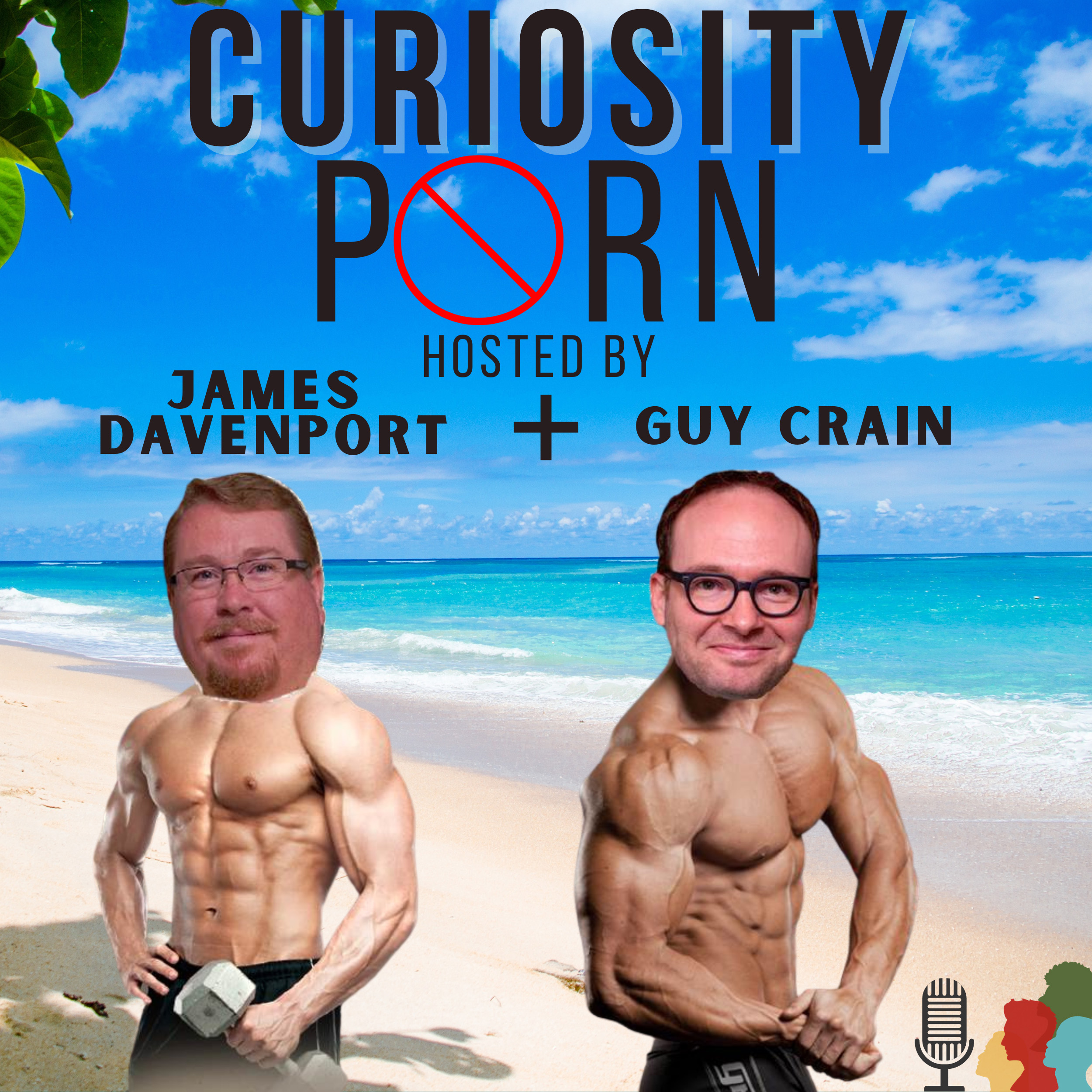
We also just have like a literacy and reading fluency crisis in the United States. 40% of Americans read it at sixth grade level or below. Do you get aroused by stimulating intellectual conversation? Are you turned on by the idea of engaging with thought leaders from across the United States? Do you go gaga over exploring important ideas from influential books, research, and essays? Then welcome to Curiosity porn, the place you can satisfy all those intellectual urges guilt-free. Your host are Dr. Guy Crane, Professor of Philosophy at Rose State College, and Professor James Davenport, Professor of Political Science at Rose State College. However, the views expressed here are solely the views of the hosts and their guests and do not reflect the views of Rose State College, its administration, faculty, or students. And now here are James and Guy. Sir, Dr. Crane, how are you today? Warm. Yes, you know, I will say, I got spoiled by all the rain in May and June. We have had it very sweet this summer. I have acknowledged that to the Hilt because I am in general allergic to the Oklahoma summer, but we've done very well. You, I said, sir, I was very tempted to say the future, Dr. Davenport, because I know how you've been spending your time. Getting closer, inching closer to having this dissertation put the bed, I've been doing more regression analysis than I ever really wanted to do, but it went okay. It's went all right. And we'll be, we'll be done. I committed, you know, they had this progress check that you have to do every so often. And this, the last one that I did had for the first time asked me a question that was not on the others. And it's like, will you be prepared to submit your dissertation by September 30th? And I was like, here goes nothing. Yes. You know, so I kind of committed to it now. We won't out anybody specifically, but I kind of want to know are your close loved ones finally willing to admit that you are in fact a scientist? No. No. Did you do regression analysis? Yeah. No, they're not there yet. I'm working on it. And we've been working together because of some, some, some challenges using different statistical programs for different jobs. I don't know how you get more sciencey than I'm working on regression analyses. Yeah. You would think, but no, they're not, they're not giving you the cred. Not at all. Right. If I was doing the math that produced, see, that's the neat thing with these statistical programs is they do all the hard work of producing the math to get the results. And then you just have to know how to properly interpret the results. You know, if I was doing the math to get the results, I might get some recognition. Okay. Yeah. Well, I'm whole not hope for you. I appreciate that. Maybe you can still insist that your loved ones call you doctor by the end of the year. Do you think I'm going to do that? Maybe. I know. I, you know, I, I think they're excited to do that actually. So yeah, I think I've got some folks that are like, they'll be really happy to be able to say, Dr. Davinford. The only person I insist call me doctor is my wife and it never works very well. Yeah. I don't insist, but I, I have told them that I, you know, for, for six months or so, don't need to call me. I feel you. I feel you. Hey, we've got a great guest today. We do. Let's talk about this first. This is a topic we've actually been interested in for a long time, but did not know how to put it together. And the fact we have solved that today. I think so. And you have actually taken a class. That is correct with him. And I took a training session, a two or three week training session and just loved it. Loved it and was kind of regretting the fact that I had a dissertation that I was working on and I didn't get to immerse myself as much into some of this as, as actually my daughter who also took as much more immersed in this now than I am. So why don't you introduce me? Oh, we've got. Yeah. Michael Hanigan is an adjunct professor of artificial intelligence and the future of learning and work at Rose State College and the University of Central Oklahoma. He is also the founder of the Center for the Future of Learning and Work, navigating the relationship of generative AI, learning, work and our shared life. Michael Hanigan, thank you for coming on. Thanks for having me. I'd be here. And just so our listeners know this is actually Michael Hanigan. This is not an AI generated. That is correct. That's true. He's much funnier. Well, let's start with this. We got some rapid fire questions for you. Just kind of introduce yourself a little bit more. How'd you get into academia? I'm nerd, so I love to learn. I'm also addicted, I think, to student loans is maybe part of what it might be. You know, I was raised in a way that just said, that really taught me to chase the truth wherever it took me and the problem is it just kept opening more questions. And I was like, what better way to answer those questions than to pay a lot of money and go into debt and read a lot of books? And so that's what I've done with my life. And so I'm glad for the time I spent in academia. It's not the only place I live, but I'm glad to be back in and around it, not just in the industry anymore. And it's a fun time to be in the classroom, I think. Yeah. What's one interesting thing you are currently reading, listening to or watching your pick? I'm reading a book called "Bacteria to AI" by In Catherine Hales. It's about human, non-human, and synthetic cognition. So it's about how like, and that human beings are never, they never operate entirely by themselves. We are creatures filled, our bodies are filled with creatures, right? We don't exist on our own. And we don't do cognition on our own either. And so it's to help think about how we fit in the larger world that is alive and thinking and then the way that we relate to AI. Nice. Okay. This next question we've adjusted, especially for you. We tend to, whatever the person's field is, ask that person who is the greatest insert field here of all time. You are teaching in AI. You've got a toe dipped in industry. You've also got a toe dipped in theology, if my memory serves me correctly. You've got a lot of plate spinning that sort of make up your various fields of expertise. So I wanted to allow you to choose the field who is the greatest blank of all time and answer it how you like. I'm going to say my current favorite philosopher of all time is Monipython. Okay. I do hope someday in my academic career to teach a philosophy of Monipython course. I would probably take that. I have a weird story about this. So the first time I saw Monipython in the Holy Grail was two days after 9/11. Wow. Okay. And so as a freshman in college, right, the whole world has just been up and dead, at least my world anyway. In the following days, immediately after 9/11, we heard a lot of prayers about war and vengeance and justice. Then I was introduced to the Holy Hand grenade of Antioch. Monipython in the search for the Holy Grail. And it broke my view of the world because there's the line, blow them into tiny bits in my mercy. For a 19 year old, that was a great way to ruin an entire world view in a satirical movie. So that I think is a great, a great place to start. I had that same experience with Team America, which I believe you still have not seen, have you? I don't think I have. That is the puppet movie that was kind of paradises, I mean, everyone gets made fun of in this movie. I'm going to have to, can I find that on Netflix? I almost guarantee that you can. All right. I would definitely not watch it with the children around. Well, my children are all adults, so they can handle it. All right. And if they can't, they can go in the other room. Okay. That's it. Yeah. Okay. Hey, what's one thing about the work that you do that you wish people understood better? Yeah. My work is not about AI. My work is about learning and work and how we build a world that we want. AI accelerates and complicates those questions, but the questions that I'm trying to ask are much older and probably much harder than just questions about artificial intelligence. I love that. I love that. Okay. What's one belief you hold that puts you at odds, either with your peers, colleagues or family? I'm in great odds with my kids right now because I believe that 1980s cartoons are vastly superior. Yes. You are 100% correct. Preach into the choir here. Yeah. We will not get any argument from me. All right. I don't think I'm guy either. No. Yeah. No, I mean, my son grew up in the Outs and early teens.
and I had to watch the stuff he was watching. And some of it was just really tough to sit through. He would watch Kaiju on PBS. And that little kid is a turd that was very hard to tolerate watching him watch Kaiju because I was just like, that kid is to go away. And he's the main character in this show. Yeah. Hey, we might actually get some feedback off of that now. But to Kaiju, fans, you could be calling an email and saying, hey, we'll see. We'll see. Yeah. What is your favorite 80s cartoon? What would be my favorite 80s cartoon? You know, I would, I don't know if it counts as an 80s cartoon, but I loved watching Scooby-Doo. I loved watching Scooby-Doo. I think that one over the last 70s to 80s. Yeah. I also watched the Justice League was a big fan of the Justice League. I kind of remember that. Yeah. Those are probably the two I remember the most and was big into. Yeah. I don't remember which was my favorite, but I was definitely watching like He-Man and Thundercats and stuff like that. I watched a little bit of He-Man. Not a lot, but a little bit. There were also Saturday Morning, do you remember this? There was a Saturday Morning cartoon of Dungeons and Dragons. Yes, I do remember that. And looking back on it, I am mind blown that that was acceptable because of all of the, all of the negative hype about Dungeons and Dragons at the time. Yeah. Interesting. There was another one out about that time. What was the, now as you were talking about Dungeons and Dragons, it hit me and now it just flittered away. It's the problem of having an aging brain. Yeah. It's all right. Let's get to the meat of things. We want to talk to you about all things AI, if we can. I mean, this is going to hit all areas of life, really. People are probably hearing about it more now than they did say 10 years ago, but it's not at all new. And it's not even new that it's a part of most people's daily life. So for folks who just haven't spent a lot of time thinking about this, can you tell us just first of all, what is AI and what are the ways that it probably pervades most of our waking hours? I mean, AI is a lot of things. I think it's a much larger question. We've been thinking about, or theorizing about these kinds of technologies for decades. What I think has happened now is we've got, we now have hardware to bring to life the things that we've always dreamed of. But traditional AI is really tied to what we would largely just call algorithms. These are part of our everyday life right now. The Netflix recommendation engine, when you finish a movie and it says, was this great? Do you want to watch this one? The way your car insurance premium gets calculated, the fraud protection on your debit card. There are a lot of our lives are shaped by this kind of technology. What's new is this generative AI. This is a totally different kind of technology. And really what this is, other forms of AI are working through huge data sets. But it's all kind of stable. It's looking at data and it's making decisions. Generative AI is a predictive technology. So it's looked at a massive amount of data and analyze all these patterns across language and all kinds of other material. And then when you use these tools, they try to provide kind of the most likely answer. They're predictive in this way. So it's not like it's going and getting an answer off the shelf and bringing it back to you, which is kind of our traditional experience of software. There's a stable answer somewhere and we use tools to get that for us like the internet. Like if there's a web page out there and it goes and gets it and brings it back to you. Generative AI is actually building stuff from scratch. Or at least it's new. It's novel in that way. I think the thing that's so disruptive about generative AI is it kind of breaks all the rules of how we experienced technology. We're used to technology being incremental and slow. So I remember getting my first cell phone. It feels longer. It's probably longer ago than I wanted to admit. But in the grand scheme of things, it wasn't that long ago. But the way in which those have moved, I've never kind of looked down at my cell phone and been like, how did we get here? It kind of made sense. It was this kind of gradual incremental. Or we think about this with like software. I always joke about people at my age. Do you remember the Windows 95, 2000 XP years where it was like this roller coaster of, is this going to be great? Is this going to be terrible? Right? But we always kind of, we knew it was coming and we knew we would kind of ride it out and it would be fine. This technology breaks all of those rules. So it breaks the rules of adoption. So like previous technologies, even really transformative ones, take a long time to kind of reach like mass adoption. Like refrigeration took 50 years to get 100 million people in the United States. Chadge-Beteet took 60 days. Or electrification took like a decade to be in like major cities. We've only really been using these tools publicly for the last what 30 months. Yeah, that's probably what we're going to do. And our cell phones, for example, we use 5G, right? This fifth generation technology. This is taking us decades to get to our fifth generation. Chadge-Beteet, which came out in November of 2022, was kind of a first generation model by September. We'll have the first of our fourth generation models. So it'd be like saying, you know, what we what we might traditionally do in other technologies in decades, we're doing in like iterations. That are getting and they're getting shorter. So it's not just that it's already fast, but it's fast and faster at the same time. The other piece is that you have these capability jumps. I don't even know what number iPhone I have anymore, but I don't remember like a wild jump between one and the next number. Maybe you held out for the upgrade a little bit and is a little bit more of a jump, right? You held out for three, three runs and then you made a pivot. But what we have now are these technologies where their capability jump is not incremental, but exponential. And that's really hard for us to kind of metabolize in our minds. Humans are really good at making sense of incremental change. This is why humans have kind of flourished as a species because we can kind of look back five years and extrapolate five years ahead. But if you asked someone to think back 100 what was life 100 years ago, it'd be hard for us to kind of explain. In the same way, it'd be hard to say what's life going to be 100 years from now. But the problem is with the pace of change that we're seeing with these technologies that thought experiment of 100 years might only be 10 away in reality. So there's just these these kind of the way that we've always kind of lived and moved with the evolution of technology, all of these rules are being broken in real time. And there's no there's no kind of precedent for us to look to and say, oh, this is how we how we ride that out. It seems to me that that the pace of change is what is so destabilizing for so many people, right? It's like you said, we're very used to and comfortable with incremental change, even if even if over a period of years or decades where it started and where it is, if that's dramatic change, if if it's incremental and it's approach, we're very comfortable with that. This this kind of rocket ship change in the span of a very short time frame makes a lot of people uncomfortable. Yeah, and I think it would it might be different if this was the only change we were experiencing, right? So think about like when you go to the ocean, right? When you stand on the beach and like the waves are kind of like at your feet, you can watch a wave coming and it's like not intimidating at all. Like you can pretty well eyeball like I'm going to get wet. I'm not going to get wet, right? What happens though is when a second wave intersects that wave, you have no idea what's about to happen. Well, the problem is we have like five or six of those all moving at the same time, right? And so it's that it's that that crossing of those waves of disruption. You know, you've got AI, you've got major kind of geopolitical changes, you've got kind of like economic turmoil, you've got kind of this like social friction that's taking place. And then just like the unpredictability of the world, like you know, we're not too far out of a pandemic, right? There's just a lot of it's so it's each of these would be complex. All of them together is both complex and unpredictable. And I think that's where a lot of the anxiety comes from. Well, tell us how you got into working and thinking about AI, working with it. What was your journey to get to that? Yeah, I got lucky. So I as a as a perpetual student, got bored and started doing a PhD in social science and then got bored being told what to do and what to read.
And so I started a company focused on future of work and future of expertise. Because one of the trajectories we were seeing even before the pandemic was that higher education is designed to instill expertise, but the world of work cares about competency, which is a much lower level of capability than expertise. It'd be like bringing Michael Jordan to the YMCA every day. Like it's too much in most applications in the world for it. And so I was interested in what kind of skilling, reskilling, upskilling we would need in a world where expertise was still valuable, but it wasn't needed in the same quantity as just competency. And so I thought I had a pretty good agenda outlined, and I thought I had the next 10, 15 years to work all this out. And then when ChagyPT drops, I realized I've got about six months to put these questions to bed. And now we have to talk about the future of learning and work. And so I've just been fortunate enough to, because I was in the right place at the right time, I've been kind of able to stay on front. Well, that leads us into learning more about your center, right? So you found a center for the future of learning and work. Tell us about that. How did that get started? What is your primary mission? What do you hope to accomplish with it? Yeah. So when you hear me engage my work, you'll hear me always talk about inseparably learning and work. And part of this is that since the industrial revolution, learning and work have been separate. So you go to school. For however long you're going to go, you know, my grandfather went to the sixth grade. My father got an undergraduate degree. I keep stacking up letters like it's a game, right? Like we all go to our different levels of education. And then you go to work and you make a back to school, but it's really only for the purpose of going back to work. And the result of this kind of split over a long time, right? The, you know, over over a century, more than a century, is that the world of learning has become increasingly disconnected from the world of work, right? So you sit in class and you say, how am I ever going to use this? Why does this matter? Right? This didn't help me. And in the world of work, you've lost almost all of your capacity for learning. So that, that infrastructure, that skill has atrophied in the world of work. So these two realities that learning is disconnected from work and work can't really do any learning, create a real problem when you're on the brink of the largest upskilling and reskilling in human history. So the center is designed to find and curate and highlight work that is about the renegotiation of learning and work. So there's lots of people working and learning. There's lots of people working and work. There are very few people who are trying to actually connect those conversations. And I think that's going to be the fastest way for us to try and ride the wave of what's coming. I think, and I've had conversations with folks about this before. I think that separation while you are correct, that's how we've approached it. It's not a, it's not how things actually work. I go to work and there's a lot of stuff I'm going to learn there, but we don't categorize that as learning on the job training or I figure out that doing this this way isn't effective as doing it that way. And I test it out and I figure out tweak it and all of a sudden I've produced a new process or a new product. So there's there actually is a lot of learning that occurs, but it doesn't get categorized at that. And I think oftentimes that type of learning is depreciated or less appreciated than the learning that goes on in a traditional classroom. Is that true? I think that's true in white color work. But the average American gets about 50 hours of professional development a year. And most of that is complete this compliance webinar. Click through this survey and a poster in the break room that says do better try harder. Don't mess up. Right. That it's not it's not meaningful learning. It's certainly not learning that is trying to like reimagine the way in which you do work. Yeah, you might tinker. You might iterate, but it's not substantive. This is also part of a larger trend where just like Americans just don't read. Like we have this this deep problem where both attention and interest have changed. Part of it is what we read has changed right where definitely we a culture has moved more towards like short form and informational text versus like sitting down reading a whole book. But the other piece is that and I think this is one of the one of the kind of the nagging questions in the back of my mind at learning and work is that we also just have like a literacy and reading fluency crisis in the United States. Like 40% of Americans read it at sixth grade level or below. Which means that the back of the ad bill bottle is complicated. There's only so much you can do with that level of proficiency. So even if you had on the job training, even if you had opportunities for learning, we as a society have not done a good job of giving everyone the tools they need to engage in self directed learning. Well, yeah, a theme in your work is that you tend to be optimistic about the effects of AI in various areas of our life, which might put you against the grain for some folks who have let I sort of intuitions about these things. Tell us, why should we think about this as generally a good thing? I think a couple of reasons. One, this is the first technology that will enable us to unlock at scale the wisdom and learning of the human family. So traditionally, education has been rare, slow and expensive. Now with these technologies as they improve, learning becomes more accessible. It becomes faster and it becomes almost free. Will we have to do some heavy lifting to make that useful? Yes, we will. But I think one of the experiences I think about this in my family, when my wife was in graduate school, she went and took a course, a philosophy and ethics course at a prison, at a women's prison. And you know, she's a she's in a graduate school in a very prestigious program. Her professor is very prestigious. And these women were running laps around everyone. The gap was not in intelligence and in curiosity. It was in access and opportunity. And I think that's true in a lot of spaces. So these technologies really have the power to unlock learning and insight for people who are curious and who are driven. Even if they haven't traditionally been able to participate in kind of the formative educational spaces that America has made prohibitively difficult for no good reason, other than it's good for some people that make a lot of money in that system. Let me, we're going to get to this a little bit later in there, but it just prompted me. So I know some people who would push back on this notion that it's going to be good for accelerating learning and whatnot. And most of that comes in the form of, well, if we have a reading crisis now, and what I notice is not just a, a literature, but a reading comprehension problem as well. A.I. is just going to make that worse because they're just plugging in their assignments and having them produce answers and they're not even looking at it. And it's just going to make it worse. So why do you not think it will make it worse? Or do you think there might be a period where it gets worse and then it gets better? What? I think, I don't think it's an either or I think everyone is invited to choose their own adventure. This is why I tell my students, hey, I'm going to show you how to use these technologies in my courses. This is my undergraduate and my graduate students, right? So that 19-year-old kid that faculty member who's popping in, the MBA student, you know, who's, you know, maybe pivoting into another career or looking for a promotion, like they're all over the map. I'll say, look, I'm going to show you how to use these tools. You can use them to mail it in. Absolutely. And it will look good. If you're not to use these, I could produce chapter one of a dissertation in any field and pass as long as you don't ask me about it. But the written artifact with with appropriate citations and good ins, yes, I can produce that for you in a matter of days at scale. That's not learning, right? Part of this is that we have to rethink the way we think about pedagogy and design in the first place. But it's not going to be, is it good for everybody? Is it bad for everybody? It's going to be
be can we be clear about the opportunity that sits in front of our students and can we create cultures of learning instead of cultures of suspicion and surveillance that make people want to actually engage in the opportunity that's sitting before them. And so part of the way I talk about this is to say, I try to practice what I call a pedagogy of transparency, which is to say, I will not ask my learners to do anything that I will not explain why they should and why it is good for them. And in the same breath, I will also explain to them the consequences of doing it in a different way. So I'll say, hey, I'm trying to teach you this skill. You don't have to learn this skill in this class. But I don't want the next time you think about me outside of this class to be two years from now at work. And you could ask to do this thing I'm trying to teach you to do and you feel like an idiot. I'd rather you never think of me again. And that moment two years from now be great. So even if you're not excited about it, even if you don't think it's particularly useful, I hope that you will invest in the future version of yourself and take this moment. And what control do I have after that pet park? None. And that's okay. Well, from your perspective, what are some of the most exciting things that are happening in AI that people aren't really talking about yet? Yeah, we're definitely not talking enough about what we're doing in science and medicine. So like the 2024 Nobel Prize in chemistry went to two people from Google DeepMind for their Alpha Fold project, which is protein modeling, which is important for drug discovery. So we've been working on protein modeling with computers since the 70s. You used to be able to leave your dial up internet computer on the phone overnight and donate compute, you know, donate computation to try and solve this problem. Between the 70s and the early 2020s, we had completed modeling 1% of known proteins. Each protein requiring four to five years of PhD level work. So typically a student would spend their entire PhD modeling a single protein. Alpha Fold 2, which there's now Alpha Fold 3, Alpha Fold 2 has modeled them all in a year. That is 1 billion, billion with a B, 1 billion years of PhD level science. That is available for free to the entire world. Between 1.3 and 1.7 million scientists use it every day to work on drug discovery, life-saving medicine and innovation. Or there's a piece in the New York Times that I really love from a few months ago. It opens with this story of a man who has a blood disorder and the only way to treat this is through bone marrow transplant. But he's too sick to have the transplant. And the hospital just says, we're so sorry. I think we can set a posthus. And his girlfriend reaches out to a doctor who's using generative AI, who she met at our rare disease summit. And he says, "Call me in the morning." So he and his team at a research space were using AI to look at all off-label uses of medicine at a scale that no human could ever do. So he called the next morning and said, "This chemo, these steroids and this other thing, no one would ever put this together but trust me." And so they did. And four months later he was healthy enough for his bone marrow transplant. That's something that humans cannot do. You cannot hold that amount of information in a usable way within your brain. You can't even really hold it together in a usable reference library or something. It would be impossible. Even if I have it organized, my ability to move through it is constrained by just the sheer speed and fatigue of my physical body. I think we're going to see huge developments in science and engineering and in medicine. Those are the places where it's going to be most obvious but there are lots of other places that I think are really cool. I kind of want to dwell here a little bit if we can. I mean, I've been only a tiny bit exposed to kind of the fun and exciting things that you can do with AI programs. I just learned, I think two and a three weeks ago, that you can get Chatship to turn one of your photos into a coloring book page for children. Was that a wedding brunch? And the couple had used their engagement photos to make coloring pages for the children who are at the brunch. It was a brilliant idea. But I mean, okay, yeah, for the sake of anybody of our listeners who don't know, I actually enrolled in the class that you teach at our institution and you showed us notebook L. M. That was one of the more fun ones that I enjoyed playing with. I mean, we were just uploading papers and then within a few minutes, it could generate a podcast with two completely non-existent actual hosts who are then bantering and even kind of joking with each other about the content of the stuff you upload. When I was doing some work for your class, one of the coolest things I found out was the merging of AI into brain computer interfaces, especially for people who have various forms of disability. There was one that was enabling people who were physically incapable of talking. They were able to literally have a conversation through this AI program because it was hooked up to their neurology somehow. I don't understand that part of it. And then it had a camera on them and it was using their famed muscle movements in their face to predict what they were trying to say. And it was uncannily accurate at getting at what they were trying to say. And so now these people can literally converse. Whereas like the old machines were just like tracking their eye attention, looking at an alphabet as they spelled everything else that they wanted to say out letter by letter. Yeah, I'm typing with one finger. Yeah. All these are so great. I'm just I'm curious to know other programs that you think really are fun and exciting that people, the average person should know about these. I mean, my favorite go to right now is notebook at them in part because the ability to gather a series of texts of all kinds of modalities, right? Like a video podcast, you know, audio, text, all these things. And then to be able to both understand what's going on. And then my favorite feature in the notebook is the kind of like the ability to kind of call into the show and ask a question in real time. Right. So you can generate the podcast. That's great. But then you can like dial in and be like, Hey, what about and you can ask something that's not already in the show? So you showed us that in the training seminar that I was in. I was just blown away that right in the middle of it is, you know, that's a really good question. And it was so smooth and how it reacted to your interaction with it. Yeah. One of my favorite uses of this is I have a notebook with all of my stuff in it because it's like, how many things have I written over the last 20 years? And it's like, I wouldn't remember that I even wrote that or I can remember I vaguely wrote it, but I don't know. And so I just have a giant notebook where I'll just say, Hey, can you remind me like where I talked about this and like just and just kind of and like the ability for me to find the needle in a haystack is just so magical. Right. That's something that I could do if I had half a day to go sort through kind of manually, but like the exponential like impact of that time savings to go say this, this would have taken me four hours and now it took me 45 seconds. That compounded over time is massive, right? Or like I think one of the most exciting things about AI and learning and thinking right now is the way in which expertise just gets turned like to up a thousand. Like yesterday Google released a paper about a tool that they've been using with ancient inscriptions. And so it can look at a quantity of inscriptions that like over your career, you'll never look at this many inscriptions, right? But when you pull up a particular inscription, it will enable you to make associations to inscriptions that you don't even know exist. Right. And so they were showing how they had done years of historical work in, you know, very little time. And the answer was not like, Oh, we don't need historians anymore. It was like, imagine what you can accomplish now as a historian. Imagine the amount and the depth and the breadth of inquiry you can have. My favorite example of this is a engineer at NASA who took a paper from his dissertation on black holes, just a methods paper. So it didn't have any code in it. It was just like how he went about his dissertation. It was like a chapter one kind of a paper. And he gave it to an AI tool and after seven or eight prompts, it produced the same result. And he's like, that took me two years. And you can see him kind of like processing in a minute for the moment. And instead of being like, I wasted two years, he was like, what questions can
I guess now. And I think that's really where it gets exciting. It's like the, we have our curiosity and our ability to learn have been constrained by the limitations of being finite creatures. And now all of a sudden we have technology that breaks those limitations. And for the first time we have technology that is on the brink of actually creating knowledge itself. You know, everything else has just helped us do what we traditionally do maybe in more efficient ways. This is this is the first. And you know, I think that's a that's an exciting thing. Well, let's shift and talk a little bit more about AI's role in education. And I will tell you I've had lots of conversations with lots of colleagues. And I would say most of the folks that I've talked to fall into two or three different categories. You've got about half of them are like AI is just the next way for everybody to cheat. And we're never going to be able to figure out how to stop it. And it's going to ruin education and the and the only answer that they can come up with well, I'm going back and only handwritten tests and only, you know, no computers and all of this. So you got about that half. You got maybe a quarter 2020 25% that are like, we are going to start integrating this into how we teach. We're going to try to help students even though that my field might not be AI or a STEM field. I still need my students are going to need to know how to use this regardless of what career trajectory they go on. I'm going to find a way to integrate it. So you've got some of those and then you have the rest that are kind of they just don't know they don't know they're either they're overwhelmed. Maybe they don't understand it. They're frightened of it. They're concerned about cheating and academic fraud. So it get all of these folks. And then of course you have another fear among faculty, especially is that we don't need you. We can have an AI manage all of these courses and save a bunch of money. So let's talk about some of that. Yeah, here's here's what I would say first to the everybody's going to cheat. What you have is not an academic integrity or an academic misconduct problem. What you have is a pedagogy and design problem. So most academic misconduct and I think this has always been true. Most academic misconduct can be mitigated by good pedagogy and design. So the way in which you structure your learning the way you ask them to produce their learning the way in which you engage them as human beings not as customers right like the way the the environment that you create is the primary way that you navigate that if you find that the the indiscriminate use of these technologies is prolific in your courses. My first question is not about your students. It's about your content and about your design. We see this in some interesting studies that have started to emerge where they're interviewing actual students and the long story short is the line of where students feel like the ethical line is is moving. In part because there's already this crisis of whether or not like education is worth or return on investment even in high school right people are like this this doesn't help me it as a matter like I don't care like if you have teenagers you only have this conversation like three days a week right but in and in higher ed it's even worse because now it's expensive right and long story short the line has moved to if I feel like you've given me a bullshit assignment I'll give you a bullshit submission and that's and that's morally right that's the interesting piece is that while the institution and the fact I remember may say this is wrong the student won't blink because they see kind of what has been given to them the result of the pedagogy and design as kind of a betrayal of the institution and the fact I remember responsibility to actually give them something meaningful. For the people who just have no idea I hope that they'll pay attention I mean I don't have I don't have any like gentle you've got time words for them it's just like you know get on or get left behind and for the people who are really excited about these tools I would say the primary way to garner value from these tools is not to just pour them over everything like like putting more ranch on something makes it taste better right quantity does not enhance quality necessarily but to say what kind of skills are we trying to build what kind of humans are we trying to form and then and only then would this technology help sometimes it doesn't I mean you know this I I've made some of my students hand to annotate their text with a pen and you're like this is stupid I was like it I understand it feels stupid but like if you want to put something in your brain the pen is literally the greatest technology in the universe if you want to put something in your computer like go for it like but you won't hold it in the same way um so I think you know part of part of what we're going to have to sort out this is a higher ed is a great example of those multiple waves intersecting at the same time we've got generational turnover and administration and faculty we've got huge technological change we've got huge economic upheaval about is is this even worth it anymore um is a four year degree really what I want to do there's a great piece called the micro credential generation about how students are using micro credentials as a way to test the water of formal education if this is useful maybe I'll consider more it's kind of a cautious sampling that what we're really going to have to figure out is um and this is why my work is about learning and work education is freaking out about generative AI and the world of work says we know exactly what we need and so education talks to itself and it becomes this like this this ever increasing anxiety spiral of oh my god this is the end of learning as we know it which by the way we've said about every major technological innovation I think this was upset about being able to write socrates yeah well he put that in the mouth of socrates that like yeah writing was going to ruin us yeah but we wrote it down so it worked out right like you know we were worried about the printing press we were worried about the internet we were you know and have these things uh sometimes made learning worse yeah anybody ever read a bad book yes anybody ever seen something on the internet that wasn't true sure like technology is neither uh all positive or all negative for learning but it but it changes us you know humans are a species where we we shape our tools and our tools shape us um and each time a new tool comes we always panic about how it will shape us what I hope what I hope to be a small part of is to say instead of panicking about what this will do what if we invested our energy in saying uh this is what we will allow this is what we demand right so instead of saying uh oh no how how will how will I react to say this is what I will do I think the future of learning is bright I think this is the golden age of human learning that we're about to walk into uh I think in I think in three years uh any information that is digitized will be able to talk to each other I have questions that can only be solved at a scale that is not human and I can't wait to ask those questions um and so that's why I find myself in a way too many classrooms to stretch them but love and everyone at all I'd like to at least explore um some of the concerns and perhaps risks I mean I know we've already gotten uh fairly good information about the AI related risks associated with things like bias or privacy um there's already lots of social science even about that like if you give uh an AI uh training data set that has you know represents some of the social inequalities that we already deal with in the real world that AI will just spit those back out at you um privacy is another concern uh I think it was Forbes a while back ran an article about target being able to predict whether its shoppers were pregnant down to the trimester whereas like if if they just had four or five data points of your shopping habits they could kind of within about like 87% accuracy guess which trimester and that's like a nightmare to think like some of those people might not have told other people about where they are in their pregnancy journey uh what do you think about these issues uh bias privacy what what sort of concern should we have about these yeah I mean these these are all things that we have to work out in real time right like um AI is not AI is different than us but it is a reflection of us right it is trained on us
And so we shouldn't be shocked when it looks and sounds like us in all of our mess and complexity and bias. And I think we've made huge strides already in so many of these spaces, but there's always more to do. I think to this is where the wave of generative AI and the wave of big data collide, right? I don't know that target couldn't do that before generative AI was unseen. They might have been able to, right? Like the challenge here is that we live in a world where data and privacy and bias are just a part of the essential infrastructure of navigating the world. And so yeah, we have to work on technical solutions. Yeah, we have to work on kind of the social and legal boundaries that we set up. I think the harder work actually is working on the people. I think it's probably easier to solve technically for bias in an AI system than it is to help people understand how biases work within themselves. And you have to do both, right? So this is like one of them. This is like one of the mistakes we're learning about social media is like. Filtering content does not necessarily make you a better person. Like narrowing into a silo does not necessarily make it better. There's a book that keeps me up at night about this called the structure of ideas. And it's about how this myth of the marketplace of ideas is just it's never been real. But now with technology, we went from some semblance of a public square, which maybe maybe wasn't always that great. In the first place to now being almost impossible. With social media and like traditional kind of AI algorithms, right? That you know rage rage and fear a kind of fuel these machines. But now with generative AI in the picture, we actually have the ability not to create a small silo of a group of like-minded people. But we could actually create a silo of one. Because now we have technology that can actually not just serve you the material that exists, but produce it. And so how will we design our life so that the fracturing that is already a part of our society doesn't become exponential? Those are real questions that we have to sort of. Yeah, and on that exact note, I wanted to ask you about this. I don't know if you've ever heard the term aliza effect before or not. It's been around my understanding since like the 60s or 70s actually with very rudimentary programs by today standards. The idea is that people can't have a tendency to view those sorts of programs in very human ways to attribute to them to anthropomorphize them to attribute to them like, oh, no, this thing really is talking to me. And this is really, there's got to be something on the other side of this. It's not just ones and zeros behind all of that. I think it was rolling stone recently ran an article about folks who get into sort of like obsessive relationships, even with some of these chat bots and not just like romantic relationships with the ideas like some of them are designed to be very complimentary and borderline of sequoias and that people deliberate like start to develop very grandiose notions of themselves by interacting with these various technologies and like, oh, chat GBT is made me realize that I've been chosen for a special spiritual mission. I mean, some of the anecdotes in the article are pretty crazy, but I mean, there's perhaps milder things too like there's this program replica that is designed with the express intent of being a companion to you. What do you think about these concerns? Yeah, these are complicated. I think one of the these are questions that are not new about how we leverage technology to meet our needs when our human needs are not met. I think feminist ethics of care does a wonderful job raising some of these kinds of questions. What we see right now is that like one of the primary uses of these generative AI tools is for kind of advice and kind of like not necessarily in a therapeutic way, but just like in a can you can you help me think through X Y and Z. I have a friend who has been using this technology to breathe the loss of a child. And they've been sharing some of their conversations and they've been demonstrably helpful. We see increasingly a bunch of research about how like some people if they don't know if they're engaging with a tool or a therapist, they find actually the tool is more effective. But the common thread between those kinds of experiments and these kind of anecdotal stories is that you have humans in need and a society that is not structured to meet those needs. Right, so you have this kind of what feminist ethics of care calls precarity, which is like human life is precarious like we can be in a car accident like you know life is fragile right precariousness is the state of every human being precarity is a social a social reality that makes life precarious that doesn't have to be. It is that way because we choose for it to be that way or we choose to maintain it. The places where I think you see the most troubling applications of these tools are precisely in those places of precarity. It's where people don't have someone to lean on that they turn to a to a chat box or its places where there maybe don't have the social support and maybe even the healthcare that they need or the access to the kind of healthcare they need. So I think in one sense these these kind of bizarre or problematic uses simply kind of highlight the ways in which we have failed each other. And that those are those so it's not necessarily just a technical question about like well should we you know should you have to be 18 to talk to a chatbot right or whatever that might be. Should a chatbot have to disclose that it's not a person on the other side on a regular basis. Yeah, those are technical questions but if we solve those questions without the underlying kind of social questions we're just going to find new ways to make things difficult for ourselves. What is one question about AI you wish people would ask but they rarely or never did. I don't know it's that it's about AI directly. I wish people would ask if there was something in the world that I could dedicate my full effort and attention to fixing what would it be. And then help them recognize the ways in which these kinds of technologies can be leveraged in pursuit of that question. Interesting interesting. Yeah, I think there are some people who have trouble thinking of AI as a tool right it's a piece of technology it's something to help us improve the way we do things. I think I just think the nomenclature is it lends to people thinking it's actually doing something that is equivalent to them. I don't have to do any work it's just going to do all the work right. That seems a little problematic to me but again I'm I'm like you I'm much more optimistic about about this stuff than a lot of people that I talk to. It's going to be a while right like I think you know when when electrification came the job loss or the job churn right between jobs destroyed and jobs created like you weren't a lamplight or anymore but you could like install street lights right like was like between eight and 10%. Our best guess right now is that in the next five years it will be 20. Which is that's a lot. And that's not in 50 years that's in five. Right. And we're six months into the first year of that five six or seven months. So I don't think it's going to be all smooth. I think there are real real serious questions that we have to ask and try to answer. One of the questions that I hope will be able to think about humans there will always be human work for humans to do. What may come and what I what I'm optimistic will come is a world where humans work not because they must do so to receive enough compensation to survive. But because they choose. There are a lot of things that we do now that the people a hundred years ago will look like play but we think of them as work.
What do you mean you sit in right words all day? Why are you not out in the field? Why are you, well because we have this giant machine that does that. Right? Like, you know, the jobs of the future always look unimaginable to people at a different time. And I hope is that the work we do going forward will be work. We want to be a part of. Then work we must choose to survive. I think a lot of things that we do right now, we will not have to do in the future. But it will depend on the kind of society that we're willing to build. That next iteration will look like, but I don't think it will look like this one. I want to come back just touch on one thing. We are running out of time, but I want to touch on something that you said in the training seminar. It was probably the one thing that I was like, I'm just not sure he's right on this, right? Which was, and it was about how in academia, it has been always been about credentialing, right? What's the, what are the letters behind your name? And in the workplace, there's some of that as well, but it's not to the, and your argument was because the cost of gaining knowledge, because the cost of being able to, what AI is going to bring is just going to reduce the cost of obtaining knowledge and then being able to make use of that knowledge that that type of credentialing was going to disappear in some way, shape, or form, right? And I'm just think, I still am struggling with that because it seems to me like we're always going to want a shorthand way of separating ourselves from everybody else. And credentials are a really effective shorthand way of saying, I have this body of knowledge or I have this group of skills or the combination of the two, whereas, and without those, it's going to be harder for individuals to distinguish themselves from, from everybody else. I think that's true to an extent that credentials are a social signal, but I think the economy demonstrates that credentials are not a concrete demonstration of skill. So like, for example, a lot of jobs today that require a degree to apply are currently held by people who do not have a degree, what changed, not the need for a degree, but the need for a signal, right? Or 25% of last year's Harvard MBA class has not found a job. They have the credential of credentials, right? Why is this happening? Well, because these credentials function primarily as a signal, not necessarily as a demonstration or something. So I think what the future of academia is, I'm hopeful. We can try and fight and say what we have and it will burn down ruthlessly after a while. If we really want to push forward, I think the future of academia is about creating people who can learn, not who have successfully necessarily finished a particular course of studying. I think the future of learning is much more generalist than specialist because the assemblies of capacities you will need in the future are much more agile and unpredictable than what they were at a different time. Where you niche down, I did this one thing, right? I think if higher ed will pivot, if higher ed will think meaningfully about the formation of its people, not just its learners, but of all of its people, of building skills for actual learning and then getting away from just focusing on expertise, I think the future of higher ed could be fantastic. It's a wide open question whether or not there's appetite to make this. That's going to be one of those challenging pivot tried. I think you'll have some who are pushing forward and some who are very much pushing against who want to keep what they have. I don't think in 10 years they'll be able to keep it. I think it's sand running through their hands. Based on everything you're saying, I could see something like the need and even demand for some sort of credential that signals like metiliteracy. We have to develop a program where what we can literally say is we have helped these people specialize in their ability to learn new things. Well, and I think essentially jobs in the future will largely say, these are the people we need. If you already have them, like great, come on board. If you can demonstrate that you're going to acquire them, rapidly great, come on board. I think as learning and work begin to blur again, if we get that right, where World of Work has the ability to actually train and skill and up skill and reskill, that will just say who are the people who can pick up quickly. We'll see what happens. We are way up against our time, but we cannot sign off without. No, we got to be most important question that we ask any guest at all. I have had, I think the last two opportunities. Do you want to go this time? I can, sure. Here's the scenario. We're going home after this podcast and sitting down and relaxing, but you've only got two options. You're going to watch something on television, but you've only got two options. Option number one, you can watch an episode of 30 Rock or option number two, you can watch an episode of Seinfeld, which of those are you going with? I'm going with Seinfeld. There we go. But I'm, I tell you what, the distance between the two just continues to grow. I'm just going to say, I think at the end of the day, my brain feels like Kramer. Most of the time. I would argue that Elizabeth Loftus choosing 30 Rock should count for like two or three votes for 30 Rock. That was a big get for me. All right. I don't know what to say to that. It just said, when you're losing, you're always trying to find ways of rigging the game. So you're not losing anymore. I am, I'm white knuckleing my show. I'm not giving up 30 Rock. All right. I want my 20 second watch through right now, in fact. He's going to have to head into the pre-screen list for future guests. Probably so. Probably so. Yeah. Well, Michael, thank you again for visiting with us. This has been a fascinating conversation. It's an area that I think both of us are very much interested in and exploring and learning about both ourselves, how we can use AI. But in the larger scheme of things, how it's going to transform the world around us. And especially our world, which is the academic world. And like you, I'm very optimistic about the opportunities that are out there. So thank you again. Yes. Thank you so much. And we will talk to everyone next time. Bye, everybody. Thanks for listening to Curiosity porn with the two best intellectual pole dancers in the United States. Dr. Guy Crane and Professor James Davenport. If you'd like to share a comment about today's episode, suggest a gastro-topic or just leave a complimentary complaint, you can reach us at
[email protected]. We hope to hear from you.
 PodcastTranscript AI