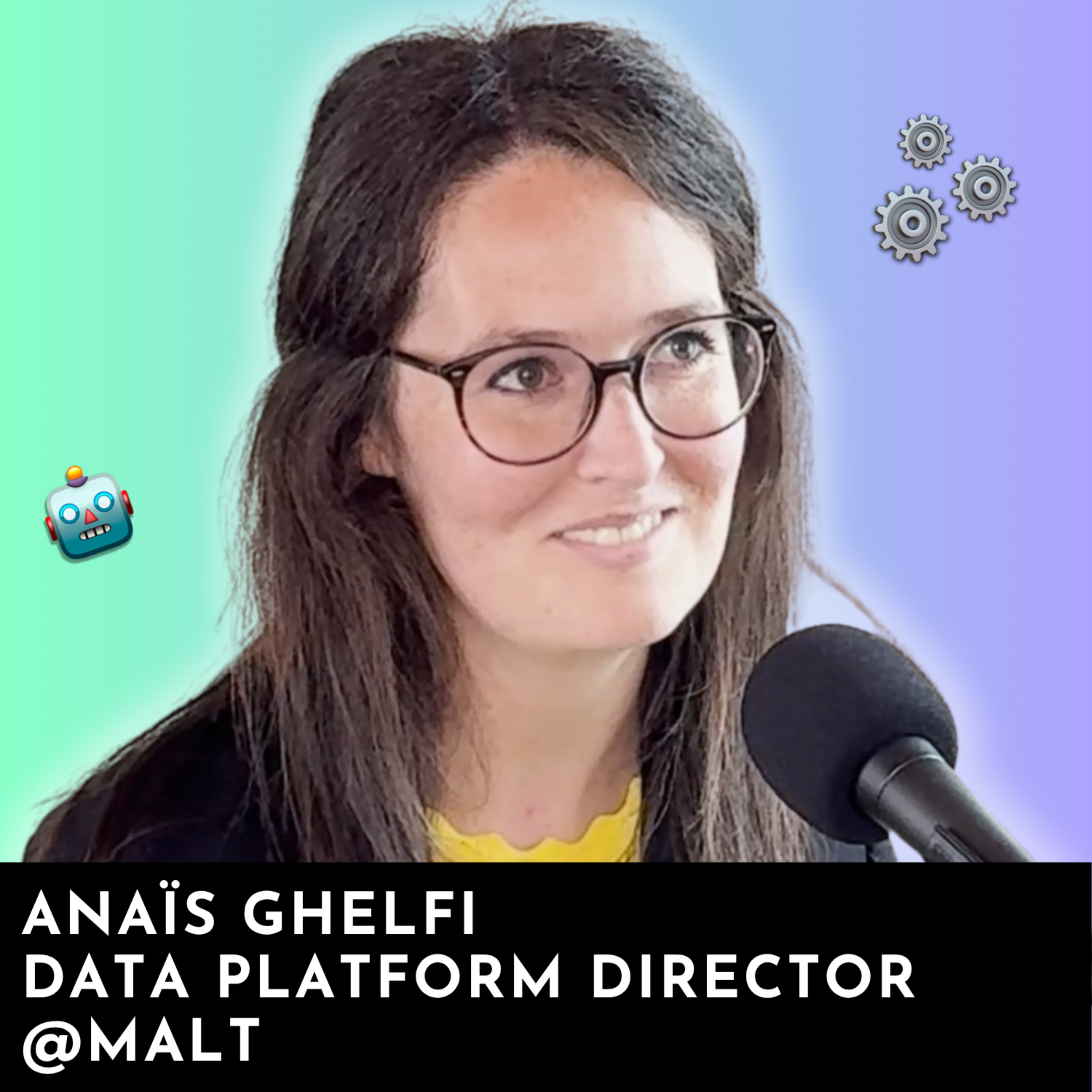
#234 - Malt : Déployer des assistants IA à l’échelle
29m 44s
Anais, the Data Platform Director at Malte, discusses their initiatives to deploy AI assistants at scale. They have invested in IA Vertical, using tools like DUST and DENODO to accelerate data projects and IA. Initiatives include launching a community for organic adoption, deploying AI in tools like Salesforce and Looker for operational efficiency, and implementing a no-code-low-code approach with N8N for automation at levels 2 and 3. Anais emphasizes the importance of collaboration between tech and data teams, leveraging early adopters and champions to drive adoption, and focusing on training and community building to ensure successful deployment of AI assistants across various teams at Malte.
Transcription
6438 Words, 34825 Characters
Today, I'm meeting Anaïs, who is Data Platform Director at Malte,
the leader of Freelancing in Europe,
who deals with freelancing with companies.
The Skylope is part of an ex-forty,
which refers to the 40 most promising Skylopes in the French ecosystem.
Anaïs will talk to us about the three initiatives
that were key in Malte
to deploy some IA assistants on a scale.
Hello Anaïs, how are you?
Hi Robin, how are you?
I'm fine, great, I'm happy to meet you on the podcast for the second time.
Do you know DENODO?
It's the virtualization solution
already used by a third of the K40,
including the BNP, Total Energy or Credit Agricultural.
I received Olivier, their general manager,
who came to explain what virtualization was.
It's a technology that allows you to accelerate
the time-to-market of these data projects and IA.
In fact, it allows you to federate several data sources
in one data request,
and so we don't need to centralize all these data
to launch projects.
It's the 230 episode, I'll put it in the description.
They have also written a manifesto
that details how this technology allows you to accelerate
these IA project projects.
I'll put it in the description as well.
A huge thank you to DENODO for sponsoring DataGen.
Do you want to explain to us
what was the context before you went to the scale
on the deployment of IA assistants?
The last time we talked about it,
you put in place your first assistants
by using, in particular, DUST.
Do you remember?
What happened then?
There were a lot of things.
First, we divided the approach into two.
A generic approach that will be
deployed by Gemini for all the employees,
especially the tasks,
a little like ChatGPT,
but secured by Malt.
Or you don't necessarily need a job context.
So we've already done that.
And then we massively invested in IA Vertical,
with DUST in particular.
And since we talked about it,
we have 40 builders at Malt.
So it's people in the job teams
who build their IA assistants
and who are trained to do it.
And today, we have about 80 production assistants.
So what does that mean?
In fact, we put in place
quite different deployment processes.
You have the level 1,
which will be the conversational assistant in Slack.
So it will be specialized on, for example, the product.
You ask a question, it gives an answer.
So that's really the level 1.
Then we invested a lot last year
on level 2 and 3.
Level 2 is how you detect your assistant
in a workflow.
So it's a business process.
So it will start from a new input into a system,
you sequence simple tasks,
you call an assistant and you send the answer
in another system.
It can be Salesforce, Notion, etc.
Level 2 and level 3, you're really on the scale.
It's a little bit of a very complicated decision tree,
very sophisticated.
Where you go, you sequence complex tasks
with several assistants.
And that's, for example, the case of customer support,
where, in fact, when you receive a ticket
to offer an answer,
you have to go in many different branches,
understand the context,
recover the data to provide an answer.
And so we have these three levels.
And today, we have a roadmap of deployment
not a vertical job for the merchants,
the marketing, the product, the tech, etc.
Where we're really going to define what are the use cases
of assistant, workflow and agent
that we're going to deploy to have the heroine.
Knowing that the heroine, we really see it
on everything that's going to be workflow and agent.
And that's really where we invest
since we talked about it.
So there's a first initiative that we talked about
when we called ourselves.
There were keys to just succeed
the adoption of these assistants on the scale.
It was the fact of launching a community.
There, like that, I tend to think
that it must have been particularly key
on level 2 assistants.
But you're going to tell me if it's maybe the case too,
rather for agents and level 3 projects.
Can you tell us a little more already
globally about the launch of this community?
To tell you the story again,
the first assistant we launched about 18 months ago
was on everything that is product knowledge,
so in a bag.
And we had a very organic adoption
in the bottom-up that we hadn't necessarily anticipated.
We hadn't necessarily put the good level of communication,
but we saw that there was really something.
And in fact, this adoption, it did a lot of things.
It's all the curious ones in the teams.
Marketing, sales, products.
They came to see us in the center by telling us
"I'm going to be the assistant for my team, how am I going to do it?"
And in fact, the community, we launched it
with all these very curious people in the teams.
So we made a Slack channel,
we informed them about Dust,
we gave them the keys to really interact with them
on the deployment of the assistants.
So it started like that, really very, very organic.
It allowed us to accelerate the adoption globally
because in fact, I imagine that someone from Marketing
who makes his assistant,
he will have a scope of influence of all marketing teams.
So in fact, you will really have an organic growth
that will be born through these people.
And that's about a year of the path.
And in fact, we realized that after a year,
we were planning on adoption.
That is to say, we were supposed to be at about 55%
of the employees used by Multi-I,
which is our platform to say on the internet.
And we asked ourselves the question
of how do you go on the scale, how do you go further?
And at that moment, we made a maturity assessment by the team
by looking at all the teams,
how many builder jets,
how many assistants, workflow and production agents,
and we realized the heterogeneity of the Paris maturity.
So there we were at the Commix, we presented that
and we said to them, to attract people and to evangelize them,
well, you have to go do training.
And that's when we shifted the approach by saying,
OK, the bottom-up now has worked well,
now we go to the top-down.
And we set up this program starting in April.
It's training that we do on the internet
with groups of 15 people in the presence of 2 hours and a half.
And in fact, we explain to you what the tools are
and we make you create your assistant.
So it's very specialized by VerticalMétis,
of which we will then create prospective assistants,
the marketing of content.
So it's a first basic assistant.
For example, it's going to be on Deust,
working on a prompt to get an automatic response.
It's for assistant level 2 to stay on the framework
that you were talking about at the beginning or not yet.
- No, it's level 1. - It's level 1 again.
- Yes, it's level 1. - Yes, it's level 1.
I ask you a question, I call an assistant,
I have an answer, you're not yet in a workflow
with a transfer of a system to another, etc.
- No, in fact, you're really on level 1
and you use either Gemini and GemManager in Gemini.
We're going to rather push that on the very personal assistants
that you do.
And Deust, it's going to be especially the assistants
that you're going to deploy on the scale of your team or Malt.
So in fact, to go to level 3
and reach maturity in an apartment,
that level 1, you really have to practice it.
And that's why we invest in really spending time with people.
And what we observe is that after these training,
in fact, we almost all converted.
And that people were still very reticent,
a lot of people who are reticent, who didn't use them,
who don't know how to create their own assistants.
And in fact, the fact of doing this workshop, of spending time,
you converted them and you reassured them too.
It brings proximity.
And it really affects adoption because in fact,
today, we are in September 2025
and we are at about 80% of the employees
who use MaltiAI directly or indirectly.
And on Gemini, in Google Workspace, we are at more than 80%.
So in fact, we are doing a huge gap
over the last 4-5 months with this effort in top-down.
We are talking about how many workshops in 2 hours
to have an idea of the scale?
About 40, I think.
And we have still planned until the end of the year
and our goal is that everyone is formed at the end of the year.
Yeah, you have to see it as a step.
And it's sort of obligated to start having a big adoption on level 1
to find people who are mature enough
and who have already played enough with me
and who have started to touch the limits of level 1
and who are going to want to go to level 2, etc, etc.
And maybe to add one point, in fact,
these workshops allow you to identify the curious people
who are not manifested too,
that you are going to join the community
or identify people who are super motivated Trenzon,
who are not identified as curious.
So in fact, it is also a way to make this community of bulldozers grow
without necessarily saying everyone is curious to evaluate the event,
because it's not the heart, in fact.
There are a lot of people who have a lot of things to do
or who just don't feel like doing it.
And so it's also this lever there to make the community grow.
Then the second initiative that we wanted to talk about,
which I think is actually a link with these famous level 2 projects,
these level 2 assistants,
we had called them "Deploy the IA in the tools"
with examples like Cessforce,
like Looker, but there are many others.
Can you tell us a little more about it?
As I told you, the hero is especially on level 2, level 3.
So it's when you put your IA directly in your operational tool on which you are,
because in fact, changing tools, people, it's complicated
and you completely break the workflow when you want to optimize it.
And suddenly, a salesman is on Celsforce,
someone from support is on Zendesk, etc.
with all your tools, in fact, from the daily one or a data analysis on Looker.
For us, what we did is that we said,
"Okay, we have to integrate IA to the closest to your tool."
I'll give you an example for Celsforce.
Celsforce is our non-commercial client.
When he meets a client to prepare his meeting,
he will look at what was the last meeting I had,
what was the meeting note I entered and what we said.
What is the activity of the contact,
whether he has external activities,
whether he went through things of his company.
And then you see what is his link with Malt.
That's a lot of information.
It's about 30 minutes of preparation if you prepare your meeting well.
Does everyone have time to spend a lot of time?
I don't know.
And typically, in this case, it applies a lot.
So for example, we put a piece of everything in Celsforce.
You click, he will get all these information.
It goes into an IAC assistant who is on Dust.
And then he makes a summary by saying,
"Well, that's all you have to know before your meeting."
And so it makes you win a crazy time.
And you can quickly pull the line by saying,
"I could put automations to send slacks every morning to all the shops."
By saying, "Here's your day.
There are two or three elements that you have to know in relation to the person you meet.
Click if you want to know more and you come back to your Celsforce.
You can go further with your buttons."
I have a lot of examples like that.
It applies to Celsforce.
It also applies to Looker.
It can be difficult to navigate in Looker.
There are a lot of dashboards, which is our reporting tool.
And we deployed our Multi-AI, which is our internal DiA platform,
in Looker where you ask a question.
He will look at the Cement Player.
He will make you the little query and display the graph.
Once again, we are in a level 2 that will of course be very sophisticated,
but which already responds to the need of "I don't let you get out of your tool."
And I take all the context that I have.
And when you think about the integration of DiA in tools,
it raises two major issues.
The first one is that the system in which you are,
so Celsforce, Celsforce, Zendesk,
is well-modeled and whether the professional processes are well integrated.
Because for example, in the case where I'm talking to you,
if no one makes these notes of meetings,
it's useless.
That's the first point.
So you really see whether your professional processes are well there
and whether these data are there in the system and well-modeled.
And the second point that is important is the quality of the files you have.
Because in fact, you were using the CIVIA generative on data that are not of quality.
For example, a meeting note where you wrote "Toto" instead of really writing what happened,
well, in fact, it comes with all the quality of your CRM.
And without a good quality, your LLM will hallucinate, it will tell you anything,
and it's very risky.
And so, suddenly, you have a real game of building your information system
and your connection with the data to make sure that these tools are ready, in fact,
to integrate DiA and without risking, you see the decisions you are going to take.
And there, you turn a little bit on an adoption game, but this time on the good documentation practices.
And on the other hand, the results, a little bit the buzz around DiA,
can maybe help to reach these documentation objectives,
to fill in the gaps, let's say, in all these elements there,
because you can prove that you will be able to make them win some time later.
I'm just a little clever.
I saw that you had changed your post there on the year 2025.
That you had just recovered a perimeter on the sales and commercial aspect,
and also Salesforce tools, especially.
It's also a vision to accelerate on these subjects.
And you can explain to us a little bit what the rationale behind that is.
I think it's interesting for audience members who may potentially be their attack leader like you,
to know that you can go and get a real pass if you get close to a very business-like BU.
There is a link that is quite important.
It's going to be when you put LiA in a tool,
you have to be the closest to the teams that master data and internal tools to go faster.
So in fact, putting tools like Salesforce in the tech side and in the data side team,
it allows us to make the gap on what I told you before,
is your data well modelled and it ensures that we do it well.
And we still have gaps on that part.
The quality of the data, in fact, being able to go back to a very high level,
the fact of saying that today we are not at the level of certain data,
and that it must be a business problem because you have to change the process.
And that, we have the credibility of the data side to say it because it actually doesn't mean "a"
if you don't have quality data.
And I think that having this message in the tech side is quite important.
And the third point, I think, is the ability to execute.
Because when you have, and I think it's super powerful, when you have Salesforce,
you have the platform data with the engineering data of the network,
and in fact, all the automation layer is there, in the same team,
finally, you make a prototype in two days, and that's super powerful.
So, to specify the perimeter, it's going to be all the tools of CELS.
So it's called CELS ToolOps.
So it's the perimeter of tools on Salesforce, on the data enrichment,
and above all, what's going to be the prospects for the commercials.
So we're really on the tooling part for the commercials.
And so with also, potentially, teams that were in charge of
ensuring that CELS/FORCE was well documented, etc.
But historically, this team was rather on the CELS side,
and now it's just a little bit on the data side.
Or at least with you and the leader who are not transversing between the two.
Yeah, that's it.
Historically, the ToolOps team was on the CELS/OPS side.
So you had a ToolOps team who, for example, Salesforce admin,
and someone who manages the admin and all the conflicts of the other tools.
And on the other hand, the CELS/OPS, who are in charge of optimizing
the job processes, making the bridge with the CELS, etc.
And in fact, this team was divided in two,
and we put all the data side to be able to make the bridge
in transverse on the fields I was talking about,
on the IA, the vision, the quality of the data.
And so obviously, I work very closely with all the people on the CELS/OPS side
to be able to make sure that what we do is in line with the job objectives
and that it can amplify all the messages and all the things we do too.
So in fact, we put these teams there in different teams,
but we work very closely.
I think we're going to move on to the third initiative
that we wanted to talk about, namely the adoption and the implementation
of a no-code-low-code approach.
Always in this strategy to scale the IA assistants,
you can tell us a little more about it.
We have already started to mention a little the automation on your left right,
but you give us a little more context.
With pleasure, and for the tech auditors, I imagine everyone asks themselves,
"How do they do these workflows and these agents just with dust?"
In fact, to scale, that is to say, it's at level 2 and 3,
and make the bridge with the tools that are reintegrated,
your outputs in your tools like Salesforce, etc.
Well, they need an automation and automation tool.
And at Malton, we were looking a lot for it.
We had a lot of historical tools that we used for marketing.
And this year, we did a benchmark and we said to ourselves,
"We want to go to the scale,
they make us a secure tool that we deploy at home."
And we decided to put in place N8N,
which is in this range of automation, no-code-low-code tools,
that we deploy at home in our secure cluster,
which really allows you to interact with your entire ecosystem
by really staying in a secure environment.
N8N, it serves us to do level 2 and 3.
That is to say, for example, when you have a ticket
that comes on the support of a Zendesk,
well, you have to trigger a workflow that will be able
to go get it, go call all the agents
and do all the tasks that I was talking about
to then recreate the output in a Zendesk.
And that's N8N that does it, in fact.
It's small boxes that have a lot of connectors
that allow you to react to events,
to call all the ecosystems, the data warehouse, dust, etc.
and then to get the output elsewhere.
We used N8N for level 2 and 3,
and we realized that when you see a dust in the hands of the builders
or even the Gemini, people tell you,
"But I'm going to automate my processes too."
And suddenly, N8N has it deployed for us, the tech teams,
but in fact, we also board a few builders,
the most aggressive and the most tech-heavy,
you have N8N, and in fact, it's them who automate their workflow
and who go to level 2 and 3.
And that's pretty powerful because you realize
that the generation is changing the approach of the tech-heavy teams.
And in fact, they say to themselves, "But I want to build it."
So before, they were more spectators
and they were watching you saying, "Well, it's Kanglite, it's my workflow."
So I find that it really creates this emulation there
and we make it available with the right information
to a certain number of people in the tech-heavy teams.
I think I asked you a little bit how it works
from an organization point of view,
between maybe the central team, the data-heavy side
and the tech-heavy teams.
And then finally, it's always on the community side.
So the early adopters, the champions, as we often call them,
some of them, in any case, potentially wanted to go further
when you put N8N in place
and also be autonomous on the automation part.
And so it's profiles that remain in their teams.
And they just added this headset.
And depending on the equipment, it can be myself.
First, I manage my level.
So I was telling you, it's almost the most part now of the collaborators.
But for the most aggressive, I build in skill.
And I also manage the automation part, potentially,
for my team or something like that.
Completely. In fact, you have a central team in my team.
There is Leo who coordinates all the initiatives.
Dust, there are communities and our local codes.
So really, he animates, you see, all this part there
and who is a contributor to all the critical workflows.
So he's really an accelerator.
Then we have the IT team, who deployed N8N
and who does all the training for the builders
on "Do you want to do your workflow on N8N?"
Well, that's how you do it.
So they really operate on the maintenance part of N8N,
deployment, training.
So we work in a very, very strong collaboration.
And so you have the central organ that ensures
the governance of the tools, the animation, the training.
And then in the team, you will have two profiles.
The level one that we call AI Champion.
So I'm trained, I'm my assistant.
I have knowledge and I can a little evangelize in my team.
So he, it's really level one.
So I make conversational assistants who will arrive in the bag.
And the level two that I call AI and Automation Ops, you see,
which is I make my assistants, but I make my workflows in N8N
to connect them to my applications.
Of course, everyone has no vocation to go to level two.
Today, we are about a little more than 20 people at level two.
And these people, in fact,
they are going to spend up to 20% of their time
on really maintaining and deploying these workflows.
And if I give you examples, it may not be long anymore.
We have someone from marketing who automated the Tumult team's feedback product collection.
You know, you go to a client's meeting, there is a client who tells you that,
you want to get it back up.
So for example, he did his workflow on N8N with DOS.
All one formula, you fill it in.
He will categorize you, he will ask you questions.
And then he will send you all that in a database on Notion.
By telling you, in fact, there is already feedback.
So sorry, but Swiss, which is already in progress,
it's support, so go to GERA.
And so you see, he automated with N8N, all that.
And DOS.
And then he sends it to the PM every week,
collecting all your feedback.
Hi, this one, it's back up three times.
I think you should go look at it.
So you see, he did it all by himself.
Another example I can give you is that on the finance side,
we have teams that do a lot of manual treatment,
where they will read messages,
go look for information to decide if you have to look at the subject or not.
And we have someone from finance who automated everything on N8N.
And we talk about hundreds of hours, manual,
month by month.
That's it, these are two examples that are not in the tech.
And I find that it's super cool.
There is an initiative, on the other hand, that you did not talk to me about,
which is the LLM Ops.
It's a subject that comes up a lot when we talk about GNI, LLM.
It's when you want to scale, you have to put in place the LLM Ops.
You explained to me that it was not really a challenge
on internal GNI projects.
You can explain that to us and specify what you put in place.
So if it's not really the LLM Ops, state of the art.
In fact, I would discover the GNI for the internal and the GNI in the product.
Why do I cut? Because you don't have the same issues at all.
You see, on the internal, you can make a mistake.
You don't have to have a fallback if it falls.
Well, it falls, it doesn't matter.
You don't necessarily need a very advanced evaluation,
in any case, when you launch it.
Whereas on the product, you don't want to have a bad product experience.
So you really have to have a strategy of LLM platforms,
of fallbacks, to make sure that if you have a model that is not available elsewhere,
to not cut your client's experience, potentially, if you want
that you don't have a PMI on the prongs,
well, you need a management tool to do it.
I differentiate the two because the issues are different.
On the other hand, for the internal, we do a little bit of LLM Ops,
because when we built Maltia AI, we decided to send the traces
on a tool like Langfios that really allows you to do LLM monitoring.
On the other hand, we are very light on everything that will be evaluated.
That is to say that today, the pertinence of responses
are evaluated with feedback loop, where people say it's good,
it's good or it's bad.
And then it's really the builders who come to correct that.
We track it and then it uses us as an indicator in time
to check that the accuracy does not decrease.
It works when you launch it.
On the other hand, at our level, I think there is a time when we will have to look
at how we manage to automate the evaluation to secure this part
that can quickly become a problem in time.
But suddenly, I think you really have very different strategies.
And that's the best person in my team to talk about it.
It's Nicolas who is staff at ML Ops and who really treats the two subjects
and who will be able to talk a little more in detail.
Yes, you talked to me, indeed.
We thought we would surely make an episode of Focus ML Ops at Malt
and also, by talking about the more in-depth perimeter with the product.
Because it's true that today, I want to emphasize that we made a big focus
rather on the internal assistants.
But you also do, of course, IA and JNAI projects,
let's say more for the external, in any case for the users,
the Malt clients in the product.
And besides, I take this opportunity to emphasize that we talked about it a little bit
with Claire, who is a CTO at home in the episode of 221,
who came out a few years ago.
I will put you the link in the description.
What we talked about just before, make the link with the stack.
Is there any other tools that we can talk about?
You said that it was rather Gemini, LLM, often Subjacent,
Dust that allowed the assistant to set up N with N on the automation part.
And you started there, you actually mentioned Longuse on the ML Ops part.
There are other elements, overall, it's going to be that which will represent today
the JNAI stack, let's say, around which you work.
So, on everything that is internal, you said it very well.
So Gemini, it's rather the workspace for everything that is generic,
classic tasks.
Dust, for everything that is going to be assistants on Verticalia.
And Dust, which is very easy to use for someone who is not tech.
So it allows us to capture a part of the LLM platform with Dust.
Longuse, we use it for the LLM monitoring part, for the traces.
So that's really the JNAI part.
And the automation is N8N, as you said.
And then, if it interests some, in the product, we will use
the same Longuse also for the trace part, and LLM like Gemini, Claude,
all that via Vertex AI that we use because we are on Google Cloud.
That's overall, the stack that really allows us to scale today.
So now it's a little step back compared to everything we said about this phase,
and especially on the three main fields.
So I remember, community, put LIA in the tools directly,
and therefore also put in place a non-code approach.
Of course, the three are linked, as we were able to see,
what have been the biggest difficulties, you would say,
that you met or that you met as a team?
I think that you have a first point, which is when you start,
sometimes you will have the most initiatives with the most heroes.
From you, from your window, so from my data window.
And in fact, if you don't have people involved, in fact,
when I am involved, it's what they have the time and what they want.
It's useless to be exhausted on these use cases,
and I think you have to easily say to yourself,
"It's not the right time, I'm going to something else, and we'll see you later."
So that, I think that there are some cases where we spent a lot of time,
and in fact, it was just not the right time.
The second point is that we have a very active Builder committee.
How do you maintain that in time?
I think it's important that we formalize these roles,
give them a little honorific title,
go sacralize the time with their managers,
we have to spend so much time,
because the risk is that we actually find ourselves on the side of tech
to recover the whole run,
and be in a kind of chaos, you see, where there are a lot of things in every direction.
And that, we have to really lead them.
So we would have to be able to anticipate this part there.
And the third point, I think it's going to be,
frankly, continue communication,
not let go, how do you animate after the training that we have done,
to really continue to animate all this,
and not that it's just a hype that lasts a year.
I don't necessarily have the answer today,
but there is a real work to do on the following.
Yes, that's it, because at the beginning, in fact, it upsets,
even people, they have the fake word,
and suddenly, there are a lot of people who have to have this appetite to say to themselves,
"It's beneficial for my career to take this role,
maybe it's going to be verified or confirmed,
and some will want to continue,
but there may be a time when the hype will go down,
and they will say, "Well, in the end, I like a lot of your work as a marketer."
And so it's interesting what you say,
the fact that it can come back to the tech,
I hadn't necessarily seen that like that.
But it's true that if you imagine it,
you will necessarily find yourself in a situation of strangeness directly.
Yeah, that's it.
I think it's a real change of organization to operate.
In fact, there is, it means a commodity, like your Gmail.
You see, it's really going to be that.
And suddenly, it's really necessary that we manage to create these roles in the team,
that is, new skills, when you work,
whatever the team in which it is.
And that, you really have to get to materialize it in the organization,
and that's a subject, you see, that we are going to pilot with the RH,
because that's how we have to transform, in fact.
We really have to create transformation.
So that's important.
You have already answered the question a little bit,
but what are the other key steps you wanted to talk about?
There is a little bit of the "gral" side of data on the Via generation,
which is going to be the text-to-insights.
I'm asking a question,
I have a great response with JuliGraph and a lot of explanations.
Today, we launched in the heart a very small first mini version of that,
which remains quite limited.
And in fact, this subject is very complex for many reasons,
because one, you really have to simplify your modelization of data,
because if a human does not understand, the other does not understand.
And in general, we still tend to have all the data teams a little more complex.
The model part is semantic, so that's the first point.
And the second point, there is no doubt that they still do that,
but in fact, when you do text-to-insights, the context is not important,
because you have documentation on the field table,
but in fact, no doc explains to you how to interact with such a table
and describe your business concept.
And in fact, it means that you really have to add a context layer above your tables,
above its semantic, and still a large amount above it to say,
"Okay, Malt, what are we doing?"
And so there is no tool today that allows you to make
context storage, so maybe it's Yamel, I don't know anything about it.
So we also have a danger of really writing all this context there to go further.
And that's what we're going to start with.
So that's a little bit the real thing, curious to see if we can really crack the subject.
In any case, we're really at the very beginning.
We talked about it several times on the podcast,
especially with Juliette from PhotoRoom,
where we also talked about it, but they were still at the beginning with Brevo.
They decided to go on Omni, which seemed to be very promising,
especially for this semantic layer part,
where I think they managed to crack something around the semantic layer,
but I think we still have to wait for some more experience.
But the problem remains there, in the sense that it's still a tool,
of what I understand, that remains a silo compared to what you say,
and you're not on a semantic layer that is completely transverse.
That's where there may still be a hole,
that is to have this context, which is a good time for everything in a tool,
which may have almost only this objective there,
and which suddenly is not attached to a BI tool or a particular tool.
I guess there are a lot of people who work on the subject,
so it's going to fall apart in the coming months.
And we're talking about siloing the data,
but in the end, today, we're siloing all the data on the BI tool,
and that's a real problem, I think, with the generation.
Like you said, maybe you have a tool tomorrow that will only do the semantic,
and in fact, if you have that and a LLM leaves the BI tomorrow, open subject.
Listen, Anaïs, we're coming to the last question.
What is the best advice we've given you?
The best advice we've given me is that a product without adoption is useless,
because if no one uses it, no one sees the value and it's useless.
And I think that as a tech team, you know, sometimes you do great innovations,
you have a lot of ideas and you say "Wow, it's great", and in fact, it's really great what you do.
But you have a real challenge to really package it, democratize it,
like what are you, to bring back adoption.
And adoption is the most important thing, whether you do it from the inside or from the outside.
And sometimes, you tend to sell it as an attack team,
whether it's from the dashboard or all the products we make,
don't think about that, whereas without that, it has no value and it has no impact.
So I think you really have to always think about products no matter what you do.
Listen, in the end, thank you Anahis for coming back on the podcast to share this return of experience
on the development of the IA assistants at the scale.
It was super interesting, I'm having a great time.
Tell us in the audience what you thought of this episode.
Put us a little comment, comments if the postings you will make with Anahis to broadcast this episode.
And then that's it, I'll see you soon, thank you Anahis.
Thank you Robin.
We created a file in which we listed the 100 favorite resources of leaders and expert data invited on the podcast.
In each episode, I ask our guests what are their favorite resources or have them centralized in this file.
To receive them, you just have to subscribe to the newsletter, I put the link in the description.
Podcast Summary
Key Points:
Anais is the Data Platform Director at Malte, a leading freelancing platform in Europe.
They have deployed AI assistants on a scale by investing in IA Vertical and using tools like DUST and DENODO.
Initiatives include launching a community for adoption, deploying AI in tools like Salesforce and Looker, and implementing a no-code-low-code approach with N8N for automation.
Summary:
Anais, the Data Platform Director at Malte, discusses their initiatives to deploy AI assistants at scale. They have invested in IA Vertical, using tools like DUST and DENODO to accelerate data projects and IA. Initiatives include launching a community for organic adoption, deploying AI in tools like Salesforce and Looker for operational efficiency, and implementing a no-code-low-code approach with N8N for automation at levels 2 and 3.
Anais emphasizes the importance of collaboration between tech and data teams, leveraging early adopters and champions to drive adoption, and focusing on training and community building to ensure successful deployment of AI assistants across various teams at Malte.
FAQs
Level 1 is conversational assistant in Slack, level 2 involves detecting assistants in workflows, and level 3 includes complex decision trees for tasks like customer support.
They launched a community of curious team members, provided training workshops, and integrated IA into operational tools like Salesforce and Looker.
Malte uses N8N, a no-code-low-code automation tool, to interact with various systems and platforms securely.
Malte divided the approach into generic and vertical initiatives, invested in IA Vertical with tools like DUST, and conducted training sessions for employees to create and deploy assistants.
Malte emphasized the importance of well-modeled systems and quality data to ensure successful integration of IA tools like Salesforce, focusing on documentation practices and data credibility.
By investing in training workshops, forming a community, and integrating IA into operational tools, Malte achieved around 80% adoption of MaltiAI and Gemini in Google Workspace.
Chat with AI
Loading...
Pro features
Go deeper with this episode
Unlock creator-grade tools that turn any transcript into show notes and subtitle files.
 PodcastTranscript AI