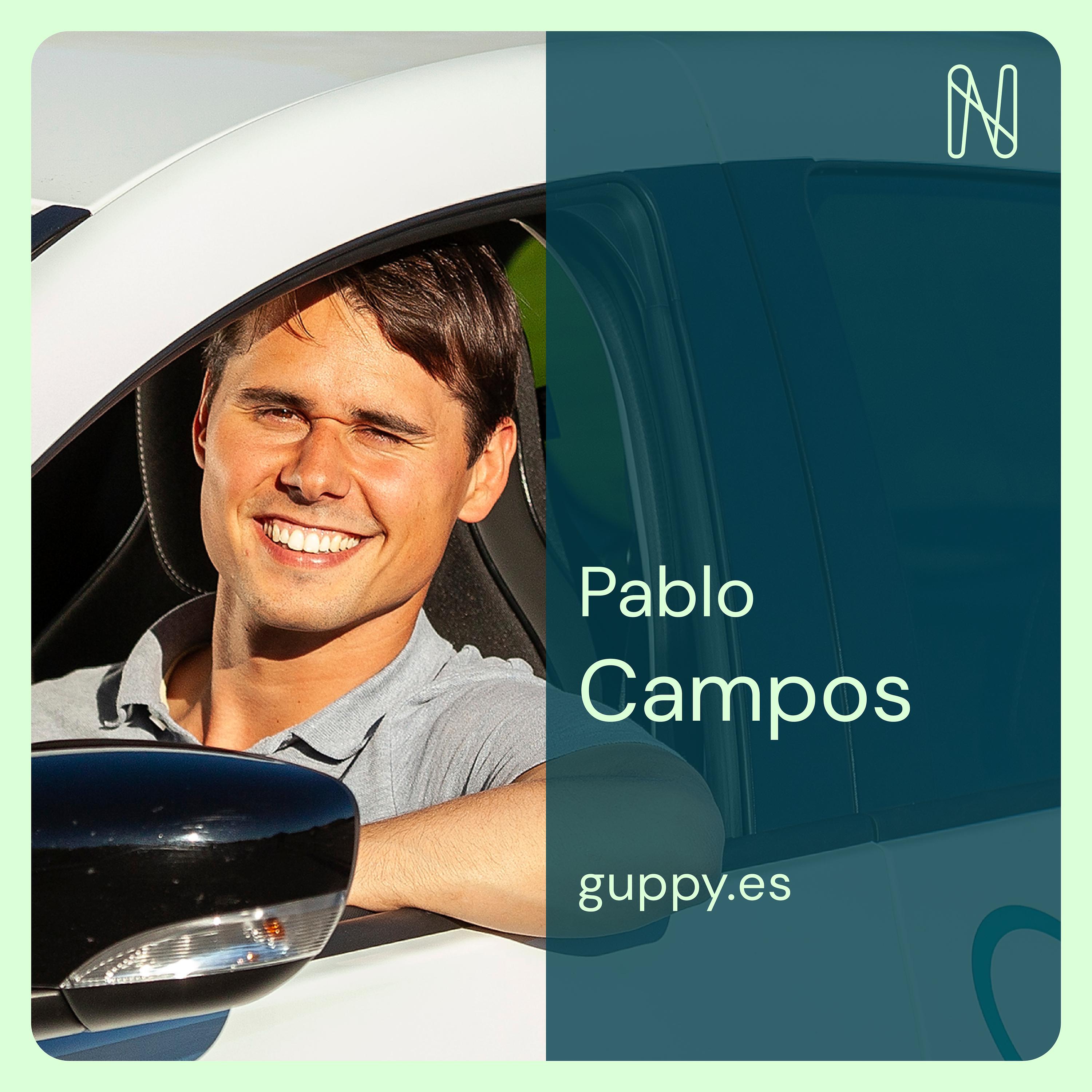
Pablo Campos, founder of the Spanish car-sharing company Guppy, discusses his journey and the company's approach to sustainable mobility. Inspired by his family's long-term business ethos, Campos launched Guppy in 2019, focusing on innovation and environmental responsibility. Two critical decisions shaped the company: investing in its own electric vehicle fleet and developing proprietary technology entirely in-house, allowing greater control and efficiency with a compact team of 15. Guppy operates a flexible service model that blends free-floating and station-based options, aiming to provide seamless travel within and between cities like Madrid and Asturias. Campos highlights the importance of supportive municipal policies, such as dedicated parking and electric vehicle incentives, to scale car-sharing effectively. He argues that sustainability must be economically viable to endure, noting that efficiency and competitiveness are complementary to environmental goals. Ultimately, Campos envisions car-sharing reducing urban congestion and fostering greener, more livable cities through collaborative efforts between companies and local governments.
Welcome to Nature's Conversation Journeys. We travel to or invite the newers and shakers of the mobility, energy and climate ecosystem. Listen in and enjoy the talks. I wish you a great conversation. Take it as it come. Enjoy the talk. Thank you very much. Thank you, Ali. So I'm very excited today to welcome someone who is shaping the car sharing industry in Europe, in the south of Europe, and to be precise in Spain. Very well welcome to Bavol from Guppy. The reason why I reached out to Bavol is because I think specifically Spain is a very interesting market because it's a pretty big country with some very distinct metropoles and cities across but the distance is so wide and let's say the cultural behavior is I think makes it makes it very challenging also to establish something like car sharing. So that's why I'm excited to have you in here today. Bavolo and learn about your journey. Thank you very much, Tristan. It's a pleasure. Thanks for your invitation. Absolutely. So let's start maybe with a short introduction about yourself and about Guppy. So how did it come that basically you started all this and you're running this very interested in that? Well, my name is Pablo Campos. I'm from Asturias, the north of Spain, a small region in the north of Spain. I would say I'm passionate about innovation and new business development and sustainability. I come from a professional world of naval and shipping but this part of innovation and technological and sustainability came up to my mind. The new business models that were showing up sometime like almost 10 years ago now in Madrid where first car sharing disappeared. And I was studying there so I've seen that this new business could have since also in smaller regions with some different situation. So I profited and I took the decision to start up from the technological part and with a very, very dedication in the sustainable way of doing this new sharing mobility. So we started up in 2019 in Asturias with a fleet of 50 cars and from them we did what we good. Here we are now back in Madrid where everything or where the idea started. Wonderful. The starting something like this takes a lot of courage. I mean, it's not like you say, well, I'll try it out. It really takes the effort. What made you actually do it? I think a lot of friends, maybe friends and family would say, hey, come on, do something for real. At least that's what I heard when I found out the company. Peace, my heart, financial, the big company, what made you say, I really want to know it. Well, it was like two or three months of finalizing it into big details, like doing all the numbers and business plan and everything. I started talking together with manufacturers and council and all the stakeholders need for this to happen. And I was receiving good enough feedback from them. It's never enough. And of course, you need that courage and the final decision is on top of your head. But big help, it was, I would say, not probably, but for sure it was the culture in my family. I come from a family business, one of our medium or small company owned by a family over a hundred years. So I'm the fifth generation of a family group business. And that final decision and that courage, I think it was probably heredited and probably it was that help that made me make it happen. We had that culture of investing in innovation, but also in fleets and long term business that probably we'll talk about it later. But it's one of the key points of culture and share mobility and mobility business that if you have a long term vision, probably you are just doing some software. In minor business, but if you're going to invest and do the complete business, including investments on fleets and a big team and infrastructure and so on, you need that long term vision and decision. Very interesting. Thank you very much, Paula, for sharing those those personal insights also in terms of your ancestry and roots. It resonates extremely well because I personally come from a family that my parents, especially my father is one of his own business. And his interest is actually come from farming, but farming in a way that it was always independent. There was never a landlord, it was 400 years, always independent. So there is a culture of long term thinking because when you have that kind of business, it's never about the quick money, right? It's you have to think really long, especially if you're dealing in an agriculture or a maritime, it's about seasons and years. These are the cycles. That's the vision sometimes we consider it's a lack in funding, banks and traditional and even investment funding and not absolutely. So this is not about the quick money, this is not about the quick buck of course not. And I think with with shared mobility, especially in relation to sustainability, we have a very single similar case where you know it's you can't make big money in a quick amount of time. There's maybe other things, you know, more like that. But I think that makes it also very interesting and also truly motivating for me because the purpose that is inside is also much bigger than just quick. It's not just one day and then the next day it's forgotten, it's sustainable in the core sense of it. Many of these are quick, common many of those quick ones are very interesting, very good for sustainability and very nice, but some others are doing a little bit of noise in our mobility world and that's not good for anyone. I agree. No, I'm really resonating extremely well to hear something in terms of like a minute when it comes to approaching this. Thank you for sharing. When you take a look at the history of the company, what do you see is the, let's see key milestones or key decision points, right? So, okay, we could go this way, we went that way. What are the big things for you? In terms of key point decisions, I always summarize them in probably two of them which are completely critical and a structural for us. One is investing in our own fleet and not renting it and one is that's affecting the business model 100%. And the other one is having our own technology, complete technology from hardware to a customer APP at everything hardware software, everything about connectivity and technology is our own team who has developed again from the beginning, there was a decision to create our own team or subcontract technology from the market. So, those two are big decisions, not the milestones, but at least decisions, important decisions. Did you, what of that are you most proud about in the aftermath? Well, this was really something that in the moment I might not recognize it, but in the aftermath this has been really something special or something brave. Probably the technology development because now that we see the market from the inside, you see, you recognize that all the companies doing only technology for our competitors and for all their sharing or technology business around the mobility. You see big teams doing all the things.
only software or big things doing only hardware and we have fast one doing everything. So having technology with a dedicated team and being able to do it in our traditional way where you only add value, you need the precise team to add value you need in your company and not more because market is going to pay for it. So being a complete team, I'm focusing on technology but at the end this is very, very good to explain the rest of the company philosophy. We are only 15 people in the matrix company, we have operations companies doing in every city but in the matrix we're leading all the technology, marketing, customer service, legal account and operations managing, we are the 15 people managing that. So I think what we need to be proud of is several those 15 people and of course all the people in street making it happen with the cars but a small team for a big project now. Yes. That's all. And my biggest respect for being able to do this with such a small team. It's extremely amazing because at the end of the day you know if you run your own technology and develop it, you have actually five companies in one because the scope of it's so broad and so multidimensional to bring this together in a group of people is super hard. For example, to share maybe a personal insight from all development, I think what we've been doing, I wouldn't say that we've been doing it wrong but what I learned is that trying to then put each role onto each task and then you have 50 roles because you have 50 things to do and then you need so many people to manage that and the complexity that comes with it. Maybe we already did that. So at the moment it's more like okay, we have smart people on board anyway, being flexible enough to cover whatever challenge comes and curious enough also to take it and not say no, this is not my job. I think this is where we are about to relearn a little bit from the early days. But I completely understand you that's pretty amazing that you're able to do that. How does the operations, so you have those 15 people in a matrix called a matrix organization right? How does the local operations plucked into this house that structure? We have general operations manager in the mother company. Then a couple of oscillaries cooperating with him in that matter, administrative things together with fleet operations and so on. But then every city where we have a team for the urban mobility because we have urban mobility and interprovings or intercity mobility. With the urban mobility we have three companies, our studio Scanta Ria and Madrid by the moment, hopefully 2026 countries, news there. But there are three teams of operations, one for each city and it's about 10 to 15 people at each city together with their own coordinator and an administrative are plagues into this general management of the operations. All the tools are the same for every city, all the processes are the same. There's shouldn't perceive any difference between taking a group in any city of Spain because we work exactly the same way internally but there's three different teams in the operational side with the same processes, goals and management. Yes. Okay. Got it. Got it. Got it. It is urban on the one hand side but then it's also regional with a completely different demand pattern typically because in urban it's about density, it's about always applying blah blah and there it's about efficiency in terms of having just enough the right number of vehicles. Okay. So it's also a mix I think, is it right? It makes between refloting and stationary, like in the contemporary it's more stationary. Well, the thing is from a market perspective and from those who had designed initially that sharing mobility words like pre-floating and station basis, it's a mix. But that mix we are trying to make it one. So from us, for us, it's always the same. It's someone who wants to move from one point to another one. It doesn't matter the distance, it doesn't matter the place. We want to make it easier, faster, cheaper and more sustainable. Yeah. So we are mixing everything in the same service perspective. So our customers should feel the same to take a Urbine car for four kilometers drive than taking an intercity car for six, seven hundred kilometers. But of course, to make it happen, you have to make some differences. We are completely open in Asturias, specifically in Hifone, where we have the biggest business. Cantaria, Santander and Madrid, the main city. Those three are completely open free-floating. But a mixed or reinforced with a specific parking places, parking slots, that only reason is to make sustainable mobility. We don't provide just cars. We provide mobility from A to B. For that mobility, you need the car in A and a parking space, will guarantee or at least best service or best potential parking than moving in a private way. So we're reinforced with both private and public cooperation to reinforce parking spaces for those car shirts. So we have a lot of cities that specific parking slots above 300 parking slots. On top of that, in some cities where we still don't have the Urbine mobility like in Basque Country, Bilbao and Sebastian, we only have private parking spots to start defining the intercity. So anyone from Madrid to Bilbao and Sebastian or Bilbao and Sebastian to Airport of Asturias or Airport of Madrid, that's where we are starting. But we should be with the Urbine mobility and everything should be the same. I just really be learning from me in what you just said because there are tons of reasons why players go stationary. But the notion of, hey, I want to provide, after a long drive, for example, I want to provide my customer a place to park. So he doesn't have to worry then and maybe a circle of 40 minutes, right? That's a big change. That's a game change in the peace of mind of people of customers, right? This is born in the Urbine mobility. Like, okay, I want to go to a city center so I need a spot there. That's of course, but then taking it into the city makes even more sense. I want to drive from from Hijon to Madrid. Madrid is the biggest city in Spain and I want to go to the city center or to my hotel or wherever. And with my car sharing solution, near my hotel, I will find a place to forget about that car and stay three days in Madrid. Maybe I don't need the car there. So I just do one way from my hometown to the city center in Madrid. Yes, yes, I get it. That's pretty cool. How difficult is it? How different are the cities in Spain? Because you've worked with a lot of different cities. You may talk to a guest more and more of them, right? In terms of parking. Because I know that for a lot of players that we work with as partners, that the parking fee and structure, in strategy of the city, pretty much defines whether you're going to launch the service there or not, and how you're going to launch it, right? It completely defines and it's completely different from one city to the other one. And it's one of the biggest barriers of entry and barriers of development of sustainable mobility. So that's a pending task in the opportunity site. For sure.
It's always take a year to understand and look for the possibility to make it happen or not. And it's both analyzing and smart thinking in cost, but also then a big investment and real cost to make it happen. So if we don't move in a same direction with the cities and councils, and if we don't harmonize and do a common law in the cities, this won't grow as it should for the good of our cities and cities and sustainable. Yes, yes, I hear you. I hear you. It's the same in other markets that we're in, for example, just giving example, handbook in Germany. They're extremely aggressive when it comes to establishing share mobility and electric mobility. So they even were one of the very first ones who say, hey, guys, everyone who operates 80% of the fleet needs to be electric who stop. You can launch as many cars as you want as long as 80% are electric. And what happens now is they have three of the main players. They have like, I think three total, it's close to 2,500 vehicles and 80% of them being electric. And the city supported it with, yes, if you go that route, then there is no party fees for you at all, right? Because you help me as a city to develop towards the sustainability of one. Yes. So it's more of a, it's entire expectations, but it's a partnership mode. Whereas some cities go in a defense mode and just try to make it really, really hard for whatever to make it happen. And then they destroy stuff or they prohibit even the good things. Yeah. The same in Spain. I completely agree on that high percentage of 100% electric, goobies, 100% fleet, 100% electric and recharge with 100% renewable energy. So that's what it's in our own DNA to make it that way. So I think if cities would make it that way, we would see way more peaceful cities. Yes. Yes. Yes. I agree. I mean, this is like, this isn't no news. We both would agree that if car sharing would be car sharing in 10, 15 years from now will mean that we'll have significantly less cars in cities, right? We'll need significantly less space in the cities that will be used for a more livable city, right? We'll be greener. It will be more healthy. It will be more kids friendly, more family friendly, everything together. Yes. I think we don't have to convince you, Jadon, on this one. That's quite clear. So we're in the less. Yes. Yes. No, it's always the discussion of its five cars, seven cars, eight cars or 12, what are deducting, but at least about five. So I think five times more space, five times less traffic jumps is good enough. Yes. Yes. I totally agree. Nevertheless, at the moment, I feel that I'm going to put it. The whole sustainability climate tech movement right in Europe was a little bit high two, three years ago. Everyone knows about it, all investors would go in at the moment. At the moment, I feel it's the other way around. It's a little bit the tailwind piece aheadwind at the moment. Completely agree. How do you see, I wouldn't call it a way out, but how do you see that changing and what does it mean for you as a company and for us as an industry? I don't like it in general terms because I didn't like that it was just a trend, like being sustainable. You must be sustainable. Everything must be sustainable and everything is sustainable. Maybe we were doing things that we thought it was sustainable and it wasn't. So I didn't like that way. I don't like this way neither. I forget about sustainability because we are forgetting what we are worried about, which is near future coming in and what the world is going to be. So neither scenarios were good. I would love to be in the middle. There is one good thing about nowadays. It's a real time, real market and everything what is not. It has no sense. It won't survive. It is not bad for us. It's good for us because sustainability is in our DNA. Our business model is based on making it more sustainable but it wasn't against any investment or any higher costs or wherever. We made it in a way that being sustainable should be even more efficient. I mean electric cars are five times more efficient, technologically. Having our own renewable plant for charging our cars, it's a long-term decision. You need 10 years to make it for freedom only. But it's more efficient in terms of economical as well. So we need to be competitive and we have been focused on being competitive from the very beginning and that is not against the sustainability. For everything that was not a sustainability and efficient and economically viable, that's not going to survive and that's good for everyone. We need to be competitive to something we can forget. We have a big world. Everything has to be that way. But we can forget about having a better series. Because that's what we were talking about, was more generally and globally. Then we come back to your city. At least in Europe we want to live in a smarter, cleaner and more peaceful cities. We shouldn't forget about it because it can happen without any costs. We can live better and we can have less health problems in the city centers easily. And maybe even more economically. I love this period. Let me explain what I really like about it. The attitude to say, well, it's not just about sustainability but sustainability ultimately will mean high level of efficiency for companies high level of profitability also. And on the long run, right? I think this on the long run is a little bit the problem at the moment because a lot of people working this is the easy way. It will come within two, three years and then we will all be fine. No, the big changes are usually big changes because they are hard. They take time and it's painful. It doesn't come easily. So it takes companies like you to take the effort and to optimize and to optimize and optimize and to optimize because in the beginning if you run electric vehicles, it's a disaster. In the beginning, you have to redefine everything. The processes, the technology around it, the people, the utilization, everything is hard. But step by step, making it better will lead to the fine outcome. Another friction point is that long term of strategic and values are completely against the short and mid-term of politics. So as we are not going to have long term politics, this is completely in a risk. Yes. I agree. Then it gets tricky. There are models of long term politics, but we want some stuff we want. But I love this period because I think it takes companies like you and leaders like you to remind us of, hey, this is a marathon. Guys, we are just on kilometer five right now. So we need to continue and not question whether running a marathon makes sense. No, no, we're doing it right now. Are you okay to play a little game with you? Sure. Yeah. So it's imagined. Imagine the two of us. I put the two of us into a time capsule into a time machine and I'd be mass into the year 2036, so 10 years from now. And then we're sitting in the year 2036, right? And then you took a look at us, sitting, talking here now in the year 2026. What advice would you give us from the future to the now? What advice would you give us? And then you see that you look at us now. That's a hard game. 10 years now. It's a long, long term. I hope that I hope that I would be telling ourselves, keep, keep or maintain your long-term goal.
If we are there and guppy exists and share mobility is a real solution above the end of the needs, because now we're on the iceberg point. So, if 10 years later the reality comes as we imagine, I would say maintain your wrong-term goals, maintain that vision, that this is going to help citizens and people have a better life and a better city and this technological, 100% electrical and renewable energy, where the technologies that may have happened just rely and just push hard to make your investments possible that we have fantastic things. What I don't know is what's the key point to survive 10 years now, as the world is like this and the funding and their investments are so hard, what needs is to go day by day, taking the best decision that you think to survive those 10 years. Thank you very much Pablo. It resonates well with me. I have one more thing I want to add if you allow, who does the question of surviving. When I take a look at history of difficult times, what made people survive was quite often working together, collaborating, helping each other, because we are all complementary with each other's strength and competencies and vision and stuff. And something that you might miss, we might have, and the other way around. So, I think especially in Europe, if we take a look at European scale, we have everything that could happen. We just need to learn to really work more with each other and complement each other in a supportive way, because at the end of the day we are trying to achieve the same goal, we are not in competition. And we can define our future ourselves. So, that's one thing. I think this is also what I perceive, even from a cultural perspective, can be a huge advantage of Europe. And it's based on the history, because we were fighting so much in the past. Maybe let's try to start working together, and I think there's a lot of power in this. So, I mean, European is small enough to have divisions internally, so we need to cooperate to become something bigger in the world. And for me personally, also as a founder, I think the mantra of the long-term thinking and not giving up is something that it's funny. And I think it's important to remind myself, because it's a must. It's a must. In the beginning, I was so proud that we're still there, we survived. And why did we survive? Not because we were so smart, yes, also. But because we did not give up. This is why we're still there. In comparison to others, they did give up, and they're not there anymore. And the long is just the fact, but needs sometimes to be remembered that it's, hey, yes, that's important, even in the hard moments. Yes. Pablo, anything that you still want to share in this podcast where you say, hey, this is important to me. I want to make sure the audience gets a message. Just as reminded that I think we need to keep thinking or analyzing how we move every day. There are ways of moving, from walking to cycling, that probably in Spain is not established that much or enough as in other ways of Europe. So we should rethink how we move daily and consider if we need that many cars. And also doing the numbers because sometimes it's just a culture that we don't suffer paying a lot in having a car. And we don't do the numbers of how much cost it really costs, no meter in my private car. It's usually way higher than share mobility solution for the same service even easier without the problems about maintaining and getting those things. And we think about our mobility because it's directly impacting in our life quality. Absolutely. I hear you. And I think we work closely together with companies in other markets like Miles in Germany in the day. You have a lot of user research in terms of behavior. And one of the learnings is that the new generation is growing up. And that for them, the owning vehicle is not a master. It's just a utility question in terms of whether we have access to it. Easy access. It needs to be convenient. Yeah, that's the key. But whether I own this or not. Right. It's just matter at all. Very similar. Yes. Yes. That's great. Well, but thank you very much. I'm very much. I'm very much. It's been immense pleasure talking to you today, having you in this conversation. I learned a lot. And also, I am impressed by the spirit and dedication that I hear from this conversation. So heads off. And I look forward to engaging with you and really wish that you are able to transform your vision in dream for your regions and Spain in general. Can make it happen. Thank you very much. Thank you very much. It was a pleasure and hope to give it a try. Thank you very much. Thanks for listening to Lecture's Conversation Journeys. Subscribe and tuning again next time.
Podcast Summary
Key Points:
Pablo Campos founded Guppy, a car-sharing service in Spain, driven by a passion for innovation, sustainability, and long-term business thinking influenced by his family's multi-generational business background.
Guppy's key strategic decisions include owning its vehicle fleet and developing proprietary technology in-house, enabling control, efficiency, and scalability with a small core team of 15 people.
The company operates a hybrid model combining free-floating and station-based services, focusing on seamless mobility across urban and intercity routes while advocating for supportive city policies to promote sustainable transport.
Campos emphasizes that true sustainability must align with economic viability and efficiency, arguing that electric vehicles and renewable energy can be both environmentally and financially sustainable in the long run.
Summary:
Pablo Campos, founder of the Spanish car-sharing company Guppy, discusses his journey and the company's approach to sustainable mobility. Inspired by his family's long-term business ethos, Campos launched Guppy in 2019, focusing on innovation and environmental responsibility. Two critical decisions shaped the company: investing in its own electric vehicle fleet and developing proprietary technology entirely in-house, allowing greater control and efficiency with a compact team of 15.
Guppy operates a flexible service model that blends free-floating and station-based options, aiming to provide seamless travel within and between cities like Madrid and Asturias. Campos highlights the importance of supportive municipal policies, such as dedicated parking and electric vehicle incentives, to scale car-sharing effectively. He argues that sustainability must be economically viable to endure, noting that efficiency and competitiveness are complementary to environmental goals.
Ultimately, Campos envisions car-sharing reducing urban congestion and fostering greener, more livable cities through collaborative efforts between companies and local governments.
FAQs
Guppy is a car-sharing company operating in Spain, focusing on sustainable mobility with a 100% electric fleet powered by renewable energy, offering both urban and intercity services.
Pablo Campos started Guppy due to his passion for innovation, sustainability, and new business models, inspired by car-sharing trends in Madrid and his family's long-term business culture.
Guppy's key decisions include investing in their own fleet rather than renting, and developing their own technology in-house, from hardware to customer apps, to maintain control and efficiency.
Guppy uses a matrix organization with a central team of 15 managing technology, marketing, and operations, while each city has its own local operations team following standardized processes and tools.
Parking policies vary widely between Spanish cities, creating barriers to entry and growth for sustainable mobility; Guppy works with cities to secure dedicated parking slots to improve service reliability.
Guppy blends free-floating and station-based models, providing seamless mobility from short urban trips to long intercity journeys, with guaranteed parking options to enhance customer convenience.
Chat with AI
Loading...
Pro features
Go deeper with this episode
Unlock creator-grade tools that turn any transcript into show notes and subtitle files.
 PodcastTranscript AI