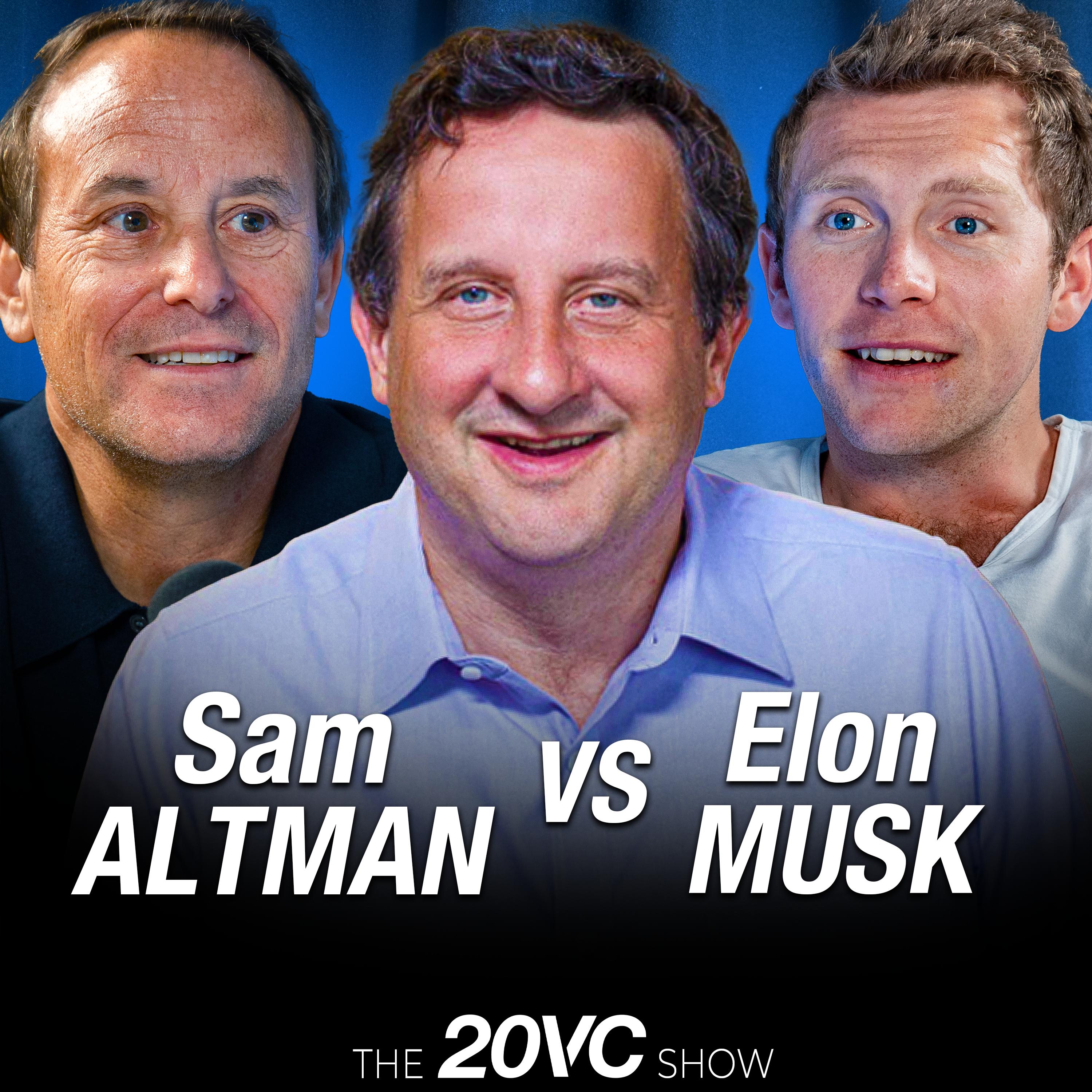
If Figma isn't good enough, what hope is there for the rest of us in software? I look at my portfolio. What the hell am I going to say at board meetings this week, Rory? It's going to be the gift that keeps on giving. If you're the kind of person who slows down or the traffic accident, in other words, if you're like 90% of humanity, you're going to be slowing down every time the depots come out. It's going to be great. If I just stayed at SRIP and just played mine sweeper, I could be worth 10 billion. Elon's in an asymmetric win-win situation and open AI is not. Advertising is not value list to consumers when it's perfectly executed. This is 20 VC with me, Harry Stabings. And it is my favorite show of the week. Jason Lemkin, Warrior Driscoll, discussing the biggest news in tech. This week, my word, we have a lot to discuss. We have can venture survive when public markets price assets the way they are today. Sam Altman versus Elon Musk, the $100 billion fight that is about to ensue, the implosion of thinking machines, replete and click houses new multi-billion dollar rounds, this and so much more. I always want your feedback. Let me know what you think of these shows,
[email protected]. But before we dive into the show today, I run the 20 VC fund and I get this question from founders all the time. Oh, Harry, I can't find a good.com. Do you have a good hookup? Well, let me tell you now, the answer is always going to be no. I don't have a guy or a girl for that. I do have a recommendation though. If you're building a tech startup, get a.tech domain. Tech startup.tech domain. It could not be more obvious. As an investor, I appreciate founders who put thought into their branding. When I see.tech in your name, it tells me right away that tech is at the core of your build. It'll say that to your customers too. A clean and sharp domain like.tech pays off in the long run. You know nothing.tech, 1x.tech, aurora.tech. All of these great tech companies, they all use.tech as their domain. These are my two cents. If you're building a tech startup, don't overthink it. Get a.tech domain. After.tech establishes your digital presence, check out how is the payments experience your customers see. Digital commerce is exploding, but payments are still where revenue leaks. Check out.com launched in 2012 to fix that. They don't try and be everything to everyone. No, they just do one thing better than anyone. Digital payments, cloud native, sub 500 millisecond latency and 99.99% uptime. Today, that bet has paid off with a $12 billion valuation and 65 plus merchants each processing over a billion dollars annually. 65 doing over a billion annually is insane. Check out powers $300 billion in e-commerce for brands like Uber, Planner, eBay, Vinted and more. Now they're building for a genetic commerce where AI agents buy on behalf of your customers in real time, partnering with Visa, MasterCard, Google, Microsoft and OpenAI. Now, if you want payments built for what's next, talk to the team at checkout.com. That's checkout.com. Once checkout gets customers through the paywall, invisible helps you scale your operations with on-demand talent and processes. Why don't we hear more real AI success stories from big companies? The models are insanely good, but implementations the problem. It's really, really hard. There's data all over the place. There's legacy tech and manual workarounds. It's a Ferrari engine in a shopping cart. Meet invisible. Invisible trains 80% of the top models. And then adapt them to the messy reality of your business. Take the Charlotte Horners, NBA team. Invisible to years of game tape and analog scouting notes to go from uncertainty to a draft pick and summer league championship win in weeks, not seasons. Get the data in order first, and suddenly, AI can do almost anything for you in the enterprise. If you want AI that hits the PNL, go to invisibletech.ai/20VC. You have now arrived at your destination. Team, I am excited to be back. I'm excited to be back. We've got a lot of stuff to go through this week. And I wanted to start with a really optimistic view of public markets, which makes me question whether venture today as a model can still make money. Because when we look at Figma down to pre-IPO levels, when we look at data, a dog, now 20% down even coattached. Monday killed. We talked before about Page of Duty. Consistently, we're just in the dumps with public markets. How do we analyze this? And do you public market multiples today make the venture model increasingly challenging? No, they don't. Because the public markets-- actually, it's almost the exact opposite. Those multiples, what they say, is when companies go X-GROAT, they get much lower multiples. Slow-gourd companies get little multiples. High-gourd companies get absurdly high multiples. And you could have also cited, at Palantir, at 70 times forward sales, for a 45% grower, every venture capital is going to make $3 trillion. So what you're really seeing is the markets are just basically doing what they always do. They're sifting. And they're basically saying low-grout. We're going to devalue them very low. And perhaps too low. We can back to that in a second. And so that's what's really going on here. So it's not an old tech is doomed. What it is is it's a sifting and assorting. Things that look like they're going X-GROATs are getting thrown out, getting discarded. They're pretty low valuations. And things that are perceived as exciting and on-trend are getting very high valuations. And venture is nothing if not a trend business. So I would argue for venture, it's pretty good. It's just reinforced into the dynamic of this business. It's the always being the hot stuff, and you'll be fine. If you're in the trailing-ed stuff, you're toast. Goodness. Here's how I think about just being more pragmatic. I'm not saying that there aren't folks that are exploding. The ones we know, the 11 labs, and the replets, and the loveables. But I feel like none of the unicorns are better than Figma, almost none of the prior. And if Figma isn't good enough, it is not a great IPO. I'm not even sure it's a great public-- it's a great product, right? I'm not even sure it's a great public company. And I look at my portfolio, what the hell am I going to say? At board meetings this week, Rory. Great job, guys. But have you seen Figma? But hang on, I'm just going to say something. You know, great job, Vlad. This is the problem with anchoring. Figma, it's a little bit down from its IPO. But then all the screen, it's hugely down from when all retail priced at the day after the IPO. If you look at it versus the IPO, you're right. It's still down a little, but it's not nearly as catastrophic. It's still a $12 billion market cap company. It's still growing. It's still creating a 10 times forward sales growing a 30% plus. It's an awesomely good company. That's just the value. In other words, 10 times more invested at 8 or 6, though. Again, the message is really clear. When you pay up for high growth companies, and the growth slows even a little, and the belief goes out of the multiple, you're in for a long, hard hole. And with competitors, I think a few times, before you can be valued on free cash flow. It's a long journey from the hope and the sizzle of a forward revenue multiple and a high growth rate to the steady anchor of 12 times free cash flow. It's a long and tedious journey, and there's a long flat period for the stock while that happens. I feel like one analysis, it's bill-girling at all. There's just windows when there's lots of liquidity and high prices, and then it's crap, 80% of the rest of the time. Another version I've always thought is, and I don't want folks to take this the wrong way. But in some ways, I feel like venture and tech is a bit of a scam. And what I mean by that is that our job is to convert very high revenue multiples into cash, almost unnaturally, through M&A, through public offerings, when they haven't earned it in free cash flow. Our job is to find companies worth 20, 50, 100, 200 times revenue, and magically convert that to cash. And when it does, that's how we build 5X or higher funds, and that's how we make money. If we have to go to an EPS world, we're dead. I feel like we're waiting for these moments, and it's even worse, because when multiples are way down like today, no matter what the card today says, there is no liquidity. But you say that, I mean, describe the system correctly, but you kind of imply it's called a scam. I don't think it is a scam. One level more sophisticated analysis here says, what's really happening is everyone has long since internalized the following sense. In the end, the surviving tech companies at scale are astronomically good businesses. Microsoft dominates the PC era, and it's going back along. It's an astronaut. So, therefore, you know you want to own that. And therefore, you just work your way backwards that says, OK, at the point in time, when I don't know which companies Microsoft, I can't wait until it's trading a 10 times EPS to buy. So, I got to take a chance. And as you say, buy a basket of things that might be Microsoft. And you price them along before they have EPS. So, you price them on forward sales, right? And the truth is, four out of five of them turn out not to be Microsoft. No one even remembers what Berlin software does. If I put a gun against Harry's head, he couldn't tell me about Karel, Vizicalk, Lotus, et cetera, et cetera. And all of those stocks traded high and then went down. But it doesn't matter a damn, because in the end, as a whole, the system, the venture guys, the public markets were correct, which is, this is a big ass trend, and the winner will be worth $4 trillion. And if the losers, if you ride off half a trillion in guessing to get there, you get there. That's why it's very hard to fund an old school SaaS company today, because people are just saying, look, you're great. You're going two to five. You're a profitable company. And again, this is the thing, these people who rain down a little bit of Vizicalk kind of project a little contempt, or your little $100 million revenue thing doesn't matter. I can come across as a little callus. And a fairer statement is this. Your $100 million revenue SaaS company is an awesome entrepreneurial achievement. You are to be hugely congratulated. It's magnificent. It's just not something that we can properly finance, because we're just not going to make our public market venture return here. So if I am a founder of linear or revenue cat, or any of this generation of companies, maybe five to 10 years old in that broad range, and I'm at 50 to 75 million of revenue. And I'm not an AI first company, particularly. And maybe AI helps a little bit, but I'm 50 to 75 million. I'm growing maybe 75 to 125%. What do I do? I think the truth is, if you're going 75 to 100% you're fine. Stop. If you're going 100% at 50, you're going to be at 100, then you go to case to 80, you're going to be at 180, then you go to case to 40 or 50, you're going to get to scale. You've got your funny face on for listeners who can't see it. How has got on his, I disagree face to face. I'll tell you, listen, I don't want to get lost in the week. I only disagree with you for two reasons, Roryam. They're just structural. One is, as someone with a relatively modest amount of capital and a concentrated strategy, I haven't bought 20% of a startup in like seven years. And I haven't done around it a million in revenue growing quickly in the teens in a decade. Now, if I could buy 20% of these companies in the high teens pre-money, like I used to do when Harry and I met, then I would be pretty zen about today. I'd be like, whatever the Lord brings, 500 million, 200 million, 3 billion. If I have to own 5% at 50 million post demo day, the math works out in the aggregate. Gary's got it all proved no criticism. But it really ratchets the pressure when the valuation's three times higher in the ownership's 25%. I think that this is where the Figma thing gets stressful. You're not quite as good as Figma. I'm going to end up owning 4%. You're going to be worth 4 billion. If everything goes well, 5 billion, guys, I don't know. Teach me about crypto. I'm so sorry. I push back. Again, 75% to 100% for the biggest and best funds. It's not enough. When you have an 11 labs or you have a lovable, or you haven't had what it's referring to. Well, let me answer your question specifically, though, and Rory can challenge it. I agree with you if that is all you have. And Rory will disagree. I'm very worried about you today. The question is, your job-- and for some folks, you're dead in the water. For other folks, it's not too late. Your job is how are you going to attach to AI trends? So if you look at revenue cat, right? The whole vibe coding mobile thing-- I think they tripled the number of developers on their platform in the last four months or three to four months of the year. So their job is to do what work OS and others did, which is directly linearly convert that to revenue. But they have a revenue cat has massive tailwinds, which it didn't even have at the start of last year. And there's a lot of folks like that that have AI tailwinds. If you have none, you sure better figure them out right now. And this is the answer. For example, I have one of my first investments. I mean, it's been around for a decade. And it's not even a 10 million yet for a decade. I'm the only investor. They're casual positive. I love them. It's a very specific use case with limited competition. They finally added a way to do deep AI analysis on their data and reports that for their niche was impossible until December. Blue up. They were more than double this year after a decade of 10% a year growth, 20% being pretty good. So it doesn't fully answer the figment question. But this is your job right now. Like sit around your company. Those kids at YC built an agent for your space. Why the F wasn't that you? There is no excuse for you to not have an agent as good as the new kids. I honestly don't think there's any excuse. And going back to your push bang, Harry. I mean, I think it's in the framing of your question. I know what I know. Let me tell you precisely why I think you're wrong. You said if you were the CEO of X, Y, or Z and you're going a 70% and then you kind of did the throwing your hands up in the air thing. I think you're wrong for them, right? I mean, what is true is this. If you're going 50,000 and going 50 or 70% you may struggle to get venture capital because you write everyone's focused on correctly on the things that have the embedded upside of potentially exploding to hugeness. And you're probably at a stage now where that kind of mega-grow is not going to re-accelerate from there. So the probability of a mid-state SaaS company exploding into something amazing is rounding error zero. So as an investor, that's not attractive. As a person who owns that asset, maybe you own 20% of it, right? You can't just say, oh, I wish I'd done something different with my life. And now I wish there's an eight kind of company. You got to play the hand your death. And Jason's exactly right. The first thing you do is say to yourself, I may not be able to raise much more venture capital on attractive terms, run my business accordingly. I am now just like, I thought we were going to talk about the public SaaS stocks here like you hinted on your questions, but you took us offline. But it's the same thing. Live in the world, you now find yourself, which is where capital is no longer free for your sector. If you describe that negative, you can say, it's because venture capital is our fashion chase. So if you describe it in a logical way, you can say it's because the kind of extraordinary growth has vanished from SaaS and has now reappeared in AI land. Run your business the way you do it so you don't need capital. Then, as Jason said, look at what these next generation people are doing and find a way to attach it to your business. And if you grow at 50% then 40% then 30%. And you get to 200 million of revenue. And you sell it five times. That's a billion dollars. And if you have 20% of that, you have 200 million dollars, it makes you one of the probably. 200 million, I've done this math. About in the top 5,000 richest people in the world, it's okay, but it's aggrined. Because it's aggrined, explains exactly why venture guys aren't investing, because grind is not in our M.O. Well, come back to new rounds. You mentioned the grind doesn't in our M.O. When the grind isn't in your M.O, you move on. You've ever seen the Home Alone movie cover, which is like Macauley Culkin screaming about it, guys. I feel like someone needs to do that for poor Mira Morati, because I think she's the only one left in thinking machines after everyone else this week. We've seen the implosion of thinking machines with now two co-founders leaving, Barrett Zoff in the last week. They have raised significant amounts of money at 50 billion dollars of valuation last. How did we analyze this news and what's left of the team? I mean, it happens with seed rounds. That's a great answer, just part of the risk. I was going to come up with a whole bunch of other things, but Jason is exactly right. You have to remember, this is a seed one. Why can't we do this thing? Is that the number one cause of failure at the seed stage is founder and compatibility? And this is just seed rounds with extra commas. And they discover after a year, they don't want to be doing this, and they want to go back to the big company. Just treat it like a seed round. I'll tell you one next thing I never understood about this company. On paper, I get it. And Jason Sequoia put in two billion. You're basically taking Mira's taking open AI co-founder, a whole bunch of the team, and it's just going to be unthrobic again, right? They're going to recruit some of the best and they're going to do it. In theory, you should do that bet in 15 minutes if you have the capital, right? It's just take a bunch of the best guys and go do a modern and worked it unthrobic. Good God, it worked it unthrobic. The part I never got, here's the weird part, and maybe this has nothing to do with the tensions. I mean, her background is not technical, and this is the part I never got. A degree in arts from Colby College, and someone engineering product manager at Tesla. I'm not saying she doesn't have 50 IQ points on me. I think she does, but I don't know how you run a lab. If you're not Ilya in the early days of open AI or Greg, at least, I don't know how you get the respect of the team if you're not on their level as a researcher. And it's a challenge for a lot of other B2B companies. How do you recruit this S-tier AI talent if your team isn't at that level? Who the hell would want to go work there? Composite, right? The best, why do folks leave open AI like after a year and leave five or 10 million? They're just so smart. They just want to work on smart problems. This one I felt was unstable. People loved her, I think, but I'm super skeptical of technical companies where the CEO isn't one of the greatest technical visionaries in the industry. I'm just, I'll never do that investment again. I'll never do an investment again where it's not like data bricks are better as CEO. I just won't do it. What happens in this situation? There will be some version of the following clause that says if more than X team members leave, then you have the ability to call for redemption and just basically wind the company down and say you spend 20% of the money. If you can't get an M&A outcome where you get a 1X, then you can wind the company up. You get them $2 billion. They spend $200 million. You take another $200 million to bribe everyone to go along with it. And you get 1.6 billion back and you say to yourself, that was a risk that didn't work. I only lost 20 cents on the dollar. I can recycle that money into the next open AI round. Everything's fine. That would be a far better outcome then. We're going to commence the long and bloody march, trying to fix this thing, trying to hire new people. 'Cause Jason's right, I mean, it's such an insight, Jason. It's a seed deal that went wrong. What do you do when the core premise you invested in turns out not to be true when you spend 10% of the total money if you're smart and you don't have another compelling idea, you give the money back, you incur the respect, everyone was stressed, okay, I got it. You moved on, you called bullshit. From the investor perspective, I wonder where they said they're going. It would be totally fine to take a 20 cent haircut and be done. Do you think they'll do that? It probably felt safer when they made the investment that worst case metta wanted to buy them. And worst case, we exit for 5 or 6 or 10 billion to acquire the team. We don't quite make as much as you might think on paper because of how the deal is structured with employees and retention. But worst case, we make some return on this deal. So that was probably, it's not as crazy as we might think from the outside because with the quality of the team, high chance we get our 2 billion back. Seems lower odds today. The way I described it, if I was on the board, I'd say this, we're not going to get our 2X from the M&A outcome, but if we get our 0.8X to a rounding error, it doesn't matter. Especially if you can quickly recycle the capital because this happens so quickly that it's all in the current fund cycle. Just so listeners know, if you're in the investment period for a venture fund, you wire a billion dollars into investment A. Instead of waiting 10 years and getting 0.8 back, if you get 0.8 back in 12 months, you can reinvest that 0.8. And very quickly, just move on. It's almost like it didn't happen much better. So much better. Forget about IRR, you can put that money to work. You can put that money right down the board. I mean, ask yourself, the loss is a bummer, but if you're trying to get 10X outcomes, you almost don't care. Just give me the money back and let me invest it tomorrow. Because watch this, if you got the 0.8 back six months ago, and you put it in the last run it on traffic, that 0.8 is now a 1.6. So on your initial billion, you're actually a head 60% despite having lost 20. This is why, at heart, ventures of capital allocation business, you are trying to stuff your money into the place where it will grow the fastest. Once they start going down venture guides, it's brutal. But the rational thing to do is we allocate to success and away from failure. I think we underestimate the challenges and the wars for AI talent. Yeah. And we talk about it being compensation based and brands, but it's not the best. Yeah. Well, it's even more. It's like the best researchers in AI, the best, the ones you need to win. They only want to work with, they want to work on. Yes. And they will leave a lot of money behind. That's why we've all moved to know, vesting anymore at OpenAI. Because we want the folks who like, you know what? I just don't love my job at thinking machines. Come to OpenAI, you will lose nothing. The smartest folks in AI in applied math and others, they only want to work on the intellectual challenges they want to work on. And if you can't deliver that and the right boss, there's so much portability that they will just leave. And that is an environment almost impossible for 99% of software companies to create. And maybe thinking machines does, I don't know, maybe it doesn't have that environment anymore. Maybe it just can't provide that environment any longer. We've spoken about the breakup of teams. We touched on OpenAI a couple of times there with Mira. I have to jump to the ultimate breakup of breakups being San versus Elon going to trial. How do we see this playing out? Who wins? What do they actually win consequentially? What does this look like? Look, it's going to be the gift that keeps on giving. If you're the kind of person who slows down as a traffic accident, in other words, if you're like 90% of humanity, you're going to be slowing down every time the depots come out. So now I'm going to start with an utterly different idealistic comment. As we get into this whole mess and we will for a few minutes, it's worth pointing out. When I, we read a lot of the stuff and they did all start by making a charitable donation for something they passionately believed in where they weren't trying to make money. Elon shipped in 30 million plus. Sam Altman shipped in 10. We'd hop into it. They genuinely believed, actually, and we'll come back to that statement because somebody would say it's alive. It appears that everyone genuinely believed that the start that they were doing something for the good of the world, they were doing something for charity and they were trying to understand what AI could do and head off existential dangers at the past. So as is so often the case in life, I think everyone's intent was pure when they forked over real money to try and do something. So I want to start with that. Thank you, everyone, for trying really hard to save humanity and then the old rule applies. No good deed goes unpunished, right? So the whole thing is now a mess because just to give the zoom out comments here, it was a nod for profit. At some point it became obvious to the management team around 2017 that the costs to build what open AI was to become was such that you couldn't keep going as a non-profit. You have to become a for-profit entity. During the period when that started to happen, Elon had his demands on how he wanted that to happen. Sam and Greg Brockman had their perspective on how they wanted it to happen. They ended up, as it were, breaking up, Elon resigned from the organization, fast forward past the drama of 22, in late 25, the conversion to a for-profit took place finally and it was approved by California and Delaware. And now open AI is a for-profit corporation with a largest individual shareholder is the foundation. And the argument Sam and Greg would make is, hey, you invested money in a charity and that charity now owns 30% class of one of the largest companies on the planet. So you kind of got what you paid for. That's the argument they're making. And therefore you're entitled to nothing. You made a $30 million donation. You created a $350 billion foundation, congratulations, you've helped humanity, you got what you paid for. And Elon's comment, which is going to be tricky to prove what is going to be messy, is all along you guys were planning to cheat me and planning to make it a for-profit company. Because his ask is not just, hey, I want my $30 million back. That's Trump change in the back of his couch. He's saying, hey, you guys plan this all along and therefore my damages claim is not just giving my $30 million back. And it's not stopped the conversion to a for-profit because that's already happened now. That can't be stopped. It's like, you guys took my $30 million under false pretenses, therefore I'm old roughly what $30 million would own out of that company now, which is $100 billion of value. He's basically saying, if we're going to go for a profit here, guys, and you guys will line me all along, then I want my share of that now. So you're all going to have to take delusion, such that I get my $30 million, the damages claim is $70 to $130 billion, which would come in the form of extra shares of open AI to Elon and everyone else will have to take the delusion. That's the ask. That's what's going on here. In the end, it's an economic argument on the basis of fraudulent intent from day one. Is Elon doing this to slow them down? Is he doing this for the side? I didn't. He's doing this for the $70 million. I think he's doing it because he can, and it's fun. Billionaires are going to billionaire, and near trillionaires are going to, near trillionaire. I mean, it's a win-win. He feels shafted, and you're right, it's good for Groc, if it slows it down. And he might win $100 billion, and there's not a ton of downside other than a bunch of legal fees, because they're going to claim on you. It's a asymmetric win-win situation for him. So why do you have the couple hundred million dollars of legal fees? It's going to consume here, right, because we are litigating over a hundred billion dollars. And then the other thing that happens is that he's lived through this on the Twitter litigation. Deposition and discovery is a sucky process, because you write down stuff in your email, in your diary, and then it suddenly comes out, and it's always embarrassing. Right? The truth is that if I spewed out your last ten years of emails, I'd find some embarrassing stuff. I put an e-lon in the Twitter litigation. I mean, some of those e-texts just look juvenile. You just, oh wow, you're the richest man in the world, you're a son of an idiot, that sucks. In this case, they were able to, I mean, if you look at already what they've got on the record, they've got Purgreg Brockman, who kept the diary at a 2017, you know, writes in this diary, "As one does, what does it take for me to get to a billion dollars?" And now that's come out, and now they're going some version of it. You were cheating me all along. You wanted to do a for-profit. I mean, can you imagine how we happened to get your diary for eight years ago? And then you had Ilja, who had to do a ten-hour depot, and this comes back to the whole mirror thing, right? He had to do a ten-hour depot on the 2022 CEO, it was a 23, CEO drama, which is not really relevant to this because the quote-unquote alleged fraud happened in 2017 or 2018. But again, it's just a fun chance to get all the mess out there. So they depot Ilja for ten hours, and we finally got to hear what he thought about the great fiasco. He's been embarrassing for everyone, everyone looks like an idiot in 2023, the board looks stupid. Ilja looks a bit naive because he relied on mirror, she looks a little naive because she just looks like amateur hour everywhere. So if you're ill and you're like, "I can torture these folks who look stupid." If there's any kind of credible case, and remember, a judge was asked, because what you're going to call it, "Open AI did go for summary dismissal," which is what you do. You say, "Hey, there's no case to answer here, just dismiss the charges." And the case, I should say, they're not charges. And the judge said, "No, there is a case to answer here." I'm not saying it's right. I'm not saying it's wrong, but there's a credible discussion here. So now they got to go to a trial. And I don't know how that impacts fundraising. But for the next one, two years, there's the potential of every financing of open AI now has. You might have to take 10, 15, 20% delusion if they lose a jury trial. Now for what it's worth, I think the intent of the other founders, Sam and Greg Orman, doesn't today want to quote, "I think Ewan's case is built on a slender, conspiracy thread, but it'll sound compelling to a jury when you also have all this dirt about, you know." Roy, what happens and Jason, what happens? It drags on a long time and it gets in the way. And who wins? Elon wins no matter what. Yes. That's the right answer. And here, this is a jury trial. A jury trial is unpredictable, and there are bad facts on both sides. Yes. Like, this is the social network, the movie, the social network, too. I know they're making another sequel at Meta. This should be the next social network. This is a sequel. You're so right. There are bad facts on both sides. And if Elon was not the richest man in the world, he would settle for 30 billion or whatever that Winkleva I got, he would do the same deal. Give me 5%. They would settle on the eve of trial for 5% to Elon. They would say, we're just doing it to move beyond. They'd give him 5% or 4% and if it was about money, he'd move on. Just like the Winkleva, I got there 4% or 5% of Meta Facebook. That's what would happen if it was about money. The fun thing about the sequel to the social network is they're going to settle for that. He's going to go to trial and he's going to win, and Elon has bad facts, but this man has already been bad-facted the last couple of years in public. His worst fact, forget about that it's an open, that Oakland is very liberal. Elon's worst fact was that Trump hated him for about six months. He fixed that issue. Now he's back in the inner circle. Get a couple, Maga folks, Republicans on the jury, we don't know. Sam Altman fired by OpenAI board for reasons not fully disclosed. Greg Brockman, and you know what I think really happened with Greg that I think maybe people missed? This is my theory. The guy really partially regretted leaving Stripe as the CTO on the fourth employee. He leaves Sam recruits him from Stripe when it's worth $3 billion and says, don't worry, we'll make it up for you at our nonprofit. Come do this thing. We're going to change the world to Greg. And it's very exciting, and Greg really doesn't want to work on the Stripe API anymore. He's already gotten payments to work. It's kind of boring. And he leaves it, he leaves it in 2015, when the world seemed very flat and simple, right? And he left and he turns around and he's like, my God, I left billions behind. How would you feel as a human being that didn't make the money Sam had already made? Sam's already become, he wasn't a billionaire then, but he's on the path, right? He's raised hundreds of millions at his own venture fund to invest in YC startups. He personally owns 2% of Stripe. How would 99% of humans feel when you're like, if I just stayed at Stripe and just played Mind Sweeper, I could be worth $10 billion? And I think that haunted him, but I think that's where these journal entries come from. It's not him being douchey and saying, man, I want to, it's him haunted by Sam getting him to leave Stripe at $3 billion, haunted by it. We've all, I've been haunted by some mistakes I've made, too. I think he's haunted by it. And I think that creates going to create a whole bunch of bad facts, the deeper we deal, like Greg was haunted by leaving the money at Stripe. First of all, I'd be haunted too. I am haunted. I'm not going to speculate, even if you would be haunted if you left a couple billion behind. Yeah. Yeah. I mean, one of the things that's also sucky about this when you're in litigation is suddenly everyone including Roy O'Jeska who I think has never put eyes on you has a fucking opinion about you. That's the way he's sucky thing. And the great, I think, I'm not sure I agree you on Elon in terms of the jury. I want to come back to that in a second, but I do agree on one thing is he is post pain when it comes to public shame and obliquely. We are, that does nothing left to do for him, man, right? So basically, everyone else is going to have to get down in the mock. And he is already so far in the mock that, you know, on various different parts of the last three years, 40% of the country have hated them and it's been a different 40% each time. There's nothing left for him to do, which actually gets to the, how do you think, you asked, how do you think it ends? I think, Jason, you're right, if it was normal people, they'd settle. If it goes to jury, I think two, two comments that will make from a facts perspective, I think in the end, Elon has to prove his case and it's a high bar to prove. You got to prove that all it's a very hard, you got to prove right when they were raising the money charitably. They were all along intending to swipe it and you don't build it for profit. And I think that's very hard to do because Altman's money went in as a for profit, not for profit too. So I think it's fundamentally, I think Elon's wrong on the course session. I don't think this was a cunning device to treat everyone because if they wanted to do that, they could have just done what Antropic did, which is the totally sensible interim stage of a public-benefit corporation and saved all this fricking drama. So I think stripping aside all the bad facts, I think the core assertion is Elon is making which is they misled me into giving them 30 million for this thing which was never going to be a charity and therefore, I think it's wrong. But to your point, you still got to prove it to a jury. Now the other coming is, remember, he has to prevail. So as long as there's one person on the jury who hates him more than he hates Sam, he ain't going to win. It's going to be hard. First of all, it's going to be a very unattractive cast of characters, an Oakland courtroom. You get Sam to come in and say, hey, talk about how you said this is going to make everyone unemployed. Then you get Elon to come in. They're going to hate the whole thing, which everyone's going to have to go on, right? I think the jury would get, if they get into that one, they're going to go, wow, I don't like any of these people, why should you know, right? But the problem is this, for Elon to win, he has to get into all vote for him and a kind of hung jury is fine for the prevailing wisdom, unless he even prevails, he doesn't get it. So I think weighed on the line two, three years from now at the end of a long and bloody trial, the probability is he doesn't win the case. But Jason, your right, he's already won the case. If what he wants to do is get kind of psychic revenge, this is going to be the best to it. This is like Peter Thiehl's spend on galker. Sometimes a billionaire just wants to spend a couple of hundred million bucks in this case to grind the other guy and make him sorry. I think he wants every bad fact about Sam to come out, every bad fact in this trial. We haven't even heard why the board fired him, right? If someone sequestered depot, my diary for the last ten years, and if you keep notes and days when you're feeling like shit, you know, you're like, oh, that's not great. That's the problem with litigation. That's the problem with convoluted structures. You end up a litigation. That's why keeping it simple, step one. And once you didn't keep it simple, trying to get up, keep everything in the tent. When you don't do that, you end up being sued by the richest person on the planet who's angry and mad at you. It's a tough place to be. If you're sad, do you not go, hey, I'd rather have the dilution, not go through three years of distractions and actually get him off my case, bring the enemy inside. I don't have a stop anyways. I don't settle at five, settle at a hundred, yeah, and it was giving me a stop anyway. Well, sort of. I think that was it. That was dishonest. You're right. Actually, how are you writing a big question? It's like, if this is getting in the way of the next financing and it's been seen as a credible risk, then would you be better off, even if it's extortion to cough up, which again, it's why, again, Elon's in an asymmetric win-win situation and open A.I. is not. The only way it doesn't matter is if every investor looks at this and says, I'm not worried about the risk in the end, Elon will lose, so therefore we can ignore it. Well, isn't that what they said? They said our exposure is capped at a Elon's notation of 30-some odd million. That was the public announcement, right, or zero public leaked, right? And that's why his aggressive claim is on the facts very contestable. I mean, it's a real reach. The claim is a reach to say, it's not just on my 30 million back. Basically what Elon's saying is, it was a for-profit all along. You guys just didn't tell me. And if it's a for-profit all along and I put in, if I was the 30 million seed in what was a for-profit company, then I want what a 30 million seed would get. It's a stretchy claim. You're right, Jason. And open A.I. are going to say, there's simply no way from a point of law perspective we're going to concede that. And even if we lose a jury trial, we'll go in on appeal. And they're just going to say they're going to litigate it the whole way down. But you're right. That's fine. And this is actually ties funnily enough to the ads come to everything else. What I don't, the key question that I don't know is, how will the investors look at it? If you're right in the check right now, do you think I'm I'm paying 600, if I'm paying 600 billion per year, 800 billion per year, do I need to say it could be trillion? Because it could be 20% delusion. I don't know. Or do you say-- You said last week, there was no existential risk to open A.I. I said there might be some structural economic risk. You said it could be-- But this is an existential to how is point. In the end, you can fold and give the man what he wants. If you can't, right? If it's hard, I don't think this will make it any harder for them to raise capital because greed trumps fear. But if it did, it could create some risk, right? If it had a harder risk capital. I think you have to fold because the winner in this case, and I know it's ridiculous to say, but the winner in this case, and the guy laughing with popcorn, is Darya. Yes. Going great. But you can't fold. I don't think he'll let them fold. I could be wrong, but there's no chance that there wasn't some lawyer discussion talking about what would it take to resolve this, right? In quiet room off the-- you know, there's just no way that open A is a fiduciary obligation to find out what it would take to settle it, right? Arguably. They have to. I mean-- He didn't want to take it. He just wants his day in court. That's why you have to settle if you're a Sam because the-- You can't settle if you didn't-- He doesn't want to settle. He doesn't want to settle. No. I mean, to be fair, you don't have to have-- because as I think about us in Investor, what would you say? You'd say here, let's just say, this is around at 700 million pre. There is a probability of an additional 15% delusion, but it's not 100%. Maybe it's only 10%. So really, risk adjust that you are kind of a-- you add a 1.5%, so you don't assume. You're assigning a probability to a capped, large, and uncertain event, right? Which is, there is some chance that I take 15% or 20% extra delusion, but it's not 100%. So it doesn't drag the financing down to zero. It merely means there's an asterisk risk on it, and to be fair, anyone who's financed open AI today. If you look at the funny thing about open AI is, it has, even though this looks very risky, open AI from a structure perspective, it's less risky now than it's ever been. If you look at all the rest, the first money went in, it was, hey, it's for profit, and not for profit. And then you had that disclosure, hey, we're never going to make money, so what can you do? Then in the last year, they've been able to convert to a for profit company. So a huge step took place last October, November of 25, when open AI, the real danger would have been if they hadn't been able to convert to the for profit company, because at that point the whole thing was at risk. When they got that done, they took a big step function, decrement down in risk. So even though this feels very risky, it is less risky than the risk under which they were able to raise, you know, 200 billion dollars plus or minus. So it'll be fine. It's just a risk. It's going to be a monstrous pain, and it's going to be popcorn time for everyone else. I think you've been way too nice. Like at a time for open AI, where you have jam and I killing you on consumer, anthropic killing you on enterprise, but you're just lumping everything in together. You know, because you have to, I mean, look, the litigation, I can't isolate things, but actually, funny enough, you have to, in the sense of whenever you have that kind of litigation, I've been to the county's occasion to have it, what you have to do is to say, the really dangerous thing about litigation is if it kind of subsumes the whole company, because the thing about litigation, it gets your blood up and you start trying to win and you just get emotionally vested in it. If they're smart, they'll have a great GC who says, other than deposition, none of you talk about this ever again, we will deal with it and our 100 million dollars will allow you. Right? Because you can't let that get in the way. So let's assume you do that. You're still running a wildly successful business with a whole bunch of competition. And you're right. You've got to deal with Gemini. You've got to do a chopper. You've got to get ads out the door. You've got to start having a convergence plan on profitability, which is, I think, why the ads are coming out. Yeah. You still got lots to do with the exception of the litigation from the world's richest man. Nothing's changed from two weeks ago. Is ads coming at just the wrong time as Gemini is killing you on consumer and producing better and better models and the Googler really feeling tailwinds to come out with something that does deprecate the product even in a small way, is it coming at just the wrong time? But I think you do. I mean, I think it actually speaks to something. Why do you introduce ads? There's three big ads. The two biggest ad businesses was Google and Facebook and both of them agonized for about a year before introducing ads, Google in 2002, 2001, 2002-ish and Facebook in '05 or '06. And then everyone goes to the following logic. There's no other way to monetize. There's simply no other way to monetize. The cost to serve a free jatchy Pt customer is higher than either Facebook or Google and the conversion rate to paid, because Facebook and Google, so what are you going to do for business model? Facebook and Google didn't have a paid tier, so one argument could have been a certain percentage of the free people were just convert to paid and that would be enough to make the business work. But the truth is, consumer conversion tends to run well under 10%, probably 5%, or less. You just don't get enough conversions to serve the free tier. You've got no choice. Once you recognize you got no choice in the end, Facebook hated ads, Google hated ads. You could hate ads till you blew on the face, but America wants free shit. And the only way consumers get free stuff is if you want ads, so there's no choice. So I think it's kind of a, it's inevitable, so rip the bandage off, especially if capital is going to get more expensive, you just got to go do it. I think the ads will be great. I genuinely think they'll add value to Chatchy Pt because I don't have the numbers on it. I know for myself, I do my vendor discovery using LLMs. I do my vendor discovery on Claude and a little bit on Google. That's when I want to find a new tool or a new product, that's where I start. I start with LLMs, especially if I'm the free product. If I get my rich response of which OAuth product to use in Founderscape, and at the end there's a little ad from WorkOS, and I choose to click on WorkOS instead of the one I chose, and that was a great option too, that's a win-win. Agreed. And I think, I actually think they're going to, I don't, so when I think it's a win-win for free people, too, I suspect in the beginning, unlike the, we wanted to blow our minds out with Google because it was 11,000 pages of blue links before the one natural thing, and then like it's just, it's so polluted with ads, we can't even figure out what's an ad. If open, if the ratio is say 10 to 1, like a lengthy analysis of what's best for you and a little ad in a different color, I think it's a win-win for everybody, it makes the product more profit, better margins, and we get some value. It's not value list. I think that's a great point, Jason, I really do, and there was a period of time, Jason, to your point, when the Google ads were awesome, you know, early on, when there was only a few, you paid links, you remember on the sign, it was like, okay, that was exactly what, that was marginally additive, right? Now, obviously, they've swamped it, and you can barely find what's going on. And you know, all these things tend to, that wonderful word and shittification at scale. But you're right, this could be the period where one or two ads at the bottom of that are additive in terms of information, especially when you're auction, I mean, the beauty about the auction process for the ad placement is that, and because they run this kind of, because Google has run, Facebook runs, these very efficient auctions, you actually end up selling the ad to the person who values that real estate the most, which usually is someone who's got something very precise to sell you. So, to your example, Jason, you're exactly right. If you write this long query on some kind of OAuth, at least the ad you're going to see is someone who says, it's worth spending 20 bucks to get in front of Jason and say, "Dude, you should buy my OAuth instead of that one." There's net information added here, right, which won't be true when they have 40 of them, but that's 10 years from now. >> Well, I think we're underestimating how much better LLMs are for discovery of what to buy. I mean, I find Google unusable for discovery, unusable today. It is all random, I can't, it's great to see vendors, I can't figure out which product to use or buy. Google's useless. Amazon is frankly more valuable, but it only works for the goods Amazon is selling. And it's still exhausting, right? And LLMs are going to, are a gift if you use properly for discovery. I think we tried to, looks, Instagram's full of ads, TikTok's full of ads, but it's pretty mediocre for discovery. It's just well targeted. This is brilliant, I think, and bring it on. Bring it on. >> I think using it will be an unbelievable, massively significant needle mover in terms of raving you very quickly, folks. >> I think, listen, first of all, there's a lot of products we've talked about like open ads, web browser, we've never discussed again. We may never discuss even cloud co-work again. I don't know. Things, they try stuff, okay? I think we are way under discussing the power of discovery in LLM. I think this is the way we will buy everything in the future as we are embedded in LLMs. Well, I don't know why we would use anything else other than the best of chat GBT or cloud or Gemini to find a product to buy. Why would I use anything else? >> But why is it? >> Powerful. And so the ads will be great. >> And you think in a quarter, this will be a billion dollar plus revenue business? I haven't run the, you have to give me a moment to run the math, but why can't a billion dollars go to it? >> Yeah. >> There's any ROI. It only has to be like 1% of ad spend going to TikTok and Instagram to move over there. Like marketers will just have to try it. Like the first billion may not be impressive, because you got to try it. You got to try it. >> Agreed. And a cup of comments on that. There's just a ton in this. So first of all, yeah, I talked about to imagine it's a billion dollars very quickly. And Jason's right. It's only 5% of, they're doing about 20 billion in revenue. It's only, did I really, it's only 5%, it won't be a needle mover. I mean, one of the differences between this, when Google and Facebook added ads, each of them at the appropriate time for them, 2002-ish and 2005-ish, they had significant but manageable cost structures. No other revenue source. And very quickly, they became profitable, right, on your, you know, popular little capex. Even a billion dollars is a drop in the bucket compared to the spent here. But better do a billion dollars pretty damn quick. Because if you don't do a billion dollars pretty damn quick, it's not going to do 20 billion dollars, you know, reasonably quickly. My gut is it does because they're just going to find a way to make it work. And I think Jason's right. It is prime real estate. And it's worth pointing out on that, Jason's comment is that, you know, we've all been in this, you know, everyone kind of went through their Google is doomed a year ago. And then Google executed company on a bunch of things. And now we've all gone to, oh, Google's amazing and Kotu was so stupid for leaving Google out of their amazing AI companies. And I think they are amazing in terms of their AI. But Jason's comment is really significant. He doesn't go to Google anymore for search. And that's the mother load. So the discovery for what to buy for discovery. You exactly for discovery, which is the best search real estate, right? So even though Google's doing amazing, it is worth pointing out that their cash cow, which kicks off 240 billion a year of revenue, which is the ads business, isn't the best product on the market anymore. And some of those dollars will go to open AI. And because it's better real estate, it's not all one dimensionally good for Google today, just like it wasn't all one dimensionally bad for Google 12 months ago, right? They've done an amazing job of getting relevant in all the spaces and winning some of the product wars. But there's still face to core problem, which is, search is not the best place for discovery anymore. Like Jason said, just for fun, I asked Gemini so that we're not biased in here for open AI to do 25 billion in search revenue, which is really Rory's point, like to open the floodgates. We've had a $50 CPM, which I think is possible because it's about discovery. They just need 0.22 ads per prompt. They don't need 11 million blue links, where you can't find it, 0.22 ads paid per prompt to do 25 billion at their scale. Does that sound implausible? Every one in five chat GPT's interactions has to be a discovery at monetize. No, it does not sound implausible. At a $50 CPM, so it has to work. This can't be garbage ads, but I think it's very plausible and going to worry. Maybe upside-surprises may turn into Facebook or Google back in the day, like within a year, our jaws might drop. This clip will be used, I think, in three years time when they are at $100 billion in revenue and you'll look back and go, wow, we underestimated the size. No, I'd push back and say, I don't underestimate it. I actually think that this is the money in tent, which the Facebook isn't about in tent because it's about consumer knowledge, right? But Google was about in tent, Amazon ads, which is exploded from, you know, we don't talk about it because it's buried in the bigger business, but all their gross margin now comes from ads. The retail business is just an excuse to sell ads that makes all the margin, right, on the retail side to be clear, not the cloud side. And that's exploded. I can't remember the numbers, and I should have a, you know, tens of billions of dollars. It's so 100, but tens of billions of dollars because they have intent. And you're right Jason, at least one time, I mean, I'm just looking at my search. I'm not my, my chat history, at least one time in five, I'm going, I bought a TV. I hate buying a TV. I just did chat GPT five or six queries. What's the best TV? Why is it the best TV? How should I pay it on the wall? How big should it be? Here's my room size. I got a name. I remember the name. I went into Best Buy and I said, do you have this thing? And they said, yes. And I bought it. You know, if they'd given me a click, I'd probably said, can you deliver it? And I'd have paid the extra money. It's prime real estate because it is the best way to interact for complex purchases. And it's not because it's inventing anything, it's just synthesizing the shitty internet into the actual answer. Now, sometimes the answer is wrong, which is a little bit terrifying. But most, it was right on the TV. I think this is a great business for them. And I think you're right. They're going to go out at Jason's etcetera. By the way, Jason, I got to give you a little push here. It is why the deals that you had, you know, Harry and I kind of like this market. He's got a play in it with peak. I don't because last one of the deals were profound or my sadness. Well, answer engine optimization is going to be a vitally important business. All those companies are going to matter. I agree with you that someone is going to build a massive business, making, connecting these ads to the LMS. I'm not convinced it's from the snake oil that I have seen in the geo products that I've used to date. I believe they're snake oil. They're telling you, they're telling you to do very basic things that, that, that maybe work. Where I tell you what we should do, let's all pull this is, and this is risky. Let's all put a bunch of money into Apple oven in the trade desk right now. That's what we should do. I don't know whether they will, other than I'm not a total addict, I don't know if they will be fully open to open AI, but if they are, if they are open for ads, if you can run your ads across these platforms, especially the trade desk, maybe you make a lot of money. I got it. You talk about the trade desk. The trade desk is beaten down. I don't know if I buy that just to be clear because I think you're saying they have access to open AI so they're able to do effective routine across open AI. If they're allowed to. I need to, I need to think about it for the next week, but that's a bet you might be able to, like who, see, if you step back and maybe I'm wrong, maybe where he's right, who can, if the, if the open AI platform ends up being somewhat open for ads, okay? And it does 25 billion or 100 billion. Who could we bet on today that ideally is public because we're all traders where we make money on it because they're beaten down by the start of the show, by, by the sass, the sass. The bet just vanished and Adobe did something smart because, so zooming out, hey on, there's two ways to make money when you're selling software to people doing ads, right? If you think, and it's the same as Google, there is helping them show up in the free part, which is about optimizing how you appear, which is what the AEO guys do. And then there's helping buy the paid part, which is what app loving and trade desk do. And I'm going to say something, I don't think you'll need app loving to help buy ads on chat GPT, just as you don't need app loving for Google or Facebook, you need app loving and all that for everything else mainly, right? I think, well, maybe not app loving but trade desk in particular, chat GPT open AI will make it very easy to buy ads on open AI because everyone knows exactly how that's done. You have this auction process and you auction against Jason's intent. And if Jason is online talking about OAuth, you run an auction process, a real time auction process. And whoever wants OAuth, the most is going to advertise against you. So I think for the paid ads, all the value that's going to be captured is going to be captured by open AI and does not going to be a optimization engine. And then you have the free content, in other words, how do you make sure that the LLM say nice things about you? And I think that is an interesting business. And as I say, I think in the U.S. to profounds, the AROPS, the EverTunes, all those guys are super interesting. How he's got peak in Europe. I think, but to your point on the trade, we missed the great trade because it will be took it up. As Samwosh, which is the king of search engine optimization for Google, got acquired recently by Adobe. And I think that acquisition only makes sense if their plan is as quickly as this humanly possible to introduce an answer engine optimization product because they bought that thing for four times. That's why they bought it. And that's why they bought it. And I will admit, why is that a better decision than genuinely buying a peak with a much smaller, more concentrated team that's much more focused and better for a new AI world that you could buy it. Why would Adobe buy S&M rush over peak? I can tell you why. Yeah. Bye. Well, I've worked. It's a long time ago, but I worked there because listen, when you have a conservative company like Adobe getting, getting 15 or 20 million, whatever S&M rush they had, they said of geo revenue at a 4X revenue overall is the kind of a creative deal that makes people comfortable. Buy a peak for 50 million or 40 million or 80 million, but I don't know if that returns your fund, Harry. They're not going to spend that kind of, like, and Adobe's done very few deals where they're spending billions of dollars on something with a token amount of revenue for technology in the future. It's just not the DNA, right? Other folks might do it. It's just not going to be Adobe. Because the five things. The five things. S&M rush are not best positioned to win. They're not best positions in an interesting word. I find that I agree with Jason. This is an odd in that you have two guests on your show, Harry, both of whom have sold something to Adobe. Jason, as a CEO, I mean, I was on the board of Amitra back in the day, which was the first cloud company that Adobe ever bought. They were all about on desktop graphic tools, and they didn't even have a marketing cloud, and they effectively bought Amitra as that. And I think when people were like, why are they doing it? I thought at a very zoom out level, when you want to make a big move, like as a big company, if you buy something small, you'll just smother it. You'll stomp on it, right? You want to buy something with enough critical mass and half that it can go do its thing and not get swallowed by the machine. If I was Adobe buying S&M rush, provided S&M rush had some story about what they're doing in AEO. It's more likely to be successful than buying Harry's little startup company and hoping that somehow it gets rolled out in the system. Because Jason knows so much better than me. If you don't have the customers already, it'll just get lost in the big company. Yeah, it's great. They just walk it around to their CMOs, Adobe does, and say we bought S&M rush. It's now been rebranded Adobe Marketing Geo S&M cloud. We know this is one of your top issues. They drop by. We have a solution. It's $20,000 a month, and it just works, and it delivers a report every day that is then forwarded to their team. That is insanely valuable for 99% of the world versus buying some crazy Lemkin guy startup that could blow up on you. There's just, it's just so much risk for a non-founder-led company. Toby could buy a company like that. You need somebody like Toby or maybe even a Satchar or something like that that can take some crazy bets, but most companies don't want to take that bet. This, and I'm waiting for the day when Rory goes, "You know, I remember being on the board of the East India Company." Well, there's a lot of learnings. We need to study it more. It's not the pen space, but it's pretty good this East India Company. Okay. This East India Company. It's got a great 50-hundred-year run, dude. They did, they did, they really built them monopoly, all right. There's a couple of big rounds that went down that I do want to hear your thoughts on. There's Click House at 15 billion. There's Ratplit raising at 9 billion, and there's Cerebrus raising at 22 billion. Which one do we want to focus on? I wish I was a total Click House expert, but I tell you what is kind of interesting about it. It's an extreme example of how to folks take advantage of AI tailwinds. Click House is basically an in-house open source product built at Yandex, which is now Nibis, built in Russia. Just like everyone has an open source product that has gotten scale, LinkedIn, and others. It's a very clever way to mine massive amounts of data and make conclusions from it, and they built their own for their own. Yandex was, you know, whatever, the Yahoo or Google of Russia, they built their own. It sort of works, and then timing's perfect. They spin this thing out in 2021, right? They take an open source product, they turn it into essentially a proprietary cloud product, and then boom, AI blows up, and folks are already using it. Tesla already figures out this works, because they're early in AI, everyone's already figured out this is best of breed, but they nail the conversion from free open source to closed source hosting, and then fast-sorted and throttpicking everybody needs it. But this is not a product that was born at the start of this year. I'm not a total expert, but man, just go find your Click House. I mean, it's easier said than done, but this is not a brand new product. Replets 10 years old, too. These are old products that found their AI tailwinds and blew up. I think it was only doing 50 million a year ago, right? Click House or something like that or less. Jason, when you're doing Click House at 15, it does feel pretty expansive when you compare it to a snowflake or even a data brace. What are you underwriting it to? I don't know, but I guess data bricks is your comp, right? Which is, I guess, is a large assumption that it's even better because everyone, everyone in AI is going to use Click House. You're assuming one way or another, you're going to get like 100 percent, almost 100 percent market share, and some will be directly competitive with the data bricks or even elastic, where the, I think the CEO was and others, others will be quite complimentary, it's not. But you're just assuming, I think that that is, I don't know, I didn't see the deal at 15 billion. Maybe, maybe Rory did. I think you're just assuming everyone uses it, which maybe is a rational bet. Once in a while, these products come into market, where just every single person uses the product. And open source, it's actually common, it's just hard as heck to monetize it the way Click House does. That's the clever part, right? Is that, and I'm not even an open source expert, but it's brutal if everyone just goes around and hosts it yourself and builds their own version and florked it, right? They nailed this. They nailed it. I agreed. Whenever you pay up to these high-goat companies, I can use three different ways to say the same thing. You're effectively saying, in math terms, you're saying the most recent growth rate is going to continue for a long time. Right? Because you're paying an absurd revenue multiple, but it's not an absurd revenue multiple, but if the growth rate continues for two or three years. So you're basically underwriting growth persistence. So next level down from that, what does that mean? What you're basically saying is, this is a category. They're the winner. And it's a big enough category to keep going for two or three more years, at least at this growth rate. And then they accelerate slowly. Yeah. Two to three years at three to four X growth at 350. It pencils out. Right. And again, you know, we have examples of this absolutely happening, if you look at the end. Well, you want to write a growth rate and then suddenly that growth rate deteriorates in your high and dry. It's just that simple. There's no one imagined this. What I always say to, as you said, to investors, and probably said this on the show before, is that, first of all, you have technical and founder risk. Then you have business go to market execution risk, which is typically what we invest. And then at the end, you have valuation risk. Right? And valuation risk expands to fill the gap. Once the other risks are taken out of the deal, you're left with valuation risk, which is all about growth persistence and market size. The good thing for click houses, it is a category, right? Because step one, what you don't want to do is find you the third best random database. But if you look at one level deeper, what they do, all app, which is, and this category has existed in prior generations too, right back to the East India company, right? In every database, like way back in the 2000s, when, you know, Oracle is the relational database, King, then there was kind of some of these obscure AI type databases, even back then, that would be equivalent to Databricks today, which is obviously a bigger category. But then you have these analytical processing databases, like terror data. And think about that, like, it's not about writing transactions to a database. It's all about you have a million, and now maybe a billion or 10 billion data elements there. And you want to quickly scan down a column and add them all up. How many clicks? How many, you know, people traverse your website? Large amounts of typically read-only data. And if you use a standard snowflake database, it's fairly inefficient. Because that's written to be able to write transactions where you write in a transaction. Like, here's my typically, you know, a debit or credit. So snowflakes optimize for that. And column of databases like Clickhouse are optimized for analytics processing. It's a different category of database. And you know, data warehouses back in the 90s and 2000s, the same thing. You have your production database where you run your system, your banking system, your ERP, your pick, you know, whatever it is. And then you have this analytical place where you put off all the transactions, because some analysts is going to wake up and say, "I have a really obscure question. How many people bought this product in this district two days after they did this online on the website? I need to know how many people did that, because I want to do attribution." Some weird corner case like that, right? And in AI, the number of those queries has gone to infinity. Because if you have that information in AI, you can use it to predict things. Jason's exactly right. You have this optimized special tool for very clear use case. That's kind of different enough from snowflake and from Databricks that you have the separate category. You become important because AI eats that shit up. So you have this explosive growth. So then the only question is, can the OLAP market support a $30, $40 billion outcome? You know, you squint and you look at snowflake at 80 for transactional database, you look at Databricks at 110, maybe it can. I mean, it's typically, if you look back in the prior generation, the data warehouse category was smaller, significantly smaller than the relational database than the transaction processing part of the marketplace. Because concrete example, you're running your airline reservation system. That's a transaction processing system. That can't go down for a single minute because you lose billions of dollars. The analysis at the back of that, American Airlines wants to run an analysis of how many premium customers flew last week on thing. That could be a little, little less performant and therefore not as big a market. So these markets have existed before. It's typically a, not a multiple of the snowflake market place, but a, what's the word for below one, a fraction of it, but a pretty appreciable fraction. So if Databricks and snowflake are worth 100 to 200, maybe you get a 30 to 40 billion dollar outcome here. And that's the bet. Sorry. Along with the answer, but it's a category. They're the leader. The man has gone up because of AI. You squint one way and you say two or three more years ago, you feel like a hero. If it turns out to be a smaller market than you think, then you're high and dry. Welcome to late stage investing. Would you rather be in Databricks at 130 or click house at 15? What you're saying is, is the old app category more or less than 10% of the core, well, Databricks isn't really relational. It's much more about AI enabled data manipulation. So when you look at it like that, you say it's not crazy that the subcategory is more than 10%, it might be 20 or 30. So yeah, if they were both public, you could have a fun, you know, kind of macro trade of short one, go along the other, but that's not the way the world is now. Final one. Do a quick find just crime a couple and one, oh, God, I'll be fine, or I don't why, Sequoia are going big into anthropic. They're also in open AI. Are we seeing the end of competitive investing? No one gives a fuck about competitive investing anymore in 2026. We didn't we talk about this last week when I said, Andreessen should target 50% market share and not 10 to Rurie's insight. I said, they can get past the competitive issues. So yeah, Sequoia has passed it different partners, different funds. I don't buy any of that. But I think the truth is, when you're piling in a 350 billion pre, you're not on the board, you don't have it meaningful information rights. It doesn't matter. Again, going back to the first principles, this is really fidelity mid cap growth. Well, actually large cap growth now, but just in the private markets, which again, I repeat is absurd that we're in this place, but whatever. Given that fidelity growth is always going to buy if they believe in a category, they can totally buy two or three different things with no conflict because they're not in the room when decisions are happening. And I think these late stage investments, if you're not in the room, it doesn't matter because you don't have meaningful information rights. You're not getting the board deck. You're not there for the strategic stuff. You couldn't do the series A of open AI and do the series A of ontropic. That would be stupid. I would assume one of the CEOs would stop you. But getting at 350 billion pre, where your billion dollars is just worth saying this, where your billion dollars gets you 0.3% of the company, which is about what you'd hire a director for at the series B. No information rights. No nothing. It doesn't matter. You know nothing. You get to two. You get one email a quarter from each of the two companies. You know where they are. And you know, as I say, you are just public market investor in private assets. Jason, I'm intrigued for your thoughts on this one. Ratplit, 9 billion bucks. A lot of what was six and a half was a last vantage point. I think that neck and neck in terms of revenue, really. I mean, so let's imagine they're at 300 million this year and when they did the round before they're at 100 or 100 something. You can justify the step up based on that. You could also challenge it using Rory's math. What I think people might not get, this product's like 50 times better than at the two billion dollars, two and a half billion dollar round. It's not a little bit better. Like when we started doing the show, I was trying to use the V1 of Ratplit. I could not finish an application. It almost blew up on social media. You might remember, right? We do. It was unfinished. And it just wasn't there. And one of the founders of a competitor called me up and said none of us are there in the industry. None of us are there. Nowadays for fun, I built an incredibly complicated game. I've never built a game in my life. I built a startup simulator that simulates everything from going through YC to IPO and to controlling all the global power and GPUs and tokens in the world. People love this game. And what's interesting is that I built it, it's that it works. Nothing worked at two billion, two and a half billion, whatever the round was. Nothing worked. And the joke was all over the internet. Everyone's got a project. They 80% finished in Loveable Ratplit. Everybody did. They couldn't finish it. Because they thought they 80% finished it. But there was no chance to go from 80% to 100. Literally, I built this thing over the holidays. And I probably put 100 hours into it because it was over the holidays, right? This was not a one shot deal. But it's magic. And so if the revenue growth justifies it, and the product is literally more than an order of magnitude better, I would argue, I know this is the math that we're going to look back of and make fun of ourselves. But I would argue this is a much less risky investment today, whatever it is. And then it was a two and a half billion, where I didn't even think this was a stable product. I thought it was cool, but it didn't work. And by the end of this year, man, it's going to be even better, right? So we're just getting so much benefits of these improvements. Like we're at everyone that's like, oh, you know, if you watch the Ben Affleck, Matt Damon one on Joe Rogan, pretty fun. And Ben's like, well, nothing's really improving anymore in LLM's. And maybe it isn't in Hollywood, although I doubt it. We've just started with agents. And it's just so much better. So I think Repplet's 100 time. I know the match venture map doesn't work this way, but if it's 100 or a thousand times better product, it's probably worth two to three times more if the revenue is growing at outlier rates. Well, I mean, they'll be at 250 millionaire on now. And then if you assume given their growth rates, they'll realistically be at 700 to 900 by the end of the year. Sounds like a better deal than a lot of other portfolio companies, if it is the number, if it is the number, it sounds like a pretty good deal, right? Yes. And blessed is a huge amount of belief in growth persistence. Yes, agreed. I too replicated over the holidays, inspired by your example, honestly, right? And it was fun. And what I did find though is I used to use it when I was doing my Python lessons. They're very much driven now to a much higher level. It's all agent base. It's basically, you don't even need to see the code, Mr. Designer. It's all about, you know, you interact with the chat. I'm actually trying to get down to the developer level and understand the code base. And it's like, it's almost hard to find and it almost with it. The interesting thing about it is you have to embrace a world of, you don't need to know the code, Mr. Rory. And once you do that, just describe what you want. It's a whole new scale is my, it's almost like it's not almost different than cousin. It's not programming at the programming level. It's describing at the describing level. And if you, once you embrace that, you get stuff done, but it's really hard to go back to first principles and say, how does it work? Yeah, you can, but you're right. You can view the code and some folks use it that way, but it's, it's basically abstracted away. It's hidden, right? Great. And you can find it, but it resists. But the more you do it, the better you'll get at understanding how the agent things in works, right? And, and this may be like a dude when spreadsheets were invented saying, I like to add the numbers myself to know they're right. And maybe I just need to let go and say the spreadsheets right, and I, and, and just stop where we don't be an idiot. But yes, it was super interesting and, extraordinary powerful once you use it. The final just comment, because, you know, you had it in the Sequoia doing and Tropic and Sequoia doing 11 labs, you know, I just was reflecting on this. Obviously, given the changes they had, clearly the mission of the new management in charge is we're going to execute an AI. You management of Sequoia, you mean? Yeah. I mean, you know, they had a, they had a transition, I think part of the way from what they had at Excel to ever, just all in, just do all the winners. My point is this, if I was a late stage company looking to raise capital right now without very compelling AI story, it's clear there's an open to buy there too. We've talked about it before, but I think the thing that people haven't discussed enough is the promiscuity of traditional early stage firms across rounds. But I think, yeah, in general, you, you have these multi stage firms and you make a multi stage bet and, you know, the whole point of the late stage is to clean up a new early stage missus and they're doing that. They're, I mean, I give credit, ever is executed in the mission that they said they do. You know, everything's staying private longer, getting the good deals. It's best to get them in at the A, but if you have in access to infinite capital, getting in at the F is okay too, or in the case of Databricks DL, stuff the money and the good companies. I mean, it obviously, as a trend, it will only stop when it reaches success because that's the nature of economic behavior, but people are going to do this until it's done work. I mean, Harry, you had Alex Rampel from Andreessen the other day on the pod, right? And he made the point, listen, we, this is how you win at Andreessen. You do want to, I mean, it's, it's captain obvious, but it's still helpful. You either own a lot early or you invest whatever you can get into if it's, if it's a guaranteed winner. It's like, it's that simple as the playbook. And so if today, if in today's world, you have LPs, especially if they're an SPVs or annex funds or something, if they'll give you billions and billions for access to these things, you could argue whether you want to do that or whether you, you don't like it, but it's, it's almost free money. And remember, this is where you're going to hate me for this and just going off on a tangent but fuck it. At the end of the conversation, you do. This is where like the game has moved to like pre-season, pre-IPO, where it's like, you know what the dummies game I think right now is playing the super competitive series A, B's, Inventure, where we're paying up super early for little signs of product market fit. In intensity competitive markets, a hundred X-era, a way or other have 15, 20% of a pitch deck in two people or be piling into air wallets as I did at 5 billion and have a little bit of something that's really fucking working. But I disagree. I hear what you're saying. I mean, risk adjusted. Why do you think that A, B, where you're getting 10, 12%, because you're not even getting 15 now in these competitive rounds? Actually anecdotally, you might be right, but in the end over the long term markets have to tend to rational equilibrium, which means as you take less risk, you get less return, there can't be bad stages. I've heard this for 30 or X stage is really bad, Y stage is really good. It doesn't make sense, right? In the medium term, you have to assume that as you go down the risk curve, which is what stage is going down the risk of, you know, you slightly go down the return curve, there are interim anomalies at various points in time. You're exactly right. Oh, you're anecdotally, oh my God, seriously, it's really hard now, blah, blah, blah. But you're building a firm over an extended period of time. You've got to be cognizant of where the market is at any point in time, but saying it's very hard to say I'm doing serious A from Bs, I'm getting 10 to 20% ownership. Oh, I'm going to wake up this morning and that whole sector was called bad. What does that mean? It's just a weird comment. It means risk adjusted. My dollar is a better suited elsewhere. And if you believe that disequilibrium is going to persist longer than, you know, I'm not saying that, but I'm saying play the game on the field. And right now the field is showing you, you know, it's Rampal and Jason's point. Oh, no. If you say play the game on the field, but what happens if you taught you're playing soccer and suddenly you start playing golf, I mean, it just gets a little weird at some point in time. It is a little weird to say I'm not going to do ultra late. I mean, so yes, there's got to be some tacking and adjusting. But for example, if a late stage firm said, let's just say if someone was doing, take the other extreme, someone's just doing ultra late. They're putting money in 10 companies at, not a 50 billion pre, because our 10 companies not a 50 billion pre, and that's their thing. Their base is saying it's pre IPO last round. And that's what we underwrite. And then they came to you as an LP and said, yeah, right now those pre IPO deals are priced wrongly. Right. I'm going to do seed. You'd say to yourself, it's too far from what you're doing. You can't get there from here, right? They might come to you and say, Hey, these late stage privates are not priced right. I'm actually going to do public cheap publics. It kind of makes sense. It's adjacent. So you can dock around in the box, but you can't do violent switches. Not when most of your money, do you really think, I'm sorry, like, you know, I think thrive approved. That'd be wildly wrong. Well, I did to go into two. I think try to have proven it to be wildly wrong. I think try to have executed that really well about, I think, excellently, you know, they probably 60, 70% of their dollars at high late stage, but at the same time, excellent early stage. Yes, they've pulled that off. Give me credit for that. People, for example, in the AI, I've done really well by stuff on a bunch of money into Antropic, you know, all the way up and that's been a brilliant decision. Look, I do think where you're at is the new space that didn't exist before was this late and ultra late. And people have found a way to profit. We fill that. And if you found a way to properly fill that by hiring the right growth folks, that's been a good opportunity to because the zoom out comment is this, the public markets seeded another three to five years of growth to the private markets, which meant market expansion for venture and market contraction for small cap publics. Not the best decision in the world, but that's why everyone's allocation to private's gone up. And that's why LPs to Jason's point are giving money to these big mega firms to say, I can't get me that anthropic in the public markets. Go get me some, as I say, I'm not sure why the world has decided to give even more money on a two and 20 basis when it could be giving it on a 50-bip spaces, but that's the world we live in. It's more combined needed, OK? Why would you? Everyone has needs. Just simple humble billionaires. All right, team, I love that rock and roll. Rock and roll. OK. But before we leave you today, I run the 20 VC fund and I get this question from founders all the time. Oh, Harry, I can't find a good dot com. I don't have a guy or a gal for that. If you're building a tech startup, get a dot tech domain. Tech startup, dot tech domain. When I see dot tech in your name, it tells me right away that tech is at the core of your build. It'll say that to your customers, too. A clean and sharp domain like dot tech pays off in the long run. You know, nothing dot tech, one x dot tech, aurora dot tech. All of these great tech companies, they all use dot tech as their domain. If you're building a tech startup, don't overthink it, get a dot tech domain. After dot tech establishes your digital presence, check out powers. The payments experience your customers see digital commerce is exploding, but payments are still where revenue leaks check out dot com launched in 2012 to fix that. No, they just do one thing better than anyone digital payments cloud native sub 500 millisecond latency and 99.99% uptime. Today, that bet has paid off with a $12 billion valuation and 65 plus merchants each processing over a billion dollars annually, 65 doing over a billion annually is insane. Check out powers, $300 billion in e-commerce for brands like Uber, Clana, eBay, Vinted and more. We're building for e-commerce where AI agents buy on behalf of your customers in real time, partnering with Visa, MasterCard, Google, Microsoft and OpenAI. If you want payments built for what's next, talk to the team at checkout.com, that's checkout.com. The models are insanely good, but implementations, the problem, it's really, really hard. There's data all over the place, there's legacy tech and manual workarounds. Meet Invisible, Invisible trains 80% of the top models, and then adapts them to the messy reality of your business. Take the Charlotte Horners, NBA team, Invisible took years of game tape and analog scouting notes to go from uncertainty to a draft pick and summer league championship win in weeks not seasons. Get the data in order first, and suddenly AI can do almost anything for you in the enterprise. If you want AI that hits the PNL, go to InvisibleTech.ai/20VC.
 PodcastTranscript AI