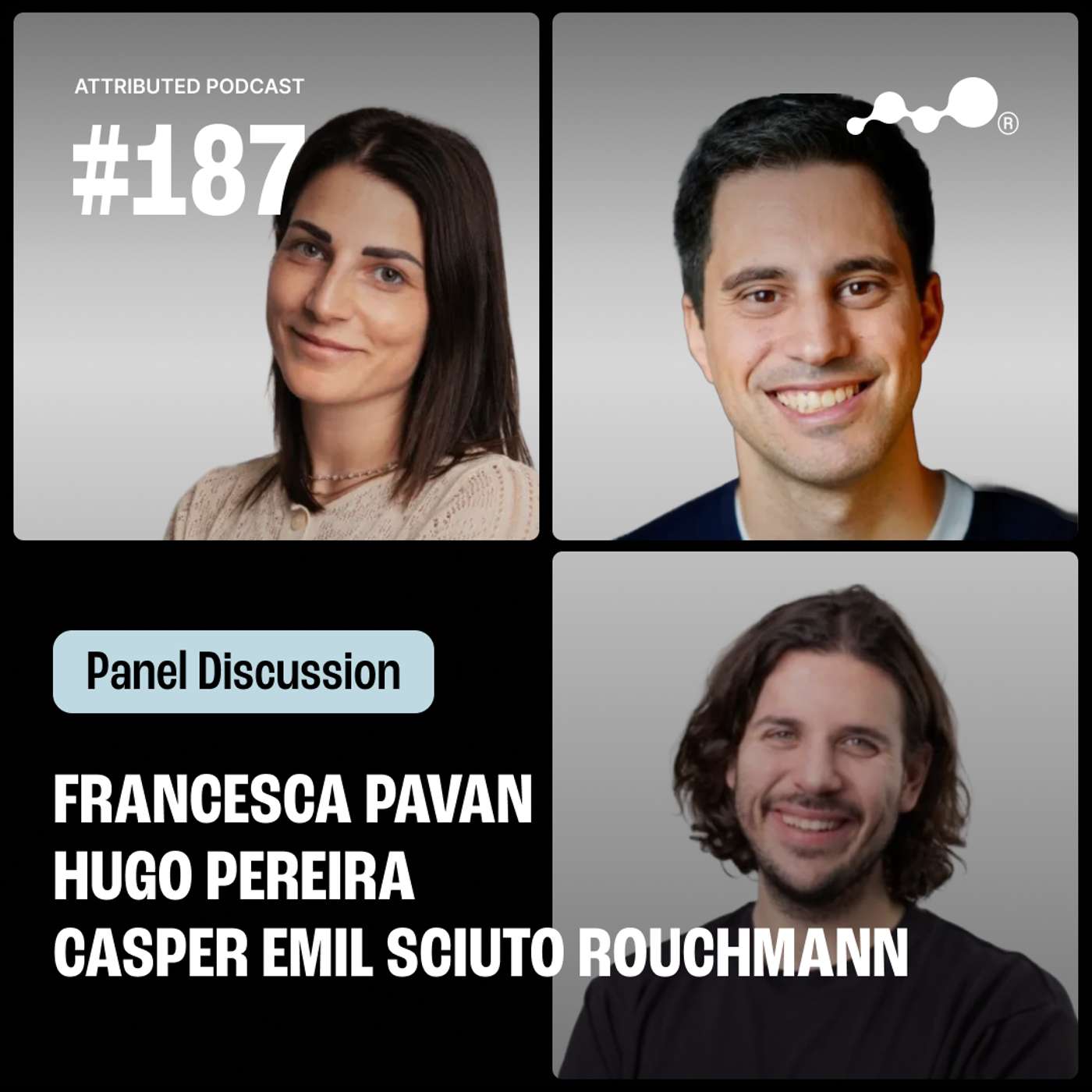
2026 B2B Marketing: Trends, Tactics, and Predictions
55m 58s
The podcast episode features hosts Laura and Stefan with panelists Francesca, Hugo, and Casper discussing B2B marketing insights from 2025 and predictions for 2026. Francesca, from a legal AI company, notes that 2025 was characterized by speed and demand capture, as her industry experiences high immediate demand, flipping the traditional "95-5 rule." Hugo emphasizes adaptability, as buyers are now more knowledgeable, requiring companies to move away from outdated playbooks like gated content and generic outreach. Casper adds that 2025 saw a relentless focus on efficiency, with AI enabling more output but raising the bar for quality, making bold, standout marketing essential. Tactics that declined include large trade shows and traditional paid advertising, replaced by owned events, creator/influencer marketing, and employee-led social strategies. The panel agrees that personalization and clarity are key for 2026, as AI increases market noise, pushing marketers to prioritize innovative, targeted approaches over volume-driven efforts.
Hi, I'm Laura. Hey, I'm Stefan and you're listening to Attributed, a podcast library by GreenDidda. The purpose of it is to store and share all the knowledge that we have gathered across DreamDid employees through our LinkedIn lives, podcasts and webinars. The typical topics you'll find here can be stuff like marketing, sales, V2B ads, operations, social selling maybe, hello and welcome everybody together with us at GreenDidda. Today, I'm super excited because we have the opportunity to get a lot of bold statements on record, which we can all enjoy in a year's time and check out whether we were exact or not in our predictions about what's going to matter for V2B marketing in 26. And I'm super happy today because we have a great panel here which will introduce themselves in a minute. I've shared a few questions with them up front just to allow them to prepare a little bit, but mainly we're going to talk about how was last year, what worked, what's going to work this year and what are kind of your boldest predictions of what's going to work or perhaps what's going to fail. And I'll try to pass the torch around to each of the panelists that are here. But let's just go straight to it and say welcome to the panel, Francesca, I'll allow you to do the one minute intro first and then we'll pass it on to Hugo afterwards. Thank you, Stefans. I'm super happy to be here. My name is Francesca, working at Lagora. Legole, I software for lawyers. I work as the management director here. I joined the company back in May last year when the company was a pretty small startup out of Stockholm. We are now over 270 people and it's growing really, really quickly. My background, I've been always working between marketing, always here in Stockholm for Swedish companies, specifically in the SaaS industry. So I work for Clarna, which I'm sure you know, and then Tink, where I work with Open Banking and with a more banking industry focus. So first time working with for a AI first company and it's extremely, extremely exciting. And yeah, like everything's probably extremely fast. So we're going to talk about speed a lot, I think. Wonderful. And looking forward to ask about AI questions to you. Hugo, you're up next and then Casper after that. Yeah. So thanks, Hugo. Pleasure to be here. I've been a marketing and going to market executive for the last 15 years at multiple B2B, SaaS and Hardware startups and scale ups. Most notably was at VV Box, where I spent seven years in electric vehicle charging software and hardware company. We grew from one to 150 million revenue and an afterwards. I said that it's time to go and bootstrap startup go management software. Exited recently, not a great exit, by the way, just a, you know, graceful exit as I like to call it. And then since that, I've been taking like the last three years of fractional CMO growth role for various B2B SaaS companies, mostly at 10 million a year at business or beyond. And currently I serve as a fractional CMO at friends, which is integration platform for workflow automation, mostly focus at mid-size enterprise business. So where they have average customer value of 20 to 40 KJR. So that's kind of like the current situation where I'm working at. And yeah, and that's essentially it. Excited for the conversation and the both predictions we might have ahead. And you Casper. Yeah, thanks. So yeah, I'm Casper. I'm the founder of a company called Spark Force. We're an agency that helped B2B SaaS and tech companies up in the SaaS tech space for, well, if you count the last three years, 13 years now, I guess. So quite a long time. I work for Templify, Trust Pilot, United FinTech stuff like that before. Head of marketing, head of growth, kind of stuff. And then I build Spark Force and we're 30 people. We've helped more than 100 B2B SaaS over the three years now. So quite a lot. So yeah. And I brought one thing today. I haven't told you guys actually, I brought popcorn because I was thinking like it's going to be some hot takes, right? So it's going to be fun. So let's see if I get to use them. But anyways, it's going to be fun. Awesome accessory there, Casper. I'm just if you were already getting into it about 25 being being a crazy year, but just to get the conversation flowing, let's love each of you to just kind of try to summarize your marketing in 25 and in one or two statements or sentences to kind of get us all aligned about where we're at today. But Francesca, how was your marketing at 25? It was fast. I tried to think about some way to summarize 2025 for us. And I think it applies to most of the marketers around in the industry, but everything, everywhere, all at once. It's pretty much been like that. I need to specify that we are in a specific peculiar industry when it comes about legal AI. The 95 fire rule is completely flicked for us. So we have the luxury of having all of our prospects accounts being in a buying process now. Which means that speed is the number one priority for us without sacrificing the quality. But I know that we tend to not talk enough or to shy away from talking about speed when it comes to marketing because you would think that it's associated to bad quality of products or campaigns and outcomes. But the idea is that AI can enable you to ship really, really quickly campaigns that normally take you longer, but by keeping that quality intact. So for me, yes, 2025 been pretty much everywhere trying to test as much as possible learning immediately and then iterating as fast as possible. Sounds like a dream come true that the 95 goes inverted? Yeah, I quickly realized that my role, demand generation, it's a bit obsolete. It's more about demand capture. We have the luxury again to have that demand already there. So it's more about capturing that demand, converting as quick as possible into opportunities. Maybe, but just explain why I have some assumption, but maybe for everybody listening, why is it that? Is it for you guys right now? Yeah, I can explain. Well, as I said, we work with lawyers, law firms are corporate, so in our teams. And right now, especially on the law firm side, everyone, every single law firm by now have understood that they need to work with AI. More than market years, actually, we're going to talk about that. But that means that they see the benefit, the true benefit of using AI and they have the urge to get AI and AI tool. So that's why everyone is looking into evaluating and that's why we need to be in the front of all of our prospects as quick as possible and everywhere. So they're making a decision pretty much as we speak all of the films. So that's super exciting. I'm sure they did invest us on pretty excited as well in your company. Google, what's your kind of like few bullets from 25, where did you end the year? Yeah, if I look back at 2025, I believe it was a lot around adaptability. That's what I felt, adapting to a new, one can call it a new playbook or a new dynamics. Of course, AI drove a lot of the conversations, but I feel that a lot of the companies were trying to adapt what work before is no longer works now. And one of the things that I found was that they know that the buyer is changing. They know that there is a shifting dynamic where the buyer is becoming as knowledgeable as the seller on what they need and why they need it right now. And that means that a lot of processes no longer work well. That whole process for many of the companies I work with, especially friends at whole logic of like, you ask for a demo, you go to an SDR, you have a discovery code, that people get annoyed if you have to do discovery code. Then you have another solution architect and people want to move faster and it requires adapting even for companies that are selling to enterprise. They have to adapt and, you know, especially to talk about speed, I think that's true, but also for a lot of the market tiers, luckily for someone that is fractional or maybe there are some fractional people missing. The reason why there is a lot of demand for fractional is because a lot of the marketties are still relying on the playbook that they learn about betting and demanding or demanding or betting and depending on traditional page channels which are not no longer working as well as before because they are more expensive and more competitive. They still rely a lot on gated content to drive NQLs, but, you know, this whole NQL game already for 70 years is no longer driving pipeline and there is a pressure from investors, from the CEO saying, okay, we really need to hit our targets and show growth. And, yeah, and all the generic outreach of SDRs reaching out, trying to convert, everyone is overwhelmed. And I think that's why adaptability exists because it is a year of overwhelm, you know, whatever people say, yes or no. Even I that spend so much time figuring out how to adapt AI, how to adapt a new to a new playbook. You know, there's like 20 posts on LinkedIn on the daily basis that you have to absorb and see if it makes sense or not. You have, there is a podcast, there is a newsletter, a new record, you know, is scooping with so much information that I felt like it's a year of figuring out clarity on, okay, I'm going to bet on these and I'm going to stick to it before I, you know, go left and right, you know, so I think adaptability and clarity or focus, I think those were the words that I found that most of the business I work with and especially friends, which, which you know, 30% year on ERR, which is still very positive for the company of the size. And I felt it was because they were able to adapt and focus on one motion, stick that motion for at least six months before moving to something else. Very interesting and a whole lot I hate the AI is yours. It's like, yeah, just framing people that just doesn't get you anywhere. Kasper Warrant. Our good friend Dave, he said pretty well at the other day stuff and where he's like, yeah, every, every CEO, every company wants automated outreach, but nobody wants to receive it. So nobody wants to be under receiving end, but everybody wants to do it. I think that's how we all feel about it, right? So, Kasper, what's your notes from last year? I think so there's a difference between what we did at Spark Forest because we're an agency, right? So that's our own marketing was a lot, a lot of fun and a lot of experimenting and a lot of cool stuff. Like for the clients, I think one of the things I've noted down is a relentless focus on efficiency. Like, efficiency is the name of the game. That means lean teams. So everyone's focused on suit. Like, it's been a lot of layoffs across a lot of SaaS companies and the reason they do that is because AI is kind of forcing the pressure and pushing the ball of saying like, okay, we need to be more efficient. And as you also highlighted who go right, it's more expensive, right? So it's more expensive to do marketing, paid media is more expensive. So everyone's kind of scrambling to figure out what works and the playbooks that didn't work before, like the classic mql hamster wheels, they have never really worked like and now they definitely don't work anymore, right? So people are scrambling and budgets are being squeezed and that's kind of putting pressure. What I do want to say with that is that it's creating space for like and it's pushing us forward, hopefully as marketers to stand out more. Like, it's sometimes it feels like a cliche, but I've been like really adamant about that lately. It's just like from my side of perspective, the one that once I'm seeing winning or just the ones who are willing to take more risky willing bets or more willing to stand out be more bold in the market because what AI does is that it creates an influx of a lot of marketing, like a lot of shit marketing. Like, let's be real. It's pretty bad. Most of it. So what the only thing you actually have to do is just be willing to go beyond that. And a lot of companies historically haven't been willing to, but once they do, those are the ones that are winning. That was my short take on it. I really like that, Kasper. I'm trying to preach that to my team as well. Just because we can produce more with AI doesn't mean that that we can put out stuff if it's mediocre. It actually is the bar just goes significantly up because everyone can do mediocre now. So you need to figure out stuff that is not mediocre and that is like truly a firm stopper as people scroll through everything. Exactly. I know we'd love to talk about stuff that worked for us, but I think we should do like a round of one tactic that kind of left the playbook of each of us last year that stopped working just to kind of align ourselves of what should we not do more of this year? I know, Francesca, you kind of said that everything's working right? Be like bragging about everything that works so fast, so quick. But there are some things that work less well, let's say, and that I would not bet on in 2026. And it's not something that you will be surprised to hear. And it's a huge trade shows. It's just like a big no for me. But it really depends on the stage of the company where you are at and the bread awareness for us last year, especially the beginning of the year. Again, because of the 95 split pro, we had to felt like we had to be in all of those big legal events. Because if we wouldn't have to be there, we would have lost opportunities. And our competitors would have been there, right? The FOMO was real. Exactly. So we had this gigantic notion list of events that we had to be. And for the marketing team has been cows like so much work, you know how much work it is to organize those or like be at those events and booth and even like keeping track of the merch and all of that. And I think a bold decision is also to not participate to those events. And instead decide to turn that interest into your own events and like organize your own network events where you can control the narrative, you can control the topics, you can control the guest speakers where you're inviting. Obviously, that's possible once only once you have reached a certain level of brand awareness, which luckily we did. And that means that now 2026 less events or huge events rather organizing our own hosted events, whether there's more or bigger but very crafted for our target audience and make people wanting to go to your events rather than you having with your booth and hopefully track what to say to him is actually even doing there. The cost of these big events have always scared me off compared to what could you actually use that money for elsewhere. Yeah, I would say that's one thing that we have learned pretty quickly that we couldn't avoid in a way in 2025 because we fell we have to. Now thankfully we reached a level of interest and consideration that allows us to move to some other tactics and put the budget somewhere else. That's great. What's one thing that left kind of playbook during last year? Yeah, so first one echo what Francesca said, we also had the same exact movement of budget. When I read it, a lot of trade shows committed, for example, last year for friends, this year there's zero trade shows budget. Like zero, like first six months of the year is like everything is owned in house built events, even for new markets where traditionally, you know, it's very hard to build up the brand reputation. So even then we're going to explore like, you know, own intimate events over trade shows. One, because budget is much more simplified, you can go faster, you can test it out and if you work with partners or at least we can on the business model, if you have a partner motion or, you know, or some resellers or valuable resellers, that can be very interesting. The other thing that we switched budget heavily was from traditional paid advertisement. The most traditional paid advertisement, I mean like, you know, Bing ads, Google ads, all of that, that all switched to a mix of creator influencer marketing and the other one, which switched also to social advertisement, but not the traditional social advertisement putting ads on LinkedIn, but more employee-led sponsor posts. So yeah, so making sure that the employees build up their profiles and we can actually, you know, to be honest, like pay for the people that follow them to actually receive the post that you are writing in the first place, because that's the game of the algorithm of LinkedIn, you know, like, I understand their business model is a game they are playing, but so traditional paid advertisement, we just saw that got so expensive that the cost of acquisition was just not worth the investment, at least that's the for this specific case and many other ones. So, I'll say those are the two biggest ones, so echoing what Francesca said and traditional paid advertisement, at least for my most recent customers, is not working as well as before. So yeah, nothing is going to die, like a traditional big bank post of like, you know, S.A. is dead kind of thing, but the effectiveness is not there any longer, at least for now. Just for anything outside these two points you want to land? No, I think like, I think I want to be more, when we say paid advertisement, for me, that's like that's a big, for me, that's taking too much into the same bucket, like because for me, it's more about like the whole search experience has been under decline in 2025. Like so, so everything like that's related to search has been in scrambles and especially the paid search of both Bing ads, that's Google brought up, but also Google ads is a declining space and that's we've seen that across the board. That does not mean it shouldn't exist and there's still space for it to exist, but there's definitely some reallocation of budget that needs to happen and it's slowly happening, but that needs to happen. And I just want to chime in and say like, thought leader ads is just like, if you haven't done that in 2025, then you're definitely missing out. Like it's a massive game changer and so that's like the other side of that spectrum. So for me, that the paid media just, we just shifting it and I actually think some of it is a good thing because like Google ads has like speaking of dream data and attribution has always historically been attributed way more than it deserved, right? And now we're finally starting to see that's not really where the world have the world works, like the buyer journey's different stuff. So, but I think that's a big thing. I do want to say like, own hosted events has been a big thing for us this year, but I do want to agree on both of you and trade shows is not like what you want, like what I want to do either, but so I just want to on the own trade shows for the, so it's just an addition for the own trade shows, a little bit more for the scrappy marketing games that sometimes we lose in the past. One thing that I've done, which is to do side events next to big trade shows without attending them. One hour percent, yeah, absolutely. Yeah, that's gorilla marketing, right? Yeah, all the buyer's already flying in for the trade show. So, there's a good chance that he might grab a few of them for a side event, so that's something that has been, I'm not going to say is effective and it works, but I'm saying that there's a good chance of you trying out and timing it sometimes next to the event. So, yeah, so that's something that's, you know, with a little bit more. I think I want to, if I can, if I can summarize one thing, I've kind of observed a little bit, the kind of ties into what we're trying to say, it's like, for me, like the whole, the wielded game of the year has been like, the personalization is just like really massively important, because like, everyone's like, the reason good, good events are still working, because like, A.I. is kind of like making the digital experience a little bit shittier. So, everyone wants to be like close to each other, have like personal relations, COVID is a few years back, but like, that's still lingers on with people. And I've kind of felt that like now with the rise and cost of all digital, like a lot of stuff, like some of the best successes we've seen are people who send like small gifts and stuff like that, gifting in general, like these ABM motions. I think the problem I've seen is that you have PLG motions over here, at least like a lot of volume, like a lot of volume, and then you have your really high enterprise. The ones that are stuck in between are the ones that are really struggling, in my opinion. That's what I've seen. Like, those are the ones that can't really figure out if you're PLG or super enterprise, those are the ones that are losing right now. Also, from a marketing, from business perspective, also from a marketing perspective. Cool. We got a question in here from Harry, which I think fits pretty well here. He says, "I'd be interested to know what digital channels the panel is that are leaning into this year. Obviously, paid is getting more expensive, but I'd assume LinkedIn, Google, are still a priority. Are there any other paid-ass channels outside of this that they're betting on?" And this is the good territory for coming up with some predictions that either work or fail. Anyone who wants to go first here? Well, I can, I'll go ahead and discuss that. No, no, no, go ahead, please. I was just going to say that, I don't know, I can say more what the trends of what happened, and for example, Google ads, the spend decreased by 70%. You know, the mind monthly spend, it is by 70%. On the opposite effect, LinkedIn spent increased by 120%. You know, like, the 70% is real, the 120% probably is an estimation on making all my mind, but he's just, not saying that he's working, but for example, if you are in a business that is highly depending on account-based marketing, for example, you just have to rely on LinkedIn as a platform. And if that's the case, then, you know, you just have to do thought leadership posts, as Kasper was saying, of beginning out ways to get the voice of your experts to the buyers, or at least to the people that are in market or might be in market soon. So LinkedIn is another one. I, we did tested a lot at least, for example, at friends, reddit ads, G2 ads. I cannot say that I have a result that I can say it's working out. Reddit ads seems like like a whole game on its own, so I cannot say it works. And then G2, I'm not sure. I have like maybe a prediction that review websites are going to go through a massive transformation in the next couple of years. So I see a declining value in those. That's my, my, my take. So yeah, so there's not a lot of channels. It's more about being really good and stand out on the existing ones, over trying to figure out new distribution. Though, who says that's a lot perplexed, that's your GPT are not going to open up a new distribution avenue beyond the I search, but even with ads, we don't know. In six months time, they might open ads, and then you are like, oh crap, my buzzer kept going to chat GPT ads and other things, you know. Yeah, exciting to do. Whether they, when they open the doors for ads on those platforms, if I'm just, what are you betting on? No, but I agree with you Hugo. And I mean, I don't think it's going to take that long until that happens. So for the time being, we're going to stick with the channel that is going to, that's been generating most pipeline for us, which is LinkedIn. But that said, it really depends on the audience. I mean, it's obvious, right? So our audience, luckily, it's very easy to be targeted, because there is a nice function on LinkedIn, and that's called legal. So for us, it's pretty, pretty simple. Our ICP is quite straightforward. And lawyers apparently are a lot on LinkedIn, so it's more about how we use and leverage LinkedIn. I cannot remember last time I uploaded a static image on LinkedIn. We have just used in thought lazy ads. It's such a game changer. And now the evolution of that by utilizing not just employers posts, but possibly customers or prospect that are mentioning your own brand. Those are the ones that build the most the trust. And it's so easy, you just ask the people to accept the, the possibility of both the post. It works magic. So for me, it's more utilizing the channels that have been working and doubling down and testing normal new formats. So definitely LinkedIn. So keeping that in terms of testing new new channels, we're looking into social media that are more towards the B2C audience just to test it out. Why not? I mean, after all, we're selling to people. We know all that and they are often as well on those other social media. So let's see how that goes. Let me throw you a curve ball since you see there's so many different accounts. So if you can't say Google search and you can't say LinkedIn, what have you then seen of funny stuff out there? No, I was going to say something different. So good. But because I wanted to say, first of all, Reddit is massive. I think Reddit is super undervalued right now. And I think I need to talk to you about like getting a better Reddit attribution stuff. But that's another point for another day because I think we're massively underrating the power of Reddit. We have multiple cases where we can hardcore seed working really, really well. So I think Reddit is one of them. I think the other one we haven't talked about is TikTok. And TikTok is working. No matter how we frame it, TikTok is really working. The thing about TikTok is it's really hard to get working. Where Reddit is easily more understandable. I think Reddit is one of those channels. The way I see it is that if you have an niche audience where like if you're like in super nerdy SaaS tech stuff with like the nerds, especially myself, maybe we hang out on Reddit. So there's like these subreddits that are really popular. That's going to work. TikTok is a little bit more broader, but you can definitely also find space there. And I think a lot of it also ties to the next one. I want to say it's like YouTube. Like when no one's talking about YouTube, but YouTube's still big. Like YouTube's still massive. And especially, so all of these in my world when you time in are part of the top of the funnel. So these are top funnel activities, the like channels that definitely work. I think the hardest part about all three is that they are less measurable. Like let's be real. And historically if something is less measurable, if you can't measure it like as precise and something else, then it just doesn't get the same budget allocation, but that doesn't necessarily mean they don't work. So I would say those three are high on my list, and I've seen results from all three. TikTok, I can't really convince all my clients to try it. So that's when I'm struggling. We're on, but the two others are very easier to convince people on. Once you get used to the LinkedIn ads system, you just really miss the account concept on YouTube, on Reddit, on like any other LinkedIn like meta meta is a little bit of the same. Like people like to call things dead meta is not dead. Like meta definitely works also in a B2B context, you just got to do it right. And it's harder to do right because you can't do the account targeting without external tools or other ways of doing it. So you got to be a little bit more creative, but you can definitely make meta work as well. Like I want to bring up one thing if I can just briefly throw it in on top of that thought leader ads influence the marketing. Like I know that's not a channel in the sense, but we've had some same results on some of our clients on that. So we're so not only so normally thought leader ads just for the audience, maybe it's just like for your own companies, people. So I would sponsor Casper's post or Stefan would sponsor Stefan's post from DreamData. But now for a lot of companies, we go out and find these influencers and they get paid quite a lot just to heads up. That's kind of crazy. But to post about your company, it's a classic B2C motion. It's just finally moving into B2B. That is, especially with thought leader ads now, that's so easy to do and it works really, really well. Yeah, and you're starting to see like even agencies, many, I think they call themselves B2B creators, but they're starting to be these agencies that have like handpicked talent for whatever your company does. And we're doing a bit of it as well. If we take a breath and then now we, if we put channels aside, I think I'm not like a thing that is unavoidably going to be huge is like AI and the kind of all the waves that is still making in both in every industry, but also for us as B2B marketers. Let's start with, like let's go gently into it and say, can you tell me one little thing you do with AI that does your work life easier? Hugo, you can go first. Yeah, I have actually plenty of examples, but maybe the two most relevant ones that I found that was a good switch is using AI to gain insights on customers, especially as a fractional, as a fractional person that has multiple clients is not always easy to have the learning curve. You have to enter Ed Valley, but understand the customer profile with the buyer, why they care for, is not always like straight forward the business model is. So I found that there's like some very minimum now that I always do and or try to get to a company when I get there, which is a workflow to analyze the sales calls on a weekly basis, just like what are the patterns of the sales calls, what are the key questions, what are some of the differentiators they highlight from the customer, or in this case from trends, send that to Slack with an weekly analysis and that's easy because if you have five flies co-pilot, whatever meeting motor, you can easily do that kind of workflow. And one that I really like is to review win loss analysis with AI. So every time there is a win wire, a win creates a small win wire, if there is a loss, there's a loss wire, why it's lost, why it's won. And that's just enriching the data automatically when an inbound lead comes in. It saves so much time for sales, there's always a problem with CRM quality and people say that this is not the marketing role or something like that, that's one thing that adds me a lot of value because for me to get that knowledge before a guy was a lot of sales conversations. Can I join a sales call, can I join a sales call, can I join to listen to the customer, and now I can do that at scale. So that's a big one and the other one that I'm having fun with, and also if you add if you add value at all times, but it gives me a lot of joy to be with internal tooling. I just saw the power of it, like a very simple one that maybe will before it was not possible, just that these sales kickoff, two days ago at friends, they were saying like, we want to do APM, but we want to have more personalization, and I was like, how the hell am I going to get personalization at scale? And I was like, well, why don't I just build a tool using loveable or replete that analyzes the scripts, the website, connects to the HubSpot CRM or Cognizm or whatever, scripts, gives an input and generates a custom landing page for every single customer at scale. That sales can do it, they can just press, create a landing page and use it as a way for AVM one to one. In two days is done, presented to sales, showed feedback, let's improve, let's iterate. Now I'm going to ask, okay, in six months time, let's see if it works or not, or in three months time, but the ability to do this internal tooling gives me the joy that, you know, there's a new momentum to create new opportunities, there are a wake-up later assessments, et cetera. So one is fun opportunity and the other one insights for me, it's the thing that gave me the most. So a bit of a long answer to something simple, but this is where I see most value today. Yeah, wonderful examples, Kasper, I bet you do a lot of fun stuff as well. Yeah, but actually, I'm going to be super boring, I think you said almost the same, so I wanted to say, because like, actually the biggest takeaway, like the biggest efficiency, I think it's a little bit different, because like, I have a lot of specialists across in our agency, so like, the creative department has a lot of, like, use it differently than I do, like, it's an example, right? But for me personally, like, no takers, it's just like been massively, like, the fact that I can just go in and listen to sales calls, analyze them super fast, like, hey, and nice to meet you company, I'm going to analyze all your sales calls from last year and hear about your biggest pain points. Boom, 30 seconds later, I have it. Like, that alone has been such a game changer for us. Like, that's a massive one. I, one of the other things I use a lot is that I analyze CRM systems with AI, so I analyze also, like, lead and takes and like, and compare it to the platforms, so we build some some some workflows around that with a nan and stuff that works really, really well. That's been really powerful for me. So those would probably be my two biggest wins. There's other stuff as well, but those are my opinion from my personal perspective, the ones that I used the most. Did you say analyze a CRM with AI? I've never heard anybody say this. Yeah, well, it depends on what you want to analyze, right? But then also just be mindful. It depends on your DPAs, so watch out, GDPR and all that stuff. So you have to build closed environments to do it, you probably have to use co-pilot and stuff like that. There's another talk for another day, but you can essentially use AI to kind of go in and build agents that analyze your CRM and say, okay, cool. Here's what's not happening. Here's what's happening. Here's what's not been followed up. You can set it up. However, you want to set it up, but we kind of do that. You can't do it on all of our clients, but some of them. Wonderful. Fantastic. You got a little nice trick for you. I'm afraid I'm going to repeat pretty much what you said. Maybe you haven't mentioned time analysis, but I mean, that's extremely interesting now, especially when doing this one to few tactics and wanting to find a specific account in a specific region, a specific segment based on revenues or number of lawyers or what's not to depend on your industry. It goes extremely quick. I'm personally using Clay, and just using Clay, there are so many things you can do. I'm also thinking about you mentioned Casper Gifting, which is back, I guess. I don't know if it ever left, but now it's definitely something that we're going to look into more. You want to find email addresses or addresses of where to send Gifting without having to ask for that. If you want to send that obviously at the office or the HQ where people work. Yeah, a lot of enrichment as well, same for as you were you said, especially when you have a very high volume of inbounds and you miss specific information that will allow you to route the leads to direct people. And then for internal purposes, I mean, I do use AI daily, mainly because it tells me summarizing, drafting, it's things that stays in my laptop. I mean, I mean, that I don't really use AI for creating content that's going to be used and distributed outside, rather than within our team. But just that per se, creating a very solid brief for every project so that you have the why and what and how. I mean, allows you then to scale faster, right? So for, I would say we are using it more for internal use than for output. I cannot think about a campaign that we have launched, which up to output has been AI generated. Maybe it's a bit of an orthodox thought, but seeing how AI has been reaching like such a high level of product market fit within certain industry, like the legal industry or engineering or even GTM with with clay. I don't think it has reached that level with marketing. I don't think we are there yet. I see market here using it here and there, but not in a systematic way. It's not yet at least, not that I know of at least. I think that's a good hook to maybe explore a little bit about how we should be like pushing AI in our teams and what we shouldn't be pushing. As for humanity, I can really also start sensing this fear of like brain rot where like nobody thinks and you just like want to prompt your way to everything. I think that is definitely the bad path and I think whenever I actually, if whenever my input to AI, if I invest a lot of creating a lot of good context for the AI, then the output I get from the AI is quite good, but it starts with me thinking rather than the AI thinking. But what I would love to hear kind of how in each of your teams you try to, let's call them good AI marketing habits. What are the things that you're doing in your teams to make the best out of it? Who you can start? Yeah, no, it's a good question. I think we are still, you know, I think we are still figuring out in a lot of the teams. There's a few things that we do that maybe I do normally do it kind of like half of the AI sessions, like every two months or every month. That's basically half a day where you just go in and try to do something altogether. And so we start at like, my AM, everyone chooses what they want to try to build. We meet again at 12 PM and we just share like what was the discovery, what work, what didn't work. That's just a very practical one. After words, I think as similar to what Kasper said, everyone has a certain specialization and try to see how it helps AI, how to build agents. With a lot of sessions if it with our own solution architects to show how I can be used beyond just chat CPT or something, but really starting to build workflows with the workflow automation or using loveable for tooling. Just to see the possibilities, I think the biggest thing that it's the one thing that I don't compromise is to just highlight the teams over and over again that do not outsource your critical thinking to AI. Because you regret into three years time. I think that's the main thing. For the rest, I just, you know, I also feel if you feel that AI is not doing like the next productivity and spend more time than not. Don't spend time on it. Let the overwhelm, let the noise be. When you are ready to pick it up, pick it up. I'm not saying, I think you have to learn to work with it. But you know, if you're not ready now, it's fine. You're going to get there. Which I think is different from people that are saying, no, go AI, go AI, adopt now, or you're going to be left behind. I think there's an urge, but I believe that people also have to protect their mental health of like, okay, you know, not feeling that if I don't use AI tomorrow, I'm already like, you know, obsolete. So I think I'm trying to maybe get the conversation now. But my most important thing is that I just do not want people to outsource that critical thinking to AI. So Simulta, you said Stefan, do yourself first and then augment with the tooling or with the platform. It's the worst feeling when you find yourself. I'm prompting so much that if I had just written this, I would be done. I know. That's not really in that sense. Just why do you think that as you kind of sense that the adoption is not, or like, maybe the output adoption is not. Yeah, it's worth the output. I just haven't seen AI taking over an industry like the marketing industry as much as other industries. Again, I'm now talking about the legal industries where lawyers work with text, with a large amount of text, and LLMS is good for text. Market tiers work. Yes, we also work with text, but we also work with creative output and creative thinking. And I just haven't seen a product that allows me to replace many activities that I would normally do other than allowing me to ship faster campaigns by creating briefs, finding the right accounts faster. So in our team, we're not thinking I first. Actually, we're just thinking about the best compelling messages that we can produce that will resonate with our audience. And if AI allows us to do that faster by doing some research or enrichment, great. But that's not the goal. That's not the outcome using AI. AI is a way to get to do our job faster. Great. And Caspar, what are you doing at Spark for us to kind of get good AI habits into your, your people? I think can I add something to what you said for me? I think it's a really interesting point, if that's okay. I said this the other day when I was talking to a friend, I was like, I think what people are mistaken is that in the beginning, they thought AI could replace everything. So it was like full on scale, like you saw a clarinet fire, what is 30% and you saw sales force move a lot of people and they're like, oh, we can't actually do that. But what I've seen now is that it AI doesn't really replace your first designer. You still need a designer. You need a designer, but it might replace the second. And I think that's how I see it. You need the first one, but then the first one becomes massively more efficient. You still have the critical thinker, the one who like is the whole like the signed guide rails and like keeps everything in check and can use the tool. But it's not like you can't have your CEO like or me sit like, hey, I'm just going to come up with some cool design concepts. So I think and that's what I'm seeing. So that's also the whole lean focus is like, okay, everyone just needs one person and then they add AI. I think that's what we're seeing. Like, but honestly, we use like in the beginning of the year and then still we still see that like people come to us and they're like, like, what we're being told we need to use AI? What do we do? And so I think what we've been doing is just like mapping out use cases. And there's a lot. I think people are still in that phase. Honestly, they're just like mapping out use cases. And it's very different, right? We have in our copywriting, we use it like we take all the inputs and then we take it in together and then we build it into our frameworks and then we get some outputs out of it. So and then so if you have good frameworks and you have good inputs, then it's really useful. You should we never ship it like hey, that's it. Good luck. Have fun, right? But we use it as a starting point. I use it more way more. We use it way more for research, right? So also coming up. So here's here's a good so we research what's interesting that space and then we use it also to validate our concepts. So before we design a final ad, we take, okay, here's the concept. Can you come up with create an image or a video that explains that concept and then we say like do you like this idea? Client yes, yo. And then we make the final version of it. So that from speed like also to your points, right? That we use a lot. But we have a lot of use cases, but it's very some, I think we're going to see that some of it is going to be more templated bold than we thought. Like everyone's like, hey, everyone, my case is so special. I don't think it is. Like I think we're going to see in next year that a lot of it is like, okay, it's the same use cases across the board. That's at least what we're seeing. So I think that will be the case. Yeah, I think my last kind of take it would that's something we've done at the marketing team here at Dream that has been just to have a monthly session where everybody has to show something that they've done with AI within the last month. Like where it's like, literally, I clicked this button. I got it to do this thing for me because there's a great let's call it cross pollination going on that, hey, I could like the thing that you found out over there I could use with the project I'm sitting with here. So that that very tangible forcing people that you have to come and live demo something has been a good educator for our team. I went ahead and hired an AI engineer like for my small agency here. So I have literally have an AI engineer whose only job is to create AI workflows and build AI agents. We started by doing it internally first just to validate. So it's just been building for Sparkforce and then we started selling some of it now. So trust me, I'm all in, but it's also we've been finding it's like people don't know what the fuck they want. I get it because they're like, the CEOs is like, hey, do AI and they're like, Mark is like, okay, what is good for you, man? What does good look like? So I'd love to die for us to just dive a little bit into the this whole Google that discussion now that there's AI about like we used to like want to just rank pages in Google and then if we could do that, we'll create our demand and then we'll all be good. But now that it's these, I think chat GPD has more than 800 million users now doing a lot of research there. There's complexity, Jim and I have whatever you call them. Watch your take on this rise of these. Let's call them answer engines and how much is that changing the man for your company? And is it something you do something to rank inside of these engines as well? So I'd love to just like hear the round of the table. Have there actually been a revolution in research for your companies? Francesca, you can start. I mean, first of all, Google search is not dead. Let's just start with that. People still search on Google. It's just that the customer, the way prospects are searching is different. They maybe start from LinkedIn, then they go to Google and then they do LLM. So yes, of course, we're looking into that. There is a very clear or clear. That's what's at least online. You can tell what LLM is ranking. So getting a Wikipedia page, for example, helps a lot boost in your ranking on LLM. Reddit as well. So even just doing those small little tricks and to get to being those channels that LLM refers to, that definitely helps. And we do see a lot of traffic coming from LLMs, for sure. But I still think that you need to keep an eye on Google search. I almost think that Google search, the intention, it's much higher. It's much more high intent. I can see that now through the end data, I can see actually that those Google search are the highest intent signals before a conversion. My take on this is that people will do their research on these answer engines. And then once they've found the one or two brands, three brands, they want to talk to, they go to Google and pop in the names, over in Google. And then they intend to super high. Exactly. That's why I think LLM, it's more top of funnel almost. And then the Google search happens when there is a higher intent. Yeah. Google, have you seen any major changes? Well, I think this will be our whole webinar on its own. I believe that this will be one of the, I can also say, one of the pitfalls that's going to happen this year is that I'm sure that we tons of market years. Myself included that have been like for the last month and a half looking for a AEO2. And it created more frustration and happiness, you know, because there's like now 20 AEO tools all rising in the next day. And I think I tested 10 of them. The 10 gave me different results on the share of voice, citation, quality. So I'm like, I don't think I know which one to trust. But the fallacy here is that a lot of them are promising that look at the crumbs, create the art for the crumbs and you're going to show up. And in some cases, it might work out. But the danger here is that, as he said, like, if you bet on AI share of voice, there's a lot of consequences around it. You have to improve your brand and you have to invest on brand. If you have to invest on brand, you have to invest on PR. And then, and then if you have to invest on PR, you have to invest on visibility. And then all of those things, as Kasper mentioned, they're not the easiest, the most easily measurable. So when you go back to your CEO and they have to invest all of these and six months later, the pipeline didn't move, and the share of voice increased a little bit, but there's no pipeline coming from it. Then you start entering on this conversation again. So ready is not an easy game to play. As Kasper said, there's a whole playbook on its own has to be very what they can call very powerful. But Wikipedia is not easy to get as to Wikipedia pages before. And you can actually get blocked. So it's not just that let's just create a Wikipedia page. You're going to get rejected most of the time. So then it becomes like a little bit. Many people think it's an SEO play, but it's not. So I'm saying that there's a lot of moving pieces. If you bet on AI search, I think you cannot ignore it. I think you have to invest on it. I think it's one of the market ideas that they should understand the consequences of wanting that. And it's just not just writing articles and hope that your share of voice increases. But I think it brings valuable questions about which prompt you want to own that highlighted differentiators. So for example, for these company friends, it's an integration platform. Competition is insane. All the other brands are American driven. They have 100x more traffic. They have 110x more power, brand power. You're not going to win against them. It's not going to be a writing artist and is there. But very few are European. Very few are European GDP are compliant. Then we might not have the same amount of volumes. Okay, let's try to win these prompts. Maybe there'll be less people searching for it. But the one searching will have higher intent. And we got, you know, like the first use coming from my eye share of voice. There are not many, but this might be a way to start getting there. So it will drive the right questions. But yeah, I think it's a priority, but I don't think it's as easy as people anticipate that is. Let's have a tool to prompt, write the SEO articles and voila solved. It's funny because like PR has been way out of my playbook for many years. Now I need to think about it again. I need to have these mentions. And I'm going to have my brand next to this. I didn't like, let's let's speech to journalists. And it's like, who are you? You know, and then it's like, and then oh, we have to have a PR person. And the PR person is like, what are you going to pitch for them? We need to prepare a theory data. Oh, we don't have to prepare a theory data. We don't have to. What do you have to share? It's an interesting conversation. I find it fascinating, but I think it's going to be an interesting time for market years and next six months because this share of voice on the AI is going to drive a lot of other conversations that perhaps were neglecting for many long for a long time. The power of brand, the power of trust, customer referrals. Yeah, we know what. Can I spend your reflections, sir? Yeah, love. I totally agree with a lot. It's actually that resurgence of PR is super interesting because I was not a believer in PR. I have not historically been a believer in PR, but I'm turning around a little bit. I think the interesting part, so for me, the way I look at it is like the AI searches are more contextual. They look for context. And that's why PR is a resurgence thing. It's the same with link building in general that was kind of like a dying sale discipline to do link building, a little bit gray head, you know, and so on. But now it's kind of like back because AI uses a lot as a reference point, right? So it's a little bit weird that game. I do think what I think fundamentally we're overstating how fast this is happening. Like the market share of Google went down below two to 15 levels for the first time last year, but it's doing slowly. Like it's like, let's be real here. Like it's not, it's a thing and it's changing, but it's not as bad of like as fast moving as thing. Then I also think like I actually did a prediction early last year where I was like, okay, Geo is going to be everywhere. I'm like Geo and seal. It's kind of the same. Let's be real. It's not that different. Like it's not, it's not almost the same. Like it's more contextual, but it's the same discipline. If you do good sale, then you will show up in like in generative AI searches like in general. So, so that's kind of, that's kind of my take on it, to be honest. Yeah. I think it was one of the ones over panicking in the summer. Like, we need to show up these places, but then Google comes up with these search traffic is pretty much the same as you said. Well, it comes even to the practicality where people are like, oh no, now will there anybody need to have an FAQ at the end for answer the most precise questions. I'm like, well, that was a good practice. Even beforehand. That was good. Yeah. You guys done that historically. That's different. That was a good practice before, but now it's a, of course, it has more and more connotation to it. Okay. My godfilling, though, is that it is kind of a little bit more a tip of the iceberg because a lot of research is going on on the chat debuts, et cetera, that we are not seeing right now, and that's probably changing some of people's behavior inside of Google. I think it's more like also that the winner takes it all mentally, like a lot of the things that if you're right, like what's the best measurement tool, attribution tool, right? It's not like you get 10, here's 10 links to 10 different platforms, like in the old search ways of doing it. It's more like green data and maybe hockey stack, right? Like you get two options. Okay, cool. So, so it's more, and it's the same way where you said that you don't click on it. So you also see, like, HubSpot had a massive organic decline, but HubSpot's revenue is not declining per se, right? Like HubSpot, so brand value is more because you know, like you will be more valued in that space, and it will be more, even more winner takes it all mentality when it comes to this stuff, at least for long. So cool. We're approaching the end very quickly, and now I'll talk for a little while just allowing you guys to think. I want to hear kind of what is that one prediction you kind of feel inside of you for marketing 26 that that no one else is thinking about. You at least think you're a bit cruncharian compared to everybody else, or if you want to just go with something that you that might be obvious, and that is just going to be huge in in 26. What are that one or two things that you think will matter a lot for us marketers in 26? And who do you look like the guy who is the most ready to answer? I look like, but I'm not. It's a really tough question, especially the part of no one has. I think everyone thought of everything. When I was thinking, and maybe like influenced by the last days, it's not a, it's just an opinion. It's made maybe something that is underestimated, which is, people are still going to do a lot of outbound, and I've been thinking more and more that next year, we're going to see more and more marketing organizations trying to own all the cold world, even outbound motion, not the sales organization. Not the sales organization, of course, the sales do it, but only the process, analyzing, seeing what's working, seeing like, really taking ownership on the outbound messaging that everyone says, cold outbound is there, that's being it in place outbound. But the fact that it wants to move to an in place outbound means that a lot of the marketing practices come back to the playbook. So I think it's going to see a little bit of a transformation where marketing teams actually also have to think about how to sell and actually maybe take ownership on the initial phase of outbound, cold being it, cold, warm, intense driven with signals, whatever is your gist. But to build an effective motion, I start, I believe that the prediction that perhaps not maybe not thinking about is how do you own and influence the outbound motion on your company as a marketer, even if you are not being the ultimate responsible or the person extending the email. So that's just something that has been on my mind the last days. Let's see how it plays out. It makes a lot of sense because it's also becoming more of a technical discipline that there's a lot of tooling you need to get right to do outbound, at least if you want to do it at scale. Francesca, you want to have your. Yeah, I mean, take it forward it is, but I think again, especially because we are in the AI hype still, marketing in 2026 for me, it's going to be all about human centered type of marketing, like putting the volume on branding people, people selling to people, that's why the leadership has worked so well, getting the people in front of the product rather than the product in front of the people, making every interaction fought through. Even at events, when you organize your own events, having that little touch, that little detail that resonates well and having like a very genuine in the end of the day, genuine and authentic approach when selling or not even selling, like just like helping buyers buying. It's even more important than ever. Here in a prospect saying or a client saying, I didn't really feel like being in a GTM motion. For me, that's what marketing should be doing. I love that. Casper, what's your prediction? So it's time for the popcorn, right? I think I'm going to go, I think those two are great points and actually I agree with both. It's not like this is controversial. But we talk about tools, we talk about future. I think marketeers in 2026 should go back to basics. Like for me, the thing that's missing that I see the most is a clear ICP and a clear positioning, hardcore full stop. Like so many companies have like literally, like I talk to a VP of marketing of a 500 main company, no names attached here. There was like, they hit line of their website, they had chat TBT come up with. And I'm like, okay, that's probably why it sounds super fluffy. Like, I can't remember, like I've audited a bunch of accounts and like all of them, like let's say project management space, right? They're all like project management. It's about saving time and saving cost. I'm like, okay, so you sound like all the rest of them. Like everyone's saving time and cost. Like if I'm not doing that, why am I buying your tool? Like so being super clear on who you're talking to and why you are interesting to them, that's what you need to do in 2026. And then you can attach your tools to channels, all that stuff on top of it. But fundamentally nine out of 10 companies, they are incapable from my perspective to actually do that. Like they're not doing it. And it's because they see you as a strong opinion, the board member has another opinion blah, blah, blah, whatever it is, solve that and you solve all your other marketing problems. You're getting old, Casper, we don't. I'm getting super old. I'm sorry, but it's just like, I don't think it makes any more. No, no, there's a lot of hacks, but it's just like, if you solve this, you solve the rest. I for this thing, I can just echo that for a dream that we do like probably this positioning exercise once a year and everybody's like, okay, we need to do it. We need to do it again. Yes, yes. But it's just like, it's all the other questions get answered. So easily once you're aligned on the ICP, which countries are we sewing to? What are we saying to them? And then everything else flows from there. Cool. We're done. Thank you so much, guys, for making this a really, really great panel. And thank you so much for everybody who's watched along or listening on demand later on. I just really want to say we appreciate you taking the time to listen to us. We hope you like listening to us. Subscribe to our podcast and the ones that we have been guests on. And if you have any feedback for us, just do let us know and should there be a guest that you think we should be talking to, then like, pitch us. We're looking forward to seeing you.
Podcast Summary
Key Points:
The podcast "Attributed" by GreenDidda features a panel discussing B2B marketing trends, focusing on lessons from 2025 and predictions for 202
Panelists highlight a shift towards speed, adaptability, and efficiency driven by AI, moving away from traditional tactics like large trade shows and generic paid ads.
Emphasis is placed on demand capture over generation, personalized marketing, owned events, and leveraging employee-led social strategies to stand out in a crowded market.
Summary:
The podcast episode features hosts Laura and Stefan with panelists Francesca, Hugo, and Casper discussing B2B marketing insights from 2025 and predictions for 2026. " Hugo emphasizes adaptability, as buyers are now more knowledgeable, requiring companies to move away from outdated playbooks like gated content and generic outreach. Casper adds that 2025 saw a relentless focus on efficiency, with AI enabling more output but raising the bar for quality, making bold, standout marketing essential.
Tactics that declined include large trade shows and traditional paid advertising, replaced by owned events, creator/influencer marketing, and employee-led social strategies. The panel agrees that personalization and clarity are key for 2026, as AI increases market noise, pushing marketers to prioritize innovative, targeted approaches over volume-driven efforts.
FAQs
Attributed stores and shares knowledge gathered from DreamDid employees through LinkedIn lives, podcasts, and webinars, covering topics like marketing, sales, V2B ads, operations, and social selling.
In legal AI, the 95% rule is inverted, meaning all prospects are actively buying, so speed is crucial to capture demand quickly without sacrificing quality, enabled by AI for rapid campaign deployment.
Traditional paid advertising, such as Google and Bing ads, is becoming less effective due to rising costs and lower acquisition returns, leading companies to shift budgets to creator marketing and employee-led social posts.
Companies are moving away from large trade shows due to high costs and effort, instead focusing on hosting their own targeted events or side events near major conferences to control the narrative and attract specific audiences.
AI enables faster campaign creation and iteration, but it also raises the quality bar as mediocre content becomes common; marketers must focus on standout, bold strategies to cut through the noise.
Personalization is key because AI has made digital experiences more generic, so tailored approaches, like intimate events and targeted content, help build stronger connections and stand out in a crowded market.
Chat with AI
Loading...
Pro features
Go deeper with this episode
Unlock creator-grade tools that turn any transcript into show notes and subtitle files.
 PodcastTranscript AI