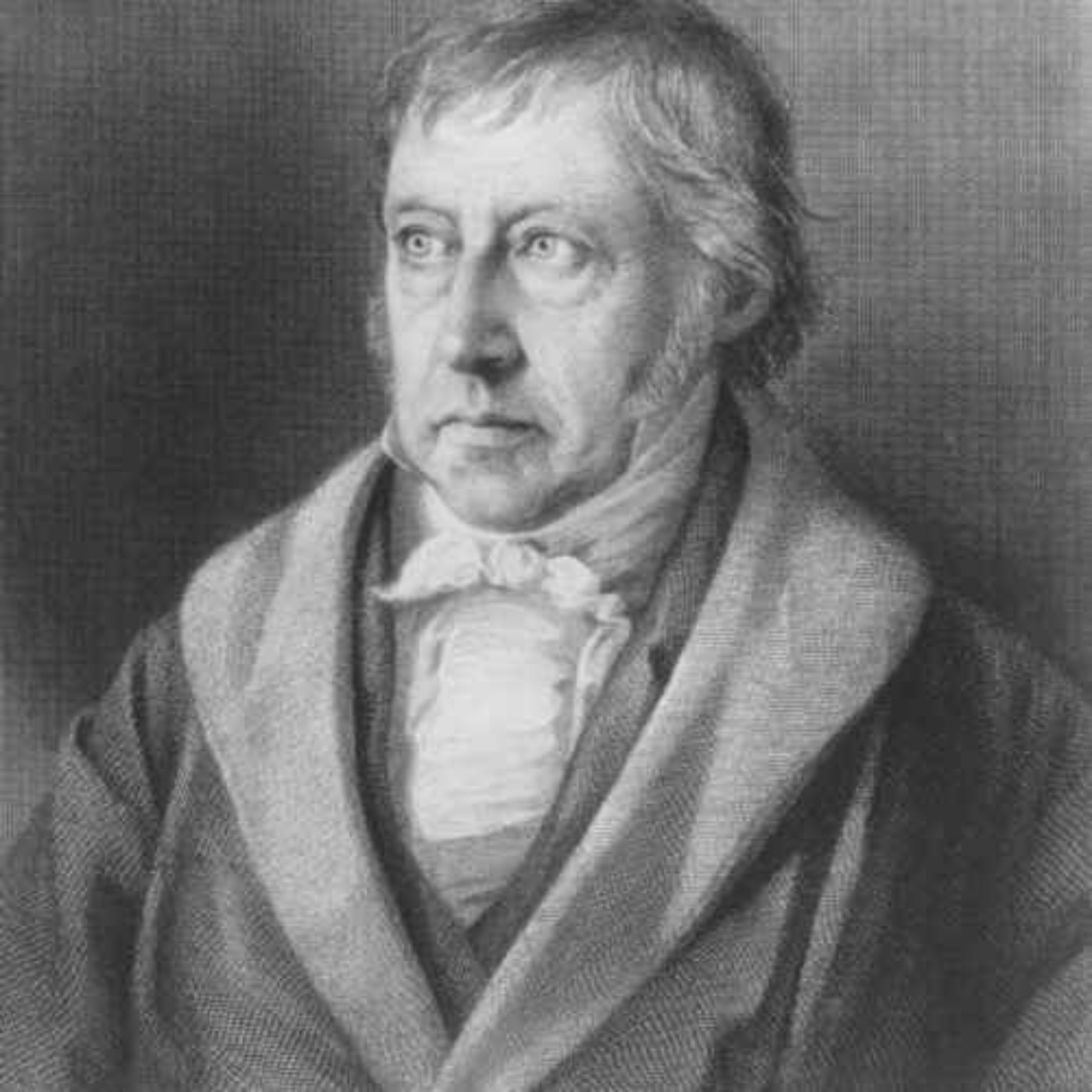
This lecture introduces Hegel's *Phenomenology of Spirit*, contextualizing its creation during the turbulent era of the Napoleonic Wars and Enlightenment. It challenges common caricatures of Hegel as an authoritarian or rigid teleological thinker, positioning his work instead as a profound exploration of human consciousness as historical, active, and self-interpreting. The core aim of the *Phenomenology* is to trace the development from the most basic, immediate form of awareness—"sense certainty," where the world is taken as simply given—to a full understanding of "Spirit." This concept encompasses the collective, social, and historical dimensions of human existence, including self-consciousness, reason, and culture.
Hegel argues that truth is not found in abstract principles or individual subjectivity but emerges through the concrete, historical process of reality itself—summarized in his phrase "the rational is real and the real is rational." The text begins by analyzing the limitations of "sense certainty," demonstrating how its inherent contradictions force consciousness to move toward perception and self-awareness. Ultimately, the *Phenomenology* presents human beings as beings in continual becoming, whose essence is realized through their active, social, and historical existence rather than through static, immutable faculties.
This week's lecture will begin with some historical and biographical context of Hegel's Phenomenology of Spirit. I would proceed to explain what the text overall is trying to accomplish. Subsequently, I will turn to the opening chapter of the Phenomenology of Spirit and explain what Hegel means by "since certainty". There is a received version of Hegel, perhaps a caricature, perhaps not without some warrant in some instances. This caricature generally suggests Hegel was first and foremost an authoritarian. Bertrand Russell famously quipped that the way Hegel redefined freedom meant that freedom was nothing more than the freedom to obey the police. This view is consolidated by Karl Popper, who taught Hegel an enemy of freedom in the open society. In addition, the general received view we have of Hegel is that his philosophy amounts to some combination of Euro-Centrism, Obscurantism, Freedom at the expense of equality, Constitutional monarchy, a cultural snob, a reactionary racist, a forerunner of totalitarianism, as well as the worst kind of teleological thinker. The teleologist who thinks history is progressively moving towards a certain end. Worst of all, when Hegel comes along, history is in fact finished. I would like to think that we will be able to challenge this picture. There is a lot more to Hegel than what this portrait paints, and it is my contingent at least that the modern world itself is unintelligible without an understanding of Hegel's philosophy. More specifically, and while this is only my opinion, I think the Phenomenology of Spirit is one of the most important texts of philosophy, and perhaps the most important texts of continental philosophy. Again, only my opinion and his Hegel himself thinks opinion in common sense are the enemy of philosophy. So what then is the Phenomenology of Spirit about? The biography of the book itself is exceptionally interesting. 1806, the year Hegel was completing the Phenomenology of Spirit, was exceptionally turbulent. It had not been long since the French and American revolutions, which most effectively undermined the divine right of kings. I think one could quite plausibly add the English revolution to this story too. Although of course the English revolution eventually ended up with the restoration. To this political upheaval, we can also add the scientific, technical, and cultural upheaval brought about by the Enlightenment, which led to an overturning of the feudal medieval worldview. Hegel's own life was also undergoing something of an upheaval. In 1807, the year of publication of Phenomenology of Spirit, he had a first-born child with the wife of his landlord. In addition, Hegel had financial problems. He worked as a teacher, tutored privately, and worked for a newspaper until 1805, when he became a professor, a Jaina. albeit not a very well paid one. Against a backdrop of these financial tribals, Hegel was really pressed to try and complete the Phenomenology of Spirit, which was to be an introduction to his philosophical system. There was all that, and Napoleon was coming to town. Hegel was finalizing the Phenomenology of Spirit when Napoleon's army engaged Prussian troops outside the city of Jaina. On the day before the battle, October 13th, 1806, Napoleon entered Jaina. Hegel later explained his impressions of the day in a very famous letter to his friend Friedrich Neitamer, and I quote, "I saw the Emperor, this world soul, riding out of the city on reconnaissance. It is indeed a wonderful sensation to see such an individual, who concentrated here at a single point, a stride a horse, reaches out over the world and masters it. As for the fate of the Prussians, in truth, no better prognosis could be given. Yesterday it was said that the Prussian king had his headquarters in Capellandarf, a few hours from here, where he is today, we do not know, but surely further away than yesterday. To add to all this upheaval, once the manuscript of the Phenomenology of Spirit was complete, it reputedly had to cross the Fridge military lines in a mail coach to get to the publisher. Is it any wonder then that motion becoming or the primary themes of the Phenomenology of Spirit? Indeed, this is a valuable place to begin to understand what Hegel's try to accomplish at the Phenomenology of Spirit. The book was completed in a moment of great turmoil and transition. While I cannot understand what would have been going on in Hegel's head, it would have been hard for not to ask what the meaning and conjunction of the completion of his work was, with the historical evid taking place at his doorstep. We could already discern some themes about Jig, we see ideas of transitioned, history, and becubbing as for the middle. And in a way, this is what the Phenomenology of Spirit is trying to show, that the human being is to be taught as a being in motion, a being in process, a being continually in transition. This separates Hegel from some distant and immediate philosophical precursors, namely Plato and Kant. Hegel is tried to give it a count of the life of the Spirit, that is, that which is most essentially humid as a vegan process. This was certainly not the case for Plato or Kant who saw that there remains something immutable about the human being. In contrast to Hegel, the world and all things in it were their individual state societies nature out of continual motion. Hence Hegel's dialectic is the principle of that motion, is the principle of reality, where reality itself is mutable, wronged and static or immutable. The dialectic of Phenomenology of Spirit is about ridrig explicit how humans are essentially developed with little beings. This is a good static part for anyone who has tried to understand Hegel as well as simply to try and remember when we look at different aspects of the Phenomenology of Spirit. He will continually return to the question of humanity or the human spirit, in a very elementary way the Phenomenology of Spirit asks what does it mean to be a human being. The answer to this question is the Phenomenology of Spirit itself, where Hegel outlines the different aspects and competencies of being a form of human sentience. That is the Phenomenology part of the Phenomenology of Spirit. He is asking what it is like for human beings to be alive. So, what is it like to be a life for Hegel? Well, lots of things really. Hegel offers a very rich account of the human spirit incorporating immediate sincerity, perception, self-consciousness, reason, ethics, religion, science. Although I think the other side of Hegel's title that is Spirit can be explained by understanding the distinctively human being as the being that is self-conscious. Or better, self-interpreting. We are agents who appear in the world when the ability to question our own existence. Thus, Hegel wants to build a very rich picture of what it is like to be self-interpreting agents at historical junctures. This picture incorporates a variety of skills, dispositions, competencies which account for this agency. This is particularly the case in the opening chapters of the Phenomenology of Spirit, where Hegel talks about the immediate empirical and cognitive constitution of human beings. After the fifth chapter, Hegel begins to talk about Spirit more explicitly, explaining what it is like for any human to be alive. Robert Pippen gives the best description of this, I think, suggesting that the Phenomenology of Spirit is devoted to explaining the collective like-mindedness of human existence. This is an important point. Moving to an account of human existence demands a shift from understanding, self-consciousness not only derived from since experience as an empiricist would, or cognitively interpreted as a rationalist would, to spirit. This thus requires a philosophy which transcends the study of concepts or experiences. Hegel argues in the Phenomenology of Spirit that while certainly concepts and experiences exist, we must understand them in their concrete actuality. In other words, they need to be understood in their historical actuality, or put a bit more abstractly in their real historical becoming. Hence Hegel's favours dictum, the rational is real and the real is rational. Here, subject and object, inner and outer rationality and empirical experience are deemed secondary to the fuller philosophical task of understanding the human being as they exist in their concrete life. Furthermore, we can hear the implications of another one of Hegel's depictions of the task of philosophy, which is to comprehend its own time and thought. Hegel takes the time part of this proposition very seriously. We could even price this a little further and say that thought is time, or put into more Hegelian register, thought is the actuality of historical becoming. The historicality of the human being works in a double register. The human is at once immediately temporal in an experiential sense, but also formed by living true history across the ages. Thus, what he is trying to grasp in the Phenomenology of Spirit is how does self-consciousness appear in history. Naturalistic accounts of the human being, not purely naturalistic accounts of the human being, for example empirical or genetic, do not really give us a full answer. The answer they give is that the human being is given or determined a historically. Again, Hegel is not saying we are not natural since he was beings, we are certainly that, we are not determined as such. Thus, the human being must be essentially active or better understood as a form of activity. Self-consciousness cannot be intelligible such that it is absolutely given once and for all. Here, we can see how Hegel distinguishes himself to a degree from Kant, who, if we remember from last week, argued that the human being was given a priori faculties, for example space and time, which were immune to empirical experience. For Hegel, the human being can be explained in its becoming, and how it has become. The point is that the real, the concrete, the actual are what is philosophically more significant, rather than abstract principles. Here, we need to understand abstract and the fullest sense of the word. Abstract means abstracted, or taken out of direct concrete experience. Again, this does not mean that we do not have since experience or mental content, but rather that if we are to know what it is like to be human beings, then we must understand our knowing as a type of activity as such, knowing, doing. Thus Hegel, in the phenomenology of spirit, moves from consciousness to self-conscious to spirit to absolute knowing. The latter point we will return to in a later lecture. For now, what we need to understand is that the phenomenology of spirit is committed to understanding truth in a very distinct sense. Truth is not something that can be derived from consciousness. Nor can truth simply be factual knowledge, which might sound strange to our contemporary years. Instead, truth is where self-consciousness comes to understand the self-spiritually. We should pause here over the word spirit, and no sense is Hegel using the term spiritual in a transcendent sense. Truth is not supernatural, nor ought to be understood as indicating disembodied beings like ghosts or spirit. Instead, truth is phenomenal, as in it arises directly through the unfolding of appearances. Again, here is where we see the phenomenology part of the phenomenology of spirit come to the fore. Hegel's phenomenology of consciousness confirms the ancient Greek under the standing of the term phenomenon, which becomes hugely important for Edmund Husserl and Martin Heidegger in the twentieth century. The phenomena, or the phenomenon, is that which appears in itself. Thus, the world of appearances are in fact that which is most real. Appearances stand in their own right without reference or derivation to any eternal or immutable, sensible, world-sustaining them. The eternal, after all, cannot be mutable. Since if it were mutable, changing, or altering in any way, it would no longer be eternal. Truth then for Hegel, in its optimum form, lies in spirit fully coming to understand itself individually, historically, socially and politically. Hence, truth lies in social relations themselves. One might ask, how can truth be temporal and changing? Would this not be a recipe for the opposite of truth, that is uncertainty? But it would be a very impoverished notion of truth that would not count for past and prospective events. Even in a very basic sense, if there's something as a fact that already implies in earlier and later than relation, this fact is an effect, this fact is an effect which comes after a cause. We will return to the social nature of truth when we begin to look at the famous master slave dialectic. But for now, what we need to try and apprehend is that truth is not something that can be found in an individual sense. That is my truth. There is a very good reason that Hegel wants to use the term dialectic, which he develops from Socrates. Truth requires mutual reciprocity. In consciousness, there is no such thing as truth. One does not find my truth. Put in a more technical way, subjective truth is a contradiction in terms. Even stronger, we can see Hegel's deviation from Kant here. Truth cannot be found in abstracta, such as transcendental forms of consciousness. But what does it like to be conscious? The first section of the phenomenology of spirit begins by understanding what it is like to be immediately conscious. Hegel begins by examining what Berkson, Henri Berkson, would later call the immediate givens of consciousness. That is the things in Kant and consciousness directly experiences as it goes about his business in everyday life. The opening section of the phenomenology spirit is perhaps the most difficult and abstract part of an already difficult and abstract book. There is good reason for this though. Hegel begins by trying to explain one of the most inexplicable things of all. That is consciousness. While we all have a basic sense of what it is like to be aware, we also grasp that one of the most abstract things of all is consciousness itself. We can't observe it, we can't see it, we have internal, ruthless, ethical debates on what it is in material, what is material and so on. In terms of consciousness itself, we arrive at a fundamental contradiction that Hegel tries to resolve. Our immediate consciousness is something both immediate and familiar, yet at one at the same time unfamiliar and strange, even alienating. So what does immediate conscious givens or content look and feel like? Hegel begins this exploration of consciousness by talking about sincerity. The best way to think of sincerity are as the immediate givens of experience. It is since in that we are directly experiencing, it is certain in that for the most part we are experiencing what we are experiencing has an immediate and unquestionable thereness. This is the most elementary form of consciousness. Consciousness sees a thing, we assume it exists. In another way this could be understood as common sense. That which is there and that which is is is what it is. Common sense, as I already mentioned, is the enemy of philosophy. Hegel shares this perspective with Plato. But what does all this tell us about immediate consciousness? Well, it means that always already we are conscious in relation to something other than ourselves. That is, other things are other objects. Indeed, one would be hard pressed to think of a form of consciousness that was not thought in relation to something. One might, for example, talk about hallucinatory experiences, dreams or intuting mathematical and geometrical shapes. But still we are thinking about consciousness as something in relation to some kind of object irrespective of whether it is real or imaginary. So consciousness in its raw and rawest and most elementary form has a directed quality. That is, all consciousness concerns some object. Consequently, consciousness can be understood as a relation between something that thinks and something that is thought. If we consider consciousness as a subject and object, Hegel would not be entirely pleased with that formulation since both parts of this dichotomy are in some sense abstract. It would perhaps be better to think of the subject object as a correlation in that both are thought simultaneously. Although, this would also imply a contradiction which Hegel later turns to. For now, it is enough to understand that consciousness is always about objects. This might seem vague but for Hegel is the basis of all thinking. What would be more abstract would be in fact daycast position where mind and material are such radically divergent substances that there can really be no interaction between the world and consciousness at all. While this may seem compelling, nothing could be further the truth for Hegel. Hegel sees thought as fundamentally enmeshed in the world. Because both the subject and object are in some sense co-implicated, thought cannot abstract itself from out of the world. The broader question of the phenomenology of spirit is again a historical and developmental one. If our most basic experience is one of sin certainty, then how is it possible to get from arcane and ancient forms of ourselves to an understanding of ourselves as self-interpreting animals? If we think of ancient forms of life, for example hunter or gathers, irrespective of how much smarter we might think we are than we do retain something in common, that is that they too had immediate sin certainty. The question Hegel asks throughout phenomenology of spirit is how can we get from that sin certainty, a world which is pre-conceptual, immediate and receptive to a world where we humans develop science, art, religion and philosophy? Again, how does self-consciousness appear? If we were left to sin certainty, self-consciousness would certainly not appear as this consciousness would just be brute experience. As such, since certainty, common sense or naive certainty, if you like, had to be overcome. If thinking, which always understands itself as that which reflects on external objects in the world, remains on the level of common sense, then self-awareness cannot appear. It cannot emerge, there is nothing to be questioned. We know this because common sense, self-certainty, do break down. The ways that it breaks down are very interesting for Hegel. And this is where he talks about the move from sin certainty to perception. In the opening passage of phenomenology of spirit, Hegel sees sin certainty as quite seductive, quite compelling. In some sense, consciousness always wants to remain in sin certainty. Why might this be the case? There are a couple of reasons. Firstly, it is because sin certainty is immediate, there, and it is something of which we are purely receptive to, and thus it seems automatically compelling in a very basic sense as the world appears to us. It is full of the diversity of things in content, which we may notice or not notice, which we take as the truth of the world, since certainly scenes like the truth of the world. Secondly, there is a taken for grantedness of the immediate reception of sin certainty. It is something which we assume to be the case. It is there, there is nothing I need to learn from it, and there is nothing which I can do about it. You can perhaps here begin to see why Hegel thinks that philosophical thinking is radically divergent from sin certainty. Philosophical thinking presupposes that consciousness does not rest in sin certainty, but rather it restlessly challenges and subversity immediacy of experience. As we will later see, there is also an ethical dimension to this. If we remain in the world of naive certainty, then this can lead to a very cynical and nihilistic outlook, and outlook based on the claim that "since is all that there is", and that is what is in front of my nose. Such a pattern of thought at best cannot engage in any interpretive activity, and at worst would be a form of political quietism, that is everything remains the same and there is no point in changing anything. From the viewpoint of sin certainty, my immediate experiences are the truth, and all else is just blather. Consequently, this view is anti-philosophical, and since certainty one's immediate sense experience is the only truth, and there is nothing we can do about it, and there is nothing we can change about it. But this is in philosophical thinking. In fact, it is the philosophical impulse, which is crucial, not just for Hegel's project, but for humanity developing itself consciousness in the first place. It is spirituality. Why? Because the philosophical impulse is precisely that, which elevates the human being out of the brute immediacy of experience. The philosophical ticket shows precisely that contingency resides at the heart of any form of common sense or sin certainty. Remember, since certainty presupposes that the eye holds an intimate relation with external objects, because I experience this, that and the other. As such, the truth of sin certainty is just immediacy of a sinced object. I experience one thing after another. The subject in this immediate experience is only ever really a pure eye, a pure eye that experiences a pure it. Or this. Every eye is indexed to an object. Hence, sin certainty demonstrates its limitations as an accurate account of human experience. All that sin certainty really can show is, in fact, an abstraction, where each conscious act exists in a one-to-one relation with specific objects in the world. And while we do have sin certainty, there are a variety of other forms of thinking, which undermine our natural assumption about the existence of the external world. Hagel's problem with the immediate givens of sin certainty is that we just do not really think like that. To think that every eye is related to an external this is a very discreet and fragmented way of understanding our relation to the world. When he proceeds to the next chapter, Hagel will talk about perception. Preception is and is not the immediate givens of consciousness. As posed like this, this is an obvious contradiction. But Hagel's point is a bit more straightforward. The designation of any experience presupposes a context of experience. As we will see later, Merluponte makes much of this idea when he's talking about the field of perception and Gestalt's psychology. So, we don't just experience objects in isolation, we also experience them in a broader contextual field. Thus, Hagel welcomes contradiction. Contradiction shows no objects exist in itself. There are a few other places where we can discern his meaning in the opening chapter. Firstly, we can see his point easy enough if we turn to John Locke's distinction between secondary and primary qualities. That is between properties of an object and properties which are attached to an object because of my perception. For example, the book had foot to be right. Daew is properties such as weighted solidity. But when I experience them, my perception of a secondary quality like color may change depending on the time of day and lighting. So, regarding secondary qualities, my immediate sincerity of the object is therefore mediated. If we're of our most basic experience of the world shows that all redoag is fundamentally asserted, we could did see immediate sincerity is valueless for telling us anything of philosophical value. Secondly, and I think this is a more complicated point. If sincerity is not a tabular as it is without experience, then the objects of consciousness, which the eye experiences are also in some way not eye. For every single object in immediate consciousness, because it is an object, it is therefore not eye. So, every eye it is also a not eye. John's Paul Sartre will make a lot of this in being in nothingness. But let me try to be more precise. Consciousness as a form of sincerity implies that I am conscious of this object or that object. I am conscious of this pen, that table, this house or that road. I am only conscious because of the objects I experience. But this proposition also implies the opposite. Because my sincerity experience objects, because they are objects, they are therefore not me. And thus, my immediate consciousness is constituted as a form of not this, not that, not those. This pen is not eye. It is also not that table, not that house. There is thus an essential negativity to the immediate give us of consciousness. If every thought I have automatically applies a not eye, then my immediate consciousness experience of this dash at the other object is constituted by negation. Thus, consciousness applies the negation of the self. The eye is also a not eye. I think Hegel also makes a stronger point here. Every act of the eye is concurrently an act of negation of the eye. An act of negation is just another word for change. Thus, consciousness is constituted as actively transforming, or in other words, consciousness is inherently temporal. Thirdly, if consciousness is temporal, it is important to disentangle Hegel's idea from Kant's. Remember, as we saw last week for Kant the all the way that we can intuit space and times by reference to absolute space and time. Space and times that we experience are utterly indifferent to our immediate experience. Our absolute space and time are utterly indifferent to our immediate experience of local bits of space. Kant here is indexing as epistemology to classical physics. Hegel, on the other hand, is making it more direct point. Space and time does not need any reference to absolute space and absolute time. Since every object which the eye immediately receives is negated, this shows that our immediate experience itself is always unfolding. If we think of time and philosophical sense, we are confronted with a conundrum. The peculiarity of time is that we feel like it flows, but in another way it seems like it doesn't. Because any one time we experience is a now, and all now do seem a lot like each other. In terms of sincerity, what is immediately given to consciousness seems like the now. In that our immediate, since certain experience of the world is always present, we thus face a contradiction. In one sense our experience of space and time is always the same. But in another sense it is always otherwise. Thus naive certainty assumes what is given to consciousness is always present. But once we think about it a little we see that it is also not present. Thus at this point in a phenomenology of spirit, even for sincerity, that which is immediate, directly experienced, present is mediated temporally. Thus the truth of consciousness is that it is temporally mediated. The truth of our experience of things is always given in time. That which is immediately thought, that is, that which we since now does not appear only as a self. Ultimately nothing is simply given in itself for Hegel. Every immediate experience presupposes a wider context of involvement to use Hydrogres term, as well as a before, after and about to. In conclusion, since certainty is a type of naive certainty, it assumes and takes what it experiences as given. And what is more, it assumes that what is given is the truth. It can be summed up as thought accepting the obvious. This cup is this cup, this chair is this chair, we experience it and that is all there is to the matter. The phenomenology of spirit tries to show how the immediate givens of conscious experience are always embedded in a broader context. As he proceeds to develop his thought throughout the phenomenology of spirit, he will see that this context becomes quite expensive, incorporating ethics, art, religion and politics. Or put another way, the different forms of life which constitute the human being are human sentience even historically. The reason self-consciousness appears is because of the limitations of sincerity. Sincertainty shows itself to be too abstract and not attuned to how we think and experience the world, which is at this point the idea that we are temporal and historical beings. When Hegel talks about sincerity, what he is in fact demonstrating is that sincerity is not at all certain. It is in fact quite abstract and contingent. But there is quite a way to go yet. Hegel and the next chapters will talk about perception and force. The ultimate task of the phenomenology of spirit is a reflection on self-consciousness, but also how we become self-consciousness. In the chapter on sincerity he has shown the self-consciousness appears through the expansion of the immediate givens of consciousness in terms of the negation of conscious acts spatially and temporally. There does remain a Kantian element here. There is a form of transcendental to Hegel's thought. That is, he is asking what must be there for self-consciousness to be intelligible at all. However, Hegel ends up in a very different place, fully affirming the historicality of the human being. At this point, let me conclude with a couple of key pines. For Hegel, consciousness is not derived from pure introspection. Certainly, we have mental content and direct sense experience, but this gives us a very depleted account of being human. Secondly, and this really has been the topic of this lecture from the very minimal sense of being self-aware or as a presence of self-to-self. We move to the idea that consciousness is essentially restless and emotional, and thus requires some form of struggle or will to survive or transcend itself. As such, the phenomenology of Spirit shows that all living beings are characterized by desire for self-maintenance. Our spiritual existence in Hegelian sense is that we attempt to self-maintain ourselves over time. What is fundamental about self-consciousness then is that it is never satisfied. In fact, what is normative about consciousness is that it is fundamentally dissatisfied. If this is the case, then self-consciousness must also and always be a desire as being. That is, we are the self-interpreting beings who have desired to be satisfied. This will be the subject of our next lecture.
Podcast Summary
Key Points:
Hegel's *Phenomenology of Spirit* is a foundational text of continental philosophy, written during a period of immense personal, political, and intellectual upheaval (e.g., Napoleonic Wars, Enlightenment).
The book challenges caricatures of Hegel as merely authoritarian or teleological, aiming instead to understand the human being as a historical, self-interpreting agent in continual motion and development.
Its core project is to trace the journey from immediate "sense certainty" (naive, receptive experience) to "Spirit"—a rich, collective understanding of human existence encompassing self-consciousness, reason, ethics, and social relations.
Hegel argues that truth is not abstract or individual but emerges phenomenologically through historical becoming and social reciprocity, encapsulated in his dictum "the rational is real and the real is rational."
The opening section examines the contradictions of immediate consciousness, showing how "sense certainty" must break down to allow for perception, self-awareness, and ultimately philosophical understanding.
Summary:
This lecture introduces Hegel's *Phenomenology of Spirit*, contextualizing its creation during the turbulent era of the Napoleonic Wars and Enlightenment. It challenges common caricatures of Hegel as an authoritarian or rigid teleological thinker, positioning his work instead as a profound exploration of human consciousness as historical, active, and self-interpreting. The core aim of the *Phenomenology* is to trace the development from the most basic, immediate form of awareness—"sense certainty," where the world is taken as simply given—to a full understanding of "Spirit." This concept encompasses the collective, social, and historical dimensions of human existence, including self-consciousness, reason, and culture.
Hegel argues that truth is not found in abstract principles or individual subjectivity but emerges through the concrete, historical process of reality itself—summarized in his phrase "the rational is real and the real is rational." The text begins by analyzing the limitations of "sense certainty," demonstrating how its inherent contradictions force consciousness to move toward perception and self-awareness. Ultimately, the *Phenomenology* presents human beings as beings in continual becoming, whose essence is realized through their active, social, and historical existence rather than through static, immutable faculties.
FAQs
The main goal is to explore what it means to be a human being by tracing the development of self-consciousness through history, emphasizing humans as beings in continual motion and transition.
Hegel sees humans as mutable beings in process, whereas Plato and Kant viewed them as having something immutable or fixed, such as a priori faculties in Kant's case.
Sense certainty refers to the immediate, unquestionable experience of objects in the world, representing the most basic form of consciousness where things are taken as directly given and true.
Hegel believes philosophy must challenge and subvert the immediacy of sense certainty, as resting in naive certainty prevents self-awareness and deeper understanding from emerging.
Truth for Hegel is not factual knowledge but arises through self-consciousness understanding itself spiritually, historically, and socially, emphasizing mutual reciprocity rather than individual certainty.
The book was completed in 1806 amid political upheavals like the Napoleonic Wars and revolutions, as well as Hegel's personal financial struggles, reflecting themes of motion and transition.
Chat with AI
Loading...
Pro features
Go deeper with this episode
Unlock creator-grade tools that turn any transcript into show notes and subtitle files.
 PodcastTranscript AI