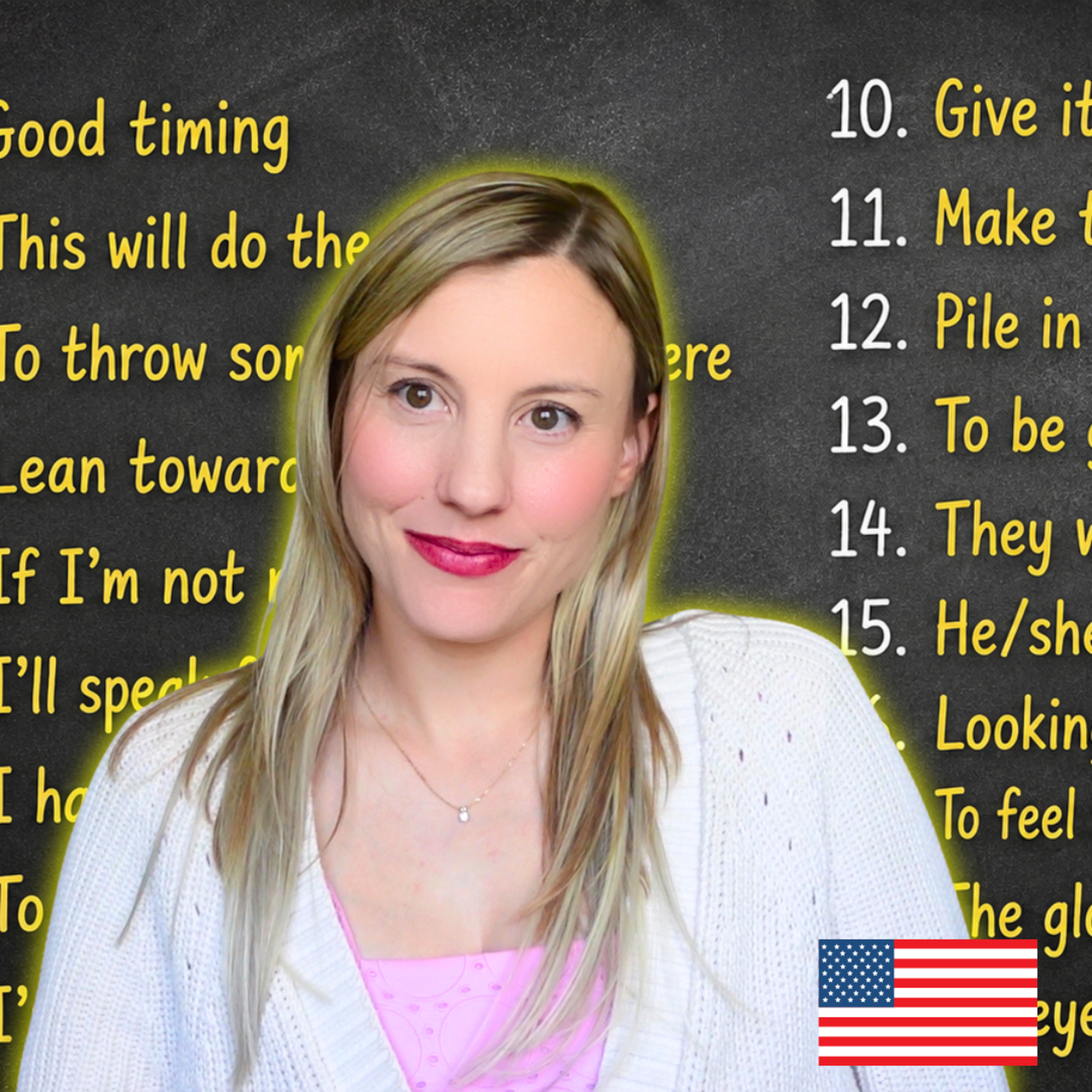
The transcription is a lesson on advanced English phrases that native speakers commonly use in everyday conversation. The instructor introduces phrases like "good timing," used when something happens at a perfect moment, and "do the trick," meaning a solution that works even if not ideal. "Throw it out there" is a casual way to suggest ideas without being assertive, while "leaning towards" expresses a preference without full commitment. "If I'm not mistaken" softens corrections or expresses uncertainty, and "speak for myself" clarifies personal opinions. "Hate to admit it" conveys reluctant agreement or embarrassment, and "wing it" means doing something without preparation. "Pace yourself" advises steady effort to avoid burnout, and "give it your all" encourages maximum effort. "Make the most of it" focuses on maximizing enjoyment in any situation, and "pile in" describes squeezing into a small space. "Green" refers to being new or inexperienced, while "some random" is slang for a stranger. "Dog" in sports highlights relentless effort, and "looking back on it" is used for reflection. "Feel the magnitude" emphasizes recognizing an event's impact, and "glory days" recalls past peak times. The lesson provides relatable examples, such as using "do the trick" for a makeshift sweater or "wing it" for cooking without a recipe, making the phrases easy to understand and apply.
I'm just going to throw it out there. It's good timing that you clicked on this video. I think it's going to do the trick. Are you confused? Do you want to learn advanced phrases just like these ones? And today's lesson, I'm going to teach you how to use these advanced phrases. I'm going to give you a really good example to help you understand them. And I promise native speakers like myself actually use these in our everyday English. If you want to learn more with me and have maybe your English teacher, make sure to visit englishwithcala.com. Now let's get started with the lesson. One phrase that you'll hear native speakers use all the time. It's a very positive, uplifting phrase is good timing. Good timing. This can be used so many different ways. It's very versatile. Maybe you've heard it before. Let's say that you bring someone a coffee and they'll say, "Oh, good timing. I am exhausted." That's just kind of complimenting like the way that you brought the coffee right when they needed it. Or you might say, "Oh, I'm so sorry. I'm late." And they might say, "No, good timing. We're just getting started." So they're trying to ease you and say, like, "You're not late. This is perfect. You have good timing." Or if something comes again like the coffee, just when you need it, you say, "Oh, good timing. I was just needing that." So again, phrase is very versatile. Just doing that. Something happened at the most helpful or the most perfect moment. I am someone that I like to fix things myself if I can. Especially nowadays when you can just use AI or go on YouTube and look up directions but I don't always have the perfect tool. But sometimes if I go in my garage, look through all my tools. I can find something that will do the trick. Does it say the trick? So we use this phrase, "It will do the trick." Or you can say, "This will do the trick." If it's something that will work and it will help you solve a problem or a situation. Again, it doesn't have to be a perfect solution to a problem. Let's say you're at your friend's house and you say, "I'm really cold. Do you have a sweater?" And they might say, "I don't have any extra sweaters but I have this sweatshirt." And you might say, "Oh, yeah, that will do the trick." Thank you. So it's not the exact thing that you ask for but it will help solve the problem of you being cold. So again, when we think about tools or ingredients for food, something that might not be the perfect match or exactly what you're looking for, but it's going to do the job that you needed to do. It will do the trick is what we say. A great way to casually suggest something when you're not trying to be super serious or forceful or you just don't feel like you want to be bossy is you might say, "I'm just going to throw something out there. I'm just going to throw something out there." So maybe you're making plans at a friend group or maybe you're at work and you don't want to be too assertive or asumptive and think that everyone wants to listen to you but you have an idea, maybe just casually say, "I'm just going to throw it out there, could we try this?" Maybe I work your suggesting a solution and you're not being so assertive where everyone might be annoyed with you or maybe someone will say, "Well, that wouldn't work or. " "Oh, let's try it since you just threw it out there." Again, you can use this in casual situations as well with your friends. Maybe everyone's trying to decide where they want to go for the evening, for dinner or an activity. And you might say, "I'm just going to throw it out there. Could we go to this restaurant?" Just a suggestion. It's a really nice casual way of suggesting something without being too assertive to throw something out there. When you are trying to decide between two options, you might use the phrase, "I'm leaning towards something," or one of the options. - "Leaning towards engineering." - This means I haven't totally made up my mind or decided for sure yet, but this is the one that I'm starting to like or preferring. For instance, you might be trying to figure out a color to paint a room in your house. Maybe you are deciding to in a gray or a brown, when you say, "Well, I'm actually leaning towards the gray." This means you're thinking about going with the gray and you probably will if you're leaning towards it, but you could still have your mind changed or you could still think about it a little bit more. I went out to brunch with a group of women and my family recently and we were all deciding what food we wanted to order and I asked everyone, "What are you ordering?" And someone said, "I'm leaning towards this option." And they didn't say that they were thinking about another option, but they just weren't sure yet. So they were kind of thinking that's what they wanted to do, but they still hadn't decided. So you can have this phrase when you're deciding between many things or two options in particular. When I have an appointment or an activity or a meeting, something like that, I always like to be very certain of what time it starts because I am someone who, if I don't look at it before I leave, I could be thinking of the wrong time. So the phrase, "If I'm not mistaken, this is where I would use this." - If I'm not mistaken. - So someone says, "Hey, are you going to the meeting at 12 o'clock?" And I might say, "If I'm not mistaken, it's at two o'clock, but I'll double check." This means I'll check again to be sure. So in this case, I'm correcting them, but I'm not 100% sure because, you know, now that they said 12 o'clock, I'm doubting myself a little bit. So I'm going to double check. If I'm not mistaken, it's at two. Or if someone again asks me, "Hey, what time is the meeting?" If I'm not certain, 100%, I could use this phrase. If I'm not mistaken, it's at two o'clock. So you can use this just for your own assurance that you're going to double check it and you're going to make sure that it's correct before the person totally trusts you. Or you can use it as a really soft way to correct someone saying, "Oh, if I'm not mistaken, that's not totally correct." Like, let's double check this. So again, this phrase, very versatile, you'll hear it all the time. In your native language, you might have a phrase just like this one. It's, "I'll speak for myself. I'll speak for myself." - I'll speak for myself. - So this phrase is just used when you don't want everyone to think that your opinion represents a group of people. Or a lot of times, husbands and wives will use this phrase to answer a question, like to give an opinion and say, "This is just my opinion, my wife, or my husband might feel differently from me." So I'll only speak for myself. I don't want to speak for everyone. It's another phrase that we use here. Actually, these two phrases really kind of go hand and hand and together. So, my will say, "I'll speak for myself. I don't want to speak for everyone here." But you could use either of these phrases on their own. A lot of times me and my husband, we differ on what kind of movies that we like. So if someone says, "Oh, did you like, do you guys like the movie?" I'll say, "Well, I'll speak for myself. I liked the movie, but my husband thought it was okay." I hate to admit it, but I really like this song. (audience laughs) - I hate to admit it, but. - You might hear this phrase. I hate to admit it in a lot of different ways. The first way is if we want to admit, someone was right and we were wrong. You know, it's kind of playful. It's not such a serious phrase. Like, I hate to admit it, but that restaurant was really good. You're right. Maybe you said, like, "I don't like that restaurant. It's not gonna be good. I've heard bad things about it." But your friend says, "We have to go. It's the best. I've had it before." You might say, "I hate to admit it, but you're right." Another thing is if you want to admit something embarrassing. So again, maybe you like an embarrassing song, like, it maybe you think like, it's more for kids or like, it's not a serious song, but you say, "I hate to admit it, but I love this song." Or something embarrassing might be like, you're procrastinating on a project and you hate to admit it, but you're procrastinating. You're just saying it, but you're kind of ashamed of it. So you're kind of using this phrase to soften what you're saying. If you're embarrassed about something or you're kind of slightly annoyed that someone's correct and you were wrong. In English, when we say we're going to wing something, it means we're going to do something without any preparation. - Now wing something. Some really specific ways that you would use this phrase is one, if you're doing a presentation without preparing at all, you might say, "I just have to wing it. I didn't have time to practice." Or if you are cooking in the kitchen and you don't have a recipe, you might say, "Oh, I just winged it. I just winged this recipe. I didn't actually know what I was making." And maybe people are saying, "Oh, it's so good." Like, what's your recipe?" And be like, "I don't know. I just winged it. I just started adding things together." This means again, no preparation. You just used what you had in the kitchen already. Some people like to plan out their trip when they're traveling and some people like to be spontaneous and just wing it. This means again, they don't think about what they're going to do. They just kind of wake up, go see things, walk around, see where the day takes them. Enjoy their trip without having a very detailed itinerary or travel plan. And finally, you might have a scenario like a job interview or something that you have prepared for, but maybe something unexpected happens or they ask you an unexpected question. And you have to just wing it and answer it the best that you can because even without preparation, you can come up with something. So again, winging it isn't always a bad thing. It's just a way to describe a scenario where you don't expect things or you don't feel like planning things. A really useful phrase at work and an exercise is to pace yourself. I'm pacing myself. A pace is the speed that you're going to. And it's the speed that you're going to work at and it's also the speed that you're going to finish something at. So when we talk about a pace, when we're racing in a running race, we're talking about the time that we're going to finish the race or the time that we're completing each kilometer or mile. So if you say, I'm going to run a half marathon at a two hour pace, this means that you're going to try to complete it at that pace or you could say, I'm trying to run a half marathon at a 10 minute per mile pace. So you can use either of these measurements to describe pace. Now if you're at work, you might say, I'm going to pace myself today. This means you're going to kind of try to work at the same speed all day so that you don't burn out or run out of energy completely. If you have a job where you work really long days, this is important not to just work so hard.
than tires yourself out. If you know you're going to eat a big meal at home or at a restaurant, you might say I'm kind of pacing myself here, meaning you don't want to eat all the food at the beginning and then not save enough room for the other courses or for dessert. You're kind of trying to eat at a slow and steady pace. It's really important in life to give it your all. Give it your all. This phrase means to completely try your best to give all your efforts. So in sports, this phrase obviously comes up a lot. Maybe you're saying our team really needs to give it our all today, meaning you need to give your best effort. Or if you want to work towards goal, you could say I'm going to give it my all towards this goal. Or you could say I'm going to give it my all to study for this exam. Even when someone fails, you can say you did a good job, you gave it your all, even though you failed or you didn't complete your goal entirely. It's just kind of an encouraging phrase in this situation to make the most of something. Make the most of them. So when you make the most of something, you try to enjoy something as much as possible. And you can take this phrase in a bad situation and let's say you're having bad weather, even though you know you had a vacation or you had a wedding plan, you might say even though it was bad weather, we made the most of our situation, meaning you still try to have fun or come up with an alternative plan. Or you can use this phrase in a good situation as well. For instance, if you are in a nice place as a vacation, for only a short amount of time, you're going to want to make the most of it. So you're just going to want to enjoy it and do the most activities in that short amount of time. Even though I live in the United States, my students overseas always think that I live in New York or Los Angeles just because that's what they're so familiar with. But I don't. And I've been to Los Angeles twice and I've only been to New York City once and I just made the most of it because I was only there for one day. And I'll tell you, I made the most of it, but I was absolutely exhausted after that day because I did so much walking, finding subway stations, seeing all the things. It was great. I made the most of it. This just means I had the maximum amount of enjoyment for such a short time. Maybe you're talking about a time in your life where you didn't have much money, but you're kind of looking back at that time and saying, you know, even though we didn't have much money, we made the most of it. Meaning we still, you know, valued our family and had fun and tried to just enjoy our lives without much money. One phrase that I heard recently that is really useful is to pile in. Make yourself a pile in the process. Usually when you have a small space, like a small vehicle, or you want everyone to fit on the couch, you could say, okay, everyone pile in, pile in. So it just means everyone can get in quickly and like squish together. Basically, if you have, you know, five friends sitting in a car, it's going to be like you pile in and squish together. If you've ever sat in a booth with a lot of people at a restaurant, you could say, we all just piled into the booth, meaning like we squished together. It's a really casual and fun phrase to use. A lot of times, children, you know, they pile into a school bus or they pile into a van or they pile into a bed together to kind of cuddle and watch movie, whatever it is. It just means that a lot of people or a decent amount of people are squished together in a small space. Okay, you might have heard somebody in English just describe someone as being green. Going to have an employee green ambassador to promote sustainability efforts within the store. We're not talking about aliens here. This phrase means that someone is new at something. So when you look back at when you first started your job, you may think about that time like, oh, I didn't know what I was doing. Like I didn't have any real skill. You might say, I was really green when I started. This just means you were really new and unfamiliar. Another phrase that I heard recently on a podcast, but I have said it and I've noticed that my friends and family say it too is they were some random. They were some random. I'm not traumatized by some random comment from some random woman. Oh, he was just some random. Sounds really funny if English is not your first language. This phrase, it's kind of shortened as they were some random person. And here we just mean that they were a stranger or they weren't a significant person in our life that we need to go into detail about. For instance, maybe you see a movie and there's an actor that you've never seen before and you don't think that they're very famous or they haven't been in very movies. Very many movies. You might say, yeah, there was there was some random in the movie, but it was a pretty good movie or there was some random, but they did really good acting. Meaning you don't know who they are again, but you're just kind of complimenting their acting in the movie here. So maybe you are in a grocery store and someone comes up to you that you've never met before and has a conversation and you walk away and then you find your husband or your wife later in the store and they say, who are you talking to and you say, oh, just some random. So again, it's just short for some random person. This is kind of a slang phrase because it's really shortened and it's really casual and informal. This next phrase, it's kind of funny and you need to be careful of how you use it because the phrase has kind of evolved over time. So if you're a big sports fan and you're watching American sports, you might hear the announcers or the commentators say that that person is a dog. Oh, she's a dog. Now it used to be an unkind thing to call someone dog. Maybe you were commenting on their looks or their bad behavior, but in this scenario, I hear this phrase used now to comment on how hard working someone is or how relentless they are in a sport. For instance, you might hear an announcer say like, they are a dog on defense in basketball. I mean, like, work really hard. They're relentless. They're really good. Or just kind of commenting on someone's worth at work ethic. You might say they are an absolute dog they never give up. So if you hear this in sports specifically, you're commenting on someone's mental toughness, their hard work, and their relentless play in the sport. A lot of times when you reflect on the past in English, you can use this phrase looking back on it, looking back on it. Now looking back on it. Sometimes we say looking back on it and we can say also looking back at it. They really have the same meaning here and it's just dependent on your preference, which one you use. So you might think about a stressful time in your life and you can say looking back at it, it didn't really matter that much. I should have been way more relaxed. So you're kind of reflecting on the amount of stress you had and wishing that you were less stressed at the time. Or maybe you look at something from the past looking back at it and you think, wow, that was really a red flag. Like I should have known this person was not going to be nice or was going to be hurtful to me because they did this. Looking back at it, that was a huge red flag. So again, this phrase is just really good for reflection, thinking about things that have happened in your past, thinking about regrets that you have as well. A really common phrase you'll hear people use when they're talking about understanding the power or how serious or impactful something was is you say, I felt the magnitude of something to deal with something of this magnitude. So to feel the magnitude of something is like to feel the size or the impact that something has, there's a lot of historical events that you know, you feel the magnitude of later on. Or there's just small life events like becoming a parent or getting married or graduating that. At the time, you know, they just kind of feel like steps that you're taking. But later you're like, wow, I really feel the magnitude of how much that affected my life. So you'll hear this phrase just to be like, this event was really impacting my life a lot or you're reflecting again and thinking about how powerful something was and what a force it had on everyone or just on your own life in general. Another really reflective phrase is the glory days, the glory days. Glory days, thank you. Football. A lot of people refer to their high school experience as the glory days. It's just a time where they are really carefree or maybe they're a really successful athlete or things were just going well in their life. And so they think of them as the glory days, things that times that were easy for them. So a lot of people use this phrase when they talk about their athletic career in college or in high school. Sometimes we use this phrase to kind of joke about how we're getting older. So for me, I think about the times in my life where I just stay up really late watching TV and movies or I would stay up and go to the bars with my friends. And now I just could not stay up that late. So I'm like, oh, those were the glory days when I would stay up and have fun. So it's kind of a joking phrase as well. If you want to tell someone that everyone is kind of paying attention to them or they're in the center or in the spotlight of an event or you're just saying, you know, a lot of people are paying attention to what you're doing, you can use this phrase, all eyes are on you. All eyes are going to be on you. I really felt like all eyes were on me when I was, you know, giving this presentation, meaning I feel like people were really paying attention in noting what I was doing. So this phrase can be used if you're kind of self conscious. Like, I feel like all eyes are on me right now. Everyone's paying attention or you can just give this phrase as a warning, you know, all eyes are going to be on you during your wedding. You're going to feel like you have a lot of attention. So it's a really common phrase to say that everyone is paying attention to you or to someone else. What did you guys think of this lesson? Are you ready to use these advanced phrases in your real life? If you are, make sure to join me with EnglishwithKeyla.com or you can join my membership in each week. I'll give you a new lesson. I'll give you the PDF, a quiz, and you can ask questions to me as well there in my community.
I can help you learn these phrases and go beyond just your basic English. Thank you guys again for watching and I'll see you guys in the next lesson. Goodbye!
Podcast Summary
Key Points:
The video teaches advanced English phrases used by native speakers, with examples for everyday situations.
Key phrases include "good timing," "do the trick," "throw it out there," "leaning towards," "if I'm not mistaken," "speak for myself," "hate to admit it," "wing it," "pace yourself," "give it your all," "make the most of it," "pile in," "green," "some random," "dog," "looking back on it," "feel the magnitude," and "glory days."
Each phrase is explained with context, such as casual suggestions, correcting politely, reflecting on the past, or describing effort and spontaneity.
The lesson emphasizes versatility and real-world usage, encouraging learners to visit englishwithcala.com for more.
Summary:
The transcription is a lesson on advanced English phrases that native speakers commonly use in everyday conversation. The instructor introduces phrases like "good timing," used when something happens at a perfect moment, and "do the trick," meaning a solution that works even if not ideal. "Throw it out there" is a casual way to suggest ideas without being assertive, while "leaning towards" expresses a preference without full commitment.
"If I'm not mistaken" softens corrections or expresses uncertainty, and "speak for myself" clarifies personal opinions. "Hate to admit it" conveys reluctant agreement or embarrassment, and "wing it" means doing something without preparation. "Pace yourself" advises steady effort to avoid burnout, and "give it your all" encourages maximum effort.
"Make the most of it" focuses on maximizing enjoyment in any situation, and "pile in" describes squeezing into a small space. "Green" refers to being new or inexperienced, while "some random" is slang for a stranger. "Dog" in sports highlights relentless effort, and "looking back on it" is used for reflection.
"Feel the magnitude" emphasizes recognizing an event's impact, and "glory days" recalls past peak times. The lesson provides relatable examples, such as using "do the trick" for a makeshift sweater or "wing it" for cooking without a recipe, making the phrases easy to understand and apply.
FAQs
'Good timing' means something happened at the most helpful or perfect moment. For example, if you bring someone coffee when they need it, they might say 'Good timing.'
'Do the trick' means something will work to solve a problem, even if it's not the perfect solution. For example, a sweatshirt can do the trick if you're cold and don't have a sweater.
This phrase is a casual way to suggest something without being too assertive. For example, you might say 'I'm just going to throw it out there—could we try this restaurant?'
'I'm leaning towards' means you are starting to prefer one option but haven't fully decided yet. For instance, 'I'm leaning towards the gray paint color for the room.'
'If I'm not mistaken' is used to softly correct someone or express uncertainty, implying you'll double-check. For example, 'If I'm not mistaken, the meeting is at two o'clock.'
'Wing it' means to do something without preparation. For example, 'I didn't have time to practice, so I'll just wing the presentation.'
Chat with AI
Loading...
Pro features
Go deeper with this episode
Unlock creator-grade tools that turn any transcript into show notes and subtitle files.
 PodcastTranscript AI