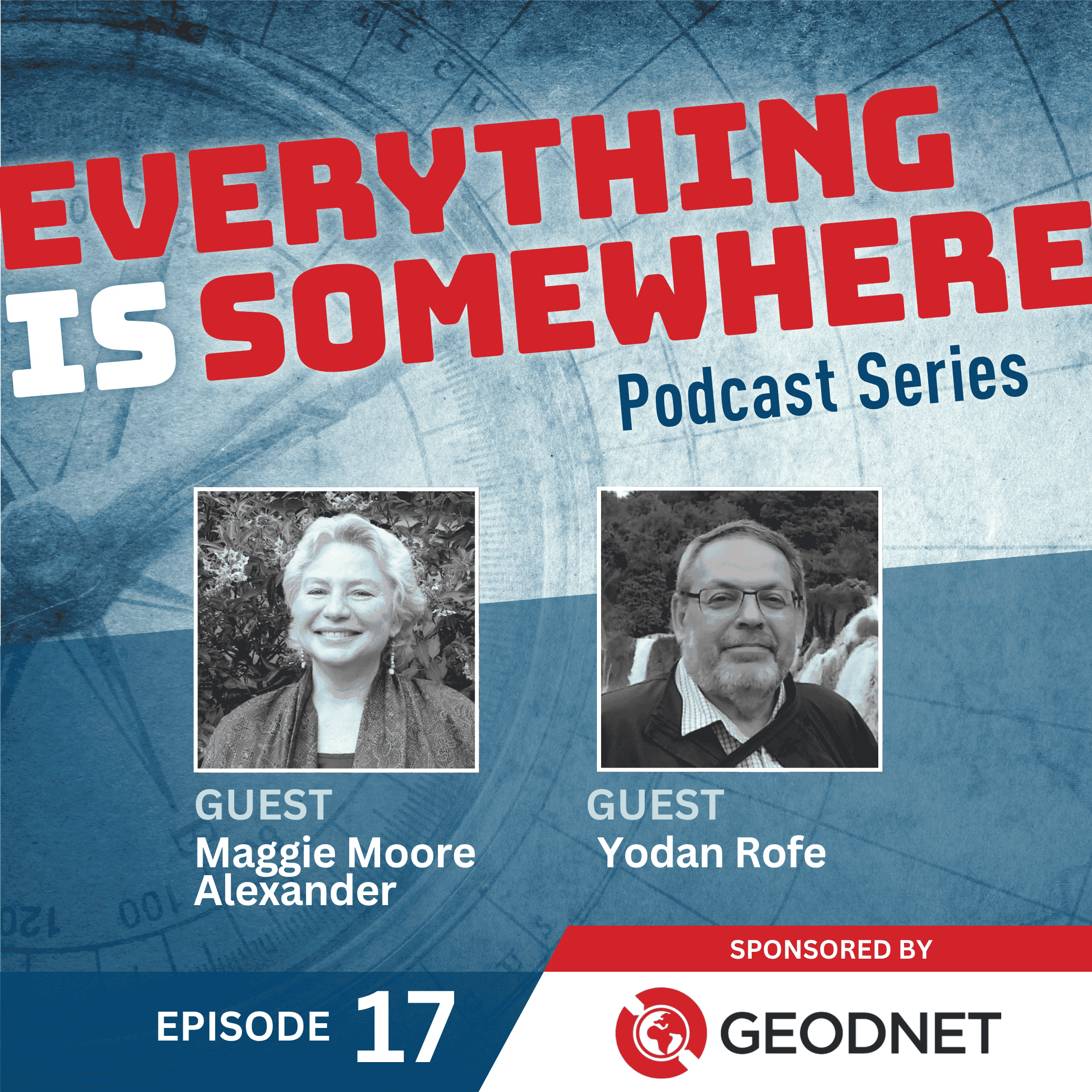
This is everything in summer. I'm Angus Stocking. Today's special guest are Maggie Moore Alexander and Yodan Rofa. And I say special because both are colleagues and friends of the late Christopher Alexander and architect, philosopher of the built world and spiritual figure that I review. Maggie is the president of the Center for Environmental Structure, served as Alexander's editor and worked with him to produce his four-volume magma opus, the nature of order, and also his influential, the battle for the life and beauty of the earth, a struggle between two world systems as well as other projects. She has a master's degree in organization, change in development, and Maggie is also Christopher S. Widow. Yodan, a former student and colleague of Alexander, is an architect and urban planner with more than 30 years of teaching and research experience. He's a faculty member at the Department of Environmental Geo-Infomatic and Urban Planning Sciences, Ben Gurion, University of the Nagab. Both are founders of Building Beauty, a multi-disciplinary educational program, and a community of explorers founded in 2017 to extend Christopher Alexander's legacy and provide an alternative path for students and practitioners in the building professions by providing academic and experiential knowledge of Alexandrian Building Principles. Learn more, please, at buildingbeauty.org. Maggie, Yodan, welcome to Everything Is Somewhere. Thank you. To both of you I should say right off, I had a stroke back in May and to listeners also. You may hear a bit of a stammer in my voice. I was not speaking at all for a bit, so I'm happy to have anything at all. But just to you know, I stumble a bit and I'm going to lean on you to do most of the eloquent speaking because that's been removed for me for an extent. Anyways, we were talking earlier about this and you are both aware from previous conversations that I deeply admire Christopher Alexander and I also, to some extent, regret that he's not better known among the people who are making buildings and other infrastructure including sewers and dams and so forth in the world because I believe that if his principles of building were better known and more widely applied, it would be not only a more beautiful world, but a more functional world in which humans could be better lives. Is that fair to say or what are your thoughts on Christopher Alexander in today's world? I think that's fair. Many of our endeavors from day to day could be supported if people better understood what Chris's work was about, what he intended to provide us with and support us with. So yes, I agree. I would sense also. I think one of the interesting things is when you look at things that were built, you know, large infrastructure projects that were built in the 19th century. I mean, the 19th century already was the century of enormous growth, new, ordinary works. And yet, it was clearly, it was imminent, even in, you know, they built foundations when they built dams when they built any large buildings. Beauty was always a criteria and that was something was totally forgotten in the 20th century. And I think one of the contributions is that it actually brings back the importance and unifying again, function and into one as one thing. It's not too separate thing, but it's one thing. Exactly. You're on one of the most provocative, but also fundamental aspects of Christopher's work. From the beginning was that he insisted on the idea of life in living structure. Could you, for listeners who may not be familiar with his work, could you give us sort of a precise overview and I know that's asking a lot of what life really meant to the idea meant to Christopher Alexander and architecture. And very important form. I think, in the work, it starts very early as an interwitch, even in his first work, if he was trying to understand what it was that makes places built have life. And at some point he understood that it's a very complex issue. That is very thing of paper. A city is not free. And then when trying to understand how to create life, because this is really the question that was the basis of all his intellectual term, he, he, he, he, he, first of all developed the theory of pattern language and as a way of trying to handle complexity. And yet bring it down to a level where you could simplify the actions by following particular patterns in a particular structured way. And then in the later they find out that it wasn't certain in order to create places and buildings with life, he developed the theory of centers, which is more about form and process of how, how you can create life and buildings. And in a sense, the whole journey is, it was for him, a journey of discovery that even goes beyond that because it, it goes to the basic world view that we have as modern society. So, society did it based on 300 years of scientific research and and mechanistic scientific research. And so at the end of the whole journey, it, in the end, it's, it's not really about patterns or about centers. It's actually about how we see the world. And whether we see the world as a living thing or whether we see the world as a machine that is not living. And once you understand that the world is a living thing, then you, you also understand that you have to, that you cannot design it, you cannot, you can't, you can't, you build it, you have to cultivate it in the same way you cultivate any, any limits. That's beautifully put. Thank you. And Maggie, of course, I, you were married to Christopher, you lived with them. What was, what's your sense of what the concept of life and structure? Well, I'll have to say I began with very little understanding. I'm not an architect. I'd read some of Chris's work, but not a lot. And the nature of order had just been published. Book one was out. And I got to work, steep learning curve. And I had to read not only from an intellectual level, but process it in the way that I process material, which is more practically. And I had him as a coach. I was indeed fortunate to have him as a coach. So as I read, I looked around and discovered what he was talking about that I had never noticed before, particularly with book one of the nature of order. And it was quite surprising and challenging. Had to change a lot of my orientation to the world as Yadana described. But I found it very enriching. So it was many things at once. Gradually I became his editor. And then we would get in deep, deep conversations about what he wanted to express and how to express it. And he was always challenged by that too, how to say it well enough so that we could understand and begin to explore on our own. I have a real personal orientation to this. And this is what I say to our students. Our Chris came up with is marvelous, but what truly changes the world is what it means to each of us. So it's not enough just to read it. We have to find it within ourselves. It's beautiful. Thank you. You're on you, hit.
But on most people know his name, if they know it at all, from a pattern language, which is, after all, believed to be the world's best-selling book of architecture. And taken up by writers like Stuart Brown, and others, and the counter-culture, it's just justly famous, and it's amazing. And I'm assuming thousands of people have built homes and other structures, according to its principles. That's certainly where I learned about Christopher Alexander. In his mind, I first interviewed and started corresponding with Christopher as kind of like you, Maggie, as the nature of order was coming out. And he had a somewhat complicated relationship with that particular book, a pattern language. He didn't disavow it by any means, but he certainly felt that in the four-volume magnum opus, nature of order, he had gone well beyond that. And I think he was attempting to establish a theoretical and even spiritual underpinning your foundation for some of the extremely radical ideas that came up in nature of order, but were defined and explained in nature of order, or they came up in a pattern language, but were, went further. Am I getting that transition and it's thinking, right, would you say? And some sort of growth in his idea that it happened with nature of order. Yeah, there wasn't the growth. At least over the scientists. At the basic basis of it, he was the scientist. And he was studied mathematics and physics at Cambridge and then his PhD was Harvard. And even though it was a PhD in architecture, he worked in cognitive science, Paris, with a collaborative design to see what his motive thinking was very scientific. And personally, I found, of course, his book, no synthesis of form, his first book, I found it when I was reading about architecture as a high school student. I was looking for something that was combining some rationality with architecture. Because what I was reading, I wouldn't say, was very irrational in many ways. So for him, his struggle was to make sense of what it is that we do in design, what it is that we do in building, what are the thought crosses that we use. And also in the end, it was the proof, as he used to say, the proof was in the pudding. The building had to be equivalent to the works of art and the great buildings that we know from past human cultures. That was his standard. And as long as he didn't feel that the work done, even his own work and the work done by people who were using battle language was reaching that standard. He felt that there was something missing. He wasn't giving us an account that is clear enough and really enough to enable us to be able to do the kind of work that our predecessors have been able to do. It's not because he wanted to copy what they were doing. He wanted to do what they were doing with the same level of work in our own time with our own means, with our own limits. Limits of our economy, limits of our political system, limits of our technology. And most of all, the limits of the expense of work, which in modern times kind of labor that was employed, building the great buildings of the past, because either not available or so what happened in the 1970s as pattern language was not even in public, but it was kind of bootlegs around Northern California and people who were building buildings based on using patterns. He saw the results and he felt and he saw his own attempts at the Modesto Clinic and other buildings that they built that similar time. He felt that they were still not reaching the left kind of level that he wanted to reach. That's what kind of set him on is almost 30 years past off research that led to the nature of order. And I was lucky enough to meet him in person and come to study at Berkeley in early 1990s. As the book was beginning to take shape, there were still about 12 to 13 years away from being published, but they were already relatively coherent, graphed form and participating in that stake in the first public courses that he gave on the nature of order to undergraduates. And that was a battle itself. Yeah, and it was rather mind-blowing. Peter, can I ask, were you able to work on any particular structures with Christopher? I took a course, a construction course. That was one of the courses given by the building process area of emphasis. We set up with Professor Hire Nice at Berkeley Time, which actually started the same year that I arrived at Berkeley. And one of the courses was the construction course in which we participated in one of the building's ES building. It was a residential home in Prado, Lotto, California. And that was the only building I worked on that Christopher. No, most of the work I did with this was as teaching assistant of the nature of order, and also as his research assistant, when he was working at the time, mostly on the process. Very good. Maybe we can switch topics just a bit now. Maggie, perhaps you can tell us about buildingbeauty.org, which is a very vital publishing and teaching concern. How did buildingbeauty get started? What exactly is it? What do you hope to accomplish? And what is the activity of building beauty in the world right now? Okay, that's a lot. I'll begin. Yeah, take your time. It started in 2017 when our colleague, Sarah Dioporta, who teaches architecture at the University of Strathquide in Scotland, came for a visit and told us there was an opportunity to start a new architecture program, a postgraduate architecture program, and would Chris like to do that? He was ill, so he was no longer able to work himself. I was invested in finding ways to show him his legacy would continue, and Chris was excited that we wanted to create a program that would teach like he taught. The Don's referring to the time that he spent with Chris at the University of California Berkeley. And we began to gather people like Yadon and others who worked with Chris during that time in the 1990s. Maggie, I got shut out when you were just getting started and talking about buildingbeauty.org and Chris for being happy that you were doing that work. I'm sorry to ask, but can you continue from there? I think we've got all that recorded and I can patch things together, and I deeply apologize for the problems in connection today. That's okay. Good heavens, that's okay. So I might repeat myself here, but you can take care of that. Our colleague, Sarah Dioporta, who teaches architecture at Strathquide University in Scotland, came for a visit and said we had the opportunity to start a new program in architecture, a postgraduate program, and he asked Chris if he would be interested in doing that. Chris was ill and he was no longer working, so it was up to a group of us to gather together and make proposals and see what we could bring to fruition by that fall. So we started in 2017. We gathered together people who had worked with Chris at Berkeley in the 1990s.
who had taken studio courses and others from Chris. And we used his model of teaching to put together a course for people of all different backgrounds. We have architects, we have laid people, we have other professionals like engineers, we have community builders, it was always the goal to spread our reach into different communities and help them grow largely the way you'd on has described bringing life and beauty. So that's how we set out. It was quite a challenge, but now we are going to begin our ninth year. And we've grown a lot, we've added more courses, we've been able to really concentrate on each student who comes, what their goals are, how they need to prepare to provide leadership in their communities or wherever they live or work. And the program in terms of setting people up for how they want to contribute for the rest of their lives is getting stronger each year, which I'm really pleased about. For me, it was important for Chris to understand that his legacy would continue and it was a joy to watch him be excited by what we were, trying so hard to do and what we began to accomplish before he passed away. Oh, so we actually started out physically and at a college called Santana in Tutin, Cerento, Italy. And that's where the course was given for the first couple of years. And the course was structured very much on the same lines as the Thrills' building process area course in the graduate division, in the graduate master's program of architecture at Cerento. It included the theoretical course, which was the nature of order, which was a lecture in the seminar. The studio, which was the practical, trying out of actually trying to do, but it's not enough to understand it. Intellectually, you actually have to try to implement these ideas in order to learn and internalize. So there was an introductory studio, which gives you the basic ideas in the first semester and you kind of graduate from one, from simpler projects, more complicated or complex projects and hopefully Susan Ingham, which the main teacher of the studio was going to talk about that in one of the future episodes. And then there was the construction, they actually building, in the second semester, the students designed and built an element in the garden of the Santana Institute. And it was in both cases. In the first year, they built a fairly large bench and in the second year, they rebuilt a parabola and built a small, small bed. And the idea was that we will gradually, over the year, over the time, we will improve the garden for the Institute. Now, unfortunately, coronavirus interview and we had to move online. And moving online was difficult from one aspect but it was actually a bonus from other aspects because we became much more successful. Because it's one thing to take a year out of your life, you go to Sorrento and spend eight months in Sorrento living and working and it's another thing to be able to do it in your own home. And also, I think we had one of our best years during the coronavirus because people were at home and didn't have anything to do. So that was that plenty of time. It became harder afterwards as they had to do it while carrying on their lives. But basically what we're doing since then is the first, the first semester is in given online or all the courses are giving online. But in the second semester, after the students have done the introductory studio, they are doing a project in their own community. And the idea is that they have to take responsibility for the project from A to Z. They have to work with people. They have to think how we're going to build it. They, if they need help with professional, they need to procure these professionals. And so in some ways, students have been learning more doing this way, working on their own project, then working in the garden where all they had to do was actually just a design and building where all the other issues were taken care of by us. But this way, they actually understand what it means to make something alive. How much effort and involvement and thinking and playing a hard work, it is. And it hasn't been easy. It hasn't, by any means, always be successful. But when it's successful, it's really both for them and for us. Now, over the years, we found out that we had to change the course a little bit, both to adapt it to large percentage of our students who do not come from architect. They come from many, many other fields. Some of them come from computer work because actually Alexander is more known among programmers than he is on students of architecture. Some of them come from design, some of them come from building trade, some of them want to become developers. And somehow they find their way to us. So in some ways, we have to teach them some basic architectural skills together with Alexander's own theory and that takes more time than that. Then we have another course which we've added and hopefully, or Ettinger, who's developed it and teaching it, that didn't exist in, this curriculum was its course called "Self and Holtness". Let's talk about this surprising, but then in the end, it's not surprising because there is a theoretical explanation with connected between the health and beauty of the world, the order of the world and our own self, our own self-personal will be. So the course "Self and Holtness" explores exactly this issue, but with more emphasis on one's own self than on the world. The studio is using the idea of mirror of the self and the well-being, our own well-being in order to understand how good or bad is the world out there. The course "Self and Holtness" is teaching students to be more in connection with their self. And this is something that for people, in our own time, is not easy and particularly for young people because our culture does everything in its power to divorce us from ourselves, to just to sort our view of the world, confuse us with regard to who we are, what we'll see it. - Wonderful and the little pompous of me to say it, but I want to thank you personally. I'm glad that there are people doing this work, Qtos, for doing a very important thing. - Angus, I want to say it's very important for you to be paying attention and we're really happy that it makes you happy. We hope this is true for lots of people all over the place and the joy of the community is what keeps us going. - Well, you know, my special thing has been trying to get land surveyors interested in Christopher's ideas and there has been some of that. And also urban planners and geospatial people we might say. So thank you, of course, and I've written a fair amount in American surveyors and I'm glad that you're here.
a lot of proselytizing, if you will, about the Alexandria and ideas. And I think it's having some effect. And in this podcast, I hope to do some of that. Incidentally, for listeners, this is the first of, I hope will be several monthly episodes devoted to Christopher Alexander's ideas and his importance for the built world. So look forward to that. You're on, could you talk to us about the coursework at Building Beauty? What kind of courses have been offered over the years? And is there do students come together and make things or is this online or what publications were? The academic component of Building Beauty? Say that in another course that we've recently added was called Construction Experience, which goes back to the construction course that Alexander had. And the idea here is actually that sometimes people are different in the way they learn. Some people learn, they need to understand first, then they do. And some people, they understand through doing. And so the idea of construction courses, basically, even if you have never taken any other course with us, and you just do this, during the course, people have defined projects, more constructive projects that they want to carry out, and they do. And they do it with the guidance, obviously, of our features. And so even if you haven't read the Nature of Order or you've never heard of Alexander, you can do this course. And through doing this course, you're getting the basic concept. And then obviously, if you're curious, then you would go on to study other courses. And if not, you've learned something useful. In many ways, we've become, at least I have become, much less orthodox in terms of having to learn everything, having to do it in a rigorous, particular way. I think I take my inspiration, actually, from one of Frutus ideas about how do we get to this kind of world, which is describing in third book, in the vision of the living world, we will get there, not by large narratives. We will get there by a lot of small interventions in our ways of doing things, which will gradually change. Even if we do these little seeds, and I think I always look at our students as seeds, that they're leaving us, they're carrying whatever they've learned with them, hopefully for all their lives. And these seeds will find a way to grow. What I would say there is that there's almost a culture war happening as we speak, and maybe it's going, been going on forever, but this idea of separating people from their own often correct inclinations about what beauty is and what they like. It can get very profound. Well, I think it can get very confusing to have an inner voice that is pulling us in a direction and then be distracted by things that are going on in the world, in our communities, our countries, in our cultures. And we lose sight of the need to work across differences and engage with people at a human natural level because systems distract us from that and tell us in different ways that what we're feeling personally is not so important. So I think it's very confusing. And self- and wholeness focuses on how to connect with that inner voice, figure out what it means, figure out how to take it seriously and understand how it can contribute not only to oneself, but to the community we live in with loved ones and in our cities, places where we can have an impact and make a contribution. You spoke about the, to me, odd truth that Christopher's ideas about the built world are very common in computer programming now. And one of the ways I know this is because I interviewed Ryan Singer, this podcast, and he has very explicitly applied the ideas from a pattern language and from nature border to his work as a program. And he's a very good programmer, a founder of several good systems. Why do you think that is? Why have Alexandrian ideas proven so robust in other areas outside of the architectural? I think programmers were uniquely very attracted, like many other architects, a lot of them who are, I mean, for some of his colleagues, did not continue with him to the nature of order. They really remained that pattern language continued working with patterns. It's done a good work too. So I think that idea of patterns was something that immediately appealing to programmers because you have these elements that you can combine them in many, many different ways and each different way is creating a new program. So that's, I think, I can understand the immediate appeal. I don't know enough about the computing world in order to understand why you are attracted to the nature of order actually. And so you have to ask that about that. But I think what is attractive is to me, Alexandrian theory, is that on one hand, it acknowledges the complexity of the world. And on the other hand, it gives you ways of handling this complexion in your own work because our minds are not filled for complexion. We are very simple. We are, first of all, we can only think of one thing at a time. We cannot think of many things. We are almost, we feel best when we solve problems that are within our capacity. But the problems that we solve are, again, things that we can focus and complexity actually is almost against this. And even Chris is always been saying, you have to do one thing at a time. You cannot do everything. You cannot think of all the various variables and try to maintain the capacity to do one thing. But what you are thinking has created a path for you to decide how to create the process in which you actually individuate the important decisions first. And then you solve them one by one. And I think that is very appealing for programmers and people in the information, the information to know. Because they have to create systems that allow people to do exactly that. They allow people to sit in front of the between and make choices either click or not. And click this or that. But you cannot have to do everything. So, and, and, but they have to create the system in such a way that it presents you with the questions at the right moment. So, I think maybe that is why they started also. Can I ask you a question? Yes, but let me just say I was so struck by something you said there. You said we feel best when we solve problems. Do I have that right? No, it's not my idea by the way. I'll be quoting you on that. I think it's just a wonderful sentence that could guide much of life. It was great. If it was just your words, Tremeth. And I'm sorry, what's your question for me? Let's see how I do. I wanted to ask you as a surveyor. What is it that made Alexander so relevant to your own work? First thing I would say is that surveyors are involved in subdivision.
and dividing land into reasonable shapes and lots. And usually this is done for purely cotidian reasons for profit or organization. So you get a lot of square parcels and straight lines and equal area. And even before I knew anything about the nature of order, in my workers' allowance of air, I did a bit of subdivision planning. And it was easy for me to go at least a little way in the direction of life by doing the topographic survey first, identifying beautiful areas. There's a nice pattern in a pattern language that talks about building the worst places first. Respect for lines that develop in the landscape, such as swells or rivers, of course. The edges of trees and there's centers. I didn't really know the word centers at the time, but the idea is always apparent. And just by knowing a bit about how Christopher Alexander viewed space in life, I believe I was able to do better subdivision work and make places that were nicer to build on and to live, because I knew at least a bit about organizing space, not along strict mathematical principles or profit or anything else, but I had enough influence even as a low-ling land surveyor. I was the one making these decisions and it wasn't too difficult to make better decisions. And it was even possible to sort of sell these ideas to the developers, because I found that most people in the process wanted to make a nice lot, wanted to make a nice subdivision, not merely profitable, but something that would be beautiful. And the big problem I would run into was planning committees, but even there there was a distinct desire to make a community more beautiful. And that was much easier for me to do knowing something about Christopher's ideas. Another area that became very interesting to me was surveyors make maps that are recorded. So there's a subdivision map or there's a certified survey map or some sort of parcel mapping. And every time we do that and it's recorded, that map is expected to become a visual reference decades or perhaps hundreds of years to come of how the land is organized. And there's ways to make that map itself more of a living object that is pleasurable to look at. And so you get the great ideas of cartography. And another writer that's very important there was Edward Toothty, who made an art of the visual display of quantitative information. I found that I was able to make better maps with knowledge of Christopher's ideas and Edward Toothty's ideas. And I was even able to lecture a bit on that and share those ideas and my profession. And to this day I believe there's many more maps in Dodge and Washington County in Wisconsin that are better. More useful and more appealing to look at as a result of Toothty and Alexandrian ideas. So that's and also my own home. My garage is a much nicer place because I know what space should be. I have some idea of what I'm going for there and how to get there. I would say I'm going on a bit, but. I think I think your answer. I thought, you know, when I first came across a writing, I thought, you know, why wouldn't a quent, a surveyor, a land surveyor would be so interested in Alexander. And in fact, it actually is one of the major problems understanding centers. If that are not easy to represent and maps are our representation of the world. And what you can't represent, it's very hard for us as modern beings who are grew up with maps. It's very hard for them to even see the things that are not back. And so if we can actually create a way to survey that recognizes centers and give them form in maps, then I think we could. That could be a very significant change to our way of seeing work. And what we do with the students. We ask them at the beginning of each project, we ask them to do full maps. One is do a center map that actually try to diagram what are the major centers that they can see and give them names. So as to represent make them more visible. It's just a major center because you cannot really represent more than the major centers. It just becomes too much for us to grab. And the second thing we do is something that I did as my PhD at Berkeley. What is for the feeling we ask them to walk around the area and note their feeling on a full level scale and write it down. And all the students, if they're all working on more projects, we make like a comprehensive feeling of project. And again, this is something which more and more people are actually doing. You can see this happening in many different ways. And again, it's a very, very busy map than your ordinary prevail. Even when I was working on this project and we're working on the, during the feeling maps question is what is the base map going to be? What are you putting as the base, in the sense the base map is supposed to be the major center. So it often the buildings, it may be major trees, it may be some elements that are more significant than other. But the base map, and this is really what the surveyors do. The base map is incredible. And if the base map is good, then everything else afterwards is better. If the base map misses some basic things, some basic strong centers, then it seems to go right because people are not aware of some things that are actually there. And that is one of the major, major difficulties that we have is that, especially now with BIS, most of the maps are horrible. They actually do not give you sense of what place is like. Yeah, I'm laughing a bit because I happen to write quite a bit about GIS. And one of my clients is Ezri, the big GIS producer. And they would not be happy to hear that. So GIS maps are ugly. And I think you're correct. But also it's a very hard remaining problem. And it's not so beautiful in the sense that they quickly present information on the fly. They can produce almost anything. But there is, it leaves an odd taste in your mouth that the product of all this sophisticated and useful technology is not being finally presented as something that is necessarily pleasant to look at. I think there's some thought that might get better in the decades of combat. You're correct. There's a lot of work that you have to be. The thing is that you have to learn to make maps of better. You have to do a lot of work. Usually not something that. GIS people's personal learn. The graphic artist learned it, but not. But I'm sorry. I took the discreet into another into a different path. That's what that's what you're here for. You know, done. So thank you for that. As we draw to a close here, I wonder if we could talk a little bit about. What affects. I think it's been a nine years of building beauty courses that have had in the world. Are either of you aware of buildings or. Productions or urban planning or anything. That is in the world today that is perhaps a bit better because some student of yours.
has taken new ideas and extended them into their domain. Well, all of our students who are with us online are taking on independent projects in the second term. They spend the first term learning the basic skills. And in the second term, they involve more of their families and communities to become involved. And they learn how to talk with other people and get other people involved in the process that they're developing for their independent project. So pretty much everywhere, I think, students have made changes. As in most of the projects that are in the context of the nature of water, the work goes on. You don't necessarily get finished because even after making a series of decisions and acting on them and creating marvelous spaces, there's still more you can do. So yes, we have some projects that are getting off the ground in Detroit, for instance. This year, we had a student in Nicaragua who-- Nigeria, sorry-- who is beginning work in his small city and beginning to involve a landowner in developing work on the landowner's property. It's hard to anticipate where they go exactly. We've had people who owned land, and they are busy working on that land, and that will continue forever, even where I lived in southern England. Chris bought this property in 1995, and I've been here for 23 years. And things begin to continue to evolve here. A living system goes on if we're lucky. And if we're paying attention and can learn to make moves that enhance where we live and how we live. So I think most of our students have been engaged since they learned things in building beauty that they have. A set of skills that will carry them forward wherever they wish to experiment. You know, that's the way Chris always approached everything. Everything was an experiment. Everything was a learning opportunity. Every project that he took on was to investigate more, to identify things that needed to improve and find ways to improve them, find solutions. So that's the ethic and the practice that we work with at building beauty. And we hope everybody engages on that level. It doesn't always happen, but when it does, it means a lot to us. Wonderful. And just incidentally, Maggie, I always wanted to express that Christopher wrote so lyrically and beautifully about Southern England. He made it clear in so many places in his writing that it was a very special place that he was happy to be part of. So I'm glad to hear that your little corner of Southern England is continuing to adapt itself to the greater whole. If I can add to what Maggie said, one place that we definitely made a difference is Santa Ana Institute itself. When we came there, it's a former monastery which had some time, at the time of the school. And now it's this private catering, mostly, to foreign students coming to Italy for study abroad. And the garden was a nice garden. This part of it was nice, but was not really that much used by the students. And one of the results of the first year students work was presented to the teachers and the staff at Santa Ana was a pattern language with regard to how to make the garden more beautiful and more alive. And I haven't been there for a couple of years. And I returned there last summer. And it's amazing what changes have happened since the work that we have done. There's they've continued, but they made the changes inside the buildings in order inside building in order to make the garden more accessible. They used to have the lounge at the top floor, and they moved it down to the bottom floor. So it'd be accessible directly to the garden. And they made some other places to stay at the garden and was very much lived in. I was there as opposed to when we were working. So that's one thing, not small thing, but it's definitely one thing that we've made a difference. Another project is a student in Marmo who developed together with his companion and group of other people developed a community garden that on the top of modernist community center. That project took several years to happen, but it's definitely happened. But it could be something as little as the transformation of bathroom done by our architect student into a lovely and life-filled bathroom. It's something that we enter our bathroom several times today and it's usually a very utilitarian space. But if you enter it and it's a place that is full of life, something that gives value to your life in a very ordinary but significant way because it's every day, four times a day, three or four times a day, you enter that place. And it's enduring a place of beauty. And we know from psychological research that our quality of life is dependent more under the regularities of our lives than by big events of our lives. So even something as small as that. Yodin and your dry, scientific scholarly way, I feel like you often sneak up on spiritual truths beautifully expressed and I really appreciate it. Here, here. Yeah, we'll have more time to talk about it when we talk about teaching the nature of water. And I'm looking forward to that. But for now, I'm Maggie Yodin. I'm so grateful that we had this conversation. (upbeat music) Thanks for listening to this episode of Everything a Summer. I'd like to begin this outro by thinking listeners for their patients. You may have noticed that it's been a couple of months, at least since my last published episode because I suffered from a fairly serious stroke at the end of May. And this is my first recorded episode as I recover from that. You may or may not also have noticed a bit of a stammer and/or swear to my speech. And I promise I am working on that too. I received some feedback in the last couple of months. Here's a note from Andy Loings, a Lancer Bear in Cambridgeshire, England. He wrote, "I just read your article on setting out "crop circles as a surveyor myself. "I found it well written and understandable." Well written and understandable is just about the best feedback writer like myself can receive. So thank you, Andy. And this is in response to an article I wrote in American Surveyer and I wrote back to Andy and let him know that he would likely enjoy the two episodes I recorded of the podcast with Jeff Wilson of the Independent Crop Circle Researchers Association. And at this moment I'm reminding listeners of those two great episodes that I think are some of the best episodes that everything a summer has produced. More feedback comes from Joey Waltz, P-O-S. On LinkedIn, he writes, "Enjoyed your windy laythropped "interview. "Thanks for a great show for American Surveyer." Thank you, Joey. Very much. It's good to hear from a listener and I'm glad you enjoyed the episode and windy really was a tremendous interview. So thanks also to a windy. It should go without saying that I love this kind of feedback and I love hearing from listeners. To do that, you can subscribe to the show, which is awesome and rate and/or review in the episode on Spotify and/or iTunes. You can email me directly at
[email protected]. That's Angus Like the Cow Stocking Like a Christmas Stocking. All one word at gmail.com. You can also provide feedback anonymously at amariserve.com/podcast. That's AMERISURV.com/podcast. And of course, you can find it.
and connect with me on LinkedIn. I'm easy to find. There was only one. Angus Stockton.
 PodcastTranscript AI