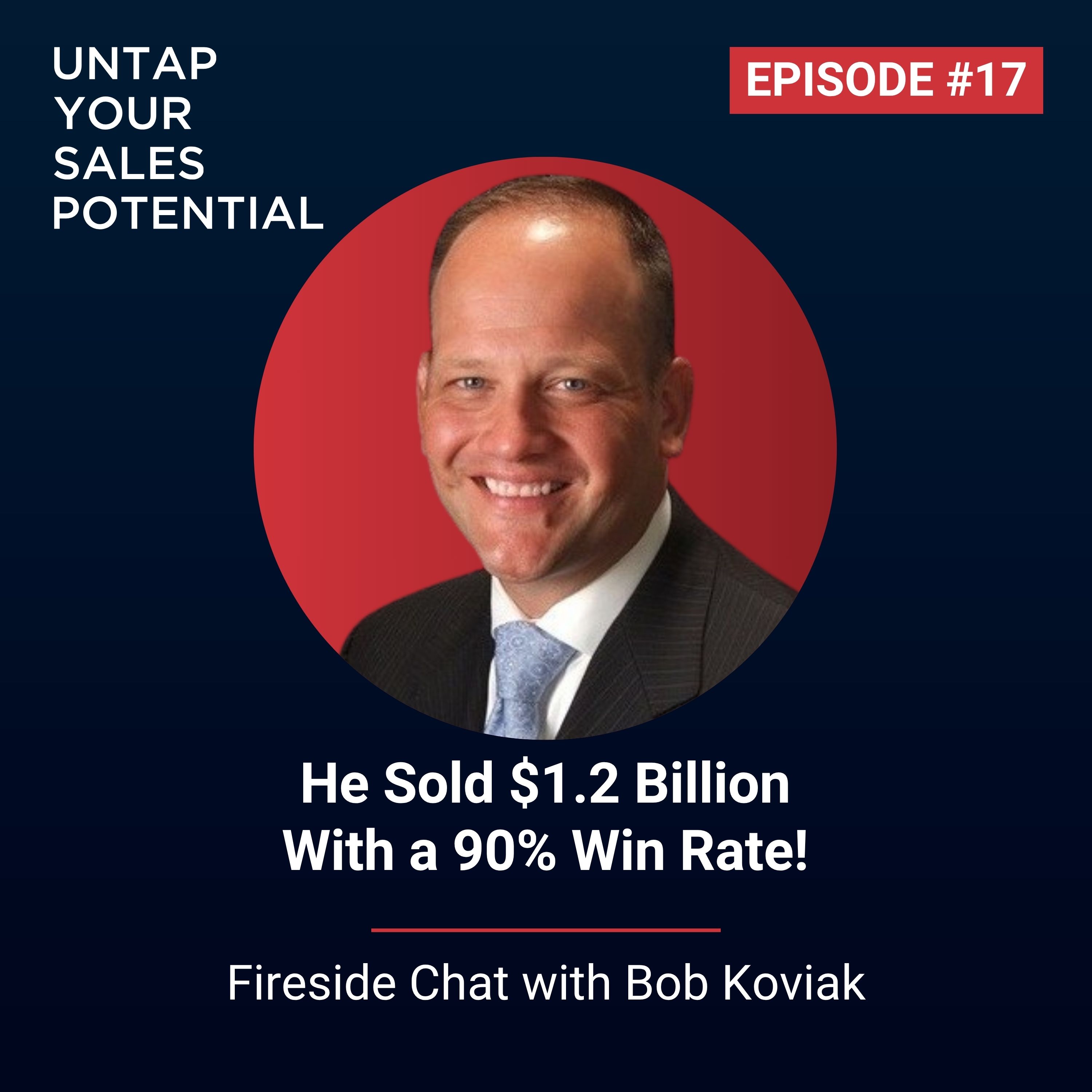
#17 - He Sold $1.2 Billion With a 90% Win Rate! | Bob Koviak
from Untap Your Sales Potential
64m 43s
In this Fireside Chat, Bob Koviack, a legendary tech sales figure with over $1.2 billion in career sales and a 90%+ win rate, shares his playbook for closing transformative deals. Bob emphasizes that he doesn't sell products; he helps people invest in future outcomes. His success hinges on a disciplined approach to opportunity qualification, using frameworks like MEDDPIC and his own "Three P's"—Power, Priority, and Process—to ensure he works with influential champions who can drive decisions. He stresses the importance of measurable business metrics, arguing that if a deal can't be tied to a quantifiable outcome, it's not viable. Bob also builds joint success plans with customers, often drafting their business cases to reduce friction and control the sales process. A core theme is making the customer the hero: he actively seeks change agents who want to advance their careers and aligns deals to help them get promoted, citing examples where champions became chief officers. He finds these agents through self-selection and probing questions like "What does success look like for you?" to uncover personal motivations. The conversation concludes with a focus on mindset—adopting an abundance mentality over scarcity—and mastering fundamentals like listening and asking deep questions, which remain crucial even as AI transforms the sales landscape.
I always say I don't sell anything, I just help people invest in the future outcomes. When I look over largest most transformative deals over my history, there's always a change agent. Somebody that wants to break some glass, make a name for themselves, I used to say if you can't measure it, it doesn't count. So if you can't put it in a business metric that they agree with, you don't have a deal. I basically said to myself, "You know what, I need to slow down, focus on what's most important and that's being present with my family. I need to work, I'm the only wage earner in my family, so I need to come up with a better plan because this approach is, you know, I'm not too happy with the outcomes right now." To every deal, I think your words where I got more people promoted in their own companies than anyone else. So you're the CEO of your territory where you spend your time as almost like you are investing your time in strategic stocks and each of these things are going to churn out some level of return. What are some business outcomes that you've seen that move the needle in terms of getting big deals done? Welcome everyone to this month's Fireside Chat. I know I say this every time, but I am incredibly excited about this month's guest. It's Mr. Bob Koviack and I learned about Bob from one of our coaches, Mike Fiskone, and he said he was constantly competing with Bob back in the day. When I met Bob, I learned that his career is one of the most impressive that I've ever heard in tech sales. So few of the stats. Number one, his total that he sold along with the total around his team is $1.2 billion, not million, but billion dollars. So Bob, usually it's like 100 million, it's like the max, but yeah, he's not a billionaire, but he sold over a billion in software with his teams and individually. The second stat that I thought was insane was his win rate. He has over 90% win rate. And I asked him about competing with you, Mike, and he said, I don't know if I ever lost to Mike or anyone else for that matter. I don't lose. I'm like, all right. All right. Is that true, Mike? Is that just Bob beating his own drum? Can I plead the fifth on that? No comment. You can't. We'll hear more. I peaked early. Mike became far greater in many ways. I just peaked early. That's what he said. He said when you were competing, Mike was newer to his career. You had been a little longer. So I had to defend you, Mike, but in his defense, he did say that. He also earned the nickname Big Deal Bob for consistently closing the largest deal in every company that he worked for. Bob's been in tech sales for 30 years, 15 as an IC, then 10 as a leader, and then the last five back as an IC. He's had elite performance at every level. He's crossed seven figures multiple times in his career. His last year was at Microsoft where he finished 345% of plan, selling a GENTIK AI. Now, he's an AI solutions executive in a new division of service now. He also is a former golf pro. He's a scratch golfer, and he helped create the professional sales minor at his alma mater, Bowling Green University. He's a father of three. He's probably seven years sober. He really is a competitive guy who loves the game, and I'm excited to dig in. Welcome, so much to the show, Bob, and thanks for coming on. Thank you for having me. What you're doing for the sales profession is tremendous. You and Mike and everyone, so anything I can do to help really, really love doing this. Well, I want to give people the playbook, right? I know how hard it is to underperform and how that feels. I know how much pain and shame there is of not achieving your full potential. The part of this program is bringing in people who are performing at the very highest level. So you are making a difference by sharing your playbook. So let's just dive in. I want to talk about the 90% win rate. And when I asked you about compete competition, you said, "I don't lose." So walk me through how you reverse engineer win rate, and specifically what the psychology is behind a mindset of, "I don't lose." Yeah, I mean, well, make sure you're focused on the right opportunities. But when I look at every deal in a very unique way, but obviously, for years, I was kind of just kind of learning these different things. And I was like, "How are they making the decision?" I had a loosely coupled process. But later in my career, I was introduced to Medic and we actually added the P for when I was at a company called Sprinkler. And that concept has just dramatically helped me. And I just, I rifle through where am I at, right? I think the first M is so critical, right? What metrics are they going to use to justify a solution that will allow them to make this investment, right? And I always say, "I don't sell anything. I just help people invest in the future outcomes." And I try to keep the technology out of it more as the business. But I really look at, you know, you look just really understanding where you are in the process, being honest with yourself, asking for help, and making sure that you control the process as much as possible. The other thing that I, I don't think I invented by any means, but I utilized probably because I had a little ADD or early on. But I always build a joint success plan. When I joined Salesforce, people called it a closed plan and I literally had reps send the closed plan to the customer. I'm like, they don't want to be closed. But I just come up with, you know, how they're viewing the steps that are going on in this process and get them to commit to timelines and we agree early on that if we follow this process, the outcome will become this. And I often find that the more that you're engaging them, obviously, and you're working on the same side of the table solving a problem, I've learned over the years that clients are inherently busy or some people might say lazy. So over the years, I've pretty much gotten my clients to let me write their, you know, their business case and present. I would say, give me your PowerPoint template. I'll do a draft business case for you on why this makes sense. And I just try to take all the friction out of the sale possible. So when you say, I work the right opportunities, what does that look like? What is, how do you know if it's the right opportunity? When I look over largest, most transformative deals over my history, there's always a change agent, somebody that wants to break some glass, make a name for themselves. And that person has to be truly a champion and not just a coach. So really determining, you know, true champion has influence and power and will sell for you when you're not around, figuring out if that person can make that happen. But if there's not somebody in there willing to do something dramatically different and take a risk on that, sometimes it's the political capital to do that, then generally there's not a deal to be had. If they won't let you engage with their executives, then there's also generally not a deal to be had. Later in my career, I learned just to ask a simple question and is really, you know, what are your most strategic initiatives really learning what the customer's trying to accomplish? And I only align, I just try to make sure we're aligning and informing the customer that these are your customers, these are your executive strategic priorities. This project fits into these three, right? Helping them sell it internally. So a lot of words there, but I think the process and then understand the psychology of the buyer and making sure it's a win for them. If you want to simplify it, I teach a concept called the three P's. It's as simple as it get. Are you at power, right? Are you working with someone who has influence or power, a K, a champion? Is it a priority for them or does it align to their top priority and process? Do they follow your process? Are they going to give you access to the right people? Are they going to let you do proper discovery? Are they going to fill out a joint action plan with you? Are they going to engage in a business case? Whatever that process looks like? So it's a simple way, you know, align with what you're saying and you said the same thing. Let's talk about like met. Well, having a framework is important and then having a common vernacular that you're using. So you can kind of get a benchmark for what's working and what's not. That's critical. How do you find a change agent and how do you even know if you're dealing with a change agent? A lot of times that's that's generally you take them to dinner and you just talk over things, you get them to know them a little bit and get them to open up about what's going on. Try to understand. I've noticed that people, any organization that does event marketing, people like when we were at Salesforce, people self-select, when they show up to an event, that's like they're walking into a Ferrari dealership, right? They're telling you I'm in the market for a 200 or whatever they cost car, right? So getting, you know, just getting. getting the people to the right event and then making sure that you're exicking on that. - Okay, perfect. So metrics, what are some of the, you said that's the most important. You told me on our call, you sell outcomes. Can you share a little bit more about how to sell outcomes or how you think about outcomes? - Sure. A lot of times, a bit is this wants to accomplish something. And then they assign the task to the most technical person in the world that for some reason it seems like people that have the most strong aptitude for technology almost just have like a, they are not able to have a conversation on business value. It's almost like it's taken out of their brain and it seems like, right? - That's why they're engineers. They're not business owners or CEOs. They build stuff, but they don't necessarily understand the reasons behind why they're building what they're building. - Right. So basically when people come to the project or you're talking about a project, most of the time you want to control your own narrative, right? And offer up a relevant point of view on helping their business that aligns with your product set. But when people are like, I learned in this one I was at UI Path. When I was at UI Path, it was kind of the early days of RPA and it was really exciting. It's kind of like a gentick AI right now. Everybody comes at you and they go, we want to do this. And I asked them, why? And if they couldn't tell me how this is helping their business, then I would maybe help them reprioritize a better project to work on that we could validate. But in the metrics component of the sales cycle, it's what specific items are you measuring in order to make that business recommendation to move forward with an overall solution that can't generally happen unless you're talking about driving business outcomes. And that metric has to be, I used to say if you can't measure it, it doesn't count. I mean, you might get lucky, but if you can get them to help them understand the critical metrics for success and you're aligned on how they're measuring that, then you guide your sales engagement around a, you know, accomplishing the metrics. - What are some business outcomes that you've seen that move the needle in terms of getting big deals done? - Sure. I'll share that example with you that we talked about. When I joined you, I passed, we were working on an engagement with the world's largest HMO and other $221 billion in sales. And we asked them a question, what's your biggest business problem? And they said insurance claims adjudication. And I'm like, what the heck is that? And they said, since we're an HMO, you ask us for money and we try to figure out how to not pay you. And I'm like, huh, how important is this to your business? I don't know what this is. And they go, it's everything. And I'm like, huh. So, big picture, we came up with a solution to help them dramatically simplify this process. The person we were working with was a project manager that little technical, and we put together the overall solution. And we didn't know what to charge 'cause we were new to the market. So we came up with a number and it was, let's say less than $10 million. And we won the deal. And then they brought us into a executive meeting and they announced our partnership. And they told us that we were gonna help them take 1% off their bottom line. So the metrics that we built together, they presented their board that we were gonna save them $2.1 billion a year for $110 million. - You should have charged $200 million. - I was new there and sometimes people tell you that. - Oh, it would have been, that would have been a TXRLI. That's how the big deals get done, right? There's, there's, there's, - You know, that was aligned to something that was very big and measurable. If it's not measurable, if it's not easy to measure, you gotta come up with the critical components of that will make sense. - Yeah, so this aligns to one of the strategies that you said was biggest for you, which is make the customer the hero. You said in every deal, I think your words where I got more people promoted in their own companies than anyone else. And I'm after helping the champion get a promotion. Can you elaborate more on that strategy? - Yeah, example on the big HMO, that person became the chief automation officer for United Health Care, okay? That was a pretty big promotion. Last year, one project I worked on with a Fortune 500 company, the use case that we saw was simple to measure. It was had a $5 million bottom line impact and the entire team now runs all AI transformation for the entire business. And they've hired a team of like 15 people. That's significant to promotion through, which is great. That's kind of the idea there. My best relationship and success was all state. I worked on it when I was with Mike and we were back in the day and a director of IT and I ran a project to put 14,000 routers across their entire agent network to build the first area of land so they can send data. And that guy retired last year as the chief information officer for all of all state. And when he retired, he flew me to Scotland and took me golfing for a week. - Wow. - To thank me for my impact on his career, right? - To tell them, do you tell them I'm here to get you promoted? Do you mention that? How does that come up in terms of understanding their personal motivations? Even your intentions around helping them climb the organizational ladder? - Yeah, I mean, it's not a first date conversation probably, but as you're getting to know them, I'm sure some people are not motivated to move up. Some people are very happy with what they're doing. But that's where you kind of know that change agent, right? You know that person that wants to go above and beyond and then that person generally guides you through the process. And that's a simple version of it. And in today's world, I think there's a lot more power being wielded by that super technical dude or dude at it. That's attending one of your events that wants to learn more. That person may be the person they're really asking for their insight. And you spend some time with them, make them successful and make sure that they have a plan. That'll bear a lot of fruit. - Yeah, I think the hardest thing that people, it's interesting, but like 90, I would say 95% of sales success is mindset. And one of the mindset principles is, I'm here to make you successful. And so when you're talking about outcome for the company and selling outcomes, you're talking about making people a hero or getting them promoted. When you're talking about just the way you approach your customers, it's just the psychology of like, this is for you, it's not for me. What we call our, people are at work just, they're there to make money to provide for their family. And we're lucky to have them as a customer. So it's like, hey, why not make them happy and make them their career flourish? If you do that, you're gonna be the most referenceable sales person in the history of the world. - How many people do you have to talk to to find a change agent in general? 'Cause you can talk to, I mean, you're talking about big companies. There might be 50 or 100 executives there, VP and above, right? So how do you think about that? Like in terms of the numbers game within the same company to find the change? - Well, obviously they self-select and they're all over social media if they're really actively change agents. So, I'm a baratious user of LinkedIn. I think I've, I can, I talk my wife this. She just recently rejoined the workforce at workday and she connects to everybody before meaning and anybody she meets and it's just totally changed her trajectory, but just making sure that some people are telling you what they wanna hear. You're asking feedback from others, but asking simple questions. Like, what does great look like on that? Some people, there's a framework that's Sandler sales has, right, and it's level one, two and three gain, and level one, two and three pain, right? Level three's personal, right? So the technical business personal. Well, why not get to the personal aspects of what they're trying to accomplish? If they're not willing to do that, then you don't have that trust in relation. - I think, I think, I think it's so simple, it's not easy. That's why I say it's all mindset 'cause you need to make it about them and not you and so many people are operating from a scarcity mindset where they need the sale, they need the performance for their jobs or afraid and there's the people that are actually fulfilling their own prophecy of failing because they're making it about them, which is the very thing that leads to failure. But what you're talking about is abundance. You're talking about really understanding what success looks like to these people. So I'll give you guys a couple questions that I ask that you're referencing is what is good look like for you? If you were to fast forward a year from now, and you could say,
best year in my career ever, what would you have accomplished? I love asking that question. What does success look like for you in just fast forward? Just imagine. I look at them and say, just imagine a year from now and you're so proud because you're your best year ever, what would you have accomplished and just shut up and let them share. That's a game question. And the second one on top of that, you know, is is when they start telling what they need, I say, why is this important to you personally? Why is this important to you? Simple level three question, but those two, like what does success look like to you? Right? It just gets them thinking about the future and it activates a lot of excitement and possibility in their emotional system. And then then you can go ask about the challenges and the problems and the pains and they're going to be way more excited to share them. I'm curious to get your thoughts on that. Is that similar to what you do or how you phrase it? Absolutely. Right? And then you have to be willing to ask, you know, a little more probing, you know, questions to get in there. But no, absolutely. Well, what's stopping you? What are the risks? What are the challenges? Once they share the vision, right? It's easy to share what you want, but it's harder to share what's broken or what's what you're ashamed of. You know, so you start with the vision and say, okay, well, what's getting the way? So it's pain and gain, the sampler stuff. All this stuff is like, it's fundamentals, but right now I feel like we're lacking on the fundamentals. The fundamentals of just having a conversation about someone else, you know, I don't know if you're seeing that too, but I feel like so many people are depending on AI and they don't know how to think them for themselves or converse. Are you, are you seeing that too, Bob? Well, absolutely. And I think the key to anything is be as relevant as you possibly can to the person you're talking to in every interaction and be as responsive as possible. And if you do that, you're in the one for top one percent of all sellers, right? And, you know, being relevant is the good thing about AI and I'm a service now now and we have clotted embedded into everything to where I can literally ask it, tell me how to talk to this customer about this. It pulls every customer or it's amazing. I mean, it does, it, it simplifies the conversation, but then I have to ask myself, all right, does this resonate with them? How am I going to present it? But it provides a lot of a lot of great context. And to that point, like learning about the customers, one of the things you said, you said, I get to pick my customers. I don't, I don't want to sound arrogant, but I pick literally handpicked my customers. Can you, can you just elaborate on that? Because I know it's not like I can have any account I want. I know that's not what you mean. Yeah. And you said it was a psychology of like, you have to choose who you work with. Maybe, maybe share some more. And let us hear the global account director with one account, right? If you have a territory, right? Then then you get to, we're going to say, get to pick your customers as you're engaging with these customers, asking good, good qualifying out questions. As to why, you know, have you ever gotten something done like this before? You know, I mean, just, are these people over their skis just kind of trying to help disqualify things. So then you're not wasting your time with people that really are never going to do anything, right? I think as a leader, you learn to teach that. I didn't, I didn't know that as well as an individual contributor. I mean, I would take on any account anywhere, any way how. And then later on, I'm like, man, this is a really bad deal. I mean, Cherishing your time and setting boundaries, right? If you have a system on how you want to live your life, you're not going to accept a bunch of lousy deals. So you're the CEO of your territory, where you spend your time is almost like you investing your time in strategic, you know, stocks, and each of these things are going to turn out some level of return. And the customer can't get to a decision in the timeline that you get paid. You have to, you have to shift your priorities into a different strategy with that client. Makes makes a lot of sense. Back to the win rate, right? It's like, I get a lot of people that are competing now because there's more niche players, there's more optionality. But you're keeping a 90% win rate. So let's say you get invited into an account that there's a big off going on, right? Whether it is competition, you haven't had necessarily the first access to do discovery or work of the executives. And they're really just evaluating the systems and tools. I'm curious how you keep a 90% win rate and those type of opportunities. Or if you even participate when they're not really opening up or, you know, they're not really giving you the access that you need. I think early on in my career, I would say things like we don't do POCs. Like we're going to prove it and talk to our close customers and all that other stuff. But I mean, with the level of complexity and the speed, the things are moving right now, people need to kind of see things. But I generally won't do a bake off unless I understand exactly what the success criteria are and why. And if if you know your competitor totally wrote the success criteria and stuff like that, then then you need to be the challenger, right? You need to change the gain. There is a cool book. I think it's extremely relevant to sales. It's very old. And it's called it's the art of war by sun soon. So I think in order to have a higher win rate, you have to decide where you're at in that attack, right? And most people take what's called a frontal approach where you basically you do what the customer says and you win some deals and lose some deals, right? And then you can change the game and all those different things. But try to engage with the client with the correct tactic. And sometime the delay tactic is the best to make sure you don't lose until your product has the functionality needed. But there's there's a correct tactic to take with every account that is interested. And you just need to then focus on the ones that are going to close when you need them to. Yeah, it's interesting. The best books are often not sales books. And I think what you said is really important. It's like get their success criteria, figure out what it is and challenge them to think differently if they're thinking about it the wrong way, right? We've seen more RFPs one because they backed out and said we can't participate because this isn't written for you to succeed. What you're asking for is actually not going to lead to the outcomes you want. And here's why. And those are the ones that said, okay, stop the RFP. We're working with you and you alone. We saw that a lot. I had a scenario when I was very young in my career. I got an RFP out of Monday with Target and it was due out on Tuesday. I submitted a hundred page response thinking I got a shot and they just said it sent it over. I'm like, no, they go, what do you mean? I go, I've been working on it for 24 hours straight. You're sitting down with me. And I said, you are getting into the room. I just did this. And I got the people that were whatever in a room and I presented to them for an hour and I got a solid note. I'm like, okay, I figured a no was coming. Why, why are you saying no? And the reason they gave me was that we don't really view that you're a player in the market right now. I'm like, we were the leader in the market. I called my CEO and I said Target doesn't think we're a player. Do you want to talk to the CIO? They ran it through this project for no reason. We won the deal in about 90 days for 2.5 million a year. So you had the CEO engage and you offered that. You told my CEO to call the CIO of Target and get it on the phone because they don't think we're a player. We have an we have an issue with our brand and large retailers. This is critical. So what happened with the CIO? He's like, sure, I'll talk to your CEO like what happened after that call? Just walk through how you went from node to yes in 90 days. Bridget Bonner, brilliant woman. And she said basically, you're right. My team just picked the easy option because they were the incumbent. They didn't do a thorough evaluation. And we got an opportunity to explain how we were going to partner with them and we won we won the deal in about 90 days. You told the CIO, can I have my CEO call you because we are the leader in there's a misconception here and I want to clear it up for better or worse. I think I might have the CEO call her. You didn't even tell the CIO that the CEO was going to call. I don't remember but it might have been more. No, I probably set it up whether she was pretty she was pretty good. She was open to hearing more. It wasn't like contentious. She was direct. I think being direct is the super power that you have. I think she thought it was crazy and it worked out. You are a little nuts. We'll get into that in a minute. I think everyone who sells 1.2 billion has to be a little nuts. We're going to transition to your personal story. But I want to ask before anything else. So we are in a time of more disruption technologically than I've ever seen. And I don't say that lightly. Right. And specifically there's more optionality for customers than ever before. So they could use the new AI niche product. They could build something in Claude code. They can use the traditional software's AI capabilities to amplify their core footprint. Like the number of choices customers have and the number of solutions that are available is creating this environment of like, oh shit, I don't want to do the wrong thing. And it's slowing a lot of the deals down at least that I'm seeing that in some of the clients I'm coaching.
I'm curious, number one, are you seeing this now too in terms of customer optionality? If so, what can sellers do to stay relevant and stay ahead in the hyper speed age of AI that we are living in right now? If you're listening to this podcast, it's because you want to be the very best in tech sales. Throw, earn more money and perform at your full potential. You hear the guests speaking and you say, "Hey, if they can do it, I know I can do it too." But here's the thing. Every guest that you hear made a critical decision before they got the results. They decided to invest in themselves and hire me as their sales coach. If you're not getting the results that you want and you know you're capable of more, I'm offering a free strategy call to all my listeners. To untapyoursalespotential.com/podcast to book your free strategy call today, I'll see you on the inside. That's a good question. But yeah, as I mentioned before, being relevant, you're competing for time with every other vendor out there. So how are you engaging? With all the tools available, you should know everything about them, connected every dot and have a very good story to tell, but with a very succinct value prop. We did a thing last year at Microsoft where we actually, it was really educational. We did a shark tank concept and just by saying out loud, "Mr. Custer, I'm going to ask you for $2 million for the following. You kind of learn if your stuff makes any logical sense for doing what? Why? When? How?" But one thing is, if you have a myriad of things to sell, sometimes if a customer wants to spoon, sell him a spoon and get in and then land and expand, don't make it more complex than it needs to be, every deal is great. A new deal, right? Expansion deal. I think you have to prove out. Most of my big deals, or almost all of them, is I proved out a few use cases to get them excited about what a new solution could offer them. And then I often do these things. Some people like to call them hackathons, some people call them ideation sessions. But if you could get a group of people coming up with creative ideas and you stack rank on business value, you got a whole deck of about $100 million of stuff you could do. You get a great amount of $10 million and then you get them to invest in part of that. They just have to see some level of success. Why are you easier to work with? How are you going to reduce risk? Right? The same reasons people buy all the time. People generally will move and they say like seven times more likely to alleviate pain than buy gain. They don't believe the gains story anymore. So you got to fix something, you got to consolidate something, take whatever. I think there's a huge play in the consolidation aspect, especially with all the AI, because it's going to be very difficult for these organizations to stitch a lot of this stuff together. So I'd be very relevant in helping them understand not just how you're going to sell it to them, but through the full deployment cycle and how you're going to ensure they're successful. It's kind of a part of my joint success plan as it doesn't end at the contract. It ends at their success criteria. Maybe in month three we're going to have this done. I try to get them to think about like a five year deployment roadmap sometimes to get them to commit it up front to a larger contract. So then we can bring a bigger partnership to them. Yeah, it's like you sell the vision. You sell the big picture and then you phase it out with implementation and product stacking. Yes. I mean, you can get them to commit to a large five year contract or three year, but you can actually ramp up the pricing as they consume more, but still get the commitment on the big vision as long as they don't think they're paying for everything up front and they don't have capacity to deploy it. So that's why having an employment schedule, having a success plan, having a partner come in and actually show them a roadmap and an implementation timeline is critical if you want to sell like big deal bond. What's interesting is I just joined service now. They mandated it with any deal that's over a certain size that you have a joint success plan in place with your customer because we're not going to allow you to forecast it unless it's unless you have a detailed plan with your client. Brilliant. There was a woman who came to my office hours and she's telling me about a deal and she's like, what should I do? Is it real or not? And I said, what's the success plan if you brought in the partner yet? She was selling service cloud and I already knew the answer. She inherited this deal as the new territory. I'm like, you don't even have a partner and it's not real. Like how are they going to implement? You don't buy the software or you buy the outcome that it's delivered and not enabled through the implementation cycle and adoption and change management and resource allocation on both sides. So these are the things you want to think about if you're in software, especially in the enterprise. Let's talk about you back to the basics on that. You're looking at the total cost of ownership. When you're doing your career, you don't know what all that stuff means and that's great. But it's like, what are all the different things you have to do to do this and that's a great way of making sure that you're helping the customer streamline consolidate, which makes your solution and more valuable. It's funny. Every big hitter, every multi-millionaire seller making seven figures that I bring in. It's like, say the same thing maybe a little differently, but you could teach our program because it's the same things we teach. So thank you for reinforcing some of this. I don't. I needed one this week. I need multiple haircuts. Going into your story a little more. So you went from sales to leadership and now back to sales. I'm curious what made you leave leadership and go back to IC because a lot of people are curious about the career path. That's an interesting one because usually you go and ship you keep climbing, but you said, no, no, maybe go back to sales. So what happened there? Yeah, I think I got the most fulfillment out of developing my sellers and helping see how I was impacting their lives, but as a leader, I wasn't very present for my family. And being at sales force and then a sprinkler, I mean, some pretty high growing companies, a couple of pre-IPOs. I was pretty much, I was the go to dinner every night with a client guy like six nights to where I was drinking too much and I basically said to myself, you know what? I need to slow down, focus on what's most important and that's being present with my family. I need to work. I'm the only wayjourner in my family. So I need to come up with a better plan because this approach is, you know, I'm not too happy with the outcomes right now. How old are your kids now, Bob? 1917, 15. So this happened when your kids were at 10, 12 and 14. So it's like teenage years and you're realizing, hey, like maybe, maybe this is more important to be home and present. Yeah. And part of it is you want to be involved with their games and stuff. Also, I quit drinking and I went to rehab and mentioned that to you because I said, I'm not the best version of myself. I have a, it's in my family's history and I just wanted to stop it. So I did that and I learned a lot about, you know, addiction and therapy and all that stuff. And I just, you know, it's just a value exercise. Is it am I living what's important to me or not? And I wasn't. So some of the people that I've respected the most over my lives are those senior sales execs, they just get it that have control of kind of their life a little bit more that gets work on cool deals and that have been amazing providers for their family and have a lot less stress. So I said, I'm going to, I'm going to go do that. I also like doing, I like to go into a company and learn. If I can't sell it, I don't necessarily want to lead a team. So I don't, my ego, I don't have an ego. So I'm like, I could make more selling it. So I like, I like just to be, I figure the more I'm in front of customers, the more I can control the outcome. That's where I want to be. Very similar path, but I know we can talk about my path, but I was in sales 10 years, went to leadership for, you know, five of the years that went back to BNIC and for the same reasons. I loved working with the customer and I just felt, especially if you climb up in your managing managers, you're more and more disconnected, you know, from the customers, from control, and even from impact in front line sellers. I love being a front line manager, but then your managing manager is, and then it's like the front line, it changes. And so I advocate for everyone. Like if you love sales, don't go into leadership just because of, that's what you're supposed to do, or you think it's a career path that you were told was good. Like, it sells a great living. If you can control your schedule, have a great income, have time with your family, like what more could you ask for? And I think why I made the transition to leadership wasn't because I had an ego and I just said I had to be, you know, a big shot, but it was, I wasn't getting, I was closing big deals. Great. I said in my number, great. It wasn't very excited. So I wanted to.
a little something more. And that was, you know, I needed a challenge. And after doing it for 10 years, I didn't need the challenge anymore. - I only lasted five and I was done. Although I do lead now, but it's very different leading a company. To talk about the downside of success, you said you drank too much, you traveled too much. You had a lot of financial success and a lot of leaderboard success, but these other aspects of your life were not, let's say you weren't successful, maybe at your home or your health with alcohol addiction. So what are the downsides of this high performance that lead maybe to some of these other shadow behaviors or just, I don't know if it's ego, I'd love to get your take on some of why these high performers struggle so much with some of the, 'cause I see it all the time, these great performers, but then neglecting their families or they're struggling with secret addictions. - Sure. - And everybody deals with different things in different ways. So don't ever judge anybody as I always say. But, now you've not lost my train of thought there. - Yeah, I'm sorry to success. - Oh, yeah, you have all the success. - I think sometimes why they screwed up in other ways. - Yeah, some of these companies, companies always, and they kind of groomed us to want that lifestyle. So, I mean, they took us to dinners, they explained to us how to order wine. They actually, our first company that we had finishing school, I mean, they wanted us to live the lifestyle. They wanted us to have expensive cars, expensive watches, and with all of those things, if you're competitive, you get a dopamine hit for that, and that's pretty exciting. So I think what you do is you associate, problem with sales is unfortunately, one of your biggest metrics is how much you bring in the company, which then directly impacts how much you make, right? So your brains are kind of money motivated. So I just think that I probably made every wrong decision you can make with a buy this at the wrong time, build a house you don't need, join three-country club, anything I could possibly do to make myself feel better, because I was working so much, but not around. And I think what I ultimately did, and that's why I relocated to Atlanta five years ago, one of the things they tell you sometimes, if you go through a life change, they'll say, "Change jobs, change friends, and move." So I kind of did all of it, and it worked out really well. - Yeah, your environment, it's amazing. The impact it has, the people you surround yourself where you live, if you're in a party's place, you're in a party, if you're not, you know, rural suburb, and near Atlanta, it's a very different lifestyle, so that's good on you. I think you're hitting something interesting, which I didn't even think about, but you're working so much and you're so stressed, and you need a justification of sorts for how exhausted you are. So you go and you drink, or you go and buy a bunch of stuff, and feel better temporarily. I mean, that's what it feels like you're describing. - Yeah, early on, I was, you always say fake it till you make it, so I always wanted to have the nicest suit on or whatever. You still, you get these habits, right? It's like, well, hey, if I get one chance to make a first impression, I'm a zolec, but it's like, you never have enough, right? So, what you find, want you find something really nice, then you realize, oh my goodness, there's something called Ferragamo, it's even nicer, and I know I'm a good, it's just, that just kind of, it becomes a very empty thing. - And even a line. - I posted about that today, it's like, the chasing is constant, you can always have more, it's like, you wanna be Jeff and I, he's those gonna have a $500 million dollar yacht, and houses all, like, sure, you can do all that, but like, when is enough enough? Also, I've chased probably four different IPOs, and unless you're a venture capitalist, you can't have time in IPO. I mean, just go work for somewhere where you like the people, like the product, and you can have fun. Those things, most of the people that I have know that have become Uber wealthy through that, it wasn't, it wasn't obviously, there was just a lot of timing in that. So, focus on what, you know, control what you can control, and don't hold yourself to that kind of standard. You see these things going on, that you should have more or be more, that's irrelevant. - That's what I mean, is that I just kinda started, as I got older, and I stopped drinking, and I was 46. Like, my daughter was 11 at the time, and she asked why I was talking funny, and I just got back home from golfing, and I said, I probably shouldn't have been driving, and I said, I'm done. And, you know, it's just something that really helped out, and from then, you know, I haven't really looked back. - So, what have you learned since being coming sober? How have you changed since you stopped drinking? 'Cause now you have to sit with yourself, and you have to, you know, feel whatever you're feeling, 'cause you don't have that medicine, you don't have that escape. So, I'm curious how you've changed since becoming sober. - Yeah, well, I'm just trying to be present, there's a book called, I think, Ender Toly, the power of now, or something like that. - Yeah, yeah. - I got it, just, oh hey, I was gonna make this day, I'm not gonna say one day at a time, 'cause I'm gonna make this day the best day I can possibly make it. Now, one thing I noticed, and some last few people I've talked to a year, are very good in the moment, but sometimes don't plan out. So, one thing that's critical for me, is that I put a plan in place, you know, a detailed plan for the week, maybe a few weeks out, and then I'm scheduling my own time, and everything else in there, and not just, you know, at the back and call of anybody that can possibly, and that's something that was hard for me to do, 'cause I was just, I won't have to be there for who, - Actually, if you have ADHD, you know, I think a lot of those kind of, it's in them. - Well, no, for sure. I mean, this is like a godsend, the 12 week year, any kind of time in, just to plan your week and have your calendar, it just gives so much more peace than having the chaos and clutter in your head. I know what for me it does. - But that, and having a consistent routine, what I learned over the years, as your kids change an age, I mean, you gotta be there for them, and if you're not getting your stuff done before they're up or whatever, you're probably not gonna get it done. So, I'm not some things that work for me, and folks on my spirituality, but just really what's important, and then also having a number, right? I can retire here comfortably, and maybe I can do this, but now I'm just playing a game. I'm just playing this as a game, and I get to control the outcome, and I'm gonna bet on myself, and I'm gonna play the game for as long as I wanna play the game, and it seems more fun that way. - Because you're not attached. - Well, you're not attached. - Yeah. - In a way, if you're saying it's a game, there's a level of detachment in that mindset. - Yeah, I was watching an interview with this professional golfer, he had mentioned that he was playing just terrible until his coach benched him, and he's a professional golfer now, and then he didn't care, and it was a senior year, and he won his last three tournaments. - Yeah, I'm just saying, I'm just saying, if you don't think of what, this is a game. No one dies. - It's a game, right? - Person who cares the least is the most likely to win. Doesn't mean you don't wanna win. It just means you don't lose your identity if you lose. There's a golfer, Scotty Schaeffler, who's been just double everyone, and he says that I wanna win, and I'm so competitive, but none of this matters. There's a famous club. He said nothing matters. This is all a joke. Why? Because he has strong spiritual faith. And he said, I already know I've won, 'cause I have faith. And so I think when you get sober, and when you fall on your face, and you realize your way is not necessarily helping anyone, and certainly not helping yourself, that's when this surrender happens. It sounds like that happened to you, and in some extent. - Absolutely. - Absolutely. - So we're gonna take some questions in two minutes. I'm gonna leave my last question with you. And you don't have coping mechanisms anymore. There still is the pressure of big deals. I know you feel that, but you don't have the unhealthy coping mechanisms that you used to have with workaholism and alcohol. Curious how you stay calm, and how you deal with the pressure or stress, or even if maybe you feel it. I'm sure you feel it still, even if you're not. If it's a game. Curious how you deal with the stress now. If you replaced alcohol with something else to help you, that's maybe more healthy? - Yeah, well, me and first off, I eat extremely healthy because I know what you put in your body is important. And I have practiced, I've learned some mindfulness techniques. I like to do a consistent mix of yoga, and anything that just, that just gets my blood going. And then also what I learned is, when I'm happiest, I'm getting to golf, 'cause it's part of my identity, I grew up doing it. So I've noticed that if I don't, if I don't get to go out there and spend certain hours in the sun, golfing, I don't have the energy to play the game anymore. So getting those things that are very important to you doesn't matter what it is, but prioritize it. Because if you're not getting in what's important to you, then it's not, you don't wanna be playing the game. - You only live once, you gotta do what makes you happy. You can't just wait 'til, 'cause tomorrow's not guaranteed. All right, so I want everyone to just, if you have questions, there's a unique opportunity to get coaching from Bob, and while you're thinking of your questions, just raise your hand, hit the react button, and then I'm gonna ask one last question, and then we'll open it up.
If this was your last talk, Bob, and you were talking to a room full of tech sellers, what would you want them to remember about building a sales career and a life that lasts and that is sustainable for the long term? Yeah. Be extremely proud of what you do every day and how you're helping your customers. If you do that, then you're going to be successful. The more of your customers that are reference to Belon stage, whatever case studies, you're leaving a legacy. And you're helping those companies. I mean, maybe hopefully one of your CIOs takes you to Skull and it was a really good trip. I mean, you can change people's lives as long as you're doing it for the right reasons. So simple and so profound. Be proud of what you do and how you help your customers. Otherwise, why you in sales? I think it's a great place to transition over to questions. Our first is from Jacob Hugsley. Thanks for everything. It's funny you mentioned change jobs, change friends and move because I'm about to do all of that. So what would you do, I guess, if you had to go back, would you change anything on how you approached it and how you would make that experience better for your family, family faith and work? So how do you be successful on all three during that transition? Yeah. I was also moving an 89 year old mother-in-law with me. So I wasn't very popular. But you got to be a team effort. What works best for your family while you're moving? Me moving to the south had a lot of implications. It's good for my mother-in-law and me for more seasons of the golf. But I would look at that and then, yeah, I don't know if you guys talked about this, but like a little simple value exercise. What's most important to you, right? Write them down and then stack rank. It takes so few times to get it right and make sure you know what's important to your wife and if your kids are old enough to have an opinion and then do what's best for your family. That's what I'm doing. I think the value exercise is interesting. We're going to be doing something like that at the upcoming Mastermind because ultimately, if you're living your values, you're going to be happy. If you're not living your values, you will be miserable. Period. If you want to simplify how to be happy and fulfilled, if your values family and you're not spending time with family, there's your problem. If your values health and you're not healthy, there's your problem. If your value's success and you're not working hard and actually focusing on your career, there's your problem. It's called the integrity gap, the line between your values and your actions and behaviors. I love that you bring that up because that's a big part of what I do in a lot of the work that I teach. So thank you for that. It's the reason I love Salesforce. I wrote it down. I was getting out of train at 6.19 every morning, coming home at 9.30 p.m. My boss asked me to do the value exercise and I started bawling because I wasn't living any of them. So I quit. Very powerful wisdom from. I don't know if that was his goal, but he went to a house state. He's knocking Mike right now. Party culture. Amber, next question. Bob, this has been so fun. I just can't. The similarities between the two of you, your names are basically the same, but one letter is upside down. He's better dressed, that's for sure. That's what's so fascinating to me, Bob. Your presence, your pocket square, your fantastic background, everything about you, just like. He's my fire for the fireside chat. It's so beautiful. It's so like. It just feels like billionaire Bob and the thing that strikes me the most is how humble you are. Like the humility that you have, the generosity that you have, the service attitude that you have, it is so striking to me. I'm curious if you have a mantra or if that's something that you built or if that's something that you just naturally do and who you are. That's probably my mantra is not something I share because it's not appropriate, but I kind of grew up in not the nicest area in Ohio and I was just told to be, you know, treat people the way you want to be treated. And that's just what I do. I have a servant leadership type of mindset. I could take advantage of a lot for a candidate. So learning to say no is helpful, but some people think you're disingenuous when you want to help, but I appreciate that. Humble answer Bob. Really? Now you have to tell me off-line what your mantra is and he says it's inappropriate now. How can you say, "Anyway, offline you can tell me." Mike. I'll just say in the late 90s, I worked in the same office with Bob and I remember going home about eight o'clock at night seeing Bob printing paper and proposals and said stacks on the floor all around him. And I'm like, "Bob, what are you doing?" He's like, "I'm working on this proposal." And I come back the next day and Bob is still there. And so I have seen Bob in the work of Hallic Amod. I've seen him so competitive. I've seen him so focused on winning the deals and he's taken that competitiveness to his life and to like being authentic and being competitive, but he's like being the best version of himself now. So I love that transition that you can channel competitiveness. It doesn't have to be about only about closing deals. You can be like, "How can I live the most authentic, powerful life?" So I just want to comment just, you know, 30 plus years ago, seeing Bob, the work of Hallic too, who he is now is quite transformation. The question, "You've worked a big company, Microsoft, Salesforce. Now you're at service now." You know, it's sort of easier to get through it executive when you have a big brand like that. But you also worked at, sprinkler wasn't here at the time, you had path and definitely I passed back in the day. But consistently you were able to get two executives. How do you get the meetings? What strategies seem to work? We talk a lot about having the right message and the right metrics, but let's face it. It's not easy to book a meeting with an executive if you don't have the big brand behind you. Absolutely. And you're saying an executive at a C level at a big company? A big company. Yeah. I mean, you have to connect all the dots and be extremely relevant. And generally you're going to have someone, I don't think you first call the company, you're generally to the CEO, right? So you're going to have somebody help you navigate to that session. If not, you play the EAA strategic EAA card and you work that way. One thing I did, you eye path because no one knew who we were, as I would create a, I call a BFC, a big fat claim and make a nice little like glossy, I wouldn't call it like a proactive proposal, but this is what's possible. And I fed exit with a handwritten letter in the CEO, CFO, everybody on the like executive leadership team. Same day. And then make sure the EAA is know it's coming, right? And then cost much. And what are they talking about on the next staff meeting? Sky just sent me, say, he sent us that to you too. He says we can save $50 million. Who's meeting with them? Works. I mean, just go big. But it has to have enough. It's called a blitzkrieg. It's a multi-frontal attack. A lot of times having multiple things in motion at the same time is the only way to get that excitement, obviously not giving up, but being very relevant, you know, meeting them where they are. If they're at an event, I had the, I was, we were working on a deal sales force for Airwatch in Atlanta. I found out that the CEO who was the founder of Manhattan Associates was in Chicago. I called his EA and said I'd like him to come over to the office, we have a new office for sales force. He had no idea why, but I got, I talked her in the, having him come over. So I got 20 minutes with him. I mean, I don't know, be creative. They've heard everything before, right? So be real creative. I love it, Bob. I love it. It's just be bold and go direct. It comes down to being fearless and having courage. That's why I say it's mindset because who does that? So I think that's the thing. The thing is, I think that's the thing that's the thing that's the thing that's the thing, that's the thing. So, that's the thing.
benefiting from it. The question I have for you, you had actually touched on the unpredictability of IPOs, and I couldn't agree more. Many of us work at startups, and we like that environment, and want to continue pursuing working in startups. I was wondering if you might coach us or what your thoughts are and how we should think about equity when we get to the offer stage and just cut out any advice you have at that point. I look at equity as gravy. If you go to work for a company that's already public, you may get a teeny bit of equity, but it's just less risk and reward. If you can't take care of your family, this is where I aired. This is my number one air. On the job and what the job pays without the equity and get to where your goals are, then you're going to do unnatural things. You can't control that. I was at a company that IPO it's $40 billion and is it six billion right now? I didn't control that. It's almost like a 401k. You don't touch that. It may happen. It may not. Now there are different levels of equity, but that's my advice on it. Believeable, Bob. I'm excited. I know you're going to get a lot of. You're going to open the floodgates. You're going to get a lot of people reaching out and watching this. If they want to get a hold of you and what's the best way or connect or follow, what's the best way to reach you if anyone has questions or follow up? They'll give your email or phone number, but where can people go? I have a situation. Mike's working with the fellow that he would like some advice we chatted. He's in the QBIT service now for two different roles. He was right for him. I'm happy to help wherever I am. He's on the call. It's down. Yeah, thank you, Bob. I think it's moving towards one, right? Yeah, but hey, I got an offer pending offer coming by Monday. Thank you again. That gives me way more excitement than winning a $5 million deal. That helps his family. Winning a $5 million deal doesn't really harm you at all. It doesn't get you in your next watch. So that's always good. Or your next move. Yeah. So what's the best place if people do want to, do you have a LinkedIn or a website or anything? Yeah, my LinkedIn is pretty active. So Bob Kovyak on LinkedIn, just look him up. He's at service now and reach out if you have questions or just share how this interview helped you in your role. This is what elite sales looks like. This is what it takes. You can't make a million dollars or sell a billion dollars if you're not willing to do the things that that requires. And you just heard the exact playbook of what's required. So Bob, thank you for coming on and sharing so openly, congrats on your sobriety. What makes me the happiest is the changes that you've made. It's also showing it's never too late to focus on what matters most and to improve your health and really be the person that you're proud of. So congrats on that front in addition to your sales success. When you said 70 years, I mentioned you six and a half, but just as it, you know, God works in a mysterious way is that my first day joining a company, I was sober and they took me to play this called the Bourbon Library in Manhattan. So I had a mistake there and that mistake lasted me about six months. So don't give in if you're having a problem. You know, I had never said to somebody yet, I don't drink and I didn't know how to do it. I wasn't prepared, right? So you have to prepare for those moments if you're having any any any challenge. No, I think the stigma around recovery is gone. I think a lot of people more than ever are wanting to be sober and they just don't get served by alcohol, no pun intended or anything for that matter. Phon addiction, drugs, porn, like there's a renaissance of people who want to be present and want to be healthy and I think that you're by talking about it publicly, you're you're you're doing a lot of good goodwill even for that person that is in that same boat you were in. So thank you for being open with your story. No problem. All right, everyone. Until next time, thank you guys so much. See you soon. Bye-bye.
Podcast Summary
Key Points:
Bob Koviack has sold over $1.2 billion in software with a 90%+ win rate, earning the nickname "Big Deal Bob" for closing the largest deals at every company he worked for.
His approach centers on frameworks like MEDDPIC and the "Three P's" (Power, Priority, Process) to qualify opportunities and ensure alignment with influential champions.
He emphasizes selling business outcomes, not technology, by focusing on measurable metrics—"if you can't measure it, it doesn't count"—and helping customers build business cases.
A key strategy is making the customer the hero, helping champions get promoted by aligning deals with their personal and professional goals, which builds lasting relationships.
He finds change agents through self-selection (e.g., event attendance, LinkedIn activity) and probing questions like "What does success look like for you?" to uncover personal motivations.
The discussion highlights the importance of mindset, abundance (versus scarcity), and mastering fundamentals like listening and asking deep questions, even in the age of AI.
Summary:
2 billion in career sales and a 90%+ win rate, shares his playbook for closing transformative deals. Bob emphasizes that he doesn't sell products; he helps people invest in future outcomes. His success hinges on a disciplined approach to opportunity qualification, using frameworks like MEDDPIC and his own "Three P's"—Power, Priority, and Process—to ensure he works with influential champions who can drive decisions.
He stresses the importance of measurable business metrics, arguing that if a deal can't be tied to a quantifiable outcome, it's not viable. Bob also builds joint success plans with customers, often drafting their business cases to reduce friction and control the sales process. A core theme is making the customer the hero: he actively seeks change agents who want to advance their careers and aligns deals to help them get promoted, citing examples where champions became chief officers.
" to uncover personal motivations. The conversation concludes with a focus on mindset—adopting an abundance mentality over scarcity—and mastering fundamentals like listening and asking deep questions, which remain crucial even as AI transforms the sales landscape.
FAQs
Bob focuses on helping people invest in future outcomes rather than selling products, emphasizing business metrics and making the customer the hero.
The three P's are Power, Priority, and Process. Power means working with someone who has influence, Priority means aligning with their top goals, and Process means they follow your sales process.
He looks for someone who wants to break glass and make a name for themselves, often self-selecting through events or social media, and ensures they have influence and will sell for him when he's not around.
Metrics are crucial because if you can't measure it, it doesn't count. Bob aligns on specific measurable outcomes to justify the investment and guide the sales engagement.
He helps them achieve significant business outcomes, like saving millions, which leads to their career advancement, as seen with clients becoming chief automation officers or CIOs.
He suggests asking 'What does success look like for you?' and 'Why is this important to you personally?' to activate excitement and uncover personal motivations.
Chat with AI
Loading...
Pro features
Go deeper with this episode
Unlock creator-grade tools that turn any transcript into show notes and subtitle files.
 PodcastTranscript AI