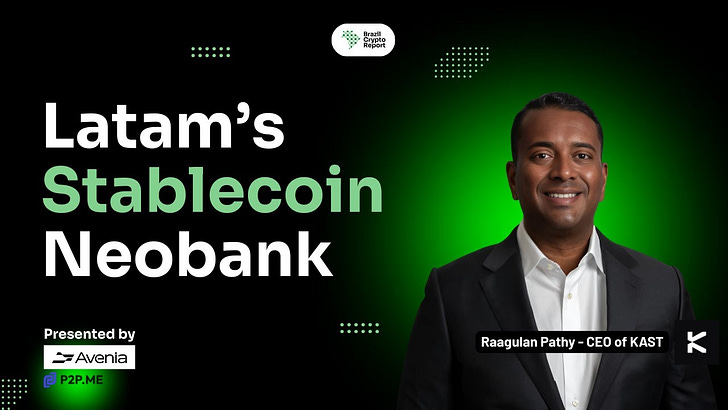
#168: How KAST Became Latam's Stablecoin Neobank with Raagulan Pathy
from Brazil Crypto Report
45m 21s
In this episode of Brazil Crypto Report, host Aaron Stanley interviews Raguilan Pathi, founder and CEO of Cast, a stablecoin neo bank experiencing rapid growth in Latin America and globally. Pathi explains that Cast serves "crypto-native" and globally mobile people who need a banking platform beyond traditional local banks, allowing them to send and receive cash, stablecoins, and crypto while offering a savings account and card. He earned the nickname "Stablecoin Guy" from his time at Circle and his belief that stablecoins are crypto's biggest opportunity, with the real use case being making them usable as an alternative to conventional banking.
Cast launched in July 2024 and quickly found product-market fit, achieving 500K app downloads, 64% weekly user stickiness, and 20% monthly growth, crossing $20 million in volume. However, the journey was challenging, involving rebuilding the app three times, managing fraud, and shutting down operations in 50 countries due to compliance issues. The team works intensely (60-100 hours weekly) to capture the market opportunity.
Pathi outlines four customer profiles: crypto natives needing off-ramping, stablecoin-first users from developing regions, remote workers unfamiliar with crypto (targeted via virtual USD accounts and payment links), and "mobile rich" individuals earning $100K-$500K who live across multiple countries and struggle with traditional banking's geographic limitations. Cast differentiates from other crypto cards through heavy investment in compliance, multi-chain support, global acceptance, and rapid customer support, aiming to provide a seamless global banking experience that bridges cash, stablecoins, and crypto.
[MUSIC] >> Everyone, welcome back to Brazil Crypto Report, a podcast produced by Activo Media and Advisory. I'm your host, Aaron Stanley, and today I'm joined by Raguilan Pathi, who's the founder and CEO of Cast. Cast is a super exciting stablecoin neo bank that's been gaining a lot of traction in Brazil and Latin America. And we're going to be diving into that today. Before we do that, I want to give a quick shout out to our show sponsors. We have Avenia, which is building seamless infrastructure for cross-border payments in the Americas. And we have ptapi.me, which offers simple and decentralized fiat on ramping to USDC. We'll be hearing more about both of them later in the show. With that, I'd like to welcome Rags to the show. Great to have you here. >> Great to be here. >> Thanks for having me. >> Yeah, absolutely. So to get started, I would love for you to give us maybe the elevator pitch, the TLDR for what is Cast, what are you building? >> So Cast is a bank-like platform for, I would say, crypto-nated people, people who are part of the global economy. They sell and buy and sell goods and services. And also people who work remotely as well. So we feel like now the internet has been around for 30 years. There's a significant population of people who are not dependent on a single country. And they need a new style of banking platform. Their local bank probably just doesn't cut it. I think one thing that's different with us is that you can send and receive cash. You can send and receive stable coins and crypto. You can send payment links. But at its core, it still does the thing that most people want out of the bank, which is that you have like a cash count, a savings account, and a card, right? But it's in this new world, which mixes all the different things that you can, you can actually get out of a single account. >> I love that. So you've earned the title online of Stablecoin Guy. I'm hoping you could maybe tell us a bit about that and maybe how you earned that title. And then tell us a bit about your background in the space as well. I know you spent some time with Circle and some other places that are quite relevant. And so tell us about that and then tell us what was like the inspiration to start Cast. >> Yeah, absolutely. The Stablecoin Guy, I think I just, I'm sorry, I didn't know exactly how it happened. Maybe I self-appointed it. But I've been in Stablecoins for around five years. Prior to it starting Cast, I set up on Rand Circles Asia Business. And so it was quite deep there and was generally in and around Stablecoins for a while. I've had a macro thesis around why Stablecoins are the biggest things in crypto for a long time. When I came to working crypto, I had a career in web too, like Zoom Facebook Amazon before that. And when I came into crypto, I think everyone was just super focused on trading and NFTs and memes. And I was like, look, everyone's missing the biggest opportunity, the biggest ham opportunity is actually Stablecoins or rather what you could do with Stablecoins. And so yeah, I write a lot on LinkedIn. Actually, weirdly, less these days because my job of running Cast is actually so busy. But yeah, I've been writing a lot around why Stablecoins are so impactful. That's how I earned it. Yeah, through my experience at Circle, great company obviously came to understand a lot about the Stablecoin business, who the different players are, how they adopted in different parts of the world. And I think that inspired me to think about building Cast because, as I have often said, Stablecoins are great. There's three or four big ones out there. But the real use case is making it usable for people so they have an alternate to their current banking platform. And that's really what we're trying to do with Cast. We felt it hadn't been done properly. You have a pretty clumsy experience when you have a wallet or exchange. People want to bank like experts and that's what we're doing. And then so you guys launched in 2024, I'm not mistaken, fairly recently. And it seems like you found product market fit quite quickly. So I was hoping you could give us some color on like just what that first year or so of the journey has been like and what you've accomplished and maybe what some of those like highlights of the first year have been. Yeah, absolutely. We launched in July 2024. I left circle earlier in 2024. Actually, I kind of was like kind of retired and so cool from like traveling. I was just like, I need a break. I've been working for like 10 years. And then of course, very hard to sit still. And so the year has been, look, I think for entrepreneurs, if you're looking at it, like getting product market fit almost immediately is extremely rare. And so that's been amazing. We've had half a million downloads of the app. We have a very, very sticky user base, something like 64% of users use our platform weekly, 30% user daily, which is in the S tier of like stickiness for an ear bank. And so yeah, the year has been crazy. We're 14 months operating 14 months. We've crossed 20 million hour. We grow roughly 20% every month, some months, more, some months less, but that's roughly where we're right. But when you compound that, it becomes very, very significant. It has been, you know, not, I think, externally founders have this habit, myself included, of saying like, everything's going smoothly. Everything's going fine. But it certainly has not been that way. We've rebuilt the app three times. We had time to, we couldn't manage all the fraud. We shut down like 50 countries that we were operating in because we just couldn't manage the volume and the fraud or compliance. And you know, until we just were too small and too young, obviously had to raise money in between. So it's been a pretty hectic year. It's been a pretty roller coaster ride for 14 months. But you know, we have a very hardworking team. You know, I make no, I'm not shy about it, that we hire people who want to come here, probably for less work life balance because you'll find yourself working between 60 to 100 hours a week. Not because I'm like someone who breathes down people's throat, actually don't care what time they people clock in and clock out. But there's just so much to do. The market opportunities huge. The amount we build pipeline for our products is very long. And I think it's a race, frankly. And there's a race to build this global bank like platform that has the most connectivity, et cetera. And so yeah, that's what we're trying to do. I look relatively fresh right now, but I think that's just because I had a shower and a shave just before. If you still be like having an hour ago, I was like looked in full-founder mode, scruffy, and like, you know, it's a busy time. It's a busy time. So well, let's talk a bit more about the features of the product itself. Maybe kind of walk us through like what are kind of the core kind of functionalities at this point. And then how do people, how are people using it? Maybe how are people using it? They think that's maybe like different than what you expected them to use it for. Maybe give some early feedback on just what that reception's been from the user base. Yeah, and it's cool. Our proposition was extremely simple. You deposit stablecoins. We didn't even accept crypto for the first year or so. You deposit stablecoins, USDT, USDT, a few chains, you use a card. It sounds extremely simple, but if you want to make it work for like 150 plus countries, you want to have the licensing underneath. You know, there's so many nuances from Apple Pay and Google Pay, how the app works, how you do KYC and all of that. It's actually very difficult. So that's how we started. Deposit stablecoins, spend it on a card. The card has an amazing experience. Work's 99% of the time. You know, it's a secured credit card. It's secured by the amount of stablecoins you have. And then we evolved it so you can deposit crypto. You'll now have earn on the products that you can earn money for your stablecoins as well so you can keep more there. And what we're doing now is essentially molding it into much more like a bank like platform. So you can open a US dollar account on their now virtual account and sooner you row one as well. But at the moment, like you use the main platform, which looks like a card platform where you deposit stablecoins or crypto, you spend on your card. Well, we're now moving towards defaulting so pretty much everyone will have a virtual US dollar and your account opened by default. And so it feels a lot more like having a bank, right? Because you can accept, you can send your bank account number to someone they can send you money or you can send out both ways as well. And you still have the card. We're also adding things like pay to wallets as well. It's a large large part of people in Asia and Africa in particular. They're banking version is like a local wallet. So you'll be able to send to that. You'll be able to send payment links. Of course, we'll also be adding business as well. So you could a lot of people are small businesses, a few people. So they may have the business name and so they want to open a account and a business name as well. So in some way we're going, still pretty simple, but huge demand for it. That's literally hundreds of millions of people who need this immediately. And probably 3 billion people in the world who want just a USD account and outside of the US don't actually have one. That's super interesting. And I think it kind of goes back to one of these, maybe these kind of entrepreneurial paradoxes where a lot of times like the killer product is really just something that is very simple and executed very well. It doesn't have to be some complex crazy thing. But it's like, what's the problem here? So we're giving people like dollar access. We're giving people easy access, stable coins being able to spend those coins.
to see those coins, whatever. Maybe talk a bit more about the profile of your core users right now. Are these more of crypto native people that may have just be sitting on a pile of stable coins from trading or whatever, and to off ramp would be a hassle for them. But it's easier if they could just spend via a card, then that's a nice solution for them. Or is there folks that are maybe new to crypto that you're onboarding or that are just kind of, you know, maybe getting their feet wet with crypto, maybe maybe talking a bit more about how you're thinking about that customer segmentation right now or what, where's the early interest coming from. P2P.Me is the fastest way to buy and sell USDC in Brazil using PIX. It's direct, secure, and fully on chain. Backed by multi coin capital and Coinbase ventures, P2P.Me offers a compliant on and off ramp with ZKkyc and no hidden keys. You can easily use p2P.Me to pay PIX QR codes in Brazil using your USDC balance. Just top up scan and pay. Check out the link in the show notes to get started. I'd like to take a moment to tell you about our show sponsor, Avenia. If you're building a wallet, a crypto consumer app, or a global payment platform, Avenia is your bridge to Latin America. You can instantly connect to PIX, SPAY, and CBU using stable coins with a single API. No banks, no effects, desks, no swift. Get over to Avenia.io to learn about how you can move money globally with full compliance and real-time settling. Back to the show. Maybe getting their feet wet with crypto. Maybe talking about how you're thinking about that customer segmentation right now. Where's the early interest coming from? It's funny you asked me because I was up very late last night finalizing our deck for investors as we're about to do a funding round. There's one whole deck exactly on this. I can repeat it for you. We have four customer profiles. The first customer profile, exactly as he said, crypto native, they trade, they need a way to off-frame. They probably also need some bank-like platform because they have friction in the current banking system. They keep getting rooted from the bank. The bank doesn't understand where they're moving money to, etc. There's that crypto native user that's a huge amount of our base, especially with our strong partnerships with platforms like Salana. For example, so we have a huge amount, a huge base there. The second one is what we would call the stablecoin first group from the global south. This is obviously Latin, this Asia, this is Africa, people who live in countries where they used to dealing with stablecoins because their current bank systems are not great. There's a good percentage of people with stablecoins, maybe five or ten percent of the population. They've got used to using stablecoins to move into money. That's our second ICB. I think the third one is which we're developing now, which is much smaller, is the remote worker. The remote worker is someone who doesn't really know much about crypto or stablecoins. They're the ICB we're going after by adding bank accounts, virtual bank accounts, by adding payment links and other ways to move cash. They can basically use the platform, not having any stablecoins, not knowing about crypto or not even caring about it. That's the third one we're developing. It requires us to do a lot more plumbing in terms of how you can move money in an out of the platform, but that's what we're developing. The fourth and final one is what we call the mobile rich. These are people who are in, frankly, the 1% from a lot of countries. They were traditionally back in the day, they were good at Switzerland or London, and then they became the new, went to Singapore or Hong Kong, and then they became the new, they went to the UAE. Now, they actually don't need to go anywhere because, and I call this the virtual nation state of Switzerland, maybe. The people who are earning pretty good money, they're talking 100 to 500,000 US dollars. They live maybe in a developing market, but their lifestyle and their income is much more like a developed country. They maybe live in multiple places, they may work remotely, they may not have a single residency, typical residency. There's a population of them, probably around 10 million people, but probably which will become 100 million pretty quickly, who are pretty significant as well and require a different type of bank. Right, so those are folks that for them, it might be easier to use something like Cast, than it would be to have just multiple bank accounts set up in all these different countries that they're frequenting, or even maybe you still have these bank accounts in Switzerland and the US and the UAE, but having Cast, something like Cast as a way of just sort of ease of spending in your daily usage, your daily consumption needs or whatever, paying bills, paying buying stuff at the store or whatever. Sometimes it's a little easier just to have one card, one product that you can just use anywhere you're at, right? And then maybe you leave. These people are kind of not understood by the financial system, because the financial system is, but tell me what country you're in. I live across two countries and challenge a lot more. And so for me, I live in Singapore, one of the best places for banking, one of the places that I spend a lot of time in Australia, both great banking places. But I still get calls from my bank here just going, explain this transaction to me, why are you moving? Why is there so much money moving between Australian Singapore? For me, I just think of it as like, I've got two bank accounts, I've got two different places, I should be able to move money freely. But you're still going to get the calls, because I don't understand your kind of profile, right? A person who just lives in different places and needs to move money around. He doesn't fit their mold, he doesn't fit all the systems that they developed. And so we're building the platform for people like that, we understand that kind of user. That is our native user, right? It's not the person who lives in a country and has a house and has lived there in the same house for 10 or 20 years. That's not our customer. The local banks can deal with that. But there's a different type of customer that is global and mobile, which we're trying to serve. Yeah, I think anybody who's probably spent time across multiple, I mean, just myself, I don't know if I put myself in the global 1%, but I do spend time in multiple countries and it's have multiple bank accounts in different countries. And it does come to be a hassle, right? Where you get these kind of compliance checks of like, why are you spending this money here? Why are you spending this money in this place when you're supposed to be here? And it's, yeah, like the traditional financial system is just like not necessarily, there's not like a box that's, like a, you know, kind of a, it doesn't really fit very well to like just, like, this side of this profile person doesn't really fit well in that kind of existing framework. Yeah, and these platforms that came along like New Bank, Latin America, Revolution Europe, done an exceptionally good job of like helping with a little bit of movement between the countries in the region, have given us a much better UX experience, you know, both like obviously companies are respect hugely. But they're still solving for, you know, a user experience within a region that not still like a global bank first, I guess, a bank like platform first. And that's what we're trying to do with the next evolution of, they took you from bad experience, the local bank to a regional experience, which is really good. And we're trying to take that to a global experience, which is even better and also native to cash and stablecoins of crypto, all of one kind of piggybacking off of this. I put what we're talking about right here, but it feels like this year is kind of the year of like crypto cards. Like it kind of just feels like everybody is either, you know, launching a crypto card or already has a crypto card from, you know, exchanges to, to like some of these other neo banks, like we were talking about like your revolutes or whatnot. And I think, you know, I think, you know, folks like us made, we're in this every day, so we probably understand some of the differences. I think maybe for folks who aren't really following this on a database, it's just like, like, how do I pick what card to use? Like which one's the best? Like everyone's got a card now. We say that would be Alaska. There you go. I like that. But maybe like, maybe talk about like, how would this differentiate from, you know, from getting like, you know, not to like pick on anybody, but like, you know, like Avalanche has a card now, right? That they're, that they're distributing. It's like, okay, like, or or or say like, there's like a polygon card that's just becoming out at some point. Like, how would like for the average kind of crypto pro sumer, like, why would something like cast might be a better fit than one of these other things out there? Well, firstly, I think if you look out in a few years time, most of these cards won't exist. They'll get canceled. Because people think it's really easy to set up a card platform. But to keep investing in all the details, like we've added, we started with one or two chains now with more than 10 chains and 20 chains. We allow you to just deposit USDC, USDT, pay while USDT, multiple and a dollar is the dollar. So making all that user experience invisible, running the compliance team would be like 30 people in compliance, you know, to manage like a global compliance across lots of countries, making the card available nearly everywhere, making sure it goes run smoothly. And then also if you have a problem, you hit our concert hour average response time. It's one minute and we'll cut, we'll chat you on WhatsApp as well. And so you can have a card, but I think everyone's had a card where the experience is just like it's just a card, right? But building a whole experience around it, that's totally different. And we just think that there's a lot of people who are just spitting up cards, but just have a lunch, give a fuck about you as a card customer.
I don't know that though. Thanks, they were chained, right? With a bit of branding. They want to put their brand on a card, I get it, right? You know, and many others do, right? If we get asked by people almost every day, there's some chain of someone saying, put us on a card, create a card, 'cause we've got these cool salana cards. But the reality is, is that you have to build a whole experience around it. Like everyone's had a bank before, you know, ultimately you can feel the difference when you have a bank that really cares about customer service, really cares about the customer. And it's continuously trying to make that experience better for you, a better app, more options, et cetera. And so you can launch a card, but it's just like a thing, a distraction, another, you know, it's there like 1% of everything they do. Versus, we don't have anything else, right? Like this is all we do, right? Like if we don't do this right, like, we don't have a business, right? And so that, I think, is the difference. Like extreme focus on a singular bank-like platform, which includes cards and USD accounts, et cetera. That's our game, right? We're not running an exchange, we're not running, you know, wallet, like we will add wallet-like features and stuff, but this is our main game to make, give you the global user an amazing bank-like experience. And so that's why I think we're winning, I think I'm gonna show it. We actually did a panel together blockchain Rio with Luca Prosperi from M zero. And I know you guys are actually have your own, I can't remember if you're actually, if your own stable coin is live using M zero infrastructure, or it will be launching, but maybe talk a bit about that, like why it is live, okay. But maybe talk a bit about like, you know, what's the play here, like why are you doing this? And then why, I mean, I guess I'm a M zero fan, so you know, we'll give them a plug here, but like why are you using M zero as the platform to watch this? So I mean, I think we were looking at a lot of the different platforms. So I was like, who are you gonna bet your horse on, right? And I think M zero has the best technical team, not only Luca, but they also have Joe Owl, who was a peer at that circle, they call him the Godfather of USDC. They just think so much deeper around stable coins. And so I think if you're gonna bet your horse on someone, I'd bet it on M zero. If stable coins are involved, we're gonna need a lot more features. I think they're the right partner to make it all happen. The second thing I think is that the reason we're doing it is, you don't need another stable coin, frankly, right? But there's things that you need from a stable coin. For example, you wanna be able to deposit any stable coin, any chain, and it just becomes a dollar, right? And so it's actually part of our stack along with swaps and a part of like this composability of stable coins. And that's the main reason we using it. At the moment, we can do it sort of custodial. But what we wanna do with this is, so you deposit USDCT, PYUSD, whatever, and you get USDK, but you can see it on chain like, hey, this is my, you know, you have $1,000 in your cast account, you can see the $1,000 there. So that's kind of where we're moving into. And we couldn't really, we felt like doing it ourselves, working with M zero was the best way to achieve this. And then it looks like you guys have been targeting heavily the emerging markets global south with like your initial go to market over the last year. And we talked about this a little bit earlier within the customer segments, but maybe pivoting the conversation here to talk about Brazil and Latin America. Maybe just talk about like, what value to see a product like this bringing to users like in this part of the world, and maybe what's been the reception from early users so far. So I think there's a couple of things, right? So firstly, I think whether it's Brazilian or others, they're in search of a global bank like experience. Maybe a lot of them have accounts in the US or other places, but that comes to challenges if you're not local resident, you know, you can continuously getting your bank account shut down, et cetera. So they're looking for a bank like experience because a lot of Brazilians and Latin Americans are very global, or they, you know, they work for companies in other places, so they want to get paid in stablecoins, et cetera, right? So there's a huge bucket around that. The second thing I think that we've done better compared to others is we've actually built a brand and we've created status, right? Like it's no secret that you get the virtual card free, but there is, you know, a thousand dollar a year level. There's even a $10,000 a year level, right? And I think Brazilians like, they like tiny things, you know, and so do people in Latin America. I think what the mistake that many have made was that they've just presumed that people need stablecoins. I think the mistake that many, the thing that people don't understand is that they just think stablecoins and they think people who don't have money and are remittance, right? Which I think is actually not true, right? There's of course a large use base for that as well, but there is actually a big use base of people who, like I said, have more money. They're awkwardly mobile, they're global, and they want a different style experience because their alternatives are American Express or others, right? And they want a crypto version of that. And I think that's what we've been able to execute. And I think that drives a lot of brand loyalty, you know, for people in Brazil and other places as well, because they're like, okay, this is a cool, okay, I want to show people I've got a card card, right? Because it's a cool, it's a cool brand, you know? And we invest from day one, agency record is boundary LA, you know, agency out of Los Angeles. And we've invested a lot in brand, and we're investing even more in brand when they're upcoming special offer and next fun new round, we'll be going deeper and deeper on brand, right? Because ultimately, like, you're gonna have a lot of options, right? But people are human and they want to have a brand that they love, they want to feel like they get the best user experience from that brand, they want to feel like it's something shiny that they want to show your friends. >> This was the big takeaway from the NFT phase in 2021, right? Is like, people, they want to, they'll pay, you know, absurd about some money to have this little like, pixelated image as their Twitter profile picture, right? >> Exactly. >> Exactly. >> So, I mean, what you're mentioning here is super interesting, because this, it was kind of at Blockchain Rio where we first met, you know, mother so ago, I had kind of the same realization where I'd always kind of thought of stable coins as like, okay, it's remittances and it's, you know, there's a lot of this kind of cross-border B2P payment stuff going on, right? Which is obviously, there's obviously a lot of like value there. That's a lot of probably work-a-fit that we're finding there. But I hadn't really realized that there was such an interest and demand from kind of the more the consumer-facing products. Like what, like what you guys are building and even, you know, I think I did a panel with like the red dot pay guys who have some of the similar and, and I, I should have realized that there's, that there really is like a big market for just consumers who want this type of experience. And I think every time I walk past your stand at Blockchain Rio, it was just completely packed, like full of people, which obviously looks like a lot of money. >> That's cool because we can do it. >> It was a through the hottest pot of it Blockchain, right? So, I think that helps. >> And that helps. >> That helps too, yeah. >> That helps too. But it, it feels like, okay, that's a pretty good indicator of that, like, okay, there's something here that, that people are, are wanting, they're coveting. And I know you guys just launched picks also, like a picks integration. >> Yeah. >> So, I mean, I'd be interested in kind of hearing a bit more on like, you know, like, are there any other kind of like localized features, you know, that can, or maybe even as you're trying to roll this out into different markets, whether it's Latin America or elsewhere, how do you kind of make this thing like kind of localized so that it really, is a global product, but you're trying to look at the market as well. >> But I mean, obviously, a picks is a big thing for Brazil, and we're partnering with bits are actually to get rails and lots of parts of Latin America, Colombia, Mexico, Argentina, and other parts as well. So, picks is definitely big. I think obviously, it can't be in English, it's just called in Portuguese, Brazilian Portuguese specifically. So, there's going to be a Portuguese version of the app. We're actually changing the app into 30 different languages. So, people have a lot of different languages, partnering, someone to help with that. And then the second thing is customer support at the moment. A lot of our customers support is in English, and because obviously a lot of Brazilian speak English. But of course, you know, it's always better to be able to speak in your native language as well. So, we're investing in customer support there. Then we are also investing a lot in terms of our brand partnerships in places like Brazil and Argentina, as well as brand partnerships, and also just like more staff on ground to help with the community, et cetera, more events, et cetera. So, yeah, so I think we want people in Brazil, I mean, it's a Brazil, but we want people in Brazil to feel like this is a brand that they own. You know, it is definitely one of our biggest markets. We have a hugely loyal fan base there. We love there. We've got a number of great staff there. Personally, for me, Brazil is like one of my favorite countries. I've traveled to a hundred countries in the world. So, I'm obviously biased being from Australia, but like Italy and Brazil, like my other top two countries that I really love. So, I have no complaints coming visiting very often. But yeah, that's what we're trying to do. We're trying to localize a lot more for people to feel like they are in the brand, and they're invested in the brand itself, right? And yeah, do you have, before we kind of move on here, are there any numbers or kind of data you have built this share? I'm just about like.
casts adoption or uptake in Brazil or Latin America. Like what maybe any any just sort of numbers on user growth or what percentage of your total users maybe are coming from this part of the world or anything like that that might just help give our audience some useful color. Yeah, we do it fully break it out. I can tell you that last time is roughly around 30% of our global business. Obviously the rest coming from like Middle East Asia, Europe and the US are still pretty big but you know 30% is big and we think it could become 40 or 50% one day and the second thing is is that growth is very strong. We grow roughly 20% a month right now which is like if you do you know some rough maths on what 20% a month is compounded you're doubling nearly every three and a half months or so. So yeah we you know we're growing between 7 to 10 acts annually and now we obviously came out of the gates very hot and then we thought it was going to slow down but actually weirdly we've settled into this 15 to 20% month of month growth and we want to grow even faster and I think that's just more because like more trust is building around the brand. So yeah Latin America is like super important to us you know I personally will be spending like two months there this year in Q4 and really to hire a lot more people you know put boots on the ground and make sure people know exactly you know that we're really focused on them as a community as well. And I was actually at the Bitsoh Stablecoin conference last week in Mexico which was really great conference and I think for me I was kind of I chatted as light bulb moment where realizing that like I think crypto adoption like in Latin America or stablecoin adoption specifically in Latin America is probably like the kind of crypto like meta narrative for the second half of the year just based on you know everything we've been seeing over the year and then also seeing just the energy at this conference which frankly that was kind of shock back I never been to a stablecoin conference before so wasn't really sure what to expect but like the sheer amount of kind of energy behind this stuff was very palpable. I guess I would you know can't maybe kind of broaden the conversation here I would love maybe your reaction to just that that hypothesis here of stablecoins in Latin America as really being like kind of a key product market fit for crypto right now. And then also you know where how much how much room to run do we have as we're in kind of this stablecoin euphoria at the moment but how much how much room to run do we have where are we going from here. Yeah I mean so firstly let me touch on stablecoins in Latin America it's like perfect PMF right because everyone knows that generally let the money flows from the US South and so a lot of countries in Latin America are selling goods and services to the US so they're getting dollars right it's not like other not like Asia where you're selling between Asia but it's different currencies it's all in dollars right. And so for that it's really good I'd the fact that there's in various countries you know friction and issues let's say whether it's like inflation or moving the money or capital controls etc. And so I think that creates like a perfect environment for stablecoins. So I think the PMF is is very obvious. We in terms like where is stablecoins like I predict that we'll get to 10 trillion dollars in stablecoins around the year 2034 because stablecoins are going roughly 50% year on year so if you just do the maths that's where you land. There are about 300 billion dollars today. So we have about 30x upside in stablecoins right but one of the things I would say about this having been in stablecoins for a long time is that people are misunderstanding where to place their bets right whether it's investors or whether it's the public. So so everyone thinks that the big money is in stablecoins themselves right because they just look at a number like oh we're 300 billion today we could be a 10 trillion let's bet the house on stablecoins themselves right. And it's very easy but as I say stablecoins don't own any customers right and I think actually the biggest opportunity is the rails that stablecoins have created you know US dollars permissionless global independent countries that's the magic and what you really want to do is build a business and services on top of those rails right that's where the magic happens not the stablecoin layer itself is is great but I think it's largely one by you know three or four players actually I yeah one of the funny things is that 99% of stablecoins are US dollars so all the stablecoins in all the other currencies are 1% and then 99% of those US dollar stablecoins are just four stablecoins USDC USDT obviously USDE by Athena now and die which has been around a long time all the other US dollar stable coins are 1% right and in all time I think there's only been six large stablecoins you know that have got significant traction before I mentioned and obviously BUSD which got wound down effectively and then of course we don't want to mention our favorite friends at Tara and Luna which obviously blew up as well but it didn't have fundamentals so for the hype around stablecoins I mean people are missing the fact that you don't actually want to go and build a stablecoin that's a very hard business to be in unless you're in the platform like M0 which enables you know all the other use cases what you actually want to do is just do the hard work go and build a platform that's usable for end customers I think people are scared to go on service end customers it has customer acquisition costs it's you have to wrap a lot more around it and so they just go like I'm just going to build another stablecoin but that's not where the magic is you have to provide the end value to the customers no I love that and it does seem like we have in crypto generally this is a critique of maybe industry more broadly it's like we have been in this this frame of mind of like oh we're just building infrastructure right we're building infrastructure building infrastructure that and then at some point like somebody's going to come along and build applications that people might actually use right but it's like for years and years and years we're just infrastructure infrastructure new layer ones new new whatever new modular stuff on your theorem and you know so seeing someone who's coming along with like a real vision of like let's build a product that like consumers you know everyday consumers are going to actually use is quite refreshing right so props to you for for taking taking the lead on that and I guess I mean this is neither here nor there this is just like a question I've been wrestling with since the terrelluna debacle since you brought it up but like I mean do you think that there is any future for these these type of algorithmic stablecoins or these anything that's basically not collateralized by like not backed by a fiat currency like is there or are we at the point where like I think a failure has proved that there's a way to do it and they've you know I've looked at their wrist models at a respect guy a lot he's done a fantastic knockout job in my personal trading of crypto my biggest holding and you know and so like I'm very bullish on that team and I think they came at a time when people thought that there's no way to build something that's not just US dollar back in cash and I think they've proven that there is right so they've done a great they've done a great job um yeah but so I think similar models to that I saw the Binance's launch one that's similar as well you know I think those called a models work I think that thesis around an algorithmic stablecoin where you flip between you know a token others I think that's been disproven you know and amazed that it even lost it as long as it did really yeah it's one of these ideas that sounds like intellectually exciting but maybe in practice it doesn't work out so well um so um I got you for a couple more minutes here I just want a couple kind of quick rapid fire questions but would love to to get your thoughts on what's been like the hardest part of trying to scale cast I mean you've mentioned a few different pain points of just you know trying to hire and just like to wrap a growth and I assume there's a lot of kind of compliant stuff behind the scenes and you know anytime you get you're dealing with cards there's all sorts of like anti-fraud you know stuff going on right like what's been like the biggest sort of thorn in the side of of your growth your success so far have you got another 40 minutes so it's like okay it's a whole cycle right so when you when I present the idea of stablecoin banking investors most of them believe it they're just like this is not gone build infrastructure don't build now how you're going to get through care care you're going to find pmf so you go through the disbelief stage right then you've got to go and build it and then when you go and build it you've got to go through all the you know what I explained earlier I want to repeat myself around how hard cards are then you're going to hit with this is also another reason I don't think 80 percent will survive because you're going to get hit with hard or fraud you're going to get hit with like bad actors going after you no we had we got hit with a lot like sms pump fraud people trying to drain you just mess on sms fraud which is just by the way like away from them to earn money using your Twilio so you're going to get hit with all of that and then you have to recruit the best engineers who work day and night to basically keep all the systems up keep all the customer puppy keep you safe and secure and so all of that has been very [BLANK_AUDIO]
hard, you know, and we not everyone has survived. And I really now pressure tests, I think a lot of the people coming in because it's not an easy place to work. It sounds very glorious from the outside, but it's a very high pressure environment, not because I'm high pressure, but because the growth is there, the customers expect a lot, they can't afford to make mistakes. And so, so that bit is very hard. And so the external glory of the growth is underpinned by just extremely hard work. And I think also for entrepreneurs going into this, I think the hardest, I had two big advantages as a founder. Right. So firstly is that I had a roller dex, I could, I had, you know, even if a lot of early investors said no, I had people who would say yes. And I had a roller dex for people I could hire or I could basically bring on to the mission to come and work hard, you know, because of my, you know, because of being the stablecoin guy and having put a lot of work around that, people were curious. And so we don't really hire by putting, we do put job ads out, but we don't use recruiters because we want people to like lean into us as a company and come hunting to us for a job, you know. And so those two things are very hard. And the third thing is just building partnership, having a roller dex that through which you can be able to affect partnerships, people that's learner and others. So those three things are hard to execute, you know. And I think for founders they struggle with multiple of those things. And that's I think what separates us. We also, I think, are very focused on having a winning culture and work extremely hard because I think, you know, this is what you can leave on that I personally believe as crazy as it sounds to everyone, because when, you know, one 200 or one 500 of us now that we can build a hundred billion dollar company. Right. I think that it can be extremely big. It's not like, like if we, if we raise money at a billion dollar valuation, I'm sure we'll do it the next year, to me, it's just like, okay, we're not, we're just getting started, right. I think the opportunity is just that gigantic, but it requires very precise execution and having the best people and having the best vision and being able to deliver on it. So yeah, what can I say to founders, like go for it, but don't do it, don't do it for a lot easier ways to, if you want to make money, like honestly, go and get a job with like a big culprit and, you know, get paid tons of stocking, you know, I've worked at like Facebook and places much easier life compared to what I've got now. This has really been really helpful, really appreciate your time. I mean, it's just been fascinating hearing about your growth trajectory and the product market fit you've been able to find and, and I just want to congratulate you on success so far and I just want to thank you for, as I mentioned earlier, just being like really laser focused on building an actual kind of consumer app that just feels like that's been a kind of a black hole and crypto lately as folks just really building with the end user in mind. So congratulations on all that. I know you mentioned you're going to be spending quite a bit of time in Latin America over the last few months of the year. Yeah, maybe just give folks, you know, how can folks find you if they want to get in touch, sure, if they want to work with you on, you know, are they just want to learn more about what cast is doing or get involved somehow? Yeah, absolutely. So our website is castkst.xyz. If you want to email me, it's just our actcast.xyz and I'm always looking for great people to work with and great people to join the team. I'll be personally doing a bit of a tour around Latin America, spending more time there. It's no secret that there's also summer by the time I arrive and I'll be enjoying the best of the summer and everything that Brazil has to offer. So yeah, I'll be around a Sao Paulo over here and many other parts of Brazil as well as Latin America. I think just one final note is that just a huge appreciation to the Brazilian community. You know, it's been a favor country of mine since I was very young. I was actually just kind of pinching myself, personal note, that we have such a strong user base there. I was just like, I didn't in my honestly, honestly, in my wildest dreams, especially when I started cast, remotely thing that Brazil, country I loved so much would actually end up being one of our biggest user bases. So huge thanks to the team, you know, everyone who supports us out there, love you guys. We will invest very heavily in making, do everything we can to make, you know, cast really work for the Brazilian community in particular, you know, both Brazilians in Brazil as well as Brazilians globally. And we'll throw many more cool parties and we'll make them bigger, some more people can attend because I think we didn't have enough slots at the last one. Amazing, amazing. Well, Rags, that's great. Really appreciate your time. Appreciate your enthusiasm for the Brazil market here. And yeah, hopefully we'll catch you in real life again in a couple of months on your tour through the region. So thanks again and thanks again for watching and we'll see you next time on Brazil Crypto Report.
Podcast Summary
Key Points:
Cast is a stablecoin neo bank targeting crypto-native and globally mobile individuals, offering a bank-like platform with cash, stablecoin/crypto deposits, savings, and a card.
Founder Raguilan Pathi (ex-Circle) emphasizes stablecoins as a major crypto opportunity, focusing on usability over trading/NFTs.
Launched in July 2024, Cast achieved rapid product-market fit with 500K app downloads, 64% weekly user stickiness, and 20% monthly growth, crossing $20M in volume.
Core customer profiles
Cast differentiates from other crypto cards by investing in compliance (30-person team), multi-chain support (over 10 chains), global card acceptance, and fast customer support (1-minute average response).
Summary:
In this episode of Brazil Crypto Report, host Aaron Stanley interviews Raguilan Pathi, founder and CEO of Cast, a stablecoin neo bank experiencing rapid growth in Latin America and globally. Pathi explains that Cast serves "crypto-native" and globally mobile people who need a banking platform beyond traditional local banks, allowing them to send and receive cash, stablecoins, and crypto while offering a savings account and card. He earned the nickname "Stablecoin Guy" from his time at Circle and his belief that stablecoins are crypto's biggest opportunity, with the real use case being making them usable as an alternative to conventional banking.
Cast launched in July 2024 and quickly found product-market fit, achieving 500K app downloads, 64% weekly user stickiness, and 20% monthly growth, crossing $20 million in volume. However, the journey was challenging, involving rebuilding the app three times, managing fraud, and shutting down operations in 50 countries due to compliance issues. The team works intensely (60-100 hours weekly) to capture the market opportunity.
Pathi outlines four customer profiles: crypto natives needing off-ramping, stablecoin-first users from developing regions, remote workers unfamiliar with crypto (targeted via virtual USD accounts and payment links), and "mobile rich" individuals earning $100K-$500K who live across multiple countries and struggle with traditional banking's geographic limitations. Cast differentiates from other crypto cards through heavy investment in compliance, multi-chain support, global acceptance, and rapid customer support, aiming to provide a seamless global banking experience that bridges cash, stablecoins, and crypto.
FAQs
Cast is a bank-like platform for crypto-native and globally mobile people. It allows users to send and receive cash, stablecoins, and crypto, use payment links, and have a cash account, savings account, and card in one place.
Cast was founded by Raguilan Pathi, also known as the 'Stablecoin Guy.' He previously set up Circle’s Asia business and worked at companies like Zoom, Facebook, and Amazon, giving him deep experience in stablecoins and web2.
Cast launched in July 2024 and achieved rapid product-market fit. It had half a million app downloads, 64% weekly user stickiness, crossed $20 million in volume, and grew roughly 20% each month.
Core features include depositing stablecoins (like USDT and USDC) or crypto, spending with a secured credit card, earning on stablecoins, and accessing a virtual US dollar account. It also supports payment links and wallet transfers.
Cast targets four profiles: crypto natives needing off-ramping, stablecoin-first users in the global south, remote workers unfamiliar with crypto, and 'mobile rich' individuals living across multiple countries with high incomes.
Cast differentiates by offering a global, multi-chain platform with over 20 chains, robust compliance, 24/7 support with one-minute response times, and a focus on users who move across countries, unlike regional neobanks or simple card issuers.
Chat with AI
Loading...
Pro features
Go deeper with this episode
Unlock creator-grade tools that turn any transcript into show notes and subtitle files.
 PodcastTranscript AI