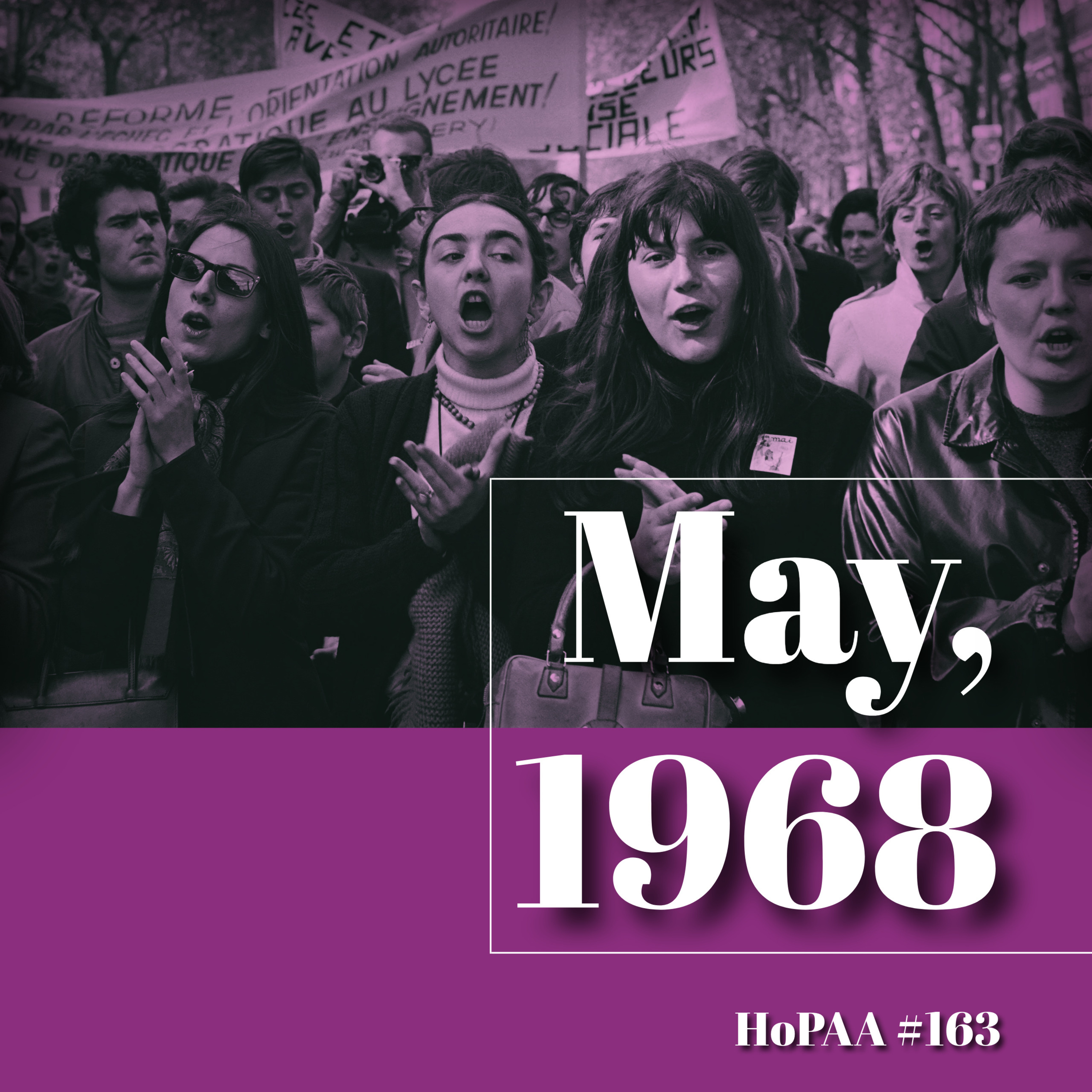
#163 - May, 1968: An Intellectual and Political History of the Paris Student Revolt, Sexual Liberation, Street Philosophy, Alain Badiou, Feminism, Simon Critchley, Sartre, Foucault, Derrida, and Zizek
from History of Philosophy Audio Archive
1h 17m 59s
The 1968 French student and worker protests were a pivotal moment in modern European history, marked by widespread social unrest, intellectual ferment, and a challenge to traditional hierarchies. Though the movement did not lead to a sustained revolution or lasting political transformation, it profoundly influenced French society and culture. Students and workers, frustrated by rigid social structures, gender inequality, and the conservative rule of General De Gaulle, organized massive demonstrations that temporarily dismantled the existing order. The uprising was driven not by economic hardship but by existential boredom and a desire for personal freedom, echoing philosophical critiques of consumerism and alienation. Key thinkers like Michel Foucault and Jacques Derrida provided intellectual frameworks—deconstructing institutions, power, and traditional authority—that resonated with the movement’s spirit. While the government ultimately regained control, and the students returned to routine life, the events sparked enduring changes in education, gender relations, and public discourse. The movement’s legacy is complex: it is remembered as both a failed revolution and a cultural turning point. Later political figures, such as Nicolas Sarkozy, used 1968 as a symbol of social permissiveness to justify conservative policies, revealing how the event was reinterpreted over time. Despite its lack of immediate political success, 1968 reshaped the way French society thought about freedom, authority, and the role of intellectuals in public life. Its influence remains visible in contemporary debates about democracy, gender, and institutional power.
Hey, everybody. I don't know how many of you have seen the classic with the capital C1942
black and white film Casablanca with Humphrey Bogart but and Ingrid Bergman. But I have to say
it is certainly worth either a watch or a rewatch depending on your experience with it.
The plot of Casablanca is that in literal 1942, France has fallen to the Nazis and the
expatriates from previously democratic Europe that are fleeing the Nazis have gathered in a sort
of way station in French Morocco, namely Casablanca. And they're all cramped up in this North African
town waiting, begging, hoping that they can get an exit visa and a plane or steamer ticket out of town.
Humphrey Bogart plays the whiskey bar owner, or I'm sorry the gin joint owner, Rick, the American,
who is in the midst of entertaining a couple of Nazi SS officers who have also come to drink.
And after a short chat upstairs with a Hungarian revolutionary,
he and the revolutionary having a slight disagreement in terms of a praxis. Poked their heads out of
Rick's office and noticed that the Germans have started loudly singing a third rike drinking
songs and patriotic anthems. And then the Hungarian revolutionary, the lover of Humphrey Bogart's
ex-girlfriend goes downstairs to the jazz band that he has in the corner. And he says play the
Marciés and the band looks confused about what to do and they look over to Rick the American and
he gives them the little nod to do it. And I just thought I'd kick off this episode about the
May 1968 French student revolts, which features some interviews from the BBC and some good historical
context setting for a period in time that seemed to have the sort of revolutionary potential that
I know a lot of people are looking for right now. And so I wanted to play that song and the
little bit of the audio from that scene to kind of set the stage for what this episode is all about.
So without further ado, Constable.
What I've been doing, you know what it means to the work to the lives of thousands and thousands
of people that'll be free to reach America and continue my work. I'm not interested in politics,
the problems, the world and not in my department. I'm a saloon keeper. My friends in the underground
tell me that you've quite a record. You ran guns to Ethiopia. You fought against the fascists in
Spain. Whatever. Isn't it strange that you always happen to be fighting on the side of the
underdog? Yes, I found that a very expensive hobby too, but then I never worth much of a business man.
Are you enough of a businessman to appreciate an offer of 100,000 francs? I appreciate it,
but I don't accept it. I'll raise it to 200,000. My friends, you can make it a million francs at three.
My answer would still be the same. There must be some reason why you won't let me have them.
There is. I suggested you ask your wife. I beg your pardon? I said ask your wife. My wife. Yes.
We shall give fair and bold enough to might, to might, to thy trial. There will be a strong seemer sign.
The fatherland must rule itself. Thest they don't try to give up, give up, from right. Thest they don't try to give up, give up, down right.
Wait. Thest they don't try to give up, from right.
You see what I mean? It loves those presents in a café, can inspire this unfortunate demonstration,
but more of these presents and cards are blank up and on. I advise that this place be shut up at once.
But everybody's having such a good time. Yes, much a good time. The place to be closed, but I've no excuse to close it.
Find one.
It's not in this here, it's not in. Everybody is to leave here immediately.
On Tusa is in Paris, seen of some of the most sustained protests of that year. He's joined by a range
of those who are involved on both sides of the barricades to assess the impact on France from the events of 1968.
Here in the Bulbasime Shell in Paris is Latin Quarter. It's a lovely spring day and it's everything you'd expect
Paris to be. People sitting in the cafes wandering around enjoying themselves.
Forty years ago, these streets were the scene of what could have been a revolution.
They were filled with barricades. The students had set them up. The riot police were fighting with them
and for days they fought for control of the streets. In due course, the workers joined in on the
student side and for while it looked as if France itself might be on the verge of revolution.
So these streets, as normal as they are today, were the scene where France's political future was set out
and where 1968 turned into part myth, part reality.
I've just gone back to the Bulbasime Shell. The police are trying to defend one of these swallows
streets against the fossil throwing, one's a slander rather than the stem throwing of the students.
The police are now trying to undo a sort of barricade that's been made in the centre of the street
out of old railings. They got over the students cornered at a jet job. The students are
coming out of their hands up. There are notices stuck outside the theatre saying
the ex theatre, the Odeon, is no longer a theatre. It is a revolutionary political tribute.
It was in France in spring that the authority of the government and the structures of society were
more severely shaken than anywhere else. When the police in May occupied this courtyard in the
soft bone, they triggered off something very much like a revolution.
That last voice belonged to one of the people joining me now, Olivier Todd,
then working for the BBC and a journalist with Le Nouvelle Observateur, the writer.
I'm also joined by Alan Gésmar in 1968, one of the leaders of the student protest movement.
Christine O'Crent, who's just been appointed director general of the French World Service,
and one of France's best known television journalists. Annette Le Vier, a senior writer
on the left-wing newspaper Libert Haassion, and on the other side of the barricades,
and the political floor Jacques Mier, an MP from the right in the French national assembly.
Can we begin by getting something of the atmosphere of that time? And I know you're all involved
in very different ways. What was it like at the time, Olivier? You had a grandstand view.
It was very exciting, no doubt about it. People were crying, people were laughing,
especially the students. The atmosphere at the Sorbonne was very exciting,
you know, posters of Ho Chi Minh, Mao, all over the place, Trotsky's book being sold,
and the students, of course, were very much with it. I think slogans really give the flavor of the thing.
One slogan was, "It is forbidden to forbid."
That gives the libertarian flavor of it. Another one was "I'm a Marxist, groucho-style, groucho-moss."
This was not a communist-led revolutionary movement, but the main thing is that, though there was a lot of noise, it was very colourful,
very few people were wounded on the whole, even if on the 10th of May there were 500 people who were wounded,
and practically no one was killed during those events.
"Alicia's mum has been shaking his head quite furiously."
"Mergers was Christine Okrent, first, just in terms of the atmosphere of the time, and what impression the events had on you."
"Well, I'd love to say I was far too young, but it wouldn't be that true."
"I don't think any of us have to bother with that question, well."
"I think Olivier is right, but it was more of a mood, of a part of that youth."
"It was like a surge of energy. It was politicised to the degree."
"And as Olivier Thorjus mentioned, the me idea that these students were having Ho Chi Minh and Mao Zedong, who at the same time was really leading a very bloody upsurge in China, shows how far off they were from reality."
"But it was very romantic, and I think it was very much against Tantivon."
"Tantivon was the very respectable wife of General De Gaulle, then President, and I think that pretty much what '68 was about."
"Alicia's mum, as the person who was deeply involved in the left, and you would have been indicating a certain reservation or disagreement while those last two contributions were made, was it like that at all from your point of view?"
"First, it didn't occur like a storm in a peaceful country. It would have never take place if there was nothing before."
"From '63, the social movement had not let a week free for the government since the big strike of the miners, and every month, your demonstration and social problems in France,
since '63 to '68, non-stop."
"So it was a build-up, there was a long seat."
"It was a build-up, and in the winter of '67 to '68, you had very long strike six weeks, you had riots as well in corn with young workers, with barricades."
"Anette Levy, they are. What is your memory of what you saw on the streets in the Latin Quarter?"
"Warning on high heels, and wearing a mini skirt, and falling in love."
"Falling in love."
"I mean, that was what was happening."
"Yes, I would have thought that it doesn't happen."
"I was in not there, the university where it all started as a student in the sociology, which convinced it's a little,
future leader of the movement, this university, this campus, happened to be surrounded with shunty towns, while we discovered the other face of France, a face that we didn't know."
"And that was the first cultural shock. It was the awareness of what is the goal society."
"So that was the first step towards rebellion, I would say, more than revolution."
"Shank me, you come from a completely different physical tradition, you heard these views."
"Yes, but I think I agree with what has been said around the table now. I would say that, first of all, never forget that the country at the time was very rich.
I agree that we had strikes in the mind and so on, but it was time for changing. The economy was booming.
I was in Lyon as a student in low and political science, and it is true that the phenomenon, the process, was at the very beginning,
a student approach of new life, every 20 or 30 years in this country, you have a very biologic absurd to change the world.
But every time, and you can see now in France as well, that it's very easy to mobilize, use to say we are going to change the world and so on,
there is a kind of biological absurd, which happens every 20 or 30 years."
"So there is common agreement, regardless of its being left or right, is that you can understand the circumstances, the social and economic circumstances, from which this movement grew."
"The economy was working right, the growth was high, the growth was rising, the growth was widening, the growth was widening, the growth was wide, there was employment, there was just a minute."
"So there was just a minute, a lot of big projects, but the government at this time, and General Legault himself, had forgotten two things, the social problems, and the society problems, and that are the two things that exploded into his face at this time."
"So was it also about, you mentioned 20 Vaughan, which I think is a very interesting idea, but the girl herself was just an ancient figure, you know, the figure from the Second World War."
"The society was very backward, you know, women couldn't get that."
"So the society is always backward, yes."
"Yes, but as you said, there was an economic boom, a demographic boom, I mean, it was a baby boom from a post-war 1940s,
and at the same time, the girl, a society hadn't moved, you know, especially for women, and it all started once again in Norte, when male students, both couldn't go and visit girls in the dorms, that's how it all started."
"But that's how it started at the end of the year."
"It's extraordinary that the revolution ended up in like a war to start with that."
"No, it makes a lot of sense, because there was a discrepancy between that economic boom,
the political system, extremely conservative, run by an old, glorious figure untouchable,
and the economic boom that Jack Mia was describing, and the society as a whole, and it is perfectly right,
can you imagine that France was of the last European countries where women had the right to vote?
Women had no right to vote in 1945." "That was late, very late, very late, very late, very late, very late, because the socialists. "
"Okay, that's it, okay, women had no right to open a bank account, if they didn't have a written authorization from the husband,
the society was extremely rigid by any standards, the pill had just been introduced,
so there was that flavor of sexual revolution, and sex is very important in any revolution."
"Aleviator, first to get back to what Jess Ma was saying, I think he believes that we're very naive,
that we try to concentrate only on the students, of course not, but let's get back to the students,
so they're dissatisfaction. I mean, they had claims, not only today, some of them want to have access
to the girls' dorms in Nantes, but they hated the system. For instance, the students hated the system by which professors
had tenured for years and years and gave long, long speeches. They also felt that they were quite distant from their lectures.
You could spend five years in a French university without knowing your professors or your lectures."
"Aleviator, you advised the authorities on how to react, and you were, I gather, amazed at the way they did react."
"First, I want to make a point that all those slogans or the groups which have been mentioned,
when you have a mass movement involving two-third of the students, or more than half of the students,
ten million workers on strike, small groups have no influence in their reality."
"So people are focused on a few slogans which are very sexy when you mention them."
"This is a kind of verse, of course, about what is the basis of a phenomenon like May 16th?"
"You've been a real observer of the events. I was just in the center of it, and maybe I could try to tell you
a little bit of what I was feeling and how this movement progressed at that time, because it has a small importance,
but if you just want to discuss between specialists from outside, well, I just can leave my seat without any problem."
"No, we have you as much, but we have you as an expert, because we need to move on,"
I think, to the question of the unions of the relationship. "Yes, yes, well, in my case, it is my choice,
because I want to hear what you say about the relationship between the unions and the workers."
"Can we just play in a piece of reportage from the time leading up to the National Strike,
an awful six-storeny event, or ten million workers were on strike, and David Jessel reported
for the BBC from 1968." "Fright police have now come to the temporary halt
about a hundred hours away from the main body of the demonstrators. The exchange of rocks and tear gas
goes on." The huge misunderstanding at the time was, and I misunderstood it, too, as a reporter,
I have to admit that we thought that these things were related, that somehow there was that historic
synthesis of the intelligence.
Against the students and the proletariat the workers and it was all going to lead to revolution an avalanche of strikes and
Occupation of factories by strikers is now sweeping across France
There was this key march where about a million of them turned up students and workers and then at the end of it
They would students were saying right. Let's go on to the Elise and the workers are both low
That's the end of the demonstration was meant to finish at five o'clock and they filled it up their banners and and went away
De Gaulle always sort of loved France more than he particularly loved the French
His broadcasts to try to control it in the beginning were interesting because the first one was it was a television broadcast and it was disastrous
He appealed as always you know
I appeal to you the French to help me come to my aid and they weren't going to do that
And I remember being with the students when they saw that they took off their bandanas and waved them in the air and shouted adieu de Gaulle adieu de Gaulle
I don't think anything because I don't want to hear him because he's just a bastard and I hate him
It's not often that you see a European captain flames total strike
Present leaving the country on mysterious missions the prime minister talking about the possibility of a civil war
But I think there was a moment when I thought actually this it isn't really going to happen
And it was the day they marched on the boss the stock exchange and they set fire to it and then they went home
It struck me then that you know if you're going to smash capitalism setting fire to the boss is a terrific start
But then really to go home and let the fire brigade put the fire out
Probably means that this is not revolution so much you're playing out
You're playing at revolution
Hello, Shazma, did you think that the fact that the workers were
Increasingly protesting leading up to the national strike that that represented some sort of potential historic
synthesis which might lead to revolution no
Students were very keen on trying to get the sympathy of workers and workers
after the
13th of May
March to protest against the violence of police which was very strong when the when the workers started
Factory after factory to to get and strike their respected students
It did like them young workers when they went to try to
Interest the girl they said there were students, but that doesn't mean that that was a unique movement because
You had the CP and the CGT which was a national union who's very close to the communist party that made everything
They could to separate students and workers at the time you didn't think that the students and workers would form some kind of
Unique synthesis
Well, you would have liked it to be but it was it was very difficult because the CP was strong and in capacity
To try to have a deal with the government both at the same interest at this time
The CP and the CGT wanted to control the movement and the government wanted the movement to stop so they add a
Common interest the only moment when I thought a revolution who might be possible and that changed my mind because I was not a
Revolutionary before is when the workers in
Rono Bianco refused the agreement that had been passed the night before between
Everybody and the government and everybody needs to get in Jack me out
Please omit I agree for once with Alan jismar why because
Was enough but you know on the analysis he made because it is true that never forget at this time
There was a huge let's say left movement in France and the the entire
Let's say momentum that has been tried by this leftist was to involve the workers and of course as he said
The conservative communist party did not want really to move and to be in in the train led by the students
We have to be aware that the French Communist Party at the time was a major political force
It was a Stalinist party and it controlled the biggest trade union
Cigeti
These people were for low and order
That's they were not at all for these bourgeois kids
Dishevelled and throwing stones in the streets no one of the revolution failed as a la
There was no revolution as a la very rightly said there was a defect to alliance between the conservative government and the
Communist Party
But the goal a man of his time was obsessed with the communists
He thinks the revolution is indeed happening, not the students revolution a communist revolution
Let us come back to that in a moment. Yes, yes, I think so
In all the recent testimonies about how the gold felt is exactly what what the Christian just said
He really believed that there was a revolution happening
He got scared. I mean now we have new testimonies by
Moriak was
Trinidad is very close to the goal and spent years with him and other people were close to him
And he was really scared for his own security and his family's life to and he saw that a revolution was taking place
And once again when you see what actually happened to go back to the report
We just heard about the story change labours, you know the small group actually is set fire to labours
But besides that the only building we took over was a theater theater de l'odion
I mean in the mind of people marching on the streets of Paris
It was more of a rebellion than of a revolution. I think as we've raised the goal
I think we should just talk about this his extraordinary
Disappearance do we know does anybody know what he said to the army in Barton barbeque?
Well, he didn't talk to the army in general. He talked to Masu and we have the Masu's memoirs
And we also have the memoirs of people who talked a bit to the goal
But the goal factor is that it's very important the fact is that the goal was lost like many people
I mean we can all talk about May 68
Serenely and perhaps pompously at the time
But the fact is that during those days even the best commentators didn't know exactly what was happening
Yes, I mean he had disappeared. He had no more grip
I think it's a very questionable whether he sincerely thought there was going to be a communist revolution
I talked about this to Björn Arthrico who was his secretary-general at the Elysée
And I asked him whether he thought that the goal meant it when he said communism is coming
You know doing this huge speech in the end of June
And Thrico smile and said perhaps he has perhaps no
I think the goal was far too intelligent
The goal was far too intelligent to make that kind of mistake
But never the least. He had lost his grip
Alan Shosma
We were naïve
The movement was occupying factories, was occupying universities
occupying the streets and we didn't see any gollist anywhere except the police
So we thought in a naïve way everyone was with us
And when on the 31st of May there has been a big demonstration called by the goal
He spoke at the radio
And 10 minutes later you had a few hundreds of thousands people gathering on the Shosma
He said who can imagine that it has been spontaneous
Well, in the case it was very well organized
So in 10 minutes you cannot, so they were preparing
It's all the gollist movement
They made buses to come to Paris
So what?
Can I get in?
Do you think the goal was ready for any occurrence
It could be communist or not communist
It was easier for him to think and say it was communist
I agree with you so become
But he was also prepared to other events
Because at this time so many things that surprised him
That it was not sure of what he could think
Does anybody think he was ready to use for it?
I must tell you
Does anybody think he was ready to send the troops onto the streets to shoot people?
Who thinks that?
I will tell you one thing
It is true
In this, yes
We knew that it might happen this way
But it did not
I would say that you cannot say that nobody was going to shoot one day
Because when you are facing something which is out of control
As a government, sometimes you use the means you have in hands
But I would say one thing
I was a student at the time
And contrary to what Sallange Smager said
You cannot say that everything was prepared
It was a hot surge of the goalie's party
And now stopped
Fed up with all those students
And we go down into the street
And it went this way
Because I was in the movement at the time
And you cannot say that it was so prepared for a long time
In order to give a pass
Yes
In order to give a. preparations were huge, but that was a miscontaneous right of what I was saying
It was perfectly spontaneous
In order to give a full picture of what happened at the time
And we've been concentrating on the things that we have been concentrating
But after one of the characteristics of 1968
Was that people talked
Didn't they? They talked in the Sochabon, they talked in the Odéon
They talked as we would say. Yes, and we'd. talk the hind legs off of the donkey.
What was the significance of that talk?
'Cause that was the other dimension of 1968, wasn't it?
- Well, that's extremely important.
You had a generational upsurge against the way
these people had been brought up
and they just didn't want to be like their parents.
I mean, something which is perennial, it happens.
- Well, it happens for every generation.
- Okay, and what is, I think, very important
is also the role of women.
Not only did people talk, but women will talk.
- Start it, start it, start it, and I think it's very important.
- And what was there to do with a pill?
It has to do with sexual freedom that women
at long last could control their role.
- I agree with the PR, which is a technological revolution.
Never forget that women in French history
has always taken part in politics and revolution.
And it's living here, what was, what has done,
it's clearly, and it's living here, what was,
what was the, every man have one or seven months
existing, every thing is always a repetition of the thing
before.
- What was, what was the, that was the intellectual atmosphere.
- You did not start the first revolution in France
as there were more revolution before than you've done.
- What was the, I'm trying to get,
to find out what the intellectual atmosphere,
I'm assuming that there was deep, deep rational French discourse
of a kind, which the English were incapable of.
- That was exactly not Russian, that was the opposite.
That was the outcoming of everything that people
haven't been able to say for all these years
in this conservative environment.
It was absolutely not Russian.
And it had young people talking to old people,
women talking to whoever, and it was a mixture
of a kind of generation on the street,
and that intellectuals and workers.
- I do need to want to be international perspective,
because clearly the turbulence of the events in Paris
and in France are enormous.
And we just like to hear something from a German writer,
Peter Schneider, he was involved in the student protests
in Berlin.
He's also been looking back at those events and writing.
And this is the perspective that he now has on those events.
And then we can discuss how this played in.
(indistinct chatter)
- Every nation, every national movement had its own
circumstance and its own motives.
And in Germany, of course, the fact that the generation
before us was responsible for the worst crimes
in human history, the Nazis, of course, had played
an enormous role, and it was the underlying motive
for all of us that became protesters.
We ourselves went to Paris and spoke there.
I myself was in Paris May '68.
There was an enormous opening between young people.
We all felt, as a matter of fact, as one movement,
and not as different movements.
(indistinct chatter)
I myself became a radical, and for a half a year,
I was even a Maoist, and you know,
an intolerant bastard, and I said a lot of really silly things.
As I say to my kids, it will always be important,
and it will require courage to go against a bad
and unjust government.
But it requires more courage, even,
to go against the wrong leaders in your own groups,
who start to become crazy and say silly things.
And this second courage might even be more important.
It would have saved us from a lot of agencies in the '60s.
- Well, there's a man who is going back on his 1968 heritage
with the vengeance, and we can see how you agree with him.
And what I'd like to concentrate on for a moment is,
what was the international dimension?
How far, of all the Vietnam War, for heaven's sake?
I mean, the peace talks were taking place in Paris,
but a sense of rage of the American intervention.
- How far was that, and how far was what happened in Germany?
Was that an element in what happened in Paris?
Christian Orgrant?
- It seems to me that at the same time there was Germany,
of course, there was Poland.
In Poland, you know, students would be in the streets
because they wanted to listen to music,
and the regime forbade them from doing so.
We all thought France as usual,
but then the French didn't think so all the time.
France was the center of the universe.
But what is remarkable is that in Germany and in Italy,
the same seeds produced awful terrorism for years.
- Quite true.
- You know, blood, murders, not in France.
So in France, it was an extraordinary sociological event.
It was a social victory for the workers.
It was a political defeat for all these kids
who thought at the time that, you know,
Mao was a hero, Ho Chi Minh was a hero,
Albania was the greatest of all regimes,
and it was just those crazy ideas,
and I think they will recognize that today.
- The fact is that this whole thing was unique, unforgettable,
but still today, I think we don't understand it fully.
We don't understand the reasons
and the motives of the main actors.
For instance, I would love to know
whether Jess Maard here present
had actual contacts during those days
with the people from the government, with Grimo,
I know that he had, but did he have contacts
as the communists had with Shirak,
who was then a minister for the gold
and negotiating with the unions?
- No, we cannot answer that question.
- And Jess Maard.
- From the first day I had contact with Grimo,
who was a chief of police in Paris, who called me
and said we'd better get in touch
because if things get rough and rough it would be,
and it worked.
- You can't things down, you advised him on tactics.
- No, no, I was not advisor.
No, but we, one thing we're getting very tough
in some spots there in Paris.
We could have a phone call of two minutes
and the cops would retreat from the street
and I could try to send a message of people
to take another way to evitate, to convict people.
- To convict people? - Yeah.
- That sounds like advice to me. - Very good.
- I was General Secretary of the Union,
which was member of a federation,
which was in contact with the government all the time.
- Who, who, who in the government?
- A lot of people.
- No, come on, I mean to do. - No, no.
- We're talking this through. - Can you not, yes.
This is the, can you not tell us?
This is something. - It's not a new issue.
It was not me. - Baladur? - Yeah.
- They had contact with the First Minister of Education,
which is a normal, perfect, and of course,
was not in your, which was the seat of the government.
- You were the president. One of the leaders of the president,
and you were in touch with the government.
This is not, this is not to be ashamed of, is it?
- It's not a shame, I assume that very clearly,
you have no problem with that.
And I don't think I'm here to answer the question
if I live a talk that I would like to be able
to give my own point of view sometimes.
- Which means, which means, which is important in what I lost it.
- Please, please, no.
- Because we see that it, what happened in France didn't happen.
- I don't know, I don't know.
- What happened in France was different from what took place
in Italy and Germany with terrorism later on.
It's because you see, and that is why all these people
were not crazy.
They were actually very rational.
They didn't try to build more violence on the street
when they, as Alan just said, you know,
they tried to avoid blood and escalation of violence.
And that's very important.
- I would like to say something.
This movement in France, which in my view,
is more romantic than a genuine revolution,
has no international effects at all.
It was, as Olivier Todd said, very unique to speak Londoner.
And it was an ideological and a very interesting movement
because, you know, attitude changed, but in fact,
it did not really change the structure of France
because it radicalized--
- Of course he did.
- No, no, not that much, not that much.
Because we are still living--
- What do we know when you talk about structure?
- I mean, you know, first of all,
the conservative one-delection.
Secondly, secondly, secondly, secondly--
- We can defeat it, really.
- The left one with Mitterrand, almost 13 years afterwards.
- 13 years later, though.
- And they pursue almost the same policy of leading the kids.
- No, it wasn't.
That's why I say.
I would say it's a hard burst of generosity,
but without a genuine political structure.
- Alan Shuzman, do you see it like that?
Was there no change to, you said,
political structures, Jacques Nier?
- First, France was different, not unique, but different
because there was this workers' strike,
which is very different, which anything that happened.
As for the importance of the events,
I wonder if they have no importance
why every 10 years, a leader of the right
like our president of the republic
has to kill the movement again.
If the movement had no importance
and if the movement was dead now,
I just wonder why this Mr. Sarkozy
used the last speech
before becoming president to say that he has got to kill it.
Let us move on to that Sarkozy speech and the extraordinary way,
which suddenly 1968 became an issue in the presidential election.
Rafael Gluxman has written a book called "Made 1968 Explained to Nicola Sarkozy".
Let's hear what he has to say.
Sarkozy came and explained that everything that was bad
in our society, everything that was destroyed, was a fault of 68 movement.
He called on the conservative friends to liquidate,
63, which means terminate or liquidate, 68, and it's legacy.
May 1968.
He imposed on us a moral and political relativism.
The followers of 1968 have imposed the idea that everything has the same value,
that there is no difference between good and bad.
No difference between what's true and what's wrong.
And it was a very, very long and very powerful statement on the state of affairs in France
and saying in fact that everything that went bad in French history for 40 years
was because we were all part of the 68 events and its legacies.
The years of 1968 have declared that from known anything is alone,
that authority is finished, that good manners are finished,
that respect is finished, that nothing is important or sacred anymore,
that nothing is to be admired, that there are no more rules and that nothing is forbidden.
The provocative idea of our book is that Tharkozy is, in fact, hidden some of 68
and that without the change that follows 68, he could not have been elected president.
You know, it's the first president who is not French for generation,
he is a French president who has been divorced and remarried and re-divorced.
So it's truly not the kind of president we could have had before 68.
The paradox is that the candidate who was attacking 68 was truly the hidden son of 68.
Well, you don't have to agree with that assessment, but I'd like to know
where any of you surprised that he bothered to raise 68 again as an issue
all the way in which he attacked it, Christine Okrent.
When Nikolas Okozy was trying to win the election, and he did, he won
and he had at that time to reassure the conservative base of his constituency.
And what is very interesting is that Nikolas Okozy was 13, okay, in 68.
And what he actually expands upon is the permissiveness,
which 68 has come to crystallize and indeed symbolize.
And that permissiveness is something which frightens any conservative society
and the French like to think of themselves as revolutionaries.
In fact, they're extremely conservative.
So it was politically very clever.
The paradox, of course, being that Nikolas Okozy is very much the product of 68.
All the freedoms, the way he behaves, the way he acts as the president.
It's not 20 Vaughn, is it?
No, why is it 20 Vaughn?
It's not a vital table.
No, no, no, no, no.
Okay, but his amount of his generation, and that's why 68 was so important.
It was not important in political terms.
It was important in a much more deep fashion, because it's changed French society,
and it changed the way French society would look at itself.
Let us therefore try to sum that up,
and I think we're getting some of the ideas of a possible conclusion.
The long run effects of 68 look as if they are very, very deep, very, very profound.
You say there are no changes to the political structures, well, maybe, maybe not.
But so how would each one of you make the summary on what 68 means?
Because clearly, and certainly from where you've discussed it, this is very, very alive.
Yeah, I would like just to have something what Christian said.
Never forget that the entire political life in this country is between left and right.
And that is the structure of the presidential election.
And when you point at, let's say, the 68 movement, you point at the left and the left, which failed.
And this is why Sarkozy rebursed 68 to say, look what they tried to do.
So left one in 1981.
What is your going on?
What is your summary?
Let us try to pull this together, because the debate clearly continues.
And at Levy we are, your very French, rational, balanced total summary of what 1968 meant and means.
Well, obviously there was a political defeat in the elections for 30 years.
As you said, we still had a conservative party in power,
until the mid-Around War in 1981.
But it did force, Massachusetts events, it did force the society to move on to change.
I mean, talking about education.
It changes the relationship between men and women.
It moved a lot of things.
So maybe it would have moved without Massachusetts.
But it really worked as an accelerator.
Levy told your summary.
Difficult to assess, but I think they are very positive left overs.
Even very small details.
The way workers are represented now in industry.
And I also think that relationship between people change.
I may be mistaken, but I think, small example, that people not only thou each other much more than they used to.
But also, they called each other by their Christian names in a way in which they didn't do before 68 at the very higher level.
It's superficial, but it runs deep.
And I just want you to feel that when you look at your involvement,
that you can look back and say, "I'm proud that I was involved in that."
Well, it depends what you call my involvement.
Well, let's take your involvement as read without going into the details.
But you know, you're proud that you are. It's a question of time, because there has been 68 and what happened after 68.
I'm quite proud of what I did in 68.
I can assume that very. So do I.
Very quiet place.
So do the people who were on the far right at this time.
Right? Right or far right?
You know, that's. I'm going to have your chance.
You will have your chance. Finish our round, please.
For what was after, just after 68,
growing revolutionary, pro-marys movement,
I'm not proud of it, and I'm glad I've been one of those who decided to stop it,
because it would have been dangerous, not only for us, but for this country.
Jack, me are your final thoughts.
You know, the main reproach I will do to this movement
is that it radicalized situation and it blocked it, you know.
Because I think that this country needs to evolve step by step,
because it is true that many ideas have been stirrupped during this movement,
but I would say that they would have come.
Woman liberation would have come.
Of course they've come.
And I do believe that in many, many terms, it's been frost and waste.
I think we will leave it there,
and it's clear that the intensity of the debate is there.
68 clearly lives on.
It is here to the studio. We have seen it.
So thank you Alan Jasmar, Olivier Todd,
and it's Lady VR, Christine Okrent, and Jack Mia,
and if anybody has any doubts about the importance of 1968 Paris,
then I'm sure they have been laid to rest.
I'm standing in the midst of the not our campus,
which is part of the University of Paris,
but is located outside the city in a suburb.
The architecture is grim, workers housing,
drab communal buildings.
Even on a spring day, it seems bleak.
Students are milling around.
But this is also the place, improbably,
where some of the most momentous upheavals of the post-war world began.
May 1968 was incubated here.
A key turning point in the history of ideas.
It was something new.
It didn't fit the old traditional co-ordinates.
I think that maybe even more than politicians,
philosophers were surprised.
How could we be so free, comparatively,
to the present and intellectual life?
How could we dare to do that?
The events of May 1968 showed the foundations of French society.
A mass movement in the streets
and a huge general strike brought the country to a halt
in the month. The world looked on a gust.
It was over as quickly as it began.
Politically, the movement failed.
The goal was return to power.
The students went back to their studies.
The workers returned to work.
And everything it seemed went back to the way it was before.
But the insurrection of May 68 was an intellectual one too.
It's a key moment in the transformation of ideas
where the old academic order is turned on its head.
The impossible seems possible.
Ideas take flight.
Philosophy takes to the streets.
Philosophy in the streets was not only that the old philosophy was in the streets,
but that there was also something new in philosophy itself.
The point is that philosophy in the streets is also the streets in philosophy.
The philosophical thought of 68, I think I put it in the words of Marx's 11th thesis on Feuerbach,
which is that philosophers hitherto have only interpreted the world to point however, is to change it.
Can philosophy really change the world?
In this programme, we'll be uncovering the thought of 68 and its thinkers.
A new generation of philosophers whose work to paraphrase Jacques Derrida made the intellectual world tremble.
Simon Critchley is professor of philosophy at the New School for Social Research, New York.
There's a great expression which I always like is that you're either utopian or you're a schmuck.
And therefore, I think the duty of philosophy is to be utopian is to come up with imaginary conceptions of politics and life.
Plato's Republic is nothing but that.
You've got three men that wander down to the port of the Parayas and try and dream of another city.
In speech, they criticize the society that they live in which pretends to be democratic, it's not at all, it's the horrendous oligarchy.
And they imagine in speech another world.
And I think philosophy has to be about that radical utopian imagination.
Anna Badu is professor of philosophy, the Ecole Normale Superia in Paris.
We understood very soon that it was a completely new situation.
Not only in Paris, but very soon also in all the countries, the small towns and so on.
So, May 60th is not, in my sense, pure result of the intellectual movement because it was a philosophy of life.
The search for a new determination of intellectual provisions.
And so, there is no contradiction between the most difficult conceptions and the most intense existence.
May 68th always presented certain difficulties indeed did so at the time because it simply didn't fit the standard pattern of political revolutions.
David Cunningham is an editor of the journal Radical Philosophy.
France, if anything, was going through an economic boom at the time that was not great material want.
And for the whole of May 68, particularly among the students, it was never entirely clear what was being fought for.
One of the reasons why the situation is interesting in relation to this is because they seem to provide a partial answer to this question.
The origins of the situation is international.
Go back to the late 50s, which it was formed out of various avant-garde art movements at the time.
What, however, the situation is wanted to do, was not to create art for, say, art galleries.
They wanted to take art out into everyday life, to take art into the street, essentially.
Their slogans are adopted, catch phrases, as it were, from situations and become the standard staff of radical posters.
And in May 68th becomes the basis for some of the most famous graffiti that's scored over the walls of Paris and over institutions like the Sorbonne.
Such as Notre-Vier Jamais, never work, among the most controversial of the situation is ideas, the abolition of work itself to free up what they call free activity.
And perhaps the most revealing one, long-weigh counter-revolutionaire, boredom is counter-revolutionary.
Rather than material want, rather than something like starvation, fomenting revolutionary desires, it was boredom.
The boredom of everyday life, the boredom of being a student, the boredom of being a worker, the boredom of consumer society.
The most important situation was Guy de Bohre, a philosopher and writer.
In 1967, he published a book called The Society of the Spectacle.
De Bohre said that we had become passive consumers of our own lives, partly through the mass media and advertising.
Instead of living life, we watched.
For De Bohre, passivity was the essence of modern life.
Modern capitalist society required docile, passive, non-citizens.
De Bohre directed and narrated his own film.
All that was directly lived has moved away into a representation.
The spectacle says nothing more than what appears is good, what is good appears.
The attitude that it requires is this passive acceptance, in order that it can retain its monopoly over appearance, forcing the submission of living men.
The spectacle is the bad dream of in-chain modern society.
While De Bohre and the situationless were mining society from below, the highest stratosphere French intellectual life was being shaken up too.
A new generation of philosophers were transforming the way elite France looked at the world.
The intellectual revolution began in the dusty austere lecture halls of the left bank.
I'm sitting in an amphitheatre, the Ecole of Normal Superior, and I don't think there's anything quite like this institution in Britain.
You get your bachelors, you graduate from high school, then you have to study two years, and then you come here.
Let's say about the age of 20, and there are 800 students here, but 1200 teachers.
So it's the elite of the elite.
And if you look at the list of people who've been here, it includes Jean Paul Sartre Jacques Derrida, the philosopher, the political scientist Raymond Aron, Romain Roland, the novelist, the wonderful writer Simon Veil, Louis Pasteur, Leon Blum, the prime minister, Michel Foucault, the sociologist.
And you could say, really, this is the forcing has of intelligence in France.
'68 was itself the result of many, many things. It's actually in retrospect the last moment that Paris was the intellectual capital of the West.
Colin McCabe is professor of English and humanities at Berkbeck University of London.
This is a fact that's lasted since Richler and the academy. It goes through the 18th century and the philosophs, the 19th century and the impressionists, the 20th century and Bergson Sartre.
Paris is the intellectual center of the West, and there is this last flowering of Derrida Lacan Bart in that moment of a very exciting and rich flowering.
French society is still a place where you can think of ideas happening first from within the academy, they happen in the academy, they happen in lectures, they happen in grand statements, and then they move out into the streets.
And the economic super-youth over the generations is a place where this has happened a lot, and it happened particularly in the years prior to and after 1968.
So this is a place where Michel Foucault and Jacques Derrida came up with some of the most subversive ideas about the nature of the French state, but about the organization of contemporary life itself.
France has a long tradition of lava fair, maybe an illegitimate lava fair, I'm not saying marriage, but lava fair between philosophy and politics.
Shlavo Azizek is professor at the European Graduate School and teaches at the University of London.
The whole front page and then the whole dossier, 67 pages dedicated to that, this happened with Foucault, with Sartre, with Lacan in France.
Much French philosophy had that sort of ambition, it had a broad social ambition.
Simon Critchley, philosophy in the streets, as it were, philosophy realized as changes in the world, is not some narrow professional.
activity divorced from the world,
but is a critical practice of thought
whose resource is reality
and which can make echoes in reality.
Structuralism is a good example of that.
It's a technique of analysis
which begins in linguistics,
which is about, as it were,
cutting through something like language
to find its basic structures.
But then, in the hands of a number of French thinkers,
it then widens its survey, widens its purview.
Structuralism argued that structures,
institutions, systems,
the impersonal forces of order and control,
dominate human beings
at the deepest level of social life.
Free will is a sophisticated illusion.
It sounds pessimistic,
but wait a minute, structuralist argued,
with no apparent sense of contradiction,
by exposing and analyzing these deep structures
that control us,
we can transform them too,
promising a radical shake-up
of the social and intellectual order.
Like a face drawn in sand
at the edge of the sea,
wrote Michel Foucault,
that order may be washed away.
It seems to me, says Foucault,
that the real political task
in a society such as ours,
is to criticize the workings of institutions
that appear to be both neutral and independent,
to criticize and attack them
in such a manner that the political violence,
which has always exercised itself
obscuredly through them,
will be unmasked
so that one can fight against them.
On the other side of Paris,
in a cramped flat in Pégal,
I met the eminent philosopher Jacques Rancière,
les philosophiques de 68.
OK, let's say that 68
is a paradoxical moment
because in one sense,
it's a development of an effervescent
that is at once political and theoretical.
There was this theoretical effervescence
that happened under the name of structuralism,
which seemed to lead to theorizing for its own sake.
However, this philosophical structuralism
that was so apparently disconnected
in relation to action
had created a sort of intellectual questioning
of the structures of thought,
and therefore pushed lots of people
towards action on the barricades.
Structuralism was also a frontal attack
on the sacred cow of French thought,
existentialism,
whose most famous exponent was Jean-Paul Sartre.
Sartre's thought was now considered passe.
Not to be beaten at his own game,
Sartre made sure he was never far from the streets in 68,
but more as an activist
than the left-bank pontiff he'd once been.
Sartre was, like, everybody was embarrassed by him.
It was possible to see Jean-Paul Sartre,
I remember, I saw him in some Paris bookstores.
No, like, oh my god,
is this guy still here, you know?
Sartre was treated as passe,
and it was the age of Michel Foucault, Louis Altissier,
Le Vistros and so on.
It was the epoch of structuralism.
(cris)
- This is a Laune bookshop on Ruvassant-Jérôme,
and I've been coming here for many years.
It's where I buy books,
but I also come here because it's a kind of stock exchange
of French intellectual life.
You get a sense of the relative importance of people,
writers or philosophers,
by the shelf space they occupy.
And Sartre seems to me to shrunk rather drastically.
There are only six mega titles and paperback
from Jean-Paul Sartre,
whereas if you walk over here to the philosophy section
and there's a huge amount of Foucault,
there's a ton of doulures here,
and I'm just looking for Derrida.
And sure enough, here's a great pile of Derrida.
So you can say that tastes have shifted
from the Sartre generation of existentialism
to the 1968 generation,
and they're really the people in fashion now.
- The production of books and major works in the 1960s
derrida brings out three books in 1967,
and they have an immediate and cataclysmic effect.
A Foucault produces limo with a shows,
translates to the order of things in 1966.
Lacan's one book of writings,
a clease also published in 1966,
the famous text on reading capital
comes out at the same time,
Gida Bours Society of the Spectacle.
There's this ferment of intellectual activity
that particularly young people are reading,
and that when the events of '68 happen,
when that, as it were, trigger, has been pulled,
then all of that build up of intellectual stuff
is unleashed into the culture.
- There is no single school of '68 thought
in French philosophy.
Rather, there's an amazing proliferation
of new, powerful, and intersecting currents.
- Jacques derrida's work, known as deconstruction,
operates on limits of philosophy, literature,
and the human sciences, and is both dazzling
and disquieting.
- Like his fellow Ecole Normalean Michel Foucault,
Derrida wasn't on the streets in May.
Instead, as the barricades were going up,
he was writing a polite, but unsettling paper,
the ends of man, written, he said,
when the universe is a Paris
were invaded by the forces of order.
He concludes by citing Nietzsche
as a prophet of disorder,
and wonders if the existing order may be on the brink.
We may be in a twilight hour, he says.
Are we to understand it as the awakening
to the day that is coming, at whose eve we are?
David Cunningham.
- Derrida's work and deconstruction certainly chimes
with the events of the late 1960s,
I think because it's perceived as a work
which is fundamentally unsettling of convention,
including the history of Western thought as a whole.
Part of what Derrida does is to interrogate
what goes on in the university,
what the purpose of things like university education might be,
and I think that has a profound resonance
with what happens in '68.
One of the gestures of deconstruction
is not to naturalize that, which isn't necessarily natural,
not to assume that what's conditioned by history,
institutions or society, is natural,
Jacques Derrida speaking.
In the ends of man, Derrida talks about deconstruction
as a total trembling.
It's an amazing phrase of total trembling, Simon Critchley.
If we think about that in the French context,
it's a very powerful thought,
because France was governed by a father figure
of General De Gaulle, who was identified with the state,
the authority of the state,
the authority of the state was reflected
in the authority of the university,
the authority of men over women and all the rest,
and what deconstruction promised to do
was to provide a method that dismantled all of that.
Dismantled the structure of the state,
the structure of the university,
the structure of something like patriarchy,
so that deconstruction is a powerful political weapon
for dismantling the structures of power.
So May '68 did take philosophy to the streets,
and the streets were much like this one on the left bank,
just next to the bourgeois Saint-Germain,
where a lot of the rioting took place.
What happened here in '68 was that everything
became up for grabs.
People wandered out loud, or shouted out loud,
with slogans about the nature of society.
It was as if, temporarily,
the whole existing order of things have broken down,
and as people, through cobblestones,
navigated their way among the tear gas,
they began to formulate what the world might be like.
One of the slogans was "soulopavé la plage"
under the paving stones, the beach.
And it meant that when you started to rip things up,
you would find, underneath,
a world of possibilities.
They're ripping up paving stones,
and they're now starting to rip up strict signs.
Kristen Ross is professor of Comparative Literature
at NYU in New York.
You have existing intellectuals
who are participating in the movement,
but we're part of the crowd.
They didn't self-identify as intellectuals,
or represent any sort of larger body of specialists,
intellectual workers. Very soon after there was an enormous amount of literature that came in as
an attempt to come to terms with what had occurred to try to understand what had happened.
One such group called themselves the "Nouveau-Philosoph", the new philosophers. Coming from the left,
they were a loose affiliation of writers, led by the telegenic Bernard Henri Levy,
an anti-glucsman who had been on or at least near the barricades and were deeply disillusioned.
They turned their eye onto the left itself, specifically Marxism, and the French Communist
parties' links with Soviet Communism. I paid a visit to the one-time leader, the "Nouveau-Philosoph",
Bernard Henri Levy, or "Bea-shell" as he is known in France, in his Parisian apartments,
overlooking the Boulevard Saint-Germain, and very grand, they were too. We talked about revolution
amid the Austrian regime deco. What happens in the 1970s? What brings you to the "Nouveau-Philosoph"
from 1968? From May '68 to May '77, when I published "Barbarity with the Human Phase",
when my friend Henri Levy, published "The Master of Thinkers", there was the development of this
situation, which is that Marxism can be a force-force-leverry. The most efficient totalitarianism
is the one coming from the left, all this, which was the content of what was called "Nouveau-Philosophie".
This criticism of the left from the left, what was it if not the product of May '68?
I think that the new philosophers are a symptom of something that maybe regularly occurs after
a political movement at that scale. It's possible that it generates its own counter-reaction,
and in a sense that counter-reaction set in the mid-1970s. They were really denying the entire
event of '68 and casting it as a delusion of use. We were provincial, we were provincial cultural
children. It helped us to break this provincialism. On the reverse, May '68 was the beginning of the
exportation, yes, of some thinkers, from Michel Foucault, Jacques Derrida, and so on.
France appeared sadly stagnant in the post-68 years, but May '68 had made Paris intellectually
glamorous again. Michel Foucault, Jacques Derrida, Louis-Alchussère, Gilles-de-les, and others became
international celebrities, Penseurs-Célèbes. They and their ideas traveled the world. In American
campuses, they found a second home. Colin McKay, what happens after '68 is that those thinkers get
taken up in America in the mid-70s, not immediately funny enough, but in the mid-70s, and they get
taken up in a situation where the much more important political movements in America,
our student movements and social movements, have undergone massive defeats, and there's actually
a kind of retreat into the universities, and that retreat goes together with a taking up of these
theoretical models as a kind of replacement for politics. And I think that's what works out
over the next two or three decades in the American University. One of my targets is today,
those techniques are the same, to understand how and why the problem of desire became so important.
Media visibility of the events of May '68 around the world is one of the things that
helps the dissemination of French thought globally into America, into Britain, into Italy,
into Germany, and elsewhere. In part, that philosophy is association with what happens in May '68
that gives it this power through the 1970s and beyond. But there is not presence. Presence is
always divided and split and marked by difference, by spacing, etc. So this is on the one
and back. Even when many of these philosophers not directly involved in the events of May '68
itself, certainly May '68 turns many of this generation of French philosophers into global
celebrities who become visiting professors at universities around the world, who influence
different national philosophies and different national traditions. More than 200 years ago,
Immanuel Kant argued the real importance of the 1789 French Revolution wasn't that it destroyed
one order and created another. Rather, he said it was that this message of emancipation
had such a general form. It awoke those in distant lands who could find in it a message for themselves.
And I bad you. Probably we have to say that something like a Drete event like May '68
is not the realization of a possibility, but the creation of a new possibility. And that is why
he said no, no, it's finished, it's closed. No, it's not closed. May '68 is the creation of new
possibilities and we have to find the way to realize this new possibilities. Philosophy is also in
this sense the political duty. So what is that? What we should engage in today is the message of
'68, which is absolutely still alive. Is this enough? And the message of '68, it's confused
as it was, this is not enough. We still have to think radically. That's the true
task of the '68 to still keep open at least our gaze for outside the basic coordinates of our system.
If there is one slogan of '68 that is more than ever answered today, is the one so young
to realize the man don't l'em possible. Let's be realists, let's ask the impossible.
Hey everybody, I just wanted to put out there that what really makes this show work is the Patreon
subscribers. And frankly, if it wasn't for them, I probably wouldn't be doing it at all, or I
would be doing it at a far slower rate. This show is basically my third job. If this show means
something to you and you want to see more of it, you should come join and become a member.
Not only is there early and exclusive content over on the Patreon page, but you'll be part of
making this show a reality going into the future, and as well as keeping it ad-free, which it has been
for the last year and a half. And so if you want philosophy, history, politics, social commentary,
as well as just a general fuck Trump reservoir of left and progressive politics to continue
existing, please consider joining and becoming a Patreon member. There'll be a link right at the
bottom in the description, and if you click that, it'll take you right over to the page. Thanks in
advance. Bye.
Podcast Summary
Key Points:
May 1968 in France was a mass student and worker uprising that challenged the political and social order, though it ultimately failed to achieve revolutionary change.
The movement was driven by widespread dissatisfaction with rigid social structures, gender norms, and the conservative authority of the state, particularly under General De Gaulle.
Intellectuals like Michel Foucault, Jacques Derrida, and Guy Debord played a key role, with their ideas—especially deconstruction and critiques of consumerism and institutional control—fueling the revolt.
The students were motivated by boredom, a sense of alienation, and a desire for freedom, not material deprivation, which marked the movement as distinct from traditional revolutions.
Despite its short duration, 1968 had a profound cultural and intellectual impact, shifting French society’s view of education, gender roles, and political participation.
The movement failed to create lasting political change, but it catalyzed long-term social reforms, such as greater gender equality and worker representation.
The conservative response, including the government’s suppression of protests and the subsequent political backlash, demonstrated how 1968 was reframed as a threat to order.
Ironically, later leaders like Nicolas Sarkozy used 1968 as a symbol of moral decay, reflecting how the event became a political narrative rather than a genuine revolutionary force.
Summary:
The 1968 French student and worker protests were a pivotal moment in modern European history, marked by widespread social unrest, intellectual ferment, and a challenge to traditional hierarchies. Though the movement did not lead to a sustained revolution or lasting political transformation, it profoundly influenced French society and culture. Students and workers, frustrated by rigid social structures, gender inequality, and the conservative rule of General De Gaulle, organized massive demonstrations that temporarily dismantled the existing order.
The uprising was driven not by economic hardship but by existential boredom and a desire for personal freedom, echoing philosophical critiques of consumerism and alienation. Key thinkers like Michel Foucault and Jacques Derrida provided intellectual frameworks—deconstructing institutions, power, and traditional authority—that resonated with the movement’s spirit. While the government ultimately regained control, and the students returned to routine life, the events sparked enduring changes in education, gender relations, and public discourse.
The movement’s legacy is complex: it is remembered as both a failed revolution and a cultural turning point. Later political figures, such as Nicolas Sarkozy, used 1968 as a symbol of social permissiveness to justify conservative policies, revealing how the event was reinterpreted over time. Despite its lack of immediate political success, 1968 reshaped the way French society thought about freedom, authority, and the role of intellectuals in public life.
Its influence remains visible in contemporary debates about democracy, gender, and institutional power.
FAQs
The revolts were driven by a combination of social, economic, and cultural factors, including dissatisfaction with rigid university systems, gender inequality, and the perceived lack of political engagement, especially among young people.
No, the protests did not result in a full revolution. While the movement sparked significant social change, the government retained power, and students and workers returned to their routines, though lasting cultural and institutional shifts followed.
Philosophy became central to the movement, with thinkers like Michel Foucault and Jacques Derrida challenging established structures of power, authority, and society, providing intellectual frameworks that inspired the protests.
Women's liberation was a key component, with the introduction of the birth control pill enabling greater sexual autonomy. This fueled a broader demand for gender equality and challenged traditional family and societal roles.
Yes, there was a notable alliance between students and workers, particularly in large demonstrations. However, the movement was limited by the influence of the French Communist Party, which prioritized order over radical change.
The slogan reflected the protesters' rejection of authoritarian rules and their demand for freedom of expression and self-determination, embodying the libertarian spirit of the uprising.
Chat with AI
Loading...
Pro features
Go deeper with this episode
Unlock creator-grade tools that turn any transcript into show notes and subtitle files.
 PodcastTranscript AI