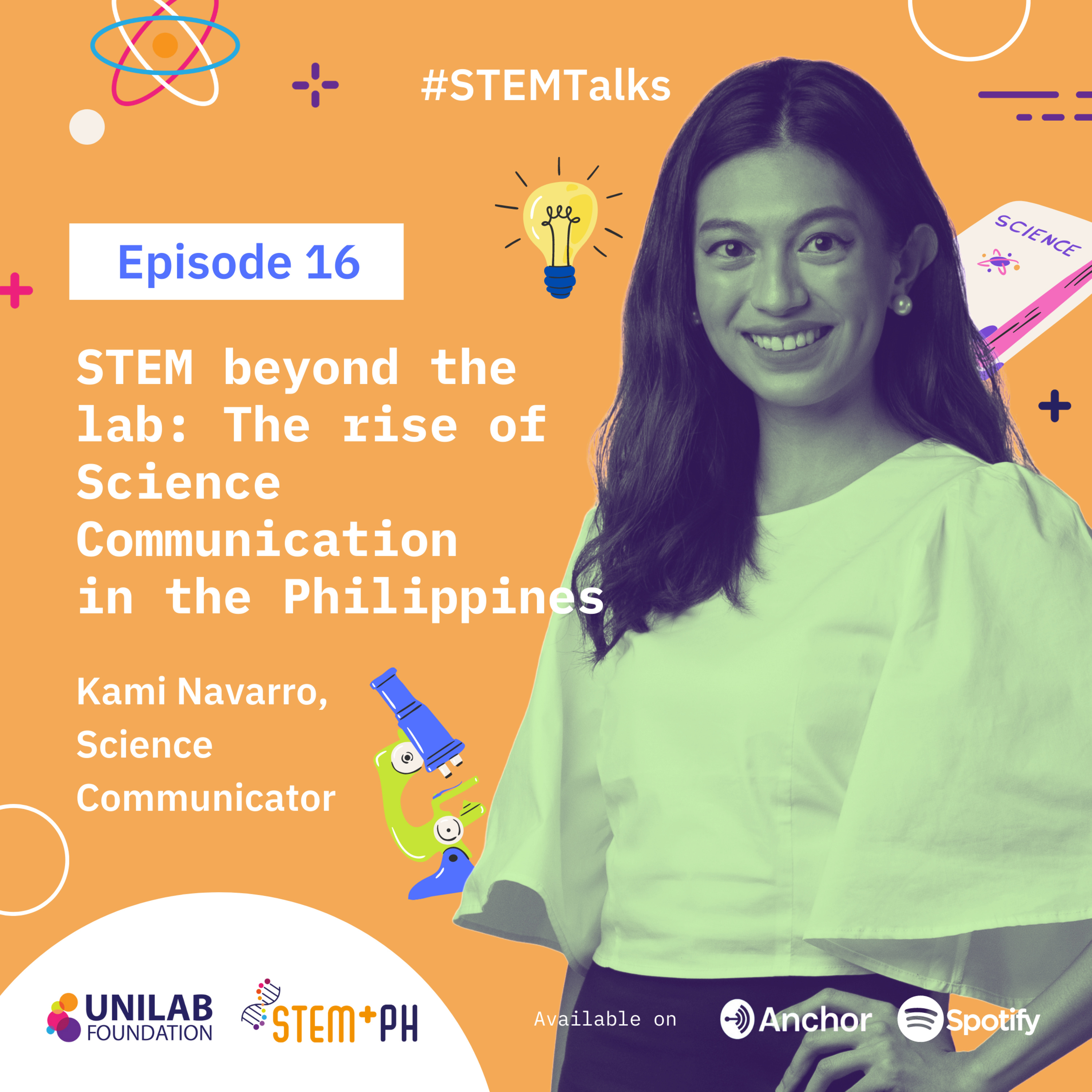
#16: STEM beyond the lab: The rise of Science Communication in the Philippines
24m 33s
The discussion emphasizes the growing relevance of science communication in the Philippines, where it helps inform the public, shape evidence-based policies, and foster trust in science. Camille Varyl, a science communicator, explains her transition from a Molecular Biology and Biotechnology degree to the field after realizing her preference for communicating science over laboratory work. She describes science communication as diverse, including academic, media, and creative forms like news articles, social media content, and podcasts, all aimed at making science accessible. Examples in daily life range from government health advisories to educational videos. The field is open to individuals from various backgrounds, not limited to STEM degrees. To boost its presence in the Philippines, increasing role model visibility, improving science literacy in basic education, and establishing more training programs are recommended. For those interested, exploring different formats, seeking mentorship, and engaging with science through volunteering or content creation are key steps to finding a niche in this evolving domain.
[MUSIC PLAYING] Science and location continues to rise as more and more Filipino states relevance in our world today. Science and location is not only about conforming the public about scientific discoveries and terms, but is also used to influence position making through science communication that is very evidence-based. When we know more about science, we also build trust and acceptance with it. So now it's important to bring more people here, to make science accessible the debunked myths that surround it. We invited one of our resident science communicators, Camina Varyl, to talk to us today about the wonders of science communication. OK, so I guess to start things off, Cami, maybe if you'd like to talk more about the work you do right now in science communication. OK, so currently I am affiliated with a US, specifically the National University of Singapore, specifically they have their synthetic biology institute. And what I do is I support the researchers there, whenever they need to communicate it, anything, so whether that's the grant proposal or the academic papers that they publish, if they need to communicate to the media about their latest scientific findings, then that's where I comment to play, and I helped them out. And hopefully develop their own science communication skills in the process. So it's more of academic science communication, which is one of the many, many, many, many, many different forms of science communication that there are. So there's also my previous experience was in media, so I was part of a STEM media agency. And that one was a lot more. I would take consumer-friendly, so very magazine, very shiny, video, TikTok, and all that. OK, thank you so much, Cami. Maybe you can talk to us more about your journey, like first-ass and MBB student, and suddenly shifting into a science communication career. OK, so as you mentioned, I took up MBB and college, and MBB stands for Molecular Biology and Biotechnology. And it was one of the approved courses, because I came from Philippine Science High School. And so even in high school, I always liked biology, so it made sense to go into MBB. Over the course of MBB, I really enjoyed it, like not finnaly, but I always struggled with the laboratory aspect of things. It didn't come easily to me. There were some experiments that I would break things. I would not be able to manage to measure some chemicals correctly. And I could not handle my mice, because I was too scared of them, stuff like that. And I realized that maybe doing laboratory experiments wasn't exactly what I was cut out for. And so after I graduated, I was wondering what I could do, because for most people, it just makes sense that after you finish a science course, of course you go into research. I need to go on a research scientist. So I really struggled with looking for a field where I could still be in science, but not have to do the science, if that made any sense. And it was good that when I graduated as well, I found out about this competition that was being run by Novartis. At the time, it was called International Biotechnology Leadership Camp. And it was a more entrepreneurial conference, meant to develop business skills in science students. And I attended that. And then there, I realized that I actually enjoyed that process of communicating science in these business-fetch presentations. Like I really enjoyed making the pitch deck. And I think that was the experience that really solidified my wanting to go into communications, because I did enjoy the business side either. So basically, it was a process of elimination, if I were to be honest. It was like, I love science, but I did like the lab work. I don't want to be in the business part of it, but hey, I love the cons part of it. So that is the long story short of how I ended up into science communication. So I guess like, after you graduated, entering these different experiences and careers, that's when you realize that science communication is something that you want to pursue and something you want to delve deeper into. Like it's such a new field here. I mean, in the Philippines, also, it's kind of hard to explain it to, I guess, the older generations. Like what you said, a lot of people who are in STEM courses, MBB or any other course, they still think that your path is either research or medicine. Like those are the whole careers you can get into. So it's very interesting to hear your story also. Like what got you excited about science communication? Can you provide, I guess, some examples of how psychoms apply the night every day, like every day activities? Sure. So I think for us, Filipinos, the most prominent would probably be, if you're a bug, you might ask the advisory, I think it's still the color, if you're a yellow or orange, chakarad. I mean, that is science communication. When to I was acting up and they would raise alert level one, not bad times communication. I mean, it's very dry science communication mind you, but at times communication nonetheless, the COVID-19 and bulletins, that's also science communication. So I think that's an unrecognized science to me, form of science communication. That is always, that you always encounter. But otherwise, the science article, the science article that you read in Rappler and GMN news online, whatever news out that we prefer, that science communication on six types of science communication in YouTube and TV shows as well, and you'll the dress, size on Bill Nye. So we have a lot of science communication avenues. So beyond the government science communication efforts, which are quite dry, I think other applications of science communication that we encounter in our daily lives would be on the news, you know, like when the black hole, anything new about space or dinosaurs, you know, those are also forms of science communication, climate change communication, whenever the IPCC releases a report and then all the news outlets pick that up, that science communication. And there's also a growing movement of science communication on TikTok especially, like people just using the weirdest and most insane means to make science more accessible to those who aren't in science itself. So yeah, there's a really whole wild world of science communication out there, including this podcast, which is also science communication. Yeah. Yeah, and I think what people, maybe now, like some people say, science communication is really limited to just writing, but they're really different formats of it. Like what you mentioned, there's the news videos, podcasts, even artists who communicate for the scientists books and other materials, they're also considered science communication, right? And I guess it's also important, like, that the young age for kids to appreciate it better also, like when they talk about science, that science communication, you know, it's not limited to the hard science or the intimidating kind of science that a lot of kids or a lot of students feel now. So yeah, thank you. Thank you, Kami, for sharing that. Oh, sorry. Would you like to add to that? Yeah, what you were saying was that, you know, it would be great if even at the young age, kids would recognize it, what they are doing is science, a science communication. And that reminded me of, you know, your Facebook update a couple of, I think a couple of weeks ago, you were saying something like, you know, you didn't consider yourself a science communication. But then, but then now you do, I mean, you don't have to have a STEM degree. Like, you could be a graphic designer and you could still be a science communicator. So yeah, I love how accessible the field is and it's definitely something that's open to everyone, like everyone, kind of business, you know, or kind of a degree. Yeah, it's a very accessible field. Yeah, that's true. The STEM is really like science is everywhere now and it takes a lot of people, it takes people in the field really like, see that kind of perspective, like appreciate it more. So thank you so much, Camille. I guess going back to how science communication is a very, it's another new field or concept here in the Philippines. So since we're talking about like younger students or kids, like how can we make this more known to them? Like these young Filipino learners and maybe grade school, high school about the whole idea of our concept of science communication. I think that it's about having more role models in the field and of course it's what the nice can stand is also about right. So just really raising the visibility that these people, that these kinds of women, these kinds of science communicators and scientists, they exist like they're there. And I think that's a great starting point already. And from there, hopefully the students can reach out and ask questions if they're too shy, they can email or slide into the DMs. And so yeah, I find that's ultimately how to make it more known to the younger learners. I mean, it would be great if it were something that was included in the curriculum, but I'm not sure
or when that would, or if it's possible to have to make that happen, because there is a lack of trained science communicators, you know, at the collegiate level already. So I think also, you know, at the basic education level, I mean, it might be, I don't know how many. So yeah, it would be great. It would be something to work towards, I think. But in the meantime, at least there are initiatives like Penais-Konstan, Papi-Noir scientists, and in general, scientists who are very vocal about their advocacies, who are at least advancing the field and making. And hopefully the younger kids are seeing this and are feeling inspired. Yeah, and I think, well, coming from the public also, coming like you as well, you've been doing such a great job, also promoting science especially. And then Singapore, but also in Philippines, even though you're far away, you still make a point to like take charge of Penais-Scientists to talk more about the importance of science in the Philippines. And I think slowly, I mean, hopefully, at least the science communication field will continue to boom. Maybe I hope it got you increases as we move forward, especially in COVID. I mentioned also role models, so did you have any, I guess role models, not just the science communication, but in STEM, like the motivated YouTubers who, this kind of STEM trap. So my first role model would really be my mother because she is a dermatologist and she also came from the site. So of course, she pushed me towards applying for a PCI as well, and then she was the U.P. Intermediate, the Fast Track Medical Program. So of course, she also made me apply for internment. I'm kind of thankful I didn't fast be honest because I have no intention of becoming a doctor. But yeah, I had her as a role model and she was really my blueprint for, you know, my first initial forays at the STEM. And then when I got into MBB, my principal investigator who I worked under was Dr. Sanca Sardoma, and she is the executive director of the Philippine Genome Center. So I had another excellent role model in her. She's super fabulous and very Makquento, and despite that, she still manages to administrative well and, you know, make sure that excellent science is being done. So what a multitasking queen, right? So those are, I think, our my two early role models. And then now that I'm in the science communication field, I think that we share this role model, which is Dr. Inez Ponce de Leon, who is also very fabulous and Makquento, but, you know, manages to teach so well. And yeah, someone I really aspire to be, especially because she's so knowledgeable about the philosophy of science. And I think that she really, I love my young, like she really puts theory into her practice and her practice in the theory. And it's just so amazing how she can do it. Yeah, she is actually my, because I took up a science communication elective back in college. So I really had no idea what science and education and, as in zero knowledge. But it seemed interesting. I faced my fears because I was really scared of science before. So I faced my fears. Okay, I'll try it out. And then having her as a prof, like a role model, like, really, I just helped me with that confidence or appreciate science in a different way, like not just in the, as mentioned, the card science. But you know, through arts, through expressing what sciences, not about the sciences. So shout out to Makquento. We idolize you. But yeah, like I agree that we've encountered so many role models, like, although we don't realize it at first, but they've become like this blueprint or this kind of person we want to aspire to be. And like, maybe hopefully work alongside them or get the new one also. So thank you, Kami, for sharing. It's also great that your mom was like one of your first role models. And even though you didn't pick up that kind of traditional path, like, truly had a big impact on you also. Absolutely. I mean, I grew up with my mom and dad. So apparently sometimes I felt like I had no choice. I mean, even though I don't have an initial choice in the matter, right? Like, that was all I knew. I mean, I think that maybe in some ways it's genetic, but I do think I have a nap for this, which I definitely got from here. So it's good, you know, she was there in my life to kind of nudge me in that direction. But I'm sure that if it were otherwise, she would have been supportive just the same. So yeah, it's good to have the supportive role models. And I can say the same for Dr Salona and at the in-ness, like when I told her that I was going to because I used to teach it at the near right and then I told her that I was going to leave to go to Singapore. And she was very supportive of that. So I think it's important to have not just role models, but support and points at that. That's true. And I guess what besides role models, Kami, did you ever encounter like having to somehow explain what you do? Like being a science communicator, like explain it to people, like maybe your friends or other family members, like since it's so new in this world. So if you have any like difficulties, if I ever try to explain it. So, my tier first question, which is do I have to explain myself every single time? Like absolutely every single time I meet anyone, especially here in Singapore. Whenever I meet other Filipinos, for instance, because a lot of them are actually from Ataneo and they tend to work in management, marketing, you know, the creative and business fields. And then here I am, a science communicator, like what the hell. So yes, I do have to always explain. And I think the good thing is that because of COVID and because of climate change, which are two of the most pressing issues of our time, it's become a lot easier to explain what I do. So why it's important. But in 2019, I really struggled. I was like, what am I? So yeah, I'm sure. So now it's a lot better. But the way I would say that I'm a science that I explain science communication is, you know, I just point to the vaccine campaigns or to the climate change campaigns. And I think from there, it's very easy for them to get what is science communication. But of course, you know, have to explain that it's not just in health and it's not just in the environment. But there's also, you know, can you communicate quantum physics, for instance, that still falls within the realm of science communication, engineering, like these bridges, building roads, all of that has facets of science communication. Yeah, yeah, I think explaining anything around you is considered science communication. Like I was going to a friend and she said, like, writing manuals, like how to use certain technology, like a TV, a laptop that is science communication. Like it's something that people don't talk about, but it actually is because you're explaining like how to use this, what happens when this happens. So, yeah, very interesting. Like I think it's such like given that there's a boost right now of science communication here, like what you mentioned because of climate change because of COVID. It somehow partly interests of people, like they're more interested in knowing more about it. And they're also kind of, I hope they're inclined. I guess they're taking the science communication back. So, my guess with this, how can we better boost it here in the Philippines? Like given that it continues to rise, continues to increase the interests of the Philippines. How can we boost it further? So, my wish list, like my dream would be there's a dedicated, like there is really a BS or like a masters and science communication. Like that is the absolute dream. But, you know, in the absence of that, I think it's just the really build up the capacity of creating science communicators who can then on train more science communicators. So, it's like a pyramid scheme except it's science communication, you know, getting more people to join and become evangelists of science communication. So, I'm very glad that at the nail and the style and I think you can really manner also offering science communication classes at least, you know, I mean, you're a product of this kind of class right. So, even one class can really change your life and influence your career. UPLB has a science communication program. I got my degree at ANU but I think that it's more advantageous. Like if you want to help out the Philippines, like, must make it more local, the degree, because it's more relevant to the theories that we can discuss. So, that's one. Another way to boost it would really be to improve our basic education system, science literacy. As you mentioned, you were saying that, you know, you were scared of science. And I mean, I don't know why you're scared of science, but I think for most people, it's because the way science was thought to them before was very intimidating and damning memorization. But, you know, it's just like, yeah, right. So, it's like, how can you, how can we boost science and science communication in the Philippines if, like, when you're in grade school, you're scared now talking about science because it's all just memorization, right. But the fact is that science is so cool, science can be fun and science can be so random. So, I hope that the education system can kind of inculcate that more, that the process of science is actually pretty fun. Yeah. So, I guess my last question, Kami, would be if you have any tips or advice for students who'd like to pursue the field.
of cycle like helping me also support them if they want them to do this. So I think that you know, you know, have they say maybe it's a terrible advice to give a podcast but to buy the city collect collect collect and then select. So I mean that's that's the usual dating advice you go from you know, the lawless and lawless but I think the same advice also applies to science communication and to science and in life actually there's a whole world science communication out there. I think that I managed to find my niche and science writing and science editing because precisely I explored that whole world. So volunteering at the local science museum or whatever organization there is at a science oriented or you know watch these science YouTube videos or be inspired to make your own. You know, if you want to go to the more academic route then you can research on the different universities local and abroad. If you want to make science related art, you know, Instagram is there and there's a whole following that we can have. So basically just try to dip your toes into as many different types of science communication as possible don't be afraid. I think that because science communication is such a niche field and the Philippines, if you manage to kind of carve your own niche within that niche, then it's very it's quite easy to kind of, you know, promote your vocacies and also get your name out there because you know, I feel in some ways it's how my journey also started because there's not a lot of formally trained science communicators back home. So I know me and Kapatilangan and resource person at the, you know, for they're gonna call it usually the same set of people to be honest. So yeah, it's a really, there's a lot of things to to explore in science communication. So I really hope that more people will enter the field and that someday, you know, science and science communication won't be these niche fields back home. Hopefully someday when when I say that I'm a science communicator back home, the first reaction wouldn't be, "ha, I'm a young." It's worth like, "okay cool, I know what you're doing and I like what you're doing." Yeah, I really hope that happens in like real school. Like when you tell someone, "I'm a science communicator," they'll be like, "Wow, that's amazing." And I want, I also want to enter the field. I'm interested in learning more about the field. So thank you so much, Kamid. Yeah, he wouldn't like to add anything else, maybe say anything else related to the podcast. Sure. So I mean, of course, this is a bit of a plug, but I mean for the listeners of Benoit's Gensham and the STEM Talks podcast, I hope you guys can also check out Benoit's scientists for a source of role models in the field as well. So basically, Benoit's scientists, we have these different scientists who pick over each week and they basically tell us about their lives as a Benoit's scientist. And with this week, it's actually quite inspirational because it's materials engineer who you might want to go to, also highlight Sigura Someday and STEM Talks. She's a materials engineer and her post actually went viral recently because she was saying that she was a terrible student on paper, but she, you know, she really thrived outside the classroom and now she's happy working as a materials engineer for a local company back home. So that just goes to show you what you were saying, Dayan, right? Like it's the stories of the scientists, of failure, of getting back up that ultimately defined science and life as a whole. So, so yeah, I hope that you guys can also check it out along with of course the content on the nice good STEM. STEM Talks is powered by STEM+P.H, the flagship program of UNL Foundation. Make sure to subscribe and follow this podcast as well as our Facebook page, STEM+P.H or at stampih.rocks. You can also follow our Instagram @underscore.Stempih for more updates. Make sure to tag us when you share episodes and use the hashtags #StempihStemphi and #Stempihdrop. We can't wait to stemify the future of the Philippines with you. [Music]
Podcast Summary
Key Points:
Science communication is gaining importance in the Philippines, serving to inform the public, influence policy, and build trust in science by making it accessible and debunking myths.
Science communicator Camille Varyl shares her journey from a Molecular Biology and Biotechnology (MBB) background to science communication, highlighting it as a diverse field encompassing academic, media, and creative formats like news, social media, and podcasts.
The field is accessible to people from various backgrounds, not just STEM, and is present in everyday life through public advisories, news articles, and educational content.
To promote science communication in the Philippines, increasing visibility of role models, enhancing science literacy in education, and developing more training programs are essential.
Aspiring science communicators are encouraged to explore different formats, seek mentors, and engage with science through volunteering, content creation, or academic routes to find their niche.
Summary:
The discussion emphasizes the growing relevance of science communication in the Philippines, where it helps inform the public, shape evidence-based policies, and foster trust in science. Camille Varyl, a science communicator, explains her transition from a Molecular Biology and Biotechnology degree to the field after realizing her preference for communicating science over laboratory work. She describes science communication as diverse, including academic, media, and creative forms like news articles, social media content, and podcasts, all aimed at making science accessible.
Examples in daily life range from government health advisories to educational videos. The field is open to individuals from various backgrounds, not limited to STEM degrees. To boost its presence in the Philippines, increasing role model visibility, improving science literacy in basic education, and establishing more training programs are recommended.
For those interested, exploring different formats, seeking mentorship, and engaging with science through volunteering or content creation are key steps to finding a niche in this evolving domain.
FAQs
Science communication involves informing the public about scientific discoveries and using evidence-based methods to influence decision-making. It includes various formats like news articles, videos, podcasts, and government advisories.
A science communicator helps researchers communicate their work through grant proposals, academic papers, media interactions, and public outreach. They aim to make science accessible and develop others' communication skills.
You can become a science communicator by exploring different formats like writing, video, or art, and gaining experience through volunteering, courses, or self-directed projects. A STEM degree is not required; it's an accessible field open to diverse backgrounds.
Examples include government advisories (e.g., COVID-19 bulletins, weather alerts), news articles about science topics, educational shows like Bill Nye, and content on platforms like TikTok. Even manuals for technology can be considered science communication.
It builds public trust and acceptance of science, debunks myths, and makes scientific knowledge accessible. Effective communication helps address pressing issues like climate change and public health.
Promotion can involve increasing visibility of role models, offering science communication courses, improving science literacy in education, and building capacity through training programs. Initiatives like local classes and media outreach can help.
Chat with AI
Loading...
Pro features
Go deeper with this episode
Unlock creator-grade tools that turn any transcript into show notes and subtitle files.
 PodcastTranscript AI