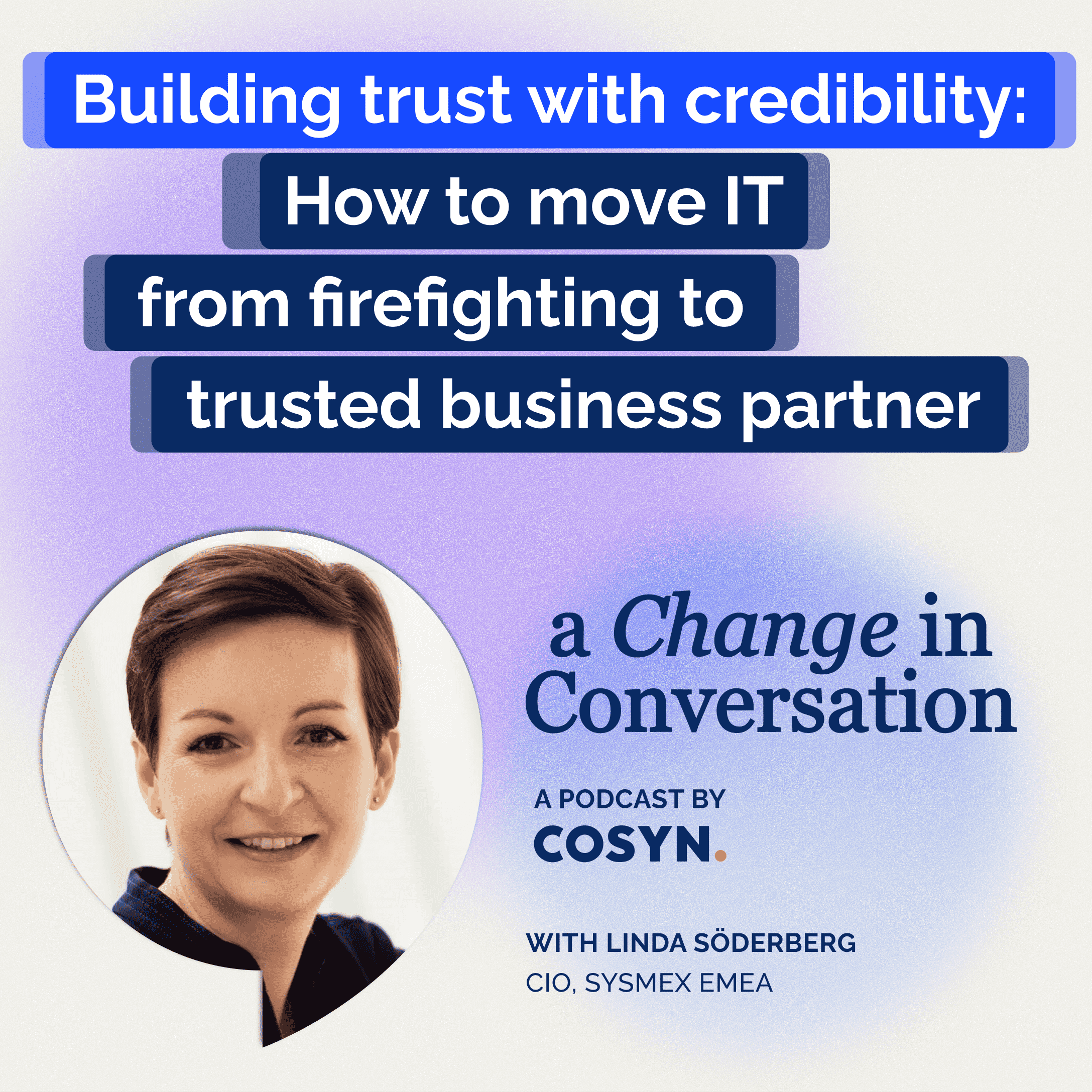
15_Building trust with credibility:How to move IT from firefighting to trusted business partner/Linda Söderberg (Sysmex)
from A Change in Conversation
41m 36s
In this episode of "A Change in Conversation," host Anna Cutting speaks with Linda Zürderberg, CIO of SysMex in May, about her journey transforming a decentralized, firefighting IT organization into a credible business partner over three and a half years. Linda stepped into an environment where IT teams were dedicated but overwhelmed, spending energy on daily surprises rather than root causes. Her first move was to listen—conducting extensive interviews with IT staff, business leaders, and regional management to understand where energy was lost and what was expected from IT. This listening phase revealed a clear need for change, and Linda developed a strategic plan focused on minimizing complexity, establishing IT governance, increasing transparency (especially in costs), strengthening security, and building skills. Her vision prioritized stabilizing operations before promising new innovations, believing credibility beats ambition. She gained team trust through one-on-ones, selective hiring, and demonstrating small successes. Managing business demands required strategic "no" answers, explaining limitations based on capacity and value, and fostering collaboration for prioritization. Linda's next step is transitioning her team from reactive implementers to proactive advisors, deep in business processes, while also educating the organization on data quality and ownership—essential for future AI and automation initiatives. Her calm, human-centered leadership emphasizes that change is a marathon, not a sprint, requiring persistence and trust-building.
Welcome to a Change in Conversation. The podcast that helps you turn tech resistance into user adoption. If you're leading a tech transformation and you want to get the buy-in from all critical stakeholders so you launch with impact in a noisy workplace, this is for you. I'm your host, Anna Cutting, CEO of Cosen. And in each episode, I'll share proven strategies from over 20 years of practice that turn your next program launch into a career-defining success. Today, I'm speaking with Linda Zürderberg, CIO for SysMex in May. Linda joint SysMex about three and a half years ago and in this conversation, we look at the journey she's been on since then. How she took an IT organisation that was largely in firefighting mode and step by step, went into a more stable, credible and trusted business partner. I've had the chance to work with Linda myself, which makes this conversation a special one for me. And what always stood out to me was her calm, human-centered leadership style, something you don't always find in IT. In this episode, we talk about what it really takes to build credibility over time, how to manage priorities when everything feels urgent and how to stay focused in the middle of a constant change. If you're an IT leader looking to strengthen your role in the business and build real impact, this conversation is for you. Without further ado, here is my conversation with Linda Zürderberg. So Linda, welcome to a change in conversation. It's so great to have you with us. Would you, for having me, really glad that you asked me and invited me? Linda, as mentioned before, you joined SysMex in May 3 and a half years ago. Take us back to that moment. What kind of environment were you stepping into and what stood out to you in those first months? I walked into an environment on the one hand full of expertise. People were there who had a long time within SysMex. And also the, I would say, impressive ability to make things happen, but also in your environment where a lot of things were surprises each and every day and where a lot of NEC was spent in techal operational issues. So keeping the lives of people in the way. Absolutely. Yes. So the organization, the May IT organization was highly decentralized. So this means a strong local ownership, fragmented processes, limited transparency, and, but especially, and this is really what stood out, this kind of heroic problem solving and into it, yeah, atmosphere. So people were really dedicated to both issues, but nobody, I would say, had time to focus on the root cause of the issues. And once you had those first impressions, what was your approach to understand where the real issues were and what needed your attention first? So my approach was very simple, I would say, at the beginning, because this was also something I promised in the beginning when I was recruited that I will listen first. Listen first means I really spend a lot of time listening to people, asking questions, talking to every IT employee, to every, I would say, local IT team, business leader, to the regional management. And I ask questions like, where do you lose most of the energy or time a day? What frustrates you repeatedly? Also for sure, content wise, where I think documented it, how do you do things? And what's the only conversations you had with within your organization, within your IT department, or also with the so-called business or with BS? Business leaders, for sure as well. Because I need to understand as well the business organization, the business drive and targets, and also what their expectation was towards IT. And how they perceive the organization. And this was kind of eye opening, but it fits, I would say, it was fitting together. But the business told me how they see the IT organization, but also like the IT organization had a good reflection on themselves, I would say so. So it was clear that they were in a firefighting mode. And this was also the reason why they welcomed me so nice, because I think this kind of support and help was something they waited for. So you experienced really a high level of appreciation for your kind of open and collaborative approach at the beginning? Yeah, absolutely, but this is also a kind of culture thing at SysMix. I have to say, really appreciated this, that people are welcomed, that there's a kind of openness for change. SysMix rapidly grow over the past years. And it was clear that changes in the organizational structure and also how to solve issues are needed. And this was something which this kind of understanding and reflection was already there. So there was nothing to fight for. The people know that change needs to be. And therefore this openness was as well there. And this was a great opportunity for me to start in this environment. And also a lucky situation, I have to say. So the starting situation was good for you, was favorable for you. So you had your first phase of gathering data, identifying really the pain points through conversation with your peers, through conversation with your IT team. By the way, how big is the organization? Give us kind of an outline of the size of your organization. That's the funny question because in the beginning nobody could tell. Now I know that's all. So who belongs to IT? And also because the region is very big. So it was not how many local colleagues depend on the mayor region. So I'm about 100 people. So the IT organization about 100 people big. So that's a little bit about maybe jumping now in the status, status quo. I'm about to go back into the past, but tell us a little bit about your setup. Like 100 people. How are they organized? So first of all, I would say I have a metrics organization. I have people who are responsible for the sub-legions. We call them sub-legions. And we have function teams who are for infrastructure operations in workplace and enterprise applications and security responsible to, I would say, from a central point of view, define the standards for the whole mayor region. This is the status quo for them. OK, got you. So going back to the past, or certainly this wasn't the structure you had back then, the organizational setup you had back then. So how did you move then from identifying the problem towards defining the future state or the vision or the strategy for your IT department? How did you do this? So first, I listened, this something which is really crucial. And then after I heard everything, and not everything, but most of the things, I developed a plan for the future to have to 18 months and also presented this to the board. And I would say it was clear what was missing. And I made it as a kind of strategic patterns that we need to minimize complexity, take ownership for IT governance, making things transparent, also in terms of IT costs, but also in terms of what's really in our environment where we are responsible for, a high need for security and as well for skill, which was needed in order to develop the organization into a future path. Yeah, so these were the strategic pillars. And the vision was that we at least first developed ourselves into a trusted business service provider. And for me, it was crucial to not start with too many promises, rather than gaining trust first by stabilizing the situation and the operation. And not I would say over-promise with marketing slogans what we could achieve by not believing in it. So the first thing was to bring silence into the operation, to stop firefighting and have time and energy to concentrate on new things, because this was from the beginning, 100% clear, the demand in terms of new requests from the business were tremendously high. Everybody would like to have new tools, new processes digitized and everything. So, but first things first, I said we need to stabilize the status quo before we start building something new. For sure, everything runs in power, but the concentration was really on that piece. Okay, so you've developed your own strategy, your own plan presented to the board. Tell me how did you
you start bringing your own team along on that journey? What did you do? I would say it was not something which was done from the beginning onwards, but step by step I gained the address by believing in them, believing in the strategy but also in showing that things are working the way they are supposed to work. And so the self-confidence came by doing it and by encouraging them to go this way. Even so it took a time, it also took a time to convince them or to get them out of their thinking patterns from time to time. A lot of talking I would say. A lot of one-on-ones, but always in a kind of constructive way. I had the opportunity and possibility to really onboard new members to the team, to the management team so that I also was able to select people which had already put experience in these kind of companies where a certain governance structure needs to be in place and they also had leadership experience which held a lot as well to make this happen. And sometimes it's quite tempting for a new leader who was stepping into the role to kind of outline or promise the big ambition or the very kind of or paint a, yeah maybe two ambitious or glorified picture, but you seem to have taken a little bit more of a measured route. Why was it so important for you to really kind of build up trust and credibility first before doing a little bit of louder storytelling if you want in the organization? Because it's my personal belief that credibility beats ambition and that I would say every single time. And I have also an odd behavior that I can't go on a stage and tell people what I don't believe in. I know that I'm only one person and I need a team behind me which is able to repeat or to say what we would like to achieve and have the power to achieve it. And this takes time. So and I also would rather say I would like to be sure that something is achievable before I make promises. That's an odd behavior for me. No, I think. Yeah, sometimes I would say not expected, but it's like I mentioned is a strong belief of myself or how I see the world. I think it makes a lot of sense to build trust with real proof points. Because it's also so tempting these days for CIOs to also I see this often to over promise actually on AI use cases. And obviously the organization is super receptive for this and they love to hear it. What's possible? But there's always a trap. I think there's always a trap that you kind of over promise what you mentioned. And I think you've really kind of avoided that trap. Yeah, from from time I would say there are always pros and cons in which diverge in your goal. Because from time to time you need to stand up and also taking a risk by promising things which you don't know if you really can hold them, but showing also a direction by taking a certain opportunity. I would not say that my strategy always wins in being a leader. But in this specific case, in my situation in the first three years, I think it was at least for me and the success which has been proven was a good good good thing for you and also fitting to the culture of the company where I was in. And this is also something you need to take into consideration. And there are a lot of people who are coming in and making a lot of noise. And they for sure also move things. I don't want to put that down, but sometimes it takes time, not only sometimes, I think change takes time. And if you would really like to bring things to an end, you need to have a certain power. It's not a sprint, it's a marathon to go to a certain extension of fail and try again fail and try again and not getting rated. And many people I would say can't hold that. So they would like to be motivated the whole time. They would like to feel excitement. The whole time promised things and do things. And I think sometimes it needs this kind of frustration. And you stand up, try it again. And this kind of little steps make the whole journey. We'll quick. If you're thinking, I need to level up my program comes, but your internal comes to him doesn't have the bandwidth to support you and your system integrators won't get the cultural nuances right. We built this for you. The change playbook helps you to build your engagement strategy in a super easy step by step way. Roll it out across hundreds of sites on time on brand and tracks they call the buy in in real time had to www changeplaybook.com to find out more. And now on with the show. And sometimes as you alluded to, it also requires leaders to oftentimes say or more often say no, then yes to new ideas that come from the business. And I guess again, I'm referring to AI. I think you're often like many of your peers, CIO peers are not short of AI pilots, etc, etc. So for all the CIOs and and and and head of IT soliciting to that, how did you manage this kind of tension between kind of saying no to, you know, to create ideas from the business, why it's kind of also reinforcing, you know, the, you know, create or provide a clarity on your priorities. How did you how did you manage this tension? Yeah, if you can tell me one one year ahead of functionality who can also this prolly that he managed to do that in a good way, please give me the number. So I would say saying no is more comfortable. But saying yes to everything is even worse. Because I would say it's it's a kind of a lie to the organization. If you say yes to everything, then you you you are not honest that you really can deliver what you are promising. And so a no from time to time helps, but not a flat no, you need to explain why, whether it's capacity limits, strategic priorities or dependencies. And I think it's a really hard way. And I'm still on it. I will have to admit to get the conversation in the right direction. So what do we have by I would say what did we get out of it? What value does it have if we implement certain tool or process? Is it really worse doing it? What is the priority for for that specific project? And is another project might be more valuable for the overall organization than another. And then they are fighting business units again business units. And I would say I didn't find a solution so far, but prioritization and return on investment calculations and all these kind of talks about this starting to emerge now. And this is because we see that we have a lot of operations to keep the lights on. I say like this already is binding a lot of costs. And in order to be the innovate things to build new things is also a cost driver. And we need to make decisions where we would like to invest our money for future growth into the company. And if you always say yes to to every initiative, then I think your news focus and you don't stick to the right priorities. But this decision making process is really I would say something which is the the premium standard of every organization if you if you are able to moderate this parisation because as an IT organization you can only deliver I would say effects and figures and maybe a technical evaluation of certain things. But you need to have the business on board and close collaboration and alignment in order to really make a good decision for the world. And I absolutely and I think for that one it's not just I assume it's not just you you have to who has to do the conversations with the business. I do also have like an organization or a team that does business partnering with the next.
main functions that are also kind of requested to do these conversations with the business to really understand the business needs, the business case to make this, as you said, these informed decisions, what's in scope or what not. Do you have that in your organization too? I would say not specifically named like that, but I would like to develop the organization to this direction. What we have is a big and really strong team of in the enterprise application area, so ERPs, here MQM tools, whatever you name it, and they are really in close collaboration with the business organization. And I would say we are still in alignment of all the responsibilities, and I would like that we get the advisor of rather than the implementation apart now only, because I really would like to come from this kind of reactive mode into a proactive situation where we make suggestions, where we make not only suggestions for future applications, but also how they can maybe improve their processes by using certain functionalities and so on. So I would like that they are the stars in the application itself that they know the business processes so good that they can advise what might be coming next and would really bring a value to the organization. That's at least something the next strategic step lead to, and yeah, we are on a good track I would say to achieve this very soon, because now we have an overview on every demand for the upcoming period of time, and we can go into this kind of evaluation wisely with the business together, but also it's not only the IT organization I have to say, it's also the business who needs to, I would say, bring their team together in order to understand which responsibility they have in order to make the business process they would like to expect. I think this is super interesting, Linda, so you're not trying to also to upscale only your internal team to have a deeper understanding about the business requirements so that they really, really understand the process, good as they are the kind of counterparts, but you're also saying that in some regards you also need to educate the wider organization more about data and also the use of technology for achieving business goals. Is there some upskilling educational work that needs to be done in this direction too? I would say yes, even so that I would not say that I educate anyone because that sounds really odd. But yes, there is for sure something in it that this kind of understanding is from time to time not very present in the organization that they are not only using a certain application, but they are responsible for the process, how it needs to be worked and how other people are working with it, training of these kind of processes. And also because we mentioned data quality and now coming to the nice part of AI, I think it's also now clear that we can do everything in terms of automation or bringing AI into the game. If the data we are using is not on a, I would say level where it's clean, structured and reliable, then every automation or every AI agent will not work as expected. The results are not as expected. And I would say that's something which I would say every organization needs to run through right now. But this is a big part which is not only within the IT organization which really plays a big role in the business organizations. And I'm still, I would say even so that I'm a fan of making clear roles and responsibilities I think when it comes to IT, I think everybody is using IT so therefore it's also responsible. And this kind of understanding is I think clear on one hand, but needs as well as certain leadership and also time to explain a change management, a good collaboration with stakeholders, also good examples which helps to make things transparent. And yeah, lately we had the success that we found not only process owners but also peer users for a certain application which were not there before where we opt to find internal colleagues who could take over this role in order to help us to select the right tool for a certain topic which I don't name here. And this is really based on really long discussions and collaboration with IT and business that this kind of roles on business side are as well needed. So one of the other things or key drivers that influence the brand of IT if you want within an organization is how new tools software technology is landed in the organization. So how have you helped your team, your project leaders to move beyond a purely technical delivery mindset and see more also this kind of the human side of transformation as an equally important part of their job? Yeah, so I would say in the workplace environment that's maybe the best way to explain it where we have really projects which comes to the end user. I really invested in people who are taking care of change management. So who really I would say checked if we, for example, writing mails to end users that they are written in a really understandable way for end users and not technically I would say explanations which nobody would understand and nobody would read at the end. If we go for, I would say small instructions which we try to avoid to give instructions to end users but then also check them if they are really understandable, make tests but also repeatedly ask the project team what in effect this has to the end user, not stopping by deploying a solution rather than thinking about what does it at the end mean for our end users. It's what the real change is for our end user. And what can we even put on the table of the end users and where should we serve them with help. But this is also a balance. I fight for this quite often in terms of what can be delivered as a service but where we also need the self responsibility of an end user to figure things out by him or herself and are we responsible that he is, I would say, asking Google or checking a YouTube video how to use certain functionality because we are not apparently, we are not a training organization. But this is a lack for sure that we also see in the organization that people who are longer within an organization and people are maybe also younger. That's a demographic topic, are more used to use certain tools in different ways than others. Some need more explanations, some not. And therefore I'm also opting for a kind of change management network which helps to spread the information much more earlier and helping to bring this information not from an IT to an end user rather from an entry to an end user. Because getting help from a person next to you is much more nicer and much more valuable and brings more effectiveness, I would say, then opening a ticket or calling someone who's doing it for yourself. And this kind of role model always works. If somebody works differently, then you ask, "Oh, how do you do that? How do you manage to use this task this year?" So can you show it shortly to me? Or if somebody is pushed to use a certain task or anything, then the people getting curious and they would like to know when they're asking and it's easier than asking a colleague in your team than asking someone from the IT at least that's my experience. And it protects also some resources from your IT team. It's not only more impactful. But we also had the pleasure to work together. I was always impressed by working with you because I rarely experience an IT leader who has so much this customer centricity at the center of thinking and I think you're a real good example for this one. And finally, I really had a conversation with one of your colleagues who was working in the communications department and she told me that the communication, all the engagement coming from IT has massively stepped up with the, in terms of the level of understanding, the level of empathy, how it's conveyed and how you approach the organization. So big contribution from you and your team. But share some more. You share this idea with the key user that you think there's a lot of potential. And there are a lot of other kind of tips you have for people to really keep this customer centricity and
customer centric mindset top center within your team? Yeah, I'm thinking as thanks first for the kudos. Also for my conversation. Nice to hear. Thank you so much. Yeah, I think it's, I would say like mentioned in the beginning, I was, it was firefighting also for me and for me and the expectation was also that I, we dive, dive into operational things and might solve things, which I don't do. They are expected from me. But I would say the, the main target was to really get this kind of noise also on my table, because people were complaining. It's not working and people were, who couldn't help or I've no time to help and so on. To get this, I would say from, from, from the table from my table, but also from, from the frustration level of the employees in a certain, more manageable situation. And what helped, I would say, is to build up reliable process and some structures. And to, I would say avoid a hate your principle that everybody can come to everyone because the company was so small, everybody knows everyone. But apparently it comes becomes bigger and bigger and the people didn't know who to approach. Maybe they, and then this person was not responsible. The person said, Oh, I'm not responsible. So one incoming channel for things helped a lot. Yeah. So that we said, whenever you have an issue, there's something which has worked before and don't work anymore. You open a ticket or call this number. You don't need to have a name specific name for that because you, I would say, so many people, so many application tools and responsibilities. Re, I couldn't, I would say, I would not explain my organization to every employee. Doesn't make sense. They just need one entry channel to IT if they have an issue. And then I would say the process behind. And I would say this, I have to admit, this is not rocket science or anything. So this is normal IT is and process processes, but which every organization needs, rather in which way they're working. And this helped a lot in getting more like to get the noise down in terms of complaints. So the people were not, not the business where frustrated, but also my people, the IT people had a chance to go through the tickets to the things they were supposed to go through. And there were times also when I was there, there was a big backlog. Yeah. And which means there's a lot of tickets and they can't come behind solving the tickets because they are more incoming than they could solve. And I think for every IT support person or for every IT person who's doing support, the best thing is to get things from the table. And I think with great measures and with also sizing the team and making clear assignments and all of that, it we solved the issue of having always the full table and they still have a lot of things to do. I don't, I don't want to make it smaller than this, but I would say the backlog situation and this feeling of not coming through the mess. At least as transparent if it, if it pops up, but it's really, it's getting, it's manageable because it's visible. And then you do something against it because what I was also getting a lot is gut feeling. Gut feeling in terms of we have so much to do and they, they never answer my tickets. They, so this kind of gut feeling, you know, where you don't have proof. And now we have numbers. We are clear, clear numbers, assignments, we have SLA. So a service level agreement with which time we will solve tickets. I would say this helps a lot to calm the organization and make the service thing also a fun thing. Yeah. So because now if you are overwhelmed and you always get, I would say, screamed on, you, I would say lose motivation to be nice or to serve someone you would like, but you don't, you are not able to. So I would say that was the work which needs to be done. And I have to also have to say, I have a great team. So really most of them are really, they like it, they like their job and they do what they can. What's in their power to solve issues and I couldn't wish for more. So when you compare the kind of conversations you had three and a half years ago with your team and with the other peers and compare them with the kind of conversation you have today with your peers and today with it. How have things changed? Yeah. Like, like the story, I would say, in the beginning, it where I would say I was really approached by operational issues, which no glue in most of the cases or were super detailed. And now I would say I rarely, rarely receive any escalation in terms of nobody's helping me or I have an issue which couldn't be solved. I'm rather now on on the discussion layer of what are we doing next, which projects can we tackle? Which project do we need? Is there any opportunity to prioritize this, this topic? Who could help with that? I would say this shows the, the growth of the majority of the organization for my point of view. And looking back on your, on your journey so far, what has been harder in your time in, in CISMex now? What has been harder than you've expected and what has been easier than you have expected? Oh, I have to say what is for sure easier is really the part I mentioned in the beginning that everyone was open for for change and was expecting change. That was really easy, also easy to collaborate with different kind of people, my team, but also business take careers, management, regional management. This easy to talk to and they are easy also to convince if you have good arguments. That was the easy part. The hard part was I would say the constant structural and governance issues we have and had and also the, I would say the acceptance of certain decisions, which need to be taken in order to really build up. In IT organization, which is ready for future close and this is something like saying no to things or making a budget transparent making IT cost transparent is not in favor of everyone and also centralized. IT cost this was really hard and still a hard topic to make IT cost transparent, which is for sure something which is necessary not to steer IT costs in the right way. But this was harder than expected and took longer than expected. Yeah. So last question. If you know for a leader who is who is now listening to this for a CIO ahead of IT and who also wants to kind of reposition or transform its function from a more kind of a, well, it's a tool provider reputation to strategic partner or trust the partner who wants to call this what would be your top three tips you'd give to that person. The first thing I would say everyone needs to have a known to make a good job at least what a good job for me means is to have this kind of frustration tolerance. Because there are days which are super good and days where you think oh god. What did I do? Yeah. I would say still I believe still in certain even so everything is in a change mode right now AI here AI there. We all know that this will change the world anyway. But I have a still calmness in me that I say yes, I need the skill for that. Yes, we will implement this. It will serve our organization, but not I would say from day one. And we as an organization, we can't manage the speed which the speed on the market right now. We need to observe we need to adapt and we will jump into the topic and we are jumping into the topic, but not over stretching this kind of topic too much. Because still the organization needs to run and it would like to stay still focused on what is running right now and making space for new things. But I will not lose my head because of that third one is I don't know. Third one is stay brave and but also staying on eye level with everyone. That's also a lot and like I think you you you recognize already by working with me, but also having the interview. I'm I would say still humbled and trying to be a person who's approachable who is doing mistakes day by day, who's making or even bad decisions from time to time. But I rely on a good team and a good alignment with my team because they are the experts.
words. And so this is why a good together is something which I always prefer over power or over decision making authority because I know I can't make good decisions without the team and I'm not the one who knows everything best. And this keeps me dependent on good relationships and this is what I'm standing for. So we've learned it's a team game and it's a marathon to transform an IT organization into a real trusted business partner or strategic partner. Linda, we are done. Thank you so much for taking us onto your personal journey from the last three and a half years and sharing with us all these great insights. I think you're remarkable. A leader and you've achieved so much and I hope this inspires a lot of people here. Thank you so much. Thank you. Was nice to reflect on this. Thanks. Thank you. Thanks for listening to a change in conversation. I hope you're walking away with something that you can put into action right away. If you liked this episode, hit subscribe so you'll never miss the practical strategies that could make your next tech roll out a career defining success. You'll hear more from me next time on a change in conversation.
Podcast Summary
Key Points:
Linda Zürderberg joined SysMex in May as CIO, inheriting a decentralized IT organization in constant firefighting mode with heroic problem-solving but no focus on root causes.
Her initial approach was to listen extensively—interviewing IT staff, business leaders, and regional management to identify pain points, frustrations, and expectations.
She developed a 18-month strategic plan emphasizing minimizing complexity, establishing IT governance, improving transparency (especially in costs), enhancing security, and building skills.
The vision was to become a trusted business service provider by first stabilizing operations and gaining credibility rather than over-promising.
Managing business demands required saying "no" strategically, explaining reasons based on capacity, priorities, and value, while fostering collaboration between IT and business for prioritization.
To move from reactive to proactive, Linda aims to upskill her team to become advisors on business processes and applications, while also educating the business on data quality and ownership.
Summary:
In this episode of "A Change in Conversation," host Anna Cutting speaks with Linda Zürderberg, CIO of SysMex in May, about her journey transforming a decentralized, firefighting IT organization into a credible business partner over three and a half years. Linda stepped into an environment where IT teams were dedicated but overwhelmed, spending energy on daily surprises rather than root causes. Her first move was to listen—conducting extensive interviews with IT staff, business leaders, and regional management to understand where energy was lost and what was expected from IT.
This listening phase revealed a clear need for change, and Linda developed a strategic plan focused on minimizing complexity, establishing IT governance, increasing transparency (especially in costs), strengthening security, and building skills. Her vision prioritized stabilizing operations before promising new innovations, believing credibility beats ambition. She gained team trust through one-on-ones, selective hiring, and demonstrating small successes.
Managing business demands required strategic "no" answers, explaining limitations based on capacity and value, and fostering collaboration for prioritization. Linda's next step is transitioning her team from reactive implementers to proactive advisors, deep in business processes, while also educating the organization on data quality and ownership—essential for future AI and automation initiatives. Her calm, human-centered leadership emphasizes that change is a marathon, not a sprint, requiring persistence and trust-building.
FAQs
The podcast helps leaders turn tech resistance into user adoption by sharing proven strategies for launching tech transformations with stakeholder buy-in.
Linda Zürderberg is the CIO for SysMex in May, and she joined the company about three and a half years ago.
The IT organization was highly decentralized, in firefighting mode, with fragmented processes, limited transparency, and a focus on heroic problem-solving rather than root causes.
She spent time listening to IT employees, local teams, and business leaders, asking about frustrations, energy drains, and expectations to identify pain points.
Her first priority was to stabilize operations and stop firefighting before building new things, focusing on gaining trust through reliability rather than over-promising.
She explained the reasons behind 'no' decisions, such as capacity limits or strategic priorities, and emphasized prioritizing initiatives based on value and return on investment.
Chat with AI
Loading...
Pro features
Go deeper with this episode
Unlock creator-grade tools that turn any transcript into show notes and subtitle files.
 PodcastTranscript AI