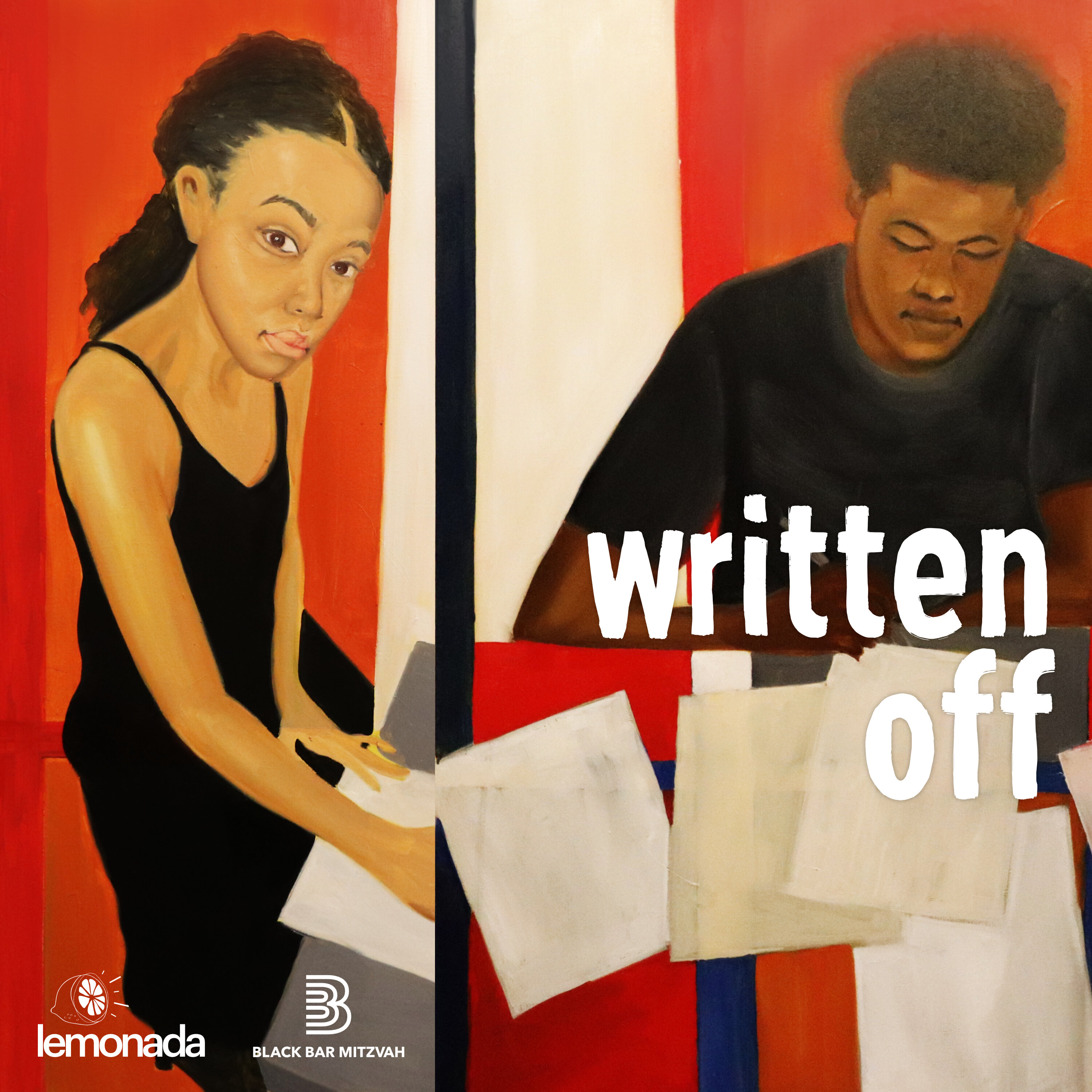
The transcription begins with promotions for the podcasts "Wiser than Me" and "Don't Listen to Us." The core content is from Walter Thompson-Hernandez's show, focusing on the nonprofit Inside Our Writers (IOW), which teaches creative writing to incarcerated and formerly incarcerated youth in Los Angeles. The episode centers on IOW's executive director, Jimmy Wu, who was part of its inaugural class over 26 years ago. Jimmy reads a deeply personal essay recounting the day he was sentenced to 15 years, 8 months, and 2 strikes in state prison at age 18. He describes the emotional courtroom experience, his despair, and the unexpected support from loved ones.
In a subsequent conversation, Jimmy discusses the emotional impact of hearing his work read by actor Randall Park, which triggered memories of that day and reflections on his late brother. He explains that he wrote the piece immediately after sentencing to process the trauma and capture a pivotal moment that set his life on a different trajectory. The discussion highlights how writing became a therapeutic and vital coping mechanism for him, a practice introduced through IOW. The facilitator, Mark Salzman, built trust by sharing his own stories first, creating a safe space for vulnerable expression. The episode underscores writing's role in fostering self-discovery, resilience, and hope, while also commenting on the challenges within the justice system and the privilege of having a support network.
Hey there, it's Julia Lewy-Dreyfus. I'm back with a new season of Wiser than me. The show where I sit down with remarkable older women and soak up their stories, their humor, and their hard-earned wisdom. Every conversation leaves me a little smarter and definitely more inspired. And yes, I'm still calling my 91-year-old mom Judy to get her take on it all. Wiser than me from Lemonade of Media is out now, wherever you get your podcasts. It's morning in New York! Hey everybody, I'm Mandy Potinken. And I'm Catherine Grady. And we have a new podcast. It's called Don't Listen to Us. Many of you have asked for our advice. Tell me, what is wrong with you people? Don't listen to us. Our Take It or Leave It Advice Show. Every Wednesday, out now, a Lemonada Media Original. Lemonada. 15, 8, and 2. That's it. That's the sentence. No, really. That's the sentence. Jimmy sentence. 15 years, eight months, and two strikes. You'll hear those numbers again today. Though echo for you, the way they once said for Jimmy when the judge first handed it down almost half his life ago. The way they echoed for me, one Friday morning back in April, when he and I sat across from each other on a couple of couches in an office offered for Mont Avenue. I'm Walter Thompson Hernandez, and I'm a product of Los Angeles, or LA, as we call it here. I used to write it for The New York Times. I wrote a book about a group of friends called the Compton Cowboys. I hosted a show called California Love, and I'm now directing my first film. I rep LA in everything that I do, our people, our stories, and the creativity we often find here, and sometimes in the most unexpected places. But most of all, I love how this city is a walking, breathing, juxtaposition, like here, offer mounted sunset, at the inside our writer's headquarters. Where, in the heart of Hollywood, you get a true mix of opposition, co-existing, the continual wailing of sirens mixed with car sound systems, all blended together, and the rural sounds of roosters clucking from backyards for real roosters in Hollywood. Inside our writers, or IOW, is a nonprofit organization known as the best secret to drastically reducing LA's recidivism rate. On the surface, it teaches creative writing classes to currently incarcerated young people inside Adelaide County's juvenile halls. It continues those classes on the outs, as they say, once they released. But it's created something more than that. To some, it's like a church for writers that keeps every student coming back, and IOW Executive Director Jimmy Wu couldn't embody that more. He was part of its inaugural class of students more than 26 years ago, since then, hundreds of young people with similar stories have passed through his halls. Their vibrant pictures plastered on the walls surrounding the couches I was sitting on, creating a sense of love and family that fills anyone the moment you walk in. I'll talk to 13 of these writers over the course of this show, about their work, about how writing has impacted their lives. But this show, for me, is also really personal. In some ways, I feel like a lot of the writers who I've spoken to. I was once a high school drop-off, and spent time getting arrested for everything from graffiti to fighting. My best friend, Danny, used to call me from Jovey every week, and I still remember the first time he called, and hearing his voice on the other end of the phone. He sounded distant, removed. Almost like he was calling from summer very far away from the streets weeks to walk. Danny wrote in his free time. He wrote me letters. He wrote his older sister, his mom, his dad. He wrote the past time, and more importantly, as a way to cope. Writing is what gave him hope. You'll hear similar stories throughout this show. Stories of life, and pain, and joy, and redemption. I'm also really excited to surprise each of the writers with recordings of celebrities reading their pieces. I'm talking John Legend, Issa Rae, Jay Ellis, and many more. So let's kick things off with actor Randall Park, and our first guest, Jimmy Wu. This is Ridnaf. At the sound of the door opening to our holding tank, my conversation with the three other inmates came to an abrupt end. Looking over my shoulder, I saw my lawyer walk into the room. "How are you doing?" he asked. "I'm doing pretty good," I replied. We talked about nothing in particular for a few seconds until I finally popped the question. So what's going to happen today? He told me that I would be getting sentenced, unless there was some good reason for me not to. We went over what he would present to the judge on my behalf, and when there were no more questions that I needed an answer to, he told me that he was going to find my co-defendant's attorney. "You'll be coming out soon," he said. And with that, he left the room. Thirty minutes later, the door to the holding tank opened once more. Gentlemen, step out, a voice called. My co-defendant and I exited the tank, and the bailiff that was standing outside the room told us to turn around and put our hands behind our backs. As the cold steel of the handcuffs were snapped onto my wrists, my heart started to pound furiously, and I thought to myself, "This is it." The bailiff led us to the door of the courtroom, as I silently said a prayer for everything to go well. Opening the door, he ushered us inside, and when I looked to see who occupied the seats for the public, I saw unfamiliar faces. Feeling depressed, I asked myself, "Where is everybody?" Clancing at my lawyer, I noticed that he was nodding his head towards the door that led us to freedom. The bailiff removed the handcuffs and told me to take a seat in the chair that was directly in front of the judge. The sounds of a door opening filled my ears, as did the shuffling of several feet. I sneaked to peek to see who had come in, and I was amazed by what I saw. Every chair in the courtroom contained someone that had come to the court to give me support. People were lined up against the wall, smiling whenever I made eye contact with them. The whispering died, and everyone settled down, and my judgment began. The judge opened up by acknowledging me and my crime partner's presence in the courtroom. She informed everyone that if there were no legitimate reason for us not to get sentenced, that would be taking place today. My attorney stood up after we agreed that there didn't seem to be a good excuse, and began pleading for the judge to allow me to be housed in youth authority until I reached the age of 25. From my viewpoint, he presented a strong statement that should have been taken under serious consideration, but every word that came out of my attorney's mouth seemed to go through one of the judge's ears and out the other. She kept referring to the law book that stated how I would not be eligible to go to YA because of my age, because I would not be able to serve all my time by the age of 25. As my lawyer continued to argue that this law was passed well after my incarceration, every hope and dream that I had for my sentence to be reduced, or for me to be housed in YA slowly vanished. The full realization of what was taking place hit me like a car ramming into a concrete wall at full speed. In a few minutes, I would be a criminal for the rest of my life, in the book that I have to carry for the remainder of my existence, I will be labeled as a convict, a felon. While I was fighting my case, I still had a clean record despite being locked up. Now, my record will forever contain this one mistake that I made when I was a young and naive adolescent. I thought about all the people that were sitting in the courtroom giving me their support and love, and I lost complete control of my emotions. The tears that I had held in for so long streamed down my face as I cursed myself for letting these people down. Why couldn't the judge see that the young man sitting before her was not the same person that had entered juvenile hall two years ago? Why couldn't she see that I had dreams of getting out and getting my life together to be somebody? After a long and hard battle of trying to get me housed in youth authority, my attorney finally realized that the judge's mind had already been made up. She was like a tree stump that refused to be moved. Her final decision was to send me to state prison for 15 years, eight months, and two strikes. We asked if she could recommend fire or work camp, which she did, but that doesn't seem likely because of the fact that I don't fit the criteria due to the number of years I have to serve. A week or two ago, I thought of 15, 8, and 2 as numbers and nothing but numbers. Sitting in the cork with my life in someone else's hands made me open my eyes to the harsh reality of what these numbers really mean. Those numbers that at one point in my life meant nothing were now representing the number of years that I would be away from my loved ones. The worst of the worst had happened, and there was nothing I could do about it. Through tear-filled eyes, I looked at the judge and silently asked her, "Why couldn't you give me a chance? Why are you taking 15 years of my life for one mistake? I know that I have to pay a penalty for what I did two years ago, but why can't you look at me and see that I've now changed?" Thank you for that. Thank you for destroying my future too. Now a few hours later, I'm in some ways relieved that everything's over with. There's no more worrying about how much time I'll get, or where I'll be sent. The decisions have been made, and I have to live with that. There's only one more thing that I can do, and that is to stay strong. For my parents, for my brother, and most importantly, for myself. Because I have to. Jimmy. Yeah. How you feeling? A little emotional right now. Haven't heard someone else read out out loud with the footer. And then it was so long ago, it just really feels like, you know, happened just now. So it's just like, you know, reflecting on it right now. Well, there's something different about hearing someone else read your words. Yeah. There was definitely something different, because, you know, reading it myself, you know, it's just like something that I created, and I think that it takes some of the emotion out of it, because I'm more kind of like paying attention to whether or not it's flowing correctly if I'm presenting the message that, you know, I want in my writings, but hearing it from somebody else, it was more for me to like kind of pull myself in readers or listeners, you know, type of seat, you know, where I can appreciate it a different way. Is there something about reliving that moment and hearing someone read your words that kind of tick you to that moment, you know, in court, in the holding cell? Yeah, absolutely. You know, I think that after having gone through that, and it being so long ago, I didn't really think back to that moment in quite some time, and you know, I think it's just like, you know, it was triggering in a way, you know, for me to go back to that moment, you know, what I was 18 years old, and yeah, not sure whether or not I was going to be able to make it, and then, you know, was particularly difficult, was what I was talking about like my brother, and you know, unfortunately, he's no longer with us, you know, he passed about two and a half years ago, so I was able to spend time with him, you know, after I did come home from prison, but it was just hard to, to just think about him, you know, and what happened to me the way that it, you know, kind of like, impacted my entire family. So it was like a flood of all those memories coming in, and yeah, you know, because like there's a moment in your piece when you write about the sort of like surprise, and I think maybe joy that you feel when you see people, you know, there to support you, and is that kind of what you thought about right now? Absolutely, absolutely, and it just also reminds me of how fortunate, you know, and privilege that I've been, because I think about the number of individuals who go through that same thing, and you know, when I glanced at that courtroom when I first got let out, it was empty, but then obviously, you know, people did, you know, come in to show me their support, where it was filled to capacity, and I just think about how many people are sitting in that same seat being sentenced, or being, you know, judged, and they absolutely have nobody, you know, so yeah, I thought about that as well. More with Jimmy Wu, after this. Hello, I'm James Corden, and on my new show, This Life of Mine, I sit down each week with some of the most fascinating people on planet Earth. From Dr. Dre to Julianne Moore to David Beckham to Cynthia Arrivo to Martin Scorsese to Jeremy Renner to Denzel Washington to Kim Kardashian, we talk about the people, places, possessions, music, and memories that made them who they are. These are intimate conversations full of stories that you've never heard before. This Life of Mine premieres October 21st, wherever you get your podcasts. When you wrote this piece, like I love to learn about that process, right? Like tapping into memory, tapping into like a certain, like, a certain creative process. I remember, you know, going back to my room, the day of my sentencing, and then writing this piece in particular, because I, for some reason, felt that it was going to be important for me to capture what occurred that day, because I knew that it was now going to be sending my life into a very different trajectory where, you know, the hopes I had of coming home at a certain age, serving a certain amount of time had been completely obliterated, you know, and it was now, you know, me trying to force myself to accept the fact that I was actually going to be going to a state prison at just 18 years old, and knowing that I was going to be growing up behind walls, not coming home until I was nearly 30 years old, and not knowing if I was going to survive that, because of the horror stories I've been told during my two years or so awaiting the outcome of, you know, my case, right? And so that it was now all set in stone. I wrote it just to be able to maybe have something to look back on one day, and, you know, us even having this conversation, I think it really fulfilled its purpose, you know, for that moment, in my life journey, that moment in time to have been captured in the way that it was. I think it's even more amazing that, you know, I didn't know that you wrote this that day, right? And it's even more incredible, I think, because, like, you were essentially writing this for a future version of yourself without even knowing, you know, who that person would be, where you would be in the future, would you be alive essentially, right? So, like, you were doing, I think, really important archival work, but also, like, really looking ahead, and I think that's really incredible. Yeah, thank you, and I think it was also for me to use kind of, like, as a reminder of why I couldn't ever give up, you know, because of everything that happened, you know, to me, and to my family, you know, like, I ended that writing by saying, this is why I have to keep going forward, no matter what, you know, because it was like, everything I put my family through, I felt like I had to, I had to redeem myself in a way, by no matter, you know, my thinking about, like, no matter whatever it is, that I am about to go through, and as difficult as things may get, as terrifying as it may get, that you have to keep on pushing forward for them, because of what you've done to them, by they now having to suffer alongside you, because of your actions. Yeah, you know, and it seems like writing, I think, for a lot of people, is like a very therapeutic experience, right? And I'm curious if writing was already something that you were practicing before this day, or is it something like this happened, and you're like, I need to write this, but like it's talking me through like writing in your life that day and also before maybe. Yeah, I think you absolutely nailed it, that there is a very therapeutic component to writing, right? There are so much that takes place as you sit there with a blank piece of paper and a pencil or a pen, and as you write something, you know, magical often happens where you learn so much about yourself, you know, just really digging deep, allowing yourself to come across, confront, and battle personal demons, being able to see what you're really about, what you're made of, allowing yourself to be vulnerable, right? And so this wasn't the first time that I wrote, because I had the incredible privilege of being, you know, introduced to what can happen through creative writing, because of inside our writers, because the former Catholic chaplain of central juvenile whole approached me one day and asked, if I'll be interested in participating in this innovative creative writing class. And it wasn't something that was, you know, appealing to me, to be honest, right? Because I was like a 17-year-old wondering what the hell am I going to be able to do in a creative writing class when my entire life right now is in limbo, and I'm wondering if I'm ever going to come home, you know? And so when she asked me, I was just like, you know, I'm not really interested, but she encouraged me to like, you know, just give it a try. She's like, you know, don't have any expectations, just give it a try, and something great may be able to come out of it. So then I took her up on that offer and I figured, okay, if anything, I'll be able to spend more time out my room. That's it, right? And so I was housed in unit KL at central juvenile home, you know, one of the housing units where they housed all the high risk offenders, you know, the so-called supervisors, you know, kids who are, you know, having their cases hurting their little courts, and inside that housing unit is like, you know, a small library. And so, you know, the first time I participated in this class was, you know, walking into that small library with two other kids being introduced to a man by the name of Mark Salzman, who seemed to be more intimidated and terrified by us, you know, than we were of him, right? And I think that, you know, what was really, really effective in his way to get us to really be able to eventually learn to trust him and open up and talk about things that we had never talked about with anybody. Was rather than asking us a ton of questions because unfortunately by then we had learned not to trust most adults, you know, that we encountered, you know, in that type of setting because we were just like someone's client or they were just asking us a ton of questions, right? And Mark didn't do that, you know, he began his relationship with each of us by talking more about himself, you know, helping us get to see him for who he was, you know, and then by seeing an adult being comfortable enough to do that with those as strangers, I think that is really what helped us then be able to like, you know, return that favor, right? And I think there's something there, you know, because even all these years later, our writing classes are more or less, you know, facilitated in that same way, where we have incredible teachers, volunteers that go in and are, you know, really there for our kids. I'm wondering if you can expand more on how it sort of allows you to learn more about yourself. Yeah, I think that, you know, most of my writing has been more, you know, just like recollections of memories, right? And I think that first and foremost, it shows me how incredible, you know, the human mind is when it's, you know, able to retain memories that sometimes we think are long forgotten, but when there's nothing left, you know, we can explore our mind and it takes us back to our earliest childhood memories. And through writing, you know, about those experiences, you know, while I was in car straight, it was just a means of finding mental freedom, you know, from my physical confinement. And in doing so, I think I was able to really learn more about who I was as a person, you know, who I really was, you know, not the person that was walking the holes in juvenile hole, walking the yard later on in prison, you know, the facade that I had created for myself, you know, for survival purposes, but who I really was, you know, and to really start becoming, you know, like hopeful and ambitious. One of the things I remember I wrote to Mark Solzman in when some of my letters while I was in car straight was, you know, just about how I really consider myself an ambitious fool without direction. And I say that because I always felt that there had to be a reason for me to have been sentenced for all those years for my first and only offense. With my crime, not resulting in any physical injury to the victims of my crime, but it was based off of previous mandatory minimum sentencing laws here in California, having to grow up in prison. I always felt that there had to be a reason for that. And so I was ambitious, you know, in trying to figure out at some point, whenever it was right, what that reason was, right? And I think that I was able to start thinking about those things while still having several years to serve because of what I was able to discover, you know, through writing, right? And at the same time, using writing as an instrument, as a tool, you know, for me to remain hopeful, you know, that despite how difficult current circumstances were for me back then, that it was all temporary, although it may have felt rather permanent because it was just like day after day after a month, after a year after, you know, it was a lot. I think it was really just like, you know, me being able to hold on to that, you know, light of hope, you know, through writing. We'll have more written off after the break. Hey everyone, it's Leah Greenberg. And Ezra Levin, you might know us as two of the lead organizers of the No Kings protests. We're also the co-founders of Indivisible, the grassroots movement organizing against Trump's regime. And this is what's the plan, you're a weekly guide to the state of our democracy and how we fight back. This is not canned talking points, it's a real life discussion space for the pro-democracy movement. We wrestle with strategy together, we take your top loaded questions in real time, and we talk about the most impactful actions we can take right now. Democracy is a participatory sport. The fascist win when we sit on the sidelines, what's the plan is about how we get into the game? What's the plan available Friday, January 23rd, wherever you get your podcasts? Subscribe, recruit, discuss, organize, and win. That's the plan. What is it about like writing on a piece of paper or even writing in general that feels like such a personal experience, such a vulnerable experience, tender even, as opposed to sharing these vulnerabilities and fears and anxieties in a public way. Why is it that you felt like you were safer to express yourself in that way on a piece of paper? For me, it was really because I knew that I was in a rather unforgiving and hostile type of environment where, for the most part, the only emotion that was acceptable in my surroundings then was anger, right? And I didn't feel like I was able to openly talk about, you know, how terrified, you know, the thought of going to prison was at that time, you know, and I wanted to talk to the other kids that I was with about that. But I just didn't feel like I was able to for fear of judgment from them, for fear of being, you know, thought of as a person that was weak, right? And it's not easy to be vulnerable, you know, in those types of settings and that's why, you know, I turned to that blank piece of paper just to give myself that space that I knew that I needed to be able to like process it all, to let things out. And so like that piece of paper, you kept that piece of paper through the years? I absolutely did. I, you know, was able to utilize one of the copy printers, you know, in the school, you know, inside central juvenile hall to make some copies in case the original draft, you know, somehow got lost or, you know, something happened to it. But yeah, I was able to hold on to that particular piece, you know, throughout my entire time that I was incarcerated. Did you write any other pieces? Yeah, I did. You know, writing was basically a tool that I was able to use just to survive prison, you know, just to be able to get through 13/2 years altogether, you know, the way that I was, it was a tool for me to be able to really remain true to myself, to not lose myself to everything I had to undergo, you know, during my time growing up, you know, behind walls. So yeah, I did write quite often, quite frequently, you know, throughout the years of my incarceration. And what's your process like now? Like, are you still writing? Is it still an important exercise for you? Is it still therapeutic for you? Absolutely. I don't write as much now, just because of where my life now is. But a lot of times like, you know, when major life changing events in particular, you know, happen, I do take the time to just sit there and then be able to like reflect it on it and be able to like, you know, just go back to, you know, that coping mechanism, I guess, you know, for me, where, you know, like, as an example, when I lost my brother, that was a moment where, you know, I did a law of writing just to be able to like, you know, try to find some sort of peace in that type of devastating loss. So yeah, I still write, it is still something I turn to in particular when I'm going through something, you know, pretty, pretty difficult. Do you remember the piece you wrote when your brother passed away? There were several, I mean, I don't recall, you know, those exact writings because it was just, again, you know, a really difficult dark moment in my life and, you know, I couldn't even form thoughts, you know, on most, most days, right? And it was just me sitting behind my laptop and just letting out whatever it was. But there were some pieces and it was mostly like social media, you know, Facebook, right? Where I write something and I, I hope that there is a message that can be received to buy people that read, you know, what it is that I'm posting. So, you know, the writings I do remember when it came to my brother's passing was really just trying to number one kind of like come to terms with his death for myself. But then later on, as I was going through the various stages of grief and having certain moments that, you know, were rather spiritual, I guess, you know, that I felt like there was something that I was going through that could be helpful for someone else who may have gone through, was going through or was about to go through something similar to just try to provide, you know, some form of reassurance, you know, for them. Yeah. What would your life kind of look like? What would it feel like? Had you not picked up writing? Had you not wrote that story or had you not, you know, continued this practice of writing today? Honestly, if I don't think I'd be here today, you know, and I mean that in every, every sense, you know, that I literally would not be here today. I think that I would have given up. I think that I would have possibly became increasingly violent because I didn't, I wouldn't have anywhere to cope with, you know, all those years of being in prison, being perfectly comfortable, you know, just being in such a violent, hostile place, you know, at some point, right? Because I did become institutionalized. I may have very likely become dependent on some form of substance, you know, that's why there's a huge number of individuals in car straighter that are on drugs, you know, methamphetamine or heroin in particular. So yeah, I think that if I was never introduced, to this outlet, right, through writing, I wouldn't be here, you know. And if you could like talk me through, walk me through Jimmy of today. The Jimmy of today. What's he like? His interest, what he likes to read, what he likes to watch, just like paint me a picture. The Jimmy of today is continuously trying to become a better person, you know, now really trying to live my best life, you know, thinking of those I've lost, what they will want for me. Learning to forgive myself? Never forgetting how privileged I am to be where I am now, you know, to have so much support, you know, from family, from friends, to be able to, you know, work at a place that has saved my life, has transformed it. That I've been able to grow with. You know, that's the Jimmy of today. And oftentimes, you know, the materials I read or watch often deal with like, you know, just like where things are with the world of social justice. Is there anything that like you'd like to share, like anything you'd like to just like speak about that I haven't asked you so far? Well, I think like, you know, when it comes to like, you know, me being where I am now and who I am today, I think it's important for, you know, everyone to really be able to think of how they can really impact growth and change in someone's life. You know, I am a product of, you know, the work of incredible volunteers, people who just showed up for me, complete strangers at one point, who never judged me, who were able to see me for who I really was, to believe in me when I didn't believe in myself, to see my own potential, you know, that I didn't recognize back then. And I think it's important, right? When we talk about like, what we can do just as, you know, people that are living this life in this world. And, you know, there's so much that's going on now in 2021. When it comes to like, you know, the justice system with so many various issues, social issues that are taking place, and I think that, you know, we can all do better, right? And there's so many of us who have benefited from people that simply want to do a better, finally, you know, really caring for us and loving us. Yeah. I also wonder if there's a part of you that continues to show up for people today, like, does people show up for you in that courtroom? Absolutely. I mean, I try to, you know, to the best of my ability and just being able to work here at inside writers, you know, I'm granted those opportunities, you know, quite often, right? Where that's something as simple as responding to a text message at times, answering a phone call. Because oftentimes, you know, people just want to be heard, you know, if they're going through something, they just want to be able to talk to someone that they have learned to trust in, right? And the work we do at inside writers, you know, is just that, you know, showing up, you know, for incarcerated youth, you know, and adults, right? Providing our services, you know, during each person's reentry and reintegration process, you know, meaning them where they are. Listening more than we speak, you know, just like giving them that space. So, yeah, you know, I'm very fortunate to be able to do that. Thanks a lot, Jimmy. I appreciate it. Thank you. Thank you, Walter. Thanks again to Jimmy Wu, who you can follow on Instagram at unapologetically underscore just Jimmy Wu. He's also manning IOW social accounts, which are at inside-out writers on Instagram, inside-out writers on Facebook, and at IOWriders on Twitter. Move by what you heard today, want to do more, follow and support inside-out writer's workshop at insideoutriders.org, and click on ways to give, to get involved personally in the work to end mass incarceration in California. Check out the work of ARC, the Anti-Recidivism Coalition at A-N-T-I-R-E-C-I-D-I-V-I-S-M dot com. Next week on Red Noth, writer Candice Price. The way she read it, it was just like, it felt like it was passionate, like, and to be the one, like, like, the one that wrote it, but to be the one to sit back and just listen to, like, that soft voice echo, like, off my words. Red Noth is a co-production of Lemonada Media and Black Bar Mitzvah. Our producer is Claire Jones. Superbising producers are Jorge Olivares and Chrissy Peas. Executive producers are Aaron Bergman, Jay Ellis, Jessica Cordelva Kramer, and Stephanie Whittles-Wax. Music and sound design by Zander Singh. Mixed and scoring by Matthew Simonson. Special thanks to all of our contributors and inside-out writers. You can learn more about them at insideoutriders.org. If you like what you heard, help others find us by rating the show and writing a review. Follow us at Lemonada Media across all social platforms. To support Red Noth and gain access to exclusive bonus material, like additional conversations with the writers and producers of this show, subscribe to Lemonada Premium, only on Apple Podcast. And for more of my work, visit my website, wthdz.com. I am Walter Thompson Hernandez. Thanks for listening. Don't forget to subscribe to Lemonada Media and make sure you don't miss out on the new video.
Podcast Summary
Key Points:
The podcast "Wiser than Me" returns with Julia Lewy-Dreyfus interviewing older women for their wisdom.
A new podcast, "Don't Listen to Us," is introduced by Mandy Potinken and Catherine Grady.
The main narrative focuses on Walter Thompson-Hernandez's show featuring Jimmy Wu and the transformative power of creative writing for incarcerated youth through the nonprofit Inside Our Writers (IOW).
Jimmy Wu reads a powerful, emotional piece about his sentencing at 18 to 15 years, 8 months, and 2 strikes, describing the courtroom experience and its lasting impact.
The conversation explores how writing served as therapy, a tool for self-discovery, and a source of hope for Jimmy and other writers in the IOW program.
The episode highlights the importance of support systems and the stark reality of the justice system for young offenders.
Summary:
The transcription begins with promotions for the podcasts "Wiser than Me" and "Don't Listen to Us." The core content is from Walter Thompson-Hernandez's show, focusing on the nonprofit Inside Our Writers (IOW), which teaches creative writing to incarcerated and formerly incarcerated youth in Los Angeles. The episode centers on IOW's executive director, Jimmy Wu, who was part of its inaugural class over 26 years ago. Jimmy reads a deeply personal essay recounting the day he was sentenced to 15 years, 8 months, and 2 strikes in state prison at age 18. He describes the emotional courtroom experience, his despair, and the unexpected support from loved ones.
In a subsequent conversation, Jimmy discusses the emotional impact of hearing his work read by actor Randall Park, which triggered memories of that day and reflections on his late brother. He explains that he wrote the piece immediately after sentencing to process the trauma and capture a pivotal moment that set his life on a different trajectory. The discussion highlights how writing became a therapeutic and vital coping mechanism for him, a practice introduced through IOW. The facilitator, Mark Salzman, built trust by sharing his own stories first, creating a safe space for vulnerable expression. The episode underscores writing's role in fostering self-discovery, resilience, and hope, while also commenting on the challenges within the justice system and the privilege of having a support network.
FAQs
It's a show where Julia Lewy-Dreyfus interviews remarkable older women to share their stories, humor, and wisdom, often discussing insights with her 91-year-old mom.
It's a Lemonada Media podcast hosted by Mandy Potinken and Catherine Grady, offering a take-it-or-leave-it advice show released every Wednesday.
It explores stories from writers involved with Inside Our Writers (IOW), a nonprofit that uses creative writing to reduce recidivism in LA, sharing personal narratives of life, pain, and redemption.
Jimmy Wu is the Executive Director of IOW and was part of its inaugural class over 26 years ago; he now helps teach creative writing to incarcerated youth and supports them after release.
At 18, he was sentenced to 15 years, 8 months, and 2 strikes in state prison, a moment he captured in writing to process his emotions and the impact on his family.
Writing serves as a therapeutic tool, allowing participants to confront personal demons, explore memories, and find hope, often helping them cope with incarceration and plan for the future.
Chat with AI
Loading...
Pro features
Go deeper with this episode
Unlock creator-grade tools that turn any transcript into show notes and subtitle files.
 PodcastTranscript AI