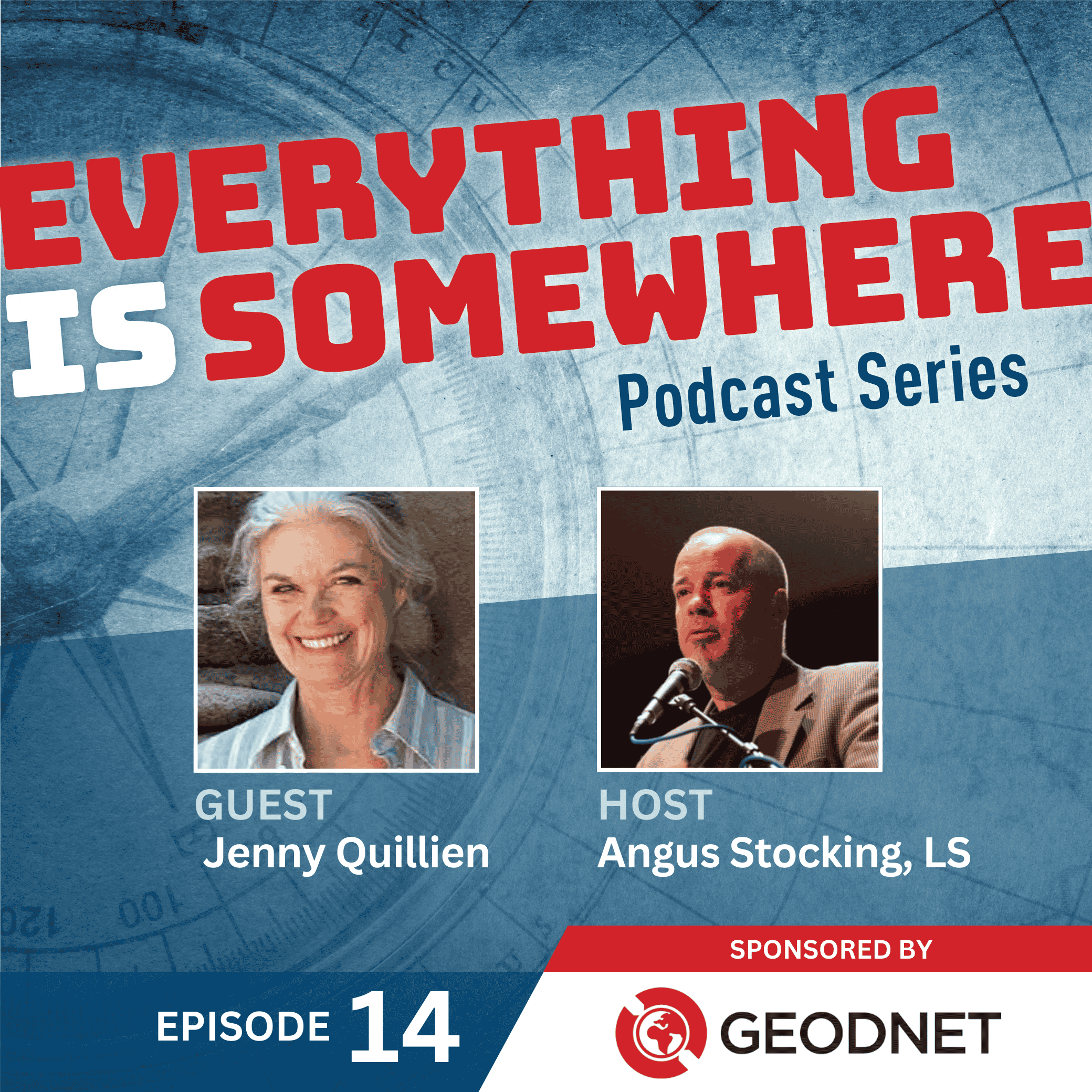
This is everything is somewhere, I'm Angus Stocking.
In this episode, it's my distinct pleasure and privilege to be interviewing Jenny Quillian,
a scholar and consultant whose work spans architecture, anthropology, and organizational
culture.
Jenny is perhaps best known for her six-year collaboration with the late Christopher Alexander,
the visionary, iconoclastic architect, and theorist behind a pattern language and the
nature of order.
She introduced his groundbreaking ideas to new audiences through her book The Lights Muse,
which explores Alexander's philosophy of creating spaces that enhance human life.
Jenny's current gig is a position on the board of Sustasis Foundation, along with Michael
Mahaffee, another scholar and architectural theorist, strongly influenced by Christopher
Alexander's ideas.
The Sustasis Foundation describes itself as a small catalytic organization that seeks
to convene other collaborators in strategic ways, and thereby leverage its small resources
for maximum effect.
We develop and share tools to promote vibrant, livable neighborhoods.
All at the same time, addressing the critical issues of resource depletion and climate
change.
Jenny, Quillian, welcome to Everything is Somewhere.
Well, thank you very much.
You know, I've enjoyed our email exchanges and a flurry of swapping articles back and
forth, so I'm quite curious to see what shape the conversational take.
Yeah, well, on that, we had talked briefly about starting off on, maybe, land surveying
in particular issues, partly in response to my column that touched on Christopher Alexander's
subdivision proposal in Harbor Peak.
And then beyond that, we might get into discussion of Luminous Ground, the fourth book of Christopher's
magnum opus, Nature of Order, which talks about cosmology, and that would be primarily
a discussion of your writings on his work.
So with that, maybe you could start us off with your thoughts on the subdivision process
described in Harbor Peak.
And also before that, even if you care to give an overview of your life and work, what brought
you to Christopher Alexander, how you've worked with him?
Sure.
Okay.
Well, we could start that with the book fairy.
So, you know, you're going along in life.
And for some sense of elegant synchronicity, the book fairy will simply manage to put into
your hands exactly the book you need at that time.
So it was in the early 90s of friends said, this is a gift for you.
I think you'll like it.
And it was the pattern language.
So indeed, I liked it.
I read it.
I read everything else.
And in a move that I don't make often, I actually called up the office and said, I've read
this and this and this, is there anything else?
And they said, well, no, but I mean, there's the manuscript of the book that isn't finished.
And they said, I could read it.
So I got that.
I read it and then actually called them back again.
And this is where you will come in.
I gave them my questions and they said, well, none of us can answer those questions.
You'll have to talk to Alexander himself.
Do you want us to set that up for you?
And I said, sure.
Jenny, I'm laughing a little bit because I have a very parallel story.
I know you do.
So let's talk about that.
But you say the book fairy and I say the book angel.
OK.
I had a similar book angel experience.
I went, I was in Cambria, California, I lived in the central coast for a while.
I was with my wife at the time and I always popped into bookstores.
And I went into a little bookstore and a second story, it was a little small and unusual.
And I got up there and I was drawn.
It was like a pattern language was glowing somehow.
And I couldn't help but pick it up and start browsing.
And I was broke at the time and I parted it anyway.
I couldn't afford it.
I felt compelled to buy it and that was 30 years ago.
And it set the tone for much of my Christopher Alexander became a giant of my intellectual
life.
And it started with a book angel experience.
And I also got in touch with Christopher Alexander, Count of Out of the Blue, and secured
an interview, which led to a lot of writing on American Survey R Magazine, which you've
read.
It's interesting that we have such a parallel experience.
And I wonder how often that happens with people who come to Christopher Alexander.
Well, I don't know, but there's another parallel.
And that is, so I met with him.
We talked about my questions.
And very, very quickly he turned the tables on me and I became the one who was interrogated.
And the upshot of that was to finish answering your question.
He asked me if I would be a first reader of the draft, that is, you know, as he continued
with the draft, I would be the first to read the draft and say where it was making sense
to me or not making sense to me, and apparently roughly the same thing happened to you.
You went to talk to him.
And in the end, he's the one who talked to you.
Yeah.
And in particular, he interviewed me about Lanser being practice.
I had and had read the first volume, the phenomenon of life, I think, of the nature of order.
After the interview, he sent me out of the blue, the remaining three volumes and it, because
I think he was working on them, but I got an early read of the volumes.
And we were talking, yesterday I think, you mentioned that there aren't that many people
who have actually read through all four volumes.
And I'm in that small group, I guess, they've been a scripture for me and I've really appreciated
everything he said.
And then also, in particular, on the Lanser being, Christopher sent me his proposed subdivision
process for Harbor Peak and Brookings, Oregon and called me actually and offered me a job
working with him doing the initial survey work and I didn't take that and I regret it.
Certainly, something I've tried to do is introduce Lanser bears to his thoughts on the subdivision
process and the creation of living structure in the land.
As a launching off point, could you maybe tell us what you think about that in terms of
how important are Lanser bears in subdivision process in the creation of living structure
in the world that Christopher invented?
Oh, believably important.
I mean, what have we got to start with but the land?
I mean, so it's unbelievably important.
So for me, and I'm not a Lanser bear, it's recognizing what is a site, I mean, walking
that site, understanding the beauty of it and where it's really good and where it's
broken and I mean, there are a few golden rules is you walk a land, you feel it and where
it is best, you leave it the hell alone and you try and put buildings where the land
is broken and where the land will be least offensive to the beauty that's already there.
And in all of the nature of order, what is incredibly important is this investigation
of sequence.
What do you do and what do you do in what order?
And if you screw up the land surveillance and that initial placement of things, you've
screwed it up, you can't, you can fix a lot in the house, but you can't move it.
It's hard to come back from that.
Absolutely.
And I mean, to me, obviously two mistakes, you just see them repeat it constantly.
And they're both mistakes of what's fast and what's cheap.
So one fast, cheap thing to do is take the friggin bulldozer and just roll it out flat
and then it's much easier for everything else it follows.
Which is of course, a sacrilege and we can talk religion and that's a sacrilege.
He used the phrase and he called it a torment to the land.
What is a torment to the land?
That's a proper expression.
And then the other mistake you see constantly is people, engineers, communities.
And they're just being engineers, so the first thing they will do is lay down roads and sewer pipes and that kind of thing and they'll lay it down to be most cost effective.
So we're going to wreck a division, we're going to wreck a piece of land to save 150 bucks for the sewer pipe.
Now, why in the hell would we do that?
So the fundamental process or this process or the sequencing is being mindful of what's significant and where you put a house and where you don't put a house is a lot more important than 150 bucks for the sewer pipe.
Especially when you think about the lifecycle of that decision, a house will be in place for ideally 100 years or more.
So why save 200 bucks an hour of time right at the beginning?
So that's why, I mean, this whole idea process and sequence is so important because if you can't backtrack or you can't backtrack easily,
you're living for another 100 years with some really stupid decision making.
So the answer, yeah, there's no question in my mind about how important that would be.
And just to drill down on that, probably the main thing discussed in the first three books of nature of order is the idea of centers, of course, are important, but the idea of process that correct design and construction isn't according to a plan.
But rather it's according to what he called the fundamental process and he didn't talk about a nature of order, but he did in other places, the idea that a fundamental aspect of the process is the serving work, it's we've been discussing.
And I was tickled and impressed as a land surveyor to realize that this body of ideas that I found to be great and important, necessarily included the work I was doing at the time as a land surveyor.
So on this particular subdivision document, which is, I've read a lot of codes and plannings, I have gotten subdivisions approved, it's something I know quite a bit about.
And Christopher's fundamental process proposed in his document was worthwhile and valid did adequately address the realities of the process and could actually have been adopted.
So it wasn't and there's probably good reasons for that, but he was a struggle, a battle, if you will, a little bit like what he faced at Ison campus, he was proposing a method for dealing with a very labyrinthine complex bureaucratic process that I think could have worked, but in the event that he lost that battle.
But what's the status of that idea in Alexandrian circles now? Has there been any progress on this particular aspect of the fundamental process? Is there urban planning or subdivision that is proceeding according to these ideas?
Actually, not that I know of. Well, I can answer with the one example that I personally lived through, which was so Alexander was called in by Duncanville, which is a small town, now bedroom community of Dallas.
And they wanted to preserve themselves as a real entity, a real town and they, you know, with the downtown and they didn't want to become just another subbedroom community.
So I was on that project and we, you know, we did the surets and had the stakeholders and extra came up with some pretty good stuff.
But this is where, in a sense, Alexander did not have really the full skill set he needed to pull this off in the real world.
So we did all this work and then he asked them for a substantial fee and the city managers turned a bit green.
And the new urbanists got wind of this and being much more street smart came in and said, well, we can do it and we'll cost you a dime.
We'll find the grant money and we'll write the grants. So who won that one?
And then the urbanists did do some work in Duncanville in the way that they do it, which is a bit more, you know, change the codes. So you get a more of a look alike.
It does raise the bar. There's no question about that. It's much less bad. But it's not the Alexandrian process.
So it's less bad. But there's a whole thing where the Alexandrian circles have not done particularly well and that's in being street smart, money smart, politics smart, those kinds of things.
There's also often the sense when I read about Christopher Alexander in his books and also when I read about him that he spent a lot of time tilting at windmills and sometimes successfully, but often not.
I mean, he had some great successes, but he had some failures to it, which I guess would be expected in any important movement trying to reshape the world. There's some pretty fundamental forces that are being fought there.
And it'd be weird if you won every time, but I'm glad that there are folks like yourself and many others who are still engaged in the battle.
Right. And since you're an efficient out of the nature of order, in a sense, the same thing could apply to the book. I mean, so the strength of my personal opinion, the strength of the nature order and its weaknesses is to a great extent the same.
So here you have a guy who, unflinchingly, relentlessly worked around the clock for what 30 years, I mean, between a pattern language in the nature of order.
And we're basically solo. So the interesting side of that is you really have one mind pushing itself to the end of its own logic. So that's a very interesting thing to have one mind pushing something that far.
And at the same time, it's a bit of a weakness because he was never countered or tempered by co-authors or people would say, no, no, no, we have to test that.
So so in a very interesting sense, its strength is its weakness.
Yeah, I'd like to quote you actually from our previous conversation. We were talking about luminous ground and what you're talking about. And you said about Christopher, he was after the big fish.
He really wanted to prove the existence of God. I don't think he does, but that doesn't take away from the idea that building is a spiritual activity.
A very nice summation, I think, of what he was trying to do. And could you make, let's move into that discussion. Christopher Alexander's cosmology. What's your take on it or what's your overview of what he was trying to do?
Well, it wasn't a sense precisely that. I think like many of us, it's with age, maturity, reflection, that the bigger questions, the spiritual questions started to take up more and more of our time or preoccupations.
I think that was true with him. So with the passing of years, he became more and more perplexed with, I mean, how does this universe work?
And why is it that this room makes me feel good? And the next that room doesn't, I mean, what's going on?
What's led into the question, what is the nature of reality? What is really going on?
What's really going on? So book four, I mean, to go back to the conversation we did, and we both agreed, book four, which is the book of cosmology, is a bit like the Bible. If you want compassion, you can find a page with compassion.
And if you want an eye for an eye and a tooth for a tooth, you can find that too. So book four is really a writing down of an exploration of one man's mind.
And he was a theist. He was raised Catholic. And that was kind of home base. I mean, wherever he went, he kind of slid back into that theest point of view.
And I don't know, I don't have any surveys to back it up. I think that readers who who share that theist assumption find the book very comforting.
And I don't think that people who don't have it
are convinced or compelled by the book. I don't have numbers to back that up. That's just a
sense that I have from a very small sampling. The way I've been trying to frame it, there's an
interesting, an American politics in the candidacy of the Vic, Rama Swami. He proposed and talked a
lot about the idea of God is real and that that was an important component. He was Hindu and he was
American and leads Christian, that basic idea of faith and the reality of God. For me, that often
comes down to idealism versus tralism. Is it mind before matter or matter before mind,
which causes the other? I think that when you say theist or when Christopher Alexander talks about
the luminous ground, the implicate order, I think that basic idea is whether materialism is actually
correct or whether there's mind necessarily preceded matter. That absolutely crucial idea.
To me, luminous ground was trying to verify or describe precisely idealism and I think he
did pretty well, but in your essay on the topic, you looked closely at the psychological premise
of luminous ground, that there was material reasons maybe that could explain centers and life
and other Alexandrian ideas. Is that fair to say? And if so, how would you talk about that?
Well, I'd say it a bit differently. I mean, one of the interesting things, again, if we put
the writing as it was taking place, which was what the mid-late 90s, the dead hand of materialism
and matter was very much the mainstream. I think it probably still is, but it's gotten a real
beating in the last 20 years. So Christopher Alexander was writing prior to that. So in the context
of the time, he was doing something fairly unusual and it was certainly unusual for an architect
to be talking about architecture. I totally agree with him. That building is a spiritual activity.
It requires a kind of spiritual mindfulness and the essay I wrote was really that he was so
enthusiastically asked after this big fish, you know, could he do what no one else had done,
which is proof and existence of God, he threw away as insignificant and uninteresting the whole
question of, well, what part of this can we explain through pretty ordinary things about human
cognitive psychology and cognition? And my sense was, which is why I took the trouble to write
that essay, you can dig down a bit and you know, you can go pretty far with some very ordinary
cognitive explanations. And in the last 20 years, I don't know if you know people like Donald
Hoffman or Bernardo Castro, people like that. And they really are saying, look, they use a metaphor
of the dashboard. You're you're piloting a plane and you really don't see what's outside the
plane. You see a dashboard, but the dashboard's not what's outside the plane. And we all are
dealing with our dashboards. We do with them what we can. But we don't need we can't forget that
actually we're dealing with dashboards. Well, and sure, and that's kind of a fundamental idea
to like Zen, for example, who is a master that makes a green grass green. We're not dealing with
the world, we're dealing with a model of the world that's presented to us by our brains, I guess.
Yeah. And so I just stopped and took the time and said, okay, if we look at this model that our
brains are doing, how far can we go with that? And we can go through this. Yeah. And by the way,
outbreak in, the essay is called haunted spaces for lesser gods. It's a wonderful read. Is that
available for download somewhere? Where could people come across that? I mean, it was the basis of a
talk. I'll give it to anybody who wants it. But I use it as a basis for talks. I never published it,
but I mean, it would be easy enough to do that too. Okay, we can get it in the show notes or something.
Sure. Absolutely. Easily. Yeah. Okay. So please proceed. I'm sorry to interrupt.
Well, tell me more what you would want to know about that. Well, that basic idea that you can go
pretty far in describing the phenomenon of living space and structure, which is, I think we both
agree that that's real. There's something fundamental there, but it can be explained by
aspects of the brain or even linguistics. Proceed that idea for us.
Well, let me think. Well, one was to part of it. Well, what I, the way that essay structured,
as I went back to book four, and simply took Alex Chris at his word saying, so he says,
this insignificant, unimportant explanation, and he goes through three or four points,
and then throws it out the window, and so I think he uses a word zap that something about structure
can zap the brain. I don't know if it's structure can zap the brain, but it's clear that,
okay, the the first one comes to mind is void. So a void is one of the fifteen properties.
It's, it's central to any kind of sense of cosmology, but we experience our own body that way
of a central void, and we orient ourselves left, right up, down, front, back in relationship to a
internal kind of void. So our our cognitive apparatus is connected to how we're physically
structured. So we can look at that. Then we can look at how people, you know sacred objects,
and you know how in Mexico, they'll walk a statue of the Virgin Mary around on the street,
and what in the world is going on there? Because when we hold that statue of Virgin Mary
and in deep respect, we treat it like we would treat a person, we give it a house, we feed it,
we care for it. So there are there are all these parallels with how we physically deal with
objects like that, and our and our idea of cosmology. And I think when he talked about the
zapping, it was in his chapter on art, and everyone involved will acknowledge that when you look
at a great piece of art, you sometimes have a profound sense of awe, and the materialist,
psychological explanation for that. Christopher described as something about color and shape
and space, can trigger or zap a psychological response. And that's what he was dismissing.
And that's what you are pursuing and I think proving that you can actually go pretty far with
that idea. You can. And there's another kind of split in the road at that point, and they're both
in book four. And Chris Alexander prefers one and personally, I tend to prefer the other. So
you're looking at a fabulous piece of art statue. And in one point of view, it's kind of like a
window. And you say, oh, because you've been able to perceive something on the other side of
something. So the piece of art is like a window onto something which is already there.
And this is the stronger, theist point of view is God is already there. And you are just having
an extraordinary moment, an opportunity to to get a glimpse at it. You know, the other way,
which is not materialism, but it's a view that is a bit more Aristotle, a bit more Gregory
Bateson, a bit more Fritz Capra that the world it does have atilos. And it is completing itself.
So we're talking about with art, not a glimpse onto something which already is there. It is an
experience of something which is becoming. And so that's what the universe is. And that's also
kind of interesting point of view. I forgot. And maybe you will remember one of those great
scientists who had a great gift of the gab and it goes something like the Tilos, the university,
the universe going somewhere. This Tilos is the scientist's mistress. He can't be seen with
everybody. He can't live without her. So, so all this science doesn't talk about the
becomingness of the universe, but they're all in their way dependent on that ideas do their science.
And so that's kind of an interesting angle on it too.
I'll break into this interview for just a moment to identify the quote that Jenny is reaching for.
It's from biologist JBS Haldane and he says teleology is like a mistress to the biologist.
He dare not be seen with her in public, but cannot live without her. I also wanted to
define teleology because I wasn't sure what it meant. Teleology is a study of the purposes of nature.
So, what is the purpose of reality? What is the purpose of life that's teleology? And famously,
as a scientific discipline, teleology began to decline in the 17th century and in today's
materialistic age is considered to be entirely defunct. So, there you have it.
So, in discussions, you'll hear things like more and more complex in the more
Alexandrian point of view towards more and more life. And part of centers growing is sometimes throwing them away.
But that interaction, so what he means by the 15 properties, so a lot of people hardly get through book
one and they don't get to book two, is this dynamic constant transformation of the universe and
the best way to describe it or try to get closer to it is that it takes place through a constant dance
of these 15 properties. So, that's how he's exploring the kind of constant evolution and the moving
forward of the universe. That's how biology works. If we had any sense, that's how our towns would
grow. It would just be this creation of a intense and more and more intense fabric,
living fabric through these transformations. So, yeah, go ahead.
As I think about it, I would say that Christopher strongly reacted against the idea that
the universe is explainable as shit happens. That there's a purposeful growth, which we could
describe as evolution, that has an endpoint, has an endpoint, and that endpoint would be characterized
by complex living structures throughout, and that human civilization has a pattern of growth
that leads toward richer and more beautiful environment. Is that sort of it? That's how I model it,
but what do you think? I think that's close enough, and so on that essay you cited,
my response was, well, wait a minute, Chris, you're going after this big fish, but you just
threw out a nice little, you know, a nice little trout here. Let's have a look at the trout. I think
he's wrong on a lot of things, but I don't think it matters. I mean, it's because we're all wrong,
and science is all about being wrong and celebrating the fact that you figured out where you were wrong,
so you can go and figure out something else. I mean, so where Alexander succeeds is even when
he's wrong, he's wrong in a really interesting way and useful way and a useful way, and so we can
take that build on that and be extraordinarily grateful that when he was right, he was right and
where he was wrong, it was an interesting wrong. Jenny, can I bounce an idea off you and give it a try?
Well, I want to, in my essay on "Lumous Ground," I kind of concluded with what I saw as a proposed
practice of Christopher, and the quote is, "If a person dedicates himself to making the field of
centers, to making things whole, the more he or she does it, the more whole he or she becomes within
him or herself." Even one act of making this field of centers, a few minutes or an afternoon done
honestly, and in full pursuit of the real thing, changes a person and brings a level of calmness,
quietness, and peacefulness, which is quite unusual into that person. And to me, this would be an
example of even if he's wrong about, on the big picture, he's correct in terms of ways we can
orient ourselves toward spirit and archaeology or our daily work that makes a world a better place
that makes us a better person. Is that a reasonable thing to extract from the "Lumous Ground" and
Christopher Alexander's writings? Certainly, and there are ramifications to that, but absolutely,
so because to do that, and you've heard of the building beauty program, because you were in
contact with Yoden, Yoden Rock. Absolutely, yeah. So, I mean, the first thing you do with students
is have them make something, and just an object, it can be a cup, it can be a little wood,
something, it can be a bench, it doesn't matter. But the, the insistence is, is that the student
be authentic to themselves, honest to themselves, honest to kind of pleasing themselves,
and that you get objects which I wouldn't call them "childish", that's not the right word,
innocent, deeply charming, beautiful, but kind of innocent, because the the actual genuine person
has been put into the object, and by making that, that process nourishes the maker, so to speak.
So, you put in and you get back out, and that is, that's your thermometer. That's how you judge
whether it's good. So, you do something to your ceramic cup, and you stand back and you look at it,
and you say, "How does that make me feel?" So, you're using yourself as a, as a tool for judging,
whether the object is authentic or inauthentic. And Christopher's question was something like,
which is a better picture of myself? Right, that's the mirror of the self, which is a bit different,
so let's finish the one thought that we talked about the mirror of the self. So, in the making of
something, I just wanted to point out, my God, how different is this from our everyday
neo-consumer world, where we're fed fashion and image, image-driven junk? I mean, so, you have to
look like, I don't know what actress or Kardashian or something. So, but it's has nothing to do with you.
It's a, you're being forced to consume images, imagery, which are not authentic. So,
so, I mean, God bless them for really pushing that into the limelight. Why are we consuming
this image-driven junk, which is a good, doesn't service, but we're told repeatedly,
this is what we have to be doing, where it's to make something yourself, where you have to put
yourself into it. That's a totally different process. Now, the, the mirror of the self is worth
talking about for a minute, because it's connected to that, but it's not the same thing as making
something. It has an interesting history, which many people don't know. So, you know that Alexander
was a, at one point in his life became obsessed with carp.
and design carpets.
- Yes, and I love this story, please.
- So he was buying all these carpets,
but they cost a lot of money.
And the carpet dealers would let him have the rug
for a few days to think about it,
but he couldn't buy all the rugs, you know.
So he had to come up with a way to effectively
and evaluate which rug was better than the other rug,
and which one was really worth the purchase price.
So he devises crazy system, but I swear to you it works.
So you take two rugs, two of anything, two rugs,
two coffee cups, two whatever's,
and you say which one is a better picture of me,
and me, who I am, my goodness, my pettiness,
my past, my future.
If I had to be reincarnated as one of these two rugs
or one of these two coffee pots, which one would it be?
And if you do that, you will pick the one
that the expert of Sufi prayer rugs
or the expert of coffee mugs would say this one's better.
There it's a shortcut to expertise.
And you know, it works.
- Well, and for one thing, it's a practical guide to investment.
- It's a practical guide to investment.
And I can tell you, I remember the night very clearly,
when I did the test, you know, I listened to this,
okay, which one, which reincarnated as one of these two things.
That's my mama.
So I wasn't immediately compelled to run out and do this.
But there wasn't night, I went to a Moroccan restaurant,
the meal was slow and coming,
I'd been to that little restaurant near my apartment many times.
And the restaurant owner had a collection of Moroccan pottery.
So in previous meals there,
I'd already picked out the one that I liked.
And the one that I liked, which is not the same thing, right?
The one that I liked was, it was round.
It had this kind of beautiful sensual shape to it.
It was this kind of buttercup yellow.
And it was just joyful.
So I liked, that's the one I liked.
But the mirror this self doesn't ask you, which one do you like?
That's not the question.
The mirror the self asks you, which one of these
is a better picture of yourself?
And I stopped and I really thought about it.
And I had to abandon my joyful yellow,
(laughs)
impottery bowl.
And I had to pick one that was muddy brown,
very quiet, it had this kind of long neck
with these little intricate black lines around the neck.
As the one that was actually more like me.
- And I love that you say that I had to.
- I had to, I had to pick that one.
And then I asked the restaurant owner who was around
and I asked him if he would tell me about his collection.
And there he says, yeah, that yellow one,
it's a very nice pot.
But the best one in the collection
is that brown one with this long neck
and the intricate black lines.
And you say, there you go by using the mirror the self, right?
Yeah, that's right.
And that points to, I think, another strength of Alexander,
which is kind of an epistemology, he'd try anything.
I mean, to acquire information or understanding,
you can be analytical, you can go for synthesis,
you can go for intuition, you can go for math,
and you can go for the mirror the self.
I mean, it's all good.
Anything that will enhance understanding, go for it.
And I think that's one of the strengths
and I think it's pretty rare, you know?
- Such a great story.
And that's the experience that Christopher had when he was
choosing between rugs without much knowledge of the field
by using the mirror, the self test.
He arrived at the rugs that were considered
truly profound by long time experts in the field.
- Oh, absolutely.
And if you can pull that off in your profession,
I mean, fabulous.
(laughs)
- I agree, and so there's two ideas here.
One is pursuing, Christopher writes pretty straightforwardly,
doing better work if we do what pleases ourself,
if we do what we like.
And then there's the idea of the mirror of the self
to judge or evaluate art or work or daily life.
And both can be to bring it back to Lancer Bears
and daily work, one could pursue wholeness and centers
and pleasing the self when doing something as simple
as a certified survey map in terms of the layout
and how you do labeling and how you write the titles
and the spatial arrangement on the sheet.
That would be pursuing liking and wholeness
and pleasing the self.
And then when you're doing things like evaluating, say,
two possible subdivision proposals,
how you're gonna carve up the land,
you might think in terms of the mirror of the self,
and that is, you know, which a better picture of me,
you know, it can sometimes seem like a ridiculous question,
but it's a perfectly valid question that does have an answer
that will put you in line of great thinkers
or the spirit of the age or whatever for God
in making a simple decision.
It's profound and practical, and I wish both ideas,
I hope they both become more prevalent
than work of all sorts.
Jenny, this has been great,
and I don't wanna take all of your evening there
and answer them.
What should people know about you
or where could they go for more information on?
So stasis, for example, or the book that you have written
about Christopher?
- Well, let's see, well, let me say a word
about the light smooths, which is the book I wrote on,
yeah, the nature of order.
So people tell me it's helpful,
and I think it is, I would want to make sure
that people knew exactly what it was and what it isn't.
You know, so the nature of order, as you will know,
is four volumes and 2,000 pages.
And honestly, we could take a red pen
and cut that sucker in half and it would be a better book,
but it would still be 1,000 pages.
And I'm realizing that most people
really don't get through it.
So you're on the hall of fame for having done all four.
- And not because it's not complicated exactly,
but it's comprehensive and I feel like it restates points
and teachings quite a bit, reframes on,
uses a lot of examples.
So it could be cut, but at the same time,
a little hard to excerpt because he makes his point
and was such a comprehensive majesty.
But I'm dithering, go ahead.
- Yeah, well, that's true, but I can also quote you
because I listened to, you know,
when we talked about doing this podcast
and you sent me two other podcasts,
one was with Ryan Singer, the computer guy
and in that conversation, I think it was you,
but it might have been the other guy.
Describe the nature of water as a pill.
- Yeah, it's hard to take, it's a tough swallow.
- Okay.
Well, okay, it is a pill.
So, yeah, God knows, I love and respect the work.
But it's kind of like, the nature of water
is kind of like dancing with a grease tip upon it.
So I mean, yeah, you got to get your arms around it
and then you got to connect the points,
I don't know, it's a pill or it's a grease tip upon it.
So I produced a work with, I think 180 pages,
it's under 200 pages with a lot of pictures,
which is simply kind of a heads up, it does two things.
It's kind of a heads up on many of the themes
that are in the nature of water.
But I would never want anyone to think
that it was a substitute for it
or even a complete synthesis for it.
It's not, you can't write 200 pages to represent 2000,
that just would be silly, you know?
So I wouldn't want people to be clear
about what it was they were looking at.
And then the other thing I did,
because I spent about six years being a first reader
and having these discussions
and that phase was kind of over.
And then the logical thing for me to do
in my own learning process would be to go try it.
So I had bought a small Adobe in Santa Fe.
1930, you know, the typical Santa Fe,
it was an initial building of four rooms.
Some blue collar family had put this together.
Then people had added on and people had added on.
And then it was my job to make it mine and to make it more whole.
So this was an opportunity for me myself
to actually try the stuff out.
And so that's what I did next.
And so there, there bits and pieces
throughout this short piece, the light smooth short piece,
where I talk about what happened when I tried it.
So the book does those two things.
I just do not want people to think that they're getting
a substitute because that would be so patently silly.
People have said it helps them then go back
and face the 2000 pages because they've got something
I've a heads up on what they're going to be looking at.
- I have done the same thing.
And I've often had this kind of eerie feeling
that we've tread the same ground
or had or thought some of the same thoughts as we've tried
to incorporate Alexandrian concepts into our personal lives.
For me, it's been trying to make a home
more living and whole and setting up a workshop.
I'm a bit of an artist and sculptor
and it's certainly been trying to apply
the 15 properties and the fundamental process.
Learning by doing it's been very big in my life.
- So that's great, so what have you learned?
- Well, for one thing, for me,
just having a grasp on the fundamental,
15 fundamental properties,
which he talks about in length with visual examples
and having that framework for thinking about aesthetics
been huge and I feel like I make much better paintings
and sculptures just from knowing that.
And then the idea of the fundamental process
and the primacy of centers,
I feel like I have made some headway in my life
and identifying centers and strengthening them
and that's been very helpful in rooms
and in studios and workshops and art
and watercolors and sculpture.
So I don't feel like I've gone very far.
I don't know that I'm profound, but better is better, right?
And I have made better things from knowing about centers
and the 15 properties and the fundamental process
and Alexander's idea of wholeness.
So I'm very grateful that I've made a few better things.
- Right.
- Or made things better than I would have otherwise
by knowing the nature of order.
It gives one the language for making very fine
and useful distinctions between different aspects
of what you're making.
- Okay, and of course one thing, it immediately gives you
as a vocabulary, which is unbelievably useful
to actually have a lexicon to look more systematically
and more mindfully at stuff.
- I found the same thing and particularly,
you know, a long section of the luminous ground
is about applying color or using color in art.
And I found that entire section maddening
and I feel like some of his least clear writing.
It's very personal and I could tell
that he had great revelations, but they weren't translating
to me, I had no idea how to get better color
into a painting after reading it.
I think I knew what he was talking about,
but the working backwards, I could recognize it much better
than I could try to create it.
- Right, I did find that it was,
it came in more handy working backwards
than working forwards, that I found it very useful
in evaluating what was there and how that had come into play.
I found it more dicey going forward as a planning tool.
What has to happen now is we need a lot of people
messing around with it, coming to more terms with,
okay, what works really well, what sort of works,
but we can see some away forward
and what doesn't work at all.
So that whole period of where the rubber hits the road
it needs to happen.
We need a lot of people doing a lot of experiments
in a lot of different ways to kind of test things
and okay, see what remains and see what we have to change.
- Jenny, I think that's probably a good ending point
for the conversation.
(upbeat music)
- Thanks for listening to this episode
of "Everything is Somewhere"
and I think I did a good job here of arriving at a topic
that really sums up what I'm trying to create
with this podcast and that would be an examination
of geospatial aspects of obscure aspects of reality
in conversation with interesting
and/or intelligent people who've been doing amazing work
in interesting fields, but please let me know what you think.
You can send me feedback directly at
[email protected]
or
[email protected]/podcast
that's AME-R-I-S-U-R-V.com/podcast.
Also, if you enjoyed this episode,
I hope that you will subscribe to the podcast
on iTunes or Spotify or rate the podcast or the episode
and if you're feeling especially magnanimous,
leave a review.
It really helps us a lot
and I hope to keep doing this
and keep recording interesting conversations
with interesting people.
Finally, if LinkedIn is your thing,
I hope that you will reach out and connect with me.
I'm easy to find.
There is only one angestocking.
(upbeat music)
(upbeat music)
 PodcastTranscript AI