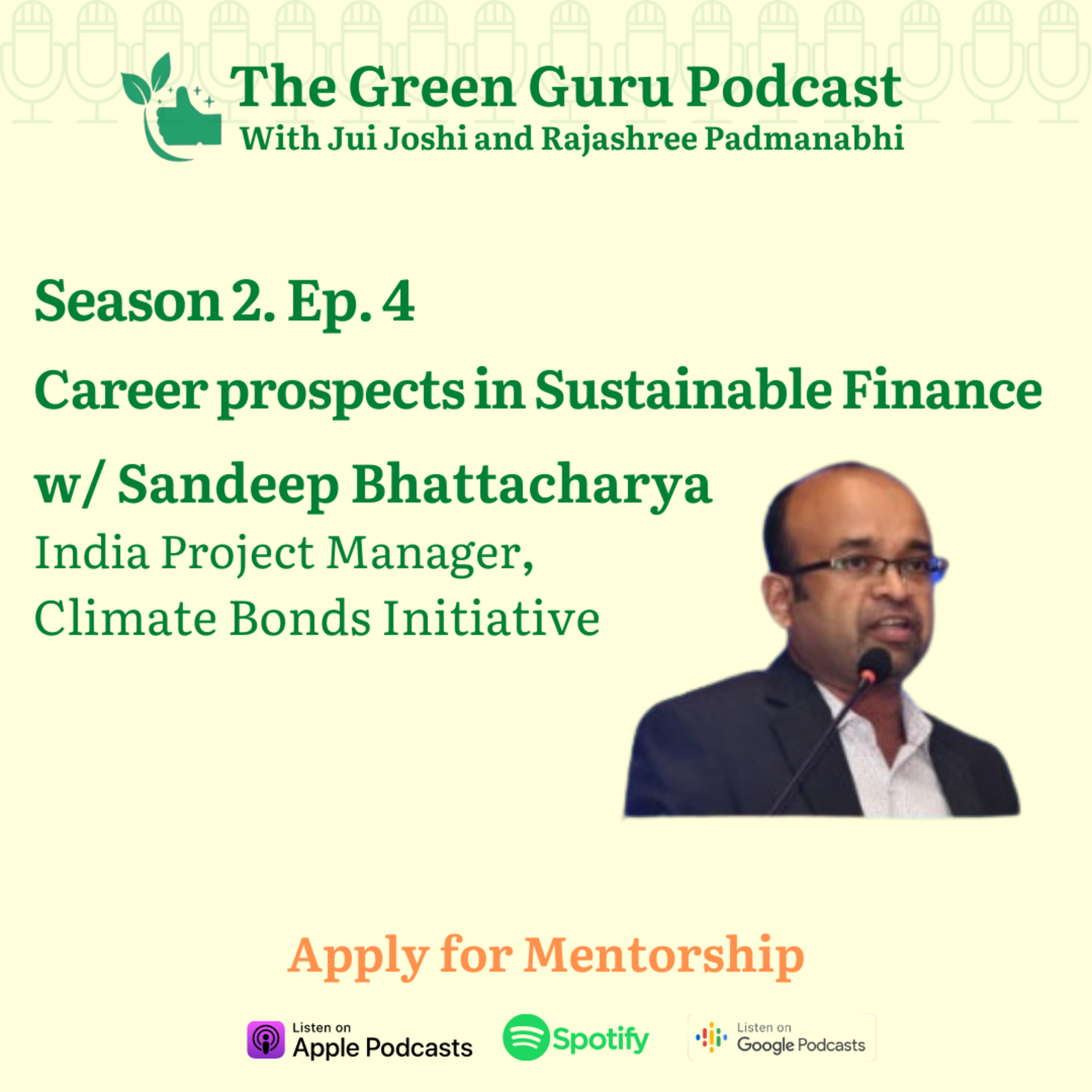
The podcast features Sandeep Bhattacharya from the Climate Bonds Initiative, discussing sustainable finance careers and concepts. Climate bonds are explained as tools to channel large-scale investment from bond markets into green projects, accelerating technologies like solar energy. The distinction between climate finance (focused on environmental projects) and sustainable finance (broader, including social goals like gender equality) is clarified. Career paths in India range from ESG research and NGO roles to green investment banking and consulting, each demanding specific skills like research efficiency or adaptability. Sandeep emphasizes the need for awareness to align finance with sustainability, countering skepticism. Currently, policy advisory offers robust opportunities in India, with other sectors like renewable energy and green finance expected to expand as policies develop. The discussion highlights the growing, diverse ecosystem where professionals can drive impact through finance.
Are you worried about climate change? Do you wonder how the next generation will survive global warming? Do you think the contributions that you are making are just not enough? Why not make it your career and send your life's work creating impact? I am Zoe and I am Radwishri and both of us are sustainable and very professional. We are excited to be co-hosting the Green Guru podcast, all about mentorship for Green Parrials. Welcome everyone. Today we have with us Mr. Sandeep Bhattacharya, who is the India Program Manager at the Climate Bonds Initiative. Sandeep has more than 20 years of experience in the financial industry with his long stints with reputed firms across India and Malaysia. Sandeep now works to build a sustainable finance ecosystem in India, collaborating with financial institutions, consultancy firms, educational institutions, philanthropies and cooperatives. So he is placed in a unique position to give us a 360 degree view of the sustainable finance job market in India and give us a broad sense of where it is heading in the coming years. So welcome Sandeep so much. We have been really looking forward to this podcast and really glad to have you on board. I spoke about climate bonds so before I move on, I just want to first start with, can you explain climate bonds in layman terms? Otherwise, nobody will understand this introduction. I think this is, nobody understands this concept generally. Correct. I understand that. So, how does the big bad world of finance meet the so-called saving earth of the green of environment? How do we save environment and also match the big bad world of finance? So let's take solar. It was nearly 60 years ago that the first solar panels came on the World Trade Center. Today they are rapidly spreading as the cheapest source of power globally and of course in more in tropical countries which are closer to the equator. What has happened is that a lot of money has flown in which has scaled this up, reduced marketing costs and made it cheaper. I am not saying it is only money. It is a lot of policy support which keeps started the demand. But this wouldn't have happened without a lot of money coming in. And the bond markets are the single largest source of capital globally. It is $100 trillion odd. Sometimes it goes up and down. So then if you can't tap the bond markets then you have to wait 60, 70 years for each of these technologies to become scalable. We can't afford that green hydrogen becomes scalable in 70 years. That's just not on. So you need money at scale and that's what we try to do. We try to bring it money at scale and volume into new technologies, into new products, into new sectors which the bond market as of now might not understand. Right. Right. Welcome Sandeep. This is Rajeshri. Very glad to have you on the podcast. I have a very simple question actually. I work at Climate Policy Initiative and on this office it may look like both these organizations do very similar work. But I would like to know if what you think about the difference between climate finance and sustainable finance. It's used very interchangeably. Would you like to talk about it? Yeah, of course. If the simplest thing I would say is look up the sustainable development goals for understanding what the sustainable finance is. So there is a certain overlap is not absolutely cut off. But sustainable finance would also mean finance for say gender diversity. While I'm not saying that climate finance needs to be bereft of gender diversity, that's not the focus. So if we have to scale up say an industry say an offshore wind, where till now you know women are not greatly employed. Yeah. For various reasons I don't know. I'm not trying to get into all that. We will not say that we that's not an area of focus because it's overwhelmingly male. Yeah. It is about scaling those sectors up. Does a lot of sustainability matter for the finance? Yes it does. For if you look at agriculture, most of the small scale farmers are women. And if you don't make agriculture sustainable say in India more than 80% of all farming is you know, small scale farmers and a lot of women do the work. If the women are not educated and if we can't make the flow of finance easier for them, which to a great extent Bangladesh has done, then that's going to be very difficult. So if there are areas of overlap, there might be areas like offshore wind where you know, it might not appear to be a part of the SDGs, but we will still do it. So I would urge the listeners to look at the definitions just to equip themselves with more details and more nuance that comes with these terminologies. And once if you want to get into the field, it's always good to know what is the exact difference and then define your career path based on that. So thank you. Thank you for making it a little clearer. So Sandeep, I'm still curious about when you say working with Cammett Bonds initiative, what does your work look like? What does a typical day look like for you? Well the best thing is every day is very different. So the best thing about working in CBI is every day is very different. There is a final objective of bringing more and more players to the bond market. And you know on a day which has a lot of results showing, I will have maybe, I may be, licensing with two or three bond issuers who are finalizing their bond issuance means they are mobilizing, they have decided they will mobilize and you know they are mobilizing they are doing their mobilization. And you know we certify some of these transactions because we have standards. So we will be working on certification. On another day I might be with an educational institution planning a session to educate a lot of their members. So some of them are like say the CFA institute which has a lot of access to fund managers who need to be told this or even work with you know a government or a regulator or consultancy firms all towards influencing more and more finance go with them. Certain cases you know we have to bid for certain projects and it's a great extent it resembles consultancy organizations to a great extent it's project like it's very project based. But there's a lot of interaction with the financial market as well which generally is not the case with consulting consultancy firms. Consulting you know you get one then you move on to the next and one might not have to do anything with the other other. So it's a huge variety. Right right right. Great that sounds really interesting because I think you're working across regulators, students and along with your of course the bond markets and financial institutions etc. So it seems like a pretty exciting job that you have. I didn't know that I mean of course I knew but how much of awareness worked you do in this you know scenario you said that you work with young students do you see a need of a lot more awareness in this green bonds. Yes yes. There needs to be a lot more awareness about what finance can really do. First I think there needs to be some awareness about climate change not being a hoax while that is receiving with you know news like this canad heat wave on Canada and all that it really sounds extremely strange and then you can relate it to people but still there are people who see that it's a leftist hoax and this and that I've heard that. So now there's a little bit of needed awareness for that. So one of our courses that we are designing is in collaboration with the Indian Institute Technology which brings in a lot of credibility. So if we partner with them then you know a lot of people will feel that we are not you know perpetrators of some hoax that is where is one thing the other thing is then then the question arises how can conventional business actually do good when you know capitalism is supposed to have brought us to this junk.
then how can the same capitalist market do any good? That's another question which very comes across. And very often this kind of thing needs a lot of convincing. So there are people who say that, oh, you know, to do to overcome this, we need to go back to, you know, the pre-industrial race when we didn't consume. Well, that's not going to happen. So how do you match the current aspirations for consumption, which I mean, you might not say, you may or may not say it's legitimate, but you can't stop the work from having those aspirations and still manage to live sustainably. It's something which needs a lot of awareness and things. It reminds me of one of our earlier podcasts, our guest, Marni had said that finance is malleable and you can write poetry with finance. You may think that there are so many, there's so much innovation that's possible and you can make finance work for your benefit if you have the right mindset. So I think the Climate Bonds initiative is very well placed to bridge the gap between both these worlds, which speak very different languages and seems like you're doing a perfect job for that. So I want to switch gears and talk about the career aspects of this. You have had a long career in finance before you made a switch to sustainable finance industry. So can you give our listeners a brief overview of what are the opportunities in this field? I'm asking this question because we always see so many short-term trends in sustainability that keep coming and going and where do you see opportunities for long-term career growth in this field? Yeah, so the point is we are consuming a lot more than we should and the earth can't keep it up and with it, with this fact comes the case that careers which direct this will stay for the long. Now what careers are available, keep myself confined to India, what careers are available in India is to the extent I have seen. The highest number of careers are available in the offshoring of ESG research. If you take off stock of share numbers, I don't have the numbers of my fingers but I can see very clearly that there's a lot of people into that. So the thing is it's about overhats being cheaper here than say in Europe or US and we have well-trained staff who can analyze and crunch and balance sheets to see how ESG friendly this particular company is and again, some certain benchmarks which have already been set. These are not perfect benchmarks and they are numerous benchmarks but this is the most higher number of careers and I see this growing for quite some time because this costs differential between overheads here and overheads in the US and Europe will remain for quite some time now. That is one. The second is the space where you know like you have the NGOs which are largely dependent on grants from offshore philanthropies. Indian philanthropies still haven't caught up on this. So it's like climate policy initiative or climate bonds initiative or CDP or the climate group where you generally have you know a lot of interaction and play a kind of a bridging role, bridging, educational dissemination kind of a role. There's a lot of variety which is good here but there are issues of sometimes your donors not being very well connected with what you're doing. Well these are there and increasingly like Citibank in US has hyped off its sustainable investment banking that has happened with MUFG in Singapore. This is going to happen. Now have a few meetings with some investment banks who are you know thinking of this. So you can have a very traditional investment banking career but in sectors which are only green. So these are some of the stuff which I have seen. Of course the big four have allied businesses on this and verification which is a typical big four or any other consulting, not it's not only big four. Difficult consulting career. So these are some of the careers which I can see each having its own characteristics and preferences. So that's what one needs to identify when you are trying to identify or target a career. What is for you you know needs to be based on that. Yeah following up on that only what do you think are some of the skillsets that are required for all these different types of job profiles. Yeah so on the on the front it looks like they do very different kinds of roles. So what do you think are some of the skills that are required? Yeah so for an ESG research which is generally off-short what you need to have is excellent online research skills. So you should be able to get very fast to a source of information which you will compile in report. That's very that's very important. You need to be able to scan through documents to get to your data very fast because it's very productivity led. If you take too much of time then then you know the cost arbitrage disappears. So it's very it is relatively standardized work. You can do it very fast and you know there are things like understanding SLA's, service level agreements. You have to adhere to you need to understand what the service level agreements are and you need to have a little bit of sensitivity to difference in culture. The person in US is expecting something and you might be understanding something else. So these are there. These are inbound which means you don't go out for meetings. So if you're not okay with that well then you need to avoid it. If you are somebody who doesn't like to travel for work or you don't want to be out in the traffic jam and either portals then this is perfect for you. But then there's where you have to make a choice. In the NGO kind of a role again we have a lot of variety. Generally you have a lot of variety of work and it's relatively project based. So then you have to jump from one job to the other and you might feel your efficiency is a bit low because you're doing so many things. Doing a job repeatedly makes you more efficient. So if you like to be efficient then ESG research might be a good thing. If you like variety then these NGO kind of profiles might be slightly better. Within consulting it could be both. But as you go slightly senior your variety will increase within consulting. Again consulting has a lot of variety. One day you're working in both one or the next day you can work in New Zealand at the third day. You can work in Sri Lanka and this range of topics. So this is the thing. In consulting or even sometimes the NGO roles sometimes you might feel that you're delivering a document because somebody is asking for certain things and that person you might feel might not be in touch with reality. So sometimes you have to deliver a document which you know will hit the shelf. Maybe somebody will read it 100 years hence. So that is a part of well that's part of the game. But it's not that you have a tremendous amount of impact. The impact is tremendous but within to keep the impact going you have to keep the cash flow also going and sometimes the cash flow comes with these kind of reports which will not be my treat. So you have to have some degree of comfort with that. So even you have what you work for. Like you use kind of screen corporates or startups for being scare for being scale up. So that is also has a lot of variety. You use he saw many startups all over the place. Then comes the next step comes is these startups with very innovative ideas about solving issues. They need to get some support. You know the people in the team might not know everything. They need technical support. They need financial infusion and to do that you have incubators. So and then therefore you have the startups. So the startup is just like any other startup. You have to do a lot with very limited resources which is exactly the opposite of say any ASG research. You generally would have all the resources. You need to be very efficient with it. So this is exactly the opposite. So then what happens is these startups need initial funding and that comes from generally a venture capital. After a minimum amount of scale up a minimum amount of operations you get it from a venture capital. Now venture capital what is the scale you need? In a venture capital maybe six or seven out of the 10 you invest will will go down the drain. The three or four need to give you that exponential return which will compensate for this. So you have to have an
eye for that. It's not just analysis and industry, it's also an eye for scalability and extreme profitability of some of these businesses. When these businesses have gone up to a certain level, then comes the other slightly large scale equity, which is the private equity. Now, the private equity firm, often invests in large companies which are not reaching its potential or are investing in many of these kind of companies who have reached a certain scale. So, they will come in invest equity gently and exit in maybe five or six years or sometimes longer. So, this is the ecosystem of equity. Now, that follows on to listed companies. So, now, there are quite a few ESG funds who are supposed to go on to ESG companies and most of them currently in India are going only to well-governed companies because they're not too many environmentally friendly companies there in the listed stock market. But as you saw TCS and HDFC Bank are aiming to a net zero. So, number of stocks will grow and therefore, this is a very growing field. So, if you want to be a fund manager with a very growing portfolio, the, you know, it's nearly non-existent and these mutual funds, they have some fund but most of them are not into environmental investing now. But then they can be great. In between comes, you know, what is known as impact investing. If you want to understand that well, I think you should read Mohamed Yunus, you know, the Nobel Prize winner who started Gramin. It's about start, it's his book on social business. You know, that is what ideally it should be. But here, you have a very much for-profit companies with a very distinct impact. So, this is a separate nation often many philanthropies support this. So, while you are doing a deal making, it's just like an investment bank or a fund, but you often have support from philanthropies for certain impacts and some of the component of your money might not require the commercial returns. We have to be able to toggle between these kind of things. So, these are upsides and downsides and downsides everywhere. It's just your choice about what you take, what is your, what is your choice? And out of all of this, I mean, I have to ask you, you've laid it out very nicely, summarize the whole ecosystem. Where do you see if the, I mean, I know you've already answered this question in terms of, but since you, you know, just just put out this map of where all everything is going and where should you fit according to your personality and your career choice, what do you think is the most exciting space right now to be in in terms of India and the way it's growing and moving towards more of sustainability, I would say, finally. A lot of work currently is in the policy space and that will be so for the next at least two and a half to three years. It's simply because the policies are getting laid and are being rolled out. So, if you are into, there'll be a lot of work for advisory on government policies. There's a lot of work there. When that is, that has reached a certain level, then you'll have a lot of these, many other industries besides utility scale renewable energy scale up. Then you will have finance with a lot of variety and then you'll have a lot of these investment banks will scale up. So, in terms of a lot of work now, a lot, a lot I think is there in policy advisory and some of it might not have a finance element, it might be very technical. But it has, that's a make a difference to the ecosystem of where it's heading towards the policy. For sure. Great, I mean, this was extremely informative, Sadeep. I'm sure if anybody who wants to pursue a career in this space would be extremely interested to hear about this and also Sadeep has agreed to mentor, at least two people who are interested in this career. So, please to apply for mentorship will be happy to connect you to Sadeep. I think if you are looking for being in the finance space in India generally in the sustainable space, there is no one more experience than Sadeep. So, take, take this opportunity and he's the best person who can guide you. So, again, thank you. Thanks a lot, for taking time out. We really appreciate it. Thank you so much, Sadeep and thank you for being so candid and putting it in such simple words for Alissa, who are probably just starting out their careers and a lot of it is very easy for them sitting outside of the industry. So, I'm sure this is going to benefit them a lot and if you've already answered a lot of questions that we get on a regular basis. So, this has really helped people for a lot of listeners and I thank you for coming up for all of them. Thank you a lot. Pleasure was my. Thank you. [Music]
Podcast Summary
Key Points:
Climate bonds are financial instruments designed to fund environmentally beneficial projects, leveraging large-scale capital from bond markets to accelerate green technologies like solar power.
Sustainable finance encompasses a broader scope than climate finance, including social goals like gender diversity, while climate finance specifically targets environmental and climate-related projects.
Career opportunities in sustainable finance in India include ESG research offshoring, NGO roles, green investment banking, consulting, and policy advisory, each requiring different skillsets such as research efficiency, adaptability, or deal-making acumen.
Awareness and education are crucial to bridge gaps between finance and sustainability, addressing misconceptions and demonstrating how capital markets can drive positive environmental impact.
The sustainable finance ecosystem is evolving, with policy advisory currently offering significant opportunities in India, followed by growth in green sectors and financial services as frameworks mature.
Summary:
The podcast features Sandeep Bhattacharya from the Climate Bonds Initiative, discussing sustainable finance careers and concepts. Climate bonds are explained as tools to channel large-scale investment from bond markets into green projects, accelerating technologies like solar energy. The distinction between climate finance (focused on environmental projects) and sustainable finance (broader, including social goals like gender equality) is clarified.
Career paths in India range from ESG research and NGO roles to green investment banking and consulting, each demanding specific skills like research efficiency or adaptability. Sandeep emphasizes the need for awareness to align finance with sustainability, countering skepticism. Currently, policy advisory offers robust opportunities in India, with other sectors like renewable energy and green finance expected to expand as policies develop.
The discussion highlights the growing, diverse ecosystem where professionals can drive impact through finance.
FAQs
Climate bonds are financial instruments designed to raise large-scale capital for environmentally friendly projects, like solar energy, by tapping into the global bond market to accelerate the adoption of green technologies.
Sustainable finance broadly supports goals like gender diversity and social equity, while climate finance specifically targets environmental and climate-related projects, though there is overlap between the two.
A day can vary widely, from certifying bond issuances and working with educational institutions to collaborating with regulators and financial markets to promote sustainable finance.
Opportunities include ESG research offshoring, roles in NGOs or consultancies, green investment banking, and policy advisory, with growth expected in areas like renewable energy and impact investing.
Skills vary by role but may include strong research and analytical abilities, cultural sensitivity, project management, adaptability to variety, and an understanding of financial markets or policy frameworks.
Awareness helps dispel myths about climate change, demonstrates how finance can drive positive environmental impact, and encourages more people to pursue careers or investments in this field.
Chat with AI
Loading...
Pro features
Go deeper with this episode
Unlock creator-grade tools that turn any transcript into show notes and subtitle files.
 PodcastTranscript AI