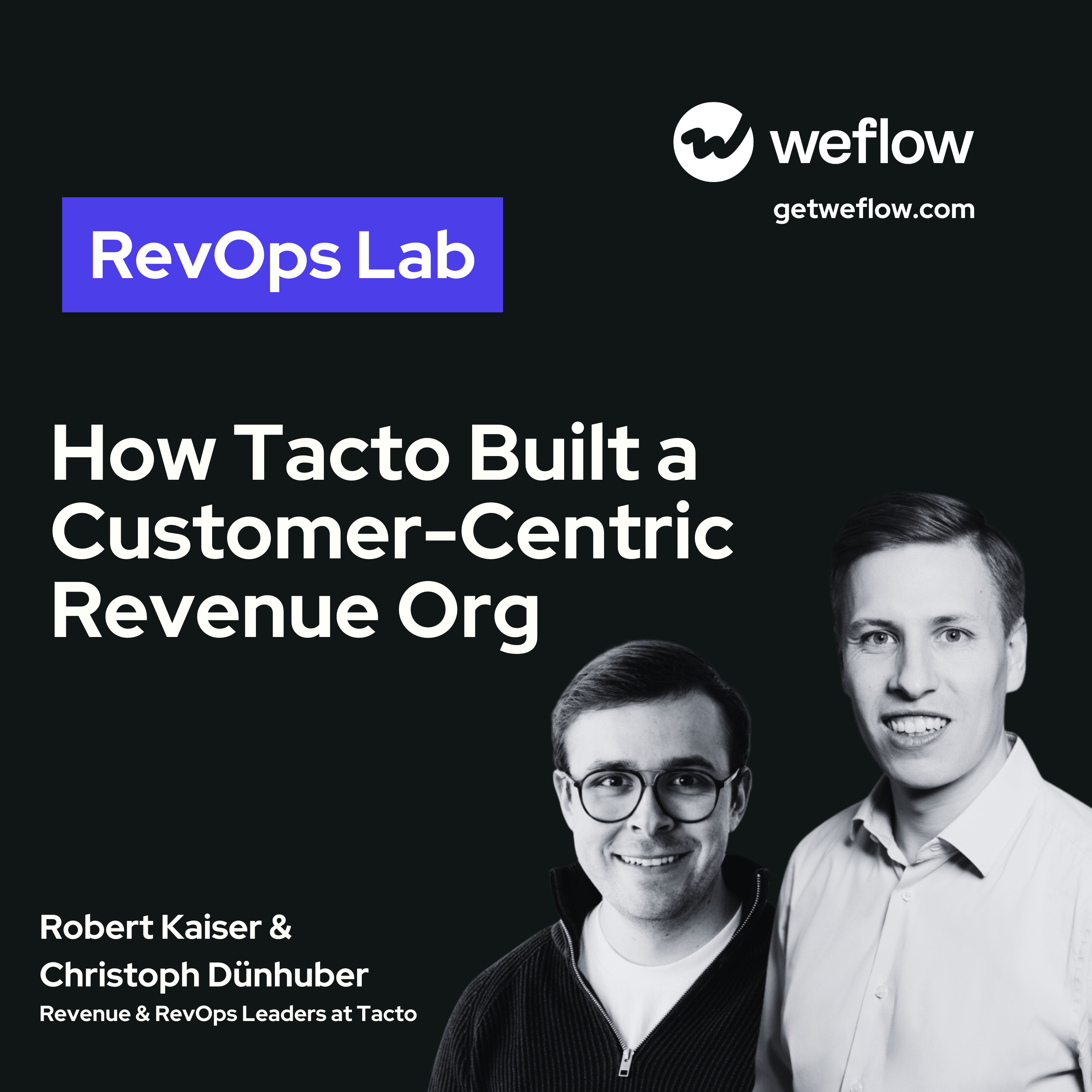
#115 Building a Customer-Centric Revenue Org – with Robert Kaiser & Christoph Dünhuber, Revenue & RevOps Leaders at Tacto
41m 17s
The podcast episode features Robert and Christoph from Tacto, a company that optimizes supply chains and procurement for industrial "hidden champions" like Radeberger and Fischer Sports. With around 130 employees and 300 customers, Tacto helps clients save 1-10% on procurement spend by replacing manual Excel and email processes with automated software. Robert emphasizes that customer centricity is about delivering value, which requires building trust early on, especially when the product is still evolving. Christoph details the customer journey: marketing drives top-of-funnel through weekly webinars (200-500 attendees) and regional events, followed by strategic business development that engages prospects naturally, often via webinar follow-ups. Sales and value engineering teams handle demos and implementations, while customer value managers, often from consultancies, ensure ongoing savings and process improvements. The team structure for expansions and renewals is fluid, with a recent hire for customer expansion, but the priority remains customer value over rigid role assignments. Ultimately, Tacto’s success hinges on balancing customer centricity with revenue focus, adapting responsibilities as the company scales.
[Music] Welcome to the Revope SLAB, a podcast exploring the art and science of revenue operations. To find more episodes and resources on scaling your revenue engine visit get weflow.com/revope. [Music] This episode is brought to you by WeFlow, the Garn alternative at half the cost made for Salesforce. I mean, we get it. Garn is a super solid product, but it's really, really expensive. That's why we built an affordable alternative for Salesforce users. Here's two simple reasons why you should go with WeFlow over Garn. First, we don't lock you into a platform that oversells you. Instead, you pick and choose only the products that you really need, with no strings attached. Second, WeFlow was built to respect best practices in your Salesforce data schema so you don't have all the issues that many customers have with GONG when it comes to reporting and flexibility. That's what 250 Revope SLAB companies like Blacklane, Coder, ID now, and many more love about WeFlow. So, go to get WeFlow.com to start you a free trial today. [Music] Hello and welcome to another episode of the Revope SLAB podcast. I'm here with Philip. How you Philip, how are you doing? Yeah, doing well, doing well. Excited for any way episode. It's been, it's been due for like some time now. Yeah, that's true. We, we were way behind and yeah, our guests today are Robert and Christoph. First time we do two guests at the same time from TACTO, welcome Robert and Christoph. Thank you so much. Yeah, super happy to be here. Maybe just should we keep it off with the intro right now? Yeah, I think it would be great. I mean, I would love to hear a bit more about you and also if you could share what TACTO is doing, that would be awesome. Yeah, of course, I'm great happy to start here. My name is Robert. I'm responsible at TACTO for Revenue Functions. I joined TACTO five years ago, approximately when the company was still like very, very small. We had like two to three engineers, past three founders and then I first of all built up like the sales process from scratch, closed the, yeah, that's a portion of the first million. Then took over our whole customer experience department, set up processes there, managed, yeah, the customers that were like at the beginning not always that happy, but I think we right now did a great job in building like a very customer centric organ. That's what we want to talk about today. And since approximately one year ago, I've been responsible for all revenue functions as also sales and BD and acting there as a managing director. I'm super happy to be here. Now awesome. Kirstoff, who are you? Yeah. What do you do? So I'm responsible for revenue operations at TACTO and I think right when Robert switched over to CX, I pretty much came in and started in business development. So we were I think like three BD hours at the time and there understood how business development works, the intersection of marketing and business development and also a business development and accounting executives and yeah, I'm pretty much focused on that for my early time at TACTO and then did more of sales ops and built up processes reporting with our head of sales. And when our head of sales pretty much left the company to join an earlier stage startup, then we were to go with the whole revenue function and then yeah, it became more of revenue operations and so I'm more focused on the CX side of things now as well. So yeah, just supporting Robert there. Yeah, awesome. I mean, we already Robert, you already mentioned that our topic for today is how to build a customer centric revenue arc. I think it's a term that's widely used and widely not lift day to day. So I think really excited to learn a bit more about that maybe before we dive in, like Robert, like how big is TACTO now? I mean, I think it's one of the, you know, like super stars in German startup scene. I know you've been growing a lot. You work with a lot of enterprise, manufacturing customers. So maybe if you share a few more stats and then we'll dive right into the topic. Yeah, yeah. So first of all, and I think that's probably also the going to be the summary of the whole episode. I think like if you want to build a customer centric arc, it's all about value in the end. And to understand where TACTO delivers the value, maybe we can start with a few sentences on what our company actually does, and also what we do today. And so we optimize the supply chains in the procurement processes for our customers. And our customers are, as you said, they are primarily in the industry. So those are hidden champions. Those are our companies delivering to the OEMs. So tier one, or the motor suppliers, for example, manufacturing companies in general. Some logos include today Raffensberger that probably everybody knows who grew up in Germany. I was seen everybody will have string beer, no, some fish and sports, also like a very well-known brandy and Munich. Everybody is skiing, probably used them once or likes the skis from Fischer Sports. And those are like logos that everybody knows, but nobody actually knows about the company itself. Because they're not that present. They're like classic hidden champions. And what we found when I joined like five years ago, and the founders did that a little bit before even, that they found that their procurement runs on Excel and spreadsheets. Yeah, a lot of the communication is done via email, and it's all like really, really manual. And that's for me at least it was really surprising, because there's so much unlock value in those processes. Yeah, like a typical customer of hours, they would do like one billion of revenue, for example. Then in manufacturing usually, more or less 50% of their revenue directly gets spent on procurement. Yeah, so they buy materials. In the end, they assemble them to the products that we all know that we love. And yeah, if you take the example one billion of revenue, 500 million of procurement spend, that's crazy that this is still like managed in Excel. And there's no specific tool managing that. And what I thought back then when I learned about TACTO and the idea behind it, back then everybody was talking about big data and nobody was speaking about AI. And now of course, it's AI, but like in procurement, you have such a great data and you have like one of the few verticals where you will have direct revenue or like direct bottom line impact. And if you just manage to save 1% of those 500 million, which is to be honest, after looking at the data, not that ambitious, you would directly have a 5 million bottom line impact. And that's a super yeah attractive business case, a super attractive vertical also. And that's why we love working with our customers because they also know that there's so much potential hidden in there. They know they can't manage all of their suppliers with the same quality and with the same attention that it would require to run all of them at the optimal level. And that's why a lot of customers and companies decide to partner with us. We help them to optimize their spend. We say 1 to 5% is realistic in the short term and in long run, we want to go for 10% of procurement optimization. So in that same example, with 1 billion of revenue that would mean up to 50 million, so 5.0 million of savings that we could achieve with them and every year, year over year. And that's why we are being quite successful in the market. That's why we keep growing because we manage to deliver those results. Those results are tangible. Customers can see it. Yeah. See us can and see if us can directly feel the impact. At the same time, we of course also optimize the processes and for our customers so that the operator fuses that in the end use sector that they do no longer have to do the manual work. For example, manage certificates, manage their suppliers to the onboarding. All those manual processes that nobody really likes doing, we optimize for them. At the same time, we provide guidance how they can use their time to save money for their company and to have a bigger impact of their work. That was the idea behind it. Just to finish that off, and that brought us into a very strong, growing motion here. Right now, we are at around 130 people working at TACTO, 300 customers. And again, a lot of the brands that you might have heard of, but you probably don't know the company behind them. Yeah. Awesome. I think this is a great context, especially for the topic. You basically obviously saw a lot of the good bet and actually of customer being customer centric. As a startup, you typically start with a product that might not be complete. There must be reason why this is so important to you. Also, when you think of customer centricity, what does this mean for you? Why do you think it matters so much? I mean, in the end, you don't want to be a product that somebody from the top management tells the operator, the users to use. You want to be the product that the users like using, and at the same time be the product that CEOs and CFOs love because it saves them money and it makes their company more efficient. And that's why I
I think that we are successful because we address both. As I said, it's always a tool, side at bridge or two side coin for us. The same, one thing is that we optimize processes and at the same time, we help customers to save money. But of course, that path wasn't that easy and not from the beginning. We managed to deliver successes in both areas. And they're at the very beginning, I think the customers that trust you there and that are willing to take the risk. I think those are probably the most crucial moments in developing a, or growing a software company to also lay the basis for scaling. Because I mean, everybody always is so focused on investors. Yeah, it's great. We have Sequoia and Index on board and he helped us a lot. Yeah, don't get me wrong. In all those board discussions, super helpful input. But at the same time, it's their business model. Yeah, a few companies will fail in their portfolio. Others will probably be the next, yeah, I don't know. Videos and that will drive the returns. But in the end, the customers, those are the ones that really risk their business and risk their career for you because they believe, you, they believe that together you can achieve something great that you can yeah, make the work of like the day today, of the employees more successful and better. And I think those are the people that we are the most thankful for that trust and for their and also their collaboration. And because we at the beginning didn't know a lot about procurement. And we knew about software, we knew about like our vision. But in the at the beginning, there wasn't a lot more than a vision and an vision. And then you need customers to trust you on the personal level, but also trust the idea that something great can develop on that. Yeah, yeah, I think that resonates super well with me. I think also like because like we should we build we flow the same way, right? Like just like the last couple of weeks and months, like there was like a bigger part of the product. And we were like cooperated closely with a couple of customers on like really making sure that we move it to like useful to like, you know, very, very useful and like trying to get to like best in class together with them. And I think it's just so important to listen to the customers and closely partner with them. Like, oh, and of course, in order to do that, you need to convince them to trust you first. Right? So like the whole relationship building plays like a huge role. Having said that, like how does like a typical customer journey nowadays look at Taktu? How do you build that initial trust and like keep building it? And yeah. Yeah, I mean, pretty much how it starts early on is with marketing and growth. We have a great team there that had pretty much host webinars each week. And we have about 200 to 500 attendees each week. So a lot of the top of funnel comes in there. And then obviously on top of that, you have from our website, some inbound. We do a lot of regional events. Last week we actually had our flagship event at Tim's and Bits here in Munich, where we rented the knockout back and had like about 400 people there, which was pretty cool. And I think like speaking of customer centricity, it was all about the customers. A lot of customers got their awards there. And we're celebrating procurement, which pretty much wasn't the case over the last couple of decades. So like that's a component, not only the online side of things, but actually like in person doing regional events at our customers as well. This is pretty much our early funnel works. And then we have our business development team. And they nurture our customers strategically. I think it has changed a lot over time. Like when I came in, I had like 1,700 companies in my territory. And if I wanted more companies in our head of business development, just gave me more companies. And now it's way more of a strategic approach. We just try to provide value and show them how TACTO can help them save costs and automate their processes. And they go into the early discoveries. So they set up the first meeting with the accounting executive, or they do this discovery call themselves. And then from first call discovery call or demo until the signature is pretty much all our accounting executives. We also have a value engineering team that helps build up the business cases. And then the handover works with our solution engineering team. They do the whole implementation. So we sit on top of the ERP system. Most of our customers have SAP. And then we have data pipelines where you pretty much onboard it really quickly. And then early on in the process, we also do an assessment of where procurement within those industrial companies is right now. And then we have our customer value managers that actually provide value and save costs with them. And you have to think about it in a way that they're really qualified to help those customers because they come from procurement consultancies like BCG and VIRTO or other consultancies. And they work with our customers strategically and our procurement advisors and help them pretty much expand and have the opportunity to use TACTO to their advantage. And this is where customer centrality happens when they are customers. But I think it's along the whole journey. On that, curious actually, who owns expansions and renewals if that is a thing. I'm not sure if it's more consumption based or if there's a baseline fee or how the pricing models work there. But curious about that piece as well. Because I think it's so critical who actually manages the actual expansion of the account. Sometimes it's more of the seller that initially closes the studio. But it sounds like with you, it sits really with the account management team. Or? Yeah, pretty much we have some strategic upsells where our account executives go in as well. And our customer value managers are also involved in the expansion of the customers. But we just hired a customer expansion lead that is really focused on account management. And we do a way more structured approach with that now. To be honest, we also haven't figured out the final setup. And I think during growing from 5,200 million, everybody who had done that journey before will confirm that you will probably change that a few times. I think in the end, it's not the most important thing to set up the responsibilities in the right way. But rather to make sure that the customer gets the value from the product and from all interactions with the company. And then everything else that follows, you'll find a way to also convert value into revenue. Everybody in the org should be very revenue focused and very revenue centric. And at the same time, customer centric. I think those are the two components that will drive a successful business. If you manage to get that right, you'll also get the business numbers right. And who exactly owns what part should be clear for the moment. But that can also change over time. And I think that's like the clear and the prior three in that equation. A prior one is always customer value. Prior to is a revenue centric org. And prior three is on how exactly you align the responsibilities. And who's basically taking care of what. And just a question on the like persona. Is it a strong focus on the procurement persona itself? And because it sounds like in marketing and growth, you're very much building a community webby now with 200 to 500 attendees sounds like a lot. How do you do that? And like what's the approach to that? Hey, Philip here. Are you enjoying this episode? Well, good news. Because you can find more free red ops and go to market resources on get reflow.com/redops. Access over 20 cheat sheets, reports and guides that will help you become a better revenue operator. Or join over 2000 subscribers who already get the latest resources right into the inboxes without a free newsletter. Just go to get me flo.com/redops. So talking about the persona, yeah. So most of the time we sell to the head of procurement. And also increasingly we get the managing directors on board earlier in the sales process. In the end, it's almost always the day. Have to sign off the budget. But we try to also address them directly and go the other way around to tell them, hey, look, we can save you after 10% of your spend at the same time. We will get your procurement team on board because we have a solution that also has facilitated the day to day. So sometimes we also got the other way around from top to the head of the
on procurement. And then at the same time, the community is built around primarily the procurement teams also. So of course, the head of procurement is engaged a lot there, but also the operator fuses or like operator bias that they also take part in those webinars. We always try to again do or produce their value for the customer content in this case. As a content that the customer really likes or not to just spread something that is not really interesting and just makes noise, but rather that the customer or like delete or the buyer leaves the webinar and says, "Hey, that was a well-enwaisted hour. I learned something new. I got some inspiration." And then, yeah, I think that's what keeps them coming back and keeps also the webinar attendee numbers quite high. Yeah, I mean, it feels very high and you probably hit interesting topics that they care about or interesting problems that they want to solve for. And you think from the customer, right? It's a bit like what we do with refops, right? We have a podcast, we have a community, with a lot of LinkedIn. We actually don't really care about WeFlow very much. We only care about what's valuable to the audience, right? And how can we share those learnings with the community globally, which is actually very aligned? And curious, on the business development piece, right? Like sometimes calling people cold, right? That feels a bit like off when you think about customer centricity, right? Like, is there something you do there that, you know, basically incorporates that and if so, how? And maybe not, right? But just curious how you think about that, really. Yeah. I think with business development, it also changed a little bit over time, because we have more awareness in the market right now. And when we were earlier, that wasn't the case as much. And then it sometimes might have seemed a little bit more pushy, but we had so many webinar attendees early on and had that as a really great channel that it was possible to ask them really friendly, like, what do you, what did you think about the webinar? Like, why was it interesting to you? Why did you even get hooked in the first place to attend the webinar? And then it's just a really natural conversation and it's not as pushy, you know? Then, I mean, obviously, if you have some code leads that are unaware, you have to get in touch with them somehow. And then you can use sequences that can provide value for them in their specific industry, for example. We have a lot of machinery manufacturers and then you might tell them about a problem that other customers of our head and you warm up the account and you try to provide value there. And this works really well for us. And then you can just like, call them, tell them, yeah, I sent you an email. What's just curious about if you have the same problems and then you get into the discovery and it's not as much just like selling, but really trying to understand your customer and asking what's important to them and then helping them along the journey. I just want to, you know, add a short thought here, because I think this is something that we see across the board with a lot of different companies that marketing and outbound are actually converging. And you have to really think about what's valuable to your core persona. And so, right? And then you can lead all these different areas with a lot of value. And you obviously lay out the signals on top, right? So you know a lot more about the companies you're approaching. And then you do it strategically in a way that it feels very natural. You know, this is very different to this, you know, kind of some tactics like, you know, hey, we just send cold calendar invites and we provide some context in the description, which, you know, it's in the reality people also do sometimes, right? But it feels very, very off, right? So I think I think this is a great point. Like brand matters a lot, right? Like if you have a web you know, and there's a topic you call them and it feels almost natural and then you basically just discover is there is there right? Like there's a reason why they go to the web now. There's a reason why they might attend to your event. They might know your company and this opens up the conversation. And then if you have a high quality conversation, they might be willing to spend 30 minutes of the time to learn something and see whether this would make sense to them. Obviously, I always sent it around big problem set, right? Like, and I think the problem set you you alluded to, like, you know, I think probably many like procurement teams are aware that the way they work today is changing and so, you know, they are also interested in learning about new solutions and, you know, how they could do this more efficient and with better results because that's essentially also how they're gold. And so it basically aligns with their career incentive and their career goals, which is I think really, really important always. So, Chris, I think you have a thought. Using our, you know, jump feature in Zencasa for the first time here in podcast history. I think what's also really important is that we invest a lot in everyone that talked to really understanding our customers and Obert has created a format there, which is called customer internships. And I think both of us did the first customer internships. Yeah. It's very shaviac, so it's machine and that's a classic machinery manufacturing company. And I mean, Robert is one of the first employees, like he understands, like, procurement really well. And when I when I came in about two years ago, I didn't understand procurement that well. My mother is actually a purchase to herself. So I got a little bit of that from her, but really understanding it for a machinery manufacturing company and sitting next to them, seeing how their processes work, not only how the head of procurement works, but also the strategic purchasers, the operative purchasers. Like, that's really cool to see all of that. And then also build a personal relationship with customers because the head of procurement and shaviac, shaviac, shaviac, machine, martyra, shlotta, he's just also a cool guy and it's really fun to hang out with them because yeah, last week at the Atoms and Bits also, like, those are cool people that you want to hang out with. So that's pretty much just the personal component there as well. Yeah. Robert, what is this? Like, can you share more about what what it is? Yeah, so I mean, I really, I love our customers. I have total respect for the business they are doing. Maybe like those, like, this, yeah, group of companies, they were basically the main factor that Germany could recover from World War II. The Wirtschaftswunder, the economic miracles that we had in Germany that our parents probably lived by and also brought them the uplift of their living standards and terms of education, terms of like society, infrastructure and so on, that would not have been possible without thousands of entrepreneurs who founded companies after World War II or even before that contributed to the development of the economy and the society. And that's like typical German, typical European approach towards the economy in total and that they have a way bigger role here for the overall society than they do, for example, in the U.S. And I have total respect for that and I also just love interacting with those people because yeah, I can totally relate to it. And what we thought around, I think it was two years ago when we introduced that, our employees, they also need to understand how our customers actually work because not everybody has a background where the family was working in a middle-aged-and-company. So we said, "Hey, everybody should do, well, first of all, Kirsten and I tried it and then the response was so great from the company but also from the customers that we decided that everybody should do one of those custom internships at the very beginning of their journey at Taktos, so that they really understand how the customer thinks, how the customer works, what their issues are, how they work with Taktos, how they think of the future, how we can even help them further in the future and by now everybody who joined Taktos has to do an internship and I think we already did more than 100 of them. So basically, what does it mean? It's like a day, is it a week, is it a month or like six months? Probably not six months, but two days. Two to three days. And then they sit in the office with the folks in the procurement team, or? Yeah, yeah, exactly. Just like a regular intern, yeah, they get the like one-on-ones with a lot of the key people in the department, they just observe them for some time, like there's no real standardized approach. It's up to also our customers, we send them like one-pager with ideas what they could discuss with our employees during the two to three days. But yeah, it's like the first few days of an internship, yeah. So I saw in your team, you hire a lot of smart young people that come straight from universities, you build a path to make them successful. Like, I mean, so they do this internship. What else do you do to get them in?
into the persona. - Yeah, so first of all, I think you have to be really careful when hiring also for a cultural fit because coming back to that point, and what you just said earlier, that you always want to basically have warmly see, if you really cold call somebody, it's not fun for the person being cold and it's not fun for the person calling. And like you need to have the people that also understand that that also are not only numbers driven, but really have the deeper sense of bringing value to the customer that really are capable also of running a high-quality conversation with the customer. So we first of all select them very carefully, then they usually pass a cold calling academy, that is more of a warm calling academy, I would call it. And then we also provide them like regular training on a very regular basis internal, as well as external, to educate and to give them a clear path. So that especially BDR's, that's our standard joining track after school, that they can then develop into an account executive. Some of them did that after just one year being in the job, and that of course you can only do if you have access to the very smartest people. - Yeah, I mean, it's crazy to me that customers allow you to do internships for all your new hires there. That's insane, I mean, that's like a crazy level of trust and commitment from them also to you. So kudos, that's really amazing. It's the first time I hear something like this. And that also makes me wonder how big referrals for you, because if you have such a tightly knit community, if you give out awards, if you run these big events, like Atom St. Bitts, great name, by the way, then this must have overtime also turned into revenue channel, was that something that you're still working on and trying to improve? - Yeah, I think in the end, it's really how to depict like what is a referral? I would say that 70 to 80% of our new customers, at some point during their sales journey, they speak to one of our existing customers. So it's a very important element in closing customers, but I think also that that's specific to our target group, they would not call us up and say, "Hey, I just spoke yesterday to person X, Y, Z, could we just run a call?" But the majority of our customers, they are super happy and super willing to do reference calls for our leads and one of our customers, just like recently, I don't know, we had a call or a meeting or whatever, and then I think it was on a Friday and then he said, "Yeah, he needs to say until 2 p.m. "everybody in this company usually lives around noon "and has lunch at home, but he needs to say until 2 p.m." And I was like, "Yeah, why do you say longer?" And he was like, "Yeah, because after noon, I always have blocked for reference calls for a cut-packed dog." And he does it every week, won't he? (laughing) - Excuse me. - Yeah, look, I think this is what your customer's centrality really means. I think actually, word of mouth always plays a role. - Yeah. - And community always plays a role. And so, right, this typical question of like, you have a persona, which is your power persona, and then you have the economic buyer, and then you have your users, and they might not actually be the same. And so you have to pick and choose, and you have to really, like if you basically create content for the managing directors, the story is very different. You talk about how you save costs, how do you drive efficiency gains, but the procurement team, they wanna know how exactly they work with it, what's their day to day, is their risk if they introduce that tool, right? So they are probably a lot stronger persona, and I think almost every AI SaaS company has this, and it's a very important strategic decision you have to take, and then really execute on it, because like the ripple effects of this is like, what kind of very nasty you do, what LinkedIn do you create on LinkedIn? What are the events you're creating, right? How do you speak to them? What are the words you're using? So what's the messaging, positioning? And then it triggers down to the sales and CS journey, so it's really, really crucial, and it's great to hear that you're having so much success with it, because I think that's where, you came from the CS background, right? Like the custom experience background, would you say that helped you in having that kind of mindset throughout the entire revenue lifecycle? Or definitely, I mean, when I got the responsibility for the customer experience department in the first place, it looked like the CS departments in most organizations, so we had people that, yeah, we had good relationship builders that also worked well with the customers that explained them how to use the product, but I have a consulting background also, and I thought, hey, this is not the level that we should provide to customers in order to maximize their value, and that's when we thought of a concept on how can we actually maximize the impact and the value for the customers, and then we thought, okay, like the software is getting better and better, and by now it's a great product that really helps customers to save millions of euros, but like the transition of having those insights into putting them into practice, that was a piece that was missing at the beginning, and there we then came to the conclusion that it makes total sense to have people that are super smart that noted the topic, that also know the customers, that also are willing to work really, really hard to achieve those value for the customers, that this is something that we should put on the front lines of our being, yet that we really make sure that customers achieve the outcomes, and so it was kind of a, what people right now call for, deployed, but what we brought in as a concept there, and that then also of course, was something that we again used in sales, because in sales it's a totally different story, if you say, hey, we optimize your processes, we don't know if it's like 10% or 20%, okay, you have five people in your team, probably won't let go any of those, okay, so how much money do you save? Well, like there, the conversation starts to stall, and like this, centricity on value, yet to really create tangible procurement value to achieve savings, that's of course a concept that we then also transferred into sales at all the conversations right now around value, that we get an extract from the ERP systems, from the customers, during the sales process, totally for free, we run our AI over it, we tell them, hey, here's money that you can actually save, you have it brings somebody also with procurement background into those sales calls, so that they can really have a conversation eye level, and that's something that totally originates and roots in the customer experience department and the customer experience function, and the concept that works there, that produces tangible value, we basically implement in our sales processes and that works well. Just a quick question on org design here, right? Like, so you have the AEs, right? Like you have solution engineers, like do they join, are those the procurement experts, or is there a different function? And then how is the CS, like, or like the, let's say, onboarding to renewal expanse, right? Like how is that structured, what kind of roles do you have in these? Yeah, of course, so maybe it's the easiest, if I run you through the whole journey, so we have big E, then we have sales, then hopefully the customer closes, then our solution engineering team, they were primarily responsible for the onboarding, and for setting up the data pipelines into the RPS systems of our customers, then we have the custom value team, they're responsible for the long term customer relation, so they own renewals, they also own the generation of upsell opportunities, and then either, depending on the nature of the upsell, either an AE, or the account management takes over to, yeah, expand this customer, but the renewal is owned by the customer value managers, and they are also the ones with the most procurement expertise, then we have also for the AEs for sales, they have a value engineering team that is dedicatedly responsible for, they are really demonstrating value to the customers during the sales process, or the naming might be a little bit confusing, but we make sure that we have the procurement expertise and the right people in all functions in order to really demonstrate the customer that we understand that business, that we care, that we bring them value, no matter if they are customer already, or if they are still considering to introduce TACTO. Yeah, awesome. Yeah, I think it's super helpful for context. Look, I think I have to jump soon, so I don't wanna make it around that. I think this was already really, really insightful, customer internships, heard the first time, someone had to fill up awesome, and I think that's exactly the idea of this podcast like to have you all listen in and maybe take some inspiration, right? Like how do you get to 200 to 500? Where we now attend these, or 400 people attending real life events, right? Like those are things that are possible, and I think you've done those. Before we dash off any book recommendation for the audience. Yeah, so fortunately, you told us that you would ask the question, so I give a little bit of a break. (laughs) So I can recommend indeed one book. It's called The Qualified Sales Leader from TANMAC9. Yeah, it's basically,
describes on like fake or real life examples, how you build up a sales organization, start to finish and then addresses all the concepts that you might want to introduce, including a meditate, including a pipeline generation, including forecasting. I think it's a really, really good book because it contains such a holistic approach towards building a revenue function. Qualified sales that leader, John McMan, highly can recommend it. Yeah, we actually had John McMan on the podcast as well. And I think he would love this podcast as well because there's so much attention to detail. And I think that's what it's all about. It's like these things are always like the devils in the detail. And I think you alluded to that beautifully here today. So thank you so much for coming on board and spending time with us. Thank you so much for having us. Thank you. Thank you. Thank you for listening to the Revops Lab podcast. If you enjoyed this episode and would like to support us, share it with a Revops friend or try us five star rating right now. And if you have feedback, questions or guest ideas, just send a message to Janice or me on LinkedIn. Thank you and see you next time.
Podcast Summary
Key Points:
Tacto builds customer centricity by focusing on delivering tangible value, such as saving customers 1-10% on procurement spend.
They target industrial "hidden champions" with manual procurement processes, offering both cost savings and process automation.
Trust is built through a value-driven marketing approach (e.g., webinars with 200-500 attendees) and strategic business development that prioritizes customer needs over pushiness.
The customer journey involves handoffs from marketing to BD to sales to implementation, with a flexible team structure that prioritizes customer value and revenue centricity.
Expansion and renewal ownership evolves as the company grows, but the primary focus remains on delivering value, with roles like customer value managers and a new customer expansion lead.
Summary:
The podcast episode features Robert and Christoph from Tacto, a company that optimizes supply chains and procurement for industrial "hidden champions" like Radeberger and Fischer Sports. With around 130 employees and 300 customers, Tacto helps clients save 1-10% on procurement spend by replacing manual Excel and email processes with automated software. Robert emphasizes that customer centricity is about delivering value, which requires building trust early on, especially when the product is still evolving.
Christoph details the customer journey: marketing drives top-of-funnel through weekly webinars (200-500 attendees) and regional events, followed by strategic business development that engages prospects naturally, often via webinar follow-ups. Sales and value engineering teams handle demos and implementations, while customer value managers, often from consultancies, ensure ongoing savings and process improvements. The team structure for expansions and renewals is fluid, with a recent hire for customer expansion, but the priority remains customer value over rigid role assignments.
Ultimately, Tacto’s success hinges on balancing customer centricity with revenue focus, adapting responsibilities as the company scales.
FAQs
The main topic is how to build a customer-centric revenue organization, featuring guests Robert and Christoph from TACTO.
TACTO optimizes supply chains and procurement processes for industrial and manufacturing companies, helping them save 1-5% of procurement spend short-term and up to 10% long-term.
Customer centricity is important because early customers risk their business and careers to trust a startup, and delivering value to both users and executives drives long-term success and revenue.
TACTO builds trust through marketing channels like weekly webinars with 200-500 attendees, regional events, and a strategic business development approach that provides value before any sales pitch.
The journey starts with marketing and growth, then business development nurtures leads, followed by account executives and value engineering for demos and business cases, then solution engineering for implementation, and finally customer value managers drive ongoing savings.
Expansions involve a mix of account executives, customer value managers, and a newly hired customer expansion lead, but the priority is delivering customer value over a fixed ownership structure.
Chat with AI
Loading...
Pro features
Go deeper with this episode
Unlock creator-grade tools that turn any transcript into show notes and subtitle files.
 PodcastTranscript AI