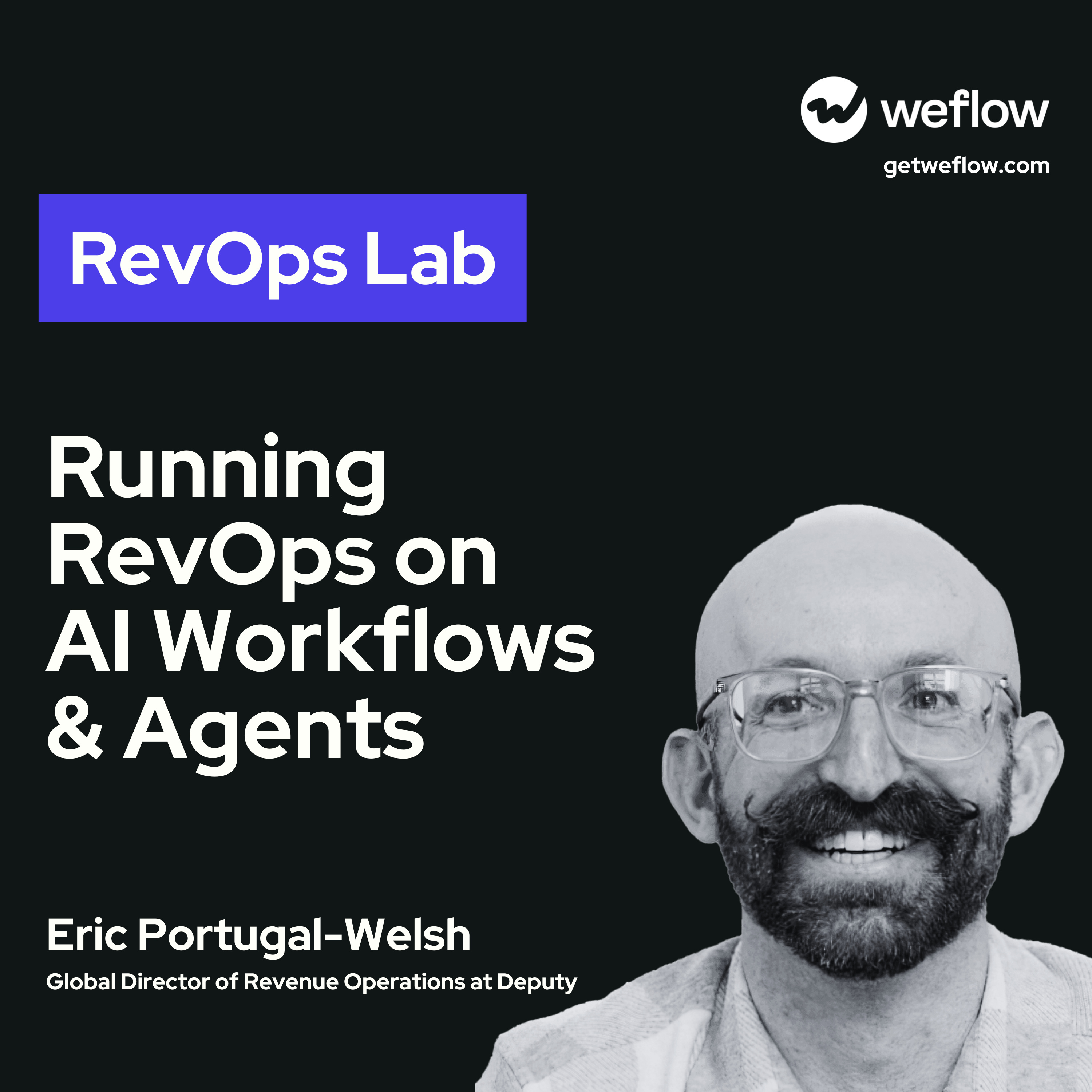
#114 Running RevOps on AI Workflows & Agents – with Eric Portugal Welsh, Head of RevOps at PlanetScale
38m 54s
In this podcast episode, Eric, head of RevOps at PlanetSkill, discusses how AI transforms the role of a RevOps team of one. Having moved from leading a team of six to being a solo operator, Eric relies heavily on AI tools like Claude, Cursor, and Notion AI to achieve 200-300% productivity gains. He uses AI agents for rapid onboarding, leveraging integrated systems (Notion, Slack) to access company knowledge and historical context within days instead of weeks. Eric emphasizes "vibe coding" with Cursor to build custom apps, such as pipeline prediction models and funnel trackers, replacing traditional spreadsheets and BI tools. He notes that Claude outperforms Gemini for complex tasks like spreadsheet modeling. Key automations include weekly summary agents that push updates to Slack, Notion agents that answer RevOps questions autonomously, and automated pipeline meeting prep that provides executive overviews. Eric stresses the importance of documenting work in platforms like Notion and recording meetings to feed AI agents, reducing tedium and communication overhead. These innovations allow him to deliver high impact as a solo operator, with AI handling routine tasks while he focuses on strategic initiatives. The episode highlights how AI enables RevOps professionals to scale their output without scaling headcount.
[Music] Welcome to the Revope SLAB, a podcast exploring the art and science of revenue operations. To find more episodes and resources on scaling your revenue engine visit get weflow.com/revope. [Music] This episode is brought to you by WeFlow, the Garn alternative at half the cost made for Salesforce. I mean, we get it. Garn is a super solid product, but it's really really expensive. That's why we built an affordable alternative for Salesforce users. Here's two simple reasons why you should go with WeFlow over Garn. First, we don't lock you into a platform that oversells you. Instead, you pick and choose only the products that you really need with no strings attached. Second, WeFlow was built to respect best practices in your Salesforce data schema, so you don't have all the issues that many customers have with Garn when it comes to reporting and flexibility. That's what 250 Revope SLAB companies like Blacklane, Coder, ID now, and many more love about WeFlow. So, go to get WeFlow.com to start you a free trial today. [Music] Hello, and welcome to another episode of the Red Ops Lab Podcast. My name is Philip, and I'm here together with Janus, although Janus. Hey, hey, how's it going? And our guest today is actually someone who's been here now for the, or is here for the second time. Eric, project go well. Hey, Eric, how are you doing? Good, good. How's it going, guys? Yeah, great to have you back. Great to have you back. The best beard on the podcast so far. [Laughter] All right, that's what's yours. Okay. It's my playoff beard. My wife is pregnant. It's a little bit of a superstition I have. Until we're in the morning. Keeps growing. Congrats. Congrats. Yeah. Good news. All right. Cool. Yeah. And, Eric, for those who don't know you yet, and who are you? And what do you do? Yeah. Well, I'm Eric Portugal Welsh. Neither Portuguese nor Welsh. The best part of the card's line. I am currently the head of Revops at a database company called PlanetSkill. formerly the head of Revops at the global payroll and workforce management company, Deputy. Which I believe I was at when we last met. Yeah. All right. Perfect. Okay. And our topic here today is how AI can help a Revops team of one, which I think is a very hot topic. I'm not sure what we're going to talk about. So I'm not sure if the word wipe coating will come up. I have a feeling it will. So Eric, I'm curious like, why is this like an important topic for you? Are you a Revops team of one right now? Yeah. Yeah. So I came from being a team of about six, or leading a team of about six. So I had a lot more like firepower from a human perspective. Came over here to being a team of one. And working at a company that really values high output and high performance. PlanetSkill is really designed to kind of keep headcount costs or headcount numbers and give us like the really fun and performance based like AI platforms and tools that can help us do the job of like a handful each. So this really, you know, like I was looking at, I was from the outside in previous to PlanetSkill looking at like, oh yeah, AI is nice and all, but I really needed that much to, oh yeah, I needed every day all day in order to do the job with like six people. Yeah. Yeah. Yeah. Yeah. So would you say like you made yourself 600% more productive with AI? It's amletting there. I'm definitely maybe two to 300% more productive. But I am, I mean, this is going to be fun to talk about. Like I'm only scratching the surface. And I'm starting to get deeper because I have kind of daily inspiration from some of the most brilliant engineers I've ever seen and gotten to work with here. So it's been, I feel like the last three months have been a very intensive boot camp for me. Yeah. Okay. Maybe maybe to get started like an ease into the topic. Can you describe just like where you are right now in terms of your setup and sort of like what do you use AI for? Yeah. I can give you a little land on like the tech stack and what I started with and what we have. So PlanetSkill is a notion company. We use notion as our knowledge base internet. We also have access to the, I don't know what I can't remember with the name of the actual tool. Nightshift, the AI agents, the data AI agents that they have. I have access to cursor, clawed, co-work, clawed code, and then Gemini. So that's kind of my, it's kind of my like AI platform suite right now. The way we have clawed and unthrowed, and unthrowed, set up internally as it's connected to most of our internal systems. And so I took it, I tried to take advantage of that from get go when I started at PlanetSkill. You know, I think one of the interesting thing is when you, when you're a manager of a large team and you're constantly onboarding new people, you have to build out these elaborate onboarding plans, find documents, sort of reference that are stale, maybe, maybe still relevant, you know, help get training materials together for like new systems. Using our kind of all of our integrated systems here, like I built out my own onboarding plan. And I did say because like I'm the first or I'm the only rev out tire, my boss is the COO. He's not going to be able to go deep on the systems that we have. So I built out my own plan. I just built an agent in clawed and in notion. I didn't want in both just to check to see how close they would come back. To build out like kind of that, you know, first 30 day onboarding plan for me in it. It referenced all of the right materials, documents and like I didn't really have to go to people for the first week to ask questions like notion and claw just had the end of this for me based on like everything that had done. And it had all like the historical context. I think one of the cool things also maybe also it has slack context too. So like any public Slack channel in conversation like it could reference for me. So if anything had been talked about in the world of rev apps or anything like related to it, I had contacts in my first couple days. So you found out that all the different definitions changed three times very quickly. I saw all the process maps, all the systems that got like onboarded and retired. You know, it took it was it was great and a little depressing at the same time. But it got me to you know, when I talk about like operating at that like 200% through 100% capacity, like it got me there quick. You know, what would have taken a couple weeks, Scott, I got there in a few days. Yeah, I mean, realistically, if you talk to anyone, right, most likely they won't remember or you know, they don't really have the reference point. It's very inefficient. So if you basically can tap into the entire knowledge of the company, obviously that's extremely unique and useful. And I think we all know the situation even just in Slack, right, where you oh, where was this and then was it in Slack, was it an email, which channel was it in? It's just like painful, right? And I think everybody knows that that feeling, especially in reference where you get pinged all the time from many different areas at the scale system. I've got solutions for that one too. We're ready to talk about it. And which system like is most effective for you at the moment? It's just like speaking for myself, like I currently have a chat, CPT subscription, a Gemini Ultra subscription, a cloud subscription, right? And we use notion as well, so use notion AI and stuff. But I'm always falling back to cloud at this point. And I'm not sure whether it's just like some kind of like bias because everyone has been talking about cloud so much, whether it's like really just because it's like the output is so much better, but I basically just stopped using in church of eternity.
entirely. It's a zero purpose for me nowadays because I'm just the style of Cloud just works better for me and if there's ever a moment where I need to create an image, then I just use Gemini because there's anyway included in our workspace subscription. How is that for you? It's similar. I would definitely say if I have intense web research that I need to do. I'll use Gemini's deep research. I think that works really well as I know like Google owns the internet. So if you're going to do web research and you don't need to go like too deep on people, Gemini's great. I'll also use it for image generation if I need to but I don't really need to do that very much. Choose a logist for it, comic meme or something. Cloud seems to be the one I definitely use the most. I use the desktop app and I use that code work almost more than just the, almost more than the chat. Actually, I use it a lot more than the chat. I have a lot of plugins to notion, to slack, to claim. So it just works better for me. I found this out because I ran a handful of tests and I were going to talk about vibe coding in a little bit. But I did run a handful of tests against different reporting models that I wanted to ship out to our team here. And with like building out pretty intense spreadsheet models as a starting point and Gemini was awful. Like really really bad. I have an example. I'm not going to show the examples but I have some examples of the, you know, Gemini or Claude Opus is what I was using for Opus setting 4.5 at the time now 4.6. Built me some very robust like pipeline prediction models. And the output I got from Gemini was like for Rose on a spreadsheet. It was yeah, obviously that's like. So for the actually talk to Kai this morning, is he showed me our new financial model which you built with Claude? I know. I know. Oh my god. This is like intense track. Yeah. So it's pretty, it's pretty crazy. I did, I did that. And then and then I started to dabble with like cursor vibe coding and building, building an actual app for the pipeline model. And then like, you know, pipeline trackers and trackers for our bus dev team and our A team and all like the standard revops funnel metrics that you can imagine. And I did that with the help of our finance who is an accountant and an engineer by trade. So she got really into cursor vibe coding. And if you'll believe it, she hasn't used or built anything in a spreadsheet. This is somebody from on finance has a building in a spreadsheet in I think like three or four months. She doesn't even go into Excel anymore. Everything she does is vibe coded and built into an app now. Okay, that's crazy. I mean, I mean, I don't you know, shed it like a single tear for Excel. But it is surprising that Gemini is so bad at building spreadsheets given like Google docs and Google sheets. I mean, it's huge. And but I do have a similar, I do have a similar experience. And like, what is like a crazy, I think with me for cloud is like, cloud is so proactive in just building you like a custom app. And like sometimes I even have to tell it like stop stop like not not another custom app for this like just like just actually give me a spreadsheet. I just actually want a spreadsheet for this use case because it's easier. And like an app like brings its own like problems with it also. Like then like you need to maintain it. Other people don't understand it and so on. But maybe that's like a good segue to start talking about like the web coding piece. Right, so are you currently web coding for yourself or are you web coding for the benefit of others? Yeah. Yeah. I mean, been a both. I mean, personally, after starting a few work projects of I could and I started building apps to make my life at home easier. I can talk about that in a minute that builds a really fun one. But yeah, the it started it started like I think any revops person would start a vibe coding project like I I inherited a new a new instance of sales force and needed to understand like where things were and what what was going on. We had no real pipeline metrics and no nothing set up in sales force to like to traditionally track pipeline velocity conversion rates like didn't have didn't have fields like time stamping for your stages. You know, kind of just like the basic stuff that you would expect out of the legacy instance to have. And so I started I just where you would normally start as like a history report. Right. I had a lot of duplicate entries. It was really difficult to like if you just put it into a spreadsheet, really difficult to like manipulate and figure out what your conversion rates are and the pipeline velocity is. So that was my starting point. I just got one single report, put it in a cursor and then began writing like everything I wanted out of it. And that it was like intimidating to try to build an app to start. But once I got started, once I like, you know, built out a plan doc in cursor, then started asking questions and then started prompting the agent to actually build. I was able to get to essentially of what you would you would traditionally have built into like a full pipeline dashboard in like a thought spot at Doho or whatever BI tool you're using. And that only took maybe an hour and a half to do. Something that like, you know, my previous company would take in weeks to build. This just took a couple hours. It was great. And got me really good insights into like where where our funnel is and like how things have progressed to the past for you. And do you feel like the data is reliable for you would also share that with the rest of the team or is this rather too quickly onboard and understand get some, you know, initiative views like how robust the standard right? Like how much can you trigger to? Yeah, and probably a combination of both like it. Want to give me it gave me good insights into like where things might be a bit messy. And I did share with the team. I shared it with with our CEO Kevin who to to maybe got checked to see where things might be off because he has the most context and Megan are head of finance. I think things like that are good to push and get public early. So that if there are issues we can all see them in real time. You know, part of part of that was to show where this are actually a mess. We're involved. We're doing a full rebuild of our lead to customer funnel right now. And that includes our deals funnel. Hey, Philip here. Are you enjoying this episode? Well, good news because you can find more free red ops and go to market resources on get reflow.com/redops. Access over 20 cheat sheets, reports and guides that will help you become a better revenue operator or join over 2000 subscribers who already get the latest resources right into the inboxes without a free newsletter. Just go to get me flow.com/redops. One thing with white coding that I and I think this is white cloud is also so preferred as a solution. It's asking you questions before it starts. But it's like in some cases. And what I found is to really speed up my own white coding. And I've set this now just work now more often than I think the entire year so far. But whenever I do white coding for myself, I first ask, I'd basically create a basic description of what I want. I'd put it into a cloud or some other LLM. And I'd basically tell it create like an acceptance criteria document for what I'm actually trying to achieve. It then creates the acceptance criteria document. And then I take that document and then I put it back into a cloud and say like, and now built this. And it's just like the returns are so much better. So I think that's something I just want to share with our audience for it because I think it's yeah, it does work to just tell it to build something. But it's definitely worth to invest those five minutes in beginning or 10 or whatever.
because the output will just be so much more reliable and buck free, then if you just give it a basic description and say built. - It's a bit like the typical traditional process of building product wide where you would do that anyways, just in one person and in a very time constrained experiment, which is actually really cool to see. It's a no brainer, but you gotta think about it. - Yeah. - It's a yeah. - I'm curious like obviously, like understanding pipeline health risks, metrics, always crucial. But are there other things you've done to basically clone yourself and just deliver more impact on the rough upside? Curious what other use cases you're seeing? - Yeah, there's a ton and these are like, these are kind of, these are to be like not the, well for rough ups first name I'd be exciting, but they're kind of like the boring ones that just help remove the tedium of the day to day because we have a lot of tedium all the time. The all premises by saying like, I found it with the stack that we have to be really important to write down as much of the work that I'm doing as possible in the platforms that I'm using. So I document just about everything in notion and slack because those are the two places that are really important for what I'm about to talk about. The other things internally we have adopted the idea of recording every call and every meeting, like every meeting that we're in, even if it's in person, we record it and it's the origin meeting recorder app. I found that to be really helpful when ideating on different ideas because I can then take that transcript or take the transcript there and then builds like the outline of what I'm gonna do or even like start the build? Using the AI, like the notion AI or a cloud. Those two things are important because there's a couple things that I've found to be really helpful being a team of one, communicating like the priorities and the work and doing the kind of a standard stuff of making sure everybody knows what's above and below the line. I have a couple different agents running right now on a weekly and daily basis, depending on priorities of stuff. One is I have a weekly summary of everything that got done for the week that goes out that pushes to Slack and this is all built in cloud projects. Sorry, that just pushes like, here's everything that we talked about and here's everything that got done and here's everything that's on the agenda for next week. It gives people the opportunity to kind of like plus one or minus one stuff that my people have on. That I think is kind of table stakes. There's nothing really exciting about it but it takes one thing off my plate and I don't get constant questions from colleagues about, what are you doing? What's, where's the so and so and such? The other thing is that I have notion agents running several, I got this idea from the rest of the company where we have a handful of agents running in different channels to allow people to ask questions, gives actual responses and so I have the same going. In certain channels, if people ask questions and directly rev up or directly they'll scan notion and reply with a response with an answer, that takes kind of a lot of time. Like a service desk automation kind of on steroids and not just for intake but also support dashboard questions, metric questions, definition questions, you name it right? Like all the typical stuff that comes up. Okay. - Yeah. It's also for us like our flow is really important. We have most of our Salesforce opportunity data and call intelligence data pushing into, to notion two. We have a weekly pipeline meeting on Monday mornings. Typically what you do and kind of your standard procedures like Friday afternoon, you'd run, you'd go into your pipeline reports or your forecasting reports and you'd look at all the data, write down notes, ask questions. I built a notion agent that just does that for us and pushes it out. I think I haven't set to satir for our Monday mornings like 7am, this calls at 830, gives you enough time, gives you the executive overview of like everything that we got go in this week, all future calls, all previous calls. It does it based on the way our COO likes to communicate. That's another fun one. It's another, I told him to this last week. I built also a cloud project that allows me to give him updates in the tone and like the detail that he wants specifically. So it analyzes all of his slack conversations, picked out his tone, picked out all the questions he tends to ask and then pre-hemp solve it with that. So all I have to do is input my update form or question form and it spits it out in language that he loves. I saw a noticeable change in like how he responds after I started doing that. But it uses a handful of those communication agents that I've built in this sales pipeline update. And so far it's been a pretty good success. It gives you like a really quick snippet to show like where things are for the week. Just a quick question for the audience. Like kind of how big it says to you, how big is the company overall? Because obviously this is like, I think it's obviously like for a lot of people, I'm pretty sure like you're all listening here and you're like, well okay, I see a bunch of different challenges with permissions who can see what. Like you're kind of a very engineering, probably like access to everybody, everybody has to open access to everything. Right, you record every conversation, everything is like going into the context window of the, and I'm so I'm curious just to share for the audience. - Yeah, it's a good call. We're a company of about 65 people. And I would say, I haven't done the full math on this, but about 85% of the company is engineers. So it is very much like open data concept here. - Yeah, so just one remark here, like so I have to actually constantly smile you because this is what you basically build through different systems. Like that's essentially what Philip and I are building with WeFlow, very much right? Like from the data pipelines to automate activity, conversation data capture, field data capture with an app, to then the query layer, the unification layer of CRM activity, conversation, field data, right? To essentially then being able to either use chat based systems or workflows and agents to query the data and then push the data or reports into Slack or email or different other places, right? And so on. It's actually so interesting because there's I think the reality that you're describing. And I think this is how startups are run today, right? This is how we run, this is how you guys run. But if you look at scale setups, you know, 500 people, you know, different hierarchy, like most companies don't run that way. And so there's like then more complexity to get into that kind of place. But I think it's fascinating to hear you talk about this because it's basically, this is gonna happen to everybody whether, and this is awesome, right? This is like really a superpower because in my mind, like what you're basically able to do is you can basically orchestrate the entire workflows and to end. And so you sit there and you really do resource allocation at steroids based on huge basically data or like context data that is available to us. And so even, you know, you're describing that you document all the internal meetings that you push more data and to know which to have more context data so that you can basically have better outcomes and better output. I think that's just a reality of like, you know, this is coming and you know, like we can embrace it. And then this gives like rough off superpowers in my mind because I don't think that like the VPs of sales or CROs of the world will sit there and build something like you're describing, even if it's a prebuilt system like we flow, right? We had easy to configure. It's still fairly complicated to, I mean, it's not complicated, but it's like, it's a lot more, it's not easy maybe to do what you're doing because you have to build that yourself. But you know, at the same time, it's also something that you need to then think about the different use cases. So it's fascinating to hear you explain this actually. - Yeah, one just to give this the VPs sales credit for stuff that they're not seeing them. We are, our head of commercial has done a, has done a fantastic like he,
He has leaned in, or leans in really heavily on agentec workflows and like doing a lot of this stuff. He built a really, really great notion agent that can take all the context data from notion and builds really good sales sequences and sales games. And we have, our outbound motion is really new. And so we're iterating on a lot of different ideas and trying to figure out how we, how we like, which play, which kind of motion we move forward with quickly. And being able to stood out really good content in the planet scale voice, in our brand has been extremely helpful. And I know that being at this really small company like this with access to just about every tool like an imagine makes it a lot easier, but those kind of things are just, you know, it's really good to have a partner who can just do that. And then all I have to do is take that content and spit it into the systems that we're using. Yeah. Yeah, 100% I mean, this is like, I mean, this is, I mean, this is why working at like an early stage company can be maybe sometimes a bit more rewarding in the sense that you have like certain freedoms that you don't have, but then I think it's also understandable, right? Like, so one thing that we do at Reflow is like, we automatically respect your hierarchy in Salesforce so you can only access the data that you should be allowed to access, which then obviously is like a huge pain point, right? So if you just, and a lot of criticism, my being is just like, you know, if you work at a company with like 5,000 people, you just can't throw everything into notion. (laughs) It's just like very hard to do, right? Like the security compliance team will freak out and for good reason. And then you need like these safeguards, you need to kind of like, anonymize before you do things and then there's GDPR and CCPA. And yeah, all the crazy stuff that slows you down, but it's also there for a good reason sometimes. Always depends. So yeah, yeah, I think like as soon as you, like hit like a certain threshold, it becomes really hard to move that fast. But I do wanna say that all our customers from big companies, the ones that use our AI the most, VPs of sales, CROs. Yeah, so they have lengthy conversations, you know, trying to understand, hey, like who's doing this, who's doing the, who's doing what, like how are we preparing for this big deal, are we in a good position to actually, you know, renew that account? It's those guys, like it's not the sales reps. I mean, they also use it, but like a lot less is like the VP of sales and I get it because like that's the, could they have a problem, right? Like huge amounts of unstructured data and no one can pull the report for them easily to give them like a simple answer to, what maybe sounds like a simple question, but it's often just very hard to answer. Yeah, so I think that's yeah, yeah, for sure. And it's funny because like, like you know, like two years ago, I would have said VP of sales, maybe like less tech savvy overall. If you compare it like, you know, like with other, like people in a company, and again, it's not a criticism to VP of sales. It's just I think also like they're super busy and they have too many things to do all the time. But the the chat interface and the agents that just push reports directly into the inbox, that is, is just like, it feels natural, like it's just like normal natural usage of technology in a way that it just wasn't available before. Like it's not a top-level report, right? Oh, I was going to say, I think it's, I think it's, honestly, it's yes, and it's less about pushing, getting agents to push reports. It's more about giving them the context behind the report and not giving them the ability to ask the report questions and get the context that they need. That I found to be like, you know, it's like, the way things are going, the way things are moving for this cohort of startups right now, they can adopt these tools really fast and get the most out of them. The concept about building sales force reports for anything other than auditing and like updating fields is gonna go by the wayside, I think like most people, the way people are gonna interact with their CR, and this is gonna be in the chat interface. Those who like adopt a sales force are hustling. We're gonna do so for just like data input and entry, but they're gonna expect to interact with it via chat agents. They're just gonna wanna ask questions and get context. Nobody's going to go into sales force and look at a record page. Yeah, I mean, this has been true for a long time, right? This has been true for a long time. The only positive side now is that actually, you really don't need to and you can like unlock insights that you just couldn't unlock because there's too much data and especially unstructured data. So I think the way I think of how this is gonna play out is like you essentially have refops orchestrating those agents, right, and essentially, you know, across your operating cadence and different questions and reports, thinking about what are the different, you know, executive reports, you wanna schedule, you know, what are the actionability you want to drive? How can I then also repeat entire workflows, like a complete and automate entire workflows for the reps? So that essentially, you know, on the Monday morning, they all go get prepared into the, you know, do a review of a forecast meeting, the pipeline reviews, right, that, you know, they know what's at risk, they know where to follow up, they know they they have the pre-written email that has all the context data. And so I think, you know, the orchestration layer will be continued to be refops. The interaction layer, right, like will be, you know, like chat, you know, slack, right, like whether that's in slack, that's in the tool that's in email, it doesn't really matter, but like you wanna basically have kind of a set system and then the ability for the end users, whether it's reps, managers, VPs, zeros, you have flexibility around like what else they get out, right? And I think that kind of is actually like, I really like that kind of combination. And then there are many workflows where we just fully automated that just should also be automated, ideally because, yeah, I mean, I think we're, you know, obviously meeting prep, meeting follow up, you know, CREM, up admin, all these like, these are the earliest things. There's a lot more to come that you can automate, right? Like if you think about like presentations and stuff like that. So, yeah, it's a very interesting one. And it's cool to see you building that, you know, at your current role, basically from scratch in an engineering environment where this is also some, you know, something that often is, is, is a lift by the culture. So it's, it's really very, very insightful, I feel. No, no. That said, I think we're at time, you know, final question, is there a book research report? You know, you can also do like, you know, Clots best, you know, report on how to build problems or so. But like, yeah, what would you recommend and can be also, obviously, a non-business book, you know, for our listeners? Yeah, I actually built a prompt to help me build prompts and cloud. But that was a fun one. The book that I'm reading right now, and it was recommended to me by my dad and that I, I really like is the last stand of the Tim Kahn soldier, really good book about the, maybe in the Pacific and World War II. Awesome. Awesome. I think we never had that. Really appreciate you coming on and sharing all these lessons learned. Yeah, thanks for listening. Thanks for joining us. Thanks. Thanks. Thank you for listening to the Rethops Lab podcast. If you enjoyed this episode and would like to support us, share it with a Rethops friend or trap us five star rating right now. And if you have feedback, questions or guest ideas, just send a message to Janis or me on LinkedIn. Thank you and see you next time.
Podcast Summary
Key Points:
AI tools, particularly Claude, significantly boost productivity for a RevOps team of one, enabling 200-300% efficiency gains.
Using AI for onboarding (via agents connected to Notion, Slack, etc.) allows new hires to quickly access company knowledge without constant human guidance.
Vibe coding with tools like Cursor and Claude enables rapid creation of custom apps (e.g., pipeline models, trackers) that replace traditional spreadsheets and BI tools.
Documenting work in platforms like Notion and Slack, plus recording all meetings, feeds AI agents that automate summaries, updates, and responses to common questions.
Key use cases include automated weekly summaries, pipeline meeting prep, and service desk automation to reduce repetitive tasks and communication overhead.
Summary:
In this podcast episode, Eric, head of RevOps at PlanetSkill, discusses how AI transforms the role of a RevOps team of one. Having moved from leading a team of six to being a solo operator, Eric relies heavily on AI tools like Claude, Cursor, and Notion AI to achieve 200-300% productivity gains. He uses AI agents for rapid onboarding, leveraging integrated systems (Notion, Slack) to access company knowledge and historical context within days instead of weeks.
Eric emphasizes "vibe coding" with Cursor to build custom apps, such as pipeline prediction models and funnel trackers, replacing traditional spreadsheets and BI tools. He notes that Claude outperforms Gemini for complex tasks like spreadsheet modeling. Key automations include weekly summary agents that push updates to Slack, Notion agents that answer RevOps questions autonomously, and automated pipeline meeting prep that provides executive overviews.
Eric stresses the importance of documenting work in platforms like Notion and recording meetings to feed AI agents, reducing tedium and communication overhead. These innovations allow him to deliver high impact as a solo operator, with AI handling routine tasks while he focuses on strategic initiatives. The episode highlights how AI enables RevOps professionals to scale their output without scaling headcount.
FAQs
It explores the art and science of revenue operations, with resources available at getweflow.com/revope.
The guest is Eric Portugal Welsh, Head of Revops at PlanetSkill, previously at Deputy.
He uses tools like Claude, Cursor, Notion AI, and Gemini to automate onboarding, pipeline tracking, and weekly summaries, boosting productivity by 200-300%.
He prefers Claude for most tasks due to its proactive app-building and accuracy, and uses Gemini for deep web research and image generation.
He used Claude to create robust pipeline prediction models and then vibe-coded an app in Cursor for tracking funnel metrics, completing in about 1.5 hours.
Vibe coding involves using AI to build custom apps from prompts. Eric uses it for pipeline dashboards and personal projects, starting with a plan doc in Cursor.
Chat with AI
Loading...
Pro features
Go deeper with this episode
Unlock creator-grade tools that turn any transcript into show notes and subtitle files.
 PodcastTranscript AI