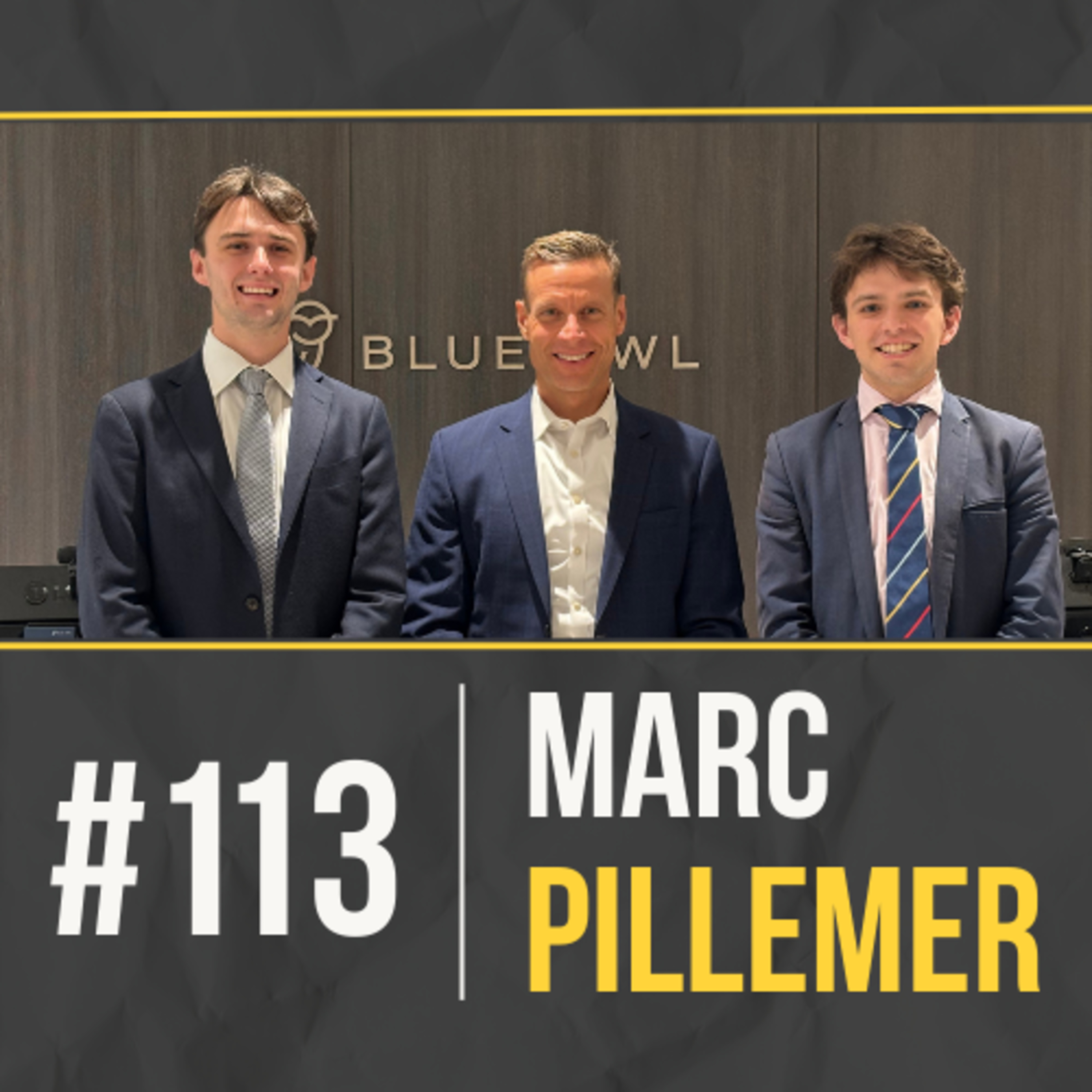
#113 – Blue Owl MD Marc Pillemer: Inside the Firm Choosing Which Asset Managers Will Win the Next 20 Years
45m 55s
Mark Pillermott began his career as a math tutor, learning to tailor his teaching approach to individual students—a skill that later helped him read clients and adapt in finance. He studied actuarial studies and finance at Macquarie University, then started at Goldman Sachs in Hong Kong's debt capital markets, later moving to New York in interest rate swaps and FIG banking. This gave him broad transactional experience. Seeking a shift from advisory to investing, he joined Blackstone's GP staking business, where he developed the discipline to discern high-quality investments. Now at Blue Owl Capital, he emphasizes building enduring relationships with general partners (GPs) through long-term connections, evaluating firms for cultural and strategic fit. Blue Owl's process involves deep relationship-building over years, supported by a large team dedicated to providing strategic capabilities to help GPs scale and succeed permanently in the market.
All righty. Hello. Welcome back. We're very lucky to be joined by senior managing director Mark Pillermott from Blue Hour Capital Thank you for joining us Mark. Happy to be here. Thanks for having me. Thanks Mark So I first question for you in a question like I'll ask all I guess is what was there first ever job was We find it's often a good story behind it or something you might have learned that stuck with that with you throughout your career So we'll start there sure of course My my first job was a math tutor. Oh, not a math tutor. I should say if you were in the Australian accent Look, I I loved it because I obviously enjoyed you know That the numbers of the math and those subjects was ours at school But it was a very personal element to it as well and there's you know when you when you're doing math or teaching math There's always a number of different ways you can teach things and you know It was a little bit of evaluating the person and the sort of way that they learned to try and teach them in a certain way And you know you'd have to sort of adjust the way you were teaching for the individual and I really enjoyed that Element of it as well and it actually in in in hindsight has actually had quite a lot of benefits from a professional career as well Right because you're in a meeting and you're you know Looking to sell something or buy something and you know You've obviously got to read the person on the other side of the table as well and change your approach Accordingly so you know, it's it was a great place to start. Oh, there you go And was that so how old were you when you were doing that was that sort of through uni? Yeah, yeah Yeah, all the way through uni. Yeah, cool. Yeah, and uni for you. Where was that? McCory University. Sydney Australia. Yeah Good part of the world. I think a couple of podcast alumni are actually from Macquarie. Macquarie Union. Yeah, a bunch of punches well above It's way as a uni. I I must say and yeah, so like I guess through that time at Macquarie uni I imagine you're studying Something in the field of finance like a what what was yeah, I was I I majored in actuarial studies. It was the place to go. You very good at my career I did a bachelor degree majoring in actuarial studies and finance Nick. I it was a great experience and I think actuarial Really set up really nicely for a career and finance for all all the you know All you're really doing is looking at present value of cash flows with probabilities assigned to it Yeah, and a lot of finance exactly that. Yeah, there you go. You know through your later years of uni Where you're looking at internships? Like how'd you sort of navigate that part of your life where you're sort of trying to get your foot in the door and get your first gig somewhere Yeah, so I was I did my summer program with MLC which is an act where you know, I've had an actuarial department there so I did two years of that And then I got a little bit of exposure to the world of asset management as I moved across to the investment management Group with an MLC for a summer and really got an idea of how quantitative investment methods work and and we're applied and then you know that sort of gave me a little bit of a Brought-of-view into okay. Well, you know, there's Actuarial there's investment management. It's managing consulting this investment banking and I kind of did a little bit of work around those Elements to figure out you know where I might want to end up for my first job I interviewed across pretty much all of those and ended up with my first job at Goldman Sachs in the debt capital markets group in Hong Kong actually Oh cool. Yeah, wow and and so the process around you know getting your foot in the door in Hong Kong at Goldman Sachs Was it through the Australian group initially that you applied and sorry? So I was interviewing with all of the firms here in Australia and they were they Goldman were running their recruiting process for multiple offices Through that. Yeah, fantastic. And so there were there were obviously the Sydney office and there were a couple of jobs in their Hong Kong office That they were looking for folks for and because of my more, I guess numerical background would say And the DCM were always more of a markets focused job as well. It was actually quite a nice fit. Yeah, so I ended up moving there for two years. Oh fantastic. Well, and I haven't spent a huge amount of time in Hong Kong. I'll stop over a little stop over on the way here. And one our biggest takeaway was just how cheap McDonald's is there and very, very good airport Yeah, it was great. No, but I can imagine as a as a young fellow sort of you know finding your way in the world Being told that you know you're packing up and moving to Hong Kong was probably a pretty big decision. How'd you find that? That was fantastic. You know, I tell a lot of people here in the US a lot of people go away for college. Yeah You move out of home. You move into a dorm or fraternity house, you know, when you guys have that college life In Australia you guys know majority of people live at home or at least go to school in the state in which they went to high school in the life and I Basically lived at home from my college experience. So moving to Hong Kong for my first job was actually the first time I moved out of home obviously And it was fantastic. I mean, I worked a lot in my first couple of years obviously But just you know that the expat culture that was there at the time was fantastic I made some really good friends who were my desk and on my team. It was a fantastic experience It was also back in we're sort of talking to you 2000 here, right? So yeah, it was a lot earlier in the handover after the handover Yeah, so you know, I would say that Hong Kong as a whole has changed a good amount in the last 25 years obviously You know, it's still a fantastic place to go and it's a fantastic place to go about then too Yeah, fantastic. And then we understand you ended up in the fig team at Goldman I did. I was I was at Hong Kong DCM for two years and then I moved to New York and I was on the interest rate swaps desk in New York for about a year or so And then I moved to fig banking And you know, that was after I had had more experience at Goldman That was an area that I decided that I want to be involved in Mainly because I learned and and decided that having a more broad general understanding of finance and being involved in transactions that were more broad across the market Rather than just focusing on debt underwriting or just focus on the interest rate swaps was what I wanted to do I was very happy that I got a very detailed understanding of interest rate derivatives and exposure to the market early But I wanted to move into the more corporate finance role and so it's fortunate to be offered a role as an associate in the fig group And yeah, went from there. Yeah, no, it's interesting because like Will and I often talk about sort of the nuances within the finance industry and the different skill sets required in each role And obviously, I think, probably initially, naturally, you found yourself in quite a quantitative environment where your initial core skills in actuarial studies Where it were able to be put to good use. How did you find sort of getting some more of those soft skills that would have been required in the banking coverage side of life? Yeah, no, that's exactly right and I think even now the number of hours that you work as a banker or in any entry level position is a lot And I was fortunate to work with many very, very high quality people and senior bankers and watching them with clients to really see how they answered questions, see their approach problems was very, very eye-opening for me and a key part of my development So, yeah, you're right, it's not only that the detailed modeling which, you know, I had to get up to speed on But it was also that softer element and really how to engage with clients and listen to what they're looking to try and achieve and then go away and come up with potential solutions for them It was a key part of that learning as well Yeah, that's interesting Yeah, and then so within the FIG team, we understand the way it sort of works more so in America is you're sort of even more solid Like how people that cover the banks, the insurance groups, then the asset managers It's probably a bit different to Australia where it's sort of all combined, just due to the fact that the market's a lot smaller So we understand you were sort of placed pretty early on into that old managers' silo and advising the asset managers, is that right? Yeah, no, actually, we then, for the analysts and associates, people were pretty broad and general within FIG You'd gravitated towards certain things more than others based on, you know, once you've got a little bit of repetitions in one area, I had an actual background Naturally fell into doing probably half of my stuff in insurance, across the board insurance, life, P and C, the whole area Probably about 50% of the stuff that I did And then with the rest made up of some asset management stuff, some bank stuff, especially finance stuff I spent a year, when I was at the end of my associate year, it's actually in the investment management division It was cool, doing a little bit of strategy for them And really got some hands-on experience with that business in, you know, actually seeing the investment management group from an inside out perspective That was around the time that the activity started to pick up in alternative investment managers broadly Yeah, people was thinking about starting to go public and there was a lot of M&A in the space And so as that activity picked up, I moved back into FIG then, about a year over at IMD, just to focus on the alternative asset management sector Yeah, cool So that was sort of in the 2000s, early 2006 timeframe Yeah, cool And since then, I've been purely focused on just both of providing advice to alternative asset managers now investing in alternative asset management firms And sort of on that, like, I think, you know, you probably went to one of the better-known household names in asset management And particularly ALT's these days in Blackstone You spent some time there post-Golmens, can you speak about sort of the genesis for that move and then, yeah, what those years meant for you Sure, well, that was really the start of when people were starting up these GP States businesses Folks that had established the industries like Dial, had already been around and Peter's Hill had been around And obviously IMG had been investing in firms for a while And Blackstone was starting up its GP States business So I had the opportunity to join them at an early stage and I was at Blackstone for about eight years It was a really good opportunity for me to take the knowledge that I built up as advisor And actually move to the investment side of the business You know, as an advisor, obviously very, very broad in what you, in the areas you cover and when you go to an investor You own the specific transaction, you own every word in that document, right? The you need to understand And so it's a little bit of just a different experience and a different skill set that I really wanted to develop Yeah So I joined the team as they were raising that first fund and Blackstone, a fantastic organization and I had a great experience there Yeah, and just quickly on probably the topic of shifting from sell side or slash buy side advisory to, you know, being the investor That change in sort of temperament and mindset Because one's very, you know, transaction led and then ones, you probably got a really master of the art of temperament and knowing when and when to pull the trigger on something How'd you find that? Because in my head, like I sometimes go, yeah, I don't know if I would have necessarily the, you know, the, the composure that you sometimes need to be able to just take a moment and think But yeah, I'm interested to do that There's a lot of things that you evolve that evolve, I think the hardest discipline to train up is that ability and knowledge of when to say no Because as a banker, you know, you want to chase all these transactions, you want to get these deals done, et cetera, totally understand that But when it's actually putting money to work, you have to be extremely discerning and not every deal that you see is a deal that's worth chasing And so to develop that ability to be able to make the determination into the firms and the people that are worth really dealing into and spending time on That ability to say no and to identify the things that really make a high quality investment and some of those considerations that you need to stay away from It was critical to, you know, the development is my development as an investor. No, fantastic. It's interesting. And then, so yes, then you sort of move from Blackstone into where you are now at Blue Hour Do you want to firstly speak to that move and then, I guess, maybe a ton of it at Blue Hour's history in the space world We understand that they're sort of, you know, one of the, one of the, one of the firms at the forefront of that move into GP staking Yeah, so I mean, I think they're a little bit related, I mean, I've been friends with Michael since those early days In fact, when I was at Goldman advising on some of those transactions with my team there, Michael Rees and Drew Laredo were at Lehman Brothers at the time Essentially, on the other side of the table joined advising us on some of these I.K.Os Yeah, cool. So we remained friends since then, so I've had a long-term relationship with the folks here over that period And then, you know, dial the dial business really did set out and established this industry and have, you know, Michael and team have built over this period of time has been not nothing short of stellar And so I, as I mentioned before, years or so ago, I had the opportunity to join the platform And just, you know, get the opportunity to work with the people that I had developed relationships with over a long, long period of time and, you know, it's a fantastic business that's just, you know, I think set up extremely well to succeed in this market at GP Stakes Yeah, no, it's a great lesson, I think there for a lot of our listeners around You just never know who you might end up sort of coming into business with one day And the fact that even though you guys were probably somewhat, oh, you're working on a lot of deals together I'm sure, but also somewhat competing for work It's interesting how, you know, you sort of fostered that relationship through time Probably, you know, you might have ended up working together, you might not Who knows, it's just funny how the work works That's right So do you want to take us inside the four walls of Blue Hour GP Studio Capital? We want, we're sort of keen to hear the process Our listeners would be very interested in sort of how you guys go from like, you know, sourcing a deal to making the investment And then that's all Because for, maybe from the people from the outside, it's almost like a bit of a black box, you know Like how do you come across these opportunities? GP Staking opportunities What's a little bit of way you just left off with the relationship side of first and foremost, it starts with the relationship Because we're investing in a capital And we want to create partnerships that will be permanent We're not looking to exit these relationships in, you know, four, five, six, seven, eight years Capital is permanent, we want these relationships to be permanent That means someone is making a big commitment to you And they are giving up a portion of their business to partner with you And that has to be relationship based, as well as all of the commercial terms as well We have many of the partnerships that we've transacted with We've had a relationship with them for a decade or longer Because long-lady times, those transactions aren't like that That's right, but we don't really think of it like that You know, you have to be developing these relationships with firms throughout the industry Because you never know when is going to be the right time for any one GP transact There is a right time in every GP's or a right series of times Whether it's, you know, between big fundraisers or when there's some succession planning They need to deal with or maybe there's a financial partner that wants to get some liquidity Or whatever it is, these things happen And it's out of our control as a buyer And we just need to be well positioned And so these folks who are making these decisions know who we are Know that we have a very stable team, and they need to turn over our team And that they are aware of the sort of partners we can be from a strategic standpoint as well And aware of our capabilities And then it's up to them to decide what they want to do And we just need to stay in front of them And so really that's where the process starts By developing relationships From our own perspective, we need to evaluate these GPs as we're meeting with them Those who provide us an ability to track their performance and get a sense of them as people And get a sense of how they manage their businesses How they develop their cultures, how they think about the equity within their firms All of these judgments that we need to make are critical to our view of whether this firm will endure And that there is what we're trying to base our investment decision on So it's, you know, that's how the investment process starts and develops And just on those sorts of initial discussions Because I got, even with my own business, we essentially, you know We sold a portion of our GP to a third party group We're only very small, a little Australian credit fund But that whole journey, there was probably a two or three month Like there was a six months of sort of getting to know each other blah blah blah And then once we worked out that it was something we wanted to do There was then a journey around forming a strategy on who's going to contribute What and how that's going to look like moving forward Yeah, I'd love to hear sort of that strategic discussion that you guys probably do have At some stage of that initial journey when entering a transaction with a GP Where you sort of, of the understanding that values, alignments there, cultures there But then thinking through, okay, well, how do we sort of take this business to the next stage Or future proof and even more such that it is an enduring relationship Yeah, can you give us sort of a little bit of a deep dive on that? Sure, you know, it's a little bit easy for us in that we've done, you know Got relationships with something like 45, 46 prime of markets Down a few of them Here is some, you know, transaction repetition And some, in terms of the actual terms that are in our typical terms That are in our transactions and the like, the way that we approach the strategic side of things Though is a little bit different in relative to others in the market Given just the breadth of capabilities that we have We have a team of over 60 people who are really focused on Providing strategic engagement and capabilities to all of our GPs Those folks don't have a job at Blue Hour doing something else Right, those people are purely focused on our partner GPs And it's across 10 different pillars and we're adding pillars As soon as there's demand for it across our platform And it is, you know, multiples of the capabilities that we have That our peers have and we're lucky because we were an early mover And we've been able to build up that team over the years And it's absolutely the case where scale, bigot scale and scale Provides us with a level of depth by understanding that we can provide On all of these different topics for our partner GPs, as we go through the process with the GP And explain those capabilities, you know, we find that that's obviously a way for us to Really differentiate ourselves Yeah, nice nonsense And then, and then as I said before, we're evaluating them Over the period as we're getting to learn about them, they're evaluating us And because we haven't had any turn over how platforms We're building the relationship over time when it's the same folks That are coming back to see them year after year I think that that very much, you know, helps to position us as a high quality and constant strategic partner Yeah, what does, like, what do you think? Because I, in finance, in a lot of firms and in, or sub industries within the finance industry There's, you know, high turnover often in roles What do you think it is about blue hour that's sort of kept you all on the journey? First and foremost, in the GP strategic capital business at Blue Hour, you know, the culture in our team And across Blue Hour, frankly, I can speak specifically across the culture that Michael Rees has built It's phenomenal, I think everyone who is there comes in every day and thinks about how They can do their best for our GPs And being a strategic partner to GPs in the way that we partner with firms That's what people think about, that's what people do And the culture across the team and everyone working towards that goal is just amazing And it's a team that's built on 100 people now So it's not a small business anymore But Michael's done a great job of keeping that culture really, really at the highest level So, you know, that's true of, not just our firm, but certainly other investor-manager businesses Yeah, you know, the way that people run their businesses, the way that people compensate their people The way that people incentivize their people, the way that people mentor their people, the way that people Promote their people and give them opportunities, all of these things combined You know, come into that equation Yeah, wow, now let's encourage to you guys Yeah, and that that alignment point is interesting because that's sort of at the core of You know, GPs taking, you almost want to, yeah, because you don't want to give them too much upfront capital Where you're buying out too much of like, you know, the founders of the fund or the GP So how do you think about that where, you know, you want to Give them some capital, let them grow their business But also don't want to have them take too much off the table as well No, it's a critical evaluation that we need to go through I mean, the majority of the capital that we're investing is primary capital because on the balance sheet of these firms And such that they can grow their firms It's capital to put in as GP commitments to add new products to, you know, do these things that positively expand the business There are situations that do involve some secondary capital Absolutely, and we're absolutely open to that But the rationale for the transaction and the use of proceeds and where that's going is a critical evaluation coming in There can be situations where there's a, as I mentioned earlier, a departing founder Yeah, who might want to get some liquidity to help facilitate the equalization of the next generation and the succession transfer There could be a financial partner who wants to get liquidity and you can replace that Passive a passive financial investor with someone who can be a more strategic holder in the business And frankly, there are situations where people who are active in the business will take some cash to diversify their own economics All of that can be fine, but you need to evaluate it within the right context Right, we are very, very keenly focused on the challenge you mentioned Which is putting too much capital in people's pockets What we don't want to do is upset the economics, as upset the culture, as upset the way that the business is being run today Upset the motivations and the incentives, right? That's obviously something that we want to be maintained through our transaction We don't want to change any of that without deal coming in We want to be a positive for the business overall So, you know, we're making sure on the way in that the deals are structured appropriately Yeah, I know, really interesting and you sort of mentioned the concept of use of funds there and, you know, strategic ways for GPs to finance that the growth of their businesses One of the things that isn't overly common in Australia, but which certainly has, you know, seen a significant growth Period here in recent times in the US is now financing Sure, we understand that it can get a bad name when used for probably less strategic purposes and more sources of last resort But when used properly, sort of, can you maybe give our listeners a bit of an understanding of what nap financing is and where you're saying it used well? Yeah, sure, look, I think nap financing is one element of the world's private capital where you've seen some evolution and some development And it's been around for a long time, I think that just given some of the dynamics in the current market, people have turned to it as a tool Yeah, I don't think it's going anywhere. I think you'll always have proponents of it. I think you'll have people who don't love it as much I think as you suggested the reality is if used for the right purposes It can absolutely be a good tool that can be beneficial for the private equity firm for the LPs and for the person who's providing the financing You know, what essentially it is is a form of financing and generally at the fund level that can be backed utilizing all of the assets in the fund as collateral And to the extent that there is, you know, a fund is at the end of its fund life And there is some opportunities that it wants to take advantage of or capital that needs to be contributed And it's a diversified portfolio which can be moderately levered and attractive cost To raise some capital to invest in the portfolio and increase the value of the portfolio in a measured way That can work for everybody If people are looking to rather manufacture returns or manufacture distributions by taking on incremental leverage In a portfolio that's got some holes in it and the light so they have to pay a little bit more for that leverage You know, that's when things start to get a little bit murky Then maybe not everyone is approaching it in a fully aligned way And that can give structures, you know, a bad name I think that the same could be said for continuation funds When used appropriately, there could be a fantastic tool that can benefit all parties involved But, you know, if used for, you know, reasons that where everyone's not aligned, let's say You know, that's when some of these structures can get a bit of a bad name Yeah, and we sort of touched on the difference in sort of where the US markets at with some of those tools at the moment And Australia And yeah, you're probably in a pretty unique spot where you do sort of keep a finger on the pulse of what the Australian market's doing Given, you know, your background as a, as a Macquarie Uni alumni and then also your role on the board of navigator Will and I, Stephen Dark, friendly alumni of the show as well Yeah, we'd love to hear sort of a little bit about your role there and, and blue house relationship with navigator Yeah, you know, it's a general, and I'm happy to touch on sort of the the image of the Australian market now That's definitely great, yeah That's a little bit, but first, first on, on, on navigator Back in 2021 time frame, we, we blew out, sold, fully or of our hedge fund, but our investments Into navigator, the public company, yeah, and we took back shares in an earn out at the time And that's those, those shares are held now, dialed on one We restructured that transaction sort of early 2024, I believe And just essentially exchanged the earn out for some incremental equity And so, you know, at that point in that transaction, that's when I went on to the board And we have a, you know, very, and established, we have a long-term strategic relationship with navigator We think that this substantial upside to the current price and we think with, you know, the current management, current Opportunity set pipeline and momentum that the business has You know, we think that this, you know, meaningful upside to where we are with that investment We continue to be a strategic partner to navigator We're speaking quite often, we're, we're fearing investment opportunities To, to, to Ross and Stephen and team there, we think that there's, you know, a great future for that business Because navigator itself is a GP staking firm, and then you guys invest in navigator So it's sort of an interesting investment for you guys because you're investing in a GP staking firm And navigator itself, I mean, don't really have many investments in Australia even as well They're sort of all US or overseas, they've got long reach, obviously But yeah, so I guess just back on trends in Australia Do you, do you see there being more interests in the alternatives space there? Sure I think absolutely, I mean, that this trend towards alternatives and towards private capital is global And it's not slowing down And Australian market has always been very, very comfortable with equity, he's in real estate and infrastructure Obviously, right, so no strange to private markets I think that, you know, private capital and private equity in the like is taking a little bit longer to catch up Huge amount of money recently into private credit Yeah And obviously, you know, more recently seems like there's going to be some increasing regulatory Focus on that industry, I don't think that that's going to slow down just given the opportunity set there And I think private equity will follow and is already being followed by many of the large supers You have made some substantial allocations to global private equity And also have built out their own direct investing teams Yeah To that end And so, you know, I think that the Australian market has always been incredibly sophisticated And as recognizing the opportunity set in these private market categories Yeah, and on that, it's interesting, I was reading recently Like obviously, as you said, a lot of the super funds that have set up their own direct investment teams In those sort of asset classes A lot of the family office money in Australia seems to be of increasing interest for some of the managers here in the US Even like we're seeing some of the, you know, the big global names come and set up private wealth teams over in Australia Trying to, you know, target that capital I think there was one group I read earlier that a third of private market capital in Australia Is tied up in family offices Now, don't quite be on that start But, yeah, it's my point is that seems to also be an area of interest for managers Are you guys seeing an opportunity there? Particularly, everyone talks about this intergenerational wealth transition that's going on And we'll continue to go on Are you guys seeing that opportunity in Australia? A hundred percent, it's not just Australia, it's globally It's here in the US, it's everywhere I mean, taking a step back, the historical major allocators towards private markets across the spectrum Has been the US pensions Yeah State corporate, the, the, the, the, the, the, the, the, the downloads foundations, etc And those folks while still maintaining substantial allocation Unincreasing their percentage allocation to private markets in general Those assets will still remain a substantial important component of the private market allocations But the growth in the alternative market is going to come from other channels The private wealth channel that you talked about is probably the predominant one Yeah Others will be some of the large global sovereign wealth funds that are under allocated towards private markets As well as an insurance channel, which you're seeing Yeah A significant amount of interesting But private wealth, you know, and, and developing the resources that you need to be able to attack that channel Is a huge focus of many, many firms, and I think we're going to, it's going to be a huge key great area Yeah, interesting, and it's a bit of a two-way straight Um, they're like, I know, um, so some of the families that we deal with, like getting access to some of the, the good managers is, is equally a challenge But then on the flip side, it also seems like some of the managers getting access to the, um, some of the private wealth channels Is a thing, there's, I guess, that's why, uh, you know, uh, the brokers and intermediaries still exist at least for some time Yeah Yeah, it's interesting, uh, what are some of the strategies that groups are using to get access to those channels? You know, a lot of, and, and this stage it really is restricted to the largest firms who have actually got the resources to build out these teams But building out teams at, for example, at Blue Al, we have, you know, a huge team Now that is focused on the private wealth channel broadly, and that is focusing on all channels there, right? And building out family office coverage, for example, to actually cover family offices directly is a, is a, is a key part of that So you're going to see people building out their own resources to reach a broader audience And that's going to be across private banks, family offices, um, you know, uh, and you're going to see these, uh, you know, family offices Uh, try to broaden their own connectivity with, uh, with one of these GPs as well Yeah, uh, it's, uh, I, I think it's going to be one of the more interesting, uh, areas to be involved in, uh, hopefully over the next few years Um, just thinking selfishly myself Um, awesome And, um, sort of, trends and challenges in alts in general Obviously, you sort of touched on, uh, like in Australia, you know, private credits, booming significantly and, and as a result, there's always a regulatory spotlight shown on, on those sorts of Boomes, in general though, what are some of the considerations that you have for the alts industry at the moment, um, at the macro level? Like what, what are you guys sort of talking about? I, I think the biggest thing that is, um, impacting the private markets, universe here is the lack of distributions And the lack of realizations, yeah, um, that, that many people have had Many people are, you know, from an allocation perspective, don't have the capital that's come back to them in order to make new allocations Which is really what has been driving, uh, the challenge fundraising market Yeah And no matter, you know, who you are, um, it's harder than it was last time around Yeah Um, um, there's certainly a case of the haves and the have-naughts and people who have got differentiated businesses with high quality records, um, are still able to go out and raise larger funds Yeah Um, but that is the minority of folks Um, it's a really hard fundraising environment and that's because people haven't received those distributions Um, people haven't received those distributions because there's still a significant bit-ask spread and valuations Um, in, in, in where things are being held and where people are willing to buy Though you are absolutely for quality businesses seeing transactions and you have seen IPOs get done Um, so certainly it's starting to thore, but we're a long way from really being able to, um, you know, see that sort of cascading Realization environment Um, that, that, that, that needs to happen before, um, you know, fundraising becomes, uh, uh, less challenging Yeah So that, that, that element of the market, I think, is sort of first and foremost, uh, for a lot of people Interesting And so, so, in thinking through how these managers, you know, uh, mean to keep the lights on through these phases Um, and, and not necessarily, it's not so that dire, but like, you know, how they, how they go about their business through this phase Is it a lot of focus now on getting their portfolio companies in as good a state as they can Such it when the bit us spreads do close, they're ready to go or what's, what's the, what's the messaging there? Yeah, that, that, that is a lot of it And I don't want to, you know, generalize, um, uh, too much But it really is a case of, you know, the firms that are in a very strong position And those that are going to struggle and there's books Wow There's a whole bunch of private equity firms that are going to be very challenged Because, um, they may not be able to raise another fund Um, certainly not a fund that was as large as what they raised last time And maybe even raise it all, some of these, some of these funds And so, you know, there's an element of, yes, doing all you can to position yourself to Sell these assets when, you know, an attractive opportunity is out there Um, there is, as I mentioned before, um, some people are trying to do creative things with Continuation funds and the like to create incremental management fee streams Yeah, um, to help, um, create that longevity Um, sometimes that makes sense, sometimes that won't make sense But, yeah, you know, I, I think that a lot of people have been forced to delay some of their fund raising, uh, because they haven't Delivered the DPI that's required, um, or they even haven't been able to deploy, uh, You know, in good enough, in good opportunities, such that they're not Quiet at the time where they want to raise again, but, you know, all of these are the Challenges that are facing, uh, managers these days in terms of deployment And realization and doing so in a responsible manner that's going to deliver High quality investment returns for your LPs, because without that, you know, that's That's obviously the hair band importance. Yeah, no, I'm sorry. Well, I'll talk about I was just curious because like, do you think we'll see some variation in sort of the way that, um, You know, JPs go out raising new funds and in terms of how they're structured, uh, To moving forward as a result of, um, sort of this experience in recent times Or do you think that that'll remain? You're, you're certainly seeing an evolution of that, um, You know, uh, and, you know, people, they'd have a green funds and people raising Different structures and moving to more power structures and that kind of thing. I don't necessarily, you know, I think that those Fund structures are going to be important for certain elements of the market. Yeah, um, I don't think that there's going to be a wholesale move away from More down structures. Yeah, um, I think that the market is going to continue to evolve, continue to mature, Continue to find structures that are going to be, um, uh, required to bring certain Investors into the market. Yeah, um, I don't think that there's going to be a wholesale turn away from, You know, a lot of the structures that are being implemented today. Yeah, no, it makes sense. I mean, I guess at the, um, Actually, GP level, he's seeing much change in the sort of strategies that, um, these firms are pursuing like we note that, you know, recently It's been a rise in like more quantitative methods driven by Use of AI tools and stuff like that. So GPs looking at those sorts of strategies as opposed to the traditional, you know, You've obviously got your stone peaks the world big info investors and stuff like that. Are you seeing many differences there? We're certainly seeing different focuses and obviously we're always keeping our finger on the pulse of new Trends and new things obviously AI and and uh The quantitative capabilities that come with that are generating their own opportunities They're up. They're generating their own physical opportunities in terms of the data centers, and energy opportunities which you rise from rise from that Um You know, I think that if you Think about where we are in terms of global macro trends firms that have been exposed to more unshoring in firms that have got less exposure to um, you know Offshore parts of their business and tariffs and the like or basically, you know benefiting pretty significantly And um, so there's things and trends um, you know Today's market you need to be able to improve these firms that you're requiring and show that you can uh Demonstrably not just rely on leverage and hire multiples and actually buying businesses with the thesis and proving that thesis out and And operating these firms and and helping to you know achieve their goals that those things are of increasing importance in today's market You know to put a GP stakes Spend on it however, you know what we're looking to do is find firms that we have conviction are going to be in existence in 15 20 years from now Yeah, right. That's fundamental To what to our own evaluation? Are they investing? Are they high quality investors that have a durable investment strategy that I've got the setup and the culture and the ethos and the personnel that we have conviction that this firm will endure What that means is while we might you know We might recognize certain trends that are happening today and sort of recognize um certain areas that we want to lean away from Given certain geopolitical risks or macro risks We're generally not making macro calls as in to say for this fund We like XYZ strategy, so let's lean in there on the GP side um, you know We want to create a portfolio that is exposed to a diverse range of strategies such that We're not overexposed to any one thing through the cycles of the next 10 12 15 years Yeah, no, I really interesting and I guess in terms of like the analysis that your team brings to you around Like I think you said there's a hundred in the GP staking team alone What it like for young people looking to potentially you know make make that move into a firm like blue owl and work under Work under yourself um, what are you looking for from a skill set perspective? That's good question. Yeah And look there's no there's no single way and we've got a very very broad range of capabilities across our teams Really really high quality teams that come from all different kinds of walks of life I mean obviously there's the analytical perspective right which is being able to you know Create that that that that models and drive the numbers and and the like but but equally important um is an appreciation for What makes a high quality investment management firm and does this firm have the attributes um to be able to endure um and what does the performance look like and what's driven that performance and what's it going to look like over the cycle and help built out Are they and what is the culture and so there's the and the now analytical side? There's the appreciation for what is a good investment strategy and how well people can execute and then there's the um the software personnel culture um Drivers and motivations of the firm and the depth of the people that that are there um as well um so you know That's a very broad skill set and you can get that skill set from many different ways you can come out through a banking route You can come out through a magic that's only a route from the personnel side and the way you think about these problems you can think about it from a Investment side actually thinking about things um from an investment perspective and being able to Understand the indifferent investment strategies Um, I think that we very much benefit from the breadth of experiences that we have from people when they come in So hard for me to say there's any one specific role But those are some of the I guess qualities and characteristics that we're looking for folks because I think uh I won't be the first to say that I think uh on it within our podcasts listeners is probably not too many of uh either heard of gp staking or or uh ever considered a career in it But it's uh, it's certainly something that um, I think a lot of people would be interested in yeah Yeah, we're certainly not going away. It's only going in one direction. That's for sure. No, fantastic No, so it's and on one more um, I guess personal note mark and we're interested in we sort of ask all our um guess this What's one piece of advice you would give to a younger version of yourself? Everything think back to The mark that's packing his bags gone off to Hong Kong um into the unknown. I I think um I Part of what I've really benefited from is um Surrounding myself with people who um are really really high quality people to learn from and who um Have been willing to invest their time and to train you and and so I think if you surround yourself by people willing to support you Um, obviously, you know you can put your own effort in um bit bit bit You know by asking questions of people who um are really high quality people Um has really benefited me um, so I would I would say um, it doesn't really matter the role where you start Um, it doesn't really matter which desk you're on in which organization um But you know being able to be around people who you respect uh and you can really learn from and that are hard workers As being huge. Awesome. Well look mark. We're very humbled to be here in the blue hour offices and I've heard uh, you know From the the horses mouth are essentially that the world that is GP staking at the moment um congrats on everything you've built here Uh and by the sounds of it uh, you're certainly not going anywhere, so we look forward to doing this again in uh in a few years time Absolutely, I'll be here anytime. Awesome. Thanks Mark. Really appreciate it. Thanks. Well
Podcast Summary
Key Points:
Mark Pillermott's first job as a math tutor taught him the importance of adapting communication to different individuals, a skill that later benefited his professional career in finance.
His career path included actuarial studies, roles at Goldman Sachs in Hong Kong and New York (in DCM, interest rate swaps, and FIG banking), and a move to Blackstone's GP staking business to shift from advisory to investing.
At Blue Owl Capital, the focus is on building long-term, relationship-based partnerships with GPs, leveraging deep industry connections and a dedicated strategic support team to help firms grow and endure.
Summary:
Mark Pillermott began his career as a math tutor, learning to tailor his teaching approach to individual students—a skill that later helped him read clients and adapt in finance. He studied actuarial studies and finance at Macquarie University, then started at Goldman Sachs in Hong Kong's debt capital markets, later moving to New York in interest rate swaps and FIG banking. This gave him broad transactional experience.
Seeking a shift from advisory to investing, he joined Blackstone's GP staking business, where he developed the discipline to discern high-quality investments. Now at Blue Owl Capital, he emphasizes building enduring relationships with general partners (GPs) through long-term connections, evaluating firms for cultural and strategic fit. Blue Owl's process involves deep relationship-building over years, supported by a large team dedicated to providing strategic capabilities to help GPs scale and succeed permanently in the market.
FAQs
His first job was as a math tutor, where he learned to adapt his teaching style to individual students. This skill later helped him in his professional career by teaching him to read people and adjust his approach in meetings.
He majored in actuarial studies and finance at Macquarie University. This background provided a strong foundation in evaluating present value of cash flows with probabilities, which is directly applicable to many areas of finance.
He interviewed with multiple firms in Australia, including Goldman Sachs, which was recruiting for various offices. Due to his numerical background, he was offered a position in the debt capital markets group in Hong Kong.
Moving to Hong Kong was his first time living away from home, and he found the expat culture fantastic. He made good friends at work and enjoyed the experience, despite working long hours in his early career.
He learned soft skills by observing senior bankers interact with clients during his time at Goldman Sachs. This helped him understand how to engage with clients, listen to their needs, and develop tailored solutions.
Blue Hour focuses on building permanent partnerships with GPs, based on long-term relationships rather than short-term exits. They evaluate firms on their endurance, culture, and business management before investing.
Chat with AI
Loading...
Pro features
Go deeper with this episode
Unlock creator-grade tools that turn any transcript into show notes and subtitle files.
 PodcastTranscript AI