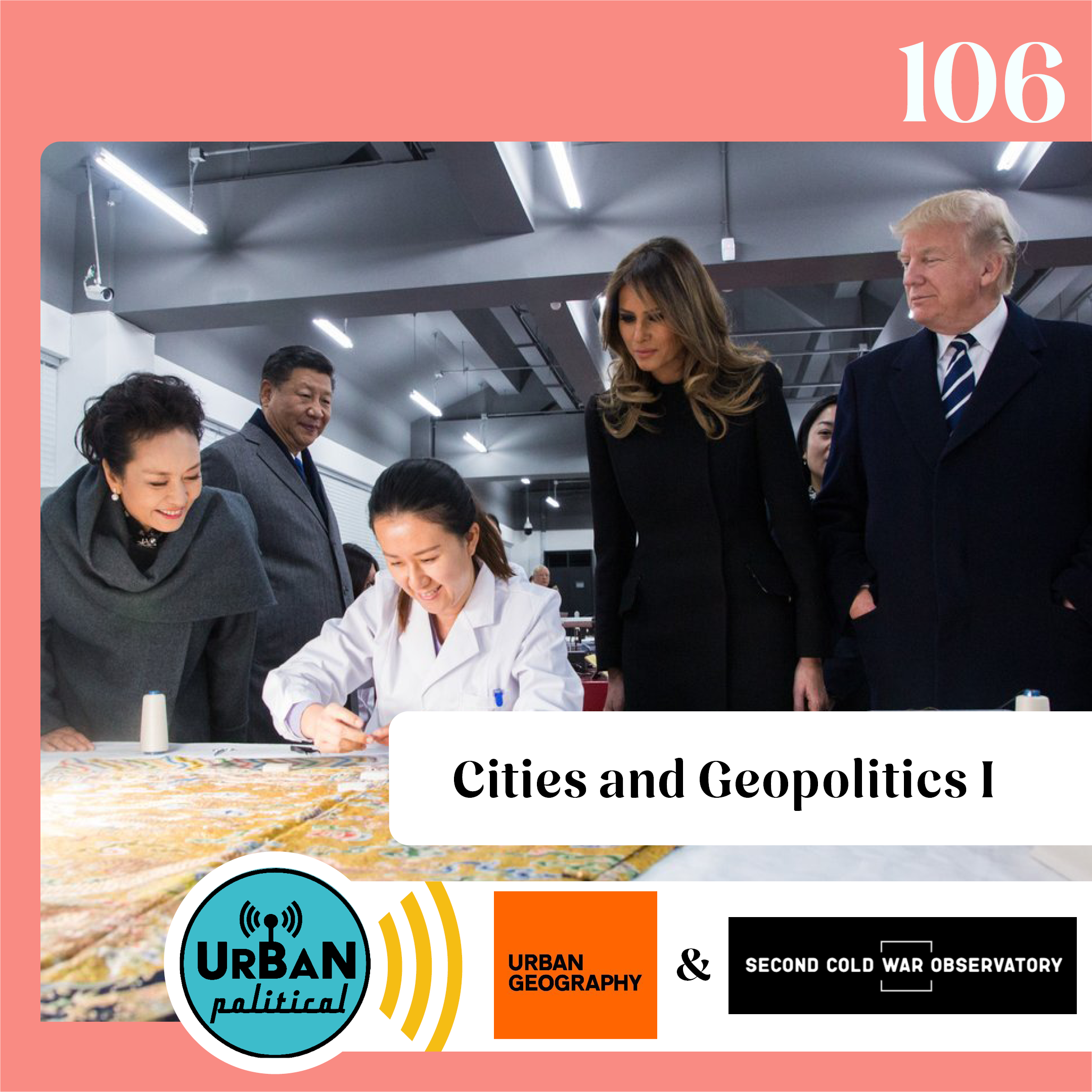
This episode of the Urban Political Podcast launches a mini-series on cities and geopolitics, focusing on the "second Cold War" between the US and China. Hosted during a ceasefire in the Iran-US war, the discussion emphasizes how geopolitical tensions create "urban uncanny" moments, revealing deep interdependencies that shape everyday urban life globally. Speakers Kevin Ward and Seth Chandler argue that contemporary geopolitical rivalry differs from the first Cold War by competing over transnational networks—infrastructure, digital, production, and financial—rather than territory. Cities are central because they serve as key nodes in these networks, hosting both US and Chinese actors, unlike the bloc-aligned cities of the past. They frame the "second Cold War" as a renegotiation of globalization, where cities are conscripted into balancing acts between the two powers. The speakers advocate for "urbanizing geopolitics" by moving beyond exceptional urban cases to see global rivalries as a general context affecting all cities. They draw on new Cold War historiography, which views the era as a structuring context rather than a bipolar struggle, and contrast it with the present, where most cities are contact zones for multiple actors. This challenges traditional urban studies to account for geopolitical rivalry as a key factor in urban development and governance, making the urban a critical lens for understanding 21st-century global power dynamics.
This is the Urban Political. The podcast on Urban Theory, Research and Activism. So hello dear listeners, so welcome to another episode of Urban Political Podcast. And today we are starting a new mini series on cities and geopolitics. And it's going to be a five-part series where we're going to look at this question of cities and geopolitics from very different perspectives. We're recording this on 17th of April in the midst of the sort of ceasefire in the Iran-US war. But as the ceasefire is happening, the straight-of-form was still closed and it still feels like a hot war and it has triggered all kind of what Maria Kakaikai would call Urban Uncanny moments in cities across the world. In the city, I am originally from in Delhi, there are riots on the periphery of the city because of the shortage of cooking gas and workers not getting access to cooking gas and not being able to cook and go to factories to work in Zurich where I'm based currently. One department at my university, Tekios, is down because they don't have helium anymore to do their experiments because all of that helium used to come from the Middle East. The Urban Uncanny amongst this geopolitical moment is sort of opening all kinds of fissures and allowing us to see the highly interdependent geopolitical world that conditions are urban everyday realities across the world in a very embodied way. So in today's podcast, we are going to introduce some of the terms and we are going to talk to very interesting speakers who are working with this topic and they're working with the idea of second-called war and cities and geopolitics. I was at a workshop organized by them in Manchester last month, which was very stimulating. So many of the people that you would hear in this many cities did present their work at this workshop in Manchester and our speakers will talk about that workshop later in the episode. So just to say that this is a collaboration between urban political podcasts and the second-called war observe way today and urban jog feed you and know so thanks for this collaboration and partnership. So I'm just going to very quickly introduce our two speakers which actually need little introduction anyone who is in the field of urban studies and listens to our podcast would know both of our speakers but just very quickly. Our first speaker is Kevin Ward, he's a professor in and director of the Urban Studies Institute at Georgia State University. He's editor and chief of urban geography and editor of the globalization community book series at the University of Minnesota press. He's published widely across issues of comparative urbanism local economic development, municipal finance, policy, mobility and urban and regional governance. He continues to be interested in local development and growth politics associated with wider geopolitical processes. Our second speaker, Seth Chandler is professor for urban politics and development at University of Manchester. He's based in the global development institute and also serves as the deputy director of the Manchester Urban Institute and is a member of the editorial board of the International Journal for Urban and Regional Research. He co-founded the second call war observatory in 2020 with Jessica Di Carlo and his current research focuses on the impacts of contemporary geopolitical rivalry on cities and urbanization. Thanks for joining us Kevin, thanks for joining us Seth. The full passing you the mic, I'm going to throw in the burning question already that has been sort of like on top of my head since quite some time and I would really like to listen more about from both of you. So why do cities matter for geopolitics in the 21st century? Hi, Nijin, great to see you. Thanks. It's wonderful to be here and how are you Kevin? I guess it's important we say we're coming to you from three different places, right? Yeah, I'm from I'm coming from downtown Atlanta where somebody will talk about a bit over the next time is a little way mo into words this morning. So something that will crop up a couple of times is driverless cars all over midtown and downtown Atlanta and come into a city near youth. I haven't already. Maybe I'll take this first one then and I'll just get us started if that's all right. Why do cities matter for geopolitics in the 21st century? I think quite simply it's because of the nature of geopolitical rivalry. Everyone knows great power rivalry is back Kevin and I along with our colleagues at the second cold war observatory. We frame this as the second cold war and in this framework the US and China are the primary protagonists. They're the only full spectrum powers you can say they compete globally, but they also compete across a range of fields or domains. What we look at as networks the transnational networks that underpin globalization they competed the deepest depths of the oceans for the internet cables and also in outer space in low earth orbit. So we'll discuss all these domains momentarily but here it's important to understand how they compete and to do so I think we need to recognize the context in which the current moment the current round of geopolitical rivalry exploded in about 2016 during Trump's first term. So this was of course following on an unprecedented era or an era of unprecedented global economic integration. The US and China are obviously the world's two largest economies. They truly have a global presence economically also politically. But most countries in the world are deeply integrated to both right and so it's it's in most countries interest to remain so. But that means that in contrast to the cold war when the world was divided into two semi-autarchic blocks and cities were in either the east block or the west block. The US and Chinese actors are present in most cities in the world and they're competing. So one of my favorite quotes is from Trump's Secretary of State from his first term Mike Pompeo. He said toward the end of the first Trump administration quote, this isn't about containment don't buy that it's about a complex new challenge we've never faced before. The USSR was closed off from the free world communist China is already within our borders. So for me that really illustrates the difference between the Cold War and what we've called the second Cold War the Cold War began after World War 2 obviously the Allies had carved up the world into spheres of influence at the Yalta conference. And then the next four and a half decades were essentially a renegotiation of the agreements reached at Yalta with the US trying to contain communist influence the Soviets and then for a time people's Republic of China trying to establish alliances in the so called third world. And now we're witnessing by contrast a renegotiation of globalization. So it's really a conflict over networks and traality rather than territory like the first cold cold war. And so here the context matters this new geopolitical rivalry has emerged out of the context of neoliberal globalization. The US and China are competing for the centrality in the transnational networks that constitute its architecture through which power can be projected in the 21st century. So we've identified those in our article in geopolitics as infrastructure networks I guess most listeners will know about the Belt and Road initiative and then very modest efforts from the US to counter that such as the Lobito corridor in Southwestern Africa. Digital networks is both hardware and software how they're integrated production networks deemed critical to national security so think semiconductors here also EVs and so on and financial networks those networks that can be weaponized to just keep pressure on adversaries. So while not every city is an important node in transnational networks most of the key nodes in these networks that are contested are cities so I would start there that's why they're so central to this competition. Sorry I just wanted to come in very quickly there yeah just just to contextualize this for our listeners so the argument then is that in order to think of geopolitics today one has to think of second goal cold war. Yeah I mean we framed it as a second cold war because we you know you that's another I think another discussion perhaps for for a different podcast because it's a bit lengthy but you know we wrote this article in geopolitics that was in many ways a response to the debate. And you had people arguing these are people that are deeply integrated into the US security establishment arguing whether or not cold war was an appropriate analogy for the present moment around in the late of so 2016 17 18. We really were dissatisfied that by that because they were looking at it as an analogy so either call the present is like or dislike the cold war and instead we see it more as a process so we see a renewed challenge to US hadgemony from Eurasia this time with people's Republic of China as the primary challenger and Russia a subordinate challenger and last time it was flipped and then of course there was a synosoviet space.
So it's quite complex, but we see a renewed challenge rather than some completely unrelated event. And I think the reason why American scholars who are in the security establishment won't refuse to see this current moment as a second Cold War is because it undermines their triumphal narrative that the US won the first Cold War so resoundingly. So the minute that you say, you know, the challenge is back, only a few decades later, it undermines that triumphalism and that's, you know, baked into the DNA of people in Washington, DC. So they can only see it as like the Cold War or not like it at all. And you know, their arguments are rather simplistic. It's like, they'll say things like, well, the present is so different from the Cold War, it can't possibly be a second Cold War. Well, World War II is different from World War I, by the way, right? You had Blitzkrieg versus trench warfare. So that's how we get to the second Cold War. I mean, you know, some listeners will agree or disagree, but I'd say we'd risk going down a rabbit hole if we get too much into the history. But but but really, I think that was a very short version. Well, this is really clear. Thank you. Thanks, that. I mean, part of it. It's also the current transformation of the global economy at the last four or five decades is in the sense set the preconditions for this second Cold War in the sense of the emphasis that we place in the framework about thinking about those kinds of networks in the context of attempts to kind of economic nationalism that's coming out of the US, which she, you know, is just, it just is impossible, politically, but also conceptually dissatisfying when one thinks about the kinds of networks and the ways in which different sites, subjects and spaces are conscripted into those kind of networks and the ways in which, you know, as geographers, we think about even development. And that seems to be an important thing to acknowledge and build upon when we think about how we frame what seems to be going on between these two geopolitical heavyweights in the global kind of disorder that we find ourselves in. Thanks. And I have a related question for both of you. So what does it mean to urbanize geopolitics in a context of renewed global rivalries? I mean, that is a good question and something we've been kind of wrestling about. I mean, on what's on the one hand, I think the Second Cold War and the framework we've been using is an attempt to reassert the agency and think about cities in the current context. And clearly, we're not the first people to do that on one level. And I guess for Seth and I and colleagues in the Second Cold War Observatory, drawing upon previous work that's been done, I mean, the two that strike, we've drawn upon most heavy, I think, and the other most important to us. One is the kind of strand of work that's been done around Stephen Graham's work on military openism and the particular take around warfare and the ways in which cities became important in thinking about that. And the second is the work of Mikhailian and Kuto and others, which talked a bit about cities, the bluntness city and diplomacy and gun of governmental relations. Again, part of that, those seems to have the hallmarks of a kind of first Cold War aftermath in the sense of thinking a bit about the kind of global governance, diplomas, diplomas in international relations and very government centres. So both quite important, but when we're thinking about the Second Cold War, we kind of use those as jumping off points and think a bit about the ways in which cities, city governments in different parts of the world get in and of being conscripted into what we see unfolding. In addition to existing cities being kind of reorganised and brought into conversations, we also see new cities being involved in a form of extended urbanisation where cities are being constituted through the needs of countries to either lean one way, China, lean another way to the US or more commonly as Seth and I and others have written about, in a sense have that kind of balancing act, right? On the one hand, look to kind of satisfy the US and do what they need to do, but also to satisfy China both in terms of the ways in which those four types of networks are present in the various territories. I don't know if you want anything adding on that, Seth. I guess I just want to say, first of all, how much I agree with you and I like reading that scholarship on city level diplomacy and urban geopolitics. The only thing I would add is that oftentimes it comes across to me as though that's a kind of particularly the urban geopolitics research, it's a bit of a subfield, right? So these cities are a bit exceptional and then the kind of context of context, if you will, is global capitalism. And I think we need to rethink that because I think increasingly it's difficult to understand almost any city, I would say, without accounting in some way or another for geopolitical rivalry. And the other thing I think is worth mentioning is that we've read a lot, so our group meets regularly in a seminar with our observatory colleagues. And we've done quite a bit of reading on Cold War history and we take our cue partly from that. And Cold War historians have, I would say, rediscovered the importance of cities in that conflict. Here we're talking about the kind of new Cold War history, which maybe some of the listeners don't know is quite different from probably what you learned at school, depending on your age maybe. So you know that I learned at school that the Cold War, I can remember the Cold War barely and it was experienced by me as a child and then I also learned later that it was this epic bipolar rivalry between the US and the Soviet Union. And these are kind of presented as these almost omnipotent superpowers. Melvin Leffler published a book for the Soul of Mankind. It came out in 2007 and already it feels very anachronistic even at that time. So I just want to read one brief passage. He says in the introduction, my focus is on leaders since I'm interested in human agency as well as contingency in history. Sounds good, but then he goes on to say this book then is about men and their ideas and their fears and their hopes. It's very much a great man make history kind of narrative in each chapter is about a different man, you know, Chris Trev, Eisenhower and so on. And that same year Audarn Westad published his book that is now well known the global Cold War. This was part of that turn in world history or global history. So scholars in this new Cold War scholarship that that followed in the footsteps of Westad, they see the Cold War as more an era or a context or a period that structures events, but the US and Soviet Union can't determine them. And so this then plays out very differently in different cities and I would just point out there are three books alone titled Cold War Cities and many articles, many books, particular books about Algiers, Pittsburgh, New York, Berlin, obviously a classic Cold War city, Southeast Asian cities. But I would draw attention to one book in particular, which I think illustrates the difference between that period and the present. And that's a book by George Roberts about Dar Salam. It's called revolutionary state making in Dar Salam. So he describes Dar as a contact zone because many different groups were there. So Eastern West Germans, the ANC and for Lima were there as well as the US and Israeli actors. So for the Cold War, this was rather unique. And but I think this illustrates the differences between one of the differences between the Cold War and the second Cold War. Now this is the norm, right? US and Chinese actors as well as many other actors, right? So perhaps Russian, Israeli, Brazilian, Indian and other protagonists, middle powers are present in most cities. There are a few cities that are exclusively aligned to the US or China. And so I think now when we talk about second Cold War cities, we would probably say the same. It's a kind of context era period, but very different from the one that is described by historians. Sorry, I have a very simple question just to contextualize again for our listeners. I really liked how you talked about global history coming into his first Cold War and this sort of like global Cold War book that you talked about, but they were also books written about cities back then. And how does that literature on the first Cold War cities differ from this push towards a more global urban studies that both you and Karen are engaging with in relation to the second Cold War? The first one that comes to mind is exactly that book on Dar Salam, right? So the revolutionary moment in Dar Salam, Julius Nereira is walking a fine line between the US and Soviet Union is deeply aligned in many ways with China. And yet everyone is there, right? So you have these revolutionary movements that are there. You can see you can take a tour of Cold War Dar Salam, which is great fun. And this is quite unique, right? Most other places are aligned one way or another. If it's a kind of a city that's associated with the East, then the Americans have to operate surreptitiously, right? So you have some cities like Vienna or Kathmandu that were associated with spycraft. But for the most part, cities were in a block and all of their networks were oriented one way or another, right? So you couldn't imagine the Soviets would do your telecoms and the Americans would build. I don't know, your transportation infrastructure and you pretty much had to be aligned one way or another. Another book that comes to mind is the book on, I think, is Jeffrey Behrin on Algiers, Mecca of Revolution. He talks about how this is, it was a great meeting place, a contact zone, but for East block revolutionary actors. It's a wonderful book. My favorite part is Timothy Leary showing up with a suitcase full of acid and hanging around with black panthers and they're, you know, supported by North Vietnamese revolutionaries. So it's a great read, very worthwhile.
But again, that's very particular to that revolutionary moment. Yeah, and the other thing is though, and the truth is that clearly people were writing about all kinds of cities during the First Cold War. And in some cases it just doesn't get mentioned. Right, it's just context of backdrop because it's either completely Russian, in quotes or a marathon. Or, as Seth alluded to, it's bracketed off as a strand of work where the only thing that's going on is there at First Cold War city. And a particularly kind of compartmentalized way, as opposed to, apart from one or two exceptions, the kind of very messy co-presences that we then see play out. Both co-presences in terms of the kind of geographies, the other air, as in who's present, but as Seth looked, Ted with those sort of networks, the fact that actually the norm now is that both China and the US are present in both those kind of global cities that we might think about, but then all kinds of other cities. I mean, the work that I've done in the US, in the Midwest, I mean, both China and the US are literally there, or are being sought after with consequences, politically. And that does, I think, extinguish the current era from previous ones. Hard to imagine studying a city, frankly, without engaging with this in some way, whether you want to or not, it's going to be present in those places you end up doing full work. I just wanted to, I mean, I'm preempting my final question to you. But perhaps allow me that. I wanted to pick up on another term that you threw in earlier, which was extended organization. And that's also sort of a parallel scholarship that's emerged in the recent times. And once you see that also in the collaborators you have in the second Cold War observatory, but also working with geopolitics. The current geopolitical moment, let's say, which is that they're working with infrastructures, they're working with eccentric urban formations that are outside the city. My question to you is, and feel free to expand also and extend the organization if you like. How does this shift change how you understand power, territory, and their urban expression? So how does the second Cold War and the fact that it acts through or acts alongside extended organization? How does that change? Maybe I'll start. I think we have a bit to say here. So I mean, I see three things in that question. Something about power, something about territory, and then the urban expression. That's how I would break it down. And we can speak with reference to scholarship on extended or planetary urbanization as well. But I would start with power. Power in the current moment, geopolitics, is waged quite differently. So once we say that it's a contest for centrality and transnational networks through which power can be exercised rather than controlling territory in the way that it was during the Cold War, then we have to interrogate how networks and trait is secured. I come back constantly to Susan Strange, she wrote in the 1980s, into the '90s, but the concept for which she's most famous is structural power. She was writing at a time when the Cold War, there was a period of detent, and then when Reagan came to power, the Cold War intensified in the 1980s. And at that moment, there were people in the West and the US who feared that the US had lost its edge to the Soviet Union. It was militarily weaker. And they would just look at things like, I don't know, force posture. That's something you hear a lot about today, right? If you listen to podcasts and so on and so forth, right? So the size of the US military is smaller and therefore must be weaker. And she said, no, hold on a second, the US is much stronger because it has structural power. That's much more important than the kind of relational power you might get with a large military, right? The power you'd get with the military, forcing your adversary to do something. Well, having structural power is much more important. And this is kind of the underlying architecture of the global economy, but how the world works, right? And the structural power was, had multiple dimensions, of security, production, finance, and knowledge. And I think she was vindicated because a few years later, the Soviet Union collapsed, obviously. And the nature of structural power, however, so structural power, I think, is still important, but it's different now. So it's very much networked because in the intervening period from the mid-80s to the present, the global economy has exploded. We've seen an explosion of all sorts of different networks. And the four that we've identified are the ones that we think then are the most significant, but they're not the only ones that are important. They might be just the kind of essence, the core of structural power, would be those four networks. So again, infrastructure, finance, digital, and production. These are important because they underpin globalization. And it's really a renegotiation of globalization that the US and China are trying to do through their establishment of centrality in these networks. So for me, I would start with how power works. And that allows you to see why cities are important because they're the key nodes in these networks. And so if you want to possess structural power, that is the underlying architecture of globalization, you have to control these networks, and oftentimes they're in cities. So that could be anything from where an internet cable lands out of particular city, an undersea cable, or you'd want to control the edge. That is the cable itself or the node that could be, I don't know, a financial index or, you know, Johannes Petri has written about the Chinese investment in the stock exchange in Kazakhstan. That's an actual place, right? So yeah, I think that explains why cities are important, the nature of power. Kevin, do you want to come in on the urban expression, or shall we talk about territory first? You go about territory, and then I'll come in about the urban expression. Yeah. So I would say something about the scholarship on extended and planetary urbanization, and how it relates to the second Cold War. For me, I see this as one of the main contributions, or it epitomizes one of the main assumptions about in urban studies, one of the schools of thought for the last few decades. And that is that urbanization and cities reflect global capitalism. Then there was another school of thought that said, no, no, there are local particularisms that are resilient in the face of capital's attempts to commodify everything. But there was not too much on geopolitics. This made sense at the time. I think it still makes sense to an extent. But I think we need to make room for geopolitics as well. The scholars who were writing about extended and planetary urbanization, most of them come from a Lafayrion, a drawn Lafayrion background. And so this is first and foremost a theory of capitalist urbanization. And again, it was well suited to an integrated world market, the likes of which we saw kind of expand and deepen throughout the period of neoliberal globalization. But now geopolitical rivalry is shaping the geography of urbanization. And I do view the second Cold War as an intercapital rivalry, but market forces are less present or less evident in shaping the geography in some instances. I think in about 2000 it was fair to say that states were weak comparatively. Urbanization was perhaps more than ever before a reflection of market forces. Footloose multinationals could roam around the world, look for cheap factors of production, and locate in places with favorable cost capability ratios. But now there's a significant amount of urbanization and economic activity taking place that is fueled by geopolitical rivalry. So things that you can't explain as expressions or reflections of market forces. So the Lobito corridor, the US is trying to very explicitly counter China's Belt and Road Initiative by funding the Lobito corridor. And this is a kind of transportation network that links the Zambian Copper Belt and mines in southeast Congo, DRC to a port in northern Angola. In Angola. And it would be almost impossible to get private sector capital to do this. I mean, Daniela Gabor's work on de-risking shows that it simply doesn't work. It's just too risky for private capital. So you can de-risk all you want. Private capital will not invest in that corridor. It has simply a geopolitical logic to it. And so we're seeing urbanization along this corridor as you would expect. That's just one example of many that we could name, where extended urbanization is not directly reflecting market forces. It's instead caught up in the geopolitical rivalry, which, on one hand, certainly, is an intercapitalist rivalry. And yet we see a lot of things going on that can't be explained by a kind of direct expression of market forces, if that makes sense. Yeah, absolutely. Seth, I agree. And Edo, you are knitting about the urban expression. And I mean, this takes a mirror to forms. I think Seth and I would argue. It began small. So some of the ways that you find it expressed is the kind of signature headline grabbing things you read about in the newspaper about new cities being built. Issues around extraction and where resources come from their location, which are, as Seth has said, it doesn't always seem to kind of jail with the kind of economic reduction. It's sometimes seen in some of the arguments. It's not just the economy. There's a geopolitical, geopolitical rationale for why these cities are being built, who's being involved in their building, where the capital is coming from, how quickly they're being built, the ways in which infrastructure, digital infrastructure, hard infrastructure, water sanitation, where these things are being built or not being built, and who's driving them, is sometimes being driven as much by geopolitics. And again, so you see both new cities.
is emerging, then you also see existing cities and the kind of landscapes of activity being reconfigured. And of course they are interconnected. Lenses are to walk around here without seeing or at least being told a bit about data centers. And if you went to various conferences amongst the academic circuit, there's no end of people working on data centers, including the conference, which you started this podcast talking about. It's a clearly data center, the big issue again, because of the sorts of debates we're seeing played around, or tormalous vehicles and other kinds of very energy intensive activity that's being organized in these cities. It's changing the landscapes, it's changing the kind of economic activity, it's changing the way the cities look and feel, it's changing what can and can't get organized, planning, zoning, you're leading to a kind of governmental restructuring, all or partly driven by the need to allow a what takes place locally, these wider geopolitical impulses. What the economic consequences are in my own work, thinking about growth coalitions locally, what does it actually mean for trying to oversee a kind of economic development strategy in a city, when part of what's being a hind, what you're being asked to do, is not necessarily going to kind of deliver the traditional kind of economy I'll do my want. So existing cities kind of being reconfigured the landscapes and new cities being organized and then those kind of things that John Silver and others have written about about the corridors and the urbanisation of space around those corridors, all those zones or other kinds of kind of spatially demarcated initiatives that are also driving the urbanisation of chunks of the world again, driven by the need responding to other countries attempts to do similar kinds of things. It's hard to understand it without some sort of almost kind of economic game theory that's going on where someone makes more some movement and someone else makes the count to move and sometimes you're looking at one part of the world where you think the story's taking place and actually it's going on somewhere else. And so in a sense it also challenges us to think methodologically about how we research some of these things, these initiatives. But definitely one sees the expression of geopolitics as we talk about it into the Second World War taking place in and across cities. That's just a great great answer. I just come back on the corridors because it's a wonderful example. Obviously people have heard about the Belt and Road initiative, but then one answer initially was announced at the G20 meeting that was held actually in Nitton's hometown in Delhi. What year was that? Was that 2021? I can't quite remember 2020 maybe. No, this is much later. 33 I think. Okay. So the India Middle East Economic Corridor. So the ideas then you relocate production from China to India, make iPhones there, ship them through the Persian Gulf and then on to Europe through Greece. Of course, Turkey's Regeptive Erdogan didn't appreciate this because this would bypass Turkey. And Turkey has signed a formal agreement with China to align its spatial plan with the Belt and Road initiative. So he didn't even land in Ankara before he was talking to reporters on the plane and said there will be no corridor without Turkey. And so then Turkey starts funding its own corridors and it's funded a couple about the envisions, one the the Iraq development road and then another one that went through wasn't sure where was going to go whether it would go through Nagorno-Karabag, Armenia, Azerbaijan. And now it's been renamed the Trump Road for International Peace and Prosperity. All this is to say these corridors and the geography and the ways that Eurasia is integrated and the competing visions for that. This is intensely geopolitical and there is an urban geography to it once you start to see these corridors emerge in real life and fits and starts the interconnections and disconnections. And so I think it's undeniable that these are extended landscapes that come with an urban geography. Thanks Kevin, that this is such a eliminating conversation. I have quite a few questions but I'm so glad that this is not the only episode in this mini-series and that we have a lineup of really excellent speakers who are going to contextualize different aspects of the Second Cold War geopolitics and cities and the urban geography of the Second Cold War. So in the next episode which will be on the infrastructures of power we'll have Simon Marwin and Justin Kohler and Emily Conrad talking about infrastructures of power so do tune in for that episode as well. Thanks for listening to the episode today and if you like us do share it with your friends. Think of getting involved with us, writers, emails, we love receiving fan mail. Thanks a lot for listening today. Kevin said if you have any final words for our listeners as well, thank you thank you thank you for having us in it's been a joy. Yeah thanks a lot it was it was very fun I appreciate it. Thanks you for listening. For more information visit our website urbanpolitical.polyg.io
Podcast Summary
Key Points:
The podcast introduces a five-part mini-series on cities and geopolitics, framed within the context of a "second Cold War" between the US and China.
Geopolitical rivalry today is characterized by competition over transnational networks (infrastructure, digital, production, financial) rather than territorial division, making cities key nodes in this conflict.
Unlike the first Cold War, where cities were aligned with one bloc, most cities now host both US and Chinese actors, creating complex, interdependent urban realities.
The "second Cold War" is presented as a renegotiation of globalization, emerging from neoliberal integration, with cities being conscripted into geopolitical strategies.
Urbanizing geopolitics involves recognizing cities as active agents and sites of contestation, drawing on previous work on urban militarism and city diplomacy, but expanding to account for the pervasive influence of global rivalries on all cities.
The discussion highlights the need to move beyond exceptionalist views of urban geopolitics, seeing it as a general condition shaping urban life worldwide.
Summary:
This episode of the Urban Political Podcast launches a mini-series on cities and geopolitics, focusing on the "second Cold War" between the US and China. Hosted during a ceasefire in the Iran-US war, the discussion emphasizes how geopolitical tensions create "urban uncanny" moments, revealing deep interdependencies that shape everyday urban life globally. Speakers Kevin Ward and Seth Chandler argue that contemporary geopolitical rivalry differs from the first Cold War by competing over transnational networks—infrastructure, digital, production, and financial—rather than territory.
Cities are central because they serve as key nodes in these networks, hosting both US and Chinese actors, unlike the bloc-aligned cities of the past. They frame the "second Cold War" as a renegotiation of globalization, where cities are conscripted into balancing acts between the two powers. The speakers advocate for "urbanizing geopolitics" by moving beyond exceptional urban cases to see global rivalries as a general context affecting all cities.
They draw on new Cold War historiography, which views the era as a structuring context rather than a bipolar struggle, and contrast it with the present, where most cities are contact zones for multiple actors. This challenges traditional urban studies to account for geopolitical rivalry as a key factor in urban development and governance, making the urban a critical lens for understanding 21st-century global power dynamics.
FAQs
Cities matter because geopolitical rivalry between the US and China now focuses on controlling transnational networks—infrastructure, digital, production, and financial—rather than territory. Most cities are deeply integrated into both powers' networks, making them key contested nodes.
The Second Cold War is a framework describing renewed US-China rivalry emerging from neoliberal globalization. Unlike the first Cold War, it's a conflict over networks and centrality, not territory, with both powers present in most cities worldwide.
During the first Cold War, cities were largely aligned with one bloc. Now, US and Chinese actors coexist and compete in most cities, making dual alignment common. The rivalry is over network control rather than territorial division.
It means recognizing that cities are not just passive sites but active agents conscripted into geopolitical rivalry. This includes existing cities being reorganized and new cities being built to serve strategic needs of either power.
Earlier Cold War history often focused on great men and bipolar rivalry, treating cities as unique contact zones. Current research sees cities as central to everyday geopolitics, where rivalry shapes urban life and networks globally.
The Urban Uncanny refers to moments when geopolitical tensions reveal hidden urban interdependencies, like cooking gas shortages in Delhi or helium shortages in Zurich, making global connections visible and disruptive.
Chat with AI
Loading...
Pro features
Go deeper with this episode
Unlock creator-grade tools that turn any transcript into show notes and subtitle files.
 PodcastTranscript AI