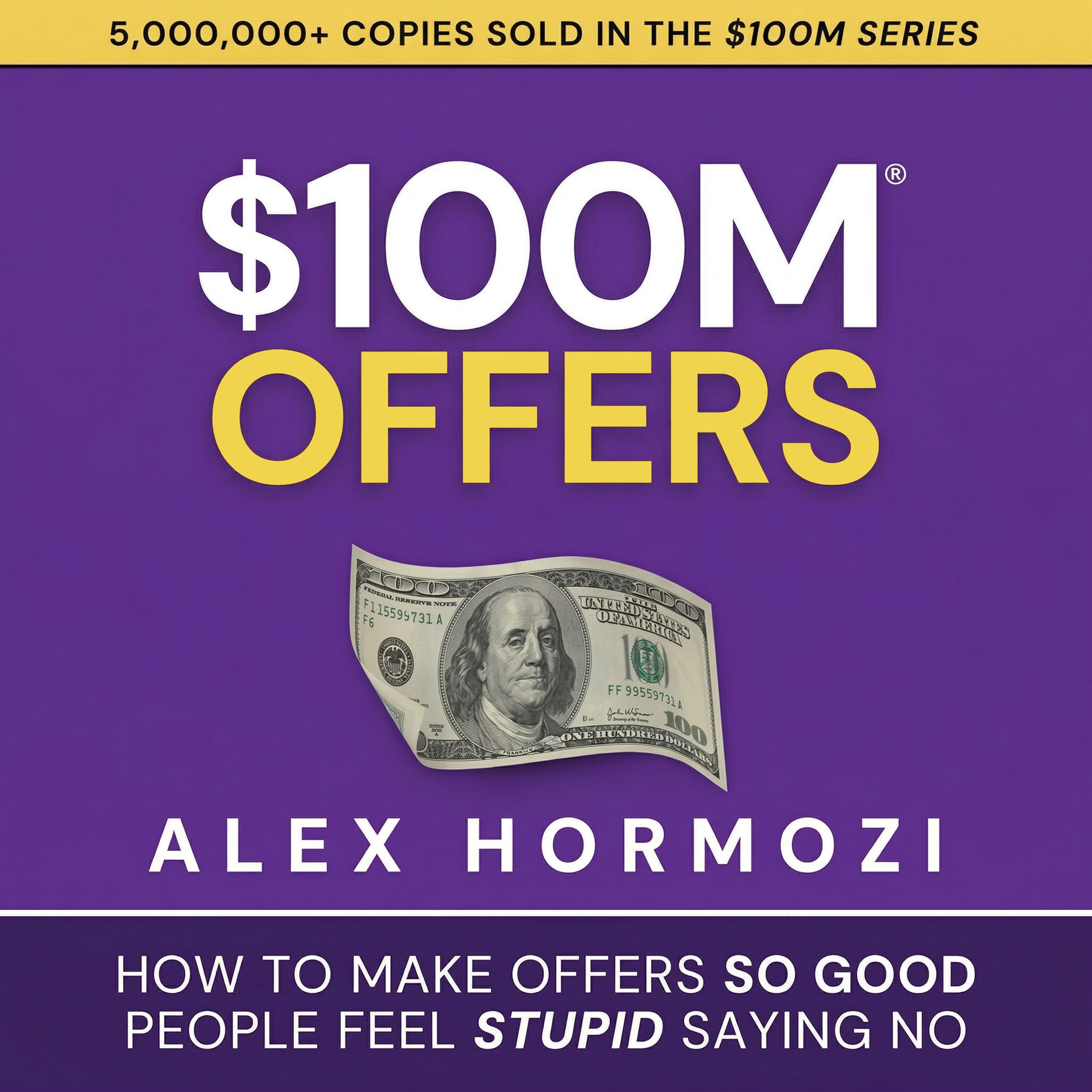
The transcription addresses core business challenges: commoditization and ineffective pricing. It argues that when products become commodities, competition shifts solely to price, squeezing profits and making growth difficult. The solution is a "grand slam offer"—a unique, compelling proposition that cannot be compared to competitors, enabling a business to compete on value rather than price. This allows for premium pricing, higher conversion rates, and more upfront cash. The text simplifies growth into three levers: getting more customers, increasing their average spend, and increasing purchase frequency. It further emphasizes the critical importance of targeting a "starving crowd," a market with intense demand, as this can override weaknesses in the offer itself. The discussion is supported by key financial concepts like gross profit and lifetime value, and illustrated with a comparative case study showing how a grand slam offer for an agency service generated over 22 times more upfront cash than a commoditized model by dramatically improving response rates, conversions, and price point.
Hey guys, this is another special edition collaboration between the game podcast and $100 million offers. Today we're going to break down the pricing and commodity problems. This is the number one issue that most businesses have and why they can't make enough profit. The starving crowd problem, which is that they're selling to people who don't have enough pain, who are hard to find, who are in markets that are not growing, and there's an easy fix for that and I'll walk you through the process. And the third chapter we'll go over today is charge what it's worth. This is probably one of the biggest unlocks for the majority of people who have listened to the book in the many messages and reviews that I have read of it. These upcoming chapters are heavy hitting and I hope you enjoy them. Section 2 pricing how to charge lots of money for stuff. Chapter 3 pricing the commodity problem. Think different. Steve Jobs. Lower die is a core tenant at our companies. We believe every person, every company, and every organism is either growing or dying. Maintenance is a myth. What this means is if your company isn't growing, it's dying. This is sobering reality for many of us. I learned the hard way and my business suffered for a long time because of it. Let me explain. The market is continuously growing. The stock market grows at 9% per year. If we aren't growing at 9% per year, we are falling behind. Maintenance in the most generic sense would be 9% per year growth year-over-year. Furthermore, if you are in a growing marketplace, then you might have to grow at 20% to 30% per year just to keep up or risk falling behind. So you can see how maintenance is a myth. So then what does it take to grow? Thankfully, just three simple things. One, get more customers. Two, increase their average purchase value. Three, get them to buy more times. That's it. Sure, there are lots of ways to acquire customers and zillions of ways to increase order value and purchase frequency. But simply put, that's it. Those are the only three ways to grow. Example, if I sell 10 clients a month and a client is worth a thousand dollars to me over their lifetime through average card value times number of average purchases, then my business will cap at $10,000 per month, aka 10 times $1,000. Paying new clients per month times $1,000 lifetime value equals $10,000 per month in max revenue. If you want to grow, you've either got to sell more clients every month while maintaining suitable margins or have them be worth more by increasing a profit per purchase or number of times they buy. That's it. Author note, only two ways to grow. To simplify this concept even more, there are really only two ways to grow. Get more customers and increase each customer's value. Increasing each customer's value has two sub-buckets. One, increasing profit per purchase. Two, increasing the number of times they buy. For the purpose of this book, I highlight both of those sub-buckets as individual growth paths. I did this because I think it will be easier to understand the money models that will come in volume three. All three, getting more customers, increasing their average purchase value and getting them to buy more are repeated themes in this book. But if you seek simplicity, both increasing average purchase value and increasing the number of times a customer buys results in one outcome, increasing each customer's value. These terms, before going any further and to better flesh out the concepts that will follow, we should take a second to define and better understand some key business concepts. When I stood in that Las Vegas penthouse in my beast mode t-shirt, I was clueless about such terms. Let me help you be better than, well, me. Gross profit. The revenue minus the direct cost of servicing an additional customer. If I sell lotion for $10 and it costs me $2, my gross profit is $8 or 80%. If I sell agency services for $1,000 per month and it costs me $100 per month in labor to run that client's advertising, then my gross profit is $900 or 90%. Note, this is not net profit. Net profit is what's left over after all expenses are paid, not just the direct cost of fulfillment. Lifetime value. The gross profit accrued over the entire lifetime of a customer. This is gross profit multiplied by the number of purchases an average customer will make over their lifetime. Using the example above, if the average customer stays five months and they pay $1,000 per month while it costs me $100 per month to fulfill, then their lifetime value is $4,500. Here's the breakdown. Revenue equals $1,000 per month times 90% gross margins times five month equals $4,500 lifetime value or LTV. Note that the indirect costs like admin, software, rent, etc are not included in LTV. Note, you will find different definitions for lifetime value depending on the source. The biggest difference is that some sources only count total revenue, while others focus on gross profit over the lifespan. I focus on gross profit. You may also see me refer to this as LTGP for lifetime gross profit in other texts, just for clarity sake. Value driven versus price driven purchases. This book was intended to be a textbook for any business that wants to grow. I spent and continued to spend hundreds of hours on calls and in-person meetings consulting entrepreneurs on crafting their offers. I've seen the ones that take off into the stratosphere and those that fizzle. Having a grand slam offer makes it almost impossible to lose, but why? What keeps it such an impact? In short, having a grand slam offer helps with all three of their requirements for growth, getting more customers, getting them to pay more, and getting them to do some more times. How? You ask. It allows you to differentiate yourself from the marketplace. In other words, it allows you to sell your product based on value, not on price. Commoditized equals price driven purchases, aka a raise to the bottom. Differentiated equals a value driven purchase, aka selling a category of one with no comparison. Yes, market matters, which I'll expand on in the next chapter. Commodity, as I define it, is a product available for many places. For that reason, its prone to purchases based on price instead of value. If all products are equal, then the cheapest one is the most valuable by default. In other words, if a prospect compares your product to another and thinks, "These are pretty much the same. I'll buy the cheaper one." Then they commoditize you. How embarrassing. But really, it's one of the worst experiences a value driven entrepreneur can have. This is a massive problem for the entrepreneur because commodities are valued at the point of market efficiency. This means that the marketplace drives the price point down through competition until the margins are just enough to keep the lights on, just enough to become a slave to their business. The business makes just enough to justify the owner waiting anxiously for things to turn around. By the time that lie is realized, they're too deep to pivot, at least until now. A grand slam offer solves this problem. But what does a grand slam offer do? Alright, let's start by defining a grand slam offer. It's an offer you present to the marketplace that cannot be compared to any other product or service available, combining an attractive promotion, an unmatchable value proposition, a premium price, and an unbeatable guarantee with a money model, aka payment terms, that allows you to get paid to get new customers forever removing the cash and trade on business growth. In other words, it allows you to sell in a category of one or to apply another great phrase to sell in a vacuum. The resulting purchasing decision for the prospect is now between your product and nothing. You can sell it whatever price you get the prospect to perceive, not in comparison to anything else. As a result, it gets you more customers at higher ticket prices for less money. If you like fancy marketing terms, it breaks down to this. One, increase response rates, think clicks, two, increase conversions, think sales, three, premium prices, think charging a lot of money. Having a grand slam offer increases your response rates to advertisements, aka more people will click or take action on an advertisement they see containing a grand slam offer. If you pay the same amount for eyeballs, but one, more people respond, two, more of those responses buy, and three, they buy for higher prices, your business grows. I've struck gold on my fair share of offers, not because I've got some superpower, but because I've just done this a lot of times and failed even more. I've sorted through the crap that chronically fails and pocketed all the stuff that reproduces of Lee's exceeds and put it into this book. Here's the key takeaway from all this. A business does the same work in both cases with a commoditized offer or a grand slam offer that the fulfillment is the same. But if one business uses a grand slam offer and another uses a commodity offer, the grand slam offer makes that business appear as if it had a totally different product. And that means a value driven versus price driven purchase. If you have a commodity offer, you will compete on price. Doing a price driven purchase versus a value driven purchase. Your grand slam offer, however, forces a prospect to stop and think differently to assess the value of your differentiated product. Doing this establishes you as your own category, which means it's too difficult to compare prices, which means you recalibrate the prospect's value meter. Real life, grand slam offer money math before and after. Quick backstory. One of our companies is a software that advertising agencies use to work leads for their customers. Using this software, agencies transform their offer from a commoditized offer of lead generation services to a grand slam offer of pay for performance. Let me show you the multiplicative effect it has on revenue for business. While rounded for illustration sake, the values I will share with you are based on real numbers of lead generation agency selling services to brick and mortar businesses experience. Old commoditized way, price driven, race to the bottom. Just offer a thousand dollars down, then a thousand dollars per month retainer for agency services. I will read through the chart that is displayed. Advertising spend $10,000. Impressions reach $300,000.
response rate 0.0013, appointments booked, 40, show rate 75%, appointment showed 30, closing percentage 16%, appointments closed, five price $1,000 total $5,000, Rhoaz or return on advertising spend 0.5 to 1. At 0.5 to 1 return on advertising spend, you lose money getting customers. But in 30 days, those five customers will pay another $1,000 each, bringing you $10,000 total and breaking even. The next month, the $5,000 that comes in will be your first profitable month. And each month thereafter will be profitable, assuming they all stay. This is an example of a commoditized service. Normal agency work. There's a million of them and they all look the same. Commoditized businesses and offers have a harder time getting responses from ads because all their marketing looks the same as everyone else's. Note, it all looks the same because they're all making the same offer. You pay us to work. We do work. Maybe you get results from that work. Maybe you don't. It's reasonable, but easily duplicated and subject to commoditization. This commodization creates a price driven purchase. You were forced to be price competitively to get clients and to stay that way to keep them. If the client sees a cheaper version of the same thing, then the value discrepancy will cause them to swap providers. This is a dilemma. Lose this client, the rest of your clients, and potential clients, or stay competitive. Your margins become so thin they vanish. Furthermore, it's hard to get prospects to say yes and keep them saying less unless you're hypervigilant about clients commoditizing your business by staying again competitive. And that's the problem with the old commoditized way. They're able to compare. Unless you switch to a grand slam offer, your prices will keep getting beat down. The business eventually dies or the entrepreneur throws in the towel. No bueno. We want to make an offer that's so different that you can skip the awkward explanation of why your product's different from everyone else's, which if they have to ask, then they are probably too ignorant to understand the explanation anyways. And instead, just have the offer do that work for you. That's the grand slam offer away. Let's dive in to see the contrast in sales numbers. New grand slam offer away. Differentiated, incomparable value driven. Grand slam offer. Pay one time, no recurring fee, no retainer. Just cover the ads. Ben. I'll generate the leads and work your leads for you and only pay me if people show up and I'll guarantee you 20 people in your first month or you get your next month free. I'll also provide all the best practices from all the businesses just like yours. Daily sales coaching for your staff, tested scripts, tested price points and offers to swipe and deploy, sales recordings and everything else you need to sell and fulfill your customers. I'll give you the entire playbook for insert industry absolutely free just for becoming a client. So in a nutshell, I'm feeding people into your business showing you exactly how to sell them so that you get the highest prices which means that you make the most money possible. Sound fair enough? It's clear that these are drastically different offers. But so what? Where's the money? Let's compare both in the chart below. Avertising spend $10,000 same as before. Impressions reached $300,000 same as before. Response rate 0.00332.5 times the response rate because you have a more peeling offer, so more people respond. Appointments booked. 40 becomes 100. Show rate 75% stays the same. Appointing showed 30 goes to 75 and that's just a result of numbers flowing down the funnel. Closing percentage goes from 16% to 37%. 2.3 times the closing because there's more value some more people buy. Appointments closed goes from 5 to 28. That's just a result of the higher closing percentage. Price goes from $1,000 to 39.97 which is 4 times the price because we're charging a 1 time V versus recurring. The total collected upfront goes from $5,000 to $112,000. That's 22.4 times the cash upfront collected. And the row as goes from 0.5 to 1 to 11.2 to 1 which means you're getting paid to get new customers. Breakdown. You spend the same amount of money out for the same eyeballs, then you get 2.5 times more people to respond to your advertisement because it's a more compelling offer. From there you close 2.5 times as many people because the offer is so much more compelling. From there you're able to charge 4 times higher prices upfront. The end result is 2.5 times 2.5 times 4 equals 22.4 times more cash collected upfront. Yes, you just spent $10,000 to make $112,000. You just made money getting new customers. Comparison. Remember the old way? The way you lost half the advertisement upfront. With the new way, you're making more money and getting more customers. This means that your cost to acquire a customer is so cheap relative to how much you make that your limiting factor becomes your ability to do the work you already love doing. Cash flow and acquire customers is no longer your bottleneck because it's 22.4 times more profitable than the old model. Yep, you read that right. This is the part in the action movie where you walk away from the explosion and slow motion. This is the exact grand slam offer we used with our software business that serves agencies. The numbers can become wild fast. I know. 22.4x better sounds unreasonable. But that's the point. If you play the same game everyone else does, you'll get the same results everyone else does. Mediocre. You hit singles and doubles, keep the lights on but never go ahead. Or remember, the opening passage of this book that when you align all the pieces, you can nod it out of the park so well that you win for good. In my first 18 months in business, we went from 500,000 a year to $28 million a year off of less than $1 million in ad spend. So when I say 20 to 1, 50 to 1, 100 to 100 returns, I mean it when you get this right, the results are well unbelievable. Some reports, this chapter illustrated the basic problem with commoditization and how grand slam offers solve that. This gets you out of the pricing war and into a category of one. The next chapter will focus on finding the correct market to apply our pricing strategies to. It's one of the most important things to get right. A grand slam offer given to the wrong audience will fall on deaf ears. We want to avoid that at all costs. We must detour from pricing for a moment to learn what to look for in a market. It's an essential box to check before continuing on our journey. 3. Gift number one. Bonus tutorial. Start here. If you want a deeper dive, go to acquisition.com for its less training for its less offers and watch the first video in the free course starring yours truly about how I differentiate offers in businesses I can solve with and get them charging premium prices. I also created some free SOPs and cheat codes that you can download for free so you can implement faster. Enjoy. Pricing chapter four. Finding the right market. A starving crowd. The seed that fell on good soil represents those who truly hear and understand God's word and produce a harvest of 30, 60 or even 100 times as much as has been planet. Matthew 1323 and LT. A marketing professor asked his students if you were going to open up a hot dogs and you could only have one advantage over your competitors, which would it be? Location, quality, low prices, best taste. The students kept going until eventually they had run out of answers. They looked at each other waiting for the professor to speak. The room finally fell quiet. The professor smiled and replied, "A starving crowd." You could have the worst hot dogs, terrible prices and be in a terrible location. But if you're the only hot dogs stand in town and the local college football game breaks out, you're going to sell out. That's the value of a starving crowd. At the end of the day, if there's a ton of demand for a solution, you can be mediocre at business, have a terrible offer and have no ability to persuade people and you can still make money. An example of this was the toilet paper shortage at the beginning of COVID-19. There was no offer, the pricing was atrecious and there was no compelling sales pitch. But because the crowd was so big and so starving, roles of toilet paper were going for $100 or more. Selling newspapers. A good friend of mine Lloyd owned a software business that served newspapers for almost a decade. They set up digital ad services on newspaper websites with a few clicks and instantly helped them sell a whole new ad product. He only charged them a percentage of revenue he added. So if they made nothing, neither did he. It was pure gain for the papers and a great offer. But despite having a great offer and natural sales ability, his business began to decline. Being a high achieving entrepreneur, he tried all different angles to solve the problem, but nothing worked. He couldn't figure out what the issue was. It was hard for me to see him struggle with this because I think Lloyd is much smarter than I am. And the answers seemed obvious to me. But watching him go through this has been a lesson that I have taken with me for life. Before I reveal it, what do you think the problem was? Product, offer, marketing and sales, his team? Let's break it down. It wasn't his product. That was great. It wasn't his offer. He had a zero risk rev share model. It wasn't his sales skills. He was a natural salesman. So then, what was the problem? He was selling to newspapers. His market was shrinking by 25% every single year. He had looked at all the angles except for the most obvious one. Finally, after a user fighting an uphill battle in his market, he realized his market was the source of his problems and decided to downsize his company. Don't worry. The story has a second half. Delostrate the power of a market as soon as COVID hit, Lloyd pivoted. He started an automated mask manufacturing company. With new technology, he brought the cost per mass down below when people could buy them from four from China. Within five months, he was doing millions per month. Same much for the different market. He applied his same skill set to a business he had zero experience in and was able to win. That's the power of picking the right market. I give you that story as a cautionary tale. Your market matters. Lloyd is a very smart human. He's obviously very capable, but we can all be blinded as entrepreneurs because we don't like to give up. We are so accustomed to solving possible problems that we will keep ramming our heads into the wall. We hate quitting. But the reality is that everyone is affected by their market. So how do you pick the right way?
right market? What to look for? There is a market in desperate need of your abilities. You need to find it. And when you do, you will capitalize, all while wondering what took you so long. Don't be romantic by your audience. Serve the people who can pay you what you're worth. And remember that picking a market like anything is always our choice. So choose wisely. In order to sell anything you need demand, we're not trying to create demand. We're trying to channel it. It is a very important distinction. If you don't have a market for your offer, nothing that follows will work. This entire book sits atop the assumption that you have at least a "normal" market, which I define as a market that is growing at the same rate as the marketplace. And that has common unmet needs that fall into one of three categories, improved health, increased wealth, or improved relationships. For example, Lloyd could have gone through this entire book and nothing in here would have worked for him. Why? Because he would be targeting newspapers, a dying market. That being said, having a great market is an advantage. But you can be in a normal market that's growing at an average rate and still make crazy money. Every market I've been in has been a normal market. You just don't actually want to be selling ice to ask him, as well. Here are the basic tenets of what I look for in markets. Let's run them before we return to the offer. When picking markets, I look for four indicators. One, pain, two, purchasing power, three, easy to target, four, growing. One, massive pain. They must not want but desperately need what I am offering. Pain can be anything that frustrates people about their lives. Being broke is painful. A bad marriage is painful. Waiting in line at the grocery store is painful. Back pain, ugly smile, pain, overweight pain, humans suffer a lot. So for us entrepreneurs, endless opportunity abounds. The degree of pain will be proportional to the price you will be able to charge, more on this in the value equation chapter. When they hear the solution to their pain and inversely what their life would look like without this pain, they should be drawn to your solution. I've been saying that I use to train sales teams. The pain is the pitch. If you can articulate the pain and prospect is feeling accurately, they will almost always buy what you are offering. A prospect must have a painful problem for us to solve and charge money for our solution. Pro tip, the point of good writing is for the reader to understand. The point of good persuasion is for the prospect to feel understood. Two, purchasing power. A friend of mine had a very good system for helping people improve their resumes to get more job interviews. He was great at it. But try as he did, you could not get people to pay for his services. Why? Because they were all unemployed. This again may seem obvious, but he thought these people are easy to target. They're in massive pain. They're plenty of them and it's constantly adding new people. This is a great market. He just forgot a crucial point. Your audience needs to be able to afford the service you're charging them for. Make sure your targets have the money or access to the amount of money needed to buy your services at the prices you require to make it worth your time. Three, easy to target. Let's say you have a perfect market but no way of finding the people who comprise it. Well, making a grand slam offer will be difficult. I make my life easier by looking for easy to target markets. Examples of this are avatars that have associations they belong to, mailing lists, social media groups, channels they all watch, etc. If our potential customers are gathered together somewhere, then we can market to them. If searching them out, however, is like finding needles in a haystack, then it can be very difficult to get your offer in front of any potentially interested eyes. This point is tactical. It is reality, not theoretical. For instance, you may want to serve rich doctors, but if you're at your being displayed to nursing students, your offer will fall on deaf ears, no matter how good it is. Main point. You want to make sure you can target your ideal audience easily. Lairifying point. There's no issue wanting to serve rich doctors. They are easy to find. This is just illustrative that your promotions must be served to the right audience. Growing markets are like a tailwind. They make everything move forward faster. The declining markets are like headwinds. They make all efforts harder. This was Lloyd's example. Newspapers had three of four makings of a great market. Lots of pain, purchasing power, easy to target. But they were shrinking. Fast. No matter how hard he tried, the entire marketplace was fighting against him. Business is hard enough and markets move quickly. So you might as well find a good market to give you a tailwind to make the process easier. Making this real. Health. Wealth. Relationships. There are three main markets that will always exist. Health, wealth, and relationships. The reason that those will always exist is that there will always be tremendous pain when you lack them. There's always demand for solutions to these core human pains. The goal is to find a smaller subgroup within those larger buckets that is growing, has the buying power and is easy to target. The other three variables. So if I were a relationship expert trying to find my avatar, I'd rather focus on second half of life relationship coaching for old timers than helping college students in relationships. Why? Because senior citizens who are alone are likely suffering more pain as they are near their deaths, have more buying power, money, and are easy to find, targeting. Lastly, at the time of this writing, there are more people turning 65 each year than turning 20. A.K.A. Growing. That is the idea. Think about what you were good at in regards to health, wealth, and relationships. Then think about who might value your service the most. A.K.A. is in the most pain, has the buying power to pay what you want, money, and can be found easily, targeting. As long as those three criteria are strong and the market isn't drinking, you'll be in good shape. But how important your success is finding a "great market" versus a "normal" market versus a "bad market". The answer, it actually depends. Let me explain. Order of Importance. Three levers on success. It's unlikely you're going to be in a dying market like the newspaper example. It's also unlikely you're going to be selling toilet paper in COVID, a buying frenzy. You'll likely be in a normal market, and that's totally okay. There's a fortune to be made within normal markets. My single point here is that you can't be in a "bad" market, or nothing will work. That being said, here's the simplest illustration of the order of imports between markets offers and persuasion skills. One crowd is more important than your offer strength, which is more important than your persuasion skills. Let's say you were to rate these elements on a scale of great, normal, and bad. You could essentially move down the line from left to right in order of importance. A "great" rating on a higher order piece overpowers anything else lower on the priority scale. A "normal" rating moves the buck to the next part of the equation. A "bad" stops the equation unless a grade from a higher order component nullifies it. Here are a few examples. Example 1. Even if you had a bad offer and are bad at persuasion, you're going to make money if you're in a great market. If you're on the corner, hocking hot dogs when the bar closes up at 2 a.m. with mobs of starving drunk folks, you're going to sell out of your hot dogs. Example 2. Most of us. If you were in a normal market and have a grand slam offer, you can make tons of money even if you're bad at persuasion. This is most people reading this book. That's why I wrote it. To help you maximize your success by learning to really build a grand slam offer. Example 3. Let's say you're in a normal market and have a normal offer. In order to be massively successful, you would have to be exceptionally good at persuasion. Then and only then would you succeed with your persuasive skills serving as the full-crumb for your success. Heck, many empires have been built by exceptional persuaders. It's just the hardest path to follow and requires the most effort in learning. Nailing your offer helps you shortcut this path to success. Otherwise, you will just have a normal business that takes exceptional skill to be successful. Nothing wrong with that. We're probably not what you sign up for. Commit to the niche. I have a saying when coaching entrepreneurs on picking their target market. Don't make me niche-lap you. Too often, a new entrepreneur half-heartedly tries one offer in one market, doesn't make a million dollars, then mistakenly thinks this is a bad market. Most time, that's not actually the case. They just haven't found a grand slam offer yet to apply to that market. They think, "I'll switch from helping dentists to helping chiropractors." That's it. When in reality, both of those are normal markets and represent billions of dollars of revenue. Either would work. Just not both. You must pick one. No one can serve two masters. I have coined the term niche-lap to remind entrepreneurs and my communities to commit once they pick. All businesses and all markets have unpleasant characteristics. The grass is never greener once you get to the other side. If you keep hopping from niche to niche hoping that the market will solve your problems, you deserve to be niche-laped. You must stick with whatever you pick long enough to have trial and error. You will fail. In fact, you will fail until you succeed. But you will fail far longer if you keep changing who you market to because you must start over from the beginning each time. So pick, then commit. Riches earn the niches. The other reason to commit to the niche is because of how much more you will make. Simply but, niching down will make you far more money. Author note. Went to broadened. Advice for most people. For most, if you were under $10 million per year, niching down will make you more money. After that, it will depend on how narrow the niches or what is called "tam" total adjustable market. A business can only grow to meet the total adjustable market. That being said, for most people, getting to $10 million per year is already a.4% achievement. Only one in 250 businesses achieve this. So for $99.6% of readers below $10 million per year, it's almost always easier to serve fewer clients more narrowly. But if you want to go beyond that, you may, depending on the size of your tam, have to broaden your audience by going upmarking.
down market, or into an adjacent market where your existing services can provide value. For context, many companies expanded to $30 million plus per year serving a single niche. Carp actors, gyms, plumbers, solar, roofers, salon owners, etc. If you were at $1 million or $3 million per year, thinking you have capped and must expand, you are wrong. You just need to be better. When I truly grasped how much more profit I was leaving on the table, it changed my life. It was what took me from doing acquisition for anyone to teaching it to a specific avatar. In my instance, I decided on a micrature owner with a hundred members assigned to lease, at least one employee, and wanted to help clients lose weight. That's pretty specific compared to "small business owners" or "anyone who will pay me", which is common. And I was very specific. In that business, gym launch, we turned down and still do anyone who is not the avatar. That means no personal trainers, no online coaches, etc. Should I have helped them? Of course I could have. I mean heck, the majority of our portfolios comprised of non-Gym companies. But in order to maintain product focus and high converting messaging, knowing exactly who the product was for was a game changer. It helped us know exactly who we were speaking to at all times and exactly whose problems we were solving, but simplicity and ease may not be enough to sway you. So let me illustrate why honing in on one niche will make you more money. In the first part of the reason, you can literally charge a hundred times more for the exact same product. Dan Kennedy was the first person to illustrate this for me, and I will do my best to pass on the torch to you in these pages. Nitching product pricing example. Product and then price. Time management product. Price $19. Time management for sales professionals. Price $99. Time management for outbound B2B, power tools and gardening sales reps. Price $1997. Dan Kennedy taught me this and it changed my life forever. Let's say you sold a generic course on time management. Unless you were some massive time management guru with a compelling or unique story, it would be unlikely it would turn into anything significant. What do you think, quote yet another, and quote time management course is valued. $19.29. Sure, nothing right home about. Let's just say $19 for illustration. Now we shall unleash the power of niche pricing in various stages on your product. So let's imagine you make the product more specific, keeping the same principles and call it time management for sales professionals. All of a sudden, this course is for a more specific type of person. We could tie their increase to even one more sale or one more deal, and it would be worth more. But there are a lot of sales people, so this might be at $99 product. Knee, but we can do better. So let's go down another level of niching and call our product time management for B2B outbound sales reps following the same principles of specificity. Now we know our sales people probably have very experienced deals and commissions. A single deal would easily net the salesman $500 or more. So it would be easy to justify $499 price tag. This is already a $25X increase in price for almost an identical product. I could stop here, but I'm going one step further. Let's just niche down one last level. Time management for B2B outbound power tools and gardening sales reps. Boom, think about it for a second. If you were a power tools outbound sales rep, you would think to yourself, "This is made exactly for me." And would happily fork over maybe $1,000 or $2,000 for a time management program that could help you achieve your goal. The actual pieces of the program may be the same as the generic $19 course. But since they have been applied and the salesmatches you could speak so much to this avatar, they will find it far more compelling and get more value from it in a real way. This concept applies to anything you decide to do. You want to be the guy who services this type of person or solves this type of problem. And even more niched, I solved this type of problem for this specific type of person in this unique counterintuitive way that reverses their deepest fear. That's why a fitness program for generic weight loss might be priced only at $19, while a fitness program designed and marketed only to shift nurses might be priced at $1,997. Even though the core of the program is likely similar, eat less, move more. And result, the market matters, your niche matters. And if you can sell the same product for a hundred times the price, should you? I'll let you decide. Some points. The purpose of this chapter is to reinforce two things. First, don't pick bad markets. Normal markets are fine, great markets are great. Second, once you pick, commit until you figure it out. If you try 100 offers, I promise you will succeed. Most people never try anything. Others fail once, then give up. It takes resilience to succeed. Stop personalizing. It's not about you. If your offer doesn't work, it doesn't mean you suck. It means your offer sucks. Big difference. You only suck if you stop trying. So try again. You'll never become more class if you stop after a failed attempt. If you find a crazy good market, ride it and ride it hard. If you pay a grand slam offer with a crazy market, you'll likely never need to work again. Seriously. So have this skill set, the ability to accurately assess markets by taking into account pain, money, targeting, and growth in your back pocket so that when lightning strikes, you can make sure it strikes twice. Having established how to nail a market, let's get back to pricing. The first step to making crazy money is charging premium prices. Free gift number two. Bonus tutorial, winning markets. If you want to know more about how I pick markets and find niches that are profitable, go to acquisition.com/training/offers. Then watch winning markets for a short video tutorial. I've also included a free checklist to see how your market or niche measures up. It's absolutely free. Enjoy. Hey guys, hope you guys are enjoying the $100 million offer collaboration episode with the game. You may not know this, but we have a physical copy available on Amazon and a Kindle version. And if you're like me, I get pretty ADD really easily. And I prefer to consume in multiple formats at the same time. You remember it longer. It gets stored multiple places in your brain. Lots of science stuff, but either way, it ultimately helps you retain it and use it. So if that's useful, use it. If not, keep enjoying. Chapter five. Pricing. Charge what it's worth. Charge is higher price as you can say out loud without cracking a smile. Dan Kennedy. January 2019. All I could see was black. My eyes felt glued shut. I was awake, but the fatigue in my temples felt like a five pound weight was duct taped to my skull, dragging my eyelids back down. I had to concentrate forcibly to open them. The details of the dimly lit room beamed in. I rolled over to the edge of the hotel room bed, feeling each and every muscle on my body as my weight shifted. Punched on my side, I could see my clothes scattered on the floor. I was so beat the night before that I didn't even remember taking them off. I had just finished a five day gauntlet of keynote after keynote presentation. Two days of presentations for a high level clients, immediately followed by spending two days planning with our entire company, 135 plus employees. I had missed a face time call from my father that day before. I didn't have anything on my agenda for the morning, so I crickly got up, slid into a hoodie, and some sweats, and walked into the hallway to call him back. After the initial pleasantries, he immediately dove into why he was calling, parental concern. I saw the picture you posted of all your clients. He said, but in an unusually concerned tone. I thought the event was for all your highest paying clients. I didn't know it was a big event. It looked like you had a thousand people there. Alone in the hallway and struggling to shake the heavy weight of exhaustion still, I tried to gauge where his concern was coming from and what he was getting at. I'd explained this to him already. It was only for our highest level clients. That wasn't all of our clients, I said. Just the ones who pay 42,000 year are gymlords, like I told you. Every single person in that picture paid you 42,000 dollars. He sounded almost frightened at the idea. Yeah, wild, right? My voice was worse from days of speaking and thousands of 20 second conversations. Is it legal what you're doing? Yes. Wow. That escalated quickly. I thought to myself. Do they know you're paying you that much? Yes, it's legal. And of course they know. It's not like a magically siphoning money. That's a lot of money. I hope what you're giving them is worth it. I contemplated whether it was worth the effort to dive into this or just ignore it, but knowing this was going to be a thing I took a deep breath and began to explain. If I made you 239,000 dollars extra this year, would you pay me 42,000 dollars? I asked using 239,000 because it was the average increase in top line revenue of a gym using our system for 11 months. For sure, he said. I mean, if I knew I was going to make that back. But what would I have to do about 15 hours a week of work? And how long would it take me to make the 239,000 dollars 11 months? And how much of the 42,000 dollars would I have to pay you up front? Nothing. Just pay me as you start making money using the system. I watched it click. My dad got it. Oh, he said, well, then yeah, I would do it. And that's why they do it too. Making shit loads of money breaks people's minds. It literally stretches their mind so far past what they can believe is possible. They assume you're doing something wrong early. They literally can't even. Why? Because they think to themselves, they can't be that much smarter than me or work that much harder than me. So how's it possible for them to make a thousand times more than me? Enough money that it would literally take 10 lifetimes for me to make what they make in a year. In the three years leading up to me writing this book, I took home over $1.2 million per month in profit every single month. That's more than the compensation.
for the CU is a Ford, McDonald's, Motorola, Yahoo, combined every year as a kid in his 20s. It angers those who believe that life is unfair. It confuses others who cannot comprehend and believe that there must have been a mistake. It inspires a select few who are bound for greatness. I hope that you were in the last category because that is who I am writing this for. You can do this. You just need to learn how and I'm going to show you. Price to value discrepancy. Quote, I hope what you're giving them is worth it. End quote. Those words would probably sting for most, but when my dad said them to me, I just knew he didn't understand the value we were providing. What I want to show you is how to create and communicate value, aka the worth itness of an offer. In order to understand how to make a compelling offer, you must understand value. The reason people buy anything is to get a deal. They believe that what they are getting value is worth more than what they are given in exchange for it. Price, the moment the value they receive dips below what they are paying, they stop buying from you. This price to value discrepancy is what you need to avoid at all costs. After all, as Warren Buffett said, "Price is what you pay, values what you get." The simplest way to increase the gap between price to value is by lowering the price. It's also most of the time the wrong decision for the business. Getting people to buy is not the objective of a business, making money is, and lowering price is a one-way road to destruction for most. You can only go down to zero, but you can go infinitely high in the other direction. So unless you have a revolutionary way of decreasing your cost one-tenth compared to your competition, don't compete on price. As Dan Kennedy said, "There's no strategic benefit to being the second cheapest in the marketplace, but there is for being the most expensive." So the goal of our grand slam off will be to get more people to say yes at a higher price by increasing our value to price discrepancy. In other words, we will raise our price only after we have sufficiently increased our value. This way, they still get a great deal, think buying $100,000 for the value for only $10,000. It's money to discount. Free gift number three, bonus tutorial and free downloads, charge what it's worth. If you want to know how I create value discrepancies for B2B or B2C products, go to acquisition.com/training/offers, course, and then watch charge what it's worth for a short video tutorial. My goal is to gain your trust and deliver value in advance, as such it's absolutely free. Enjoy. Why should charge so much it hurts? Most business owners are not competing on price or value. In fact, they're not actually competing on anything at all. Their pricing process typically goes something like this. Step one, look at marketplace. Step two, see what everyone else offers. Step three, take the average. Step four, go slightly below to remain quote-competitive. End quote. Step five, provide with their competitors to offer with a little more. Step six, end up with a value proposition of more for less. And the big secret, those competitors they're copying are dead broke. So why on earth copy them? Pricing where the market is means you're pricing for market efficiency. Over time, in an efficient marketplace, more competitors enter offering a little more for a little less until eventually no one can provide any more for any less. At this point, a market reaches perfect efficiency and the business owners participating make just enough at the end of the month to keep going. The bottom 10 to 20% of operators get washed out or lose the will to fight. Then, fresh business owners enter with no idea and repeat the process of their forefathers and around and around they go. In plain words, pricing this way means you're providing a service at just above what it costs for you to stay above water. We are not trying to barely stay above water. We are trying to make egregious amounts of money that will have your relatives asking if what you do is legal. Again, we are not trying to get the most customers. We are trying to make the most money. That being said, since there is no strategic benefit to being the second lowest priced player in your marketplace, allow me to give you a brief overview of why I see premium pricing as not only a very smart business decision, but a moral one. Furthermore, it's the only choice that will allow you to truly provide the most value, a unique and strong position in the marketplace. Let me introduce you to the virtual cycle of price. I've used this framework in most of the materials I release because it needs to be consistently reinforced. The forces of the marketplace will grate on your belief system. You must stay strong and ignore them. Here is the basic premise of why you need to charge a premium if you want to best serve your customers. When you decrease your price, you decrease your clients' emotional investment since it didn't cost them much. You decrease your clients' perceived value of your service since it can't be that good if it's so cheap or price the same as everyone else. You decrease your clients' results because they do not value service and are not invested. You attract the worst clients who are never satisfied until your service is free. And you destroy any margin you have left to be able to actually provide an exceptional experience, hire the best people, invest in your people, pamper your clients, invest in growth, invest in moral locations or more scale, and everything else you had hoped in the goal of helping more people solve whatever problem that is that you solve. In essence, your world sucks. And to make matters worse, your service probably sucks because you are squeezing blood from the proverbial stone. There's just not enough money left over to make something exceptional. As a result, you fall in line with the armies of average businesses that raised to the bottom. I've lived that life. It's terrible. If you love your customers and your employees, please stop short-changing them when there is a better way. Here's the reverse. This is what happens when you raise your prices. When you raise your prices, you increase your clients' emotional investment. You increase your clients' perceived value of your service. You increase your clients' results because they value your service and are invested. You attract the best clients who are the easiest to satisfy and actually cost less to fulfill and who are most likely to actually receive and perceive the most relative value. You multiply your margin because you have money to invest in systems to create efficiency, smart people, improve customer experience, scale your business, and most importantly of all, to keep watching the number in your personal bank account go up month after month, even with reinvesting in your business. This allows you to ultimately enjoy the process for the long haul and help more people grow rather than burning out and triveling into obscurity. To swing the argument even further in favor of higher prices, here are a few interesting concepts. When you raise your price, you increase the value the consumer receives without changing anything else about your product. Wait. What? Yes. Higher price means higher value, literally. In a blind taste test, researchers ask consumers to rate three wines, a low price wine, a medium price wine, and an expensive wine. Throughout the study, the participants rated the wines with the prices visible. They rated them unsurprisingly in order of their price with the most expensive being the best, the second most expensive being the second best, and the third cheapest option being rated as a cheap wine. What the tasteors didn't know is that the researchers gave them the exact same wine all three times. Yet, the tasteors reported a wide discrepancy between the high priced wine and the cheap one. This has deep implications for the direct relationship between value and price. In essence, raising your prices can directly enhance the value provide. What's more, the higher the price the more your product or service has, people want to buy expensive things. They just need a reason. And the goal isn't just to be slightly above market price. The goal is to be so much higher that a consumer thinks to themselves, this is so much more expensive, there must be something entirely different going on here. That is how you create a category of one. In this new perceived marketplace, you wear a monopoly and can make monopoly profits. That is the point. One final point I want to drive home. If you offer a service where a customer must do something in order to achieve the result or solve the problem you say you solve, they must be invested. The more invested they are, the more likely they are to achieve the positive result. Therefore, it follows that if you care about your customers, you should get them as invested as humanly possible. Ideally, this means pricing your services or product in such a way that it stings a little when they buy. That sting will force and focus their attention and their investment in your product or service. Those who pay the most, pay the most attention. And if your customers are more adherent and follow through, and if they achieve better results with your service than your competition, then you are in a very real way providing more value than anyone else. This is how you win. But I know this isn't easy and it shouldn't be. Your product must deliver. So many wish to shortcut the real work. Do that and you will fail. In the real world, to have the quote, go nads to charge big ticket prices, you must outwork yourself out. You must be so confident in your delivery because you have done it so many times that you know that this person will succeed. Experience is what gives you the conviction to ask for someone's entire your salary as payment. You must believe so deeply in your solution that when you look at yourself in the mirror at night alone, your conviction remains unshakable. So let me bring the section home with my personal experience, my premium price experience. In my first niche consulting business, Jim launch, I teach owners a better business model. Before exercising my consulting services, I flew out to 33 gyms in 18 months to do full gym turn arounds. We would fly out, fix everything in gym and relaunch it in 21 days. We would average an increase in $42,000 in additional sales in 21 days. It was wild. My fee was 100% of the revenue I would bring in. At our peak, we were turning around eight gyms a month. This quickly became a logistical nightmare. After the wear and tear of living in motels month after month after month, I thought to myself, there has to be a better way to do this. One month, there was a gym we were scheduled to go fly out to, but I simply didn't want to do it. So I told them we were going to cancel the engagement. The gym owner practically threatened me to help him. So I said I would help him, but he would have to do all the work, but I would show him how. Within 30 days, this gym made almost $44,000 in new upfront cash collected, which was four times their previous month. As soon as I saw that my process could be duveted,
from afar without me having to fly people in our business exploded. I had found the missing link because my travel schedule was no longer a constraint. We went on to sell 4,000 plus more gyms over the next few years and counting using a done with you rather than done for you model, but back to premium pricing. When I entered the space, low price competitors offered full service marketing solutions for $500 per month, with a single high price competitor charging $5,000 for a product. I wanted to be the premium price leader. I wanted to be so expensive that it created a lure around what we were doing. So we came in at three times the highest price player and 32 times more than the lowest price player. A price of 16,000 for 16 week done with you intensive. Then we upsold 35% of those people to a 3-year $42,000 per year agreement for us to help them grow their gyms. For context, the average gemowner makes $35,280 per year and take home profits. If that's the average, it means half make even less than that. So for many of them, they were committing to half of their yearly salary or more to buy our program. And I was selling this to grown men as a kid in his 20s, telling them I was going to help them make more money. This was possible because my conviction was stronger than their skepticism. How? Based on a voluntary survey taken at our last full company event with 158 gyms responding, we found that a gym launched gym who has been in our program for 11 months will experience the following average improvements. Top line revenue growth of $239,000 per year, recurring revenue growth of $160,000 a year, bottom line growth, aka profit from 29.43 per month to 89.40 per month. That's 3.1X increase. Average client growth of an additional 67 clients, churn aka percentage of clients who leave each month, drops from 10.7% before to 6.8%. Retail sales and additional 4,400 per month and retail sales after they started working with us. Prices on average went from 129 per month to 167 per month and average revenue per J-member. Their survey just proved what I already knew. I had complete conviction in our product. I knew it worked. I had outworked myself out. Summary points. What should you take from this? First and foremost, charge a premium. It will allow you to do things no one else can to make a client successful. We were able to charge a premium because we provided more value than anyone else in the industry. In a real way, we were charging only a fraction of what our clients made using our system. This is important. Our clients still got a deal. The gap between what they paid, price, and what they got, value was massive. As a result, the virtuous cycle continued to spin. We charged the most money. We provided the most value. Our gym for main the most competitive, made the most money, always had the latest invest acquisition systems, and had the support to implement them at lightning speed. We made many mistakes along the way, but our pricing model was not one of them. It allowed me the room to make big bets without losing the farm. The truth is that 99% of businesses need to raise their prices to grow, not lower them. Profit is oxygen. It fuels the fire of growth. You need that if you want to reach more people and make a bigger impact. In order to charge so much though, you must learn to create tremendous value. Let's head there next. Hey guys, hope you enjoyed the second episode of $100M offers. The follow up to this is that we have a course available on the site. If you're a visual learner, you like watching things. I have a full slide deck presentation, checklist documents, everything that goes along with this book. You don't even have to give me your email. It's free. It's on my site at acquisition.com/training. There's other courses there that I think you'll also enjoy. Next episode, we're going to be going over probably the single most famous chapter in the book, the Value Equation. I'll have a special little secret surprise at the end of that episode as well. I hope you guys enjoyed as much as I enjoyed making it for you.
Podcast Summary
Key Points:
The "commodity problem" occurs when products are indistinguishable, forcing competition on price and eroding profits.
A "grand slam offer" creates a unique, value-driven proposition that makes price comparison impossible, allowing premium pricing.
Business growth fundamentally requires only three actions
Targeting a "starving crowd" (a market with high, urgent demand) is crucial, as it can compensate for mediocre offers or execution.
Key financial metrics include gross profit (revenue minus direct costs) and customer lifetime value (total gross profit from a customer).
Summary:
The transcription addresses core business challenges: commoditization and ineffective pricing. It argues that when products become commodities, competition shifts solely to price, squeezing profits and making growth difficult. The solution is a "grand slam offer"—a unique, compelling proposition that cannot be compared to competitors, enabling a business to compete on value rather than price.
This allows for premium pricing, higher conversion rates, and more upfront cash. The text simplifies growth into three levers: getting more customers, increasing their average spend, and increasing purchase frequency. It further emphasizes the critical importance of targeting a "starving crowd," a market with intense demand, as this can override weaknesses in the offer itself.
The discussion is supported by key financial concepts like gross profit and lifetime value, and illustrated with a comparative case study showing how a grand slam offer for an agency service generated over 22 times more upfront cash than a commoditized model by dramatically improving response rates, conversions, and price point.
FAQs
The commodity problem occurs when a product is available from many sources, leading customers to base purchases solely on price rather than value, which drives down margins and makes growth difficult.
To grow, you can: 1) get more customers, 2) increase their average purchase value, and 3) get them to buy more frequently. These are the fundamental paths to business growth.
A grand slam offer is an unmatched value proposition that cannot be compared to competitors, allowing you to sell based on value, not price. It increases response rates, conversions, and enables premium pricing, driving significant revenue growth.
Maintenance is a myth because markets continuously grow; for example, the stock market grows at about 9% annually. If a business isn't growing at least at the market rate, it is effectively falling behind and dying.
Gross profit is revenue minus the direct costs of servicing a customer, while net profit is what remains after all expenses, including indirect costs like admin and rent, are deducted.
A 'starving crowd' refers to a market with high demand for a solution. Even with a mediocre offer or poor business skills, targeting such a crowd can lead to success because the need is urgent and widespread.
Chat with AI
Loading...
Pro features
Go deeper with this episode
Unlock creator-grade tools that turn any transcript into show notes and subtitle files.
 PodcastTranscript AI