If you can imagine it, there was a time before time.
Well, before clock time, that is, in fact, there were many decades in colonial America
when most people had no earthly idea what time it was.
Most people, when they keep time, they just stick a stick in the ground and call it noon.
They look for the shadows.
This is Michael Malley, a historian of time.
What are you going to do when it's cloudy?
Well, there's animal cues.
You woke up with the rooster and at the end of the day.
There's a phrase in American vernacular culture, "Till the cows come home."
Well, the thing is cows do go back to the barn at a certain time of day,
so they could look outside and see the cows heading home.
And they would know it was time for them to go home.
In the 1650s, the first public clocks were installed in Boston, Salem, and New York.
And they were all the rage.
New England towns would try to get a clock,
and it was a sign of their kind of legitimacy.
It would be used to call people to prayer or call people to church or call the meeting.
And with this clock tower, suddenly the clock was the center of everything.
Being in earshot of the town bells marked the borders of civilization.
If you were out of earshot of the town, you were almost in the wilderness.
Life was becoming organized by the clock.
But for the next 100 years, that clock said something different in every city.
Nune was one thing in Boston, another in Providence,
a third in New York, fine for a farmer, a nightmare for a railroad running on a schedule.
So in 1883, the railroad barons got together and tamed this chaos,
carving the country into four standard time zones.
But for the average American worker, that didn't mean much,
especially when your employer could still decide what time it was.
The clock calls you to work. You still had to show up to the factory
whenever the boss rang the bell.
But people don't trust that because they feel like it's always being bumped ahead,
you know, to get people in early.
Everyone knew the foreman messed with the time to get more work out of you.
They could change it. They could make it ahead in the morning and behind in the afternoon,
right? That's the issue.
So you'd never know if that clock is accurate.
And once you got inside, a human being was often the one deciding whether you were
actually on time.
So if you know Joe, the guy checking you in, if he's your buddy,
you're going to say, "Come on, Joe, give me a break."
And he's going to mark you as on time when you're not.
Or, you know, conversely, if Joe is the tool of management,
and eager to punish people he doesn't like, he can mark you as late when you're not.
Everybody, employees and employers alike, thought this messiness of time was being used to cheat them.
And into this mess walked an unlikely hero, a man who didn't care much about the factory,
or power, or money. He just cared about clocks.
But the clock he built would do more than solve a workplace dispute.
It would reorder America's relationship to time itself.
From 99% invisible and BBC studios, this is a history of the United States in 100 objects.
I'm Roman Mars. Today, the Bundy clock and how the first employee time clock
sparked a revolution in workplace surveillance and efficiency.
Reporter Ellie Lightfoot has the story.
The name of our unlikely hero, this man who would unwittingly change our relationship to time,
he's called Willard Bundy. Willard was born in 1845 and grew up in Auburn, New York,
a small but booming factory town in the center of the state.
As a boy, he was kind of an engineering whiz kid.
He liked tinkering with things, he built little toys.
This is Tom Bosek. He works at the Bundy Museum, which, as you can imagine,
is all about Willard Bundy.
As a child, he would like take apart watches and try to reassemble them.
Willard grew up to become a professional watch tinkerer, a jeweler.
Because back then, jewelers weren't just jewelers. They were the town's authority on time.
It was their responsibility to build these big, accurate clocks and keep them on display in
their shop window so that people could visit the window and see what time it was.
And it was this part of the job that Willard loved the most.
He'd spent hours and hours constructing these intricate novelty clocks,
like this hulking eight-foot tall clock that he claimed could keep perfect time for a thousand years.
It had dials for not only hours, minutes and seconds, but also the day of the week,
the date of the month, which particular month it was, and the year for 1,000 years.
But this clock, which, by the way, he called the wonderful clock, wasn't just for telling time.
It had bells and whistles that would chime on the hour, every hour.
The thing was essentially a cuckoo clock on steroids, but instead of a bird popping out,
Willard constructed this elaborate scene, a kind of mechanical diorama of a working mill.
I think it's a lumber mill, actually, so the waterfall is transporting little logs to be cut.
There was also a tiny pond with frogs and turtles and fish of every kind.
There was a mini steam engine and a boat bobbing in the pond.
This clock was so popular, such an oddity, that there actually had to be a police officer out
from just kind of keeping the crowd, moving her along, because people were so enchanted by it,
that they would just loiter in front of his store.
Willard had wrangled over 3,000 tiny pieces into a kind of masterpiece, which, to me at least,
tells me that the man loved order.
So it's not surprising, really, that he saw the messiness of time keeping happening in factories
across America as a giant problem he needed to solve. The story goes that one day, Willard walked
into a factory in his town and saw how the bosses were keeping track of their employees time.
They assigned each worker one of these little breast discs and expected them to toss it into a bucket
every morning to mark themselves present. But the system was a mess. It was sloppy. There was no
accurate record of when the guy actually showed up, and Willard couldn't help himself.
He saw a system that existed, but it wasn't up to snuff.
So back in his shop, Willard started building something that was up to snuff.
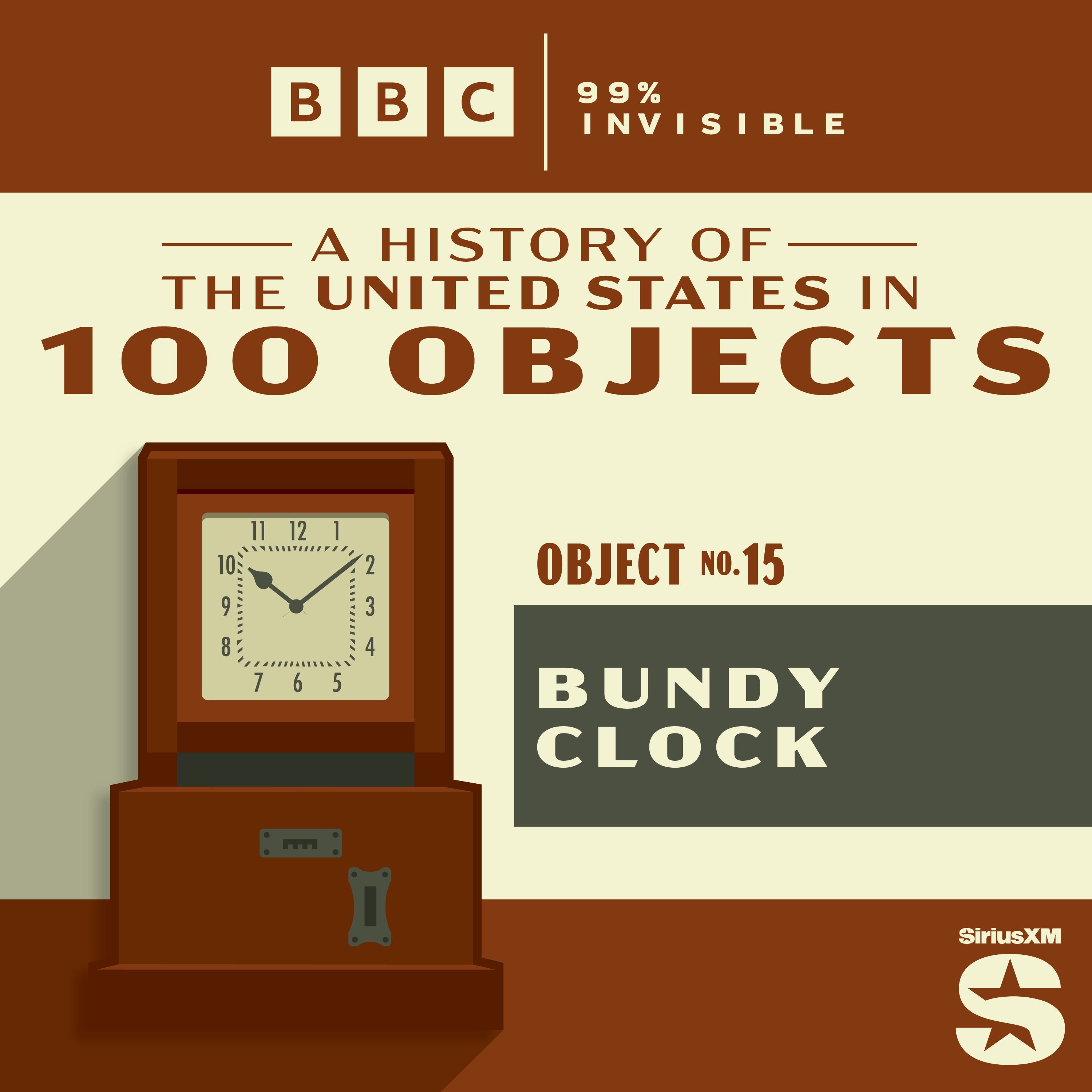
And in 1888, he patented it, the first employee time clock, the Bundy clock.
It was basically an ornate wooden box mounted on the wall, kind of like a grandfather clock,
except underneath the clock face, there was a little slot for a key. Each worker got their own
key. In every morning, when they showed up to work, they'd insert their key into the slot,
turn it a quarter turn, which would then stamp the exact time they got there onto a ribbon of paper.
But after he patented it, Willard wasn't really that into the idea of selling it.
Willard was content to stay in his lane, I guess. He wanted to make these very specific objects
that brought him joy. He wasn't necessarily looking to get rich. He wasn't trying to redefine
the system. Maybe Willard wasn't trying to get rich, but his brother was.
Willard's younger brother, Harlow, is going to play a huge role in the story of the Bundy clock,
but Harlow wants things Willard doesn't. In fact, the Bundy brothers couldn't have been
more different, and it's clear our museum man has a favorite. Everything that we know about Willard
tells us that he was a genuinely nice guy. He was well liked in the community. His younger brother,
Harlow, was the complete opposite. He was rude, he was curt, he was a jerk.
While Willard then ventured, was a softy. Supposedly, he was just like the most romantic man
that you could think of. Harlow was not. He had a very poor reputation throughout town.
Willard was more than happy to spend 20 years making a single clock,
but Harlow, the brother with the business mind, saw the dollar signs almost immediately.
He was aware of what his brother was inventing. He said, "Hey, if we market these clocks,
they're going to sell like hotcakes." Eventually, Harlow convinces his inventor brother to go
into business with him. But the Bundy clocks do not immediately sell, like hotcakes.
A lot of business owners didn't necessarily see the need for a time clock like this.
Plus, this clock was expensive. A Bundy clock was $75, which I want to say that
calculate to about $1,500 to $2,000. The other problem was that for the first year,
they tried to market these clocks directly to workers. They would take out ads in union
magazines or newspapers in factory towns that would read, "Hey factory worker, make sure
your boss is paying you correctly, encourage him to buy a Bundy clock." But the strategy turned
out to be a big old flop. If the idea was you get all of your co-workers to rally around this
device and tell your boss to buy it, they're not going to. You know, they're going to do
what saves them money. The bosses weren't going to listen to their workers. So pretty soon,
they dump that idea. Someone at the company has the genius idea of flipping the script. They put
out ads that read, "Hey factory owners, make sure you aren't being cheated by your lazy dishonest
workers." By a Bundy clock,
track their hours. Ding, ding, ding, nailed it. And you know, then they start selling.
We don't know for certain which brother came up with this, but in Tom's mind, this is classic
Harlow. I'd like to think Harlow was in charge of the advertisement with everything that we know
about his character and demeanor. A lot of the early ads sound like he wrote them.
They were just kind of aggressive. Like there's this one that's just a giant picture of a Bulldog.
It's the head of a Bulldog biting through a time ledger, a time sheet, and the caption reads,
"Put a watchdog on your payroll." This new ad campaign, it works. By 1898, they've got 9,000
of their clocks in circulation and are just dominating the market. But then, on the turn of the
century, the Bundy's joined forces with the makers of the punchcock, a new invention where workers
wouldn't need to fuss with a key. They could just insert a piece of paper, pull a lever, and stamp
it. And after Harlow markets the hell out of it, these clocks actually do sell like hotcakes.
In part of the reason that these clocks sell so well is because they tap into a growing demand.
At this point in industrialization, the scale of production is really ramping up.
Factories are employing thousands of people and they're vast in their size. Historian Michael Malley
again, he says that before this, when factories were smaller. Surveillance of your employees is easy.
Like, for example, Ben Franklin is a printer and he lives above his print shop. So his employees
are more or less in a house blowing to Franklin. He sees them all the time. He knows they got
drunk last night because he heard though. So as the bosses hire more and more workers, ones they couldn't
physically see, they began to think of themselves as facing this new existential problem. They can't
identify who's a good worker, who's a bad worker. They don't know who's working hard and who's not,
because this scale has become too big. So income the Bundy brothers with a fix. They're saying,
use our machine to surveil your employees. They're selling a new way to sort workers,
not by a human by the clock. Just look at this old ad for a Bundy clock that Mike loves to point to.
Here's an ad from 1911. That's so sinister. At the top, there's this massive clock and a long
line of workers waiting to clock in. There's working men and working women and some of them are
kind of well dressed and some of them are dressed like laborers and some of them are just dark
silhouettes because they showed up late and they were able to be discovered in their slacker hood
by the clock. There's arrows shooting out from the clock pointing to these slackers with a line of
text that reads, the Bundy clock points out you're in profitable employees. Now you can sift out the
efficient employees from the inefficient. The element of moral judgment is really pronounced about
punctuality and it's it's punctuality is a virtue. Lateness is a sin. These ads reveal that the
Bundy brothers were selling more than just a way of keeping track of your employees. They were
selling a new moral structure. It's simple. If you're on time, you're fundamentally good. If you're
not, you're fundamentally bad. One of the ways that merit gets reimagined, it's someone who has
these internalized these machine like habits of punctuality. But the workers resisted internalizing
these machine like habits of punctuality. Actually, they hated it. Was very much an instance of your
boss implicitly saying that they don't trust you? Also, it doesn't actually matter anymore if you're
on time because if you work in a factory with a thousand workers, you're going to have to wait in
a long line to clock in. There's an imposition to show up early to stand in line. You know, if your
shift starts at seven, hopefully you can clock in at seven or a little bit earlier. And now,
if you didn't, everyone would know. There's a very loud bell that goes off, so you'd be heard
over the noise of a factory and imagine where no one would come and yell at you. And then there's
a whole number thing. You were assigned a key with an employee number on it. So rather than, you know,
John Doe or Jane Smith, you're now employee number 20. In fact, Tom at the Bundy Museum found
these political cartoons made by postal workers in the 1890s, where the workers are just hurling
darts at the Bundy clock. Vandalizing the clocks. There were a number of political cartoons or
poems or songs written about just how poor of a reception Bundy clocks had. But it doesn't matter
what the workers think. The bosses have a new way to surveil their employees and they loved it.
But that's just the beginning, because there's another guy coming in, a guy who's going to take
Bundy's invention to the extreme. Not just to track when people show up, but to control how they work,
to measure every single second of their day.
While the Bundies are out there selling their clocks to factories across the country,
about 200 miles south in Philadelphia, there's another guy who's also interested in time and
kind of an obsessive way. He's about to take the Bundy clock and completely change how it's used.
His name is Frederick Taylor. He's a weird guy, Taylor. So he's born to the Philadelphia upper class.
His family does the grand tour of Europe. They have servants. They have a house. Boxley. They have
an estate. And so they're born to privilege and he could have been idle. But Taylor wasn't built
for idleness or arrest or fun, really. Take, for instance, the classic leisure game of Croquet.
When it came time for Taylor's turn, he'd make his friends wait while he squatted down to measure
every possible angle from which one could approach the ball. Only then, with this data,
could he calculate the exact vector the ball needed to follow in order to pass through the
hoop accurately. As Fred Taylor grew up, he continued to be kind of odd. Instead of going onto an
Ivy League, as his father had, he decided to apprentice at a hydraulics factory in Philly.
It's a weird move to make. And his family is kind of like a what's wrong with Fred, you know,
but he loves the work. He loves it. He loves working with his hands.
And he can't believe what the workers around him are capable of.
Taylor is really dazzled by these guys because they're making big cylinders for a steam engine,
big heavy industrial parts. And he was so dazzled actually that he tried very hard to blend in.
He started dressing like them, talking like them, swearing a lot,
you know, yelling dirty jokes and going to the bar after work and things like that.
But on the inside, Fred Taylor is really not like these guys.
He comes to the workshop floor with an innate sense of superiority.
Right, like Philadelphia Opera Class is notorious. I'm from Philly. One of my friends is from
the Philadelphia Opera Class. There's no greater snobs in America than Philadelphia Opera Class.
And, you know, they're superior to everybody else. And he grows up with that sense that he should
be running the show. And with his sprinkle of nepotism, he soon is Taylor gets hired at a steel
factory down the road where his parents were friends with the factory's owners. He gets promoted
to Foreman. And right away, he begins to wage a war on what he saw as laziness.
He said workers were always guilty of slacking on purpose because they know if they do more,
they're going to be asked to do more every day. And then they're going to ask to do yet more,
and they won't get any more money. Taylor's first strategy was to incentivize the fastest
workers to produce more. A few extra bucks if you make more than the guy next to you.
But the workers stuck together and kept making things at the pace they always had.
So, instead, Taylor shows up one day to the shop floor with a stopwatch.
His plan was to focus on one worker performing a single task in time every aspect of it.
Let's say I'm working on a lathe. The thing workers would use to shape steel.
And he'd sit there with his stopwatch and he'd watch me work.
Taylor would start the clock when he saw him doing anything he thought to be productive.
But when I did things he thought were unproductive, he would stop the stopwatch.
By unproductive, Taylor meant anything resembling human.
Like talk to his neighbor. Hey Fred, how about those fillies?
Or if he hitches up his pants or he walks over to get another tool.
Taylor will stop the stopwatch.
When the job was done, Taylor would cut out all of these unproductive,
quote unquote, waste movements to land on what he called was the standard time it took to do any job.
Famously, he extends that to shoveling. So, at Bethlehem steel where he tries this,
there's actually a shovel shed that you have to report to.
And you'll say, yeah, I'm here. I'm going to do shoveling this kind of coal.
And okay, here's your shovel, Smith, and this is the motion you're going to use.
And you're going to do it for this long in this motion.
And then you're going to take a break for this long and then you're going to go back
at the end of the day, you should be able to move three tons of coal.
But in reality, these times were just physically impossible.
No one can keep that pace. The quality will slip, you know,
I'll suffer physically. Despite this, Taylor enforces these
standard times anyways. The workers who can't keep up are docked pay or more often just
axed entirely. And like the Bundy's, Taylor uses the clock to create these categories of men,
first class men for those who complete the task in time, second class men for those who don't.
It's not surprising the men at the factory absolutely hate it.
They call them a fool, a tyrant, even a slave driver right to his face.
It gets so bad that the workers start sabotaging their own equipment.
So that if they miss a quota, they can say it's the machine's fault, not they. There's, and when that doesn't work, they just start threatening him directly.
They tell him to watch his back on his walk home.
And it's at this point about a decade in that Taylor decides it's time to leave Philly
and take his managerial philosophy on the road.
He advances himself as the first sort of efficiency expert, efficiency consultant.
Except it's a bit more extreme than that.
Yeah, see, it's the gospel of efficiency.
Kind of like Jesus, if instead of him turning water into wine, he timed how long it took
you to do it, and demanded you do it 30% faster.
And like Jesus, Taylor starts gathering up disciples.
I'll call them Taylorites, who he trained to spread the good word of efficiency to other
factories and textile mills across the country.
The key to Taylor's expansion, the part that's often overlooked, is actually the punch clock.
The one Bundy and his new company created.
That was central to Taylor.
Because as factories got bigger, enforcing Taylor's standard time with actual humans became
practically impossible.
The boss doesn't want to stand there watching him.
Come on, Schmidt.
So instead, the job of the enforcer went to a clock.
Now there's a punch clock at every station, to time how long it takes a worker to do every
task.
So he's supposed to go boom, punch the clock, start, do the thing, punch the clock when
he's done.
It's the logical extension of just clocking in.
The logical extension of what the Bundy clock introduced.
Because now, instead of just clocking in in the morning and out at night, each part of
the job gets its own punch in and out.
Each moment is timed, mechanized.
But this use of the punch clock, it actually does something else.
It accidentally invents a whole new category of job.
Because at the end of their shift, workers would hand in their little time cards to what
Taylor called the Central Planning Office.
There would be an entire staff.
They collect those cards and say, you know, you didn't do it at the right time or you
took too long on this.
In these people aren't bosses, they're not workers, they're not foreman, they're this
new type of bureaucrat whose only job is managing other people's time.
Essentially, they're the nation's first middle managers.
This efficiency expansion, it's all going according to plan until Taylor gets hired at a US Army
facility outside of Boston called Watertown Arsenal.
This is where Taylorism is going to face its biggest challenge yet.
Taylor is hired to come in and do one of his efficiency studies and that means he's
going to do this stopwatch time study.
So he and his army of stopwatch wielding disciples show up and start timing everything incredibly
closely.
Imagine you're molding these intricate parts out of steel.
You spend your entire shift bent over your workbench.
I'm talking 90 degrees folded in half.
Your face inches from it and standing directly over you, staring down at the top of your head,
is a Taylorite and a three-piece suit stopwatch in hand.
After hours of this, you're going to need to stand up straight for a second, stretch
your back.
Maybe wipe this wet from your eyes.
But the moment you do, you hear the click of his watch.
He's timing it.
He's writing it down.
For him, these are waste movements.
He's actually got it down to where he sometimes recommends hiding the stopwatch in a book.
It's a picture in one of his publications of a book that's been cut away in a stopwatch
inside.
So I'm just reading this fascinating novel, but actually I'm surveilling you.
They get really upset.
It really truck you.
And if they can, they'll drive him away.
This, for me, is where the story gets really interesting.
The start of what I can only describe as clock warfare.
Because it's here that the workers decide to put their own pocket watches to use.
They say, if they see a Taylorite timing something, they're going to time it too.
They have to be able to say, no, you stop that too soon, right?
This is how long it takes me to do it.
I times myself, right?
Boom.
I time myself.
You don't know how to do it.
Today, a Taylorite starts timing one of the workers while he does a job.
The Taylorite says the job should take 24 minutes.
The worker says that when he timed it, it took 50.
He's being told to work twice as fast.
And this could not stand that night.
They meet up and come to an agreement.
They say the next time a Taylorite tries to study us with a stopwatch, we'll just stop
working.
And the very next day, that happens.
A Taylorite comes up to a worker with a stopwatch.
In this time, the guy just refuses to go along with it.
He gets fired immediately and his fellow workers, watching all of this, walk out behind
him.
Eventually, things at the factory get so heated that in 1912, there's a full congressional
hearing to investigate Taylorism.
And whether is efficiency methods, we're damaging the government's workers.
Workers testify.
We don't object to working hard.
We are proud of our skill and we're proud of our craft and we're proud of our ability
to get the job done.
We do object to being driven by a stopwatch.
This is Roman reading the actual words they said.
I don't object to their finding out how long it takes, but I do object to their standing
over me with a stopwatch as if I was a racehorse or an automobile.
Our objection is to having someone standing over you as a slave driver.
The stopwatch is equivalent to a whip.
You might just as well have that.
The workers, again and again, refer to the stopwatch as the problem.
It was this object that was taking away their freedom.
One union leader testified.
It wipes out the individuality of a mechanic.
It simply makes him part of a machine.
He does not think for himself.
He has others to think for him.
The meaning of being a skilled artist and will have been materially degraded.
You know, I won't have control over the pace in terms of my labor.
I'll be made into a machine like entity.
When it's their turn to take the stand, the Taylor rides don't shy away from this.
Actually, they double down.
They're like, in our system, working men are literal machines, as one of them put it.
A man is a portable power plant.
He has a boiler down here, the stomach, which consumes food.
The processes are not dissimilar to burning coal in the grate.
He has an engine in here, his heart, which is a pump.
But the senators are not having any of this.
They're red faced with rage at each other.
You don't see this in the testimony because it's edited, but they're cursing at each other
and shaking their fists at each other.
In the end, the workers actually win.
Taylorism and stopwatches are banned from government-run factories until 1949.
But to Mike, this win wasn't really a win.
It represents this turning point in American history where workers stop fighting against
mechanical time itself, and actually, in a way, kind of embraced it.
Because as much as they said they hated the stopwatches, the workers at the arsenal
weren't trying to get rid of them, or vandalize them, like workers had with the first
Bundy clocks.
It was actually the opposite.
To fight the stopwatches, they brought their own.
There's no way around it, right?
There's no way to combat this except with clocks, and you're going to have to be able
to use the language of the manager to combat the manage.
They have to adopt the language of the oppressor to free themselves from oppression, so are
you really free, right?
I've freed a bunch of clock, that's it.
Taylor died only a few years after the investigation at Watertown.
But his disciples were alive and kicking, spreading the good word of efficiency far beyond
the walls of the factory, to offices, to schools, to hospitals.
In fact, Harvard Business School built much of its early curriculum around Taylor's
ideas.
Taylorism was even brought into the American home by two of his closest disciples, a couple
named Frank and Lily and Gilbreath.
The Frank and Lily and Gilbreath are married couple, Frank is a brick contractor, but
he becomes obsessed with Taylorism and what he calls the one best way.
There's a one best way for doing any job in the universe, and supposedly Gilbreath is
the guy who sets up the thing where the surgeon goes, "Scouple, force apps," and they put
it in his palms.
Supposedly that's Gilbreath.
Frank worshipped Taylor, but it's his wife, Lillian, who left the real legacy.
Lillian Gilbreath is actually sort of the founder of home economics.
Lillian does for the home what Taylor does for the factory.
She conducted studies where she timed women making eggs, doing laundry, doing the dishes.
She was obsessed with maximizing what she called "happiness minutes."
But as you can imagine, rarely does it decrease the amount of work.
It just works moves to some other task, or the expectations for the task go up.
In the end, this really is the impact of Taylorism too.
We'll end up doing more work for slightly more money.
I mean, the classic observation about Taylor is that he's got, I don't know, I'm going
to make these numbers up.
He's got 140 people, let's say, and he reduces that to something like 45.
And the wages of those 45 go up a little bit, but they don't go up as much as the savings
to management.
So they're working harder for slightly more money, and they don't realize the dream of
leisure.
If you've heard about the gospel of efficiency before, you're probably aware of this idea
that the invention of the dishwasher or the laundry machine didn't suddenly give women
back hours of their lives.
This is one of the major skepticism around AI.
It's like, "Okay, maybe these machines make us more efficient, but more efficient to
do what?"
Exactly.
Usually, the answer is more work.
In a way, this is probably the realist, maybe the sneakiest legacy of Bundy and Taylor.
Because at some point, this impulse towards surveillance
and efficiency stopped coming from the bosses
and it started coming from us.
- The idea of self-regulation as a moral virtue
is really important.
You know, this is Weber's point
that we all become our own jailers.
Why do I work?
I have tenure.
Why do I work hard?
I'm my own jailer, right?
It's a personal obligation to work.
It's not that there's a guy standing next to me
saying, "Work, you dog," right?
I've internalized the impulse to work.
It's become a moral imperative for me.
And for most of us,
people work as they have to earn a living,
they work as they have to make money.
But there's also a sense that it's a duty
and not working as a waste of your talents
or it's sinful or it's sloth, right?
- The morality of working hard is not a new concept.
The Protestant work ethic and all that
has been around since the first settlers.
But the difference now is that morality
has been powered by clock time.
- You're constantly self-surveiling.
There's a kind of identification of the person
with their watch.
- This idea that we've become identified with time
with our output,
with how good we are based on how much we worked,
it might seem like it's neck up on us.
But if you look back at the ads
from the very beginning of this industry
all the way back to the 1880s,
you can see that this was kind of the point all along.
- Mike showed me one of these ads from 1888
that I think is kind of amazing.
- It's a cartoon of a little round stout guy
and he's looking at his watch.
- The ad is made up of six little drawings of a man,
the same man over and over again.
In the first drawing, he's looking at his watch,
looking normal.
Then in the next figure, he's looking at his watch,
but now he's a little bit rounder.
And in the next one, he's even more round
than numbers appear on his face.
Then the minute hand and the hour hand appear on his belly.
- And he's looking at his watch
and he habitually looks at his watch so often
that eventually he turns into a watch.
This was supposed to sell watches.
- This was an advertisement to sell the clock.
This was supposed to get people in 1888 to say,
yeah, I want that.
- Yeah, I was our first thought, it's monstrous, right?
But it's the safety and security
of being somebody who's under the discipline of timekeeping.
I think that's what they're offering.
And we bought it because merging with a watch
seemed like becoming something good.
- Well, you're not unruly.
You're not one of the unruly classes.
You're not one of those workers
who they have to physically surveil.
You're not one of those workers who's trucking land
and potentially lazy.
You're not disruptive.
You're not going to be the subject of police interest
because it indicates your safety
as a citizen of an industrial society.
There's a merger of self and object that goes on.
But the analogy to me would be
to this compulsive checking of your devices,
always synchronizing yourself to the mothership.
- I want to go back to the brothers
who started all of this.
The brothers who began this revolution of mechanized time
in the workplace, Willard and Harlow Bundy,
because their ending is kind of tragic
and also kind of telling.
These two brothers, Willard the tinkerer who made the clock,
Harlow, the businessman who figured out how to market it,
they'd struck gold.
But as the company expanded and became less about inventing
and more about selling,
the brothers started to come apart.
While Harlow gained more and more power,
Willard was being systematically phased out.
He went from superintendent of his own company
to a lowly contract employee,
working out of a room on the fifth floor
that he had to rent.
- Willard's son even begged Harlow
to pay Willard more money.
- He had approached Harlow one day and said,
"I think my father should be making much more money."
These are his clocks, his inventions, his life's work.
Harlow responds with, "No, he's signed to contract.
He's being paid adequately."
- Maybe Harlow started to see his brother
as one of those slackers in the Bundy clock ads,
just trying to cheat his boss out of more money.
- Whatever it was.
- The brothers feud went on for about two years
and Harlow eventually gets sick of it.
So he ended up firing his own brother.
- Willard tries to start his own clock company,
but Harlow sews him over and over again.
- The brothers stayed in legal battles
for the rest of their lives
and never again spoke in person.
- The lawsuits drain Willard's family of resources
and in 1907, only four years after striking out on his own,
he dies.
For Willard, the lifelong inventor,
the craftsman hero of our story,
for him to end up like this in a rented room
on the fifth floor or relevant in his own company,
I think you can argue that this is the outcome
of the thing he invented, the employed time clock.
Because whether he intended it or not,
it started a process that helped strip the craftsmanship
and skill from the hands of the working people.
It turned the men who made the machines
into machines themselves.
Meanwhile, Harlow stayed high up in the company.
He retired, built a 10 bedroom palace in Pasadena
and left his wife multiple millions in today's dollars.
The company, in the end, merged with a few others
to become none other than IBM.
(upbeat music)
Reporter and producer, Ellie Lightfoot.
(upbeat music)
The history of the United States and 100 objects
is a production of 99% invisible and BBC studios.
It's hosted and curated by me, Roman Morris.
This episode was produced by Ellie Lightfoot.
Our other producers are Priscilla Alabee and Brenna Daldorf.
Our associate producer is Isaac Fisher.
This series was edited by Annie Brown and Courtney Herald,
mixing by Iver Manley.
Fact checking by Amy Brockin.
Our theme song is by Swan Real.
From 99% invisible, our executive producer is Kathy Two.
From BBC Studios, our executive producers
are Annie Brown and Courtney Herald.
Our production coordinator is Shan Palais
and the production manager is Mabel Finnegan Wright,
artwork by Stefan Lawrence.
99% invisible is part of the serious XM podcast family,
headquartered in beautiful, uptown, Oakland, California.
And BBC Studios is headquartered in beautiful,
white city, West London.
If you want to get in touch or have an object
for us to consider, email us at
[email protected].
 PodcastTranscript AI