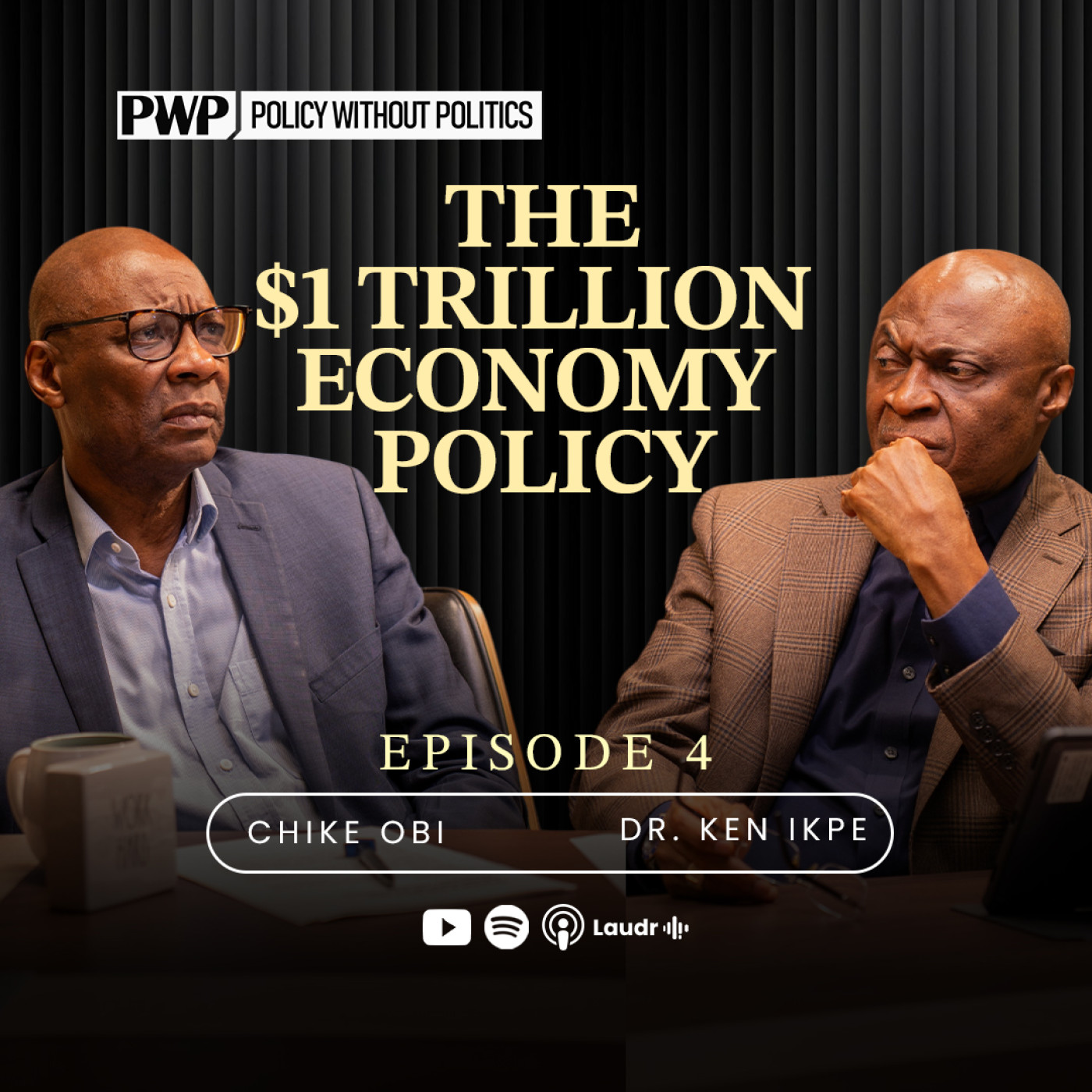
In a debate about Nigeria's economic future, two speakers analyze the government's ambitious target to grow the economy to $1 trillion within five years. They argue this goal is mathematically implausible, requiring annual GDP growth of 15–25%—a rate never sustained by any nation, including China or the U.S. during postwar reconstruction. Nigeria's current GDP is approximately $400–440 billion after rebasing, and its historical growth has remained under 4%. The speakers criticize using this target as a basis for policy, such as the Central Bank's bank recapitalization, which has diverted capital from manufacturing and other sectors, potentially increasing risk and import dependency. One speaker views the goal as an inspiring "audacious" vision needed to catalyze a quantum leap, but both agree it should remain a political slogan, not a governance framework. They emphasize that Nigeria lacks foundational infrastructure, electricity, and skilled labor, making such rapid growth impossible. The discussion highlights the danger of conflating campaign rhetoric with policy, urging a focus on achievable, evidence-based steps to strengthen the economy rather than building on improbable projections. The speakers advocate for "building a house of bricks" on solid foundations, not fanciful aspirations.
[MUSIC PLAYING] It is more likely that a lottery ticket by a housing decree than is for the Nigerian federal government to achieve a $1 trillion economy in five years is impossible. And I will take on anybody who wants to bet with me. It is a guarantee from Mustafa Chikilibir, yes, that we will not have a $1 trillion economy. Could be a guarantee, 30. I think governments are rivaling at 2023. Who wanted the quantum leak and postulates pushed that ass a lot that shows go. Yes, we can review after three years. We can review after five years half hour of work. What is important is that do you have the discipline to have the resources to go on this expedition? If China couldn't do it, if America has never been able to do it, in the reconstruction of Europe, where all the resources were devoted to growing GDP after December one disaster set on our work, they couldn't do it. It is full-heavy, poor in Nigeria. We've not an electricity. We don't have infrastructure. We don't have a well-skilled educated workforce. To say this, that they can do it GDP growth without a foundation. Without a foundation, that nobody has ever been able to-- Yes, China, let's look at the facts. We went from 2023 to 2026. Our best GDP growth. Yes. Just as modified, rebased, has been under 4%. And yes, you want us to make policies that require a GDP growth of 25% for seven years. Policy without politics is supposed to be what we put together so that we can showcase what governizes, showcase our policy effects, all of us. And then today we are going to be discussing the topic that affects everybody, all of us, 100 of us, all strata of democratic picture. With me is my co-host today, Mustafa Chico, the MCO, how are you today? Great, Dr. Keh. Yes, that's the point. What do you see here? Like I said in my intro, governance really and truly is not supposed to be complicated. It's just that one one, somebody's somewhere makes a decision or a group of people makes a decision. Then the rest of the people will have to live with it, isn't it? So we're going to be discussing a topic that is close to your heart. And in fact, there was a time for those of us who have lived through the 70s, the 80s and the 90s. A time where 1 million error was a heck of a money or a figure. From 1 million, we went into billions, you know? And then today we are talking about trillions, isn't it? That's what brought us to this topic. So when we say 1 trillion economy, sounds sensational. 1 trillion dollar. And then when I say 1 trillion economy, if I say 1 trillion, in any currency, when you say 1 trillion, it's mind-boggling. You know, to talk about 1 trillion dollar economy. So that's the topic we are going to discuss. Are you happy to embrace that topic for conversation today? Yes, audience. My name is Mustafa Chikki, we'll be once again. Today we're going to discuss a very important-- I'm not calling it a policy yet. Let's just make it a policy statement. OK. We're going to examine it. And what we're trying to find out is that, is that a campaign slogan? Oh, is that a really credible policy? Again, policy statements that will make policies over. I think that's what we're trying to get in depth. Yes. My name is Dr. Ken Oñali. He, he, he, as far as this question is still looking at it. Is it still tentative? Is it a policy? Or is it a statement? Or is it a campaign slogan? But what the-- why it is? It is one discussion. Because I hear people discuss this in seconds, it's a larger forum. And then how it affects. And then if it is going to come to, to, to, to free shot, then what are the things that we need to put in place so that we will not accommodate that thinking and that perspective? Yeah, I think one of the things we do is to just examine the statement. Examine what it means. And then we ask the question, is that a good basis for making decisions that affect the lives of nature? Or is that a statement to get votes in an election? And while both reasons may be valid, they should not be commingals. OK. So let's go into GDP. GDP is gross domestic product. It's the best, even though not the most accurate, and not the only measure of what a contract produces. That's what GDP is. OK. And Nigeria, when the statement was made and, and, publicized by this government, it's very heartwarming. It's very welcoming. It's very comforting. We would join the group of one trillion dollar economists. Nice to see. But is it possible? Is it realistic? It's, it's, if you said you're going to have a child who's going to go and play basketball? Your ideas are the child's going to play basketball in the national NBA in America. It's nice. But the odds of playing in the NBA, I think the measure is at over one in, over one in the million. So will you base your life on such a long shot? And that's the question we're examining. So let's give some context here. Nigeria's economic GDP, when this was stated, was about 250 billion dollars. It was then rebased. And after rebasing, it's about 400, 400, $40 billion. Now, I'm going to teach all of you out there who's not, or not mathematically inclined. There's something called the 10, 7 rule in mathematics. It means that if you grow at 7%, a year, it will take you 10 years to double any number. So if you start with the number 10, I want to get to 20. In 10 years, it will take you 7% growth. The reverse is also the truth. If you want to get there in double in 7 years, you have to grow at 10%. So when the statement was made in 2023, at 250, to get to 1 trillion in 7 years, which is 20, 30, that was the deadline, will have taken you growth rate well in excess of 20%, which Nigeria has never accomplished. The only congeal that has come close to 20% grows for a period of time, I think, was three to five years was China. But the couldn't sustain it for one and three or four years. Then it fell back down. So 20% growth for seven years is on half. So when that is stated, and then we can go back to 20, 20, 2023, where the GDP was rebased to $400,000,000,000,000. To get to 1 trillion in five years, will take you growth rate of about 15%. Again, on headers. So that's the context where that statement was made. The statement is highly implausible. Now, I've spoken to a senior government official, and I will mention his name in the talk. And who I made the mathematical argument like this, it's not plausible. And he said, well, if the NARA strengthens to-- I think he said $500 to $1,000, then it will happen. And he missed entirely the point that to get the NARA, to go to $500, $1,000, is the challenge. But he threw it out there. And so what was going to examine in more detail is, is it a campaign slogan that should be discarded after election? And then when governance starts, we need serious governance principles to make policies. So I will stop here. And see what I have in me. Yes. My position is a bit different, because I'm looking at focus and position it. It's not a campaign slogan, if you ask me, because as a 20-to-2 tree, I want to believe that any government was a sort of-- It's taking into consideration all that we've suffered, with that sort of economy and our social lives. She'll come up with plans that are audacious. Because Nigeria needs a quantum leap. We're lagging behind so much. So you need a government that would say, listen, we have the audacity, we have the strength, and if we drink, we work our resources, positively as much as we can. We can move from road well traveled to roadless traveled, and if possible, road never traveled. So for me, I think that the post-relation of $1 trillion of economies is a question of road never traveled. So it's a national statement. I'm not sure the government or any set of people who would have sent that and put it dead to it. They did. So even if they did, it's an aspiration, and it's a worry aspiration. OK, you say that, and you're right. Yes. Because you like soccer. You call it soccer. You call it football, yes. All right, listen. All right, listen. If you have a free kick, I'd be half of the way line. Half way line. You don't try to get my goal.
Yes, you can but nobody doesn't we do we do that last year we do it. I said I'll do it I said I'll do it. I like to remind you This was for clarity So let's see you let's see you last year dissemify now. Yes of the Champions League Which is the highest level of competition football. Yes, that was a freaky 37 meters from go. Yes A certain world class mid-through that they got right. Yeah, not only this call was but twice Okay, so let's mean that if you're a doeshose Let's move it back and start and it's got against a high caliber opponent. I accept or does yes, so let's move it back a little bit Correct from your another it's a guideline. Yeah, would you try and would you try for gold? Did the chances are more a better? No, no from your it's a guideline No, no, no, no, no, no, no, that that to be my next okay, so you wouldn't try to use do something You try to hit it somewhere in the middle. Yes, I then move from from the last last the point on making yeah But this is this is like trying to take a freaky from yeah It's you're missing the ad no, but you've just said something around 400 41 billion Yes, which is almost like 57% of it. No, no for it to grow in five years. Yes You need a 15% growth. Yes, that has never been done unlike your declares go. Yeah, that has been gone Yes, so that's the name that Nigeria probably needs something that has never been done and that is what road never traveled Okay, so let's get into it. Let us even accept that we need something that has never been done there They have to put into place. Yes Things that will make it possible. Yeah for it to be done. Yeah, and and now let me tell you You do not use that as a basis for policy the point and make it so let me give you exact marking points in December of 2023 There was a meeting An annual dinner of the Chattern Institute of Bankers in late us. Yeah, I want to be the keynote speaker the most important Speaker was a governor of the central bank And he said it That based on the one trillion dollar objective They were going to require banks to recapitalize to accommodate this audacious improbable goal. It became a basis for policy. That's my problem You can say it and you can make of all feel good But to use that as a basis for policy and that Created a lot of consequences which we can examine whether they're good or bad There are a lot of other policies of this government too and other government Um That were based on what you call audacious Foundations and so the policies are negative because we're discussing policies that that politics is there The policies that emanate from those fanciful objectives. So okay Have led to what I consider consequential Policies which the question is should we be using policies on something like a trillion dollar economic policy? Or should we be basing policies on things that are achievable? I think that's the issue here. I agree with you, but probably that's a different between a strategy and a goal and different between a mission and a vision I think in government arrival at 2023 who wanted their control leap can postulate push that as a lot of shares go Yes, we can review after three years. We can review after five years half hour of car What is important is that Do you have the discipline to you have the resources to go on this expedition? So why watch and that is what we are going to take Why not two trailers? No, no, no, no, you don't want to be ridiculous You know, but the point I'm making is that the one trillion is in service ridiculous No, no, no, no, I think these audacious You know because if you are halfway almost to one trillion then you might as well Have them the ambition and the privilege of foresight to say we can as well be it a trillion All things being a core don't forget the 10 seven or yes to do it in seven years. Yes. No, no In 2023 we had two fifth. Yes, so we had both four times. Oh It's in seven years. Yeah, impossible. Yeah, the democratic tell you of where civil and government in Nigeria is Technically four years and another four. So if you do well in four years, yeah, but you have to grant 25% GDP. Yes Which nobody Nobody has ever done and listen You know you are soft about those things But if China couldn't do it If America has never been able to do it If in the reconstruction of America of Europe Where all the resources were devoted to growing GDP after December or disaster sector or all they couldn't do it It is Full-hearted as a list. Yes. Full-hearted for in Nigeria With no electricity. Yeah, I know what I will come to that to thank this that they can do it Without the foundation without the foundation that nobody has ever been able to yes So that's the point of yeah, I get to a point But if if if a government has a mind that if I fix the fundamentals and fix the foundation I'll get the one trillion then it's what Ticket is is is is is is is an adventure what ticket and by the way talking about Ten people I mean countries like China, Russia and the rest of Europe have been able to do with not being a lot There are other milestones we've labeled to do because Nigeria Don't need to Build the framework for development. You know that there are a lot of things that we can copy and paste and use our skill set and now in down resources to Elefrog take telecops. Yeah, for example the way we have we we establish a telco and and around with it I'm not sure any company developed a database you take Issues around our financial services in fact. I've gone to American banks and when I experience their services And I'm talking as a 2024-25 you will be you remember Nigeria banking services of 2004 So there are things that we have copied and you've frog this economist you are talking about This is Nigeria after all well Nigeria after all Well now let's look at the facts. We've gone from 2023 to 2026 Our best GDP growth. Yes. I just had modified it rebased As being under 4% yes, and yet you want us to make policies that require a GDP growth of 25% for seven years I would attempt it I'll put such a goal and at 50% of it then not put another shows but you're I have results. Yes, yes, we've done it for four years. So reviewing For four years and the previous 10 years. Yes, the most we have accomplished. I believe we'll get another slayer. Yes Us know where about not not above 10% yeah, so so this is something listen like I say it's a beautiful company slogan It makes you feel good. Okay, it's like Nigeria saying they're gonna win the walk-off It's a good goal. Yes, but you wouldn't bet anything on that. Yes, because it's highly improbable Okay, so I again, I think the basis of this conversation and I like your Push him back against is should we be using what should we use to create policy? Should we be using fanciful improbable blows or should we say yes, where we are? We don't have electricity. Yes, we don't have infrastructure We don't have a well-skilled educated workforce is getting better. Well giving those constraints What should we make policy on on the things again? I keep saying on the things we can do well Because this thing's cost money the back-end capitalization has been done successfully. Yeah And there are many good reasons for recapitalizing the banks very many good reasons and I personally applaud the CBL initiated of ecartising the bank but the reason advanced for it Is what I question and I question what other things are we doing? What are things are we doing in Nigeria based on improbable fanciful? Let's base it on common sense principles Okay, you don't send your child at six years old to have it they will fail Let me let me let me point point MC to use some of those common sense things that I think the government was I've seen before they had their density to Push forward the one trillion Economy as a plant. Yes, or policy You know if if we have a sustained grudery it's high enough to approach a one trillion dollar It means that we require a minimum of all production of at least two million barrels a day As at the time that policy was pushed would we rent anywhere? But his three dozen support you no no no his three his three's High-side no, but we are talking of insight no without to me. I'm buying production But it wasn't consistent. So so if you are going to push forward and auditions policy, okay, whatever made that Foundation in consistent you make it consistent meaning that if it becomes consistent the chances that you can get there Is bright no two million barrels a day will still not give you 15 percent GDP gross no, but it will not yes But so you are still even at that. Yes, and keep in mind you have an opaque quota. Yes, your paper quota is below two million barrels a day So you can't make projections based on a quota higher than your
So whenever I'm going to produce 2 million barrels of oil a day, it's not going to happen. Because of the fact that we're going to let us do it. So my point is all those things that you don't build fancy upon fancy. If I produce 2 million barrels a day, if I get my effects to 1000 to 1, if Dr. Ken becomes the Habad's Nobel Laureates, you don't build on fanciful things. Let us build a house made of bricks. What was the most difficult for children? Where somebody made a house made of straw and the big bad wolf came on blue. Let us build on sondit foundation. There is nothing wrong with seeing in a campaign rally. I'm going to take your economy to 10 trillion in 10 years. So I think that what happened here was the political. political speech, political slogan, became the basis for policy. Can we government this? Yes, and I think that was a mixture between political, document and governance. And again, I understand inspiring people, I understand goals, I understand that. We're not going to be as simple as that. My fear is that in future. And that kind of thing would come and say something, "Our treaters, I make it the basis for campaigns. I make it the basis for governance." And I think that we should be responsible enough to say, "This is where we are. This is what is possible. And this is what is likely." Let us go to likely first. No, we start going to possible. That I think is the thing. Now, the consequences of this. I will start with the bank capitalization. That has sucked away a lot of capital from other industries. So the banks seem to be doing well. But a lot of other industries are suffering from lack of capital in Nigeria today. And the manufacturing is shrinking. The only part of the economy that seems to be expanding on the private sector side is construction in leaders. And many people have reduced reasons for that. But they won't go into that now. But the taking of money from the back, from everybody to put in banks, will have long-term consequences. It will make us more important dependent in the future. And so there is a consequence for it. And my big fear, I elune my experience from Amcot. When banks get capital that they don't need, they use it for one or two things. The less risk, the risk of the best facts, of which I will say, "GTB is one of them." We'll invest more in government securities. And make less money. If you look at GTV's books, and again, they're policy, they're not receiving their policies. They're long-growth among the major banks has been one of the slowest in the industry. Because they have a risk of a spoustion. And that's okay. If you look at other banks that have taken the money, they're taking the money, but when they get all this capital, here's my fear. The more risk, seeking banks, will invest in more risky assets. Because I do capital is not something that banks like they are. And I foresee, if interest rates they are the straight. And banks have this much capital. I foresee another potential for an unconylike intervention. I think you will see MPOs growing. And I think that good risk money is making our boy that. But all that means is that all this money is going to government. Government debt will keep growing. And to keep bank government securities at rates that it shouldn't be paid for government securities. Because they have no wealth to their money. And I think in the end, there's a consequence. And we need to look forward. We are very short term one major. So we take this short term gain and we don't properly analyze the long term consequences. And that's my concept. The other concerns of this one trillion dollar this. One trillion dollar economy. One is that your currency cannot depreciate. Because every time your currency depreciates, then the good moves further. So there's an implied defense of the NARA policy. Which is very expensive. It's again like I pointed out. It's the second largest expense Nigeria spends today. I think the first is debt sales. The next is defense of the NARA. The cost of the VNNARA today is probably in billion dollars a year or more. So once you start appreciating your currency, it then has other consequences. It makes your good goods you produced expensively to import. I read somewhere, I don't know what I'm saying, truth is, I'm saying that Aliko Dango-Tis-Finer is upset with the government for issue. He's going to the cost. He has gone to the cost. Now, the reason why is that if your currency keeps appreciating. And you have an inflationary environment, his costs are going up. By the inflation rate, college 15-20%. That's what the pressure rate. So his costs are going up here. This competition abroad, their costs are going up at 3%. So in time, his product will become more expensive than the imported version. And so he wants some protection from that. Legitably, I would say. But those are the things that happen when you pursue a policy that sounds good. But has consequences like, again, people say that your currency is stable. I hate all the things that I want to do. Now, you know, currency is not stable. It's appreciating. It's appreciating. You have a 20% inflation differential between us and the US. Every year, our currency stays nominally the same. It is appreciated by that inflation differential. So we are appreciating our currency in a development country. So those are the consequences. And what I would like is for the government to have a forum in which people can say these things and discuss them without feeling the fear of government influence or domination. I don't want to say something wrong. No, we're trying to say something that will show all our good. And it's an appreciating currency something we want. I think most sensible economists will say no. And that's what we're doing. Because we're aiming at your first full three kick from your senior deadline. Yeah. Well, if you. I get your point, you know, but today we are discussing the one trailer. And there is a macro side of it. There is a microcosm, which is the implementation side of it and the outcome. Yes, you've done well in explaining that if we begin to implement, if we begin to go to the micron, how we've been met, the consequences. I agree with you. But my position is that this. You've used what, first of all, I'm saying auditions. Why do I say that? Because I know that if you don't buy tickets, you don't want to. Yes, when government's coming, you must, as a matter of necessity, differentiate between the difference between communicating in an election or an period and communicating in covenants. I think there's a big problem here. I don't think it's just communication. No, no, no, no. I'm not saying it's. Even with the internal communication and external communication. I had looked where I did that communication in Scroogeo. But what you communicate is also. It's important. So when you come into covenants, you would have to apply the breaks and then communicate what you want to do face-by-face and be accountable to it. So can we agree on one thing? Yes. Can we agree that if the central bank of Nigeria wants back to capitalise, they have 10,000 good reasons to do that. Yes. The one this stage should not be that we're looking for a $1,000. That should be made, this correct, but it may have been made by the way. No, he said no, he was there. I was under dinner. He said the reason why I want back to capitalise to this extent is because we want to support the president's goal of $1,000,000. Amongst our debtors. No, it is amongst our debtors. So that's what it was in the comments. Now again, I say I totally agree that the bank should have recovered. But that's not the reason to do that. I get you. But let's look at an honest version. And I'm talking from my own perspective. What the want-re-lontagets would have done, and how it could have affected Nigerians. There could have been more productions which would have led to, and if we eat that, more jobs, more exports, better infrastructure. You know, this is a now-the-world target. How we get there is the secondary target. It's not a lot-the-world target.
Allah showed you how Police danger is hidden behind in this SUV taking a search. It is not likely that a lottery ticket by a housing decree that is for the giant federal government to achieve a $1 trillion economy in five years. It is impossible. It can never happen. It is a guarantee from Mustafa Chikrubi that we will not have a $1 trillion economy. Let me tell you that if you want to rent a house again in Iqoui and rent is 30 million dollars a year and your income is $5.99 a year. If that becomes your objective and you come to me and say that is your objective, I will say that this guy wants to become an undropper. If I say I am going to hit one trillion and at the end of four years I am at $6.50 by 50% that is an achievement. So that is again where communication comes in. So could the communication have said that we are going to visit this is what is going to cost us this is what is going to be required to get to where we want to go but to set an objective by setting this in a shot. No, no, no, no, I think we are policing. I think we are confusing objective and policing. I agree. You can set an objective. You want there. But what I don't want is for somebody to come to me and say in pursuance of a $1 trillion economy I am going to raise your tax rate to 60%. I am saying you are raising my tax rate for stupid reason. If you want to raise my tax rate to build electricity. Well, I can listen. Yes. If you want to raise my tax rate to provide education, universal education, I can listen. Could all those be the intention without with a poor communication? Well, I can't read mine. Yes. But if government is telling me I am doing ABCD, EFG that affects people on the street here. I am keeping interest rates at 35% because I want to do something that I know is not achievable. I don't like that. But if you tell me something, glass or buying trees together. So my point is, it's okay to say it. But if they will promise me that I will know about the basis of major consequential policy decisions, then I'm okay with it. But the truth is, if I want to live in the country, I make no money. If that's what I really want to do, then I will have to do something illegal to do it. And so you start doing, so instead of illegal, you do silly tax. Look. Interest rates today are very, very, very hard and no business, no real business will survive this for another three years. So that's why I'm afraid of bad laws. But the consequence of reducing interest rates is that it's possible inflation will rise and it's possible the currency will weaken. But when you hang on to a consequence of a trillion dollar economy, which is high interest rates, it's a consequence of it. You end up with all that resource that I'm not, look, we just got upgraded by, I think was S&P. Somebody upgraded Nigeria's, I suspect it was S&P. I don't think it was rich, but I think it was S&P. We upgraded Nigeria's fantastic news. And going from B virus to B in politics, good as a test for optics has not affected anybody in this room, one Ayoda. If I don't affect it, anybody on the streets, one Ayoda, what it has done is maybe making easier for Nigeria to borrow it nationally and make it cheaper for Nigeria to borrow international. So there are things that are good for Nigeria that are not necessarily good for Nigeria. And I think I want to focus on what is good for Nigeria's. And what Nigerians need now, what they need now today is a softer economic environment. Maybe we'll get to that B, two years later than we got today. But we could have gotten there with a softer, less difficult environment, an easier taxation system, an easier credit system, those kind of things. So I think again, the reason why it's look, this is not the only policy that we have. What is the headline policy? And I still think it should have been left after IPC won the elections very well in 2023. And it's been left in the politics room. And it's been emerging today. When we're back in the politics system, we should never have it thrust into the governance stage or into the policy stage. That's the point I'm trying to. I get your point, then I agree with most of the things you have said. But if you needed to get out from the home, you need to stop the. You need to stop the. Are the Americans. Yes, you need to. You need to get the home. I want to stop the. I think this is digging more. That's the problem. You need to predetermine. You need to forecast a destination. You need to say clearly this is. What are you going to stop doing? I agree. But you need to clearly say this is real. We need to go question the size of this economy and the opportunities there are of. And both if you communicated properly, people will buy it. People will buy it. Then you come back to communicate that we are going to do this in phases. And then we. This is going to carry consequences for there will be more physical discipline. There will be more discipline on the part of the government. There will be more discipline on the part of the majority of the public. And if we get 50% of what we intend to achieve, that would have been an improvement. So that is again going back to that road, least traveled. You know, if there wasn't an audacious policy to set the boil really, set the target, then we probably would have had a motion with almost men. So now, not our back in the politics system. I don't want to hear anybody tell me that they are going to do a 3-3-3-0 like I can have a 2035. Yeah, please. Yeah. If you want to upset something that is existing, you have to come to the table. You have to be more careful. It's a sensational. It may not be necessary because ridiculous is really relative. Maybe really close to your body has to be sensational. I'll be difficult to achieve. There are some things that are, but when you are in governor, then what you go for a messaging around consolidation. So in consolidation and in, you know, you can't keep driving with your handbrake on. I understand. But some things are objectively ridiculous. Yeah. If a man tells he's going to jump off his tennis story building and land on his feet, that is objectively ridiculous. Yeah. So we can all agree that if someone says that we will call the natural husband, yeah, he may have cautionally. All right. So I'm afraid that one of these opposition parties will say, oh, they said one trillion economy in six years, well, let's go to three. No, no, you wouldn't say that because we have a benchmark to judge from these. We had a benchmark and I just still said it. Yeah, yeah, they were. No, I said, I said, what's in them? I said, 2023, there was no benchmark. There was camps. And we needed to set a roadmap, isn't it? Thank you very much. It's a topic that if we went on and all could probably discuss for another two hours, what we'll have just terminates to deal with it. I mean, we are sufficiently confident that we have dealt with it within the opportunities and the possibilities of a 10 minute window. Next week, we're going to come with another place. Best views. And the police. Yes, I'm coming. I know that your pet peels would be very, very okay. You know what the MCO's just before I forget. Please go on with your pet yield. Okay, my pet peep of the week. We decided to copy the American presidential system. Good system does work for many years in the U.S. But I don't understand why we send
Minister, and ambassadors to the Senate without their portfolios or countries of posting. His baffles me how you can, as a Senate, confirm somebody without knowing what they are going to do. And I see presidents upon presidents upon presidents, all of them do this then. Why can't you not tell the Senate this man is going to Minister of Libre? So they can be questioned about their labor policies. Why do we approve this minister? There is nothing about being a senator, for example, that qualifies someone from being to be minister of aviation. Why if you being a senator you go and say take a bow? Please, we must stop this. We should not send somebody. There is no single ambassador to Nigeria from any country or north. That doesn't speak English. Yet we sent people to Germany that don't speak German. We sent people to Russia, they don't speak Russian. We sent people to America, they don't understand that Americans care about baseball. We must do, we must send ambassadors and ministers to the Senate with their designated places of posting and their portfolios so they can be properly scrutinized. That's what happens in the US that we're hoping. Every cabinet secretary goes with his portfolio and his question about his mortgage base. We must stop this. I plead on the next president to please, it doesn't cost you any of your authority. It doesn't cost you any of your power to assign portfolios and postings before sending your nominees to the Senate for confirmation. And I plead with the Senate to insist on it. Okay, because any confirmation without those names is in my opinion, offensive. That's my opinion of the week. Fantastic. That's food for thought for you. That's where that segment is supposed to throw out food for thought, so that you think about it. But it's quite serious. And the next logical sense next week we come up with on that topic there'll be much much interesting deeper and give us the opportunity to train ideas and promote details at our Thursday life. Thank you very much. So, five, two, one, two, one, two, one, two, one. Thank you, that was great.
Podcast Summary
Key Points:
The Nigerian government's goal of achieving a $1 trillion economy in five years is deemed highly unrealistic and mathematically impossible by the speakers.
To reach $1 trillion from Nigeria's current GDP (around $400–440 billion) would require sustained GDP growth of 15–25% annually, which no country has achieved for such a period.
The speakers criticize using this aspirational target as a basis for actual policy, such as the Central Bank's bank recapitalization directive, which they argue has negative consequences like draining capital from other sectors.
Nigeria lacks foundational elements for rapid growth, including reliable electricity, infrastructure, and a skilled workforce, making the goal a "campaign slogan" rather than a credible policy.
The discussion contrasts "audacious goals" with practical governance, urging policymakers to base decisions on achievable, evidence-based foundations rather than fanciful projections.
Summary:
In a debate about Nigeria's economic future, two speakers analyze the government's ambitious target to grow the economy to $1 trillion within five years. S. during postwar reconstruction.
Nigeria's current GDP is approximately $400–440 billion after rebasing, and its historical growth has remained under 4%. The speakers criticize using this target as a basis for policy, such as the Central Bank's bank recapitalization, which has diverted capital from manufacturing and other sectors, potentially increasing risk and import dependency. One speaker views the goal as an inspiring "audacious" vision needed to catalyze a quantum leap, but both agree it should remain a political slogan, not a governance framework.
They emphasize that Nigeria lacks foundational infrastructure, electricity, and skilled labor, making such rapid growth impossible. The discussion highlights the danger of conflating campaign rhetoric with policy, urging a focus on achievable, evidence-based steps to strengthen the economy rather than building on improbable projections. The speakers advocate for "building a house of bricks" on solid foundations, not fanciful aspirations.
FAQs
The discussion focuses on whether Nigeria's goal of achieving a $1 trillion economy is a credible policy, a campaign slogan, or an unrealistic aspiration.
They argue it requires 15-25% annual GDP growth, which Nigeria has never achieved, and lacks foundational elements like reliable electricity and infrastructure.
The rule states that growing at 7% per year doubles an economy in 10 years; to double in 7 years requires 10% growth.
It was used as a basis for bank recapitalization, which they argue diverted capital from other industries and may lead to risky lending.
Nigeria lacks reliable electricity, adequate infrastructure, and a well-skilled, educated workforce.
He compares it to a soccer player attempting a goal from the halfway line—audacious but highly improbable.
Chat with AI
Loading...
Pro features
Go deeper with this episode
Unlock creator-grade tools that turn any transcript into show notes and subtitle files.
 PodcastTranscript AI