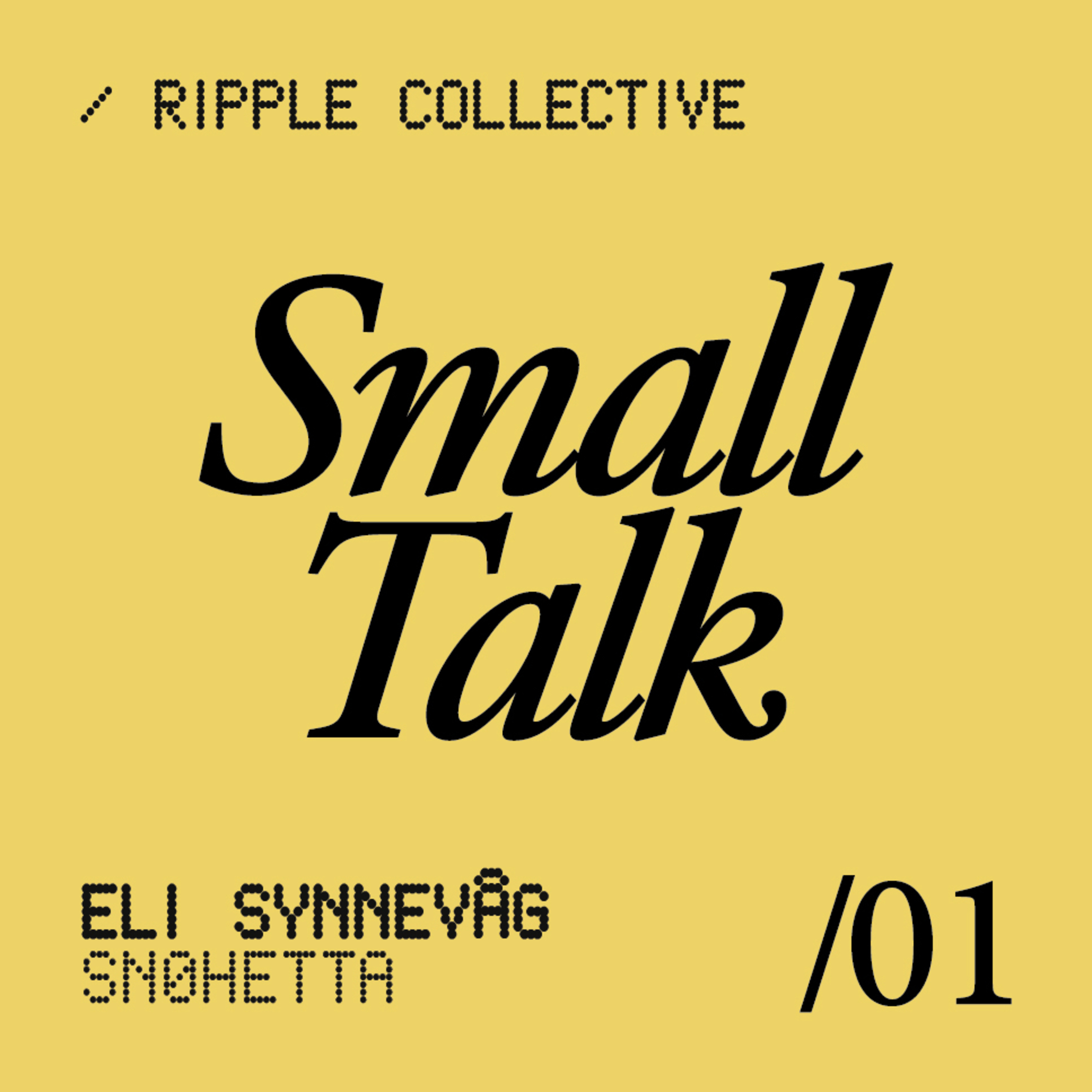
The RIPO Collective introduced "Small Talk," a conversational series in Abu Dhabi that prioritizes human connection and genuine dialogue over formal content structures. The first episode features Ali from Snowet, who discusses the core value of craftsmanship in architecture. Drawing on their work in Norway, particularly the naturally ventilated Eglist building, Ali emphasizes that true craftsmanship lies not in visual beauty alone, but in thoughtful, context-sensitive design that serves human needs and environmental challenges. He argues that craftsmanship is a continuous journey—rooted in curiosity, collaboration, and a deep understanding of materials, context, and process. Unlike formulaic design, Snowet’s projects are tailored to each location, reflecting a unique and intentional approach that values detail, user experience, and sustainability. Ali reflects on how architectural craftsmanship is both a personal and collective endeavor, requiring humility, shared knowledge, and ongoing learning. The session underscores the importance of redefining "craft" in modern design—not as outdated tradition, but as a vital practice of deep thinking, innovation, and human-centered creation. As the series evolves, it aims to bridge global design ideas with local needs in Abu Dhabi, promoting a culture of mastery and meaningful creation.
Welcome to RIPO Collective's Abu Dhabi sessions chats.
We have no idea what we're doing.
So we just decided to start having fun recording a bit of the best that we have happening
in the studio, which is meeting people and making friends.
And we discussed a lot about if we could call this a podcast or not, or if this would
be something else.
We agreed that we would not call it a podcast, so we call it small talk.
So this is the first edition of the RIPO Collective Abu Dhabi sessions small talk.
And this is recorded in our studio in Abu Dhabi in my office, where we have our guests
that I will introduce in some seconds.
And we have some members of our team that are here in the room with us.
And literally, this is supposed to be chat with friends and very relaxed.
There's no script, and I need Johnny to come and put the password in his laptop, because
it just went off.
The reason why we're doing this is because there's several reasons.
One of them is because with the Abu Dhabi sessions and the final draft, in the last years
we realized that we could through our connections and our network bring interesting subjects
to discussion here in Abu Dhabi.
We could maybe be a bridge of interesting stuff that we are involved in to Abu Dhabi.
And we realized that maybe doing it just once a year would not be enough.
Then we started thinking the idea that we could do it more often in a non-regular way,
which basically this will happen when we have guests in the studio.
And the idea would be that this is kind of an extension of that project that is the
Abu Dhabi sessions and the final draft.
Now, this is the first chapter of these talks.
It's also the first chapter of season three of the Abu Dhabi sessions.
And every year we have a theme.
And the theme of this year is craftsmanship.
It's crafts.
It's having a craft, knowing a craft, being good at a craft.
And the importance of mastering a craft.
We have the feeling that being a good craftsman is losing the importance that maybe in other
times had.
And we want through our multiple projects, including Fabrica, bring back the concept of craft.
Now, by some special alignment of the stars, our first guest is a friend that probably
is one of the few people that came to the two editions of the final draft, is a friend
that with many other relationships we have started with work.
But then today we are more than colleagues.
Welcome, Ali, from Snowet, welcome to our small talk.
Thank you.
Thank you so much.
It's an honor to be the first one out.
This is very exciting, and as all of the great things you do at Slash, you are so amazing
in connecting people and the best way to connect is to talk together.
Correct.
And we spend with you, with your team.
We spend so many hours talking about so many things.
Some professionals, some personal things that we like, we met in different countries.
But one thing that is constant is that we talk a lot.
Well, usually I talk a lot.
And then you also talk.
And we have been sharing a lot of things, not only about architecture and about design.
But I think something, I think I can say that the two companies aligned very organically.
Correct?
Yes, definitely.
And I think, you know, when we start projects, we try to talk a lot about things.
We talk about what is the object of the project.
This is also, of course, related to architecture, which is our craftsmanship at the core.
And, you know, drawing can be the easy part, but the thinking behind it, it's what's, you
know, there you find the deep meaning.
And in order to get to that place, you need to talk together.
Because just drawing an idea on board and jump on that might be good, but it also might
not be so good.
So having that conversation before is really important.
And true discussions try to create the collective understanding of what you're dealing with
and a way to proceed it.
As a continuation of the introduction, Ellie is the face of Snowhead in the Middle East,
where we are in Abu Dhabi.
And we have in common a lot of things, but one of them is that we both, we both slash
and Snowhead want to bring things well done to Abu Dhabi in the different areas.
And in a way, there's a connection with that and the craft and being good at the craft
that we are working on.
What is your reaction to the word craft?
Is it old fashion?
No, I don't think so.
I think craft is really important.
I think, you know, with all the technology and the technology and tools within our field,
it's also important to recognize the craftmanship in the work, in the execution of the work,
but also in the process behind the work.
So like yet, the founder of Snowhead always says, you know, you start as an architect and
you die as an architect.
There is like, you know, nothing in between.
You know, you can develop, but that's the core of what you are.
You know, some in some professions, you start and then you want to excel your career.
And that's natural.
But in the core business, what we're dealing is the craftsmanship and the interesting
in improving yourself in that.
And that comes to the thinking, to the development of concept.
And of course, then, to make this a built or a new environment for people that can share
it and meet in.
I've had the privilege of visiting your studio twice and you have been here several times.
And one of the things that always attract us to Snowhead even before we met is the feeling
that the work that you do is crafted, is detailed, is thoughtful, and there is not a
magical formula, and that all the projects have something in common, there's always this
perception from our side that everyone is designed in a unique way, starting from maybe
some common elements, but there's this idea that each one will be crafted in its own
way.
Is that what it happens?
Yes, I think so, we have tried to maybe put a word on this and that's contextual concepts.
So we always relate to the context where we are.
So you cannot use the same approach, the same design in two totally different conditions.
So every place has a condition, if it's wind, if it's temperature, if it's people, if
it's culture, so you need to relate to that and then try to define a response that makes
sense in that situation.
And I think that's craftsmanship to it as well.
So we tried over the years to develop this understanding between the people in the office,
that we should approach each project from an individual perspective and not just make
a copy or a default of what we've done before, and I think that is something you carry
with you moving forward, and then when it also comes into the joy of dealing with materials,
what is the right response here, and of course the detailing of the project itself.
But at the same time, I don't think we are occupied with the beauty of the object just
for the object in itself, it's the purpose of the object, what it's supposed to be used for,
if it's a building that people should meet in, or if it's a
you know fork or knife that somebody should have in their hands or if it's it's a way to find
you know signage to a building. It's always in relationship to the personal that is using it.
Two weeks ago as you know we I had the privilege of attending a talk by Chatelle in Italy and
it was so funny because in the end when we finished the talk and we were just you know decompressing
it it only it's so funny that I just finished the talk as an architect and I didn't talk about
architecture and when he was talking about all the projects and he mentioned several projects it
was never about the architecture it was about what was being delivered through that project
and and sometimes it was a restaurant sometimes it was an office building I remember how proud
it was that you got the award of the Eglist building in Norway and how that reflects what
you're saying which is the purpose of that building was not to win a beauty context. It was the
second Eglist building. Maybe next time you win the Eglist. But that building is a good example.
Of the purpose was was not beauty independently. I think the building is beautiful but but there
was there was there was a different purpose that was delivered. Can you tell us a little bit about
that specific project? Yeah so that project is it's a mixed-use project of offices
and residential it's in a central part of Oslo and it's the first fully naturally ventilated
building of that type in Norway. So we've been a part of a research project for many years
with you know stakeholders in our industry so there's a developer there's a contractor there
is a real estate yeah that has developer that is leasing these two different businesses and then
also as a designer and then it's also been a research institute connected to this. So this is an
example of a project that's been you know has a long process it's a long history behind it
but what we're trying to do is to find potential answers to how can we make a built environment
that reduces the CO emissions and also reduces the need for technical spaces within a building
because we use so much of the space inside the buildings we built today for ventilation for
ducts for technical spaces that if we could find a different way of using that it could be
you know high-sea links better air better temperature inside different thermal comfort
so now we are kind of using one solution with the AC systems that is saying that everything
should be you know 21 degrees or 18 degrees here in Abu Dhabi so and that is not comfort right
so we're trying to find much more nuanced nuances into this and this is one answer and one
potential way of doing it. It was I visited the building with you and and it's quite impressive I
think it's one of those projects that craftsmanship becomes tangible because literally every wall that
you look or every window that you look or every hallway you feel that there was thought there was
there was a detail usually when we use the word craftsmanship we tend to think about arts
and crafts and to think about the carpenter or the jewelry designer but in a way that building
is almost like architectural jewelry in the sense that even the walls are not parallel the way
that the balconies are placed in the building it feels like a lot of craftsmanship in that one.
Yes and also you know the building industry is quite conservative and quite traditional so you know
a lot of industry technologies and so I have had a lot of innovation still the building industry
is you know a little bit behind so it was a very brave client of us taking this forward but we have
yes so the way the the building is shaped is that it has these tilting walls that the purpose
of that is to increase the stream of flow of air around the building because it has these
these ventilation walls that has to open to circulate natural air throughout the building and
that's why it's kind of designed this in this way so it's like you know form follows environment
in that sense is one of the words we have been using in this so it's not just it's not
designed to specifically just looked at it had definitely has its purpose in the way that the
the walls are tilting to increase and also you know the floor height the thermal mass in the
slab is also a part of that energy system solution. I think usually articles on the internet but
also in magazine I think usually they are unfair to architecture because it's very hard to but in
this specific project I think it they are even more unfair because I knew the projects from articles
that I read and it doesn't matter what we're saying in this talk we will never I don't think we
will never be able to explain how incredible is the work done there because only when you visit
you understand all those variables that you talked about about the importance of of that
of craftsmanship there one one of the questions that I would like to ask you is when you think
about you and your colleagues and your studio does ever cross your mind that they are craftsman
that they are people that are on this journey to deliver something that is unique and
and improved every single time that they work in it. Yes and I think maybe there is a transition
from you know when you are a student you go to school and you learn and you do projects you work a
lot on your own and when you you know you step into the world or you start working in a larger
environment you understand that it's so complex that you really have to take a part in a team
to to to make these things happen you you have a role to and collaborate with others all you
know all the different functions within an office or a design team has to somewhat be a part of
the same orchestra so there's like this craftsmanship of that understanding your role but also
understanding your contribution and you know that this is not something that anybody could have done
on their own. When I when I think about craftsman and if I I need to put a face in my head about
craftsman I think about people that I know that maybe work with their hands and and they deliver
incredible incredible work but I would say that the thing that they all have in common when I
think about them is this restlessness this this idea that I've never good enough that that there's
this pursuit of knowing more about my craft knowing the tools knowing the the systems knowing the
the process to deliver to deliver that how does that apply to the work that you do to the
architect or is there a moment where you say it's enough I know enough or or you never reach that
moment. No I don't think you reach that moment if you do maybe you should stop being architect I
think it's like you know that I was I was just saying what we tried to do is also to develop
an environment where this has become like a tacit knowledge so it's like a knowledge that you
maybe have a bit in your hand and also in your head and then share that with others because
you know we we tried to over the years have this how should I say focus both on innovation when it
comes to technology and testing thing but also on the analog side of actually doing things with
your hand it's very different to look at an object that is you can hold you can feel you can touch
that has a texture that has a color than seeing it on the screen so this kind of combination of
the two I think is essential in that process and then as an architect and when you work you you know
it's so much knowledge and especially when you're traveling to you know new areas and like coming
here to Abu Dhabi all the things we have learned and and we try to you know come with a position of
humbleness in that that we're not here to tell you but we're here to get knowledge that will help
us to potentially give better answer to the problems or they should attend. When when I visited
the other.
Jeste svoj ješelj, da svoj ješelj, da ješelj ješelj, da ješelj, da ješelj, da ješelj, da ješelj, da ješelj, da ješelj, da ješel
je što je što je svoj pričih všeljšičniš všeljšičnišnišnišnišnišnišnišnišnišnišnišnišnišnišnišnišnišnišnišnišnišnišnišnišnišnišniš
svoj vzelošne arbe, kaj vzelošne arbe,
ker svoj vzelošne arbe, ker svoj vzelošne arbe,
ker svoj vzelošne arbe, ker svoj vzelošne arbe,
ker svoj vzelošne arbe, ker svoj vzelošne arbe,
kravstmen, kravstwoman.
No, I think, you know, in whatever,
kaj na vrhej vzelošne arbe,
kaj na vrhej vzelošne arbe, kaj na vrhej vzelošne arbe,
ker svoj vzelošne arbe, kaj na vrhej vzelošne arbe,
kaj na vrhej vzelošne arbe, kaj na vrhej vzelošne arbe, kaj na vrhej vzelošne arbe,
kaj na vrhej vzelošne arbe, kaj na vrhej vzelošne arbe, kaj na vrhej vzelošne arbe,
kaj na vrhej vzelošne arbe, kaj na vrhej vzelošne arbe, kaj na vrhej vzelošne arbe, kaj na vrhej vzelošne arbe,
kaj na vrhej vzelošne arbe, kaj na vrhej vzelošne arbe, kaj na vrhej vzelošne arbe, kaj na vrhej vzelošne arbe,
kaj na vrhej vzelošne arbe, kaj na vrhej vzelošne arbe, kaj na vrhej vzelošne arbe.
Podcast Summary
Key Points:
The RIPO Collective launched "Small Talk" as a non-structured, friendly, and relaxed conversation series in Abu Dhabi, designed to foster connections and shared ideas rather than follow a traditional podcast format.
The series is rooted in the theme of "craftsmanship," emphasizing the value of deep thinking, personal dedication, and mastery in design and execution—especially in contrast to mass-produced or formulaic approaches.
Ali from Snowet highlights how craftsmanship in architecture goes beyond aesthetics, involving contextual sensitivity, detailed thinking, and a continuous pursuit of improvement, where every project is uniquely designed to serve its users and environment.
Summary:
The RIPO Collective introduced "Small Talk," a conversational series in Abu Dhabi that prioritizes human connection and genuine dialogue over formal content structures. The first episode features Ali from Snowet, who discusses the core value of craftsmanship in architecture. Drawing on their work in Norway, particularly the naturally ventilated Eglist building, Ali emphasizes that true craftsmanship lies not in visual beauty alone, but in thoughtful, context-sensitive design that serves human needs and environmental challenges.
He argues that craftsmanship is a continuous journey—rooted in curiosity, collaboration, and a deep understanding of materials, context, and process. Unlike formulaic design, Snowet’s projects are tailored to each location, reflecting a unique and intentional approach that values detail, user experience, and sustainability. Ali reflects on how architectural craftsmanship is both a personal and collective endeavor, requiring humility, shared knowledge, and ongoing learning.
The session underscores the importance of redefining "craft" in modern design—not as outdated tradition, but as a vital practice of deep thinking, innovation, and human-centered creation. As the series evolves, it aims to bridge global design ideas with local needs in Abu Dhabi, promoting a culture of mastery and meaningful creation.
FAQs
The series is called 'Small Talk,' a relaxed, unscripted conversation series by the RIPO Collective in Abu Dhabi.
The creators decided against calling it a podcast because they wanted to emphasize casual, friendly conversation rather than a formal audio show.
The theme is 'craftsmanship,' focusing on the value of mastery, thoughtfulness, and dedication in design and execution.
It serves as a bridge to share innovative ideas and design practices from the RIPO Collective’s global network with Abu Dhabi’s audience and community.
It refers to deep thinking, attention to detail, context-sensitive design, and a commitment to purpose and quality over form or trends.
The Eglist building in Norway, which uses natural ventilation and thoughtful design to reduce carbon emissions and technical spaces, demonstrating craftsmanship through detail and purpose.
Chat with AI
Loading...
Pro features
Go deeper with this episode
Unlock creator-grade tools that turn any transcript into show notes and subtitle files.
 PodcastTranscript AI