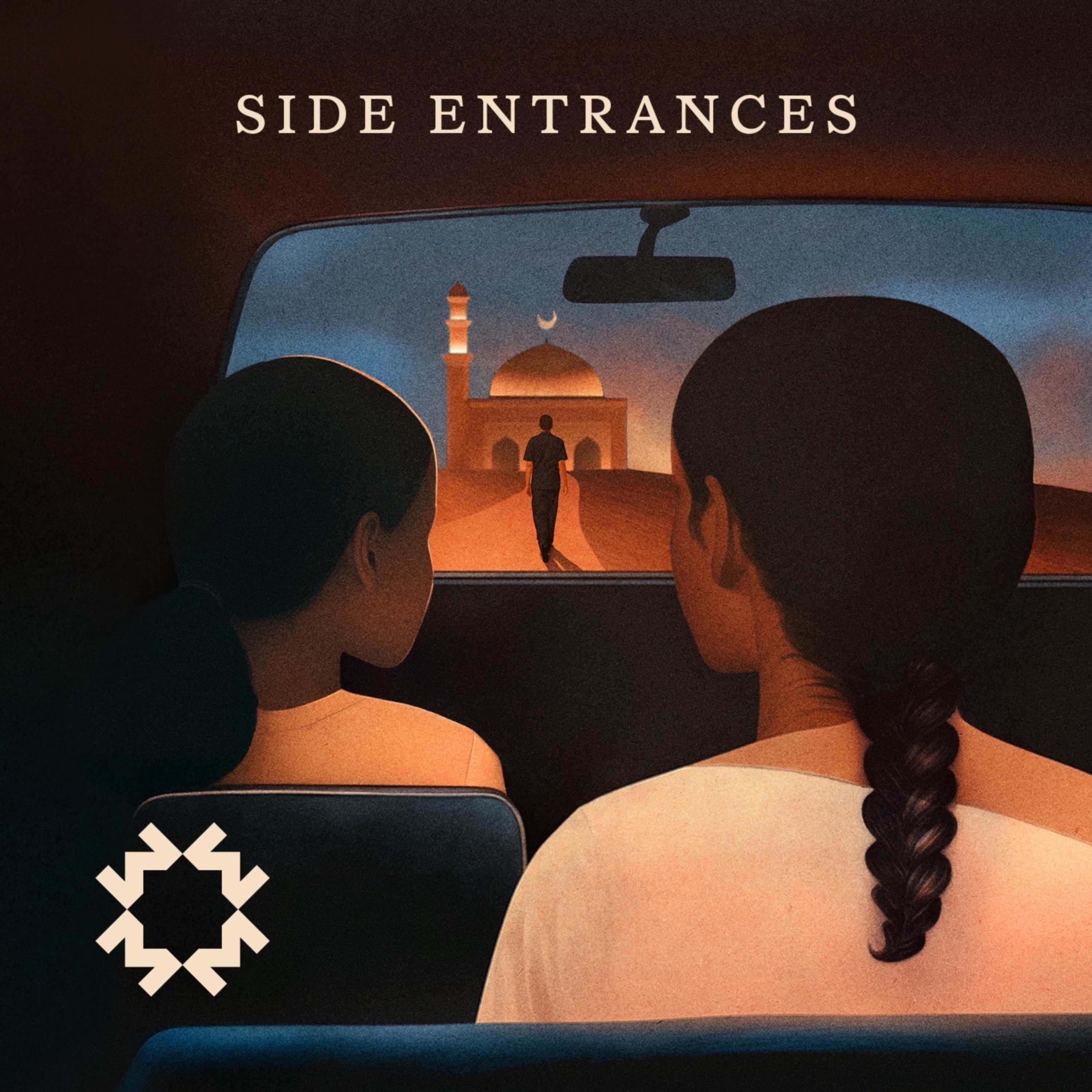
The transcription explores the historical and contemporary marginalization of Muslim women in mosques, centered on Hind Makki's experiences. Growing up in Chicago, Makki loved mosques as safe havens, but at 14 she was left in a car while her father prayed at a mosque that excluded women. In 2012, she posted a photo of a cramped women's prayer space (6x20 feet) in a large downtown Chicago mosque, launching the "Side Entrance" blog. Women worldwide shared photos of inadequate or non-existent prayer spaces, revealing a pattern of women being treated as afterthoughts. The project went viral, prompting both sympathy and backlash, including accusations of fueling Islamophobia and claims that women shouldn't pray at mosques. In 2015, ISNA and the Fiqh Council issued a fatwa requiring mosques to not turn women away, allow prayer in the main hall without barriers, and include women on boards. However, the barrier issue remains contentious; critics argue it causes practical problems like broken mics during prayers or missed funeral rites, and contradicts the Prophet Muhammad's model of mixed-gender prayer halls without barriers. The story highlights how exclusion from mosques leads to spiritual alienation and family disconnection from the community.
[Music] There's a sentence many Muslim women grow up hearing. It's often said gently, sometimes even reassuringly. It's better for women to pray at home. Most of us hear it so early that we rarely stop to ask where it even came from or what it's come to mean. It's an idea that's fundamental in shaping how our entire community functions. It shapes our architecture, it shapes our designs, and it shapes who's expected to be present and who's treated as an afterthought. Okay, can you hear me? Can you hear me? There you go. Okay, perfect. Yeah, sorry, just technical difficulties. Oh, no worries. There's a ukulele here. Nice. Reporter Takwasaadig has been working on a story about this. And it starts with a woman called Hind Makki. When Hind Makki was growing up in Chicago in the 80s and 90s, one of her favorite places to be was the Meschid. One of my earliest memories, I must have been about four years old or so. I remember how warm it was. I remember the buzz of the heater. I always loved to go there. The carpet was a lush dark forest green. There was a beautiful chandelier, and it was quiet. I loved to run in circles there in the main hall. The Meschid was a place where she felt safe, like she belonged. Outside of these walls was the rest of the United States, where people would laugh at my mom and my other aunties because they were hijab. People would comment about my parents' accent or they didn't know how to pronounce my name or my sister's name. But inside the mosque, that was not the case. Those places felt like home to me. One year in the summer holidays, this is when Hind was about 14. She, her sister and her dad came up with a new family tradition. We would pray at a different Meschid every Friday. They called it Mosque. But this is in the 90s, so the way in which you find the mosques to hop is through something called the yellow pages. You're saying that with this really surprise look, but you forget that I'm quite a bit older than you. So I'm quite familiar with the yellow pages, and that's how we would do our mosque crawls as well. Is it? It's a thing. You go to mosque or buzz jid, and then you find the list of all of your local mosques. If you're lucky, it has a phone number and you call and you find out. Amazing. Okay, so one Friday, they picked a Meschid that they'd never been to before. We drove down to the city more than an hour, and it's in a very vibrant, South Asian part of the city, where it's full of restaurants and fabric stores. You almost feel like you're in New Delhi when you're there. And so they put into this address that they had. They're thinking, is this it? It doesn't look like it's a mosque. Something feels off. The place looks more like an abandoned warehouse. Like an underground parking space, but then they see someone. South Asian uncle is in his shell archaemies, and he's very rapidly walking to somewhere. And so they'd add rolls down the window and ask for directions. An uncle who is like, no problem, follow me. Let's go. But, um, these girls, the girls don't come. And my dad said, what? And Hens dad explains these are his daughters. He can't just leave them there. They're excited to come and pray at the mosque. And the man was adamant. He said, no, no, no, no, no, no, no, no. There's no place for women. Come, brother, come. And this is the first time that they've ever heard, like, leave the girls. This is the first time this has ever happened. And Hens says it's a real shock to the system. It takes them a minute to process what is going on. And so the dad in this, like, really, he's literally in between a rock and a hard place. And he says, look, I'm just going to go pray really quickly. And I'll be back as soon as I can. And the girls are left by themselves in the car. You can kind of hear echoes of the men praying in Jamah. And we just sat there in this dark garage. Just sitting there and not praying. And just mystified, absolutely mystified. And feeling even a little bit hot. Like, because I was kind of angry, like, once the shock of it wore off. I remember just thinking, like, what do these people think that we are? Do they think that we're kufar? Like, we also need to pray. So why isn't the mosque the place for women to offer prayers? And when your dad got back in the car, did you guys have a conversation about it? We did. My father said, no, this man is wrong. These are people who think of this way, but they don't know. And, you know, moving on. My parents were so concerned with their children born and raised in the US to remain connected, to hold fast to the rope of Allah. And for my dad, I think he didn't want us to dwell on the moment. Because he didn't want us to think there's a reason to leave, you know, the faith. Because to be rejected from the messaged, the house of Allah, it's not that big of a jump to then feel rejected from Islam entirely. [Music] There are now over one billion Muslim women in the world. We take up space in every sense, intellectually, socially, spiritually. So what does it mean when our presence in one of the most central spaces of Muslim life becomes debated? This week on the show, reporter Takwasadik with a story that gets to the root of this conversation. How Muslim women's presence in the mosque has been formed and transformed through the centuries. I'm Sura Siddiqui, a professor of Islamic studies at Georgetown University and the director of Al-Mujadilah, a women's center in Qatar. This is more Muslim, a show about the Muslim experience, with all its messiness. [Music] So fast forward to a day in 2012. Hinde is obviously much older now, but she's seen in Chicago and she's out and about. I was in between meetings. She's a very vibrant part of the city in the middle of downtown. Just across from a massive lake called Lake Michigan, and she's looking for a place to pray. And lucky for her, there's an iconic messaged nestled amongst the skyscrapers. This is a five-story mosque. You have the Men's Prayer Hall and extra prayer hall. So she walks up several flights of stairs, past two giant empty prayer halls reserved for men. To reach the area where women are allowed to pray. Literally like a small corridor. And she's been there so many times before, but this is the first time where she thinks to herself, "I wonder how big this place actually is." I literally laid down to guesstimate how wide the hall is and I'm a short person, and so the width of that space was barely containing me. That six feet wide and roughly 20 feet long. I just thought that was so absurd and it was funny. And so she takes a photo of the whole room, and she's leaning against the wall and she just posts it on her Facebook. I just thought, "This is funny. Let's have a laugh." Even though beneath it was something quite painful, which is we are considered an afterthought. So Hint, she hits post, she puts her phone down and she prays. And when she's done, she turns over her phone and she's got a bajillion responses, like her phone is blowing up. The reaction that I received was illuminating. She gets a bunch of comments from women who instantly recognize where she is. "Oh, sister Hint, you're in the city. I know where you're at. I know which mosque you're praying in." And then what surprises her? She gets all these responses from men being like, "Wait a minute, you're at a mosque? Where are you? What do you mean?" I've never seen a mosque that looks like that. And she's like, "Guys, you do know where this is, because you pray in this mosque too. The iconic one in downtown Chicago." And the men are like, "How can this be that mosque?" Because for them, they've got two giant floors all to themselves and it's like this nice, well looked after space. But this is a Urika moment for her. She realises, "Okay, hold on. This is a problem that I've been up to."
that about for a long time, but actually there's something that can be done here. And I thought, ah, if we want to have a conversation about where women pray in misajid, there's Allah, Subhanahu wa Ta'ala says, Muslim men actually are our allies. She's saying, "You have this eye. It's number 71 in Surat-a-Tawba." And it says that the believing men and believing women are 'Oliya' or 'Allais' of each other. But they don't even know what the situation is. So she wonders, perhaps if she could just help Muslim men have a glimpse of what it's like to be a woman at the misjid, then things can change. But how to give them that glimpse, how to create that empathy? So like all 2012 revolutions, it starts with a post online. She posts an open call asking women to share pictures of their prayers faces. And to her surprise, hundreds of replies come in. Just an avalanche of photos, every single continent. In Abuja, Nigeria, sisters have every need address. The beauty I grew up with in Kaiv. My friend went to this beautiful mosque in DC. And the photo showed the good. We have our own eruders, but sisters were mistreating. The bad. To get to the women's section, you have to go up a flight of stairs, very difficult for older women. And the downright pathetic. When she went to go pray at the end of the men's area, a guy harassed her and her mom to go to the closet. Each eat I come home bitterly disappointed and spiritually hot. The women's prayer hall entrance and the funeral service entrance are one and the same. Hins sets up a tumbler blog to save and share the avalanche of photos pouring in. It was amazing for me that wherever you are in the world, oftentimes Muslim women will have the very same experience. That is, we are a little trepidacious about where we can go in the mosque, like which door should I enter from. And that's why she calls the blog Side Entrance. And so as all of these blips or one-off experiences are collated on Side Entrance, the pattern that Muslim women have always known is there of, you know, women being seen as second-class citizens in the mosque, segregated in cramped and dingy spaces, or just being straight up told that there's no place for them at all, that pattern becomes super visible. Visible to everyone. This is all I ever considered from it. 34-year-old Chicago woman named Hins rose into a big public conversation. An online project called Side Entrance, the photos went viral. What's the women challenge American law? Finland Mackie, she opened the stores for women. It's on CNN, the Huffington Post, ABC News, and naturally within the Muslim community, loads of people seem to be talking about it. And a lot of the response seems quite sympathetic, but at the same time, there's a backlash. People think she's playing into Islamophobic stereotypes about how Islamism is misogynist. We're already living in a time of Islamophobia and why area dirty laundry. People say she's making a fuss over nothing because it's not right for women to pray at the mosque. Come on, get serious, you know. It's right for a man, it's not right for a woman. You just want something fancy. You're a silly woman. And some people say that she's just another keyboard warrior. I did get somebody say to me, he's an imam and he said, "Oh, nobody wants to be on Hins Mackie's like bad mosque list." But it's not about that. The aim of the project was never to name and shame a mosque. Prayer in a community is not a privilege. It's a right and it's a commandment. But for a lot of men, it's more convenient for them to segregate women in a prayer space because they feel uncomfortable that women might be there and maybe they think that they will be distracted somehow with the existence of a woman entering to pray in the same hall versus the real actual function of praying in a community. Where are you going to have that community if it's not at the mosque? So in trying to reduce this hypothetical potential risk of "fits now" or whatever you want to call it, we end up pushing women away from Islam. And we lose the function of praying in a congregation which is to build a community and worship as a community. I grew up with the mosque as that third space that I would go to and I was so connected to it, you know, going to Muslim camp and having halapaz on Friday and when we moved to America, the mosque that was around us didn't have any of those things. My religious practice, my sisters religious practice, my brothers religious practice, even my parents religious practice all took a hit. You don't realize you're becoming alienated. You don't realize you're becoming disconnected from your identity or your values and your traditions. It happens very slowly. And there's just that moment where you wake up one day and you're doing something and you realize, "How did I get here?" So even though there was some backlash and the empathy idea in many ways failed, this is not the end of the side-entrant story because something tangible did come out of it. That's off to the break. So the side-entrant's project had caused quite the stir. There was this big public conversation and a backlash. But in the aftermath of that backlash, HEN began working on the ground with Massage It because the Massage It in America, well, they were having a bit of a crisis. People were leaving the mosque, but they were not leaving the faith and this is what the research had been showing. Okay, so if it wasn't like a massive crisis of faith, what was going on then? So this Muslim think tank called the Institute for Social Policy and Understanding, they launched a big research project to try and find out, and they invited HEN to join them. And what they found is, three demographics that reported that they did not feel welcome. Women of all ages and backgrounds, converts of all ages and backgrounds, and young people between the ages of 18 and 24. Yeah, I'm not surprised at all. And in other conversations, HEN also found that when mothers specifically weren't feeling welcome at the Massage, you saw whole families dropping off because fathers no longer saw the Massage It as a place to bring their families. And so there's a deeper question behind, what is the role of a Massage It to the community? Yeah. So obviously it's not simply about giving women a prayer room or a nicer prayer room. People with disabilities, for example, or people who will need sign language or children in a society where those kids are minorities, and oftentimes it's hostile to them and their identity. If you are not thinking about all of that, then why are you even building a mosque? I mean, it's a great question. Why are you building a Massage It? But I think part of the challenge is and something that we need to appreciate is that there's also this resource limitation, so there might not be enough physical space, and there might not even be enough budget to address some of these issues. Yeah, that was my first thought too, but after visiting Massage It up and down America, delivering training and workshops and getting under the hood of why all this is happening, HEN tells a different story. The budget of a Massage It does not tell me whether or not women will have a place to pray, because the Mass can have a multi-million dollar budget, but if the people behind it don't really think of women as part of the community, that shows in where women pray. And a Mass can be struggling to pay the bills every month, but if the people behind it believe that women are part of the community, women are there. There's a space for women. I think most women understand there are space constraints, but are we part of the community or not? So just wondering, that was 2012 when she started this blog, right? And then we're now in 2025. Yeah, exactly. So what's changed? So this is where it gets interesting. The main outcome of this big storm of opinions is a fatwa. In 2015, the Islamic Society of North America and the Fick Council of North America issue a statement and a fatwa. It takes them a long time to draft this and there's a lot of back and forth and a lot of conversation and like really rigorously legal debate about what this should say. And they come out with three things that they declare to all of the masters in North America that they should follow. The first thing is that no mosque should turn women away. The second is that every mosque
just should allow any woman who wants to pray in the main masala without a barrier to do so. And the third is that women should serve on the governing bodies of misogyn. So like have women on the board. The second one is where the controversy begins. Exactly. I just want to ask what is the the actual harm done by having a physical barrier? Sure. Okay. So I'll answer that question with a little story. Hint doesn't exercise with mosquitos in her workshops. She says imagine you're praying in a separate room to the Imam and you're following a long via a live mic feed. But then suddenly the mic cuts off. What do you do? What do you do? Do you carry on praying? Do you break your solar? What would you do? And she says the men are like confused because it's something they would never have encountered before. But that's happened to me. Like that's happened to lots of people. Yeah. It's actually really, really common. And it actually reminds me when I was in university, one of my best friends gave birth to a stillborn. And we arranged for the jinnaza of course to happen in the musjid. And we're in the women's section waiting for the jinnaza to begin. And we're waiting, we're waiting, we're waiting. And there is this kind of physician within the legal schools that if it's not like a fully formed child that you do the jinnaza outside of the musjid, not inside of the musjid. And someone had forgot to turn on the mics and make the announcement that they had moved the body of the baby outside and we're doing the jinnaza and the parking lot. So we're sitting there and eventually like I see, you know, of course my friend is going to stress. And so I said let me try to figure out what's happening. So I call, I'm calling all the men that I know. Nobody's picking up the phone. So I was like, let me just go out and I'm just going to knock on the men's section. And I go out and I see the the men are like loading up the cars to go to the cemetery. And so I go to them and I'm like, what happened to the jinnaza? They're like, oh, we did outside in the parking lot. Wow. And I was like, and none of you guys thought there's no women here. Like where's the mother? Where are the aunts? Where are the friends? Like all of the women who came here to pray behind specifically to the mosque for this? You guys didn't think where are they when you're out here in the parking lot? And then I had to go to my friend and I had to tell her like the jinnaza has been completed. And they're like, well, the jinnaza's been done. You don't do another jinnaza. And I just remember in that moment, thinking just because the mic was off and nobody thought to say, we know that women are here specifically for the jinnaza. Where are they? So not to insert my own biases here too much, but personally, I feel like this is all just so ridiculous to me. What do you mean? So we all know what the prophetic model of a masjid is. We know that the Prophet of the Lord has said, I'm had women and men pray in the same hall. This is widely recorded and accepted. And his son now was to have men form rows at the front of his mosque and women form rows from the back. And they would meet in the middle. There's no mention of a physical barrier between the men and the women. Women were welcome in the Prophet's masjid all the time. Yeah. And even when that may have presented a problem, the solution wasn't that women shouldn't come to the mosque. Like, there's one narration that always sticks with me. So one time in the Prophet's masjid, when the congregation would rise from Sejood, because of how some of the men would rest at the time, the women in the row immediately behind them would basically get flashed. And the Prophet's response wasn't to tell the women, okay, that means you need to go pray in a different area. Instead, he just told them to wait a bit before rising from Sejood. So the men have fully stood up and that way nobody gets flashed. Like that was his response to all of this. It's such a different approach, the idea that having women visible in the masjid or having women in the same space as men is a problem. So I'm like, how can anyone argue with that prophetic model? It's literally the son. Right. And I think the important point to note is that it's not just something that was happening during the time of the Prophet, Salah al-Alai wa Salam, throughout history we see that in many, many different parts of the world and at different times, women actually had a really vibrant relationship with the masjid. We see scholars in history actually giving fatwas about women spending the entire month in the masjid. Really? Yeah. Like women spending the entire month of Rajib, or for example, Shaban inside the masjid in preparation for Ramadan, or taking classes or my personal favorite gathering to celebrate after childbirth. We can see the fatwa of, you know, kind of women go to the Eid festival, party literally in the masjid, is a reflection of the fact that there's an Eid party happening in the masjid and the women are going. And so we start to see this beautiful texture emerge. What the women were receiving from the mosques was a lot more than just a place to pray. Yeah, exactly. So I just don't understand like what you're describing is such a far cry from what hints are on side entrance. And like this idea that women don't belong in the mosque, like where does that even come from? There is this rich history, but we also know at the same time that there is this side entrance reality of mosques not being open and not being welcome to women. Yeah, it's those two things that I'm just really struggling to hold together. Well, what's interesting for me is that I take this all back to a legal debate that began 100 or so years after the Prophet Salallahu Salam passed away and it actually continues interestingly to persist all over the world. Okay, so what's the debate? I mean, it comes from what the people see as a conflict between the narrations of the Prophet Salallahu Salam and then certain statements that his companions made after he passed. We're on the one hand, we have a Hadith that is widely considered a very strong Hadith in which the Prophet Salallahu Salam says, "Do not forbid the female slaves of Allah from going to the mosques of Allah." Yeah, it could not be clearer. Right. But then there's these three other narrations that open up the door just a little for the jurists to start saying, "Okay, but maybe we need to add some caveats to that." So the first is the Hadith of Aisha, the Prophet's wife who said, "If the messenger of Allah had seen what I see now, he would have forbidden the women to go to the mosques." Halas, the ruling would be different. What does she mean when she says, "If he'd seen what's happening now?" So that's the difficulty, right? Historically, we're not exactly sure what she was witnessing or referring to, but it opens up the door to then say, "If you fear that there's going to be some type of problem created by women going to the mosques, then women simply shouldn't go to the mosques." Exactly. And then there's another famous narration by Humor, and his wife says to him, "By Allah, I'm going to the muskid unless you forbid me from going." And it ends by saying, "And he would not forbid her." And so the jurists read this Hadith and they say, "Well, he didn't forbid her, but it means he could have forbid in her and then she wouldn't have been able to go." I mean, that's one way to read it. Yes, but this is the tricky world of interpretation, of course. And then there's a third narration. And it's a Hadith of the Prophet's (ﷺ) but here it's important for me to say that only one of the legal schools, which is the Hanboli school, takes this Hadith as a strong Hadith. And you don't really see it being used as much by the other legal schools, but interestingly, it's widely in circulation. So the Hadith is the Hadith of Umhumade, who is a woman who comes to the Prophet (ﷺ) and says, "I would like to pray with you." And his response is a bit long, so I'm just going to summarize it. But the first thing he says is, "I know that you love to pray with me," which is such a beautiful response. And then he says, "But it's better for you to pray in your house than in your courtyard, and it's better for you to pray in your courtyard than in the musjid of your people, and it's better for you to pray in the musjid of your people than in my musjid." And so this Hadith is oftentimes used to kind of say, "Well, the best place for a woman to pray is actually in her home." So it's those three narrations that open the door to this idea that, you know, there's something to be debated about the way that women interact with the musjid. And then from the rest of the history? Yeah, pretty much. We see these three narrations debated in the 8th century, all the way until today. And what ends up happening is that the kind of prophetic model of what the musjid is becomes just one option for how then we can set up the musjid today. Can I ask, like, if you take off your professor hat and you put on your Muslim woman hat, how do you feel about all of this? Yeah, I mean, I personally believe, and this is, I think, the real problem is, on the one hand, we want to say, you know, women should be these pillars of like righteousness and piety and morality and society, and they should wear hijab and they should remind people of the faith and they should raise faithful children. But then we're not providing them with the musjids as the place to nourish them. And so for me, I feel like there's a big gulf between our expectations of Muslim women's piety and what we're actually giving Muslim women. And so I think if we really want Muslim women to have that connection to their faith, then we fundamentally have to start looking really closely at these musjids that have ignored those needs so far and designed them to be a home for Muslim women in a way that historically was the case and is no longer the case in many places. So up until now.
we've been talking about making more space for women in the massage that already exist. But now I think let's talk about a place that almost does the opposite. All your life you've been into mosques. You take things for granted than the situation is as it is because it just is. And here you go, you know, the entire thing is for you. And you don't realize that you've been missing that until you have it. After the break, what happens when you design a mosque that's only for women? I'm Soher Sadiqi. This is more Muslim. So in this episode, we've been asking some important questions. What is the relationship between Muslim women and the mosque? And what is the purpose of the mosque in everyday religious life? And for me personally, these questions aren't just academic or theoretical anymore. For the last three years, I've been serving as the executive director of Al-Mujadilah, a mosque and center that is purpose-built just for women here in Qatar. And what that has meant in very practical terms is not just asking whether women belong in the mosques, but asking what it actually takes to design a mosque that nourishes Muslim women and takes our lives seriously. So Tukwa, I've been working here for the past three years, so it's become a very normal place for me. But you're coming from the UK for the very first time and entering a woman's mosque probably for the first time. So what was it like for you? So honestly, my first thought when I stepped out the taxi and looked at the building was, this isn't really what springs to mind when I hear a message. Thank you, you're taking care. Like, there's no obvious minaret, there's no dome, there's none of those like classic Muslim looking arches anywhere. Instead, it's a large rectangular building with glass walls. And instead of a dome, the roof, it looked to me like the giant piece of a full paper that's been balanced with top the walls, but it's kind of like undulating, like a wave of water. And the first thing that you see when you walk in right in the centre of the space is this glass atrium with two ancient olive trees. And the whole place is strikingly modern, but it has that deep-time peacefulness of a really old mosque. And when you're inside, all you can hear is women. My job was on the floor when I first walked in. First of all, like having a space fully only for women is insane. Robert and Lale are exchange students from Turkey and the US, and they were also visiting for the first time. I feel seen as a woman in Islam. It's like the architecture of it is so beautiful. Like the bathrooms aren't sane. I just came out of there. Yeah, I agree. I see this place as like designed by a woman and a former woman like the water place I'm in love with. In Turkey and the mosque, like water places only open to mail. So I have to take my wooden advance before I go outside and like keep done for an entire day if I'm outside. I feel like I do want to come here and gain knowledge. Yeah, the books specifically like looking at them. That just makes me want to pick the book. And especially like to see a bunch of people sitting around reading and I feel like I want to be like them. Yeah. Even though we're in the prayer space, there's an open plan library space. So we can kind of see women everywhere reading and there's even classes and a book club happening. You're straight away super aware that this is a lot more than just a prayer room. It's giving women something else. And so I was like, what even is this place? So that's when I walked over to your office and asked you like what is this place? What is a women's master? So the idea came from her highness, she's a mother of a son, that's the Chapea son of a catra foundation and the founder of Al Mujadla. So she had built a big mosque, which is known as Menaritain. And her vision for Menaritain was one large prayer space where men and women would pray together. And then at some where through the design process, they said, you know, it might be good to have some type of space for women if women are not comfortable praying in the main area. So then they made a small space for women at the top floor of this Mujadla. What she didn't predict and I think what people in the project didn't predict is that most of the women weren't comfortable praying in the same space as Men. And so that small women space became the women space. And when she would go there to pray very quickly, she realized that she was one of the only women praying in the shared space of the main prayer hall. And all of the other women were trying to cram themselves into this very small section. And she recounts one day in particular, she realized that she was one of the only women praying in the shared space of the main prayer hall. And all of the other women were trying to cram themselves under the stairs. And she said, there's this big beautiful mosque. Why are you praying underneath the stairs? Most of the women weren't comfortable praying in the same space as Men. Different women want different levels of privacy. It's very easy to kind of think that there is a, you know, a configuration of a mosque that makes everybody happy. But the reality is, is there isn't. And that for her, I think planted the seed of having a space just for women, where they can enjoy that expansive space that men were always able to enjoy within the mosque. This is Asya, she was visiting from London too. And it was when I spoke to her that I realized what this place makes possible and how it makes women feel. It's emotional because you're just walking. Like that's a little bit of a shock to the system. You don't have to find the space, you're just praying there. And you make me go motionally. Or not that emotional person. You take things for granted and the situation is as it is because it just is. But you go somewhere else in a tiny little section to the Louisvans area. And here you go. The entire thing is for you. And in terms of prayer, how does a woman only mosque actually work? Like as executive director, a museum mom? No, no, no, I'm not the mom. But it's a really important question. So we know that the wives of the Prophet, Salallahu al-Sallam, led other women in prayer. And from that, two of the legal schools say that women can lead women in prayer. This is the Sheffari School and the Hanbari School. And there are two other schools, the Malik School and the Hanfi School, which say that women cannot lead women in prayer. And so because of that, what we try to do is accommodate the diversity of these legal opinions within Mujadi Laid itself. So for example, if we have a large lecture and the Adhan goes off, we invite women to pray. We do have a designated member of staff that's a female that leads the prayer. But if people want to pray with her, they pray with her. And if they don't want to pray with her, they don't have to pray with her. And then when it comes to Jama, we want every woman to kind of feel comfortable that their Jama prayer is accepted and valid. So we have a male Imam that comes in. And we open up to men also on Jama to participate and the same thing during Ramadan for Tadawi. I mean, what do you say to people when they make the argument that you've got misadjid all over the place, why do you need one just for women? Because, you know, what we just had the conversation about is that how do women engage with those misadjid? Is that enough? I think the solution might be to create a space for women and you might say that the solution is to expand the misjid and to make more offerings for the misjid for you go work on your solution, right? And make the misjid better for women. And I'll work on my solution and both of us will contribute to the community. So the last thing I want to say is that when I visited, you kind of said something in passing, but it really stuck with me. And that was the reason why the space is called al-Mujadila. And I think it's the perfect note to end our conversation on. Surat Al-Mujadila was revealed in response to Khola bin Thaalaba who was a companion of the Prophet, Salallahu alayhi wa sallam, who was married to a very prominent companion who fought all of the early wars with him. And he divorced her using a pre-Islamic form of divorce known as the Zehar, which she felt was kind of an injustice to her. She went to the Prophet, Salallahu alayhi wa sallam, to ask about the validity of this divorce. And the Prophet, Salallahu alayhi wa sallam, not having an immediate answer in the narrations, he just kind of stood still. and then reveal it.
came down and the revelation starts off with "Ad samiyah Allah" right? So God has indeed heard the speech of the woman "Tashhtaki illa Allah" right? That's coming pleading to you. And it's this idea of a woman who feels wronged, who's identified a problem, who has a variety of different things that she could do. But she chooses to go to the Prophet (sallallahu alaikum) to find an answer from within her tradition. And she's vindicated right? When the Prophet (sallallahu alaikum) says, "The revelation comes and this form of divorce is no longer permissible." But I think the most powerful element of that is "Ad samiyah Allah" that Allah has heard the speech of this woman. And what's so beautiful about so many stories of women in the Qur'an, all of them are directly speaking to Allah. Maria when she's giving birth and she's shaking the tree, Hajiad when she is out in the desert and she's looking for water directly making du'aatu Allah. Asya at the depths of her despair with her husband Fira'un makes du'aatu Allah. There is something so beautiful about women mentioned in the Qur'an turning directly to Allah and about Allah providing an answer. And so we really wanted to house everything that we do with that basic idea that we as women should be turning to Allah and our voices can be heard. And there are solutions and that solution is from within our tradition. We have to find it for ourselves now. [Music] [Music] More Muslims hosted by Suhaira Sattiqi and created by Salman Ahadhan. This episode was reported and produced by Sakhwasadq, editing and original music by Salman Ahadhan with additional editing from Salah Kari. Fat check by Hiba Lourbani. Additional music sound design and engineering by Alexander Overington. Production support from Rabia Bushra, Sanya Ruhi and Me, Salad Yab. Special thanks to Mahasawd Al-Khalifa, Taliyah Augusta, Yismin Abdul Majeed and all the women who shared their voices on this episode and shared their stories on the side entrance blog. If you enjoyed today's episode, please take the time to read us and review us on Apple Podcasts, Spotify or wherever you listen. This season of more Muslims is powered by Al-Mujjadilah, a center and mosque for women in Qatar. Learn more about our show at mormuslim.org. And thank you for listening.
Podcast Summary
Key Points:
Many Muslim women are told "it's better for women to pray at home," shaping mosque architecture and community dynamics.
Hind Makki's childhood mosque experiences were positive, but at age 14 she was told to stay in the car while her father prayed at a mosque that excluded women.
In 2012, Makki posted a photo of a cramped women's prayer space (6x20 feet) in a large Chicago mosque, sparking the "Side Entrance" blog where women globally shared similar experiences of inadequate or absent prayer spaces.
The project faced backlash, including accusations of fueling Islamophobia and claims that women shouldn't pray at mosques, but also led to a 2015 fatwa by ISNA and Fiqh Council requiring mosques to not turn women away, allow prayer in the main hall without barriers, and include women on governing boards.
The fatwa remains controversial; critics argue physical barriers cause practical problems (e.g., broken mics during prayers, missed funeral rites) and contradict the prophetic model of mixed-gender prayer halls without barriers.
Summary:
The transcription explores the historical and contemporary marginalization of Muslim women in mosques, centered on Hind Makki's experiences. Growing up in Chicago, Makki loved mosques as safe havens, but at 14 she was left in a car while her father prayed at a mosque that excluded women. In 2012, she posted a photo of a cramped women's prayer space (6x20 feet) in a large downtown Chicago mosque, launching the "Side Entrance" blog.
Women worldwide shared photos of inadequate or non-existent prayer spaces, revealing a pattern of women being treated as afterthoughts. The project went viral, prompting both sympathy and backlash, including accusations of fueling Islamophobia and claims that women shouldn't pray at mosques. In 2015, ISNA and the Fiqh Council issued a fatwa requiring mosques to not turn women away, allow prayer in the main hall without barriers, and include women on boards.
However, the barrier issue remains contentious; critics argue it causes practical problems like broken mics during prayers or missed funeral rites, and contradicts the Prophet Muhammad's model of mixed-gender prayer halls without barriers. The story highlights how exclusion from mosques leads to spiritual alienation and family disconnection from the community.
FAQs
The 'Side Entrance' project is a blog started by Hind Makki in 2012, where Muslim women shared photos of their cramped, segregated, or inadequate prayer spaces in mosques worldwide, highlighting a pattern of women being treated as an afterthought.
She started it after realizing Muslim men were unaware of women's poor prayer conditions in mosques. She aimed to create empathy by giving men a glimpse of women's experiences, sparking a conversation about inclusion.
The fatwa declared three things: no mosque should turn women away, women should be allowed to pray in the main prayer hall without a barrier, and women should serve on mosque governing boards.
Physical barriers can lead to issues like women missing prayers or events when the microphone cuts off, as they are isolated from the main congregation. This can cause practical and emotional harm, as seen in a story where women missed a funeral prayer.
In the Prophet's mosque, men and women prayed in the same hall without a physical barrier, with men in front rows and women in back rows. Women were always welcome, and solutions were found for any issues without excluding them.
It sparked a public conversation and backlash, but led to on-the-ground work with mosques. Research showed women, converts, and young people felt unwelcome, and when mothers left, families often followed. This pushed for more inclusive mosque policies.
Chat with AI
Loading...
Pro features
Go deeper with this episode
Unlock creator-grade tools that turn any transcript into show notes and subtitle files.
 PodcastTranscript AI