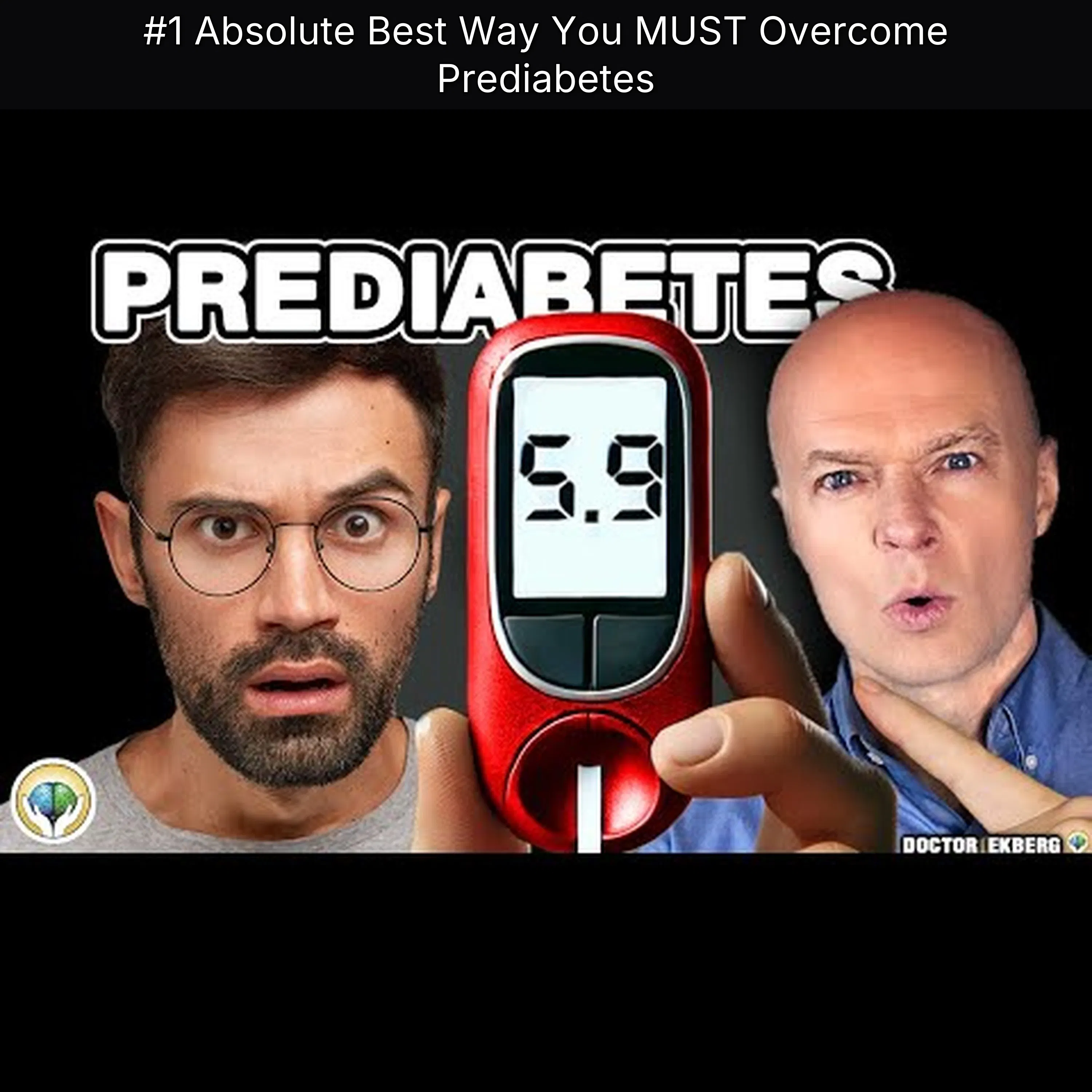
#1 Absolute Best Way You MUST Overcome Prediabetes
40m 37s
The speaker emphasizes the urgent need to reverse prediabetes, noting that 70% of those with it will become type 2 diabetic within a decade. Diabetes is a major contributor to heart disease, stroke, cancer, and dementia. In the U.S., 35 million people have diabetes, and globally, over 540 million are affected, with an estimated 1.6 billion having prediabetes. Additionally, around 4 billion people are metabolically unhealthy and at risk. The financial burden is immense: U.S. diabetes care costs $400 billion annually, with total healthcare costs at $4.5 trillion, much of it linked to metabolic disease. The core problem is insulin resistance, where the body fails to process carbohydrates efficiently. Measuring blood glucose (A1C) alone is insufficient because it changes late; measuring insulin reveals early dysfunction, as insulin levels can rise 4- to 8-fold while glucose barely shifts. Eventually, the pancreas maxes out, leading to uncontrolled blood sugar and often requiring injected insulin, which worsens resistance. Key causes include excess sugar and processed foods, fatty liver from fructose, chronic stress, inflammation from seed oils, microbiome imbalances, sedentary lifestyle, genetics, aging, and poor sleep. Solutions focus on lifestyle changes like diet, exercise, stress reduction, and improving gut health, rather than relying solely on medications.
Hello, health champions. Today I want to talk about why you must reverse pre-divities. And even if you don't think that concerns you, you really want to pay close attention to this video, because the vast majority of people with pre-divities do not know that they have it. And here's why you need to understand this topic, because 70% the vast majority of people with pre-divities will become type 2 diabetic in the next 10 years. That is how consistent that progression is once it has started. And type 2 diabetes is a causative factor. It's the strongest correlation and a causative factor in cardiovascular disease, in stroke, in cancer, and even dementia. And just how common is this problem? Well, in the United States, we have 35 million people with type 2 diabetes. And around the world, that is now an astounding 540 million people, over a half a billion people. Already living with type 2 diabetes. But then the question is, how many are going to become diabetic? And the pre-divities, again 70% of these are going to turn into diabetics in the next 10 years. That's 100 million people in the United States. And we don't have really good numbers for the rest of the world, because it's not such a recognized problem. Most people are starting to recognize most countries are starting to recognize type 2 diabetes, but not so much in the preceding stages. But if we use the same ratio here, then there is probably somewhere around 1.6 billion people in the world who have pre-divities in addition to the half a billion who already have diabetes. But it's shocking as those numbers are, that's not even the whole picture. Because if we start looking at the whole world's population, and this here would be 8 billion people, then there's a small percentage who are optimal, and there is a rather small percentage that have type 2 diabetes. So this would be the 540 million. And then we said that there's another 1.6 billion that have pre-divities. So right here we're talking about 2 billion people. But what about all the people in between here? What about the people who are what we might call pre-divetic? They're the ones who are not really healthy, not really optimal. They have started developing some metabolic problems, and they are somewhere moving in the wrong direction. That is probably somewhere around another 4 billion people. So we could make a case for 6 billion people not being really metabolically healthy, and not all of them are going to become diabetic, but we have a staggering number of people who are not optimal, who are at risk for at some point in the next 10, 20, 30 years to become diabetic. So on the one hand we have the human cost, the suffering. On the other hand, we also have a financial cost. So diabetes care in the United States costs about 400 billion dollars. And around the world they estimate that about $1 trillion for diabetes care. Now in my opinion, based on what we just talked about, total sick care in the United States is at 4.5 trillion dollars. And if diabetes is associated and a causative factor in most degenerative disease such as cardiovascular disease and stroke and dementia and cancer, then the vast majority, probably as much as 70 to 80 percent of all health care costs is indirectly related to this problem. And if it's 4.5 trillion dollars just in the United States, then I don't even want to think about what that number is around the world. So the real question is we know that they're suffering, but is this going to kill us or is it going to ruin us financially first? So then we need to really understand what pre-dabetes and diabetes is. And in a nutshell, it is called insulin resistance. And what that means is that whenever you eat carbohydrates, your blood sugar goes up and your body releases insulin to bring that blood glucose down to help the glucose from the bloodstream into the cell. And when that system is working, then everything is fine. We have a certain capacity to tolerate, to process carbohydrates. But if we abuse that system, if we overwhelm the system and break the machine, then we become carbohydrate intolerant. And that is what pre-dabetes and type 2 diabetes is. And we measure this along a continuum. So it's not something that you have or you don't have. It's not something that turns on or off. It's a gradient. It's different degrees of how much you have. So it's measured typically in A1C. Hemoglobin A1C, which is a three-month average of your blood glucose levels. And if your very insulin-sensitive, if your body is really good at processing carbohydrates and handling them quickly and efficiently, then you'll be at the green end of the spectrum and your A1C will be 5.3 or less. But if you're not perfectly insulin-sensitive, if it's starting to move along this spectrum and you get up even a couple of attempts to like 5.5, now we are starting to move along this continuum and we're starting to become part of the 4 billion people, some of which will become diabetics. And if we keep this going, then at 5.7, it's called pre-dabetes and at 6.5, it's called type 2 diabetes. But here's the problem. When we only measure blood glucose as A1C, then we don't see a whole lot of change. So from 5.5 to 5.3, there are significant metabolic changes and yet these numbers, these bars, look almost identical. Same thing with pre-dabetes. Now we have a significant problem and yet we can barely tell. These numbers are so similar. And even at 6.5, there is barely a noticeable change. And so this is part of the problem, that we don't recognize this soon enough because we're only measuring blood glucose. And if you look it up online, we find that it's a resistance to the hormone insulin resulting in high blood sugar. That is the only thing that they're concerned with is the blood sugar. So all treatments for pre-dabetes is aimed at lowering blood sugar, not looking at the two components of the problem. So one component is blood sugar. The other component is how much insulin does it take to keep that blood sugar there. And if we measure insulin, we see that a healthy insulin sensitive person would have insulin level of about three, a fasting insulin of about three. But by the time that the glucose, the A1C has changed even just a few percent, we might see that the insulin has increased fourfold. And by the time we get to pre-dabetes, it might have increased sixfold. And by the time we're diabetic, it could be eight times higher, eight hundred percent higher, even though the glucose has only changed a little bit. And this is the problem. Glucose is a controlled variable. It's very important for the body to keep it in a very narrow spectrum. So when we measure this glucose, we can only see results. We can only see changes when the body really fails. Because the body is working so hard at keeping it here. So if we measure this, we can't see changes until it has failed. But if we measure insulin, we see how hard is the body working. So with insulin, we can see that if we measured it, we would catch very, very early if there were some significant changes. And it's not going to be a perfectly linear graph for everyone. But this represents on average what we tend to see. But here's the other problem. That eventually, the body is cracking out so much insulin. The pancreas is working so hard that at some point, it can't really make more insulin. It's maxed out. It's plateaues. And what happens now is the body is working this hard, but it can't work any harder. And yet our insulin resistance is progressing. So this is where we see these blood sugar numbers get completely out of control where the blood glucose gets into the two hundreds and the three hundreds. Your A1C gets into the 10, 12, 14 range. And that's because we're becoming more and more insulin resistant because we're not making changes. But we've reached the point where we maxed out on insulin production. So unfortunately, up to this point, up to the 6.5, most people can do
well with something like metformin, which just helps the body become more insulin sensitive. And I'm not a huge fan of metformin, but I think it is relatively harmless compared to many other things. However, once we reach this point and they conclude that, well, it looks like the body has maxed out, it can't make more insulin, we need to inject more insulin to control this blood sugar. Now they are forcing the blood sugar down at the expense of becoming even more insulin resistant. So we already have eight times more insulin than we should have, and yet we keep adding more. We keep injecting it as a medication. And now we're controlling blood sugar to some degree, but we're making the whole metabolic problem much worse. And what can also happen at this point is that the pancreas is working so hard, it is struggling, it's a little sensitive, and there is a lot of inflammation and chaos in the body. So if we get an autoimmune attack against the pancreas, now it can't even maintain, it starts to fail, and the production of insulin goes down further. And in many cases where this progresses, it's called diabetes type 1.5. And this is where we have a type 2 diabetic that is in the process of becoming a type 1 diabetic. And at that point, they definitely will need some insulin. So the next question is what causes it? And there are some obvious answers, but we're gonna go through a list of 10 different things. I'm gonna run through it pretty quickly just so you can start seeing some patterns. And the most obvious one is excess carbohydrate intake. And it's not all carbohydrates, they're not all alike. Sugar and fructose is by far the worst because fructose, like alcohol, can only be processed through the liver. So the potential to overwhelm the liver is very high whenever we eat sugar. Next is high glycemic foods, things that raise blood sugar very, very quickly. And that is primarily processed foods. And processed foods tends to be high in white flour and in sugar. And then we have starchy foods. So this would be potatoes and rice. And these could be okay. So you can see by the color just how bad these are. And sugar is horrible for anybody, but starchy food is really only a problem if you have already developed significant insulin resistance. If you are metabolically healthy and you eat whole food and you cut out the sugar and the high glycemic foods, you can probably get by eating quite a bit of starchy food and never develop a problem. But what's happening now in China and India is they eat a lot of starchy foods. Their culture is based on rice and beans and lentils and things like that. But now, things that they have eaten for a long time and done well with is becoming a problem because they're adding the processed foods and the sugar. Number two is fatty liver that causes insulin resistance because a fatty liver interferes with the regulation. It interferes with insulin's ability to regulate blood sugar. The liver is kind of like the metabolic center. It sets the tone for a lot of things that goes on in the body. And excess sugar is the primary cause of a fatty liver. It used to be excess alcohol, but these days the vast majority of fatty liver is caused by fructose. And I put fructose and sugar ahead of alcohol, even though alcohol is a little bit more destructive on the liver, we don't consume as much of it. Alcohol has certain restrictions. You can't drink too much before you fall down, but sugar has no such limitations. And we give it to babies and toddlers and infants and young people as well. So there's no restriction in that sense. Also excess food can cause a fatty liver. It's like we're just stuffing the body full of food, excess food, and that's gonna end up in the liver. However, it is very difficult to eat excess foods unless you eat a lot of sugar and processed foods because those are the things that drive up insulin, that drive up your cravings, that drive up your hunger and your appetite and your ability to eat more than you should. Number three is chronic stress. When we have chronic stress, we get elevated cortisol levels. And cortisol, the primary purpose is to raise blood sugar when blood sugar goes up, insulin goes up, and therefore insulin resistance, of course. Now it also increases inflammation, chronic low grade inflammation from chronic stress. And it also interferes with sleep because cortisol shuts down completely the sleep hormone melatonin. And one more thing cortisol and stress does is it increases your cravings because the purpose of cortisol is to put you in a fight flight stage. You're looking for emergency fuel. You're looking for blood glucose. So you can get some of that from the liver increasing gluconeogenesis to making more glucose. But the fastest way to get more glucose is to eat something sugary. And that's where when you're stressed, it's much more difficult to resist all those vending machines that sell junk. Number four is inflammation. And this interferes with the insulin signaling pathways. And processed seed oils will contribute to inflammation because they are highly oxidized. And when I talk about processed seed oils, I'm talking about all the things that are sold as vegetable oils in the store, the soybean oil, the canola oil, the corn oil, safflower oil, et cetera. Even though those foods aren't terrible to start with, by the time we turn them into oil, we expose them to high heat, high pressure, and lots of chemicals. So there's a lot of oxidation going on. And we've really damaged these foods. Now, when we say vegetable oils, plant oils, we're not including olive oil or coconut oil or avocado oil because those can be made into oil with much less processing. So they're much closer to their natural state. Other sources of inflammation is processed food, chronic stress, like we just talked about, lack of exercise, dysbiosis, meaning an imbalance in your gut flora can contribute to inflammation. And of course, environmental toxins. So this whole list, and I hope that you start seeing how a lot of these things, these items, keep appearing on multiple lists and how there's a huge overlap. One thing affects another and vice versa. Number five is microbiome signaling. And this is so interesting. We're just learning more and more about how important the microbiome is and how much of your behavior and how much of the signaling in your body, the hunger and the cravings and the mood that depend on the balance and the health of your microbiome. So they've done experiments with mice. And to some degree, humans will get to that where they do a fecal transplant from a skinny mouse to a fat mouse. And the fat mouse starts losing weight. Without changing anything else, they feed in the exact same thing. And it changes the body's metabolic behavior. It starts losing weight. And it can work the other way also. Now with humans, where we've seen this the most, is with an infection called clostridioides or clostridium, difficile. And one out of 30 people have this bacterium, but it's not a problem until you develop an imbalance in your microbiome. Because as long as you have enough healthy bacteria to keep the bad ones down, the pathogens, like this one called C-diff also for short, as long as there's balance, it's not a problem. The good ones suppress. They compete with the bad guys. But if we lose the good guys, now these opportunistic organisms start overgrowing. And this can be very, very severe. This can be life threatening. And it kills a large percentage of people over 65 when they get this infection. Now here's the thing. This is cause. The number one cause for the C-diff infection is that you have been on a course of antibiotics. And these antibiotics killed off some of the good guys so they couldn't control the bad guys anymore. The second most common reason is that you were in the hospital when you got the antibiotics. Because in hospitals, you're more likely to be exposed to this bacterial strain. And now here's the problem. Even though this was caused by an antibiotic, the first course of action to treat this is another antibiotic. And pretty soon we run out of things that work and we develop stronger, more resistant, antibiotic resistant strains of C-diff. So this is where the fecal trans-diff infection
plant and the microbiome comes in. So now they have found that if you take a fecal transplant from a healthy person with a very healthy, strong microbiome and you implant it in the person with a C-diff infection, then in a very high percentage, very quickly, a few days, 80 to 90 percent of people are healed. So this is turning out to be a very powerful resource as an alternative to antibiotics. When the antibiotics don't work, we just go back to nature and we let the bacteria do the work. Now, one interesting thing is that they have found with humans also that some of the people who receive this fecal transplant, they will start gaining weight or losing weight after the transplant. They get healed from the C-diff, but afterwards they get metabolic changes because they receive the transplant from some with a different metabolism than their own. And I know what you're thinking now that this would be the next super treatment for obesity and there's a lot of people thinking along those lines, but that's not the way that you want to go because this is not going to create optimal health. It's not going to create balance unless you rebuild the entire environment. The fecal transplant is great for emergency intervention instead of an antibiotic, but if you want this to last and you want good health, then you want to do it the right way and you want to rebuild the entire environment and reseed your guts. And some of the causes of a microbiome imbalance would be antibiotics like we mentioned, environmental toxins can kill off and affect some of the good guys. Processed foods will tend to feed the pathogenic, the unwanted bacteria, and artificial sweeteners also will kill off some of the good bacteria. Number six, a sedentary lifestyle can also cause insulin resistance because the opposite of sedentary meaning exercise will have the following benefits. It will reduce obesity and insulin resistance and it's not the primary or the best way to do this. Diet is by far more powerful, but you really want to do both. Then we have exercise will reduce inflammation, it will reduce stress, chronic stress, and chronic cortisol. It will improve the microbiome balance. It will tend to benefit your good bacteria and manage to keep the bad ones down. And exercise also in many people will improve sleep. Number seven is genetics and you can have a genetic predisposition to insulin resistance, but we have to remember that it's a predisposition. That doesn't mean that you have to get it. And your genetics, there's nothing you can do about it. So basically you want to forget about that part of it. What you want to pay attention to is epigenetics, which means on top of genetics. And that is all about how you express your gene. You have a certain genetic makeup, but you can have genes and you can express them or you cannot express them. You can express them well or you can express them poorly. And this is something that is all up to you. That is all about lifestyle. And that is all of those things that we're talking about in this video. And in most of my videos, they're all about your genetic expression, your epigenetics. Number eight is aging. We tend to get more insulin resistance as we age. And again, there's nothing you can do about this. However, epigenetics comes back. And that is the expression of aging that you could age really fast. You can't do anything about your chronological age, but your expression determines your biological age. Number nine is poor quality sleep or insufficient quantity of sleep. And what they have found is that after a night of poor sleep, you wake up with higher cortisol levels. In other words, you are more stressed already. And this will increase your inflammation. It will increase blood sugar. It will increase insulin and it will increase your cravings. So anytime you sleep poorly, you have a higher tendency for cravings and eating more stuff that you shouldn't eat. And the 10th thing that can cause insulin resistance is medications. So corticosteroids, obviously, which is a synthetic form of cortisol is an incredibly powerful way to become insulin resistant. And gain weight. We have anti-psychotics. We have beta blockers, which often are given to people for blood pressure, which is associated with insulin resistance. So you have someone who's insulin resistant. You give them something to treat a symptom. And now that makes them more insulin resistance. So again, we can't treat symptoms. We have to start addressing root causes. Next one is thiazide diuretics. Again, they can cause insulin resistance. But mostly they're given the diuretics are given to people with high blood pressure who are already insulin resistance. And we have statins. We have hormonal contraceptives, if you have birth control pills that can drive up insulin resistance. And mostly insulin can cause insulin resistance. It's the number one driving factor for insulin resistance. So if you're already insulin resistant and you get to the point where your body can't make anymore, now the treatment of choice becomes insulin, even though you already have way too much. So here's what you want to do about this. It would be my recommendation that you measure your baseline. So you want to measure insulin. You want to get some blood work to measure insulin. So you know where you are. You want to measure some inflammatory and some cardiovascular disease markers. And these would be things like an NMR, which is a detailed cholesterol panel that measures the size and the number of LDL particles. If you have a high number of LDL particles and they're small, then that tends to indicate inflammation. That's a metabolic problem. You also want to measure lipolidl A. That's a genetic marker that if that is very high, then you have a greater tendency to lay down plaque. And that just makes it even more important that you control all the other factors. But it's a genetic marker. So you only need to measure it once. If it's high, you got an issue. If it's low, then your odds are stacked in your favor. CRP is C reactive protein. It's another inflammatory marker that's good to track. And homocysteine, which is a intermediate metabolite. Your body makes it and your body breaks it down. But if you have a genetic variant called MTHFR, then you cannot convert this homocysteine and it tends to build up. And that is a risk factor for heart disease. It's an inflammatory risk marker. So this would be a really good baseline. This will tell you where you are and then you can make some changes and you can compare that three to six months later. But if you've already tried a lot of things and your body is kind of stubborn and you've done the whole food and you've done the intermittent fasting and you've tried all the different diets out there and your body still doesn't really respond. Now you probably want to go looking more not just at a baseline, but dig deeper at root causes. And here is where we're finding more and more how important it is to analyze your microbiome. So in my office we now perform a DNA sequencing of your complete microbiome. So you see exactly how all the different strains relate, what's the balance, which ones are too much of a bad or a pathogenic version and which good ones are missing or not enough. And one more test you want to consider is to measure your omega three to your omega six fatty acid ratio. So if this is in your means, I would strongly recommend to do that because you can address it with much better specificity. You can be lay out a plan with much more detail and a greater probability of success. Now I'll put some links down below where you can contact us if you want more information. If this is not within your means, there's still a lot of things that you can do. It may just not be as specific. So here's what you want to do. Three things you want to exercise. You want to move on a regular basis. Your body is made for movement. You want to chill. In other words, practice relaxation, practice meditation, practice breathing exercises, practice letting go emotionally of things. And next is real food. You want to give up your processed foods, your packaged foods, your sugar, your white flour, start eating real food. If you noticed on all these slides,
how many times processed foods came up. That is the number one thing that causes insulin resistance and poor health. So stop processed foods and then I think that you should eat no more than one to three meals per day. A lot of people here that they're supposed to eat three meals and three snacks and anytime you feel that you need a little top off in your blood sugar you have another snack. That's not a good idea. That's not how the body works. Your body knows how to make energy from the foods you eat. You do not need to top it off and have snacks and breaks everywhere. So if you're very insulin resistant then you can probably eat one meal a day and that will increase your body's ability to burn the fat off your body. If you're maintaining or just preventing a slight imbalance reversing a slight imbalance then two to three meals should be fine. And then you want to eat low-to-moderate carbohydrates. And if you start eating real food, if you cut out the processed foods and the packaged foods you probably already cut your carbohydrate at least by half, maybe even down to a third. And you would be in low-to-moderate. If you are a diabetic or you're very insulin resistant then I suggest that you would go to low carb or even ketogenic but that doesn't mean that you don't eat any carbs. It means that all your carbs are going to be leafy greens and non-starchy vegetables. And then you want to eat a moderate amount of quality protein. And this could be plant protein or it could be animal protein. I think the body is made to eat animal protein and as long as it's a good quality it shouldn't be an issue. If you eat grass fed meat, if you eat wild caught fish, if you eat pastured chicken, the way those animals were supposed to live then there will be very healthy for you. And the rest of your calories should come from natural fats. You do not want to be afraid of fats but you want to be afraid of commercial oils. There's nothing wrong with the fat in grass fed meat or wild caught fish or nuts or seeds or in extra virgin olive oil or in mildly processed avocado oil. All of those are just fine but don't go the route of the commercial oils. And then you want to constantly work and emphasize trying to get a wide variety of foods because different foods have different nutrients, different foods have different properties and the more variety you can get the more you're going to support your body. So some of these foods you're going to eat for your human cells. You need certain things to make energy and to build tissue. But what we're learning more and more is that you also need to think about feeding your bacteria. And this is where you especially want to get a great variety of leafy greens and non-starchive vegetables. There's thousands and thousands and most of us probably eat three different kinds. Even if we eat a lot of vegetables we limit it to certain ones that we get into the habit of eating that we're comfortable cooking. But try to expand your horizons, try to find new things to eat and your body will thank you for it. If you enjoyed this video you're going to love that one. And if you truly want to master health by understanding how the body really works make sure you subscribe, hit that bell and turn on all the notifications so you never miss a life-saving video.
Podcast Summary
Key Points:
70% of people with prediabetes will develop type 2 diabetes within 10 years.
Type 2 diabetes is a major causative factor in cardiovascular disease, stroke, cancer, and dementia.
An estimated 2 billion people globally have diabetes or prediabetes, with another 4 billion being metabolically unhealthy.
The primary underlying issue is insulin resistance, where the body becomes intolerant to carbohydrates.
Standard blood glucose (A1C) measurements fail to detect early metabolic problems; measuring insulin levels provides earlier warning.
Causes of insulin resistance include excess sugar and processed foods, fatty liver, chronic stress, inflammation, microbiome imbalance, sedentary lifestyle, genetics, aging, and poor sleep.
Fecal transplants have shown promise for treating severe microbiome imbalances like C. diff infection, but lifestyle changes are key for long-term metabolic health.
Summary:
The speaker emphasizes the urgent need to reverse prediabetes, noting that 70% of those with it will become type 2 diabetic within a decade. Diabetes is a major contributor to heart disease, stroke, cancer, and dementia. 6 billion having prediabetes.
Additionally, around 4 billion people are metabolically unhealthy and at risk. S. 5 trillion, much of it linked to metabolic disease.
The core problem is insulin resistance, where the body fails to process carbohydrates efficiently. Measuring blood glucose (A1C) alone is insufficient because it changes late; measuring insulin reveals early dysfunction, as insulin levels can rise 4- to 8-fold while glucose barely shifts. Eventually, the pancreas maxes out, leading to uncontrolled blood sugar and often requiring injected insulin, which worsens resistance.
Key causes include excess sugar and processed foods, fatty liver from fructose, chronic stress, inflammation from seed oils, microbiome imbalances, sedentary lifestyle, genetics, aging, and poor sleep. Solutions focus on lifestyle changes like diet, exercise, stress reduction, and improving gut health, rather than relying solely on medications.
FAQs
Pre-diabetes is a condition of insulin resistance where blood sugar is elevated but not yet diabetic. It is dangerous because 70% of people with pre-diabetes will develop type 2 diabetes within 10 years, which increases risk of heart disease, stroke, cancer, and dementia.
Over 540 million people have type 2 diabetes globally, and an estimated 1.6 billion have pre-diabetes. In total, around 2 billion people are affected, with another 4 billion possibly at risk due to metabolic issues.
Insulin resistance means your body's cells don't respond well to insulin, so the pancreas produces more insulin to manage blood sugar. This leads to high insulin levels and eventually high blood sugar, defining pre-diabetes and type 2 diabetes.
Blood glucose (A1C) only shows changes when the body is failing, but insulin levels reveal how hard the body is working. A fasting insulin of 3 is healthy, but it can rise 4-8 times before glucose changes much, allowing early detection of metabolic problems.
Key causes include excess carbohydrate intake (especially sugar and processed foods), fatty liver, chronic stress, inflammation, microbiome imbalance, sedentary lifestyle, poor sleep, and aging. These factors often overlap and worsen each other.
Chronic stress raises cortisol, which increases blood sugar and insulin levels, promoting insulin resistance. Cortisol also causes inflammation, disrupts sleep, and increases cravings for sugary foods, further worsening the problem.
Chat with AI
Loading...
Pro features
Go deeper with this episode
Unlock creator-grade tools that turn any transcript into show notes and subtitle files.
 PodcastTranscript AI