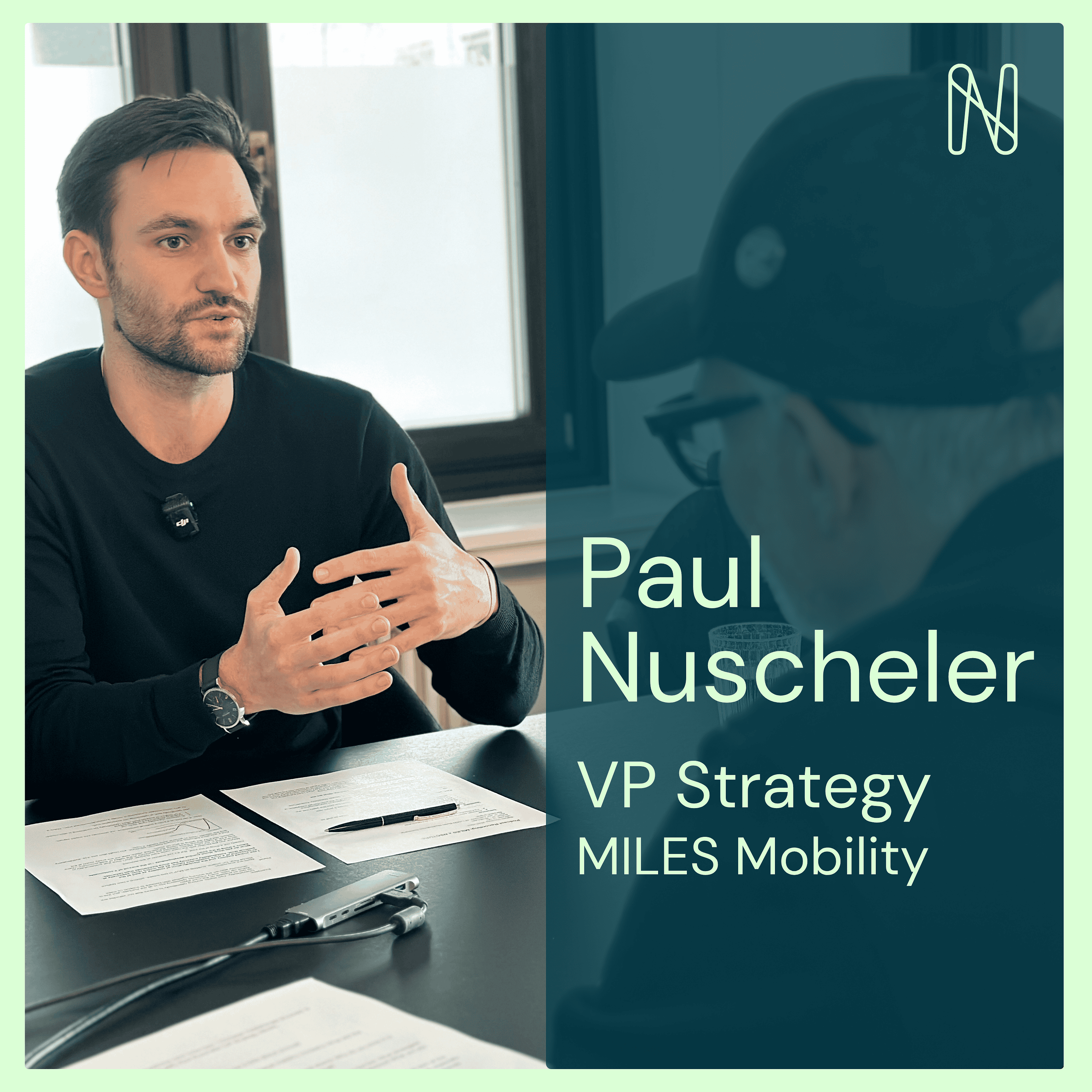
#04 - "Mobility is about convenience, and density is one of the key factors"
from Conversation Journeys & Across the First Million
12m 37s
This transcript features a conversation with Paul, VP of Strategy at Myos Mobility, discussing the company’s journey and the car-sharing industry. Paul outlines his role covering strategy development, process optimization, project management, and ESG. He highlights Myos’s acquisition of Volkswagen’s WeShare as a pivotal moment, along with launching the Myos Subscription service and expanding its footprint in Germany. Key obstacles include operational complexity—addressed by internalizing the value chain—and shifting consumer behavior toward shared mobility. Paul emphasizes that car-sharing complements public transport, filling gaps and reducing private vehicle ownership, which benefits urban sustainability. Regarding sustainability’s current unpopularity, he likens it to the “valley of disillusionment” in the hype cycle, expecting a recovery as long-term benefits persist. Density of vehicles is crucial for convenience and usage. Looking to 2035, Paul advises “courageous optimism,” urging active participation in shaping a sustainable future despite present negativity. The discussion underscores Myos’s role in transforming urban mobility through strategic growth and resilience.
Welcome to Nature's Conversation Journeys. We travel to or in by the mirrors and shakers of the mobility, energy and climate ecosystem. Please send in and enjoy the talks. Welcome everyone to this new episode of Nature Conversations. I am very proud and honored actually to meet Paul. Paul is a VP of Strategy of Myos Mobility and I look forward to very exciting conversation with you Paul. Thank you for having me. Let's start with the short introduction about yourself and Myos. Perfect. As you mentioned, I'm Paul under VP's Strategy at Myos and having with the company for almost three years now. Maybe a little bit about my role and how I think about strategy. I think about strategy in terms of different pillars. There's the one pillar which is really like the strategy and strategy development. Defining where the company intends to be in the next years and also to steer it in that direction on how to get there. Then there's the second pillar around processes and organization so doing larger process optimizations or reorganizations. Then there's anything with regards to project work. So any larger cross-functional project would normally fall under my domain. For example, we did the post-merge integration of research and maybe we can talk about this one later on. And then the last part is about ESG. So anything we do with regards to our COVID-COVID-COVID footprint is G with POTS and so on. Thank you. Thank you very much. That's exciting. So Myos, I mean, I've been following the footsteps of Myos since 2019. So pretty much the beginning. I remember the fleet size was like 50 vehicles at that point in time or the team time thing like this. So today we're taking a look at Myos as being one of the most successful players in the share mobility field in Europe and one that was super early to declare profitability. So what are you personally maybe most proud about if you take a look at your personal journey within Myos? So maybe I'm going to start a little bit with kind of where we're coming from because I'm not able to tell you the war stories from the very beginning as I joined Myos only in 2022. But my personal story with Myos began as a user in 2021. And I really had the feeling back then that Myos was changing the car sharing market from a user perspective just with the amount of vehicles that densely the service level that Myos provided. And also when I think about generally car sharing that was around the time where the car sharing service level went to a point that was so good that it posed a real alternative and maybe even a threat but a really an alternative to the private vehicle. So users could rely on it so much and I'm a car sharing user and already was back then now even more to have like this alternative. Now when it comes to my personal story at Myos pretty much around the time when I joined we acquired a competitor, a reshare which is the car sharing or was the car sharing daughter company of Volkswagen. And that was a big one for us because I think it put Myos on the map. The Berlin Underdog taking over the car sharing subsidy or Volkswagen. That was a big deal. And other important Myos on Formars in recent years at the end of 22, 23. We also launched our third product pillar, Myos subscription. That was very important. We continuously expanded our footprint in Germany, expanded within the core cities, but also added new cities. And then just I think in general like how we professionalized as a company, our operations, all these topics in general I think Myos can be proud of those. I still remember when I read the news about the acquisition of WeShare.com and I honestly I could not believe it. I had to laugh loudly because that was such a cool, you know, in such a courageous step to do. It was like, oh my god, they're really there to do this. This is amazing. But obviously coming from a comment from a position of a maybe a memory position in the market, to go and be so bold to do that was, was really totally amazing. I think you mentioned a couple of initiatives that you run and that made Myos successful. What do you think were key obstacles on the way or was one of the obstacles that you were facing? How did you overcome these? Yeah, so I think there are two key challenges that car sharing has in general. One of them is the operational challenges and the complexity that comes from it. The other one is the changing mobility behavior of people over time. The first one I would say is where Myos is really good at because I think we are probably the best operator in the car sharing industry. Why? What we have done is we have internalized a lot of the value chain and therefore have gotten many of the pain points that normally exist along the value chain under our control and can actually do something about it. That's one part. The other one about shifting the mindset, that's something that takes time and that's something that we continuously work on with our product offering, trying to expand use cases, trying to launch new product features, and really being this alternative to a private vehicle and in the end also being an important part of a multi-modal mobility mix. For me, that aspiration was always linked with the overall mobility ecosystem also in the city. Because car sharing undoubtedly contributes a major role now in the ecosystem because it feels the gap that are opening up on our own inside public transport cannot cover everything. Everything will use case and demand, pattern. On the other hand side, vehicle ownership also now in the face of economic policy challenges, is getting more and more difficult for the average citizen. So I think this is really feeling a needed gap that otherwise would not be covered at all. Absolutely. I can only underline that car sharing works particularly well in collaboration with public transport. There's only if there's a strong public transport, there's a very good case also for car sharing. I can only speak about myself as a user. I don't own a vehicle. I use public transport, I bike, but I also use car sharing for rights that maybe it takes too long with public transport sometimes. Maybe I need to transport something. So for these type of use cases, car sharing is essential and just a great addition to my other mobility mix. I can really resonate with that quite well. What I want to take is what you said before. In some cases, maybe replacing individual vehicle ownership or being the better alternative, right, be the more attractive alternative as what it should be. If you take that to the extreme and say, okay, that also then has an impact on the sustainability of a mobility ecosystem within a city. Because the total number of vehicles in a city can go radically down. Yes, right. So that the thought of sustainability, like you're growing in the last years, but specifically in the last, I don't know, 12, 18 months, I think I feel some, some headwinds and not just tailwinds for that topic. Do you also see a shift in mindset and do you see that on a, I don't know, even on a consumer level, opinion leader level. So sustainability certainly has a lot of headwind at the moment. But I believe it's clearly not a thing of the past, but it's just not very popular at the moment. I'm not sure if you're familiar or maybe you're familiar with the hype cycle from Gardner. And I think sustainability in general at the moment is kind of at this valley of dissolutionment. So you have something at hype in the beginning. Now it's at the very bottom, but then it's the slope from light and then comes and it goes up again. And I think that how I view it is we at the bottom at the moment, but it will come again. Because long term, I mean, it's just makes a lot of sense to focus on sustainability focus also. I think on electric vehicles and I'm pretty sure that that will come back. So whereas again, at the moment, it's not so popular. I'm very sure that it will become popular again. I hear you and I can follow the thought that it's a lot about mindset and also maybe mood swings of society. Yes. The moment we're at the one extreme, right? What I personally witnessed was the hype cycle of the internet. And I started my own career in early 2000s and 2001, 2002, there was this big internet bubble that burst. And then no one believed that internet will ever play a vital role in this world, right? At that point in time, it was like written dead. But this was exactly the moment where the most successful companies of today were built and started to do business and substantial business. So I pretty much see that also happening in the in the McGilley fund, although it's not easy, right? No one says this is going to be easy. This is constant improvement. But that's what I would I feel and hear from our collaboration as with my as is always always about, right? Never never be satisfied with with one one's status, but always looking forward to next because the via environment is changing as well. Absolutely. So our ambition to create this market and to be an active participate in it. And if we quickly come back to the challenges of sustainability in a car sharing setting. So for example, e vehicle subsidies have been cut, the charging infrastructure is still lagging behind. Also the degree of support from cities varies, some already subsidized or support us if we have more e vehicles. But I think if these factors also change, and I'm sure they will change at one point, that will align them even more with our interests of putting more vehicles. And increasing the share of electric vehicles and thereby just making creating a more sustainable mobility in cities.
Wonderful. Yes, more vehicles definitely because I learned that density plays a major role in the ability to address consumer needs, right? Yes, absolutely because in the end mobility is a lot about convenience. If you have a lot of time, I mean you could walk in some cases, but oftentimes you don't have the time and you need to get to a place from a place A to B quickly and conveniently. And the closer vehicle is located to the position that you're in. It's really the likelihood of you taking a car sharing vehicle, also like another fast mode of transport just increases. So density yes, for sure is one of the key key factors had to make a car sharing company successful. Okay. Thank you for sharing this inside. My last question here is a little bit of a game. So I would like to take us into I would like to put this into a time capsule and beams into the year 2035. So 10 years from now, actually. And from the position of 2035 looking back at the two of us sitting here right now, what advice would he give us? Especially in times as today where many people view have a very negative or pessimistic view on things. If I would be myself now back into today, basically I would try to ask people to or like try to advise to look at the future with curation optimism to take matters into your own hands. And just to try to play an active part in wherever you can for us, it's in mobility and shaping mobility to become more sustainable better in a way. So it's curation optimism for me. Courage optimism. Did the courage part definitely that I have to work on my courage part every day, to be honest. As as a founder and CEO, it's we said to be courageous, right? Then a day to day level. And he said, it can be very much a challenge. This resonates, resonates very well. I try to I try to share this thought also with my kids because they're ultimately gonna gonna define what the future will look at. Like we ours that with our time will be limited. We have another, I don't know, 20 years, maybe two to steer what's there. So I think it counts even more what we would we do now, right? Towards that future. But thanks for very much. We're sharing your thoughts Paul. It's been a pleasure having a in this conversation. I enjoyed it immensely and look forward to take a look where where miles will be in 2035. Thanks a lot for having me. Thank you.
Podcast Summary
Key Points:
Myos Mobility is a successful European car-sharing company that acquired Volkswagen’s WeShare subsidiary, shifting from an underdog to a major market player.
Key achievements include launching Myos Subscription, expanding in German cities, and professionalizing operations through internalizing the value chain to manage complexity.
Car-sharing works best when integrated with public transport, offering a convenient alternative to private vehicle ownership and reducing urban vehicle numbers.
Sustainability faces current headwinds (e.g., cut EV subsidies, lagging charging infrastructure), but is seen as in a “valley of disillusionment” that will recover long-term.
Density of vehicles is critical for user convenience and success, as proximity increases usage likelihood.
Advice for the future
Summary:
This transcript features a conversation with Paul, VP of Strategy at Myos Mobility, discussing the company’s journey and the car-sharing industry. Paul outlines his role covering strategy development, process optimization, project management, and ESG. He highlights Myos’s acquisition of Volkswagen’s WeShare as a pivotal moment, along with launching the Myos Subscription service and expanding its footprint in Germany.
Key obstacles include operational complexity—addressed by internalizing the value chain—and shifting consumer behavior toward shared mobility. Paul emphasizes that car-sharing complements public transport, filling gaps and reducing private vehicle ownership, which benefits urban sustainability. Regarding sustainability’s current unpopularity, he likens it to the “valley of disillusionment” in the hype cycle, expecting a recovery as long-term benefits persist.
Density of vehicles is crucial for convenience and usage. Looking to 2035, Paul advises “courageous optimism,” urging active participation in shaping a sustainable future despite present negativity. The discussion underscores Myos’s role in transforming urban mobility through strategic growth and resilience.
FAQs
Paul is the VP of Strategy at Myos Mobility, responsible for strategy development, process optimization, cross-functional projects, and ESG initiatives.
Myos acquired WeShare, Volkswagen's car-sharing subsidiary, launched Myos Subscription, expanded its footprint in Germany, and professionalized its operations.
The two key challenges are operational complexity and the need to shift mobility behavior over time.
Myos internalizes much of the value chain to control pain points, making it a top operator in car sharing.
Density increases convenience, as closer vehicles boost the likelihood of users choosing car sharing for quick and easy transport.
He sees sustainability in a 'valley of disillusionment' but believes it will regain popularity long-term due to its inherent value.
Chat with AI
Loading...
Pro features
Go deeper with this episode
Unlock creator-grade tools that turn any transcript into show notes and subtitle files.
 PodcastTranscript AI