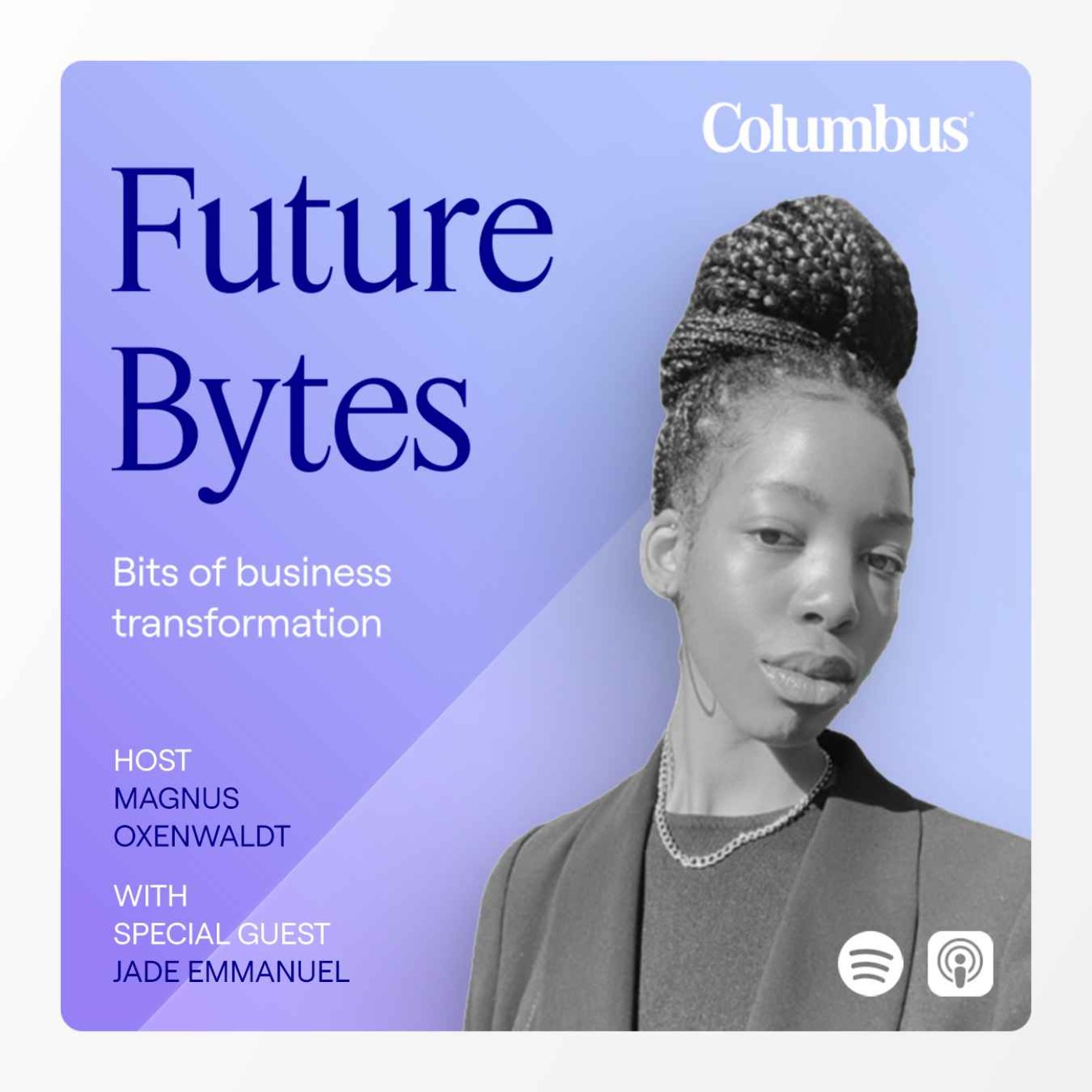
#033: Future Bytes: End-of-year special with co-host Jade Emmanuel
49m 41s
In this year-end reflection, host Magnus and AI strategist Jade discuss the major AI themes of 2025. A defining moment was the release of DeepSeek, which thrust questions of AI trust, transparency, and explainability into the mainstream and boardroom conversations. The year marked a significant shift in perception: AI moved from being a futuristic concept to a present-day business reality, increasingly seen not as a tool to replace humans but to augment them. This involved freeing employees from routine tasks to focus on higher-value work and customer relationships. A critical lesson for businesses was that realizing AI's value requires more than technology investment; it demands a holistic transformation involving people, processes, and strategic change management to avoid stalled pilot projects. The discussion concludes by noting the growing maturity gap between organizations and the accelerating pace of change, underscoring the need for businesses to strategically navigate their unique AI journeys while using predictive tools to manage an uncertain future.
[MUSIC] Welcome to a very special end of the year episode of Future Bites. I'm Magnus Oxenbolt, and today I'm excited to be joined by Jade Emanuel, a UK-based data and AI strategist and a senior data and AI consultant here at Columbus. Jade works closely with leaders across enterprise and fast-grown businesses on how data drives insights and how AI actually changes decision-making, operating models, and ways of working. Which makes this really interesting conversation and a partner toast today. Jade, great to have you here. Before we head into all the topics, maybe you can add on to that and tell us a bit more about yourself. Of course, thank you, Magnus. It's great to be here. Thank you for introducing me as well. I'm Jade, I work across data, analytics, and AI, combining both a strong hands-on and data science background with strategic and advisory work for leaders. So I've really built my career building and helping to lead analytical engines both in the large enterprise and early stage businesses. And today I'm working mostly with organizations that want to move beyond data and AI experimentation and the ideas into something that's actually changing the way that they operate. And what I really love about AI is that it lets us ask better questions, which is really the key to transformation and innovation. And what's really driving my work right now is helping teams to get more value from their data. Not just the efficiency gains, but reimagining what's possible now with AI when we're removing those old constraints and opening up those new paths for bolder growth. That's awesome. So you're hooked with the AI magic. That's really cool. All right, so let me tell you what we go in store for everyone today. This is a special type of episode. It's our end of year special. And together with Jade, I'm going to do three things. First, we're going to look back to 2025. Double click on the biggest themes that we covered on future bytes. What actually happened in AI this year and what it meant for business because that's really our focus. Then we'll look forward and share what we think is in store for 2026, our predictions. The trends we believe will shape AI and business next year. Both those that might give value, but also pet ideas that we want to explore for next years. We also got some really good questions from our listeners. So we sum them up all for this episode. Some of these which quite frankly are a bit on the edge, but might need a strong Christmas drink to properly discuss, but we'll share them later in the end of the episode. So before we look forward, I promise we're going to look back. 2025 was the year AI stopped being the future thing, I think, in my head. And became more of a right now thing for businesses. So let's go through the biggest themes we explore this year. And I'm going to pick your brain on each and individual topic here, Jade. I think one that stood out for me this year was actually episode six. So in episode six, it was titled Can We Trust AI? It was one of our most popular episodes actually. And that episode dropped right when deep seek was making headlines. It really has that deep seek moment back of their head and the remember this, right? We asked a simple question, can we actually trust these systems? And the answer was far more nuanced than the headlines suggested. It wasn't just about whether AI works. It was about transparency, it was about explainability and giving people meaningful control. What struck me is what proved to be true throughout the 2025 is that trust became the boardroom conversation. What are your thoughts on the deep seek moment, Jade? I think as you say, it was really one of those moments where you asked anyone, where were you when the deep seek drop happened? And everyone seems to remember that seminal moment. Yeah, I remember it was huge in the news. And there was so many questions flying around about what is this, what does this mean? From, particularly from a trust perspective. And as you said, it threw all those questions into the mixes to the desire and the want for having meaningful controls around different sorts of systems, who are the types of actors using these systems. When we do use these models and systems, can we trust their outputs? Because people were running all sorts of experiments during comparisons between the deep seek model and others and seeing differences in terms of the outputs or what one would might define as a truth or not. And so I think that really was a seminal moment for the globe. I think in a way much like the chat GPT moment was huge. This was huge, but in a different way people were already aware of what chat thoughts were, large language models. But I think this moment really threw into the mix a discussion of, okay, these systems can't really be involved. When people started getting involved, right, it was the moment because I felt that we got a lot of questions from people you wouldn't necessarily think they thought a much about AI in their day-to-day time of work. But then all of a sudden we got all these questions from left and right. I assume you felt the same that you were pulled into conversations with people that you normally didn't have AI conversations with. Yes, that is true. It really did make the mainstream headlines. Everybody was talking about it and everybody had an opinion. But also everybody had questions really trying to understand what does this mean. And I think that's really that wider question of can we trust AI? It does have, it's something that has to be questioned AI within itself. And I suppose a positive of that situation is that it does get everyone involved and engaged in the conversation and really paying attention to, okay, what are these advancements that are happening? What does this mean and really participating in the evolution of these intelligent systems? Do you think that the point we're at now, and if you could go back to the moment when deep seek, the first deep seek moment happened, and could predict where we are at this moment, is it close to your prediction? Because a lot of people thought that, oh, this changes everything and video drop one billion dollars on the stock exchange, and there was so much thinking about ramifications this might have. But for me, it's more like, yeah, it's happened, but it's not fundamental shifting the things we're seeing today. Or is it just that we're being accustomed to changes? So we don't really notice changes because there's so many changes. I don't know. What do you think? I think it might be a bit of both. I think I definitely share your view that right now it's not really so much of a big deal, as it was, as it happened at the time, particularly in the mainstream. But that I do also take your point. I do think just generally we are perhaps getting a bit used to big numbers, big headlines, because they seem to be happening all the time. It just doesn't look so big anymore. But and I do agree with your point. I think that deep-seek moment, it was a moment, but I don't think it's had a lasting sizable impact. People call back to it sometimes, but it hasn't really remained dominant in the conversations that I've been having anyway. Exactly. It was truly a whiplash moment for me because it was a, oh, China's winning. No. And then, you know, a couple of weeks later, oh no, US is winning. No, Google is winning. No, OpenAI is winning. There's so many whiplash moments we don't really know where to turn our head. You get almost to this news fatigue moment where I don't really care all of these moments that is happening. So this was one of the moments that sort of made us numb to future moments in 2025. Because I think potentially there were equal moments that happened after that deep-seek moment, but we didn't react in the same manner and the stock exchange didn't react in the same manner, which is kind of strange because deep-seek happened a couple of times after that and they proved open-source and really cool models, but we didn't see the same amount of ramifications at that time. Right, that's a really interesting thing. I think about AIU, I think something's going to be big. It's not, you think something's not going to be a big deal. It is. You really just never know where things are going to swing. I agree, I agree. In the first episode, we talked about AI makes us human. And the twist here was that we focused on transformation using AI. That AI wasn't displacing workers. It was enhancing abilities to deliver better customer experience in retail. We talked about freeing up employees from routine tasks. So they stopped doing that mundane thing and can focus on meaningful interactions and relations building with customers. Is that sort of what we're seeing is that we have these fundamental shifts in true value we can get from AI and the deep-seek moments or whatever other news is just a hype on top. What do you take away about that episode? I think that episode brought out some really key and fundamental points. It's not just the shift in technology. It's the shift in organizational culture in terms of workforce leadership. The ways of working as you described it's that augmentation. How does this make my work look different and how do I create value? It's in the shift in expectation. So if I'm meant to be doing things 30% faster, does that mean I'm meant to be doing 30% more work? Or what does that look like? And it threw all those different questions into the mix. And that fed through the whole chain of different organizations of full sizes. And I think what people have come to realise is really that point that the shift isn't just a technological one. It's not just, okay, we're all going to start using co-pilot now. And the world looks different. And what I've been seeing come up and in conversations is particularly with leaders is understanding this shift is really a whole transformation in the way that we think about our business, in the way that we do things, in the way that we operate and meet decisions. And really tied to when we want to bring in new tools, technologies and solutions, we have to bring in the right change management, the right approach from a people perspective, as well, in order for that shift to be truly valuable. Because I think those were the headlines that seem to really dominate in the year. You know, there were all those papers coming out of AI pilots that have failed. Can businesses say that you've introduced AI and it's actually added value to your business? Because that always is a core question. When you are doing something, what value is it adding? And I think that was the mark that became realised a lot more this year to understand that it's a lot more than just choosing what to buy or build. It's how you also build, develop your people. That's so insightful because I truly agree that at the beginning of the year people saw it all about like IT tools, but it wasn't all about IT tools. And it really ties into something we say at Columbus. We have one of the core philosophies is digital value human intelligence. I really like the transition right where AI is enhancing the human intelligence. It's not about technologies about people doing more and the right things with high quality. The practical takeaway for businesses here is that they didn't just invest in AI. They invested in the humans who would work alongside AI. It's like that. That is what really happened in the year. We understood that AI is not just yet another IT tool. It's something more with humans. I would say that we're not fully there yet. I think what you're saying is true of the businesses that actually saw value and say that we have succeeded. I think that's still a lesson that many people are learning, but the more people are talking about it. And what's coming out of a lot of these reports is that piece of, are you doing it in a people-centric way to elevate or allow people to add their human intelligence to these systems and not just merely looking at it as a new IT tool solution. So I think those lessons are still being learned today. I agree. So we see a bigger spread in the AI maturity ladder, basically. So in the bottom you have the people that is really curious about what AI can bring to them, but they don't really know what and they're experimenting all the way up to those who are actually trying to scale AI in the organization. Difference, obviously, on the approach and what they're thinking, their mindset is different. It's hard to generalize here. I agree with you very much, Dave. And the gap between whoever's just started and the organizations that are trying to scale this is growing by the day, I think, because it's not like a homogenous movement here. It's industry-specific. It's company-specific. It's even marketing-specific. And it's a geopolitical thing. We were seeing that in some areas in the world, people are adopting a lot faster than in other areas. And we're going to see this potentially as bigger maturity gap than we saw with the on-premise to the cloud journey where the companies were either on-premise or they were on-premise and slightly in cloud or fully in cloud. There's going to be a bigger spread of maturity steps here. Let's move on to the next topic. The next episode that I brought forward was episode 12. It's about the shift. And that's what we've been talking about a lot here already. I described the shift as when we stop telling software what to do and start discussing what we should do together. And it's all about this digital and human intelligence approach. So we're in this fundamental transformation in the relationship between humans and technology. And this episode tried to deep dive in that topic, trying to make the transformation from applications to agents really tangible intuitively for everyone listening. But it's such a hard topic to break down. What's going on? What is the shift really for you, Jade? What is the shift we're going through right now for businesses? The shift for businesses, I think, is entirely subjective. And I think we were starting to touch on it earlier that if you see it as a ladder and businesses across different sorts of industries or different sizes, it can be anywhere on that ladder. And AI within itself, in terms of maturity, there are multiple different lenses and angles to that. So in terms of the shift and where a company can see themselves as this is where we are, or this is where we're trying to get to, I think, is very different. But I think the important point for organizations to recognize is that there is indeed a shift that is happening. And we need to start with defining and understanding where we are and where we want to go. There isn't a one size fits all or one right answer as to how you make that next step. Something that I always talk about with businesses is delivering the right value at the right pace. And I often get a lot of nodding heads when I say that because in this time, you know, everyone is sort of under pressure. I'm sure that especially leaders in IT, we have to do something with AI. And that can be quite a scary thought or a feeling of pressure for people. But I think having that reassurance of understanding, okay, yes, we are in a very huge transitional time. There is a lot of change that is going to happen. But knowing that we don't have to just chuck everything into the mix all at once and hope that it works, we can be strategic and thoughtful about this and delivering the right value at the right pace. I think it's something that people need to hear a lot more of and realize that actually in terms of a successful outcome, that is the way to approach it. It shouldn't be a case of thinking within six months, we're going to tackle and solve everything and be the most profitable company in the world, completely transformed. These are road maps. These are real transitions and journeys. It's really for businesses to own that and finding the right people to work with, looking within themselves, studying up those structures as well, to answer those questions as to, first of all, even how do we want to evolve? How do we want to change? And another key question that I always bring to businesses, especially in that early beginning and vision setting is AI isn't just about operational efficiencies and doing the same things that you did before. Actually, let's start this conversation as an invitation to reimagine how your business could be. And when they describe, that describes the shift that it is that they want to see. And then it's just applying the right solutions from there to, again, deliver the right value, the right change at the right pace. Yeah. Yeah. So well put, James, it was very eloquently said. I think in this journey that you're talking about, I think one of the key questions that were posed by companies during 2025 was that is our AI investment strategic, is there a scalable process that delivers measurable return on investment? Or is it just a collection of fragmented pilot products? I mean, do they have an ability to scale and make true value from this? Or is it just experimentation back to the latter again, right? They need that answer and if they don't get that answer, you're going to end up in this proof of concept purgatory basically. You will never scale it and get value from this. What are your thoughts on that? Yeah, that's very true. And that's something that organizations really want to avoid because once you start in that cycle, it's very much hard to get out of it because it is an intensive process to change management and that change fatigue, especially from the leaders perspective, I've spoken to several leaders who've said things that we've tried implementing AI. It hasn't perhaps worked out well from progressing from the piloting phase. And we're at this point now where we really want to get it right. Our people are quite frustrated or they're fatigued by all the different types of changes that we've tried to bring in all at once. We realise that we now need to be more thoughtful about this. And it's that question that comes up all the time. What's the ROI on AI? And unfortunately, it's never just going to be that simple answer of it's exactly this much. You'll get it exactly on this day. It will fix these problems. And that's exactly what it's going to look like. But they are very right in asking those questions. And it's really important to ground the conversation as to what that means for you. I think that's how you avoid that pilot purgatory. It's not just about what have I seen on the market that looks good really thinking about what's your business outcome or problem that you're trying to solve, what's your use case and really personalising your own transformation journey and taking it at the right pace for you. Yeah. And this is a really good segue to the next episode I want to bring up is number 24. It's with Lars Tveda. For me, that was an eye-opener. Here's a guy who built super trends. It's an AI platform that monitors more than 5,000 publications daily in 40 languages and tracking 4,000 technologies predictions. And that previously was requiring like 160 human experts, but he's doing that more or less with AI technology. Obviously, there's a lot of humans still involved. And there's a lot of blind spots in prediction he's trying to solve with this tool. So he's truly trying to get that, give that edge to businesses. And we talked about China still remains one of the greatest blind spots for emerging tech. Do we have the insights there? We spoke about the deep seek moment, all of a sudden we got this deep seek moment that put everyone off guard. So we need tools like these to predict the future because everything is moving so fast. So we cannot just look at the history of things to design the future. It becomes more and more obvious that things are moving way too fast. So we need to be able to predict things a lot better. What do you thoughts on that episode and predicting future with AI? Yeah, I remember listening to that episode. That was a really interesting one. And the thing that really stood out for me actually was that point that you were making about using data and gathering lots of information to be able to predict or try to understand the future. I think that's a huge advantage that all sorts of organizations across different sorts of sectors are looking to use data their own data from all different sorts of sources and build that into a competitive intelligence, if you will, to better understand what is coming, be able to plan and prepare for those with all the different elements that they need to consider and be able to be competitive and resilient to all the different changes, competition and resilience or something that has definitely come up. And while in your episode with Lars, we were talking about one particular solution, you see these in all sorts of spaces, whether it's legal, if it's in climate, if it's to do with logistics and supply chain, people want information and what we've realised and what people have come to realise that the world is full of it and they want to understand, okay, how do I capture this information, leverage it and present it in a way that is meaningful to me to get the right insights, to really be able to understand what is coming, help me build my business in the right way and be resilient, strong and competitive and be able to make better actions off of those decisions and insights. I think that's a really practical use case at a lot of businesses understand from that insight to decision making element and being more confident and more competitive in being able to take the right actions at the right time. Before looking into 2026 predictions and I'm going to talk about how we see 2026, did you have any favourite episode that you want to double click on or mention that you would say that listeners should get a lot of value from listening. Obviously, all episodes are great to sing, but is there a great one that you have? I think you might be surprising, but I think the first episode was actually my favourite and the first episode was the first one that I listened to because what I really remember from that episode that I like that you said at the beginning is that we're talking about AI in business. I think at that time and even now a little bit, a lot of the conversations still get caught up too much in the theory and not really grounded in this is really what's happening practically on the ground and I think what people really need to, what people really desire and what they want to understand is what does this actually mean tangibly in the real world for business and what can I do with it. So I think that was a really strong episode in setting the ground of what's to come of we're not just having conversations about technology and new features which definitely has its place and has its place where you can enjoy that sort of content, but I think the information that particularly leaders are interested in hearing is, you know, what does that mean? How does that work for me? Give me some examples, make it real, make it relevant because I want to do something. I'm trying to understand it and that's the insight and the understanding that that I need. So I think that episode did a great job in laying that ground and I think in some ways a shift in thinking about the way that we're going to think about AI is not as an abstract thing. We're going to think about it very practically, very tangibly. Yeah, yeah, I agree. That was a good very good summarization and run up for the nostalgia part of this episode. So let's head into predictions. Let's look into 2026 for a moment and to kick things off, I just want to mention a really fascinating article I read in Time magazine who just named the AI architects as their person of the year. So people like Janssen Wang and Sam Altman, I mean, Mark Zuckerberg, we've heard about before, but a lot of the other people in this list that all of a sudden became the person of the year, a lot of people never heard of it. Like Demis Hassabis who also got the Nobel Prize, obviously, they're famous for a lot of people. Dario Amode, the CEO andthropic, the previously came from open AI. So there's so many new names that are now household names. There's some names I'm actually missing on this list. I don't know why Ilya Sutskiver was on that list, that for me is beyond me. But what do you think of time and magazine recognizing and making all these architects the person of the year 2025? I think it just speaks to the fact that we have to acknowledge that AI is just so permissive and it's such a big thing that everyone is thinking about, everyone cares about for it to make the Times magazine front cover. And as you called out, there are some names there already that we recognize, but a lot of new ones that in the mainstream wouldn't have been heard of, but now are becoming somewhat of household names. So I think just having them there in itself is a huge statement to really acknowledge that these are the Times, these are the AI Times, if you will, and these are the people who are leading it. These architects, they've been really good at delivering a lot of AI news within 2025 and we talked about some of them and some of them are actually giving really good business value. What if we're going to look in 2026? What are the new really good business values that we can expect for businesses? And what other main topics is going to be discussed and be mainstream for the next year? Jay, can you give us your ideas if you could have that crystal ball in front of you and looking into 2026? What episodes are we going to have in 2026? And are they going to be about? Okay, that is a big question. I think what we've learned from the years is that it's quite hard to make predictions, right? In this race, you never know what's going to do. We'll have fun in the end of next year, laughing about how wrong we were. That's fine, but just for the fun of it, it's hard to predict, but in your mind with the current prediction, what are you seeing in 2026? All right, so I think the first theme, which isn't necessarily new, but the way that I'm thinking about it is a different spin on it, is personalization. And that's the first theme that I really want to talk about, which has been growing throughout this year, but I think that really will accelerate next year, not necessarily in the marketing sense, which is what I think people jump to, but what I'm seeing is personalization moving into organizations first, so into businesses. What is personalization? If you break it down for the listeners, what is it? I'm new into this. What is it truly? Personalization, a way to think about it, is your own flavour of X thing. So you can have say a dish, some people like it with five grams of salt, somebody else likes it with three grams of salt. The personalization is it's ultimately that same sort of dish that you're being served, but just those little tweaks and refinements that make it your flavour and suited to you. So in terms of a marketing perspective, I think pretty much everyone, whether you know it or not, you've received some kind of personalization. It could be the same, an offer for the same product, but the message is slightly different for one person than another, because we think this is more your flavour or more suited to you. It's about making it a more tailored experience for you, which is the way that I think personalization has been looked at or so far as the focus point, and I think that's what's going to translate into applying personalization within organisations, and if we think about it as the systems and tools adapting to how people actually work, rather than everyone being forced to work into the same process or the same interface. Because in a lot of businesses today, I think we still see one system designs, it's one workflow, it's one dashboard, and expecting it to work for everyone. And AI, I think, is changing that. So the same core platform that can behave really differently depending on the role, the context, the risk, and even the experience level of the person using it. So if we take an example in manufacturing, that could mean a planning or a maintenance system that adapts to the realities of that specific plant or site, rather than just a global template, because the needs of different sites will be different, the expertise, the context will be different. In healthcare, it's a clinical and operational tools that can adjust to those different settings of care. So I think what's really interesting for leadership in this angle isn't just about personalization in the sense of making things prettier or be more agreeable. It's actually about reducing the friction, the cognitive load, and perhaps the bad decisions that people are making because the information isn't presented in the right way. And I think that has a real operational impact, and that's something that leaders should be thinking about as to when we do bring in these tools, how do we actually personalize that experience for people to get the most value out of it and really be beneficial for people across the business? Very good. Yeah, completely agree with you that the personalization and hyper-personalization is going to be a bigger topic for next year, and we had an episode with Roman Flosch, who's the CEO of Acunio, where we talked about product experience management and whatnot. So he's on top of that, so that's one thing, and then obviously we're going to also probably going to see a lot of trust discussions because it can become a bit of annoyance for people out there when they're seeing that you have these hyper-personalized offering that directly speaks to you, and they're starting to ask themselves, how do they know so much about me, right, in order to get that personalization in play? So it's going to be both a value side, and then there's going to be like a trust side and most likely that's going to be, but a lot of people has been on top of this algorithm for a long time, it's just going to be, as you say, it's going to be more and more of a topic going forward. So let's move to some other predictions. Do you have any other you know, big topics that you might see in 2026? Yeah, and I've been having a lot of conversations about this with businesses, but also people in everyday conversations on the theme of AI and the impact of work, and particularly human and AI hybrid workforces. So that's the next theme that I'd really like to explore, and not just in terms of the productivity or job replacement, which is where the conversation usually starts, and the conversation usually gets stuck, but I read a really good article by Debbie Widjaja that a friend shared with me, and she in the article introduced a concept that was new to me, and probably new to you too, and I think it's a really useful way to start thinking about what's changing, and she talks about moving from the classic T-shaped individual to what she calls flower shaped individuals. So T-shaped is the idea of somebody has one very deep skill with a little bit of depth, but they are pretty much a sort of a sharp object to specialist in one area, but with this flower shaped individuals concept, it's about people who develop multiple petals of capability over time, with enough understanding across different domains to both evaluate and connect, and also orchestrate work, especially as AI takes on a lot more of the execution, and that really resonated with what I'm seeing in organizations, and that as AI is becoming embedded into everyday workflows, the value of that role also shifts, we keep on coming back to that word, that shift it really is a shift in everything, and now it's a less about doing the task, and more about knowing when to trust the system, when to challenge it, and how to connect the output to its real world context. So I think what's really important here is that AI absolutely does let people do things faster, it lets them do more, cheaper perhaps at greater scale, but what Debbie highlights also really well is that more isn't always better, and I think that's also something that I often find needs to be part of the conversation, that speed isn't always the goal, and leaders need to be really deliberate about the trade-offs that they're making. So when leaders are thinking about decisions right now, especially even when it comes to hiring and upskilling the workforce, I think the question isn't just what skills do we need, it's what shape of capability do we need, they have to ask the question, are we purely optimizing for output or for resilience and quality, and good decision-making in an AI augmented environment? So I think the hybrid workforce conversation is really about organizational design, and AI not just changing how work gets done, but what is it that we value in people, how we structure teams, and how we think about growth. So I'd be curious what you think, Magnus, on this as well, because as leaders push for efficiency and for scale with AI, how do you see them balancing that speed with judgment, especially when in environments these mistakes can be costly? No, I think you're onto something, for sure. The way I like to see it is that we in the past had a very strict role definition of people, what they do and how we attach them to business processes in organization. I like this Gen-C type of question where you ask yourself, what do I identify as? So I think that's going to be a more natural business role question. What do you identify as? If you're a developer today in a company, do you identify yourself as a developer or is AI partnering with AI? Is that going to make you start identifying more as something else? Are you expanding your horizon? Are you becoming like an architect, developer/whatever meta type of role? And so it's going to be very, very difficult to pinpoint people in organization and say that, oh, your developer, no, I'm not that. I'm a business value giver in this meta sense, which is going vertically and horizontally through the entire business. So I agree with her in that article. It's more of a flower than a T shape. Yeah, I'm going to read that article for sure. So you need to send that to me after that episode is recorded. Do you have any like final prediction for 2026 before we head into some questions from the audience? Yeah, the last thing that I'll touch on and I think you'll like this one because I note that this is one of the favorite topic of yours, Magnus, I think, on robotics and physical AI. So we can take a bit of time to geek out a little bit, consider it my Christmas guest to you. So I think this is where AI starts to feel very real for leaders where they have potential applications in this space. So once AI is moving from recommending decisions to actually moving things, bits, atoms. So in inventory, in equipment, products, that tolerance level of the themes that we've spoken about before about trust, it completely changes. It's not just theoretical anymore. And I think that makes it very much more real for people. It affects safety, the throughput, and cost in very tangible ways. It's very expensive in many ways when you are talking about physical AI. And I think we've seen a lot of cool things throughout the year in manufacturing with the different robots and that learn from operators and adapt without the full reprogramming. And there's a lot of nice videos out there. But also again, we're in that risk of what are the things that, you know, we can create one very functional, high performing working arm that does everything perfectly. But during that at scale, into production with all these factors considered, it's a huge challenge, but an exciting one. And one that will mark a real change into how things get done, how we produce things. And hopefully have that augmentation in opening up, again, the more human intelligence, the more human driven things that people will now have the time, the capacity to open up themselves to. So I think what's really interesting about this topic is that the resistance usually isn't just about the technology, it's about control. And I think physical AI is a real manifestation of that. And physical AI is really going to move leaders to be explicit about the decisions that they are willing to delegate. There's just something about seeing something in real time rather than an algorithm of seeing, okay, this is moving this from here to there. You can actually really see how a system is making decisions and driving actions. I'm really curious what you think about this topic, Magnus, and think that organizations are evaluating physical AI with the right mindset and metrics, or do you think it's still looking like an innovation experiment rather than an operating model shift? Yeah, I have a lot of conversations with companies in their AI transformation and very few even have it on their roadmap, robotics, which is a bit surprising, because not the type of robotics we've seen in the past, but the new type of robotics we see now that's emerging with the new type of AI we see in NGEN AI and the modalities we have. Because there's a convergence obviously here. We have, you know, convergence is self-driving cars and the division AI that we're getting and the dexterity that robots getting. We have a lot of cool robots coming out in 2026 that you can even pre-order and that now drops to a price of $20,000 each rather than the normal manufacturing robotics is millions, right? The very expensive and it requires true enterprise scheme in order to add it into your your organization. So I'm a bit amazed that not more people are talking about robotics as a valuable, viable case for to put in their digital transformation journey for even for a beginning of next year. I think there will be a bit of a shock next year when these robots are coming out and people are going to see it around and they're realizing, oh my god, yeah, I can use this for so many use cases in my organization for just mundane tasks or whatever. So the application side of things here is just phenomenal. We had a reach with AI into the knowledge working area which is just no digital and then we're seeing an expansion into what we call computer guided AI where computers taking our AI taken over control of computers and basically are doing things that human are doing and now we're seeing in robotics which for me is the final modality. It's finally we have a full spread and we can go end to end delivering processes from ERP all the way as you setting warehouses to do warehouse management. So the future ERP solution that we might deliver might include a digital transformation and a physical transformation as part of the digital transformation. So in the past when we were talking about companies like Columbus Global, we were just involved in digital transformation but with robotics and the opportunity we see in the new type of robotics, we can extend that. We can attach that as a peripheral to the ERP systems of the future where you're not only going to get an application, you're going to get robotics in your warehouse which is an extension of your ERP system. So that I'm looking forward and there's been a lot of proof of concepting but we haven't seen true adoption here yet. It's going to come but it's going to be the talk of 2026 but then eventually maybe 27 or 28 is truly going to be the implementation years. Yeah it's definitely something that's going to take time. I mentioned that in beginning we have some brilliant questions from our listeners. I'm just going to get at it and the first question I had was as more businesses adopt AI and processes, we get more digital interfaces for automated interactions. What's the consequence of the world that isn't discussed enough? Could we see a much shorter adjusting time manufacturing tolerance as automated systems place automated orders? It's a interesting question. We're seeing that already aren't we Jade? It's something that's happening already but is that going to accelerate a lot more that we're going to get more adjusting time manufacturing as these automated systems is coming into play or is it still the same as it been like in 2025? I think potentially yes I think it's really coming to that trust element. The more that people trust, the more that they are kind of willing to push those boundaries to increase the just in time manufacturing and I think once things prove valuable, if they prove valuable, then people will continue to progress down that path. I think it's a journey that will be accelerated when the trust is built and the value evidence is built. There needs to be justification to do it and I think to my point earlier not just more or more speed for the sake of it, it needs to have purpose and meaning and for organisations to have confidence that it's the right thing for them to do. Okay, so let's move on to the next one. This one actually connects to Columbus philosophy to point digital volume, how human intelligence. The question is what are the things only human will be able to do for a foreseeable future that AI won't meaningfully help with? That's a good question. What do you think? It's a good question and it's a hard one, but I think creativity is usually what I come to with this question and I think what AI has done is actually allowed everyone to start exploring themselves as a creative, not in a sense of being an artist, but in the way that you look at the world and the way that you think about questions, understand processes, design solutions, somebody who's very technical can be very creative and creativity is a really key and important skill and a very human thing. I think there's definitely been use of AI in helping people to apply and sort of unlock that creativity, perhaps using it as a brainstorming partner to throw back ideas to ask questions to help with quick research if you have an idea and want to explore a bit further, but I do think that is something that is still and as far as the foreseeable future goes, will be very much something that is human and something that we should continue to really value and when we're thinking about AI, always connect it to that sense of human creativity. Absolutely, absolutely fully agree. The next one is this is what this one is really good. Do we have the right governance and human machine collaboration model to manage the ethical, legal and operational risk of autonomous AI agents? That's a good one because that's going back to the trust, right? Can we trust this and how do we scale this in a comfortable way for organization without risking our business? Do we have that in place already or is it just in the beginning of understanding how we should do this? Where are your thoughts on that? I think that's a really good question and actually, I think that is a question that you don't just ask it once, you ask it maybe not daily, but you need to ask it again and again, things are changing so fast. The governance that you have today might be the right governance for how the landscape looks today in two weeks, that could be very different. So by means of asking this question, I think governance is it's a practice. It's not just one rule set of books of rules to say, okay, here you go, these are the rules and as long as you do these for all times, you will be ethical, compliant within legal limits and actually coming to what you were saying earlier for one of the episodes and I touched on legal being an area where people are trying to predict and understand what is happening in the legal landscape so that I can make sure that I'm compliant or set up my business to be able to be compliant with those requirements and be resilient to those changes. So I think it's a really good question and it's an important question, one that needs to be asked consistently and really have governance and that essence of human machine collaboration, a living thought and a living practice with the right, with an active working group who are actually thinking about these questions and problems and coming up with the solutions to make sure that you adapt with those changes and are strong across all those different pillars. Absolutely. Thank you so much Jade for being here, that's a wrap on our end of the air special. Thank you for spending your time with us. Thank you so much Magnus, it's been great to be here and have this conversation with you, it's been so interesting. And to our listeners, if you enjoyed this episode, share it with your colleagues who is navigating the AI decisions in your business and don't forget to subscribe wherever you get your podcast and we love your predictions for 2026 in the comments of these episodes. I'm Magnus Oxawold and this has been FutureBytes. See you in the new year. You've been listening to FutureBytes, bits of business transformation hosted by Magnus Oxenvolt, a leading expert in digital transformation and AI. Brought to you by Columbus, this podcast dives into the latest AI trends and innovation shaping the future of business. For more insights, visit us at ColumbusGlobal.com.
Podcast Summary
Key Points:
The DeepSeek moment in 2025 sparked widespread public debate about AI trust, transparency, and control, moving the conversation beyond technical performance to ethical and operational governance.
A key theme of the year was the shift from viewing AI as merely an IT tool to recognizing it as a catalyst for human augmentation, transforming organizational culture, work models, and customer interactions.
Businesses learned that successful AI adoption requires strategic, people-centric change management and delivering value at a sustainable pace, avoiding "pilot purgatory" by focusing on specific business outcomes rather than fragmented experiments.
The rapid pace of AI advancement highlighted the need for businesses to use predictive tools to navigate uncertainty, as historical data alone became insufficient for future planning, especially given geopolitical and competitive blind spots.
Summary:
In this year-end reflection, host Magnus and AI strategist Jade discuss the major AI themes of 2025. A defining moment was the release of DeepSeek, which thrust questions of AI trust, transparency, and explainability into the mainstream and boardroom conversations. The year marked a significant shift in perception: AI moved from being a futuristic concept to a present-day business reality, increasingly seen not as a tool to replace humans but to augment them.
This involved freeing employees from routine tasks to focus on higher-value work and customer relationships. A critical lesson for businesses was that realizing AI's value requires more than technology investment; it demands a holistic transformation involving people, processes, and strategic change management to avoid stalled pilot projects. The discussion concludes by noting the growing maturity gap between organizations and the accelerating pace of change, underscoring the need for businesses to strategically navigate their unique AI journeys while using predictive tools to manage an uncertain future.
FAQs
Jade works with organizations to move beyond AI experimentation and help them use data and AI to actually change how they operate, focusing on strategic transformation and reimagining business possibilities.
The DeepSeek moment sparked widespread public discussion about AI trust, transparency, and control, making AI a mainstream topic and prompting questions about the reliability and ethical use of AI systems.
Trust in AI became a boardroom conversation, shifting from just whether AI works to deeper issues of transparency, explainability, and giving people meaningful control over AI systems.
Businesses realized that successful AI adoption requires more than just technology; it involves investing in people, change management, and transforming organizational culture to augment human capabilities.
'The shift' refers to the fundamental transformation in the relationship between humans and technology, moving from telling software what to do to collaborating with AI agents to reimagine business operations and value creation.
Businesses should focus on delivering the right value at the right pace, strategically personalizing their transformation based on specific outcomes and use cases, rather than rushing into fragmented pilots or expecting immediate, massive returns.
Chat with AI
Loading...
Pro features
Go deeper with this episode
Unlock creator-grade tools that turn any transcript into show notes and subtitle files.
 PodcastTranscript AI