So I would say maybe summing up the topic of today is for me start being honest with yourself.
And am I honest when I say I love my partner? Am I honest when I say I love my job?
Or what kind of small micro changes do I need to do every day in order to get there?
And you don't need to change that because research shows that you can find purpose wherever you are.
So don't take this way out and just change or leave your husband or wife, try to find more meaning where you are.
Hello and welcome to Create Belonging.
This is Mateo Pornico and I am the creator and host of this podcast where we explore the world through the lens of belonging.
Today I wanted to start off the podcast a little bit differently.
And before I introduce you to today's guest,
I wanted to ask you a direct question.
Do you always act in a way that it's in accordance to your values?
Do you always do what you think is morally correct or what is in the best interest for you?
Take for example health. We all value health. We all want to be as healthy as possible.
So why is it that you're not going to the gym regularly or similarly diet?
We all know that sugar is potentially really harmful for you.
So why is it that we cannot hold ourselves from having that extra dessert or that extra scoop of ice cream?
Or for example, you say that you care for animal welfare and you really do not want to see any animal suffer.
So why is it that you're consuming products that are fueling an industry that is killing and harming many animals and causing a lot of suffering?
Now I'm sure you have pretty good answers for that and I'm sure this is not the first time you ask yourself this question.
But before you rationalize and you give me an answer, I want you to stop yourself from answering if you can.
And I want you to sit with that discomfort.
I want you to pay attention to that discomfort that you feel when you know that your actions don't match what you think is right.
This discomfort that you may be feeling is something called cognitive dissonance and this term has been around for over half a century.
But the phenomenon I'm sure it's common to most of us living in society these days.
And according to this theory of cognitive dissonance, it comes from this deep rooted belief or tendency that we have to think of ourselves as rational beings.
And so whenever we're confronted with information that contradicts that fact, we experience discomfort.
And for coping for the discomfort that is to get us to a place of comfort, there are three main coping mechanisms that we engage with and the first one is to change our attitude.
The second is to change our behaviors.
And the third is to seek information that makes that cognitive dissonance disappear.
And as you can guess, it is often changing our behaviors, that is the most difficult thing to do.
And in many ways, it is the most effective way of preventing cognitive dissonance.
And I wanted to talk about cognitive dissonance because this idea of behavior change or living in accordance to your values describes in many ways how my guest today has been living and crafting his life.
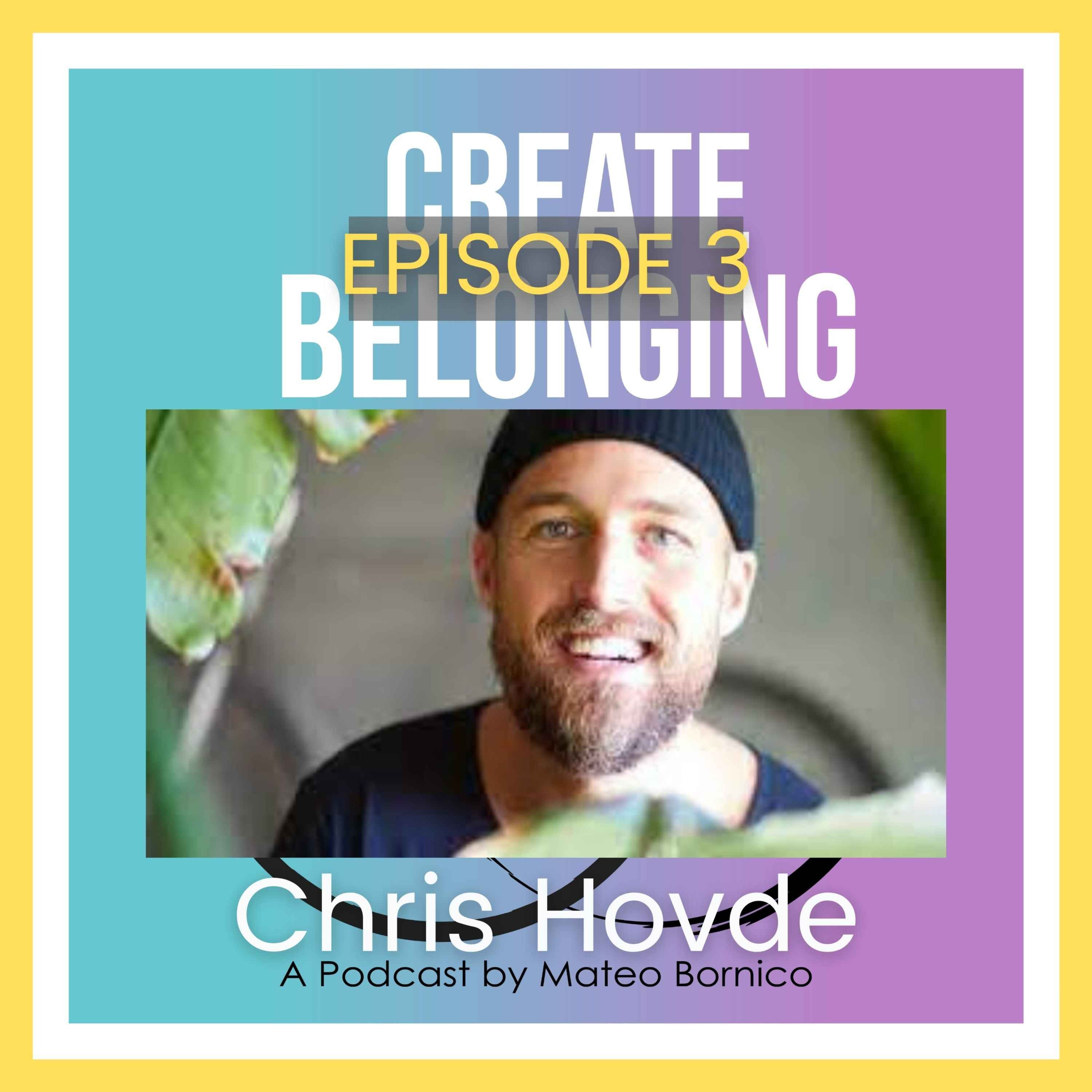
Today, I have the pleasure to introduce you to Chris Haufty. Chris is a self-proclaimed urban monk and Chris is unapologetically living a life where he strives to make sure that his behaviors are in accordance to his values.
He is one of the people leaders at Tellia, and Tellia is one of the largest telecoms in the Nordics with over 21,000 employees globally.
And as a people leader, he holds many roles and responsibilities, including employee well-being, diversity and inclusion leadership, and promoting self-leadership.
Chris also sits on the boards of many companies and is very much involved in initiatives concerning the environment, how we interact with technology, and also on issues around racial and gender inclusivity.
Chris is somebody that leads by example and is on the mission of helping people live the most authentic lives.
So by this point, you're probably wondering why did I invite an urban monk to be on the podcast about belonging, and this has to do with the way I define belonging.
Now, I've been getting a lot of feedback lately, so those of you that wrote to me at
[email protected], I want to say thank you so much for your feedback.
And one of the questions I have been getting is, Mateo, I love the podcast about belonging, but can you please define what you mean by belonging, because it is a huge topic.
And I do have my definition of belonging, as I'm sure you do too.
And I am planning on recording an entire episode, perhaps with me just talking about what belonging means to me and what my latest thoughts are on the topic.
But for the time being, I just wanted to introduce you how I think of belonging, interacting in three dimensions that are complementary and definitely overlapping.
And the first one is belonging with the self, the second one is belonging with others, and the third is belonging to our environment, our planet, and our universe.
And most of the definitions of belonging out there have to do with that second dimension, belonging with others.
And that is about belonging with other people in a group, in a family setting, in society, or even in the country and culture that's around us.
And while I visit this podcast, dealing with that second dimension about belonging with others, because after all we are social animals,
from time to time, I plan on inviting guests that are more focused on belonging with the self, or even belonging to our environment.
And today's guest, Chris, is clearly on that first dimension of belonging with the self.
And I think in many ways, Chris helps us to see that it is very much possible to just let go of excuses and just start living the life that is in accordance to your values.
And so Chris, of the, my guest today, is someone who belongs to himself first and foremost.
He understands that in order to inspire and help others, we must first live our own truths.
Chris is not one for excuses, and on this podcast he challenges us to stop lying to ourselves and start the journey to an authentic life.
Honestly, I can go on and on about Chris. I think he is a beautiful human being.
And in this conversation, we cover many interesting topics, including his routines, his minimalism, why he turned his living room into a personal jungle, or how he managed to cope with being discriminated against for being gay.
And just before we get into the conversation, I wanted to give you a little bit of a warning for those that have very sensitive ears.
There are a couple of F-bombs here and there, but they're not gratuitous and they come from a place of authenticity.
And so, without further ado, thank you for listening to this extended introduction, and I bring you Chris Hopkins.
Chris, welcome to Create Belonging.
Thank you so much. I've been really looking forward to joining you in this conversation on so many interesting topics.
Yeah, so we met a couple of years ago at a summit that we both found here. Tell me, what brought you to that conference?
Yeah, so I believe it was singularity summit, if I'm not mistaken.
And there's many aspects that, first and foremost, we have a partnership within one of the jobs I have.
So within tele company, we have a partnership.
But then I also saw an opportunity to actually volunteer because I love to support good causes.
And I kind of, I don't like conferences because like you need to mingle and have those like never ending boring.
Cheats hats with people you probably don't know and probably don't want to talk with.
So I saw an opportunity always to then contribute actively instead of just going there.
So I signed up for as a volunteer and then I also meet a lot of highly engaged people interested in the same things.
And singularity is maybe one of the world leading institutions when it comes to exponential tech or tech that's like is there for a good cause and for the impact of our world and society.
So people impact technology, that's kind of my purpose.
in life, so why wouldn't I be there?
- Okay, yeah, that's true.
Yeah, there is, it singularity does touch on a lot of,
yeah, a lot of things that you're interested in.
And what struck me, so after we met and we chatted,
I saw your LinkedIn title and I said urban monk.
Can you tell me a little bit what that's about?
Why, where that title comes from?
- Yeah, so I believe it came from
that I think it's more important who we are
than what we are.
So to me, the most important part of my life
is who I am as a person.
And then I can, like I had my own company,
I work as a global people movement leader in Tellia.
I sit in a lot of boards, both as chair and members,
but those doesn't define me.
So what is the platform that I define myself from?
And then I started a journey,
maybe after I was CEO of a healthcare clinic in Oslo,
and I reached my goal becoming a CEO before I was 30,
but then I realized why did I have that goal?
Is this fulfilling?
Is this the life I wanna live and hell no.
So then I decided to embark on another journey
and I started to get to know my purpose in life, my values.
I went to India, sat in silent in a dark room for 10 hours.
First time in my life, I ever sat with my own thoughts
and I realized actually that you can think
I thought through and it has actually an ending.
So that we think about the same thing all over again,
all the time and have this kind of monkey minds
is because we don't take our time
to actually think that thought through, so we end with a solution.
Once I did that, it was not even possible
to think that thought again because it has ended.
And where I wanna go with that is that those 10 days,
living like a monkey in India,
started kind of my second journey in life,
where I kind of started to find myself
gradually adapt my life to what I think is important.
And I believe a lot of the things that a monk embodies
is so important for my life.
So I only have a couple of pants and jeans
and a couple of shirts.
Like the most minimum, I only have one pair of shoes,
one in the winter, one in the summer,
what do I actually need?
Even in the shower, do I need one bar of soap,
what do I need this and that and that
for the hair and scalp and whatever.
No, you actually need a lot of less clutter
and stuff in your life.
And that also entails to what I'm doing at work,
what I have on my desktop.
How can we simplify life as much as possible
to actually use time on what's meaningful?
And that's kind of the embodiment of a monk,
but then I don't wanna take the egoistic route
and go to the Himalayas, sit there for 10 years
and feel like total bliss.
I actually wanna come back to the society
and combine the urban with the monk
so we can live amazing lives in the societies
that we live in.
So someone call it the Buddha and the Badas.
I have a dog called Buddha,
so maybe you can call me the Badas
and that's a good combination.
- Nice, nice, yeah.
So you mentioned, like you touched on minimalism,
getting rid of stuff, you said that you gained more time,
but what else do you gain when you remove the unnecessary,
when you peel back all the things?
So what else do you come?
- Yeah, I would take the analogy of a glass of water.
So if you have a dirty glass of water
and you shake it all the time,
you will never see it through that water.
But if you just put it in for like to rest for two minutes,
the dirt will fall to the ground.
The unnecessary stuff will fall to the ground
and the water will be crystal clear.
So that's kind of my interpretation of my inner voice.
If I kind of clear that with stuff
or needing to take decisions, should I wear this?
Should I eat that?
Should I go there?
Should I do this task?
We overly stressed all the time
because I too much to do,
because we sometimes see impact as doing a lot of stuff.
When impact can be, I usually like to take
Greta Turnberg as an example.
She didn't do a thing.
She just wrote the poster and decided to stick with that.
And that's what I'm finding with purpose and values.
If you're kind of just a really true to your core purpose
and values and use them as guiding tools every single day,
you will do much less,
but you can do one thing in a year
that has more impact than all of the activities
you've done throughout that year in total.
So that's what I gained, like clarity of my inner voice.
And then also on top of that,
giving them clarity that what means more to me in life,
that's relationship with friends and family.
That's spending time with my probably dog.
That's, I wanna live in a jungle,
but I couldn't move to the jungle,
so I made the jungle move into me.
And bringing everything I want in my life to my everyday,
because eventually I believe life consists of everydays.
And if not my everyday is a reflection
of what I want to live the long term,
then my life will not be a reflection of what I want to do either.
- Yeah, your views are great.
They're a breath of fresh air I have to say.
Yeah, it's really nice to hear that.
What I'm really curious about,
besides everything, is how,
so your job is, you work for a major telecommunications company
here in Nordics, in Telia.
And your job is to help people find their belonging
and find that they fit into the company culture.
But I mean, your views are, in many ways,
seem to clash with the superficial views that most people have.
If we look at it at the superficial level,
so how do you get to that common space?
When they internalize what you're saying
and they say, yes, that makes a lot of sense.
But there's an initial resistance I'm guessing.
How do you go about that?
That people are still stuck on judging you superficially?
How do you break through that?
- Oh, that's a good question.
But I think I have a couple of different answers.
So the last thing that you mentioned
is actually I believe coming into peace with myself.
And if that's connected to not like superficial stuff,
like clothes, what I'm wearing, the CO title,
the money, the cars, the apartments.
If that's connected to my core purpose and values,
why would I care that somebody doesn't like
my core purpose and value?
It's like my heart.
I can't do anything about it.
It's my life mission.
I don't care because it's so important to me
that it doesn't even bother me because I found it.
And it's like, I can't redo it
because I was sent to this world to do that.
So then it's kind of like pan with Teflon,
it just writes down.
So finding peace with what's important to you
then other opinions doesn't matter anymore.
But then I would like to say the first thing you brought up
also how to make that influence other people
because of course I realize if I'm kind of an activist
or like far away from many other people
that won't convince the masses.
So I'm also thinking about how can I not convince the masses
but maybe inspire the masses to think a bit differently.
And it's not like I would say I have a religion
that you should follow, but I think I have a framework
if you connect more to your purpose
and it's backed by research.
If you're connected to your core purpose and values,
not to your companies but your personal purpose and values,
it's the highly, most highly correlated factor
to employ engagement or like human engagement.
So you would like to do that.
And the thing that's kind of dangerous
is if you connect to your company's core purpose and values
and not your personal ones, it's actually counterproductive.
So you can then have a negative effect on engagement.
So it's so important that you know your personal values
and purpose in life.
And then I try to really make everything tangible
and concrete.
So how I use my purpose when I work to the store
and gonna buy some things.
I'm never gonna buy anything that's not sustainable
or ecological because it's a micro investment every time
if it's 10 coroners or 100 coroners in a year
that adds up to tens of thousands of money.
And would I put that into a startup
that supports say sugary drinks with 40% sugar
making the whole population addicted.
and obese and whatnot, the diabetes and so on.
Or would I put that into people who are running
regenerative farming, even though if it's 10 coroners,
even if it's a like on Facebook,
even if it's a event that I attend,
I will make those choices.
And then also connected to my core values.
So that's authenticity.
So I will always strive to be myself.
People may like it and people may hate it.
And what I found peace in is saying that 50% will hate me,
50% will love me.
Then I've lowered the expectations and it's okay.
Okay, you're one of those 50% you're hating me.
And then you're one of the 50% that loves me.
Because if you take that to marketing that we do in businesses,
the most important thing from a brand perspective
is to not have people who are indifferent.
Make them love you or hate you,
because then you stand for something
that people can take a stand too.
So that's much more important to be.
Never have people who are indifferent.
And if you're not able to make people hate you,
they're probably indifferent.
- Yeah, and it's that indifference that leads people
astray because they're not on a particular path
and it's where people get lost.
- Yeah.
- And then last but not least, also I try to go in front
as a role model and instead of saying to people,
you should do this, I invite strangers every week
to a dinner at my place.
And then I just tell them, this nice dinner is made
from ecological, when they throw the garbage,
garbage, they will see that I make my own compost.
Then we talk about, oh, don't you miss traveling?
No, I will have a travel ban for myself,
probably for tens of years coming
and I had it for three or four years.
So Corona is my dream situation.
I created Corona life before Corona came.
And just by being that example,
not saying that you should do, I show you some options.
Maybe you like some small bits and pieces.
And then I realized that all big or great successes
was built on small steps.
I'm not sure where I am today
without taking one small step every day.
I didn't even go to the groceries
and getting money back for my bottles four years ago.
So everyone has the potential to do so for instance,
every day and imagine how much that will be in a year
and then two years and 10 years and so on.
So start small, the dream big.
- Yeah, you mentioned, you're touching
on so many important things,
like the fact that the incremental gains
from just starting small.
And but I'm gonna put you in the spot a little bit.
So, yeah, so get ready.
So, you know, you're a white guy from Norway
and now it's easy for you to say,
hey, yeah, just live the dream, do whatever.
And then you have a, let's say a,
one of my previous guests, he's black,
an important race in Sweden, but he's black.
And he has had to deal with people judging him
even before he opens his mouth.
And you had the benefit of the doubt in so many ways.
How do you explain to somebody who is not white,
who is not, you know, doesn't have your advantages?
How do you reach those people and letting them know
that this is also possible for them?
- That's a good question.
And I believe that a lot of my engagement also comes
from own experience.
So I believe that a lot of passion,
purpose and life comes from your own experience.
So I'm a white man, yes, but I'm also gay.
And I've experienced many times.
I was in a interview process for an executive position.
Then I was told by the recruiter,
can you please say she,
when you're talking about your partner,
so you're more likely to get the job?
And I would not say that I can imagine
how black people are discriminated every day,
but I believe that we're all discriminated
in some way or another.
And we can at least try to relate because we care.
And then what I do is actually taking personal responsibility
for that both in lifting ethnicity
and talking with a lot of people who are
or have been in that situation.
So how can we become a better workplace for you
and other groups like LGBTQI,
people with disabilities and so on?
Because that's what we want to be a workplace
where everybody can be themselves.
But then it ends up, the discussion is actually about,
can you be yourself material at work?
Maybe you think I need to speak like this,
dress like that, behave like this,
I need to be professional.
Professional is the worst word I've ever heard
or that was invented because shouldn't that be
or true authentic self?
And that's the most important thing.
So we judge ourselves and we judge others all the time
because we don't feel that we are able to be
at true authentic self.
And then we won't let anybody else be that either.
And then what I usually ask leaders,
others that say they're concerned about diversity
or diversity is really important to them,
then ask yourself or look around you
and look at your group of friends.
How is it that they're all 50 plus?
How is it that they're all white?
How is that you went to the same school?
And then if you still say that diversity is important
after revealing that, you're actually lying to yourself
and you're lying to others.
So I took that stand a couple of years ago
because I also was responsible for sustainability back then.
And how can I be a true authentic voice within those fields?
I need to do it myself in order to have the integrity.
So then I put out a post on Instagram asking people,
like I had a transposed,
is there any trans gender people out there
who would like to meet?
I need to know more, I want to become friends.
So you can support one person at a time
and taking those stands, being open about it,
being open about your own story helps so many others.
You wouldn't believe how many comments, emails,
letters, SMSes, I get every time I'm out there
being vulnerable about my own story.
I'm sorry I need to interrupt the regular flow
of this conversation and for good reason.
Chris was just talking about how he is vulnerable
on social media, for example.
And this reminded me of a recent post
that he put out on his birthday
and he shared it with his LinkedIn network.
And I wanted to read it to you just to give you an idea
of what he means by being open and vulnerable.
So I'm just gonna read his post and I quote,
"Today, 35 years ago, I was born.
There are times that I wish I wasn't.
Times when people who don't know me
are screaming fucking faggot to me out loud.
When I'm just trying to take a peaceful stroll around town.
When I was beaten to the floor and ended up with a concussion,
just because someone is afraid of people of difference.
When I was told to talk about my partner as a she instead
of he, if I wanted to get the job.
And also in another process, the interview was quickly ended
as soon as they understood that I was gay.
When several of my previous partners felt the need
to hide both themselves and our love.
When my sisters and brothers still feel the need to hide
when they're threatened, living in fear, beaten and killed.
And all those small battles every day,
where we need to take the fight for our own equality.
And those of other LGBTQIA+ lives.
It takes its toll and I'm tired.
Can we just accept that love has many shapes and forms?
My greatest birthday wish is that you all take a stand
to be an active ally for equality, for all end quote.
Okay, I really wanted to read you that post
that Chris Porter or his birthday.
It gives you a little bit of a taste of how he is
willing to be open and honest on social media.
And of course, I'm gonna have links to his Instagram,
his LinkedIn, and please give him a shout.
Connect with him and tell him that you heard him
on the Crape Login podcast.
Okay, thank you for this interruption
and we'll get back to our conversation.
- So use yourself and your own story in order to help others.
Because if you, if not you, who else will do it, yeah?
- Yeah, and I think one of the things you're hinting
that you do so well is you model that behavior.
You're there first.
you're showing people that it's possible, that this is how you want to do it.
One of the classic examples is people that eat meat but then yet they have a pet or they
say they care for animal welfare while they're gulping down McDonald's.
There is a certain stress or you tell yourself a story that's false and that leads to so
many things. The cognitive dissonance I think is called when you have contrasting thoughts
and beliefs and you seem to have found a formula to live in line with your values. In line
well if this is where I want the world to be then I should just be headed that way. Even
when you go to the supermarket and I think it's amazing. Apart from having people over
at dinner with strangers because I also I see your post and you talk about the deliracy,
loneliness epidemic and you are welcoming strangers, get together, this is how it's done.
I've been really inspired by that but what else are you doing besides these dinners?
So of course I'm lucky to play with 21,000 people at Tele every day and then I'm also
lucky to sit in many different boards, both as chair of a board in a global organization
that runs self leadership programs for youth. We have had programs now in 15 different
countries. I was a part of an online program where we were from 15 different countries
22 participants and imagine one girl from Thailand sitting on the back of her parents clothing
store and then a couple of students from Harvard sitting in the same virtual room and other
like really high politician trials in Switzerland and like all the different kind of levels
of society, different countries, cultures, both not, can sit in the same room and then
discuss like world peace, how can we do a difference, my struggles, depression and so
on. It's kind of, it's just a small, small glimpse of the world I would like to see.
So how in every touch point you do or create, how do that mirror the world you want to see?
That's basically in the big picture of what I do. But then of course I also try to start
my day every day with meditation. I meditate usually two hours a day. I start to write a
gratitude to journal what am I good at or like about myself because if you're not your best
friend you will not be anybody else's best friend. And then what do I really enjoy with
my work and then also what do I really enjoy in the world at large. And then what would
I wish to be today for others and then three things I want to be for others. And then
I have a lot of kind of questions. Instead of saying a manifestation that I am a loving
and kind person and I make a lot of impact in the world. Instead of saying those as a
statement, I've learned myself to ask them as a question because if I say it as a statement
I would say no, I'm not sexy and hot. I'm not like a friendly person. That's not correct
because I don't feel like that today. But if I ask it as a question, why are you so
sexy and hot if I would like to be that of course. Then then I look at small signs or
why do I make so much impact in the world. Then I start to look for signs that confirm
that question not a belief because that can be proven right or wrong. And then of course
I continue to treat my day as it's a small, small, small mirror of my life. What would
I like to do more? Yeah, I need to work outside. I love nature. So I usually take two to three
meetings outside whenever I want to because I have teams on my phone and nobody can tell
me not to walk because I then also inspire others. And then I try to exercise every day
because I believe taking care of my temple also makes me take care of the world. It's
like making a bed in the morning. How do you actually save yourself? And here is what
I think is crucial. When you connect it back to what you said, we lie to ourselves all
the time. Many people say I love my job. No, you fucking don't. I love my partner. No,
you don't. I'm caring for sustainability. Know your actions prove otherwise. We need
to start one lie at the time to change it and actually say, I would wish to care much
about sustainability, but I'm not able today. I will try to reach my ambition, but I'm
failing big times. You have to take ownership. We can change the world. Yeah. And I do a lot
of bad stuff, but I try to do one more writing every day. You, I want to touch on something.
You mentioned that every day you do a gratitude journal, right? How do you not write the
same thing every day? I mean, does it change? I'm getting really practical here because I,
I've tried doing a gratitude journal. And I think that I see what I wrote yesterday and
like, okay, still true today. Do I write it again? Yeah. That's a good question, but what
I've learned is that the graduate journal is so important that you feel it. It's not
about the task. You should first and foremost look forward to it. And then I also kind of
understand the neuroscience in it. So if I have one negative thing in my life or throughout
that day, I need five positive things in order to balance that out. Yeah. And if I'm like,
I don't have time for five minutes to say a gratitude journal in the morning. No, but
you have time for endless hours of negative things in your life. Yeah. You will end up
your day in, day in minus 10. So on bad days, I actually take out that gratitude journal
with those extensively. Maybe I think I have 40 questions in there and read it out loud
several times. And then the starting of the gratitude journal is always like, it must
mean something to me here and now today. So I just take the top of my minds and look around.
It can sometimes be only my, yeah, I'm really grateful for my jungle being able to live
in a jungle. And then my kind of for those I can't see you. I'm going to describe it. So
your room right now, even though we're talking over Zoom, I see just like hundreds of leaves
behind your green leaves in what appears to be your living room. So yeah, I just wanted
to describe people of your setting. Yeah. Yeah, it was kind of a shock. So now when Corona
hit in like everybody started with home delivery. So of course, ordered a couple more plants.
And then the delivery man, he was like, here you have some more plants. So it's like a
atom bomb of plants that exploded in my living room. But no, but it's a best to living in a jungle.
It's great. You know, there's so many, I call it sometimes obvious research that comes out every
day that it says hospital windows that look into nature, people recover faster or people that
take a walk in a park are, I don't know, 20 times percent less, less likely to develop depression
or something. And it's like, it's almost obvious, but they actually test these things, which
gets to a question that I wanted to ask you. So you mentioned something like also, you know,
you need five positive things against one negative. And that speaks to the, there's actually
research that says we have an evolutionary negative bias. You know, so whatever is negative sticks
because we've needed it for survival. We needed to remember where we made a mistake. We need
to remember all these things. And so there's a lot of, and many of the like the incremental gains,
modeling behavior. I mean, are you researching a lot on social science or the latest research or
does this come to you kind of naturally? I mean, how do you, how do you get to all these little
practices that you have adopted? Where do they come from? Yeah, that's a good question. So they both
come from me being like curious and reading up both on research papers, different magazines,
hardware business review and stuff like that. And then it comes through my work in all the companies
that I'm involved with because I believe that if we should take a decision changing our strategy,
going for a different direction, stopping this, moving on on this, we should actually
base it on research and not like I like it to have this kind of team development. And it's not
backed by anything because there's so much, for example, leadership development training out there
that is not proven to work at all. So we wouldn't want to waste our time. And then I question myself
why, when we know, for example, that 75% of our meetings is waste of time. Why don't we just go
tomorrow. And cut that seven.
We go on and on and on and on knowing that we waste our time what are you then saying to yourself my time is not valuable.
We are allowed to waste 75% of your time and what I believe is a lot of people read books a lot of people take courses trainings and so on.
But it's not around to read the most books. You are more interesting to me if you read one book and implement that one thing and you do it for the rest of your life.
Then if you have read 100,000 books it's like a really really obese personal trainer. Right. And we're all walking around as immensely obese personal trainers.
It gets to the kind of like your mission that you were talking about earlier that that you're about impact and in order to get impact you have to go deep and to go deep you have to get rid of all the other superficial bullshit out there.
And because your job and your mission is to create impact and if you stay at the superficial level you're not going deep and yeah it all it all comes together and it's unbelievable how you have this disability to just to speak truth and you don't hesitate.
I mean it is a compliment I'm giving you but you're so in touch with your true self that you almost don't second guess yourself when you act you already have that habit that this is where I want to go and this is where I go.
So you mentioned 40,000 people, that 21,000. Yeah, sorry, yeah, 21,000. You're of course not hiring them yourself. Other people make the decisions. How have you influenced Telly or have you tried to influence your company or other companies to to say no these are the type of people we're looking for or do you accept anybody they hire and you work with them or how does that work?
And what how how would you like hiring practices to change that's that's where I'm getting.
Yeah, and that's a good question but I would rather like to start with kind of how we see people and try to develop people and then I will come to the recruitment because we have a strong expectation in teller that we say that we believe in the potentials of everyone.
Like and growth mindset the power yet so like everybody has the potential to develop.
But then of course in when it comes to recruitment practices we are training all our managers for example in on bias recruitment or inclusive recruitment practices.
So what I would like and my dream is actually that technology and that's also my purpose making people and robots or aka technology fight for a better world.
So that we don't need to fix ourselves but we can fix the system. So you already see a lot of technology removing names. We are now doing more testing skills and actually ability to perform the job and personality rather than being good at writing a letter having the best setup for your CV.
Looking good because research not today shows that if you're looking good you will more likely get the job and that's not how the world should be because that's not correlated at all to performance.
So I would actually come to world where the only thing that's important is how your skills and competences and personality is correlated to the performance that we need of you in that specific position.
And the good example is that we now hire a lot of people who are self taught like escoder is developers and so on probably some years ago we wouldn't do that then you need that university grade and so on.
We also hire a lot of people who can't speak Norwegian because that's a local language because potential and talent is the most important.
So today we said too much criteria is that not important for performance so look at ourselves and ask ourselves what is needed for important know for a performance and what is only nice to have and maybe not mention those nice to have because then you exclude a lot of people.
That's yeah that's great I wish more companies took note of what you and tell you are doing.
Say like me influencing telly I'm not sure if it's telly that's influencing me because when I came into telly I was really really lucky to actually embark on this journey and I entered the company that wanted to teach me what my personal values were what my personal purpose I got a self leadership extensive self leadership training from Oxford leadership.
When I stopped drinking alcohol I became a vegan I stopped flying I kind of left a destructive toxic relationship I moved to a smaller apartment I started all these transformational actions and I don't believe if I wouldn't have kind of started in telly and really gotten the opportunity to for many many many hours go deep within myself.
And now telly I have yeah hopefully much better performing and loyal employee probably for the rest of their lives.
So you started on let's say your cohort that you started with not everybody became under a month not everybody became a vegan and engage I mean here's a here's a question what makes you so special.
What is it about you that you just you got that spark and you did that switch I believe we're all special so that's the first fact right but then I believe that fear maybe steers us too much and for some reason I was born in a way where what I want is always more important than fear.
So I can I've never like even mentioned words like depression or anxiety attacks and so on because it's a thing but I'm also a lot more so I'm able to have the worst feeling inside of me but if I want something I will still I will go on and on for years.
Even with a bad feeling because the purpose is higher than me so I believe I don't have that fear that limits me too much of course if I look that I want to be like 10 levels ahead fear stops me.
If I compare myself to others I think I have a bigger range maybe and then of course talking to my mom really early on when I was like 67 years old I said I want to become a farmer she said no it's not called a farmer it's called a vet.
She kind of said expectations as well like you need to get good grades you have the potential in the world to kind of apply for all different educations no matter which grades they kind of you need to come in.
Is it really on the working hard and then fighting for what I believe in.
Yeah hard work is something that should not be neglected a lot of people take the easy path or just because it's what you're saying is simple does not mean that it's easy that's something that I learned the hard way.
You know just stop that as you just exercise that's that's what I have to do and then it just doesn't happen and oh yeah I forgot that it's it's difficult to do even the simplest things.
But then I changed also like when you say a hard work I would replace that with smart work I think I can do one thing in a day that is much much more impactful creates a lot of more ripple effects influence a lot more people than I earlier in my life did in a year.
So take yourself off from the kind of hamster wheel and like you need to produce amounts and lift yourself to a perspective what should I achieve this for example I'm really fun of quarterly planning if I do three things this quarter that's that's not much right then I will be highly successful then everything else just gets on top of that.
And you can sometimes relax and sometimes like you can do less things or compile a lot of things into one one example is the events that we're doing with university we usually did it in seven countries probably a couple of events or three every quarter in each country with 20 3035 participants.
Now we do it with our little finger is online inviting the whole world having participants from Russia India whatever and the whole of Europe.
average of 850 participants. One and a half hour call makes a much greater
impact. It's like hundreds of times less work and everybody can do it and
everybody can join. Yeah, it's a lot of people, they're they're they're going to
things. One is either the Pareto principle, you know, the 80/20 find find that
20% that gives you the 80% impact and then there is something that so on my
LinkedIn title, I'm I self describe myself as a systems thinker and it's about
what you were saying, like get that view of the system and finding which where
to intervene that will that create like a snowball effect if you would. Like what
changes can you make that will give a big impact? Yeah, that's that's really
interesting that that you operate that way. I yeah, I I don't know what to say. I
mean we've talked a lot so far. Is there any I'm gonna cut this out because I
don't know I don't know where I wanted to go with this but how are you doing
by the way? I'm doing really good and I also feel that maybe that's some of my
kind of life philosophy life is what it is and we can look at many opportunities. I
of course care about and feel sorry for all those people struggling at the
moment and I also know that I have struggled many weeks and I haven't seen the
best of the situation for all those weeks that we've been in lockdown but I
also then try to kind of it's no excuse stop lying to yourself you're not your
thoughts and then I try to pick my up sometimes it takes weeks sometimes it
takes a day and one great journal but whatever like to say is that for me I
created the Corona life long time before Corona came and I actually
manifested or asked or prayed or whatever you think I actually wanted or said
to many people like I just hope the world can get a break a big break I would
wish that everyone in the world could go to India sit for 10 days with
themselves and realize what's important in life and I believe now I've given
what I've been asking for and I believe when we end this and come on the other
side hopefully we have done a lot of great reflections we have seen a lot of
different opportunities possibilities that we didn't see before because we
didn't manage to create a better world ourselves that's proven we needed a
crisis and from all crisis if you look to history it has come something really
really good and transformational so I welcome all crisis as a gift to
transform humanity the planet for the better and I already see a lot of
amazing things happening so let's be grateful for that and soon we're going to
back be back together as well that's that's great does does some great words
that you said and yeah for those of you listening how can how can people reach
out to you how can they you know if they've heard you and they're they want
to reach out to you in contact with you how can they do that yeah so anywhere
you like except email my email died in 2018 so on Instagram on Facebook on
clubhouse on LinkedIn whatever we also have a website from my company that
everyone on the site if you want to join for a dinner or if you want to join
for a meditation please feel free my doors are open because I believe the world
should be open are you taking any any zoom guest on your dinners we've had
some zoom dinners but people say that they would like to and then it's not
that attractive with zoom dinner so if enough people is up arranging it and
the day and do you want to talk a little bit about your your upcoming you're
going to be starting on clubhouse soon what it's that about yeah so just me
and a friend of mine that was kind of talking about what we're talking about
today so I would say maybe summing up the topic of today's for me start being
honest with yourself and I'm honest when I say hello my partner I'm honest when
I say hello my job or what kind of small my girl changes do I need to do
every day in order to get there and you don't need to change that because research
shows that you can find purpose wherever you are so don't take the easy way out
and just change or leave your husband or wife try to find more meaning where
you are and then the other one don't say that you are concerned or like a really
passionate about something if you can't back get up with actions so start to
back up the things you're saying with actions I think that's maybe the two
most important thing I'm summing up here and then connected to that we me
and a friend did a podcast or I visited joined his podcast and then of course
I am my authentic self and I'm honest and maybe I look at things a bit
different than others so the feedback was enormous I was have been invited to
five podcasts ten clubhouse rooms different kind of journals newspapers magazines
and I believe the world is like hungry for authenticity for people who are
being themselves because we all long to be ourselves we're hungry we're
starved for authenticity and please please please make me a promise that you
will try to every day be a bit more authentic and treat yourself that would
make a better world amen to that well Chris it's been an amazing ride thank you
so much for for doing this and of course we're gonna have all your your
links and everything that we talked about we're gonna have show notes and yeah
thank you for being on create belonging Chris thank you so much and thank you
for doing this and bringing these meaningful things to the world and bringing more
the meaning that's that's something we're all need to connect
okay welcome back and I hope you really enjoyed that conversation like I said
it was it was a great ride this conversation and perhaps this has been the least
edited conversation I have done is just there was just so much goodness in that
conversation and I think Chris it's somebody that radiates joy and possibilities
for change and I want to know what takeaways did you get out of it did you
learn anything you was there anything that just capture your attention was there
anything that you would take away from you from this conversation and so we
met Chris and Chris is like I said at the beginning he is somebody who belongs to
himself the first and foremost but at the same time he's also leaning by
example and that is that he's helping others find their true selves and that
leads people to live a life that is more authentic that is more in touch with
their values and inevitably a life that we can belong to and just before we wrap
up I just want to say thank you so much for listening to this episode and please
send me your feedback to my email at
[email protected] I also started a
Instagram page but I am not very skilled when it comes to Instagram I am more
familiar with LinkedIn for example but this is so far a passion project of mine
so I cannot dedicate it as much time as I would love to so if you want to share
any content if you have any ideas of of shows please reach out to me I would
love listening from you and again the feedback I've been getting is great this
is a long journey and I just want to say one last thing I've know I've been
publishing at a rate of one episode a month however I would love to start
publishing at least two episodes per month and now that we're heading over to
the summer stretch I'll hopefully have some more time to to work on this this
great project of mine thank you so much for for listening today I want to give
again a huge thanks to Chris for making time I want to thank also Evgie in France
for his theme music and I want to thank everybody else who's supporting me
along the way and I look forward to our next episode where we'll be hearing
from Caron Campbell who is a spoken word artist but until next time go create
belong in for yourself and for others.
(soft music)
 PodcastTranscript AI