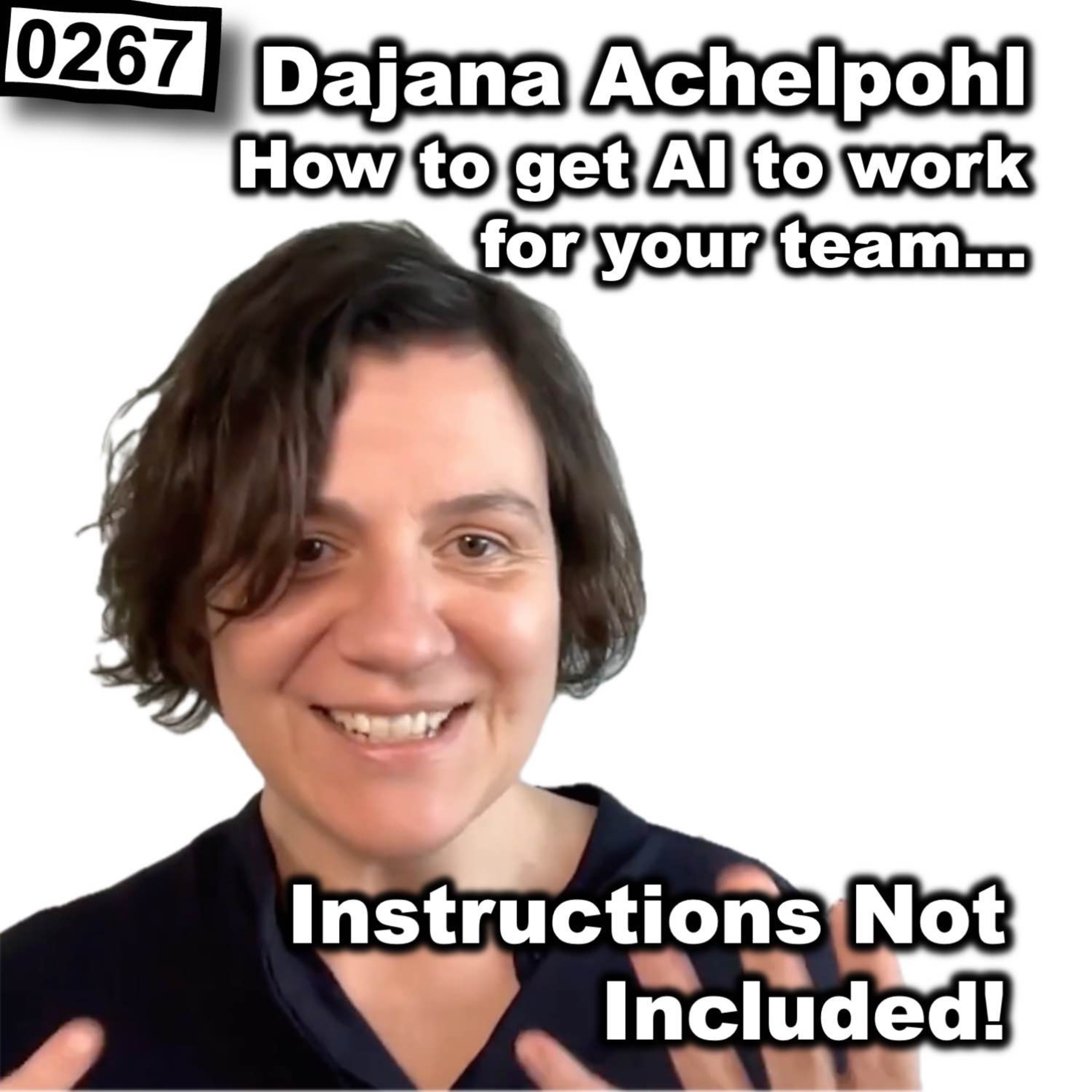
0267 - Instructions Not Included with Dajana Achelpohl
49m 11s
Diana Achaval, a former Google and PayPal executive, recounted her career path during a talk with business students. Originally from Germany, she studied law but pivoted to business, working at DHL before joining Google in its early Dublin days. After an MBA and a stint at PayPal, she returned to Google, navigating challenges like cultural adaptation and operational management. She distilled her experience into five lessons: influence must be earned through demonstrated insight; leaders must translate communications across cultures; context changes rapidly, requiring agility; proactive advocacy is essential in global setups; and real authority stems from trust, not titles. After over a decade at Google, she left to start her own company, AI Changemaker, seeking new opportunities in AI and entrepreneurship, highlighting a shift from corporate life to independent innovation.
(soft music) This is Design Talk. Next, Diana Achaval hosted by John Muni with an audience of master's students from the Graziadio School of Business, Peppardine, and the Michael Smurfett Graduate School of Business, UCD. - All right, we're gonna move on with our next session. For the UCD students, the other part of our week is we go out and visit a lot of companies. And so, last year at Google, our host was Diana Achaval. - Very good, thank you. - Practice. At Google, who at that point I think had been at Google for 13 and a half years or something like that. Most recently, in a role, a senior role for Amia Operations for Service Delivery, which Diana will tell us more about in a second. Bayana has now heard the title here, taking a new career opportunity in journey, which you will tell us about, but mostly Diana, thank you so much for being here to share with us your journey and your perspectives on shifting from ups to AI. - Thank you so much. Hello, everyone, and John has told you about the first five minutes of what I was gonna talk about. - Already. - Already. - I'll just talk about it again. So my name is Diana Achaval, as we had established. And I'm gonna share with you today a bit about what I did when I was working for big tech companies in Ireland and what I'm doing now and why I'm not working for them anymore. I try and keep it interesting. I've used all the AI available to me for the images. So hopefully that'll help a bit. And yeah, hope that we can have a bit of a conversation after so I keep this short so that we can have some questions. So let me start by talking about my journey so far. So I have a larger degree, which I acquired in Germany, where I'm from originally in Cologne in Germany. And I ended up doing a large degree because I was quite unclear on what to do. It's the first person in my family who ever went to university and I was quite unclear about all the options I always liked. So I chose on TV for the lawyers to fight in the court room. So I decided I wanted to become a lawyer. It became very clear to me about three weeks into that degree that I didn't want to be a lawyer. But being a good person and a good daughter, I finished my larger degree. However, after that, I really, really wanted to do something else. So I found myself a job in Ireland, working as a key account manager for DHL. At that time, Ireland was really, really popular for European companies, for contact centers. So there was a lot of call centers here, et cetera. So I worked in one of those. And we handled some very interesting customer calls. And there was meant to be six months gig in Ireland. That was 20 years ago, I should mention. So that didn't quite work out with the six months. And that might now have been on the third day in the country. And never went back. So I worked in DHL as a key account manager for about three years. And that was in Shannon, on the other side of the country. I don't know if any of you has ever been. Yeah, I see some nodding. Fair to say, it's not the prettiest part of the country, maybe. So I decided I wanted to move about in Ireland. I wanted to move to Dublin. And I wanted to work for this company called Google, because that seemed to be all the rage. That is 18 years ago. So back then, Google was something people knew about. But Googling something wasn't quite a word yet. So I started working in Google when there was about 120 people working for Google in Dublin. Technology has abandoned me. That's right. When there was very few people working for Google in Dublin, there was none of the amazing perks that you might associate working with companies like Google. Now, we didn't have a canteen or anything. Chakara, there was no swimming pool, no masseuse, no nothing. It was terrible. Of course, it wasn't, because we didn't know what we were missing. It was really interesting work. I was working for one of the sales teams, working with a German market, working in ad sales, so for our focused on ad words, which is all the nice of the ads you got when you searched something in Google and how Google makes most of their money. So I worked there for a while and then realized that I was probably going to stay in some sort of a business scenario, and that my large degree didn't really prepare me all too well for that. So I decided to go back to school and came here to do my MBA. That's many a year ago. Now, actually, in fact, so long ago that I had trouble finding my way around when I came in earlier. But did my MBA here at a really great time met a lot of people from different backgrounds, learned a lot of the theory of all of the things that I was doing, found that really, really helpful. And then went to work for paper, work for paper, managing their key account teams, paper, their focus on merchants, obviously, that are using their payment solutions on their websites. I worked there with the German team initially, but then also started branching out and working with teams that supported different regions, started looking after the Scandinavian team, the UK team. And that's really when things got interesting in terms of having to manage European teams reporting back to a US-centric HQ. I'm going to talk about that with one minute. We worked in paper for a few years, had a few kids along the way. And then really wanted to go back to Google. And the reason why I wanted to go back to Google was that I had now been managing teams that were doing sales, account management for quite some time. And I was getting a bit worried that that was going to be my box. I was the person who manages sales teams. And I really, really wanted to do something different. And I knew from having worked in Google before that they were quite flexible in terms of letting people move around in the business and gaining new skills. So I really, really wanted to go back. Back in the day when I first started working for Google, I had to do 18 interviews to get my job at Google. I felt like I'd talked to every single person in Google before they finally gave me the job. In fact, when I thought I was done, somebody said, do you actually know if she can speak German? That her name doesn't look that German. Quick, somebody ring her up and talk to her in German. I am German, red and born. I very much speak German. Anyway, so I was a bit worried going back to Google I was thinking, how many interviews will they do now? Will it be twice as many? And actually, all you had to do three was amazing. So they had very much streamlined their processes. There were a much bigger operation. So I went back to Google. It was like joining a different company. I had, when I first joined Google, worked in this relatively small organization with all the parks that I talked about earlier. And also, it had a bit of that garage start-up feel. Still, there was extremely short sort of ways to get things done. If you wanted something done, you kind of just got started with it and ask for forgiveness later. And when I re-doined, it had turned into this huge, much more professional organization. So I actually really struggled going back to Google. It wasn't the company that I had left. It had completely changed. Things worked differently. And because I had worked there before, everybody assumed, I knew what I was doing. And I really didn't. So I actually really struggled the first year or so when I went back to Google. I was working in sales team again, working for the German market. And everybody didn't like it. So I was thinking about leaving. Then I co-incidentally had another child. It sounds like I have an awful lot of children. I only have three, which is not that many. But that maternity leave gave me a bit of a breathing space for me to think about, is this really what I want? But aside, yes, this is what I want. I know this is an amazing company to work for. But maybe I'm in the wrong job. I joined them because I didn't want to do any more managing sales teams. So I need to get that out of this. So I actually started interviewing for other jobs in Google, while I'm maternity leave. And that worked out for me. I started working first in a channel consultancy team in Google that consults on international expansion. And I started working outside the German market, which was also something that I really wanted to do. So I worked in that role for a while, and then eventually wanted to make a complete change. So I wanted to work for an operations team. Operations teams in Google look after their customers support their look after also supporting the sales team. So we're talking about huge scale there, working with a lot of people within Google, but also with a lot of outsourced companies that they have. So that was a new skill that I wanted to gain. And I convinced somebody to give me that job. However, after having managed people for quite a few years at that stage, they said, you can join us, but we won't give you a team to manage.
You don't know what you're doing. Why would we let you manage team? To which I said fair enough, that's fine. And started working in that team and really learned operations management, et cetera, is all about. And I must have done quite OK, because at the end, I ended up as a head of the mere service management managing that team. I'll tell you a bit later why I decided to leave all of that, because now I actually have left Google. And I work for myself. My company's called AI Changemaker. And I tell you a bit more about why I made that change to AI Changemaker. I already talked quite a bit about AI before this. So I hope you're not too bored of it yet. And we can talk a bit more about it. So this is what I've done so far. And I thought I'd tell you two things. I'd tell you a few lessons that are learned by working for Google and PayPal. A few things that I found interesting, but you might find interesting as well. And then I'll talk a bit about AI and why I decided to leave Google and start my own company. Sound good? Yep. Thank you, because I've got slides for that in front of me. So five lessons that I learned. Some of them are hard way. First, you have to earn your seats at the table. What I really found is that having a title, actually doesn't guarantee anything. Certainly not influence in an international set up where you're boss, so you're boss, probably not in region, somewhere in the West. Very far removed. To say global decisions, you really need to prove that you have insight and also that you can turn it into impact. And you really need to earn that weight by showing that you understand both region and what the business wants. So there are a lot of words. What I mean by that. Let me give you an example. When I first joined that Operation Services team that I mentioned, everybody was destroyed. Customers had a fraction scores for Germany's Scandinavia and the Netherlands were super low. We're much lower than in all other, in many countries. Why was that? We were providing the exact same support. People were considering doing that a really, really big exercise to completely overhaul our service to change what we are offering to customers in those countries. Guess what? German, Scandinavian, and Dutch customers, great things, definitely. And I know that because I'm German myself. If I like something a lot and I have a scale of one to five, and I think it's amazing, I give it a four, max. Because, so nothing is perfect. So I knew that those customer satisfaction scores were probably not telling the real story. So with that kind of idea that there was something there, I did some interviews with customers. I got some data together. And I was then able to go to that team and to say, you do not have a problem in those countries. What you are seeing here is a bias from these people and how they answer customer satisfaction surveys. So do not overhaul your service, but look at your data, definitely. And that was the first time, although I've had that title for a while, that people actually listened to me, that people were like, oh, she's kind of useful. And that really got me in. So that was my first lesson about earning that speech at the table. Let me tell you about another one. You're not just a leader, you're also a translator. I spend an awful lot of time interpreting what headquarters really means and what it may actually needs. And then did a lot of invisible work adjusting the tone, the priorities, the timelines to make that global organization work. Now, I know about half of you are from Papadines. So please don't take this personal. But the way American corporates speak goes sometimes doesn't always work for a mere. If we hear things are amazing, some of us literally get physical reaction to it. We just talk differently. So I spend a lot of time taking communications that came from our American leadership team and translated them into something that a new my team would actually consider a genuine and a helpful communication. And that goes both in terms of words, but also how you do things. When you do things, don't do things to your peen's on a Friday. Like, we love our weekend. Don't comment on a Friday that you're changing everything around. Do it on a Thursday evening. Much better. So there's delicious things like that, which really add value. And let me tell you, it also goes the other way around. I'm German, as I mentioned. And Germans tend to be the court, not that funny, very abrupt, at times, to other people. I was managing a team that was quite diverse, with people from a lot of different cultures, that also didn't get me a moral son about. So I also had to translate myself and adjust what I was doing yourself. So that's lesson number two. You're a bit of a translator as well. Moving on to the third lesson, context expires fast. So you're expected to represent the region in an Emea role, but the region is constantly shifting. And Emea as Google sees it, as it's defined, is over 100 countries, over 100 official languages, and if you add a dialects, local variations, about 2,000 languages. So there's a lot of things going on there, a lot of context. And what might be true now could be completely outdated by next week. So you really need to stay up to date on that, and act soon, if things change. Again, let me give you an example. When Russia started war with Ukraine, all my Russian customer service was done by Ukrainians. And overnight, that team was not happy anymore, supporting Russian businesses. She might understand. That was something that my leadership team did not have on their radar. And something that I only became aware of because the team trusted me enough to share this with me, instead of just not showing up for work or hanging up on customers. So we had to figure out within a very short period of time how we could continue providing service, and the long-term actually very much reduced service, provided to Russian companies. But we had to figure out very quickly how we could deal with those customers. And we shot off our phone support for a good few days, because people didn't want to talk on the phone. We used to be a bit of AI, which was quite helpful. But to me, that was really big scenario. It was just like, I went to bed last night. And I was super happy that I'd actually figured out a way to provide Russian customer service with Ukrainians, because they are actually easier to hire. They can also work in other markets, amazing. And that actually literally became a problem overnight. So that's one of the more extreme examples of our context expires fast, but it happens all the time. And you need to be well connected within the regions to be able to really catch that context and to adjust. Moving on to the next one. If you don't speak up, you'll be written off. Double in leaders are close to the work in Emea, but they're often far away from the microphone. So in my scenario, I had both a leadership team in the US in Mountain View. And then I also was dealing with a quite a big team that was based in India. And I was in the middle of all of those. And I was not physically in any of these places. And time zone-wise, slightly challenged to be present as well. So I really had to make a plan how I could actively advocate for the team and for myself and how I could be in the right meetings, in the right occasions, to make sure that we were in forgotten impact. Thankfully Google is quite flexible in terms of your working hours, there's no sort of clocking in at 9. I used to split my week that I was working US hours for half of the week. And then more India friendly hours for another part of the week. When it came to meetings that involved members from both of the regions, Emea is actually quite nicely positioned for usually always catch a bit of time. That is reasonable for us, and that doesn't require you to get up in the middle of the night. But still, it's something that I had to learn the hard way. Because I thought my team was doing well. Our numbers were great. Surely things were good. Well, but you really need to remind people that you're there and of the works that you're doing. Right. The last one, man. Authority doesn't travel.
infinite stuff. So I found a title that's less and less, obviously, when you want to get the title and the promotion, you're very excited about now being the head of something. But ultimately, what really gets you seated the table, what gets you involved in the right conversations is that you have an ability to connect clarifying our trust across regions. And again, that is something that is one and earned over years of engaging and building a brand for yourself. I had mentioned how I joined that operations team, not knowing much about operations. I sort of also mentioned that at that point that operations team had three members, only in Dublin and everybody else, about 100 team members were all based in India. The other two people had subject matter expertise. There were longstanding operations experts, and I was completely new to operations, and I was also thousands of miles away from the rest of the team. I had the title, but people were literally looking at me and going, what's the point of her? She's not here. She doesn't have any experience. So that's when I really had to figure out how my previous experience was relevant for that team. I'd worked with sales teams for a long time. Sales teams were the main customer of this operations team. And the sales team actually thought operations was useless. They were actually trying to not work with them quite actively. So that was an insight that I could bring, and also something where I could suggest a way to position solutions in a way that's actually used for the sales team. So it was more that I could speak with authority about the needs of that customer, which was the sales team in that case, versus my title, which actually didn't mean anything. I think it also helped that I jumped on the first opportunity to go to India and meet the team. I love to travel, and that was a great excuse to go and meet them all. And I found that once, despite all the video conferencing and everything else you can do, I found that really meeting people face to face still makes a huge difference and really helped me along the way. Okay, so they were my five lessons. I hope you found them somewhat useful. So I wasn't gonna go ahead, been there for many years. My second student was 11 years. I was doing reasonably well, thanks to all those lessons that I had learned the hard way. And then I decided to leave, last year. You might wonder why my husband did too. Why, why are you leaving a good thing? For me, there was really two reasons. Why, it was time for me to move on. I had done this kind of work working in American corporate environments for nearly 18 years, adding up all my strengths across Google and paper at the stage. It's getting a bit tired of it. Told you about all of these lessons. So as you can see, there's a bit of politics involved. And the more senior you get, the more politics they are. It's getting a bit tired of all of this. I was thinking, no, there must be something different. I do come from an entrepreneurial household. My family has had a bakery for 125 years now. And I actually never wanted to have my own business. Because I had seen my parents literally get up at three o'clock in the morning, because people in Germany like to eat that bread fresh and early in the morning, to bake that bread. All my life, there was never any holidays with both of my parents because one of them always had to stay behind with the business. I never, ever wanted to do that. I loved the idea of working for somebody else, putting them at eight hours and getting a paycheck. However, there was something in there, which was negligent at me where I was going to go. But what would it be like? Could this be something that I could do different? Or maybe not need to get out of a three-hour room every morning and can go on holidays with my children? So I had this idea that working in this corporate American environment wasn't properly not forever. But I couldn't really figure out what I wanted to do. A lot of people that leave places like Google become coaches, and a lot of them do really well in doing that. But I was very clear that that was not for me. So there wasn't really that many examples of people that did something different apart from just going to the next American corporate. So I was really at a loss for a few years, figuring out what that could be. Until I figured out that it had to be AI. And you might wonder-- well, big deal. Everybody's doing AI. That wasn't that great an insight. For me, it was that I could make AI work with my team. So having worked in Google, I've obviously been exposed to traditional AI all the time. Like, we've been automating things since I started working there before AI was cool. I wasn't generative AI at that time. I was just good at AI. So I'd seen it in action a lot. I'd worked with it a lot. Loved it. And do amazing things. But up until two, three years ago, you always needed an engineering team to get AI going for you. Engineering resources are very scarce. So you needed to build really big business cases to secure that kind of support. When generative AI came around-- and it's most of you probably know on some level-- generative AI is something that's very much based on Google research. I know a touchy PT got out there much earlier. But this is ultimately Google technology. So Google had generative AI capabilities usable for people working in Google for quite a long time. So when this became available to me and my team, I was super excited. So now I was going to be able to use AI for my team, for our workflows, without needing those engineer resources. It was going to be great. I was going to revolutionize how we do things and what we do. But then I could not make it work. And that was very just happening. Why could I not make it work? There was a couple of reasons why I couldn't make it work. One of them was actually really difficult to figure out what was good AI problem to solve. It was very difficult to figure out how to include AI in our existing workflows. And then one of the biggest issues was my team. Because my team was not excited about this. My team was worried that AI was going to take their jobs. There was actually a scenario where we had a great AI solution. A few years ago, for our customer service, I won't go into too much data, but it was going to be amazing. And the team actually actively sabotaged that solution. Because they were worried that it was going to take their jobs. And quite rightly so. So I was in this position. I kind of wanted to do something else. Then I got excited about AI, but I could not make it work. So what to do next? I really started looking into this AI thing. So I learned a lot, I studied a lot, I talked to a lot of people. And what struck me was that I really wasn't the only one who couldn't make AI work. Stats vary, but over 70% of AI projects fail. AI project failure rate is super, super high. If you look at Ireland then, and the same applies for many other companies. Only 6% of Irish organizations have actually deployed AI at scale. Most companies just mess about with AI and do some sort of pilots, and it never goes anywhere. So now I was at the point, I was going like, OK, don't trust me. There's others that have the issue. So it really started looking into why does AI not work out. And one of the main reasons for me is really the difference between IT rollouts and AI adoption. Because I think in many organizations, you think of deploying AI as another IT rollout. It's completely different. For various reasons, if anybody here has involved an IT rollout, I do not want to underestimate the effort and energy needed for a good IT rollout. I know that that's very hard as well. However, IT rollouts usually involve the IT department. Another department that has requested this solution, you buy the solution, you train your teams on the solution, and you roll it out. Of course, there might be some hiccups around the way, but mostly that's the way it goes. When you look at AI, you're dealing with something that's a lot more complex. You're not only changing how your team does the work, you're actually changing what your team does. So it's very different in terms of the change that's involved. You will have to involve many more stakeholders along the way to make that change.
is really a cultural change of how you work. You're dealing with a lot of uncertainty. AI is constantly evolving. You're dealing with a scenario where AI often isn't as clear-cut as an IT rollout where you have this IT solution, which is going to do X for you with AI. You are letting loose this amazing power, which can do all sorts of things, but comes without a clear set of instructions. And then you are dealing with teams, like my team, like many teams who are really worried about AI, and who might not be as enthusiastic about it. You're dealing with legal and compliance and governance issues when it comes to AI, so there's an awful lot more going on. So if we look at why AI projects fail beyond tech issues with AI, there is not a lot of things that can go wrong. Both in terms of what I've seen myself in my work, what you can see from research, and what I now see from my customers. A big issue with AI is that there's no clear business goals. People deploy AI because they should deploy AI, because everybody's doing AI. But they're very unclear on what the business goal is, that they are trying to solve with AI. AI needs data to train on and to learn, and a lot of organizations have very poor data. It's incomplete. It's not organized. It's not suitable to train AI. There's really unrealistic expectations. The amount of organizations which I talked to, which have bought in Microsoft Core Pilot, or is Microsoft Core Pilot, and have said, we've got Core Pilot now. Things are going to get better. It's staggering. Let me tell you, it never does. So unrealistic expectations, because AI is not a magic want. There's a lack of employee buy-in. We've talked about that now quite a bit. Employees being worried about AI, being unclear what it means for them, for their livelihood, for their future. Week change management. I don't think I mentioned, but I do a bit of background in change management, from working in Google, from putting in a lot of change there, and I'm also qualified as a pro-side change management, practitioner, I think we call ourselves. AI needs change management. In my opinion, every big change needs change management. But AI is really an example of something that will not work out if you don't do proper end-to-end change management. There's a lack of AI governance. There's no clear guardrails. In the EU, we have the UAI Act, which I'm sure a lot of you have heard about, which actually puts requirements on any organization using AI in the EU, or anybody doing business in the EU and using AI. And that EUAI Act applies to anybody who uses AI. So you don't need to build your own AI. It's enough if you use Microsoft Core Pilot and your team. You will have requirements there. Most organizations do not have an AI governance framework. There's a lack of AI skills and training. How will we have them? This is really new. We need to train our teams and ourselves. There's wrong news cases. AI is not-- have you ever heard the saying, if you have a hammer, everything looks like a nail? It's a real problem with AI, where everybody is just wielding this AI hammer. And all of a sudden, everything's an AI problem. It's not a lot of wrong news cases. Poor integration with existing workflows. You're not going to stop doing what you do anyway. So you're going to need to integrate AI somehow. And then you need ongoing support. You can't just dump AI on your teams and then hope for the best. So knowing that, there's a few steps-- I'm sorry, this is very hard to read now. I'll talk you through it. There's a few steps, in my opinion, which you need to type the AI adoption to make sure that sticks. You need to type back to your strategy. So you actually need to be very clear on how AI will help your business goals. You need to solve real problems not made up ideas. So start with a real problem. Find a problem. It's often missing. You should start small and learn fast. I'm not a fan of these big AI-- everything AI from Monday morning. Find something small, learn, or fail, and move on. You need to build that AI know-how in your team. And that needs to include a level of AI literacy for everyone in your organization, and then role-specific AI knowledge for everyone. You need to draw the line in terms of what is allowed and what is not allowed when it comes to AI. I don't know if you're familiar with the term shadow AI, but about 50% of knowledge workers use AI tools at work that they are not allowed to use at work. It's a huge problem. There are some organizations which just pretend it's not happening. It's because huge risk, both in terms of your data. Data being shared, compliance, et cetera, and obviously also missed opportunity for you to actually use AI for something good in your organization. Then step six. Leaders go first. I see a lot of scenarios where leaders and organizations talk about AI a lot, but it becomes clear that they have never used AI in their lives. They haven't even opened chat GPT. That's not going to work, right? If you're going to talk about-- if you're going to tell all your organization there now, I first need to show that you can actually use AI yourself. And then you need to create momentum. I think it's really important with AI, as we said, not to just drop it and walk off, but to celebrate success and failure and talk about it on an ongoing basis. So knowing all of these things now, I came up with something that I want to do for myself for AI Change Management. So we are focusing on three things in AI Change Maker. First of all, prioritizing change management because you need that comprehensive change management. You really bring AI along and to land the adoption. Translating tech to business. There's quite a lot of fear around AI of business leaders thinking that this is too technical for me. And this is not right. I can't do this, so I don't understand. Yes, what AI does is complicated. But there is a way to translate it and to make it meaningful for business leaders, because they need to be involved in the discussions on AI. This is not something that just detect people in your organization can roll out. And then lastly, focusing on people first. You might hear about AI first company now. You might have seen there was a Shopify memo recently. A dual-lingo has also done one. AI first, good for you. I think the important thing is to bring people along here. You want to position AI as something that will help your teams, that will actually free up their time to do things that are more interesting to them that they want to do more of. AI can't be the enemy, because if AI is the enemy, that's here to take your job, then your team will sabotage the rollout of AI. Right, nearly there. So I offer a few things. I'm very much experimenting with this, being a very new entrepreneur. So at the moment, I offer some webinars. So I want to many scenario. One thing that I do is AI team chargers, where we sort of put together in a workshop, a team charger for a team. My team can actually talk about this. What we're going to use AI for, et cetera. That's quite popular. Then AI ready leadership. As I said earlier, I want leaders to be more hands-on with AI. So that's something that I do a lot of. Then I do custom workshops, an organization depending on where they are. And then I do end-to-end support. It's very different to working in Google. I haven't regretted it yet. I really very much enjoy the freedom. Sorry. It's great to have a new form passion for what you do. I'm really generally interested in this, in case you couldn't tell. So it's something that I think about constantly something that gets me excited. So it's really been what I guess, but I need it to get my excited about what I do for living. So yeah, it's been a really good change for me. And thanks for listening to my roundlings about what I've done in the last year or so. And if you have any questions or thoughts, I'd be more than happy to answer them. It's been very nice to be in Europe where sustainability is not forgotten. I'm just curious if you feel like AI is in conflict with carbon emissions or maybe it offsets other things. Yeah. AI is terrible for wasting resources. I don't know if you were taking part in that latest chat GPT craze where everybody was jibbling their fold levels. Yeah. That killed so many trees and wasted so much water. So yeah, it's a real problem. What encourages me is smaller AI models that you can use.
need less resources. At the moment we are constantly getting out the big guns that are wasting a lot of resource. I'm very encouraged by seeing smaller AI models that are more purpose-built and that should help with that. But yeah, no, it's a fact. It was a really insightful talk, thanks for that. Personally, I just wanted to know your experience like, how was your feeling when you were leaving the. So, how was the last day when you were about to leave Google for the first time and how was it when you were about to leave for the second time? Oh, yes. Great question, actually. When I left for the first time I was going to study and I always wanted to come back and again, it was a much smaller set up. When I left this time it was definitely more of a. This is really me leaving scenario. So, I had about a month so I think where I was just very nostalgic. I was like, "Oh, this is the last time I'm going to eat pizza here. This is the last time I'm having a massage." So, what said, it was bit of a sweet. I have to say now I've been back a few times since I had people invite me for lunch. So, it was positive both after times because the time for me was just right. I was just wondering, since you have a lot of the grade, did you ever attempt to implement some of the AI into the law area? Yeah, I'm actually currently in the process of getting a qualification for governance, AI governance because I see that as something that there is a lot of need for. Everybody but me in that course seems to be a lawyer. So, I guess that's where there is a bit of crossover. I have to admit, I'm struggling. It's really, really hard, especially when it comes to the CEU AI, various US directors that you all have to learn. So, yeah, I'm trying. But I still haven't done the test. I'm kind of pushing it down the road. Need to study more. I was wondering, how do you balance AI ethics and its efficiency? How do you find a fair point or is there one that you prioritize over the other or is it half half? Yeah, so, I like to think that I would always prioritize ethics. Of course, that's easier set and done. Something that I'm very, trying to be very clear about and actually took it out today. I don't know why. I usually always when I present show all of the AI tools that are used. I think that there's a big thing there where people don't talk about AI use openly. So, I think it's very important to be transparent about AI use. That's where I think ethics work. And I don't know. Are you thinking of any specific scenario where you think there would be a real conflict? I was thinking, whereas it's within the workforce or inside of organization. I think AI efficiency is of course the thing. It's quite realistic that that is going to mean that some of the roads as you currently have, you won't have in the future. I think there's an important element there where you think about what are you providing to your workforce along the way, even if you're reducing the workforce. Given them AI skills, it's going to be like a really useful currency in future. And even if you don't need them anymore to do the role that they were doing before, you will need people that work with AI. You will need people that oversee AI. You will need people to check on AI. So, I'm always trying to have that in there. I think we need to be realistic where people will use that lose their jobs because of AI. That's absolutely no question of that. But you might have also seen the stats that there actually will be more roads created because of AI than we will lose. They will just require different skills. So, I think when it comes to people losing their jobs, it's all about that skill thing. And I would encourage any company who comes with that. We want to reduce the workforce to come with a very clear skills plan. So, are there any sectors or industries that you think that AI should not go into? I think AI will have a role to play in every sector. I think there is, if you think of AI, obviously, there is robotics, which is very neatly aligned with it. I think generative AI at the moment is actually more in the knowledge work. Like you see a lot of more caring professions, etc., which seem more immune to it. But then, of course, they can do a lot of things in the background and back offices, etc. And they can get robotics involved. So, I think no, there's probably no industry where I don't see an AI impact. Whether they showed is a different question. There's a lot of big questions with AI and ethics. Right. I'm thinking of politics, I guess, just that possibility of a dystopian future. There was a congressman in America that had actually generated an entire speech from AI Reddit. It was great, fantastic, everyone loved it. That kind of freaked everyone out. And it should, but I'm sure there's more than that one guy who's doing it. Right. Everybody's doing it. I think it's all about having a common understanding of how to use AI for good, to have the skills, also to spot what comes from AI. Because if you read a lot of AI stuff, you will recognize this as AI. So I think it's a new skill we all need to learn. Absolutely. But the gene is out of the bottle. Right. AI is out in the world. So I don't think anybody will benefit from just going on higher, ground, or not. It's not for me. I don't need this. It's here. We need to deal with it. Even in politics. We have two minutes left. I don't know which between you guys. If you have short questions, if there's a short question, you both have a short answer. And we have short questions, short answer. I was just wondering if you've thought of using your company to maybe consult for universities or schools. Because I think the big problem, especially in the future, is that even teachers, regardless of where you are, what level of education. Yeah. I think that definitely is a market for that. I personally haven't thought of that because that's not my area of expertise. I guess I didn't spell that out. I'm trying to see something where I can use my experience that I've gained over the years to then sort of add AI on. So I guess the sort of more business thing is a better fit. But there's definitely a big need. And I'm sure all of you are using AI as well, which you should. And I'm sure it's encouraged. Yeah. And indeed, many teachers need a lot of help figuring out what to do with this last question, John. Pressure. So one of my favorite investors that I follow quite a lot of Warren Buffett was asked about AI. And he said, "And possibly with dystopian future." And he said, "The amount of times that I've seen, I've been around for a long time, the amount of times that I've seen that people have said this technology is going to cause dystopian future and the market and society finds a way and it innovates." How would you say the best way to go about building the skillset to prepare yourself for a future with AI is? Yeah. I think on an individual level, it's knowledge. Right? You need to know what you're talking about and you need to not just learn how to press buttons and make fun images. You need to like, I think I'm sure there's an element of AI literacy, which is going to be part of university courses and everything. But it's going to be a fundamental skill. Right? And as with everything, like look at different sources, question, don't just do the one thing. I agree with Mr. Buffett. Like, we will find a way with AI, but there's a lot of potential for it to actually do not so nice things. So I think it's like everybody's responsibility to know how to use AI responsibly. And I think there'll be a lot of collateral damage during the transition. Debord be. The real challenge we have to navigate through is the transition I think is going to be very tricky with big consequences for some people. Can I ask, can we take a quick selfie? Yeah. Come into it. Now, see, can I get you all? Oh, wave shout AI, do something. You're very good. Thank you. Debord, thank you so much.
Podcast Summary
Key Points:
Diana Achaval shared her career journey from law studies to roles at DHL, Google, and PayPal, emphasizing transitions and skill development.
She outlined five key lessons from working in multinational corporations
Achaval left Google to found AI Changemaker, driven by a desire for new challenges and to leverage AI, marking a shift from corporate roles to entrepreneurship.
Summary:
Diana Achaval, a former Google and PayPal executive, recounted her career path during a talk with business students. Originally from Germany, she studied law but pivoted to business, working at DHL before joining Google in its early Dublin days. After an MBA and a stint at PayPal, she returned to Google, navigating challenges like cultural adaptation and operational management.
She distilled her experience into five lessons: influence must be earned through demonstrated insight; leaders must translate communications across cultures; context changes rapidly, requiring agility; proactive advocacy is essential in global setups; and real authority stems from trust, not titles. After over a decade at Google, she left to start her own company, AI Changemaker, seeking new opportunities in AI and entrepreneurship, highlighting a shift from corporate life to independent innovation.
FAQs
Key lessons include earning your seat at the table through insight and impact, acting as a translator between headquarters and regional teams, and recognizing that context can change rapidly, requiring adaptability and strong local connections.
Effective management involves adjusting communication styles to suit cultural norms, being flexible with working hours to accommodate different time zones, and building trust through face-to-face interactions when possible.
Diana left Google after nearly 18 years in corporate roles because she felt it was time for a change and wanted to pursue new opportunities, leading her to found AI Changemaker.
Upon returning, Diana found Google had transformed into a larger, more structured organization, which made her initial transition difficult as colleagues assumed she was familiar with the new environment.
It is crucial to actively speak up and ensure visibility, as being distant from decision-makers can lead to being overlooked, even if your team's performance is strong.
AI can support customer service by handling tasks like phone support during disruptions, as Diana mentioned using AI to manage Russian customer service when Ukrainian staff were unavailable.
Chat with AI
Loading...
Pro features
Go deeper with this episode
Unlock creator-grade tools that turn any transcript into show notes and subtitle files.
 PodcastTranscript AI