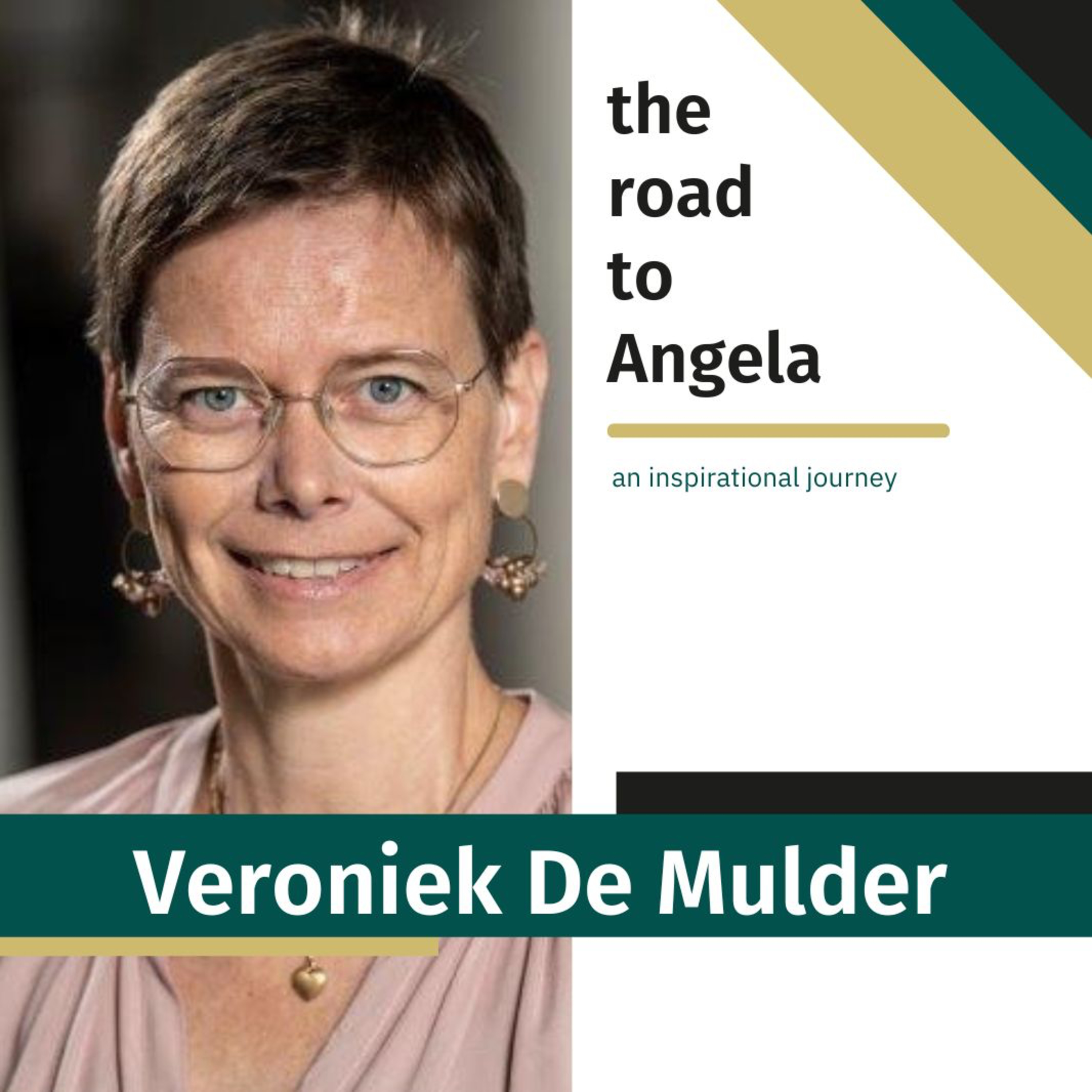
The podcast "Road to Angela" features Veronique de Mulder discussing her life, family, and career. Veronique shares details about her business, Dimples, and its unique concept. The interview takes place at the Antwerp Symphony Orchestra, a location of personal significance for Veronique. She elaborates on her role on different boards, emphasizing the importance of a strategic and supportive approach to management. Veronique reflects on her professional journey, highlighting her experiences in various sectors and her passion for helping individuals and organizations thrive.
Transcription
7434 Words, 40662 Characters
Welcome to the Road to Angela, a podcast that young professionals and managers help on the road to success and success.
By bringing authentic and recognizable stories of inspiring leaders.
The unique thing about our concept is that we show our way through our talk partner.
And as a kind of human writing, we come with every podcast a step closer.
Hello listeners, we are here today in the beautiful Antwerp Symphony Orchestra in the Dirigentologe.
Thanks to Verunik de Mulder, our guest speaker of the day.
Hello Verunik.
Good afternoon.
It's great to be here.
Maybe first of all for our listeners, would you like to introduce yourself?
Certainly. I am Verunik de Mulder. I was born in 1950.
In the meantime, I came from a warm family.
I have also known some losses in my family.
But I always find a lot of unconditional support and love.
I am married to my best friend.
We have been together for 28 years today.
That's right.
Thank you very much.
It's very coincidental, at the beginning of the lens.
So very symbolic.
I have three very cool children.
Really cool kids.
And I hope that they will come to realize at some point how important they are for us,
for me and my husband, and how beautiful they actually are as a person.
I have seen a professional.
I have taught as a teacher.
Later, after my 40th grade, I did an additional study,
in support of my father-in-law,
who was very clear in the direction of general management.
And those are the facts and the facts.
And you also have your own business?
Yes.
Indeed, dimples, management, mediation and advisory.
I am going to ask you why dimples.
It's a nice meaning.
Indeed.
It could also be called ripples,
but that is much less attractive.
It has become dimples.
Why dimples?
It is actually the English word for colds.
The idea behind it is that people with colds in their baths
or they laugh with colds in their baths,
that they have more pleasure in life.
But also golf balls, which also have dimples.
It is also a meaning that is used.
They are actually the balls in a golf ball.
And because of that,
a golf ball goes further than the same ball
that would be completely slippery.
So actually, I always say it is for entrepreneurs,
management, advice for entrepreneurs
who are just that little bit different.
Bart said in the intro,
in the Konigin Elizabeth Saal, in the Loge,
the Antwerp Symphonic Orchestra,
a special location, thanks for being here.
What does it mean for you?
Or why did you choose this location?
When I received the question for this interview,
I didn't have to think about it for a long time.
It is indeed a very beautiful, beautiful location.
And for me, it also means a special person.
But here, more than 40 years in the meantime.
I came here as Peter, or rather, Clöter,
and as a child with my parents.
That was when the Kom concerts were held.
And there were concerts that were actually held there
to make young children know with music,
with classical music.
By the way, there is still time.
Antwerp Symphony still has the KIT concerts today,
which are an incredible success.
I can only recommend it to those who are interested in it.
And later, on my 12th birthday,
I asked my grandparents,
"What would you really like to do?"
Or, "What would you like to have as a gift?"
And I chose it for a piano concert here in the old Elizabeth Saal.
I still know what I was doing.
It was so important that evening for me.
I came here with my grandmother.
And yes, that's actually a piece.
It's really in my DNA, this location.
And six or seven years ago,
I got the chance to go on tour.
For me, that was actually making a piece of the circle.
And then I also got to know the Antwerp Symphony Orchestra
as an organization.
I think I was very positively surprised by that.
I got to know an organization here,
which is really being guided very dynamically
by the host, Joost Magermann.
With the help of management, of involved people,
who really look at the many facets of such an orchestra.
Because what many people don't know,
is that we, as a Finnish art institution,
go much further than just concerts.
We also do recordings,
but we also have a very strong social engagement
with all kinds of dance groups.
And, yes, the target audience,
who may not necessarily come into contact with musical culture,
that's something that I'm really inspired by.
Can you tell us a little bit more about that social engagement?
Do you mean the orchestra, or in general?
Well, we have a number of projects
where our orchestras,
so effectively in Antwerp's lower schools,
are going to teach,
where the musical instruments are also being provided.
And you see that children in the lower school,
just like I, go to the music school,
are now a generation that gets a new chance.
Meanwhile, that is absolutely not so self-sufficient.
And you also see that it is very successful.
Children then also at the end of their career
have also participated in a concert like this.
That's fantastic.
That's really, that's really fun.
And you actually feel that warmth from the stage.
The parents are then also in the audience,
who find it much more difficult to find their way
to our performances or to our concerts.
Yes, it's magnificent.
And Veronique is in several meetings of support.
One of the questions that Tom, Tom Wilhelm,
gave us through,
because it is of course Tom who brought us to you.
Oh, and he has also given questions through.
He has also given questions through.
He's very serious.
I didn't know that beforehand.
The catch was also there.
Okay, I'm curious. Let me come.
Yes, one of the questions that he asked was,
"You actually sit in various meetings of support.
Is that mandate?
How does one mandate differ from the other?
How does your role differ from the other?"
Yes, that's a good question.
We had to listen.
A compliment for that.
Yes, of course, you can see in the steering wheel
of the expertise and skills,
the competencies that you bring with you.
In my case, it's that general management.
I'm a generalist.
Maybe we'll go further on that later.
But that makes me notice a lot in the steering wheel
that my contributions to organization,
forming and organization management.
I also close my vision of the function of the steering wheel.
I think a steering wheel should be a soundboard
for management.
A steering wheel that is strategic,
that looks ahead,
that also looks at corporate governance
and can really be a guide for the CEO
and for management.
If you have a steering wheel
where the drivers individually go micromanaging
or wake up when it's about their theme.
Someone is talking about HR, someone is talking about marketing.
"Ah, I know something about IT."
These are things that are important
and that are more valuable.
But I think that the whole of the steering wheel
is mainly about giving direction to the soundboard
to an organization.
My contribution is that in that area,
in the different mandates,
it can be very similar.
Of course, it can be different.
One, the one steering wheel,
sometimes differs in style
or in the culture of the others.
Those who run more formally,
those who run more informally.
But that also makes it very boring.
And how is it now set with the Belgian steering wheel?
Are they all working together at that level?
That's a very big question for a small person.
I can't really say much about that
for the Belgian landscape.
What I can say, I can speak for myself
from my own experience.
My mandates are currently not in native companies.
I have always been active
in the public sector and in the private sector,
mainly in the KMOs and family companies.
Now, in the public sector,
I think that this has happened.
I think the idea of independent drivers
and a diverse combination of steering wheels
has effectively been developed.
You can see that the discussions we have
are always valuable.
I always feel that I can contribute
and that it is useful.
And I also see that movement at KMOs.
The first generation of companies
often start with an advisory council,
often a step-up to a full-fledged steering wheel.
But I still see that there is a lot of movement
and that it is seriously involved.
Absolutely.
How do you choose your mandates?
Of course, you are there for candidates.
So the organisation chooses you for a piece.
But let's say that I really have a sense of love
for sectors where...
I don't know what I'm going to express,
but hard sectors, infrastructure works,
mobility, logistics,
development, that are things
that I have been working on for the past 25 years.
I have also grown in operational functions,
as has been my professional teaching path.
So I do have the desire to look in that direction.
A lot of organisations that are in transition
or in movement.
I think that's very important.
As a CEO, I also had the opportunity
to reorganise the organisation of a company,
the first generation of companies,
and really focus on it.
And I do notice that this is what interests me,
what interests me.
So there I will look for it.
And then of course you have Anthroposymphony,
but that has been love at first sight.
Tell me, what is your biggest talent?
My biggest talent?
Also in the light of the different mandates
that you take up within Dimples.
My biggest talent?
I don't know...
What strikes me is that you are actually
a teacher of education.
You also say, OK, I am actually very happy
for those hard sectors.
At the same time, I see someone here today
with a first feeling,
especially in terms of identity,
a whole human race.
I actually want to become Anthroposymphony.
I don't know what the talent is,
but I am a spoken-up human being.
I actually keep in mind the life
and the people who are in it.
I am also grateful for all kinds of people
that I can meet.
So I think, yes,
what I always keep in mind as a red wire,
that is, for me, a company, an organization,
always about people and processes,
about actually getting the best out of each individual,
on the one hand,
but at the same time also looking for synergy
between people.
And I think that you can do that everywhere.
I have already said it, I am a generalist,
and I have a lot of respect for expertise.
I also think it is very nice and enriching
to deal with people who are smarter than me,
who know it better in their field.
But I also take my motivation from the connection
and from the width.
Okay, that is actually,
we have talked about your talent.
Do you also have a,
what is your most important role model?
My most important role model.
I give, I like to delegate,
what I just said, I really like it,
and very fulfilling to see people
evolve and grow around me.
So I like to delegate,
I have a lot of trust,
and with a serious dose of patience,
but it is so that I,
and I have learned that over the years,
I have two enormous allergies.
And in the same way it is very handy,
if you know what allergies you are,
because you can apply that,
then you can deal with it,
and then you can react that wave,
to respond to allergies every time,
you can avoid that perfectly.
And allergies are actually,
on tip number one,
are actually people
who are always in the battle role.
It will not surprise you,
with what I just said,
I believe very much in,
in the power of the people,
and what it is,
that you can really get out of it
with the right context,
with the right will.
And if I come across people
who are in the battle role,
and overcome it all,
and it is sad,
then I can sometimes react very sharply,
so that's something I have to avoid.
I also have the same people
who disagree on something.
And then I don't mean that at all,
because I think that allergies are absolutely strange to me.
I think that allergies and happiness
are very difficult to reconcile,
and I have chosen for happiness
for a long time.
But especially those non-material people,
who disagree on something,
for example, power or status,
that is difficult to deal with.
I expect from people,
that they are effectively authentic,
and that everything is in there,
in there, in there,
that doesn't make me look good.
I have always, myself,
in my own way,
looked for managers
who looked good,
who I could learn from,
and who were also very open and transparent.
So that is also something
that I sometimes struggle with.
Someone who feels that in me,
because it is of course very relative,
or someone who feels in my perception
or in my own way,
who knows himself as a certain status
or a certain power,
that I dare to get out of there
verbally,
or that is what I think,
that is what I think.
I think it is a challenge
to talk about that in a good way.
I will hear it diplomatically.
We see here,
we hear a person,
who is very aware of
what allergies are,
what talents are,
have you always been aware of that?
Have you always been aware of
that this is important to me,
that I don't get energy from here?
No, absolutely not.
And how did you come here
to discover that?
I saw professionally a child
from the nineties.
I graduated in the second half
of the nineties.
At that time,
I really came from the school bank.
I was also the first
in the first ten years of my career.
I worked at multinationals.
So those are really
extremely fertile soils.
The sky was the limit
for what concerns
self-replowing,
training.
It was really unbelievable.
And I was lucky
to start very quickly
a Myers-Briggs analysis
to find out
if it works or not.
And when I was three,
twenty-four years old,
that was really a great achievement.
And the fun part of it
is that
ten years later
I did
something else
in my professional context.
What I was involved in
was that
my personality was the same
but that years in my experience
I had
a number of sharp points
and
I was nuanced.
And
it depends
on how I think.
In that way,
I am more aware
about it.
Another point
that made me aware
was that I had
a lot of time
to work in different
business cultures.
I worked in a corporate context
for ten years,
multinational and international.
And after that,
I had a sharp point
where I
worked in the Dutch government.
It was
something unconscious.
During the solicitation
I talked to myself
that I was going to ask for help.
I came home
and
my whole family
and friends
were asking for help.
I thought, that's not going to work.
It's not going to start.
You're going to die slowly.
I got that kind of
reaction.
But there was
an organization
that for a long time
was
the idea
that the government
had to
put their hands in the air
and put their budgets in.
I would visualize it like this.
The idea came under pressure.
And a number of
the services' functions
of the Flemish government
and at that moment
I spoke at the beginning of the year 2000.
A little later.
A number of the services' functions
of the government
were self-employed.
I came to a self-employed
agency
that for the first time
had to
provide
their own tools.
Indeed.
That made
it a huge challenge
for a commercial department
to start.
I worked there for
ten years.
I also had the chance
after the
commercial department
was in the real world
to make a huge fusion
of two public businesses.
So it was also a political
policy decision
to add a few rationalizations.
That process
was very useful
from the direction of functions.
Also,
the difference in culture
between the corporate world
and the public sector
made me
rich.
It gave me a very different look
at things.
It is also in that period
that I
am a postgraduate
and go around conflict management
because I came from the private sector
towards the public sector
and was constantly
shocked by it.
It was that
I went
as an employee
to the company
and I was really confronted
with a tension
as I had never experienced before.
At some point, it seemed
literally that the private
sector and the public sector
spoke a different language.
Then I started looking
at how to deal with that.
Then I came
back to mediation.
In the Netherlands
that is much further.
There is also a lot of interaction
between government
and private companies.
But in Belgium that did not exist.
There was also interaction
for social issues.
That is often the interaction
you sometimes see
at big shutters.
But actually
in government-related
matters it did not exist.
Together
with
two other
members of the KU Leuven
I developed
a postgraduate form
in the defense
of the private faculty
of the KU Leuven.
It still exists today.
In the Netherlands
it still exists today.
I
eventually studied
in my postgraduate form.
I did not do that.
Then I finally recognized
as a federal mediator.
But it was more than 10 years ago.
This year it was 10 years ago.
So 10 years later
there is this interaction
postgraduate mediation
in government-related matters.
It is also recognized
by the government-related committees.
And you also see
that it starts to live very strongly.
That is only one aspect
because later
we have to come back
because your original question was
how are you now
until that awareness has come
and
the nuance
of your own person.
My second answer was
the different business cultures.
And I later
could use
the third culture
that I was able to experience.
That is the culture
in the Kaimo world.
The family business.
So after the Flemish government
and after the fuses
I actually took over.
So I was asked
by a first generation
founder of a business
to lead
as a CEO.
And I went there.
I did that for 5 years.
And then again
on a completely different vibe
completely different culture.
And on new
a lot of fulfillment
was taken out.
A lot of
contacts were made
with the employees,
with clients, with suppliers,
with the whole context of such a family business.
That was really fantastic.
And then there was
the environment
that was really important.
Because at the time of the environment
I was there as an engineer
for the first time
with aspects of
communication science, psychology,
pedagogy,
but also a bit of justice.
And that brought me back
to the 40th
that added education
and in that way
I was one of those
very grateful teachers.
And every time
I go around the circle
taking the next step
I get motivated
I get passionate
and then I go back
to the next step.
So the challenge did work out, right?
Yes, if I tell myself
then it seems like
my mother used to say
"I don't understand that question.
It's hard, it's hard."
That's how it is.
And I would definitely
pick that up.
Even if it's about your allergies
you are very positive
and
it gives you a lot of ground
for a lot of positivism.
You try it.
You tell about that, you have to
say it with a certain
"E" side.
It makes absolute sense
how you experience it
and tell it.
But I can also imagine
that it has been easy.
No, absolutely not.
That's right.
Also the combination
with everything outside.
So of course I tell
only one aspect today
and that is the profession.
But there have really been
moments
where the professional
was the real enjoyer
and the mother.
But that is of course
the choice you make.
And I have always felt very pleased
with that. I have never experienced
when I don't need it
to go mountain biking
or to go cycling on Sundays.
People sometimes ask
"How do you do that?"
All those different balls in the air.
It seems almost impossible.
For me it is very simple.
I watch TV and I don't do sports.
Not done, of course.
Not done.
But you have to
tell how many hours a week
you will be holding on to it.
It adds
that I have always been
greatly supported
by my real enjoyer.
And that we
have always met our children.
And yes,
together that is a team effort.
I keep saying
that we are doing that for each other.
We are a team of five.
And we
try to support each other
in the phase of life that we are.
When we are married
we say to each other
We are not married to each other.
And that is something we really want to live.
Of course we also had a bit of luck
that in our professional
walking lanes
there was some kind of detachment.
The moments when
my husband jumped
I was in a stable period
or reversed.
But there were also periods
that we came together.
There were also periods
that the children
came to the office
after school.
And when they did homework
at my office
they always asked me
for a lot of advice.
They always experienced that
especially
to do that.
I also took them to meetings
that they indeed
in a part of the room
or in a office
next door.
And I always told them
what I was doing
and what I was doing there
and why.
I think you should ask yourself
if you appreciate that.
I also always
very clearly
had two rules
concerning professional life
and private life.
And that is when the children were small
from 6 to 8 I was always at home.
My employer
allowed me to work
for 22 hours a day
but between 6 and 8
was the only moment
for small children
that you have quality
time with your growth.
So that is something I really
wanted to try to live.
And secondly,
I always took the phone
as one of my three children.
I sat in meetings
with ministers
where the phone went
and I answered
with "hello" with "mama".
That is non-negotiable for me.
Sometimes I had strange situations
when I had a phone
or I had to take a weapon
out of the closet
and I said to myself
"this is such a sacred word"
and I never knew
but during that time
it was a crucial question
for me to answer the phone.
Maybe you had a few calls
when they were ringing.
Yes, absolutely.
But sometimes I had a phone
because my daughter had a accident
on the street.
So I think
that is
very clear in perspective.
Yes, I also notice
that you are also in the beginning of the conversation.
There are
a lot of important things to see
but there is
quite a lot of room
for losing.
Can you tell us more about that?
I think that in all families
there is a lot of room
and we have been in our family
for a very long time
but in the short term
I have lost my mother
as well as my great-grandmother.
And that is
because there were two figures
that were really important to me
and still are.
Was that
a critical moment?
Now you may ask me
if I have learned something
by looking at it.
No, absolutely not.
If I have learned
something from it
I have always been an optimist.
So it has not changed.
I have a kind of
very healthy
relative realism
about that.
And that makes
that I can go on with it.
Also
a bit of gratitude
that I am no longer there
only because
of how they have contributed
to who I am
and that I really
have received
a lot from those two
great-grandmothers.
I think that is
very rare to say
but
when my mother died
then
it was very sudden, very unexpected.
And we are
as family
with my father, my brother, my sister
but also with my own family
with men and children.
We can go on.
And I am really convinced
that that is her legacy.
She has made
that we
are the people we are
and that is effective
in a very healthy way
and very supportive to each other
and that is how
we can go on with it.
That is her legacy.
Just a moment.
Yes.
Maybe something to overthink.
You are getting a little silent.
Yes, we have that sometimes.
That is nice.
But maybe
to a general question
we notice
the listeners of our podcast
often talk to people
between the 30s and 40s
between those periods
where you notice that everyone
at that moment in his life is very difficult.
You are working hard
you have to present very hard
when you have children
young children where you have to be a lot of them.
Is that for you too?
Because you are there just before, I think.
Is that also a difficult period for you
and have you
maybe tips from your own experience
how do you deal with it?
Maybe a lot.
Have you ever known a moment
when certain thinkers
maybe start to think
that maybe in a different way
you have started to look
or you have started to search?
Have you ever known that moment?
No, I have to explain it to you.
I have to explain it to you.
I am actually
I have just said it.
I have been running in the beginning
that 10 years later
I have been quite consequent.
So no, I don't have big moments
where we throw everything around.
But I...
No, that doesn't fit
with who I am.
Say, the analysis
that you have done
in my talks
you say to yourself, I am ready
where you have learned at that moment.
Can you tell a little bit more about that
and maybe also make the link
with those pieces that we have made up?
Yes.
Then 10 years later?
Yes.
Now, if you are going to ask people
about how
is Veronica actually?
I think that you
will hear one thing
or I think that will be
very analytical
structured,
analytical,
goal-oriented.
If you are going to ask people
who have worked with me
I also think that
you already said the same thing.
Don't surprise me a little bit.
But I am also a child
as an optimist.
Optimist, without prejudices.
It is something that is always with me.
I have ever read somewhere on a wall
I have to keep it.
It is an expression that says
not what we are doing
does us up or down
but our way of looking at it
will enrich or enrich us.
If my children hear this
they will laugh at me.
They have already heard it.
It is one of my life lessons
that they have already heard
just once in a while.
Maybe I should
make a note of that.
But that is something that
I really like.
And it also goes with
the fact that I really believe
in what I just said
the individual competencies
and the good will
of people and the synergy
that can work between people.
So that is something
that I like.
I think that a lot of people
will also say that
I am very reluctant as a manager.
I can't deny that.
That is right.
I am reluctant for myself
and I am also for others.
I like that the things
when they are done well
are done well.
I will do that
with the soft hand
soft but not
indecisive
or with the necessary courage
I will say it like that.
In a
in a
in an expression
Rumi once said
or wrote
Persian poet Philozof
and he said
"Race your words, not your voice.
It is rain that grows flowers,
not thunder."
And I find that constantly powerful.
And I have
the experience
or if that is something
that I have noticed
you don't have to
notice that you are there.
It is much more powerful
that people notice
that you are not there.
And that is something
that I
don't like.
Because I really try
to make sure that people
where I can work together
that
yes, that they
are actually certain teams
where I have worked together
they actually have to be perfect
without myself
my work is off as
that if they can continue
once again.
I absolutely do not have all wisdom
than I think
to be able
to recognize that in a different way
but not only recognize
but also recognize
and then that people
also have space
when you have the foresight
to be able to control that kind of people
then
I think that is only respectful
and very careful with going around
and
then you see what happens
almost always
very
outstanding things, but with falling
and upstanding.
It is not a naive, rosy human
story
It is about falling and upstanding.
How
do you create that?
How do you create that
within your team?
The fact that you are no longer needed
the fact that people know
what is expected of you
that
is
a good question
I think that I am a part of that
in your evolution
I am a child
a professional child of the 90s
that was a time of the self-managing teams
it all had to
get up
get up
and I have also been there for a long time
to trade
and certainly as a young professional
when I was
around 20 to 30
I was really fed up with that
and I had already heard that
on the school banks of you are the next generation
You are going to do it
like I said, I studied in high colleges
from the school banks
so it really couldn't be
that the world was on our feet
and that was the first year
and that also makes
that you actually step
in that culture
and take risks
and in fact
you are already facing the wall
and then learn again
and now
with then actually
to evolve further
in my course
and then of course
to take up first-line management
people management
I also realized
that it has been a very personal project
and that
that absolute freedom
and let us
brainstorm and let us
freewheel and then
we all come together
my experience now 25 years later
is
there still something
different in that
today I would say
people need transparency
people want transparency
and people also want a bit of leadership
people want
a manager
who knows
who is behind me
or who is next to me
at times of success
but also at times of
disappointment
or less
less positive experiences
and
I think if you give
those two things
in combination with space
to
develop
that you then welcome
to the positive effect
that you really the lowest
out of a team
of professionals
can get
Yes I want to
not pick up
you have already learned everything
to be a manager for 25 years
the manager you see today
at the beginning
is there a certain advice
or a certain type of
try to
do that for sure
free from the one you have now
I think
yes advice
I think that's something
difficult because
of course everyone is different
but
I would definitely
say
look at where the opportunities are
and understand
don't be afraid to
make mistakes
if you do something
you will be passionate about it
absolutely also
look for environments
where you can really
grow, where you can flourish
I have always
kept the principle
that a request
that was two directions wrong
I always thought
that I had to go
to the other side of the table
to decide if they want me
or not at the club
I have never
talked to a request in that way
that was my complete fear
I really thought that was a
equality
for me it was the job
on the other side of the table
also as a solicitor
and I think that's really important
look for environments
where you yourself
can be
where you can
grow
I think that's really important
that's not just
an excuse
but that comes
from the first
experience I had
at the beginning of my career
that was a side point
before I realized
that I had a side point
I will
tell you that briefly
and I was in my last year
I was
able to sign a contract
and
being able to sign a contract
and being able to sign a contract
I was 100% sure
that I had done that
I was in my last year
and my premise was
to get out of it as soon as possible
and do something with marketing
that wasn't a success
because
in that time
marketing was a very hot topic
and there was
at every solicitation
about 20, 30, 40
studied marketing next to me
so I said
look, are you going to
throw that over another book
I'm going to participate
in a kind of case study weekend
and those were five multinationals
and they had
a case made up
they were able to solicit
from hundreds of solicitations
a number of students were chosen
per company and they were allowed
to do that in a luxury hotel
that was incredible
they were allowed to
solve that case
completely surrounded
by HR people
and a number of psychologists
a number of business people
of the company
you can already hear it
so I asked for it
and out of all those candidates
I was chosen to
do that case
for Procter & Gamble
and so I
was sitting on that weekend
with ten on that case
and so the price of that weekend
was actually that the best
student
actually got a job offer
offered
at the end of that weekend
I won
that competition
and I got a job offer
I was
incredibly happy with that
I was also in the newspapers
I took photos there
fantastic
it wasn't that
I still know that it was December 6
of my last
of my graduation year
and a few months later I got a phone
it's a pity
but it's a bit annoying news
we're going to
offer that job offer
we're not going to be able to
give it to you
I was actually appointed as
junior product manager
so I had exactly achieved what I wanted
I was far away from the debt
and I started
in FMCG
fast moving consumer goods
in the marketing
and in my head
but it wasn't like that
because they were behind
and that there was
a floating system somewhere
so that they could
get a job as
junior marketing
or junior product manager
and in the policy of then
it was impossible
it had to be someone
with an education
economy or trade
I know a lot
so, unfortunately
the job went to number 2
and I got an alternative
offered in the lab
that was of course
for me
that was the hell
that was for me
a waste
the idea of getting lost in a lab
that didn't work at all
now I had
at the beginning of the year
that was also listed at other companies
and then
the competitor of Proctor
contacted me
and they said
you can start with us
as sales engineer
a bit of a compromise
between engineering and sales then
I now went
10.000 Belgian francs
for a huge amount of money
but
they did my manager
country manager
but they said
if you perform well
then I will
write you in the Hippo program
Hi-potential program
worldwide
and then you can continue
and within 5 years
you will have doubled your salary
I say but I will mark there
and I will give you my SOT
so I did that
and that's how my job began
and within 5 years
I doubled my salary
and I had a huge
nice start
but that's actually
as I said
a side moment
without realizing it
but there I have
a very important lesson learned
that is to find places
where you are rewarded
and where you
can really
get
that the mindset of a company
is the same as yours
yes exactly
it was a very nice one
a question that was already
hanging out with me
without allowing me to
hear it very well again
you mentioned
the word "definition"
the importance of "definition" more and more
I know that you also give advice
also in family
context
in a world
where there is less and less
clarity
more and more ambiguity
how do you support
organizations
to go beyond that
also on a strategic level
there are a few
elements in your questions
but
if I click
on that clarity
I notice that
it is very difficult for people
to communicate with each other
the world
is complex
but at the same time very fluid
there is also no time
to talk about things
with each other
and as a mediator
so a very nice definition
of what a mediator is
it is someone
who facilitates other people's negotiations
I am also convinced
that you can take that step
to the conflict
or the mediation
in what context
if you have
a strong base
in negotiations
and negotiations can
in many contexts
in many situations
whether it is between a leader
or between shareholders
of a company
a leader in a CEO
or between two colleagues
or in what context
that clarity
is not just about itself
I can say
people need clarity
and you can add
the thinking
if I am direct enough
then they will understand
but that is not the case
often people ask
for some guidance
to make certain things
clear
conflict can be avoidable
but conflict can also be
solved
in both situations
maybe there is clarity
that can be something that is not
clear at that moment
yes
we cannot know everything
what can happen
yes that is correct
but it can also be
broken
and it can also be something
where leadership takes place
I am thinking of a situation
between manager and worker
when I
go into conversation with managers
I often see
your role as leader
consists of three big fundamentals
coach, manager
and leader
you will see that
most of us
will play the role of nature
for one of those three roles
but the idea
around leadership
is just that you are next to
a natural role
also a part of your role
so that you can really
fully absorb those three fundamentals
in leadership
and depending on
the situation you are in
or the person
with whom you are creating
the one or the other
or the other fundamentals
more pressure, there will be moments
where your team
gives you more need
as a coach
or an individual member of the team
gives you more need
there are other moments
where you really need to correct
and say "I am taking the lead now"
and this is the way we are going to follow
the part of your manager
is something that
by young leaders
you often have the option
to keep your project manager
while when they
make the promotion or the step
to team
leader or team manager
you just have to step off
of your project manager
but you have to start your team manager
what does it all mean?
keep in mind that you can connect
with each other
that you are the right man or woman
and that you are the right man
and that you are the right man
and that you are the right woman
and that you are the right woman
and that you are the right man
and that you are the right woman
and that you are the right man
and that you are the right woman
and that you are the right man
and that you are the right woman
and that you are the right man
and that you are the right man
and that you are the right woman
and that you are the right man
yes, that's right
so you have to do it
there are very few
who see that all three of them
are not the only three
I can tell you more about that
but that's not the topic of today
but those are the three
for me the three fundamentals
depending on the example
if you look at that role
in family KMO
you can come back to those different cultures
where I have been
in the past to participate
in a family KMO
you are going to be there very quickly
also as a fourth pillar
as an entrepreneur
a family KMO needs to be a leader
also as an entrepreneur
in a public environment
maybe that will be less
maybe that will be more
medium-sized
because you are sitting there
with a number of exciting fields
between very different actors
and in a corporate situation
that can be something else
that can be more about inclusion
or diversity management
yes, that's good
maybe a topic for our short version
indeed
maybe one last question
in this conversation
can you answer it, Patrick?
can you answer the question
I want to hear it
can you answer it
I think that's a strange question
but you already knew it
I think that's a strange question
because
I have said it several times
I believe
so firmly
in opportunities
take opportunities
and effectively
work on yourself
and on your surroundings
even the first stone
for me it's a dream
even if it's something very frustrating
or even if it's
an unrealized wish
or if it's
something unrealistic
but I think it's a strange concept
because
you really are from the judgment
take it firmly in the beginning
to really inform yourself
take it firmly
in the beginning
you see where you come out
and yourself
when you break the three times
you go under the four times
there is only one way
and that is ahead
and that can indeed be
with blood and bubbles
that is
talking about yourself
but that may not be against you
then all these things are equal
and I also combine
with what you are going to say
and also be conceivable
for example what there is today
but then
the last question
what would you like
to leave?
since no world peace
or a green planet
that's not a mistake
no, it's not a mistake
I
I hope
that the people
who have known me
will have
something to do with it
and that it is the only thing
that I can extend
and I find it
very ambitious
and not much to discuss
but yes, I must say
maybe, maybe that will
that may be due to
someone had something
on my passage here
and that may not mean much
they will say
that is really
an oracle of Delphi
someone else
who has done it to me
how it doesn't have to
but yes
let us formulate it positively
that it has been meaningful
in which sense
that it could have meant a dimple
that's beautiful
yes, exactly
everything will be okay in the end
if it's not okay, it's not the end
voila
more adventures in episodes via LinkedIn
or www.TheRoadToAngela.be
Podcast Summary
Key Points:
The podcast "Road to Angela" features inspiring leaders sharing their stories.
Veronique de Mulder discusses her personal life, family, and professional journey.
Veronique talks about her business, Dimples, and its unique concept.
The interview takes place at the Antwerp Symphony Orchestra, a significant location for Veronique.
Veronique shares insights on her role on various boards and her approach to management.
Summary:
The podcast "Road to Angela" features Veronique de Mulder discussing her life, family, and career. Veronique shares details about her business, Dimples, and its unique concept. The interview takes place at the Antwerp Symphony Orchestra, a location of personal significance for Veronique.
She elaborates on her role on different boards, emphasizing the importance of a strategic and supportive approach to management. Veronique reflects on her professional journey, highlighting her experiences in various sectors and her passion for helping individuals and organizations thrive.
FAQs
Dimples is the English word for 'kuiltjes,' symbolizing joy in life. It represents uniqueness and adding value, like the dimples on a golf ball.
Verunik has a personal connection to the Antwerp Symphony Orchestra dating back to his childhood. The location holds sentimental value and represents a significant part of his life.
Verunik's role in support meetings is guided by his expertise in general management. He focuses on providing strategic direction, soundboarding for management, and ensuring effective organizational governance.
Verunik is drawn to sectors like infrastructure, mobility, and logistics due to his background and experience. He looks for organizations in transition or movement where he can contribute effectively.
Verunik's self-awareness journey began through professional experiences in different business cultures and sectors. He underwent personality analyses and learned to navigate his strengths and weaknesses over time.
Verunik emphasizes the importance of authenticity and effective communication in his interactions. He values synergy between individuals and aims to bring out the best in each person he works with.
Chat with AI
Loading...
Pro features
Go deeper with this episode
Unlock creator-grade tools that turn any transcript into show notes and subtitle files.
 PodcastTranscript AI