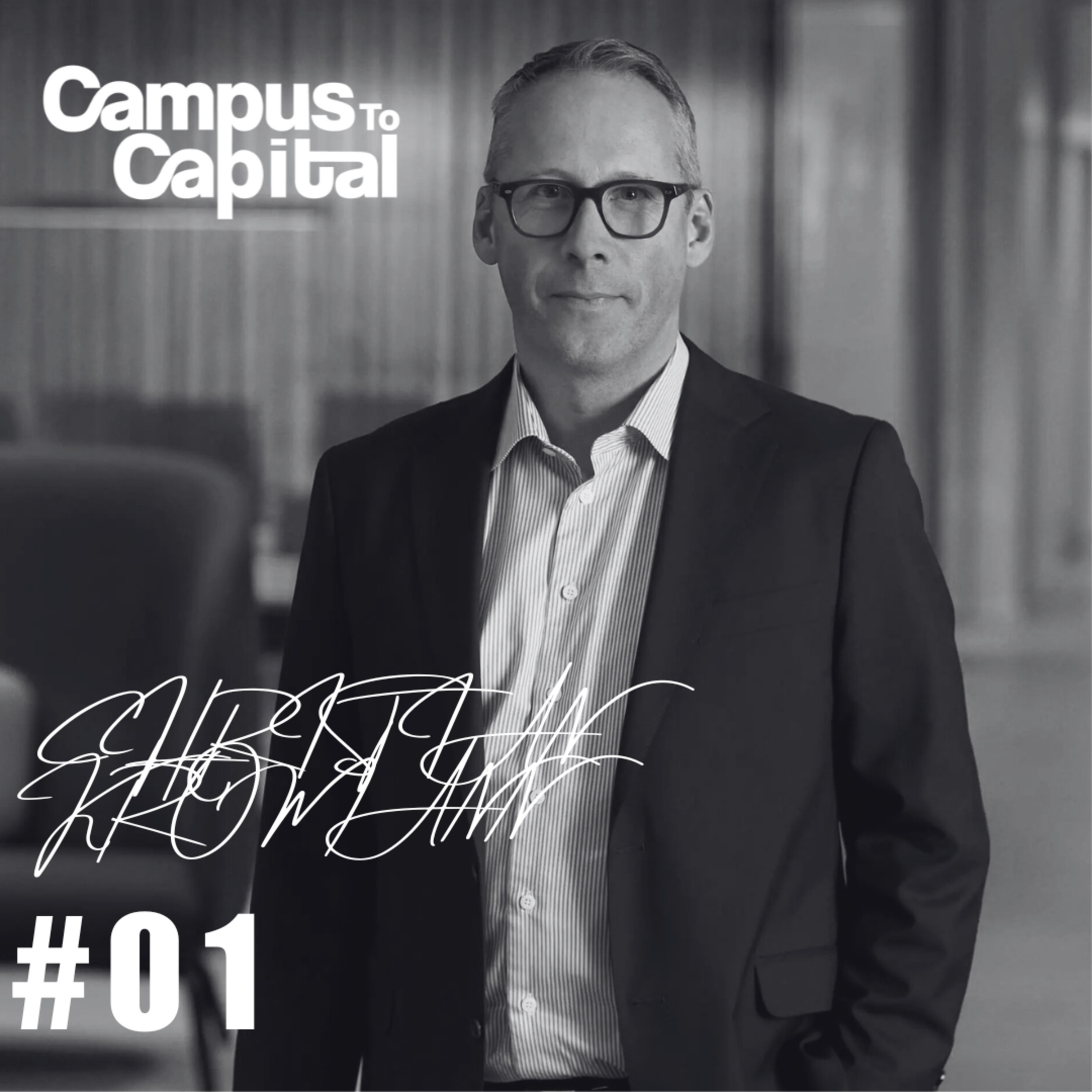
#01 Christian Kromann - Board Member @ Deutsche Börse on AI, Fintech and Financial Services
51m 16s
In the first episode of Campus the Capital, Christian Kroman, former CEO of SimCorp and Executive Port Member of Deutsche Börse Group, shares his career journey from studying economics to leadership roles in FinTech. He discusses the evolution of the financial industry, emphasizing the impact of technology and risk management. Kroman reflects on his transition from SimCorp to Deutsche Börse Group, highlighting differences in corporate culture and regulatory aspects. Offering advice to aspiring professionals, he stresses the importance of gaining real knowledge early in one's career, seeking feedback, and building lasting professional connections. Kroman also discusses the role of ESG data and investment management solutions, highlighting the significance of ESG profiles for companies in the evolving financial landscape.
Transcription
7983 Words, 44348 Characters
Welcome to the first episode of Campus the Capital. I'm Julius and I'm Konstantin. Nice
to meet you guys and thank you for tuning in. And for the very first episode we are joined
by a very special guest, Christian Kroman, former CEO of SimCorp and Executive Port Member
of the Deutsche Börse Group, joining us for a very interesting talk. Hello Christian.
Hello guys and thanks for inviting me. Thank you for coming. Thank you for your time. And
I mean those are some pretty impressive positions and I mean that's a very great chance to be
talking to somebody that is on such a great professional level. But could you maybe walk
us through your career from studying economics at KU to leadership roles in FinTech now?
Sure I can. So how much time do you have? So yeah, let's start way back. It's many years
ago now. So as you rightly said, I studied economics in Copenhagen University. And what
was that? Starting in the late 80s and going into the early 90s. And as you quite often
do in Denmark, especially in Copenhagen, you get a work, a relevant work in the later part
of your study and I ended up in a bank. And then in the early 90s, mid 90s, banking was
very different than it is today. And that's where derivatives really started to take off
and risk management became a real profession, much more sophisticated than it was. And all
of these things, even at that point, you couldn't do without technology. And at that point technology
also really started to take an off. So you would see a lot of the software companies
should all in the financial industry was actually founded in those days because that's really
where the use cases started to take off. So I started in what is now not there and was
called something else way back called Unibank and worked for five years in their risk management
department, utilizing IT and probably the first time I really got the flavor of kind
of math, sophisticated financial engineering, and technology had something to do with each
other. And then eventually that led to a job in a large global software company now called
FIS, it was called Sun Guard in the days and was sold to FIS in 2016. So what they were
doing were creating solutions for post sophisticated risk management. So actually at that point
I then joined as a consultant implementing systems. So configuring yield curves, valuation
functions and all these things for quite many years traveled around the world and met many
financial institutions and implemented the systems to their needs. So also there you
kind of there was math, there was finance, there was technology, but now I also got an
international angle to the experience. And then eventually inside Sun Guard I got interested
in sales. So I actually spent part of my years in Sun Guard selling, which basically selling
transformation. And I really enjoyed the psychological aspects of selling big transformations.
And also there that was a European job. So really got to know a lot of financial institutions
understood how decision makers think when they make a big transformation. And also really
got got the flavor of being an integrated part of that. And then eventually that also
led to leadership positions. First obviously leader of a team and then eventually leaders
of leaders and long story short, that took me to my first kind of real executive position.
So I ended up running a business inside Sun Guard. And then actually at that point, Sun
Guard was owned by quite a few private equity companies. So there was a big restructuring
going on as part of that as well. So I'm also going to hang on that. And I was so lucky
to very nearly one of my career got involved in very large kind of companies restructuring
projects, putting companies together, reshaping the value proposition and go to market again.
But all of that actually ended up with 17 years in that organization, which, you know,
if I was young and somebody would tell me today you have to spend 17 years in the same
organization, what are you talking about? But but because it was big, you ended up learning
a lot of things, doing many different things in in during those 17 years. But then I felt
ready to to take on my first CEO job. And one thing is, I feel ready that you need to
find somebody that actually thinks you're ready. But I ended up running a technology
company that was doing the processing for claims and insurance pricing, which is extremely
sophisticated stuff. Small Danish tech company owned by private equity QT. So that was my
first real CEO job. I ran much bigger divisions, but I felt it was interesting to actually
be at the at the end of the table running a company that was a little bit smaller. So
I could both do that, but also get kind of understand how the company worked in every
every corner. Was there three years created great turnaround and growth. And then eventually
a SIMCorp called and asked whether I was interested to to join in a CEO job in the first round.
And then eventually, I ended up succeeding class also as CEO took a little longer than
expected. There was the middle of COVID, but eventually we got there. So that was very
exciting. And then obviously, fast forward into to where we are now, a SIMCorp got sold
to the Deutsche Börse. And in the end of 23. And then, yeah, couple of weeks ago, stepped
up to my executive management board position and in in Deutsche Börse group. So I would
say, more or less been technology firms all the all the time, except for those five years
and in the day where it was really getting getting the knowledge of those sophisticated
part of a financial institution. So very much a red thread that has always been been sold
to to large, sophisticated financial institutions. So yeah, it's been exciting so far. For sure.
I mean, it sounds very exciting. And as you just briefly touched upon, you just transitioned
to Deutsche Börse from SIMCorp. And we're wondering what challenges or opportunities
did you encounter when you when you transitioned from SIMCorp to Deutsche Börse group?
So me personally, or SIMCorp?
No, no, you personally.
Yeah, well, I think that was, that was a bit of a longer process, if you imagine, right?
So SIMCorp became part of Deutsche Börse group. Yeah, probably around October, September.
Oh, sorry, September, October 23. All day, we spent a lot of time working together.
SIMCorp and Deutsche Börse are in a partnership around distributing some some of their products.
So we knew each other quite well, even though we're selling a company is a is a big thing.
So and then eventually, there was a succession process ongoing in Deutsche Börse, where
Teodor Weimer retired and Stefan Leitner stepped up as the new CEO. And I was so fortunate
in the end, they asked me whether I wanted to, to follow Stefan Leitner and take the
lead on the IMS side. So quite a few things are different, right?
So it's German corporate culture, which is probably you've seen a bit of Denmark already.
So the culture is different. It's a much bigger company, even though SIMCorp is also a reasonably
big company than Deutsche Börse group is substantially bigger. It's a regulated company,
which is also very different, not regulated as a bank, but it's still regulated. So quite
a very, very different day to day feel than running a software company where things are
moving at a very high pace to running a very large German corporation that is regulated
and to some extent, a relatively close tie to big parts of the political landscape in
Germany as well. So for me, I would say probably a big personal, big change, but running the
IMS segment as such is very close to what I did with SIMCorp already. So from that point
of view, I feel at home. But I'm obviously learning a kind of corporate world again,
even though that Deutsche Börse is roughly the same size as what Zunga was when I was there.
I kind of understand how a big company works, but, but certainly a few things are different.
But the ambitions are high. And in the end, that's what drives me. And it's a, it's a fun,
it's a fun team I work with. I mean, that sounds nice. It's great. I'm happy that you like the
German corporate culture from what I heard. I didn't say that. I just said that it was different.
No, no, no, it's, we have a lot of this fun discussion. There's a great relationship between
Danish and German culture. There's certainly differences. But I think in the end what comes
from me is the values. The values are the same. But as I said, we had a town hall in Germany.
Somebody asked me, what's the biggest difference between German and Danish culture? And I said,
well, meetings in Germany takes a very long time. Yeah, that's, I think it's a,
it's, it's this stereotype that holds true that we thoroughly think through a lot of
things and are very detailed on bureaucracy and all of those things. I mean, looking back
at your early career, though, I mean, you broke into the financial industry quite early and then
obviously you had a very successful progression within it. But are there maybe any career decisions
that you regret doing or something that you would do differently now if you could change it?
Yeah. So it's always a lot easier to look in hindsight what you would have done differently,
right? You know, I had to have two sons, one is 23 and it's already starting as well and one is 16
is approaching a more serious part of his, his kind of study in Korea. And of course, they asked me,
well, you know, do you have any advice? It's very seldom they ask that. So, so you have to take your
opportunity when they do. And I think if I probably would have liked to start by learning a few more
sectors than, than just one, if I could, I love the sector, right? Don't get me wrong. But, but I
could probably have, have started out by being a bit more general and understand many types of
businesses. I think that is what I really liked. But I've, you know, somehow I think I would have
ended up the same place. But being a bit more generalist on some of these things and not to
go into too much detail. The study I have started my career with is extremely academic and very
little about business. So I probably also on hindsight would have loved to learn a little
bit more about business. Now I learned it, you could say the hard way or the real way or whatever
you want to call it. But learning a bit more business and general, more generalistic across
many sectors in the beginning are probably, if I could start a new that would have been, that would
have been great. Okay. Yeah. I mean, a question that's pretty much connected to this is what is your
most valuable piece of advice for students or young professionals aspiring to excel at the
intersection of technology and finance? Yeah, but if you want to, if you want to go into that sector,
of course, then, you know, probably not too bad to replicate a bit what I've done, right? I would
say I really, really, and I can see that now. The fact that I did work on the customer side at
some point tells me a lot. Because in the end, you know, we all commercial companies, if nobody
wants to buy what we build, then it's irrelevant, right? So having that ability to put yourself in
the customer's shoes, I find extremely important, right? So I would say learn the, learn some craftsmanship,
some real knowledge early on in your career, I think is a good advice that I don't think will
ever, will ever haunt you. And I think maybe more on the, everybody always asked me, you know,
do you have a career plan? Did you plan anything? You've probably heard many times that people
like me say, well, no, we didn't have a career plan. It was in the end, more ambition and aspiration.
And then actually, you have to be lucky as well, you have to have somebody that want to give you
a chance, right? Somebody needs to believe you at some point, otherwise, you're never going to get
the next, the next shot. So that's also probably an advice, you know, you know, find some people
that can actually give you some feedback and help you on the journey is also very important,
both in personal life, but also in professional life. And I mean, something that I hear a lot
is that it's important to specialize in a certain direction. But you also said like that the
general business knowledge is very important in the today's world. How can you balance this
specialization and this broad skill set? Yeah, it's a fundamentally good question. It's something
we discuss quite a lot in when we hire people in the various roles I've been in. What do you do,
right? Because in the end, when if you hire people, you actually want to ultimately want to keep them
for a longer time and develop them and make them the future leaders. So in principle,
as a company, you want people to be productive as fast as possible, right? Which drives specialization
in principle. But but I still mean what I say is if I can, if I could choose
well for my kids, but anybody that asked me, you know, get get yourself a bit rounded in
in the beginning and be cool about it. But luckily, there's plenty of companies out there
that have figured that out, right? So consulting companies or whatever they are, that's what they
offer. So so go with that a bit and then find a business you you find interesting and go deep
at a certain point in time. I think I really like that point because I think also for us
young people that now maybe are starting to get some proper work experience through internships,
I think I'm safe to say that I always feel like when I have an internship, I learn so much more
within the span of one or two months than I would ever learn during that time at university or school.
And I mean, as you said, obviously, but getting that experience, you need to have people that buy
into you need to have people that like you, I guess, know about your skills. And I mean,
obviously, like some people have it easier than others, but for a lot of people, networking per
say or connecting with a lot of people reaching out to a lot of people asking for chances and
opportunities is not as easy. So do you maybe have some tips that we could give away for someone that
wants to improve the ability of building lasting professional connections?
Well, I can barely say that I get a lot of people connecting with me in many different ways. The
only thing I ever take time for is things like this. Because first and foremost, on a very selfish
note, if I can attract anybody that would want to work in a company where I also work, that's great.
But in principle, I also feel I have an application to give something back, right? So whatever I can do,
in that context, my door is always open. Obviously, if you post this to all of the CBS,
that might be tricky. But I think most people I meet have the same. So I think probably the mental
block is more on your side, right? Do you actually want to send me an email and ask for a coffee?
I think most people would say, yeah, sure, right? Of course, you can use the network
through the web, right? But I think maybe a question back to you guys, you know,
is there enough companies actually creating network events that you see that you I mean,
I would definitely say so. I think especially here, I mean, there's a very strong culture for
that. I mean, tomorrow, even we're going to a KPMG for a machine learning workshop. And then
other companies often come here, host events. And if you want to, if you're interested, you can
sign up. But I also think, I mean, through the fact that we're just in an information society
nowadays, I think it's fairly easy to build a connection through LinkedIn, or maybe even social
media or something. And yes, I mean, it's also easier to reach out to people, but it's also
easier to obtain information about the things that you're interested in about
the company. And I think that definitely can also help you in the process of reaching out to
somebody. It's also easier to reject people that reaches out, right? But now it's good
feedback, right? We do it in many countries where we are fundamentally growing the number
of employees. So I think, but otherwise, I would say don't, don't be shy.
And probably also quality stands above quantity in this context. I mean, building long lasting
relationships with few people is probably much more valuable than having these, you know,
not very deep relations with many people. So.
Yeah, but I thought a little bit about, I think it's a very good question. If I look
at the people I've known the most, it's typically something where you've been to
something difficult together, either inside a company or between two companies, you've done
something. And the things that don't really last are the ones where, you know, it's just
constant coffee meetings and blah, blah type of conversations, nothing, nothing really happens.
So I think, you know, once you have those kind of relationships, they typically last and
we all know people move around and then you have some basic trust, you know, you can trust
that person. And then next time you need something similar, you, that's where you start, right? That's
fortunately still people that do business with people and I don't own any machines. So
I think those kind of relationships are important, right? But I think chemistry also matters.
Yeah, I mean, I think I think once a bond is created, then I guess it will also very likely
just last because why not? Before we continue with this episode, we want to introduce our partner,
Timeless Investments. Traditional investments are great, but what if you could invest in something
truly unique? Think rare sneakers, luxury watches, fine art or vintage whiskey? With Timeless,
you can starting from just 50 euros per investment. Timeless is Europe's leading platform for
alternative investments. Every asset is carefully selected, authenticated and secured on the blockchain.
And with backing from Porsche Ventures and EQT Ventures, you know, you're in good hands.
Get started now. Download the Timeless app, invest in exclusive assets and claim your 10 euro welcome
bonus with our link. If you're interested in Timeless, please check out the description of
the episode below. But I think now we would like to move on to talk about more a bit more about
SYNCORP and Deutsche Börse Group. And I mean with Deutsche Börse's group focus on ESG data,
indices, research, how do you see these tools shaping the investment management solutions
within the next decade, per se? Decade maybe is a little long, but I think as you rightly say, so
investment management solution was a segment that was created once when Deutsche Börse Group
acquired SYNCORP. So prior to that, Deutsche Börse Group already had set the scene for what we
call a buy sign strategy. So a strategy where we support the investment management community of
the world, starting with an acquisition of a risk company Axioma in 2019, ISS, which is a proxy
voting corporate solution company in at 21-22, et cetera, et cetera. So we boxed all of that into
investment management solutions. So it has a software link, which is SYNCORP. So the platform
for the Visor industry and it has a data link, which is ISS stock, which is the ESG indices,
and et cetera. So to answer your question then, so as most likely all of you read the news,
right there, you almost need to read the news 24/7 right now, right now because there's something
going on, literally all the time. And an ESG has certainly taken a different connotation in the US
at the moment. But I think it's clear that no matter what, the people need to see the ESG profile,
whether it's ESG, including DEI or whatever it is, it doesn't really matter. People need access to
the approach to companies profiles on these things. And I've seen no signs that Europe
want to change any of that, right? So it's a very important point. We still see very
large pension funds and all the ones being active in investing in the right setup, right?
The funny reality is that it's very, very country specific. Even within EU,
what the philosophy is, do you kind of prioritize returns? Or do you actually
prioritize returns with a certain sustainable investment strategy? But let's see, the world
is certainly changing very fast, but getting the right data that allows you to classify your
investments is a very central part of our strategy, both on the data side, but also feeding that into
the platform, allowing you to do all the right optimizations on your portfolio.
But would you say that the investor sentiment might change over time now? Because I mean,
the U.S. might influence you? No, we are a global company, right? And Deutsche
Börse, even though the name is very German, is a very global company. The data company,
besides within IMS, is headquartered in the U.S. So yes, we are following the U.S. situation every
day. We have had to basically what we do, and one of the companies is that we are creating,
we're basically creating the data, and then we take the policies of the investors to
try to help them on how they create their voting policies, etc. And those policies have already
changed over the last couple of weeks, because some companies are not having requirements for
gender equality in the born or dead rig, etc. So then it's gone really fast. But let's face it,
and there's many countries in Europe where it's still part of, it's a legal requirement, right?
So you don't change it overnight. So probably the only thing I can conclude is that the volatility
is high and things are changing overnight, which normally is a good thing for technology companies,
but because that's the only way you can navigate in these things. So I think it has changed already.
And will it change again most likely exactly what the overall trend would be outside the U.S.?
I think the verdict is still out. Okay. So we briefly talked about the
SimCorp, the acquisition of SimCorp. So what was it like working on such a landmark deal
while having one of the key roles, I mean, on the selling side, so to say, as former CEO of SimCorp?
Yes, it's a good question, right? So one of the first statements I normally make is that if you
are CEO of a public company, your job is not to sell the company. The job is to sell the company
to all the investors every day. So if you are CEO of a private equity company, that is normally
part of your job to eventually sell the company. So that's one data point. The other data point is
when a public company buys a public, if somebody buys a public company, that is a very complicated
process. If a public company buys another public company, it is extremely complicated process.
And it's very well governed, et cetera. And in this particular case, it was a public
company buying a public company. And you really have to ensure that you follow the rules extremely
straight. But since we were the seller and not the buyer, we were kind of on the receiving end of
things. And we followed the rules and worked on it. But it's not, you know, it's very different
when if you buy a non-public company, because then you obviously have access to different,
if you have a different access than you have it, it's a public company where you need to treat
all investors the same. As I said, I've worked in a private equity environment before and very
different environment. And I bought a couple of companies as well. And once you buy private
companies, you're in deep due diligence and all of these things. And you don't do that in this
context the same way. So it wasn't as extreme from that point of view. But of course, emotionally,
it was somewhat extreme, right? I can imagine. Yeah, I probably can't. But
I mean, living in 2025, emerging technologies like AI are omnipresent for everyone. So we were
wondering how or is or how is Deutsche Börse Group integrating artificial intelligence into its
investment management solutions? And also, what challenges does this present when integrating
such a cutting edge technology? I think a very good question, right? And something that I certainly
spent a lot of time talking about and discussing both with clients, prospects, but also colleagues
and employees. And there's so many answers and so many questions and say reality, if I'm
brutally honest, is that we haven't gotten very far. I think the sector hasn't gone very far
overall. And one of the reasons is that we are dealing with a sector that is extremely protected,
extremely, they all sci-fi, they all significant financial institutions, data secrecy is enormous,
etc. So you don't really share a lot, right? So the sector is not really proped for AI success
from the get go, right? That doesn't count for large language models or chat GPT or whatever
they're called. But for true full blown AI, it's hard because you can only train on your own data
and principle. Well, if you compare to medical industry, etc., you actually have found a way of
pooling data so you can test them really large data sets. Here's very different. So that's kind
of one thing. But of course, we're working hard on it anyway, right? So the way we do it
is that first and foremost, we obviously use co-pilots in as many software packages and
as we possibly can, or Microsoft goes without saying, but also some of our core applications,
all our developers that's using co-pilots as part of the GitHub development setup, etc., etc.
That's the easy one. That's flicking up a switch and then it's available. The younger
people are much better at doing that. The older people, I would say, even I struggle implementing
it in my day to day work because I don't feel it's not natural, right? Yes, I can ask it to
write a party song, but actually optimizing what I do by integrating using of chat GPT or
large language models, even I still do it. But we make the tools available and we encourage people
to play around with it. Then if you look, so we are technology, we produce software. Of course,
we also need to invest so our clients get access to AI capabilities inside our software.
And once again, the co-pilots are built into all user experience. So instead of having old
menus and stuff, you have a chat-based user experience. So that's also being rolled out
in as many applications as fast as we possibly can, allowing simply the client to have a better
user experience. Then that's the easy part. Then you get to the hard part. And the hard part comes
in two boxes. So basically what SimCorp does is it handles the entire fund-to-backflow. So
from the trade initiation, your order initiation, if you buy an equity on behalf of a client or
you do an investment all the way through to accounting, you can imagine there's tons of data,
processing data going through. A simple thing, can you predict if a trade will fail on its
settlement or whether it will not? The answer is, of course, yes, you can. If you train the model
to see when it fails and when it doesn't fail. So getting those models, the technical models
is easy. But then we're back to how do you train the model? And if you only train it on your own
small dataset, then the benefit might be limited. But once again, that's a big thing. That's where
there's potentially even an industry effect that you can change. And then finally, of course,
we do the same thing on our internal workflows. If we get a lead, can we predict from all the leads
which ones are potentially successful, which ones are not successful, etc. So that's
something we're experimenting with. The other one, we have 800 clients just in SimCorp and a
very large client on the list on the data site. So of course, people sometimes have problems.
So we have help discs and we have tickets coming in. Can we create a dispatch function
that basically sends the ticket to the best person to fix it? So you optimize the time. So
in crazy amount of use cases you can get in. The real question is, how do you fundamentally
change the culture in a company to think AI first? And here is where you guys come in, right?
Because hopefully your generation will actually think AI first when you get into the job market.
And then us providing the tools as a company would then start to move the agenda. So
there we have a lot of hopes. Right now we're obviously making things available. We're training
people. We're encouraging people and all of these things. But that's not enough. You also need to
kind of flip the brain and the mentality a little bit. So lots going on.
Many use cases, it's not one thing that suddenly gives you 30% efficiency. It's many things at the
same time. And just an ongoing process. Absolutely. And you can also see it's interesting if you look
at all the reports that are coming out. It's actually the variation of what people expect that AI will
eventually mean. It's extremely large, right? So there's people below 10%. There's people
of 30%. And 30% efficiency is a lot for a company. So let's see. I'm sure we underestimate the full
effect. But there probably have also come slower than everybody hopes. I mean, what I think is good
is that a lot of students will break into the job market and they're already using AI as a normal
tool. So it's already part of their working culture. Because I guess most people use it for
studying to create, just work with it. And so they will already be proficient. So I guess that will
also show a shift within that progress. I mean, you said that it is in continuous progress. And I
guess it will take time, a lot more time maybe a couple of years to see the full effect within the
finance world. But I would definitely. What is you guys do? How has it changed your life the last
five years? I mean, for me, it changed the studying a lot, to be honest. I mean, if we get a subject
where we have to read, I don't know, 200 pages before lecture, just put it in, say summarize it
and give me the key objectives. And then, you know, you're not, I mean, probably doesn't have the same
effect as if you would read the 200 pages. But still, you can save a lot of time, be more efficient
with many things. So the principle, you could actually extend the amount of pages you need to
exactly. Yeah, yeah. I guess it's just like outsourcing the annoying work that you have to do
and prepare documents and whatever what you do for studying. And I think also here, it's very
interesting to kind of learn how to best engage with the AI, like that topic of prompting to say,
see, what do I need to give us an input to get the best output possible. And going back to what
I was saying earlier, I think there's definitely potential that AI will revolutionize the finance
industry. If it isn't so already, I mean, last year, I met someone who has a startup that
basically amplifies AI to automate the basic tasks that an analyst would do at a private bank.
This doesn't have to be necessarily like industry related, but are there any innovations in AI,
machine learning or data analytics that are really exciting for you?
Really, there's one thing to ask about that. The one thing that personally,
any free time I have, I kind of enjoy any types of music. And I play drums myself just to get
my brain away from business from time to time. But there's a lot going on in terms of writing
music through AI. That's crazy fascinating, because in principle, you can feed your AI with
all the songs I was ever written in the world, give it a theme, and then ultimately something
will come up. I'm so old that I kind of hope that the touch of the human makes a difference,
but reality, most of the pop music that we all listen to is not very sophisticated.
And you can also see what happened to all the streaming stuff that they create movies,
not necessarily creating the movie based on AI, but they're creating the script through AI to
satisfy as many people as possible. And I think I don't know about you guys, but I find most
Netflix movies incredibly boring, because they are so simple. Exactly. So it's fascinating
what can be done, but how do you then kind of drag it down to something that creates a real
interest? But I think also if you follow to make it to make your point that it is groundbreaking,
right? So if you then take the point where you're writing a song, and you have just
take download a Spotify into your mind, what about music? What are you then going to do, right?
And we all know all the Ed Sheeran cold cases or whoever at once that got accused for copying a
song, right? What are you going to do? Do you have to change the model? So anyway,
just an example that things will turn upside down. But I think, I mean, I definitely agree,
and especially that it mostly is very intransparent, which data exactly is being used
makes it much more difficult to, for example, like follow crimes or yeah, yeah, just
anything. So Simgop is a software as a service platform. And how do you see the SAS model evolving
in investment management, particularly, particularly in the post pandemic world?
Yeah, well, I'd say the faster, as you know, funny that you say post pandemic, because the
pre and post pandemic was a night and day. For something of Simgop specifically, right? But
I assume for the sector. Before that, because what we do is really only very large, very sophisticated
financial institutions is in our customer base, right? So, you know, you can mention all that,
right? And before that, still to this day, they've all of it, they're very secretive,
not secretive, but they're very protective about what they do. And very concerned about being impacted
by anything. But pre pandemic, the US firms are already saying, well, we can't do all the
tradition we want to do because we simply don't have technology employees enough, right? So we
need to have the system coming through the wall. And then we concentrate on actually operating
the system and configuring the system. Europe was still so so, you know, especially in the
Germanic part of the world. Absolutely not. If you ever come with that, we want the data in our
basement, where we can see it and feel it. But post the pandemic really changed that, right? Because
just business resilience. And now since that also cyber risk, everybody suddenly the tone
from the talk was that all our critical infrastructure needs to be delivered in a software
as a service world. So it became it's a license to play, right? Which in practical means that
you don't need IT staff to operate simple. So that's the underlying trend. And that obviously
fundamentally changes the world for SM core because, you know, we partnered up with some
hyperscalers, but, but we because of the, the sensitivity of what we do, we have to deliver
this ourselves, right? So that's, that's how it has changed. It creates a lot more scalability.
It means that our customers can focus on what they're good at investing money and,
and, and dealing with their clients. And I think basically that trend will most likely
continue. So some of the more basic functions that that financial institutions are doing,
they don't really want to do that anymore. All right. So if they can extend from software as a
service to maybe business process as a service, where they say, all right, that particular thing
over there, or one example is we have all our clients, they obviously have a lot of market
data coming in stock prices, your bond prices, corporate actions, whatever. And they all have
to secure that they have the right quality before they input it into the core system.
Otherwise, as you know, bad data in, you get bad data out. Everybody is sitting and cleaning the same
bloody data or my French, the same way. Right. So is that an efficient way for the sector to do
that? Absolutely not. Right. So same call, for example, now offer to clean that data as a service.
And we do more or less the same job across multiple clients, which is good for us. We can
create it in a scalable way, good for the client. They can reallocate that staff to do something
that is more top line generating or even save the cost of that. So the model of allowing
technology provider to take a larger and larger part of the of the boring work, if you will,
is that trend is, I don't think it will stop anytime soon. And AI might even change that.
Although the reliance on this technology is kind of a risk for some. Absolutely. And that's also why,
you know, you know, Deutsche Börse as a whole, but certainly also SIMCorp and ISS stocks and IMS,
you know, the regulatory bar raises all the time. In this particular case, actually, for SIMCorp,
that was non-regulated, become part of regulated organization has really given us a lot of
of uplift in those skills. So yeah, but that game, unfortunately, is an ever ending game as well,
as the regulators are pushing for more and more security, right?
Would you say that it's stifling, stifling innovation a lot?
Well, I think yes, eventually it does when it was the right balance. I think not to necessarily
compare it, but there's obviously a lot of discussion coming on after the tracking report
on whether EU has actually put too much complexity into the system, whether that applies specifically
to what we do. It's a different conversation. But yes, there is certainly in some areas where
I think we've gone too far, right? And I think, you know, honestly, to take full advantage of AI,
I think somehow the sector needs to come together and say for some type of data,
let's try and share it, right, for the benefit of everybody. So let's see, I think the world is
still out on that one. I think some of the stuff going on in terms of the policy and compliance
around AI is certainly also going to slow that down if it's not well thought through.
Most definitely.
I mean, yeah, thank you very much for the insights how the business processes of SIMCorp
are reacting to those current technological advancements and maybe also even reflecting on that.
What would you say how people that are at the start of their career or currently in
university should best prepare for the current transformations within the financial industry?
Also, maybe future changes as you said.
I don't even know what happens tomorrow or not, but now I think the pace of change
even in my relatively short life has just accelerated like crazy, right?
Things we, you know, just 10 years ago couldn't imagine. So that curve is just going off, right?
So, you know, the simple thing would say kind of the far near seat belt and hold onto your hat,
but I think probably in reality is to go back and create those core skills, right?
It's going to be all about skills, in my opinion, because you don't know what to prepare for.
Except that it's going to be complicated and sophisticated.
And the more skills you have, the more you're going to be able to adapt in that.
So, yeah, study like crazy. Party a little bit, but study like crazy is probably a good idea.
Yeah, okay, hard work for students that we know that that's the way that's supposed to be.
But yeah, I mean, living in a city like Copenhagen. Yeah, it has to do both otherwise it's going to
be boring. Yeah, that's very true. So you just told us that you're drumming.
And I listened to your podcast with the Oliver Wyman. Oh, yeah.
And there you said that they're having this work-life balances,
often a challenge in such a high demand role.
Do you find certain parallels between creative pursuits like drumming and,
yeah, this analytical rigor of finance?
Yeah, that's what I actually thought about.
But I do find a lot of links between playing music and especially in a band and leadership.
Because getting people to work together in a band is exactly the same
that is required to get a team of people to work together. The only difference is that
at least personally, I believe the drummer is the CEO, but everybody that played in a band
believes that the lead singer thinks he's the CEO or the lead guitarist is no, anyway.
I would say I just really enjoy playing music because it's very hard to think about work while
you do it. I don't think I would place it to any other higher level to say that it
learns to other things from that, but it's really fun. So if you don't play already, you should do it.
I mean, I used to play the piano, but I kind of, I lost my focus during final years of high school.
But drummers are always the people that can't play anything else, right? They can always play the drums.
I mean, so I guess one big takeaway here is that you should find something to balance and
obviously have a focus on work-life balance, despite being ambitious or being willing to
work very hard. And I think maybe another takeaway that I would like to get for listeners before we
come to an end here is because we talked about that people should just acquire as many skills as
possible and work hard to have a good foundation that they can bring themselves into the industry and
present to potential hires. And would you maybe have a couple of skills that you think are very
necessary and important right now, both soft and hard skills?
Yeah, I would say for me personally, my brain was always wired for math, right? So I always found
it extremely easy to understand math and go through that. So of course, that has attracted me.
I think I remember that, you know, what is obviously comparable to having German as a subject,
having Danish as a subject, that was not particularly appealing to me because there was letters and not
numbers. So I really enjoyed any problem that could solve through a kind of a sealed one kind of
brain approach. Of course, that's what I pursued. I would say later in my life, especially through
also working with my wife, who has both from CPS and has an organizational psychology as
a subject that understanding that human side of leadership. I can really recommend that you
spend time on that early on, both understanding how you function yourself, but especially also
the appetite for understanding how other people function is a skill that I probably,
I wouldn't say I learned it too late because it's never too late, but I only started to really
appreciate later in my life in the early days of my career was hard core math, finance and vision
all the time. But once you end up, you know, there's around 7000, a little bit more people in my domain
today. If you don't understand those things, I don't think you can be a good, you can't be a
good leader only by forming harder than anybody else. So that's a, whether that's a soft skill or
art skill, I'll leave you to judge, but it's certainly something of the toolbox that if you
want to be a leader, by the way, is an important thing to understand both about yourself and but
also your surroundings. I think this is a very logical advice and a beautiful closing thought
to our talk today. Christian, thank you so much for joining us and having this interesting talk.
Thank you very much. Great, great questions and wish you all luck.
Yeah. And to all the listeners out there, make sure to subscribe and leave a comment if you
have an interesting thought to this. Yeah, and make sure to tune in for our next episode. In two
weeks, we will release an interview with Magnus Resch, who is one of the global leading art market
experts and also a professor at the Yale School of Management. Thank you so much. Thank you.
Traditional investments are great, but what if you could invest in something truly unique,
think rare sneakers, luxury watches, fine art or vintage whiskey with timeless you can,
starting from just 50 euros per investment. Timeless is Europe's leading platform for
alternative investments. Every asset is carefully selected, authenticated and secured on the blockchain.
And with backing from Porsche Ventures and EQT Ventures, you know you're in good hands.
Get started now. Download the Timeless app, invest in exclusive assets and claim your 10 euro welcome
bonus with our link. If you're interested in Timeless, please check out the description of the
episode below.
Podcast Summary
Key Points:
Christian Kroman, former CEO of SimCorp and Executive Port Member of Deutsche Börse Group, discusses his career journey from studying economics to leadership roles in FinTech.
Kroman shares insights on his transition from SimCorp to Deutsche Börse Group, highlighting differences in corporate culture and regulatory aspects.
He offers advice to students and young professionals aspiring to excel at the intersection of technology and finance, emphasizing the importance of gaining real knowledge early in one's career and seeking feedback and mentorship.
Summary:
In the first episode of Campus the Capital, Christian Kroman, former CEO of SimCorp and Executive Port Member of Deutsche Börse Group, shares his career journey from studying economics to leadership roles in FinTech. He discusses the evolution of the financial industry, emphasizing the impact of technology and risk management. Kroman reflects on his transition from SimCorp to Deutsche Börse Group, highlighting differences in corporate culture and regulatory aspects.
Offering advice to aspiring professionals, he stresses the importance of gaining real knowledge early in one's career, seeking feedback, and building lasting professional connections. Kroman also discusses the role of ESG data and investment management solutions, highlighting the significance of ESG profiles for companies in the evolving financial landscape.
FAQs
Christian Kroman studied economics in Copenhagen University in the late 80s and early 90s. He started in a bank, worked in risk management, and then moved to a global software company focusing on risk management solutions.
Transitioning to Deutsche Börse brought differences in corporate culture, company size, and regulatory aspects for Christian Kroman. The German corporate culture and the larger scale of Deutsche Börse posed unique challenges and opportunities for him.
Christian Kroman reflects that he would have liked to start his career with a more generalist approach and learn about various sectors. He also wishes he had learned more about business early on in his career.
Christian Kroman emphasizes the importance of gaining real knowledge early in one's career and understanding the customer's perspective. He also highlights the role of ambition, luck, and mentorship in career progression.
Christian Kroman suggests starting with a broad understanding of different sectors and then specializing in a particular business area. He recommends gaining depth in a specific field while maintaining a generalist perspective.
Christian Kroman encourages professionals to not be shy in reaching out and establishing connections. He advises focusing on building quality relationships with a few individuals rather than superficial connections with many. Additionally, he recommends engaging in difficult situations together to strengthen relationships.
Chat with AI
Loading...
Pro features
Go deeper with this episode
Unlock creator-grade tools that turn any transcript into show notes and subtitle files.
 PodcastTranscript AI