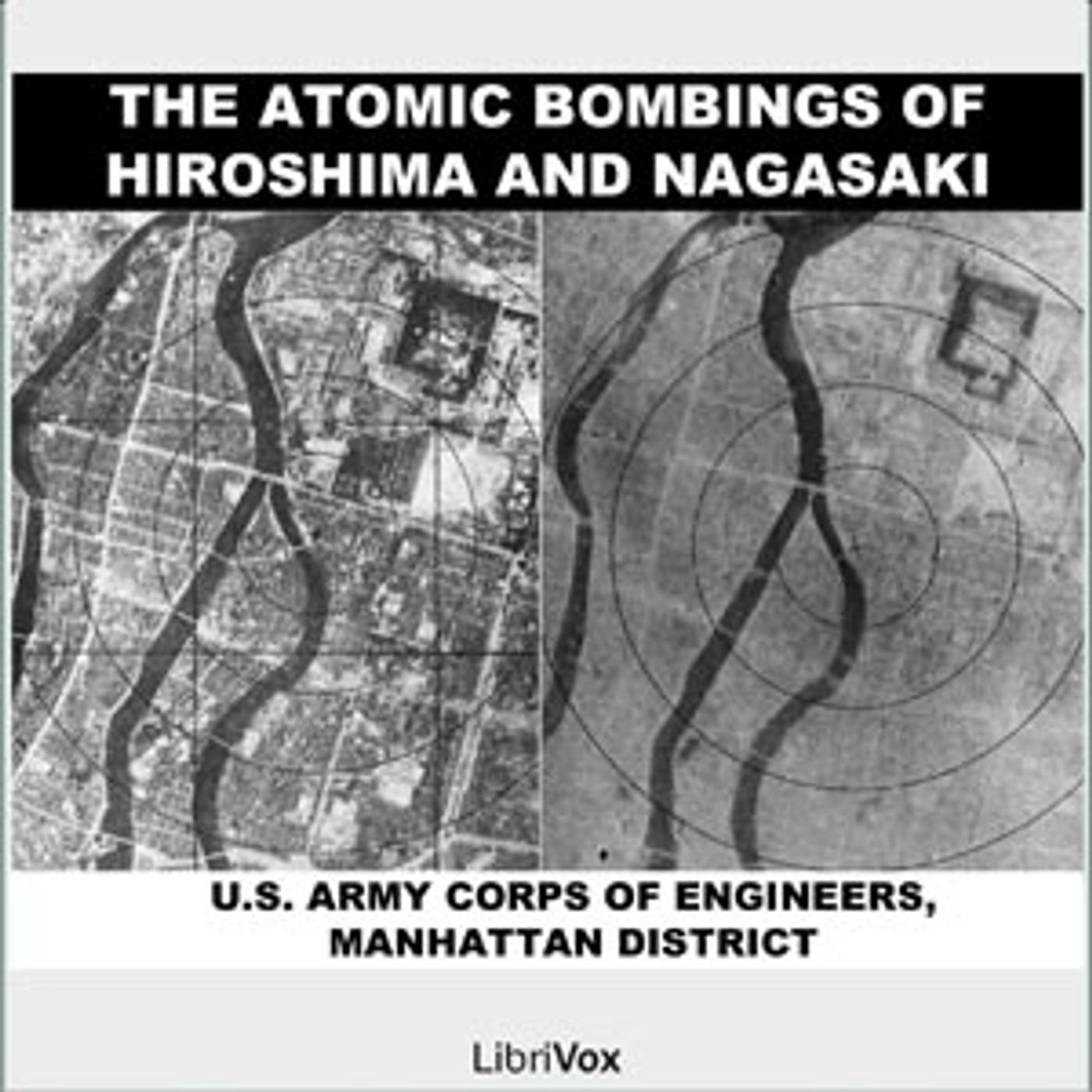
This official 1946 report by the Manhattan Engineer District documents the atomic bombings of Hiroshima and Nagasaki in August 1945. It outlines the immediate devastation: in Hiroshima, over four square miles were destroyed, with 66,000 killed and 69,000 injured; in Nagasaki, 1.5 square miles were obliterated, causing 39,000 deaths and 25,000 injuries. Damage resulted from blast waves, fires (both primary from heat radiation and secondary from structural collapse), and spread of flames. Casualties stemmed from flash burns, mechanical injuries, and penetrating gamma radiation, with no evidence of harmful persistent radioactivity. A U.S. investigating group entered both cities post-surrender to evaluate effects and ensure safety, while a parallel propaganda campaign disseminated information about the bombs to pressure Japan. Conclusions confirm the bombs' immense power (equivalent to ~20,000 tons of TNT), their precise deployment for maximum impact, and the ability to predict blast damage in future scenarios. The report synthesizes technical, medical, and structural data to inform understanding of atomic warfare.
Section 1 of the Atomic Bommings of Hiroshima and Nagasaki. This is a Libravox recording. All Libravox recordings are in the public domain. For more information or to volunteer, visit Libravox.org. Read by Dennis Sayers on the 63rd anniversary of the events. The Atomic Bommings of Hiroshima and Nagasaki by the Manhattan Engineer District, June 29, 1946. Section 1, including the Forward Introduction. The Manhattan Project Investigating Group. Propaganda, Summary of Damages and Injuries and Main Conclusions. Forward. This report describes the effects of the atomic bombs, which were dropped on the Japanese cities of Hiroshima and Nagasaki on August 6th and 9th, 1945, respectively. It summarizes all the authentic information that is available on damage to structures, injuries to personnel, morale, effect, et cetera, which can be released at this time without prejudicing the security of the United States. This report has been compiled by the Manhattan Engineer District of the United States Army under the direction of major general Leslie R. Groves. Special acknowledgment to those whose work contributed largely to this report is made to the Special Manhattan Engineer District Investigating Group, the United States Strategic Bombing Survey, the British Mission to Japan and the Joint Atomic Bomb Investigating Group Medical, and particularly to the following individuals. Colonel Stafford L. Warren Medical Corps, United States Army for his evaluation of medical data. Captain Henry L. Barnett Medical Corps, United States Army for his evaluation of medical data. Dr. R. Cerber for his comments on flash burn. Dr. Hans Beth, Cornell University for his information on the nature of atomic explosions. Major's Nolan Varley and Walter C. Young's, Corps of Engineer, United States Army, for their evaluation of physical damage to structures. J. O. Hirschfelder, J. L. McGee, M. Hall, and ST Cohen of the Los Alamos Laboratory for their data on nuclear explosions. Lieutenant Colonel David B. Parker, Corps of Engineers, United States Army for Editing this report. Introduction. Statement by the President of the United States, quote, "16 hours ago an American airplane dropped one bomb on Hiroshima, Japan, and destroyed its usefulness to the enemy. That bomb had more power than 20,000 tons of TNT. It had more than 2,000 times the blast power of the British Grand Slam, which is the largest bomb ever yet used in the history of warfare." Close quote. These faithful words of the President on August 6, 1945 marked the first public announcement of the greatest scientific achievement in history. The atomic bomb first tested in New Mexico on July 16, 1945, had just been used against a military target. On August 6, 1945, at 8.15am, Japanese time, a B-29 heavy bomber flying at high altitude dropped the first atomic bomb on Hiroshima. More than four square miles of the city were instantly and completely devastated. Sixty-six thousand people were killed, and sixty-nine thousand injured. On August 9, three days later, at 11.02am, another B-29 dropped the second bomb on the industrial section of the city of Nagasaki, totally destroyed one and one-half square miles of the city, killing 39,000 persons, and injuring 25,000 more. On August 10, the day after the atomic bombing of Nagasaki, the Japanese government requested that it be permitted to surrender under the terms of the Potsdam Declaration of July 26, which it had previously ignored. The Manhattan Project Atomic Bomb Investigating Group. On August 11, 1945, two days after the bombing of Nagasaki, a message was dispatched from major general Leslie R. Groves to Brigadier General Thomas F. Farrell, who was his deputy in atomic bomb work, and was representing him in operations in the Pacific, directing him to organize a special Manhattan Project Atomic Bomb Investigating Group. This group was to secure scientific, technical, and medical intelligence in the atomic bomb field from within Japan, as soon as possible, after the cessation of hostilities. The mission was to consist of three groups. One, Group for Hiroshima. Two, Group for Nagasaki. Three, Group to Secure Information, concerning general Japanese activities in the field of atomic bombs. The first two groups were organized to accompany the first American troops into Hiroshima and Nagasaki. The primary purposes of the mission were, as follows, in order of importance. One, to make certain that no unusual hazards were present in the bombed cities. Two, to secure all possible information, concerning the effects of the bombs, both usual and unusual. And particularly, with regard to radioactive effects, if any, on the targets or elsewhere. General Groves further stated that all available specialist personnel and instruments would be sent from the United States, and that the Supreme Allied Commander in the Pacific would be informed about the organization of the mission. On the same day, the 11th of August, the special personnel who formed the part of the investigating group to be sent from the United States were selected and ordered to California with instructions to proceed overseas at once, to accomplish the purpose set forth in the message to General Feral. The main party departed from Hamilton Field, California, on the morning of 13 August, and arrived in the Mariana's on 15 August. On 12 August, the Chief of Staff sent the Theater Commander the following message, quote, "For MacArthur signed Marshall. Groves has ordered Feral at Tenion to organize a scientific group of three sections for potential use in Japan, if such use should be desired." The first group is for Hiroshima, the second for Nagasaki, and the third for the purpose of securing information concerning general Japanese activities in the field of atomic weapons. The groups for Hiroshima and Nagasaki should enter those cities with the first American troops in order that these troops shall not be subjected to any possible toxic effects, although we have no reason to believe that any such effects actually exist. Feral and his organization have all available information on this subject, close quote. General Feral arrived in Yokohama on 30 August with the commanding general of the 8th Army.
Colonel Warren, who was chief of the Radiological Division of the District, arrived on 7 September. The main body of the investigating group followed later. Preliminary inspections of Hiroshima and Nagasaki were made on 8, 9, and 13, 14 September, respectively. Preliminary inspections of the press had been enabled to proceed General Feral to Hiroshima. The special groups spent 16 days in Nagasaki and 4 days in Hiroshima during which time they collected as much information as was possible under their directives, which called for a prompt report. After General Feral returned to the US to make his preliminary report, the groups were headed by Brigadier General J. B. Newman, Jr. More extensive surveys have been made since that time by other agencies who had more time and personnel available for the purpose, and much of their additional data has thrown further light on the effects of the bombings. This data has been duly considered in the making of this report. Propaganda On the day after the Hiroshima strike, General Feral received instructions from the War Department to engage in a propaganda campaign against the Japanese Empire in connection with the new weapon and its use against Hiroshima. The campaign was to include leaflets and any other propaganda considered appropriate. With the fullest cooperation of Sensepak of the Navy and the United States Strategic Air Forces, he initiated promptly a campaign which included the preparation and distribution of leaflets, broadcasting via shortwave every 15 minutes over radio-cipan and the printing at Cipan and distribution over the empire of a Japanese language newspaper which included the description and photographs of the Hiroshima strike. The campaign proposed one, dropping 16 million leaflets in a period of nine days on 47 Japanese cities with population of over 100,000. These cities represented more than 40% of the total population. 2. Broadcast of propaganda at regular intervals over radio-cipan. 3. Distribution of 500,000 Japanese language newspapers containing stories and pictures of the atomic bomb attacks. The campaign continued until the Japanese began their surrender negotiations. At that time, some 6 million leaflets and a large number of newspapers had been dropped. The radio broadcasts in Japanese had been carried out at regular 15-minute intervals. Summary of damages and injuries. Both the Hiroshima and the Nagasaki atomic bombs exhibited similar effects. The damages to man-made structures and other inanimate objects was the result in both cities of the following effects of the explosions. A. Blast or pressure wave. Similar to that of normal explosions. B. Primary fires. That is, those fires started instantaneously by the heat radiated from the atomic explosion. C. Secondary fires. That is, those fires result in from the collapse of buildings damaged to electrical systems, overturning of stoves and other primary effects of the blast. D. Spread of the original fires. B. And C. Two other structures. The casualties sustained by the inhabitants of both cities were due to a. Flash burns. Caused directly by the almost instantaneous radiation of heat and light at the moment of the explosion. B. Burns resulting from the fires caused by the explosion. C. Mechanical injuries caused by collapse of buildings, flying debris, and forcible hurling about of persons struck by the blast pressure waves. D. Radiation injuries caused by the instantaneous penetrating radiation. In many respects, similar to excessive x-ray exposure from the nuclear explosion. All of these effective radiations occurred during the first minute after initiation of the explosion, and nearly all occurred during the first second of the explosion. No casualties were suffered as a result of any persistent radioactivity, efficient products of the bomb, or any induced radioactivity of objects near the explosion. The gamma radiations emitted by the nuclear explosion did not, of course, inflict any damage on structures. The number of casualties, which resulted from the pure blast effect alone, that is, because of simple pressure, was probably negligible in comparison to that caused by other effects. The central portions of the cities underneath the explosion suffered almost complete destruction. The only surviving objects were the frames of a small number of strong, reinforced concrete buildings, which were not collapsed by the blast. Most of these buildings suffered extensive damage from interior fires. Had their windows doors and partitions knocked out. And all other fixtures, which were not integral parts of the reinforced concrete frames, burned or blown away. The casualties in such buildings near the center of explosion were almost 100%. In Hiroshima, fires sprang up simultaneously. All over the wide, flat central area of the city, these fires soon combined in an immense fire storm. High winds blowing inwards toward the center of a large conflagration. Similar to those caused by ordinary mass in Sindhiari raids. The resulting terrific conflagration burned out almost everything which had not already been destroyed by the blast in a roughly circular area of 4.4 square miles around the point directly under the explosion. This point will hereafter, and this report, be referred to as X. Similar fires broke out in Nagasaki, but no devastating firestorm resulted as in Hiroshima because of the irregular shape of the city. In both cities, the blast totally destroyed everything within a radius of a mile from the center of explosion, except for certain reinforced concrete frames as noted above. The atomic explosion almost completely destroyed Hiroshima's identity as a city. For a fourth of the population was killed in one stroke, and an additional fourth seriously injured, so that even if there had been no damage to structures and installations, the normal city life would still have been completely shattered. Nearly everything was heavily damaged up to a radius of three miles from the blast, and beyond this distance, damage, although comparatively light, extended for several more miles. Glass was broken up to twelve miles. In Nagasaki, a smaller area of the city was actually destroyed than in Hiroshima, because the hills which enclosed the target area restricted the spread of the great blast, but careful examination of the effects of the explosion gave evidence of even greater blast effects than in Hiroshima. Total destruction spread over an area of about three square miles. Over a third of the fifty thousand buildings in the target area of Nagasaki were destroyed, or seriously damaged. The complete destruction of the huge steel works and the torpedo plant was especially impressive. The steel frames of all buildings were destroyed.
buildings within a mile of the explosion were pushed away as by a giant hand from the point of detonation. The badly burned area extended for three miles in length. The hillsides up to a radius of eight thousand feet were scorched, giving them an atomic appearance. Main conclusions The following are the main conclusions which were reached after thorough examination of the effects of the bombs dropped on Hiroshima and Nagasaki. One No harmful amounts of persistent radioactivity were present after the explosions as determined by a. Measurements of the intensity of radioactivity at the time of investigation and to be failure to find any clinical evidence of persons harmed by persistent radioactivity. The effects of the atomic bombs on human beings were of three main types A. Burns Remarkable for one the great ground area over which they were inflicted and two the prevalence of flash burns caused by the instantaneous heat radiation. B. Mechanical injuries also remarkable for the wide area in which suffered. C. Effects resulting from penetrating gamma radiation. The effects from radiation were due to instantaneous discharge of radiation at the moment of explosion and not to persistent radioactivity of either fission products or other substances whose radioactivity might have been induced by proximity to the explosions. The effects of the atomic bombs on structures and installations were of two types A. Destruction caused by the great pressure from the blast and B. Destruction caused by the fires either started directly by the great heat radiation or indirectly through the collapse of buildings, wiring, etc. Four. The actual tonnage of TNT which would have caused the same blast damage was approximately of the order of 20,000 tons. Five. In respect to their height of burst, the bombs performed exactly according to design. Six. The bombs were placed in such positions that they could not have done more damage from any alternative bursting point in either city. Seven. The heights of burst were correctly chosen having regard to the type of destruction it was desired to cause. Eight. The information collected would enable a reasonably accurate prediction to be made of the blast damage likely to be caused in any city where an atomic explosion could be affected. The second of Section 1 of the atomic bombing of Hiroshima and Nagasaki.
Podcast Summary
Key Points:
The report details the effects of the atomic bombs dropped on Hiroshima (August 6, 1945) and Nagasaki (August 9, 1945), compiled by the U.S. Army's Manhattan Engineer District.
Immediate impacts included massive destruction from blast waves, primary and secondary fires, and casualties from flash burns, mechanical injuries, and radiation exposure, with no persistent radioactivity detected.
A special investigating group was dispatched to assess damage, safety hazards, and scientific data, while a propaganda campaign aimed to leverage the bombings to hasten Japan's surrender.
Key findings emphasize the bombs' unprecedented destructive power, the absence of lingering radiation hazards, and the strategic accuracy of their deployment.
Summary:
This official 1946 report by the Manhattan Engineer District documents the atomic bombings of Hiroshima and Nagasaki in August 1945. 5 square miles were obliterated, causing 39,000 deaths and 25,000 injuries. Damage resulted from blast waves, fires (both primary from heat radiation and secondary from structural collapse), and spread of flames.
Casualties stemmed from flash burns, mechanical injuries, and penetrating gamma radiation, with no evidence of harmful persistent radioactivity. S. investigating group entered both cities post-surrender to evaluate effects and ensure safety, while a parallel propaganda campaign disseminated information about the bombs to pressure Japan.
Conclusions confirm the bombs' immense power (equivalent to ~20,000 tons of TNT), their precise deployment for maximum impact, and the ability to predict blast damage in future scenarios. The report synthesizes technical, medical, and structural data to inform understanding of atomic warfare.
FAQs
The first atomic bomb was dropped on Hiroshima on August 6, 1945, at 8:15 AM Japanese time. The second bomb was dropped on Nagasaki on August 9, 1945, at 11:02 AM Japanese time.
In Hiroshima, approximately 66,000 people were killed and 69,000 injured. In Nagasaki, about 39,000 were killed and 25,000 injured.
The group was organized to secure scientific, technical, and medical intelligence from Japan regarding the atomic bomb effects, ensure no unusual hazards existed in the bombed cities, and study radioactive effects.
Damage resulted from blast pressure, primary fires from heat radiation, secondary fires from collapsed structures, and fire spread. Injuries were caused by flash burns, fires, mechanical trauma from debris, and penetrating gamma radiation.
No harmful amounts of persistent radioactivity were found; injuries from radiation were due to instantaneous gamma radiation at the moment of explosion, not lingering radioactivity.
Hiroshima experienced more widespread destruction over about 4.4 square miles with a devastating firestorm, while Nagasaki had a smaller destroyed area of about 3 square miles due to its hilly terrain, but blast effects were severe.
Chat with AI
Loading...
Pro features
Go deeper with this episode
Unlock creator-grade tools that turn any transcript into show notes and subtitle files.
 PodcastTranscript AI