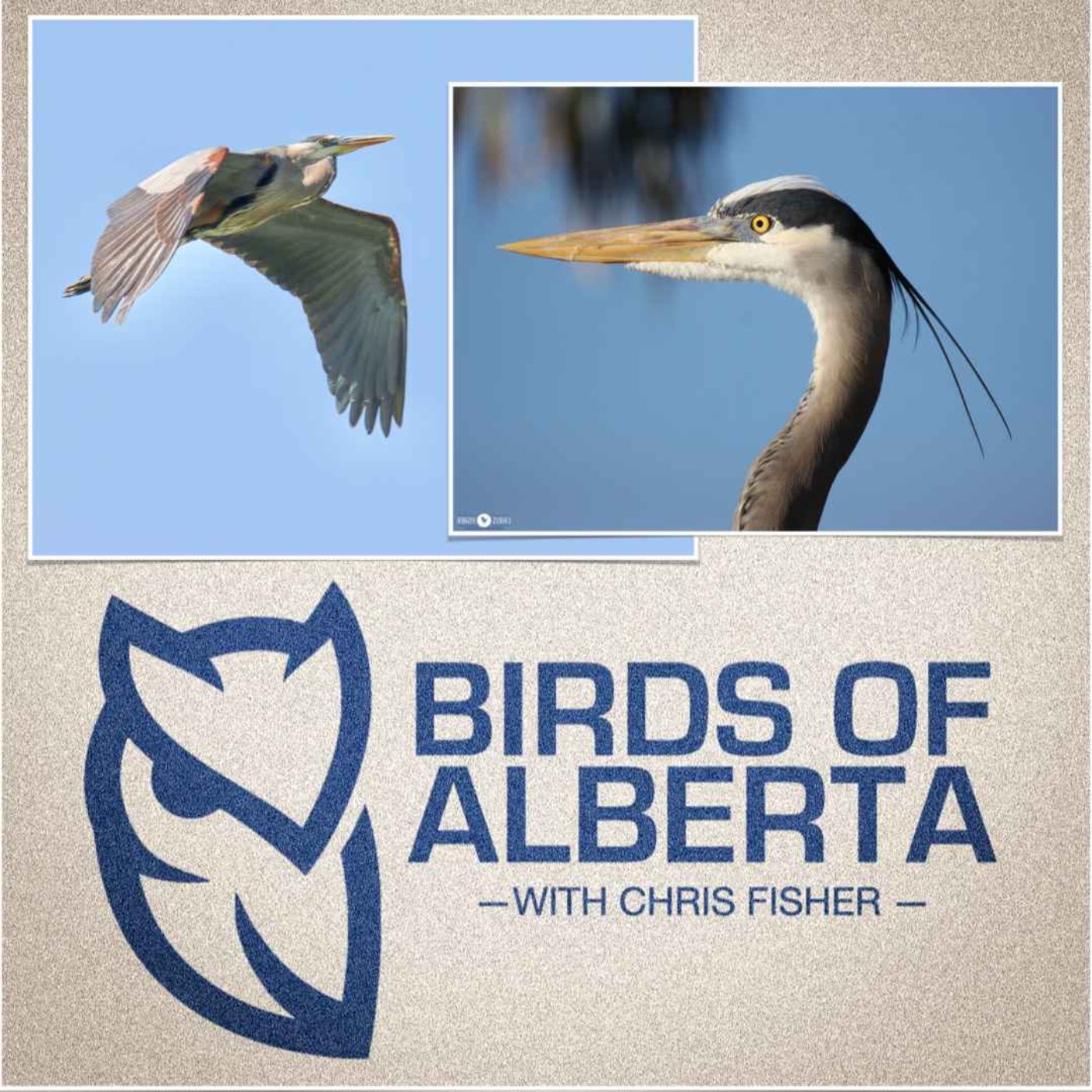
The podcast discusses the evolutionary connection between birds and dinosaurs, emphasizing the great blue heron as Alberta's most dinosaur-like bird due to its appearance and behavior. It describes the heron's habitat across Alberta, particularly near permanent waters like lakes and wetlands, where it feeds on a varied diet including fish, frogs, salamanders, and rodents. The bird's colonial nesting sites, or heronries, are legally protected with buffer zones to prevent disturbance, reflecting conservation laws that originated from historical threats like the feather trade. A notable case involving the death of herons at an oil sands site resulted in a multi-million dollar fine under migratory bird legislation. The great blue heron is celebrated for its elegance and role in local conservation efforts, often mistaken for cranes but distinguished by its S-shaped neck in flight and lighter body structure, making it a beloved and iconic species in the province.
Welcome to the Birds of Alberta podcast. I'm Chris Fisher, co-author of the best-selling natural history field guide, Birds of Alberta. Now, now I've been into birds for quite some time but but most times it doesn't really feel like it has been all that long because the experiences are always so fresh and there remains so much to learn and much to appreciate about Alberta birds. But while other times it does feel like I've been at this for a long while especially when when thoughts and facts that we just take for granted today and I even talk about them with my elementary school-age kids. Well, these thoughts were unveicable thoughts when I started out looking through binoculars all those years ago and one of the best examples of this harkens back to well a night I remember very well in the old provincial museum of Alberta back there in Glenora in Edmonton. Well, when folks packed that wonderful auditorium to listen to a public talk by Alberta's own dinosaur guru Dr. Philip Curry. Well, it must have been about 2003 or 2004 and it was on that night for the first time that I and many other people in that very room understood based on Dr. Curry's work that there was an irrefutable family connection between birds and dinosaurs. And well nowadays that connection between birds and dinosaurs is universally believed. You know my my kids know of nothing else in their little world so it's well known and understood well outside of the tinfoiled hat crowd that the relationship between birds and dinosaurs makes perfect sense based on the identical skeletal features and their DNA and while the similarities they tend to lie beneath the feathered surface sometimes now sometimes we see in birds the dinosaur revealing itself in more dramatic ways and and there is one of our birds more than any other that frequently captures the look size and demeanor of their prehistoric past making it undeniably the most dinosaurian of all the birds of Alberta it is the great blue heron. Well the great blue heron here in Albert is a relatively well known bird and to see them well most often you have to look up. Look way up for these friendly giants as they fly overhead. Unlike in many other places throughout North America where great blue herons are found where we do enjoy close-up views in places like Florida or even as you wait for the ferry at Tahuas and just outside of Vancouver well here in Alberta you don't tend to get really close-up views of these magnificent birds you often see them at a distance or as they fly by our overhead. But every now and then if you're walking along a shoreline or fishing in shallow waters you might come across a corner and before you can even appreciate the encounter a heron lifts off in the distance and catches your attention. And even if you're not really into birds you most people know that it was heron that caught your attention with the movement but if you are really on your game and and maybe your outboard motor is actually kind of quiet you might hear the displeasure of that lifting off heron emitting a loud croaking loud fronk and this this is really their most often vocalization that we hear here in the province and if that loud fronk is is not enough to single how perturbed they are at your disturbance well you might just enjoy a long thin streak of a whitewash streaming and splashing down behind the birds as they rise from the waters. So while in Alberta great blue herons can be seen well pretty much any place we do have some permanent waters there are some hot spots that they're a little bit more regularly seen than others I can think of a thin castel lake that's one of the best places in southern Alberta which doesn't have as many permanent wetlands so don't tend to see quite as many great blue herons down there hasteens lake maybe the most famous location as it's located just east of Edmonton and there is a very well-known and famous nesting colony called Rookery or a heronry that can be seen from the roadside there policemen's flats just outside of Calgary is another famous location inside the core of high river there is a well-known Rookery in that area the sturgeon river flowing through St. Albert has always a heron or two waiting in the sluggish water that flows through that area hermitage lake outside of Edmonton in the northeast area is usually pretty good the Englewood bird sanctuary usually has a bird hanging out around it as well in Calgary so they're found throughout the province even occasionally in the national parks in the Rocky Mountains Elk Island national park pretty much anywhere where you do have a large lake but you do need some quiet areas quiet forest areas because that is precisely where they nest and the reason they're here in the province to begin with is the all-important breeding grounds that Alberta represents for this iconic North American bird. I think I'm like a lot of people here in Alberta that when a Great Blue Heron flies by it is noticed and oftentimes the experience is shared with a design of many times that I've been involved in conversation with people who don't consider themselves birds but they will talk about the large bird that they have in their slew flying around but oftentimes they will not call it a heron they will call it a crane. I don't know who to blame for this obviously cranes have a outsized reputation I tend to blame the porcelain the bathroom porcelain manufacturer crane because their little icon on their toilets and urinals is not of a crane it is of a heron and that can confuse many people as they go about their business. You see cranes and herons are actually superficially a lot alike they're very tall birds both easily the size of grade school toddler and both are pretty much the tallest birds you're ever going to find in Alberta. The Great Blue Herons tend to be a little bit more colorful particularly in the breeding plumage they have some white plumes on them and they have also a little bit of rustiness particularly on their legs. The sand he'll cranes will have rustiness but that's kind of on their overall plumage on the backs and on the wings. The big difference is how they hold their necks when they fly. The Great Blue Heron like all herons and eagrets will fold their neck back onto their shoulders so that their neck forms a nice S shape where as cranes like swans and many other large birds hold their necks straight out so that it is quite a different profile between the cranes and the S shaped herons when you see them in flight. Now the reason that these two very similar birds look actually quite a bit different in flight comes down to weight distribution. The fact of the matter is great Blue Herons despite the fact that they're relatively tall are much more lightweight than similarly size birds such as cranes and even trumpeter swans so they end up having more mass that lies over their shoulders, their wings so they don't need to carry or stretch out their necks to counterbalance the weight in the rear of the bodies. So think a little bit as a teeter totter. The sand he'll cranes trumpeter swans will have a lot of mass on both far ends of a teeter totter whereas a great Blue Heron would be much closer to the fulcrum point, the middle point of the teeter totter so that they keep their mass concentrated along that middle area. This lack of mass surprisingly in the great Blue Heron is expressed in other ways as well you know these these bigs.
swans and sandhill cranes and hooping cranes have to run a bit before they get airborne, but whenever we flush a grapefruit hair and they lift off almost easily like a helicopter without having to take many strides at all. They have what is known as a relatively low wing loading, meeting they have a large surface area to their wings compared to their mass. It's about half the level of wing loading as tropical swans or sandhill cranes would have, so they're quite buoyant in flight and slow flying as well. So that helps them fly nice and slow over these wetlands as we see them and they'll drop down whenever they find a nice convenient fishing spot. And it is perhaps when they are feeding that we admire the great blue herons the most. If we were fortunate enough to sneak up on them or you get a bird that's particularly tolerant of human beings, well you can observe them and as patient as any bird watcher is they lack the patient of a great blue heron that could just stand in those shallow areas for hours and hours barely moving, just waiting for something to swim on by. And we normally associate them of course in this part of the world is eating fish, whether it's tiny little little stickleback minos or large pike or or jackfish as my grandma used to call them. You know that is principally what we figure that they're going for and that makes up a big part of their summer diet here in the province. And when they do stab a very large fish which they tend to need to do to impale and kill the large ones, the smaller fish they can just swallow right down. But with the bigger fish you see them stab it and often toss them into the air before they swallow them down and if you're fortunate enough to see a great blue heron swallow a big pike, well you see how their throat actually expands quite a bit. Has that large prey item just slinks down into their belly wear of course it will be digested. But here in Alberta they're diet is not just limited to fish. Now you would expect since they're standing around in this open water that they are eating a lot of other aquatic prey and frogs and to a lesser extent toads will make up a big percentage of what they consume here in the province. Surprisingly shockingly even a major component of their prey particularly in the months of May and June when they also find themselves in the company of breeding salamanders. And it's our large barred tiger salamander that is found in the southern half of the province that is shockingly seen disproportionately being bitten into and held aloft in the bills of great blue herons. We don't see them quite commonly otherwise but great blue herons seem to make a good hearty meal of them and they would be a very important food source as they are large and nutritious. But aquatic animals are not the only prey items that great blue herons feed on. Surprisingly they'll also take smaller rodents, muskrats who tend to be quite aquatic. Particularly young muskrats will often be seen as prey items for great blue herons. But in the early spring and in the late fall particularly with snow and ice blocking some of the shallower wetland areas we see these early and late migrant great blue herons out in fields and in those particular areas they'll actually feed on some rodents, small rodents like holes and mace. And and while we fairly regularly conspide great blue herons out in slews and wetlands and slow flowing rivers feeding we do not come across their nesting sites all that often. They are colonial nesters and typically colonial nesting birds are protected from disturbance because well these species really have all their eggs literally in one small basket. These little heronries or rickeries are the site where whole populations, whole region loads of birds will be nesting. For this reason the province of Alberta has designated a setback, a buffer zone around these established nesting colonies of 1000 meters when the nests are active and that's to protect them from disturbance and destruction. So any high level of disturbance or destruction is forbidden within those 1000 meters setbacks. That is reduced to about 100 meters when the nests are not occupied to ensure that the nests and the nesting trees for which they're located are not disturbed or toppled in any way. And it is a little appropriate I guess to talk about you know the conservation legislation that we have when it applies to great blue herons after all. It was the decline of herons and egress in particular during the 1910s, 1920s, 1930s that led to the very first international legislation for the protection of migratory birds. The resulting legislation still very much in place not only in Canada but also the United States because back 100 years ago these particular birds were highly targeted for the feather trade and their populations and their rickeries in fact were heavily targeted and decimated. So we still have the legacy of this legislation that still holds true both on the federal and provincial level and and perhaps the most no worthy incident where charges were laid in volves. The death of about 30 great blue herons here in Alberta at the Syncroid oil sand site about 30 kilometers north of Fort Mick Murray back to about 10 years or so ago there were grand total of 31 great blue herons that were found eventually dead at a sump area where bitumen had accumulated over the years and that allowed the federal government to prosecute and charge an eventually fine Syncroid can total of $2.6 million which is by far in a way the largest penalty that's been ever imposed by a Canadian court for harm to migratory birds in the statute that it violated was the depositing a substance that is harmful to migrating birds and that's the key clause added to the migratory bird convention act about 1984 shortly after the Exxon valve these spill when harmful toxic substances being deposited to pristine waters was a pretty important and top of the mind issue at that time. Well great blue herons are really one of one of our most important birds here in the province of Alberta they're well known but they are also a bird that defies convention sometimes they're solitary sometimes they're social they're piss of orres but with a taste of mice muskrats and even salamanders it's a bird of summer that arrives and leaves when they're snowing the ground and it's a modern elegant bird with hints of the dinosaurian. The great blue heron is thankfully a well-known bird here in the province of Alberta even though we don't really see them all that much especially for the people who who rarely leave the large cities but they are relatively well-known and they have a great reputation and a great status you know I can think of the big lake environmental support society based out of St. Albert just outside Edmonton whose mission has been to protect big lake in the Sturgeon River and helped with the formation of the wonderful lowest hole provincial park and I can think back of my good friend Peter Demalder who did so much in establishing that organization and that organization using the great blue heron as its hallmark icon that led to the protection and celebration of that little corner of Alberta. So so maybe that's what it is that I like best about great blue herons you know they have a reputation that that probably outreaches their actual presence in the province and that's a bit unusual but having a big reputation is probably the reason that that when we come across them at the lake or driving past them in a slew or while walking along a lazy river that we all take notice of them and and remember the encounter and recount it to others while later they're never so common here that they can escape our attention or admiration and the results we we kind of feel quite a bit of pride in knowing that the great blue heron is one of our very own birds of Alberta.
[BLANK_AUDIO]
Podcast Summary
Key Points:
Birds, particularly the great blue heron, are evolutionarily linked to dinosaurs, supported by skeletal and DNA evidence.
The great blue heron is highlighted as Alberta's most dinosaur-like bird, known for its size, demeanor, and distinctive flight with an S-shaped neck.
In Alberta, great blue herons are widespread near permanent waters, feeding on fish, amphibians, rodents, and salamanders, and they nest colonially in protected heronries.
Conservation laws, stemming from historical overhunting for feathers, protect great blue herons, with significant penalties for harm, as seen in a notable oil sands case.
The bird holds cultural significance, inspiring local conservation efforts and public admiration despite its occasional misidentification as a crane.
Summary:
The podcast discusses the evolutionary connection between birds and dinosaurs, emphasizing the great blue heron as Alberta's most dinosaur-like bird due to its appearance and behavior. It describes the heron's habitat across Alberta, particularly near permanent waters like lakes and wetlands, where it feeds on a varied diet including fish, frogs, salamanders, and rodents. The bird's colonial nesting sites, or heronries, are legally protected with buffer zones to prevent disturbance, reflecting conservation laws that originated from historical threats like the feather trade.
A notable case involving the death of herons at an oil sands site resulted in a multi-million dollar fine under migratory bird legislation. The great blue heron is celebrated for its elegance and role in local conservation efforts, often mistaken for cranes but distinguished by its S-shaped neck in flight and lighter body structure, making it a beloved and iconic species in the province.
FAQs
Birds are directly related to dinosaurs, sharing identical skeletal features and DNA. This evolutionary link is now universally accepted and well understood.
The great blue heron is often regarded as the most dinosaurian bird in Alberta due to its size, look, and demeanor that recall prehistoric ancestors.
Great blue herons fly with their necks folded back in an S-shape, while cranes hold their necks straight out. This difference in profile is key for identification.
Their diet primarily includes fish, frogs, and salamanders, but they also consume rodents like muskrats and voles, especially in early spring or late fall.
Hotspots include Hastings Lake near Edmonton, Policeman's Flats outside Calgary, and the Sturgeon River in St. Albert. They are found near permanent waters and quiet forested areas.
Alberta designates a 1000-meter buffer zone around active nests to prevent disturbance, reduced to 100 meters when nests are inactive, under conservation legislation.
Chat with AI
Loading...
Pro features
Go deeper with this episode
Unlock creator-grade tools that turn any transcript into show notes and subtitle files.
 PodcastTranscript AI