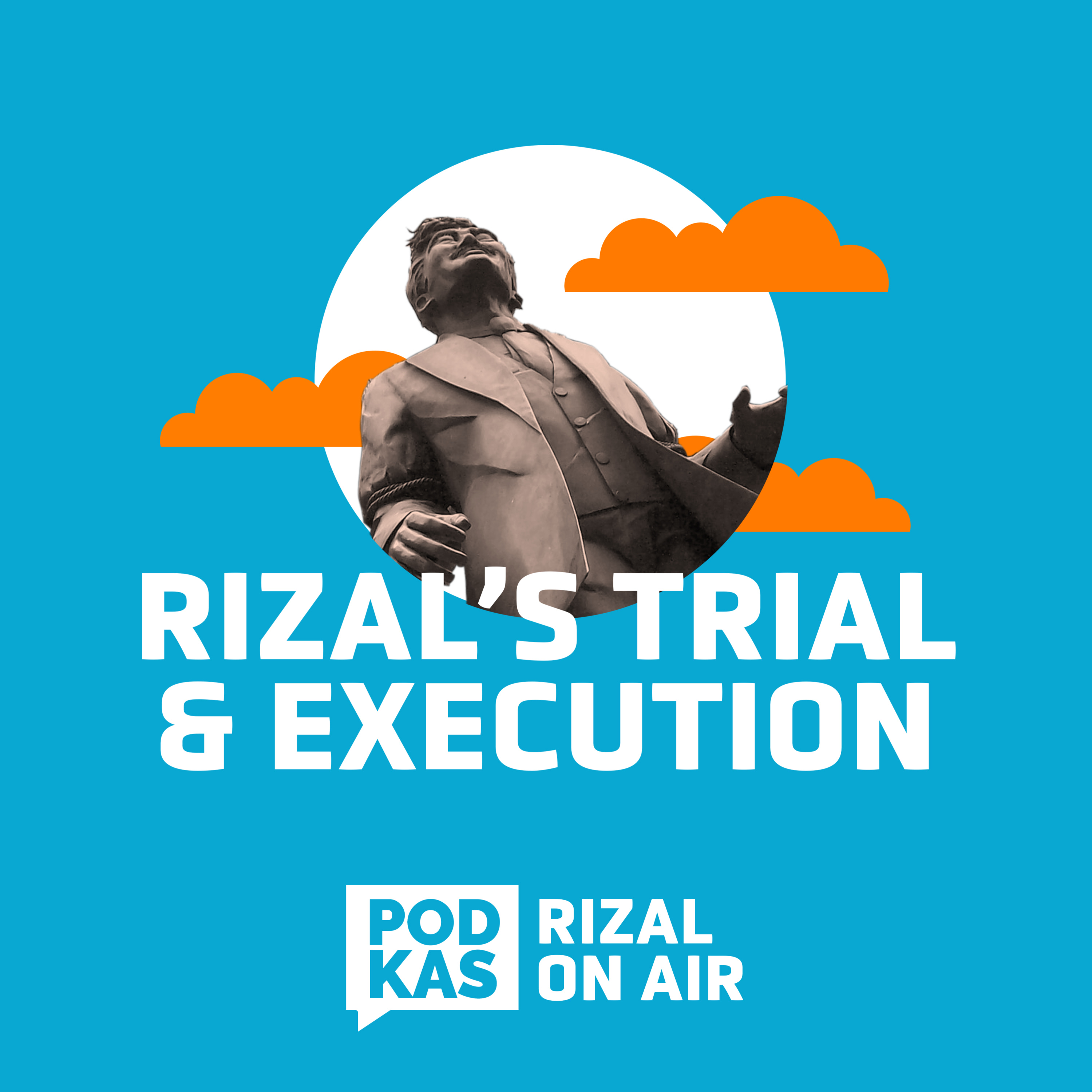
The transcription details the events leading to Jose Rizal's execution on December 30, 1896, after being arrested en route to Cuba. Rizal was imprisoned, tried for various charges, and ultimately executed, which only fueled agitation among Filipinos. The podcast delves into Rizal's trial, execution, and burial, shedding light on his final days, including his last writings and instructions regarding his burial. Despite specific requests for a simple burial with no anniversaries, Rizal's remains were eventually transferred to the base of the Rizal monument in 1912. The episode concludes by highlighting the enduring significance of Rizal in Philippine history and society.
Transcription
2116 Words, 11653 Characters
On the 30th of December, 1896, Rizal was executed.
This was a short three months after he was arrested en route to Cuba.
He was imprisoned in Fort Santiago, and later tried for rebellion, sedition, and conspiracy.
He was executed, but little did the Spaniard know he was more dangerous as a dead man,
as his execution only agitated Filipinos.
On the 30th of December, 1896, Rizal died, but his spirit lived.
We talk about Rizal's trial, execution, and burial in this new episode of Rizal on Air.
Hi, this is Leek and Delaria, this is Vacal Porja, I am Aaron Malarri, and I am Janet
Rigundi Nisthalia, and you are listening to podcasts, conversations on Philippine history,
politics, and society.
So, last episode, Rizal's life on the ground, we will continue the story of Rizal's life
until his arrest in Bagumbayan.
Yes, in 1896, we know that the person who was arrested was already guilty of discovery.
So, in that time, Rizal was arrested, and he was waiting for the boat to go to Spain.
He volunteered to become a doctor to treat the Spaniards who fought in Cuba.
During those times, the Cuban War of Independence was also found.
He was arrested in the boat, and he went to Singapore, where Rizal was waiting for a boat to go to Europe.
He will go to Manila, especially since Rizal was attacked in a fair before.
He was also mentioned here in Singapore that he was arrested, but he said that he did not want to be a criminal.
He was still in the boat to Spain, but while he was on the Mediterranean, the authorities in the boat of a telegraph arrested Rizal.
When this boat went to Barcelona, he was arrested in Montjuic, and he was informed here by Captain General Despojol
that he will not go to Cuba, unfortunately, and that he will return to the Philippines around October.
Interesting fact though, Captain General Despojol of Catalonia was the former Governor General of the Philippines.
In fact, he was the Governor General of Madestero, or Rizal's ex-exiled wife.
So, Rizal was sent back to the Philippines. He arrived November 3rd and was immediately imprisoned at Fort Santiago.
And it would take around two weeks before preliminary investigation started.
On November 26th, the case was endorsed to the Governor General, and then a judge was appointed.
And this judge recommended prosecution of Rizal as "the principal organizer and the living soul of the insurrection in the Philippines."
So, from here, the case will be quick.
Right. So, by December 15th, Rizal wrote an open letter titled "Manifesto a Algunos Filipinos" or "Manifesto to Certain Filipinos".
Here, he said that first, he did not have to be a part of the revolution, and he only used his name to recruit.
Second, he was consulted on the call for the revolution, but he refused to continue.
Third, he wanted to stop the rebellion.
Fourth, he was also convicted of the rebellion. And fifth, he will not continue the rebellion and will have to start with the authority of the reform.
Not with his parents.
Interestingly, it was not publicized by the manifesto, because it was said that a judge limited the criticism of the revolution to the insurrection.
So, this is an issue of opportunity, not the principle.
Because in the interpretation of Rizal's manifesto, according to Rizal himself, there may be a right time for the revolution.
True. So, in the continuation of the letter to Rizal, on December 26th, the public hearing was opened, and of course, the gallery was filled with people interested in what he would say.
Although Rizal was consistent, he said that it was not according to the revolution. In fact, I said to them, "Don't be sick," that's what Rizal said.
If the revolution is going to succeed, or if they want to succeed, they need the support of many people in the armed forces, and of course, the government.
They also need the support of other countries. So, they can't just do it. In the context of that, there is no desire for the revolution, according to Rizal, and it's just a waste of money and time and life.
And Rizal also looked at it. Do you know if he knows Bonifacio and the answer to Rizal? No.
And he was confused about how and why he got his picture in the documents of the Constitution.
So, in the end, Rizal cleared his conscience.
Interesting for me the point that Rizal repeated that he had a lot of opportunities to win, but he didn't do it.
He didn't accept the defeat of his opponent, and he said he was happy because he had time to write.
But all of this to no avail.
On December 29, Rizal was sentenced to death.
Rizal seemed unfazed with this decision. Maybe he also accepted it.
In fact, according to the accounts, he didn't leave the Jesuits, even when he was reading his sentence in the hall.
Then, when those times came, he was still debating about some theological issues.
These times, he also noted his retraction.
By the way, we have already discussed in detail in episode 5 of our Contested Philippine History series.
True. And one thing that we are certain of is that Rizal spent his last hours writing.
And for me, it is very emotional that his poems, particularly the "Kaypashano," are mentioned in that letter.
It's been four and a half years that we have not seen or spoken or written to each other.
Not, I believe, because of any lack of affection on my part, or on yours.
But because knowing each other so well, we didn't need to speak to understand each other.
Now, that I am to die, it is to you that I write last, to tell you how sorry I am to leave you alone in life,
bearing all the burden of the family and our aged parents.
I think of how you have worked to give me a career.
I believe that I tried not to waste my time.
My brother, if the fruit has been bitter, it has not been my fault, but the fault of circumstances.
I know you have suffered a lot for my sake.
I am sorry.
I assure you, my brother, that I die innocent of this crime of rebellion.
I shall not utterly deny that what I wrote in the past may have been contributed.
But I thought that the past would be expiated with my deportation.
Tell our father that I remember him.
How? I remember his tenderness and his love.
I ask him to forgive me for the grief which I unwillingly cause him.
It's like the burden and grief that Pepe became a burden to Pashano for a long time. In Rizal's perspective, he left his entire family in Pagadalamhati.
That night, Rizal wrote to his father, his grandmother, and his brother, Trinidad.
Of course, they are angry at Rizal, but they didn't allow him to grow up.
They didn't last long because his grandfather had a different plan. According to the first Filipino, Leon Maria Guerrero,
his grandfather had a letter that he would send to his grandfather after visiting Rizal.
He was asked to do so. After seeing Pepe, he went to his grandfather and talked to Governor General Polavieja.
According to the accounts, they gave him the Governor General.
Leon Maria Guerrero said, "Polavieja is probably thinking that while you're here, the Spanish are killing the Filipinos and I don't think I'll spare Rizal just because you're asking for me to do it."
But before Trinidad left, Rizal gave him a small alcohol burner.
After he called, he said to Trinidad, "There is something in it," like in English, so he doesn't understand what's going on in their Guardia Civilis.
When he went home, they saw in the middle of the lamp, the last sign of Jose who didn't have a home.
It was the next day, December 30th. Of course, Tono didn't have a home. He died soon.
So, he spent the time with the priests. He was praying, he was confessing, he missed his parents, he was communing, and so on.
So, he decided to visit Josephine.
So, while he was still not here, he thought, "I'll write again." So, until the last letter, he really wrote.
So, this time, in one of his letters to his entire family, he had instructions.
"Bury me in the earth, put a stone on top, and a cross. My name, the date of my birth, and that of my death. Nothing more.
If you want to fence in my grave, afterwards, you can do so. But no anniversary celebrations. I prefer paang bandong."
"Peri, poor Josephine."
So, this is his last instruction. Josephine was very interesting.
For me, it's like he said, "Pay attention to Josephine, because he will leave you."
Anyway, when Josephine arrived, they cancelled in Kodungan. So, this is around 5 a.m. of December 30th.
And around 6 a.m. Rizal was escorted to the execution. It was a slow walk to the Bagumbayan field.
Now, we know what Rizal Park or Luneta. And Rizal was dressed in a black coat and trousers and a white shirt and waistcoat.
So, this is his classic costume. He was also wearing a bolder hat. And he was tied elbow to elbow.
Of course, Rizal was very calm about the execution. He didn't like the eyewitnesses.
So, he was a little shy. But, he could do it because he didn't wear a hat.
So, when Rizal was given 3 eggs, he left them in his cage for the kids.
So, there are also some accounts where he has comments on the side when he saw the tourists of the San Ignacio Church.
He said, "Is that the ateneo? I spent many happy years there."
So, there you go. So, he was given everything to give.
We are lucky that there was a photo of this execution. You can search it online.
Then, when Rizal was giving, he said, "I don't want to be blindfolded."
"I also want to face Babaril in front of me."
So, he was still going backwards. But, he didn't give up.
Then, Rizal requested a lot of requests. He also requested not to go to Ulu Barilin.
And he was just going back to Babarilin. He had a heart attack. And the captain was angry.
This is where we always practice in the class of the kids who will say when the firing squad is ready.
They will go forward, fire, and boom! Rizal will get hurt.
And the last words of Rizal are "consumatum est" or "it is done."
He fell on his back as it was believed he wanted to face the bullets.
As he lay, he was shot once more in the head, what they call "atiro digratia" or "the shot of grace"
to make him die faster. And the official time of death was 7.03 a.m.
So, what happened after that? So, Rizal's body was not turned over to his family.
He wasn't given a proper funeral and burial.
And instead, Rizal's body was entered in an unmarked grave in Paco Cemetery.
And it actually took a while before it was found.
It was only in August 1898 when the body was exhumed.
So, when they checked the pockets, they found papers.
But because it was a year ago, they couldn't read what was written there.
Yeah. So, Rizal had very specific instructions, what to do with his body.
He said, "Simple, he will be buried in Paco Cemetery in Paco Cemetery."
He said, "No anniversaries." But of course, no, that's not the case anymore.
True. And after finding the body, Rizal's remains were put in an ivory urn.
And in 1912, the US government transferred this to the base of the Rizal monument.
To where he buried himself. And he also named it.
He said, "No anniversaries, but no. We remember Rizal every year as an important part of our country."
But ultimately, he had no choice. He was already dead.
But it was the people that decided what Rizal stood for.
And that's it for this episode of Rizal on Air.
Tune in for more episodes as we move on to the next phase of this season, Rizal's relevance.
Like, follow, and subscribe to our social media pages.
We are in Facebook, Twitter, Instagram, and YouTube.
Visit our website, podcast.org.
So thank you so much for watching. Until next week, and as always, stay safe and have a good day.
Podcast Summary
Key Points:
Rizal was executed on December 30, 1896, three months after his arrest en route to Cuba.
He was imprisoned in Fort Santiago, tried for rebellion, sedition, and conspiracy, and eventually executed.
Rizal's trial, execution, and burial are discussed in the podcast episode.
Summary:
The transcription details the events leading to Jose Rizal's execution on December 30, 1896, after being arrested en route to Cuba. Rizal was imprisoned, tried for various charges, and ultimately executed, which only fueled agitation among Filipinos. The podcast delves into Rizal's trial, execution, and burial, shedding light on his final days, including his last writings and instructions regarding his burial.
Despite specific requests for a simple burial with no anniversaries, Rizal's remains were eventually transferred to the base of the Rizal monument in 1912. The episode concludes by highlighting the enduring significance of Rizal in Philippine history and society.
FAQs
Jose Rizal was executed on December 30, 1896.
Jose Rizal was arrested for rebellion, sedition, and conspiracy.
Jose Rizal was imprisoned in Fort Santiago.
In his open letter, Jose Rizal stated his innocence of the crime of rebellion and his desire to stop the rebellion.
Jose Rizal's last words were 'consumatum est' or 'it is done'.
Jose Rizal was buried in an unmarked grave in Paco Cemetery.
Chat with AI
Loading...
Pro features
Go deeper with this episode
Unlock creator-grade tools that turn any transcript into show notes and subtitle files.
 PodcastTranscript AI