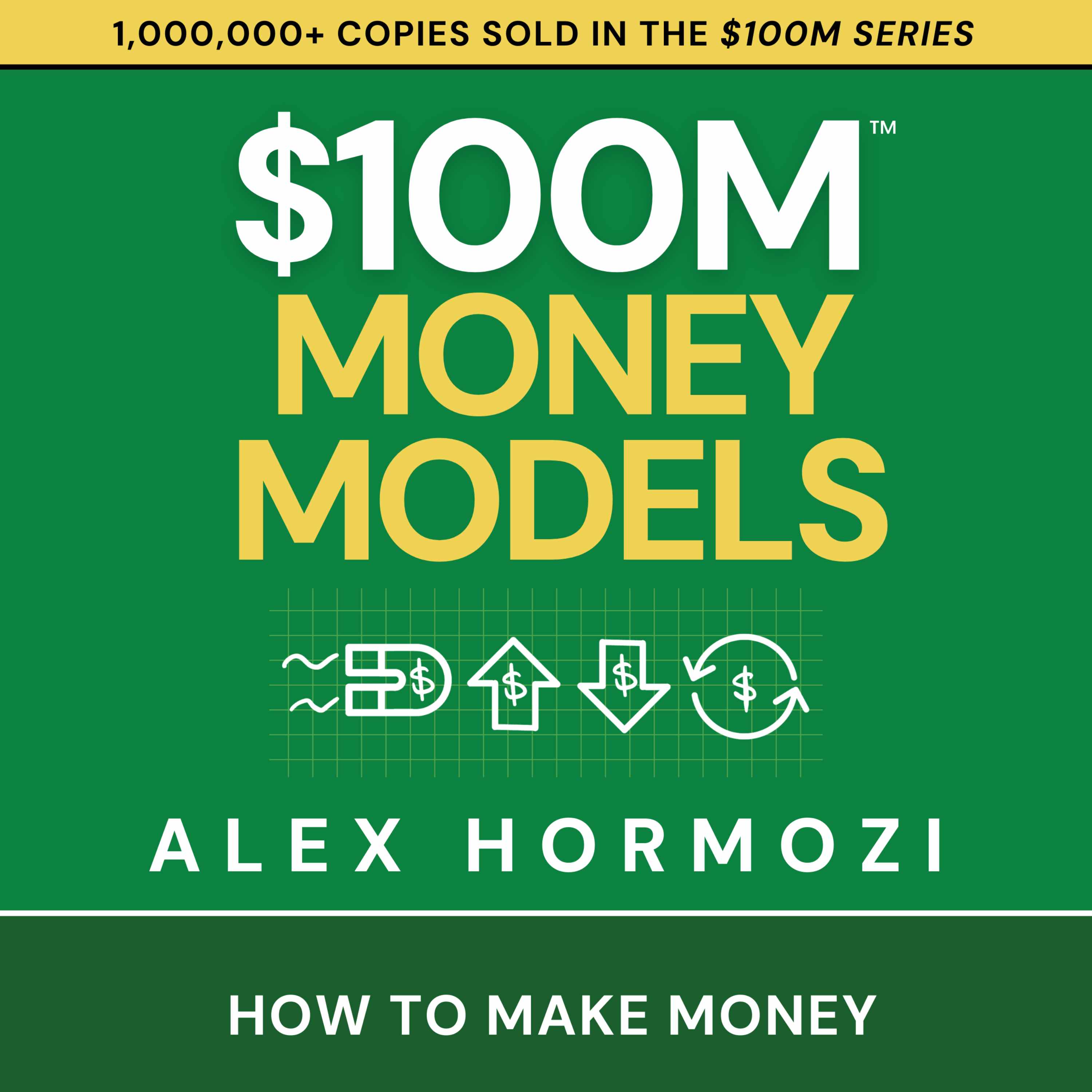
Part 2: What Is A Money Model? | $100M Money Models Audiobook | Ep 939
11m 44s
The transcription discusses the concept of a money model, which is a sequence of offers crafted to address customer needs and boost revenue. It highlights the importance of structuring offers in a specific order to maximize profitability. Different types of offers, such as attraction, upsell, downsell, and continuity offers, play key roles in a successful money model. The text emphasizes the significance of covering costs within 30 days to accelerate business growth and profitability. Additionally, it touches upon the importance of being transparent, customer-centric, and adaptable to legal regulations in designing effective money models. Ultimately, the aim is to create a well-designed money model that not only solves customer problems but also drives business success efficiently.
Transcription
2480 Words, 13457 Characters
Section 1. What's a money model? Hermosi has the highest return on advertising of any business using our advertising tracking platform by a mile. He has the biggest discrepancy between dollars spent and dollars earned and we only work with businesses spending at least 250,000 per year on marketing or more. So these are the cream of the crop marketers and his numbers are in the stratosphere by comparison. Alex Becker, CEO, Hi-Rose. December 2019. Hello, sir. Can I have your ID so I can look up your reservation? The car rental agent said, smiling. I already had my ID in hand, ready. So I slid it across the counter. Hmm. It looks like we don't have your car reserved. We have an equivalent car though, and you're a big guy. Would you prefer a roomier pickup instead? Blinking a few times. Yeah, that sounds nice. I said. I've got you down here for three days. She cocked her head to the side a bit. Would you like to have a late return so you can turn in the vehicle at any time during the day without worrying about late fees? I pulled up my schedule on my phone. Yeah, we have an evening flight. That sounds good. Great. Give me a second. Just putting that in. So would you like better insurance to cover any bumps and scratches on the car? It covers any and all damage to the vehicle during your time. Nope, I'm good. No plans on drag racing while I'm here. I joked. So only the minimum insurance then? Yeah, that's all I need. Okay, then. I'll have your keys in a second. Did you want us to take care of fuel so you don't have to worry about filling it up? You can return it on empty and not worrying about paying a fee. We do it for $3.75 a gallon. What's gas cost around here? I asked. About $3.58 a gallon. She replied cheerfully. Sure, why not? I hate filling it up when I'm rushing to catch a flight. Alrighty, then. Here's your receipt. Just go around the corner and your truck should be halfway down to the left. Enjoy your trip. As I walked, I glanced at the receipt. It stopped me in my tracks. I could only laugh at myself. I came for a $19 a day car and I left paying $100 a day. A 5x difference. And that's the power of a well-designed money model. They knew everything I wanted before I asked. And when they asked to solve problems I didn't even know I would have, I accepted. A money model happened. A money model is a sequence of offers. At their core, we find every opportunity to solve a customer's problems and then offer to solve it. For that reason, money models tend to have many offers in a specific order. If you offer the right thing when customers realize they need it, you can make as many offers as you like. This is the rental car company's money model stated plainly. Offer 1, vehicle upgrade. Offer 2, late return. Offer 3, premium insurance. Offer 4, minimum insurance downsell. Offer 5, prepaid gas. So yeah, I paid more, but it also solved more problems. Let's break down the problems she solved. First, she solved my big man in small car problem by offering a vehicle that had more space. Then she solved my late checkout problem by offering the flexibility to keep vehicle longer. Then she solved my worries about digging the car problem by offering insurance to protect against it. Then she solved my risk of missing my flight problem by offering a way to prepay for the gas ahead of time, so I wouldn't have to do it on my ride back. And all of those things cost money that I was happy to pay. The rental car company thought out every nuance. They thought about every problem, then made their solution available to me. They offer solutions for higher fees and hassles I might have had later for smaller fees in total right now. As a result, my $19 rental became a $100 rental. I paid more money faster. And now we can see why rental car industry brings in billions in the United States alone per month. A successful money model. But where? Bad money models kill businesses. It costs many businesses more to get somebody to buy a thing than they make in profit off the thing. In other words, they lose money getting new customers. That's a big problem. And here's what happens. They spend money to get customers. At the end of the month, they realize they spent more than they made. They cut back on advertising. They get fewer customers than they can handle because they can't afford them. Then cut advertising altogether. Float the business with personal cash, loans, credit, and then pray for profit. Sell percentages of their business just to keep the lights on. Wait months or years to make their money back, if ever. Fall further and further behind until, finally, they lose it all. But it doesn't have to be that way. There's plenty of money. You just have to go get it. In traditional business, the slow drip of profits from lots of customers eventually pays for a single customer. This drip starves the business of cash. It means they can only get customers through advertising if they already have lots of customers. Big companies or small companies with investors can do this because they have the money to burn. Think about it this way. If you spend $100 in advertising to get a customer and make $500 in profit from them, that's a great deal. You should take it all day. But what if it takes you two years to make your cash back? It's a great business if you already have tons of cash in the bank. Otherwise, you're going to run out of money. That leaves you with two options. Option one, wait two years to get paid and pray you don't run out of money. Option two, get paid fast and grow as much as you darn well please. A good money model is option two. Author note, make enough profit to cover your costs in 30 days or less. I like to cover my costs of getting a customer within 30 days. Main reason, any business can get interest-free money for 30 days in the form of credit card. If you clear your balance before the end of the month, it works just like normal money. So you can use credit to get a customer, pay it back, and then use it again to get the next customer. If you can pay it off before 30 days, you can do it again. Rinse and repeat. Good money models make millionaires. If you make more offers and people buy them, you make more money. If you make more money, you can use it to get more customers. If they pay you that money faster, the faster you can get those customers and stay profitable. But what if you make your customers twice as valuable? You get twice as many of them and you get those customers at twice the speed. Your business grows eight times faster. And if you triple them, your business grows 27 times faster. See where I'm going with this? You can get really big, really profitable, really fast with just a few changes. And that's exactly what I'm going to show you how to do. Next up, money models are a sequence of offers. Different offers solve different problems. So if you want to win, you have to figure out what to offer next. To figure that out, you've got to understand the four types of offers. The four types of offers that make money models. Stop being poor. Pair seldom. The limit does not exist. Lindsay Lohan as Katie Heron in Mean Girls. Making one offer works better than making none. And making more offers works better than making one. Combining offers in a sequence makes a money model. My money models combine four different types of offers. Four types of offers. Here are four types of offers. Attraction offers, upsell offers, downsell offers, and continuity offers. All improve our money model, but they do it differently. They work great on their own, but together they make your business unstoppable. If you look at a great business, you'll see different versions of these offers as core components of their money making machine. You can use one, two, multiples of one, or all four together. You can combine them however you want. But when I look at my most profitable businesses, I use all four. Here's why. If you don't have an offer for getting customers, you won't get as many. But let's say you do. If you only have that one thing to offer, you won't make nearly as much money as you could. So if you have something to offer next, an upsell, you'll finally get some cash. But you still won't make as much money as you could because lots of people still say no. So you turn those nos into yeses with downsells. And that works fine. But it would be even better if we get that extra cash guaranteed to come in month after month. So you make a continuity offer to top it off. That's how I like to do it. So that's how I structure these sections. I start with attraction offers because if you're not getting customers, you need one of those first. Then we cover upsell offers, followed by downsell offers. Then to finish the four types, I show you my favorite continuity offers exactly how I learn them. How each chapter is structured. Here's how the rest of the book reads. One, the story of how I first learned this money model. Two, a description of how the money model works. Three, a few examples of how this money model works in different industries. Think of how you could use money model in your business. Four, important notes and tactics that make the money model work. These tidbits help you execute the play like it's your hundredth time doing it on your first try. Five, a summary. All the important points about the money model. Plus some extra thoughts sprinkled in about how to make the money model work even more profitably. Important notes. All right, before I release this pile of golden nuggets, I need to make a few things clear. Number one, all businesses have money models. It makes a business a business. Switch the poor person mantra of this won't work for my business to the rich person mantra of how will I make this work for my business. They all work. Be creative. Two, some money models work better in some businesses than others. They're just different ways to offer stuff. If you just try and copy what they do, you'll be disappointed. To make it work for your business, you have to design your own. But don't worry, I'll show you how. Three, if a customer asks for their money back, give it back. Avoid the headache. And if you made a goof, fix the goof. Don't be a silly goose. Treat customers well. Spend the time and resources getting a customer a better fit for your business. Four, hard selling is for weak products. If someone doesn't want something, that's okay. Don't convince someone against their will. Make offers available at the time your customer has a problem and you'll be ahead of the competition. If they don't want it, no sweat. Find somebody who does. It's a numbers game. Five, obey the law. I learned these plays in different situations from different people using it on different platforms in different times in different places following different rules. Advertising laws change all the time. And they tend to only get tighter, especially when it comes to the word free. Check with lawyers to see if an offer you want to make is legal or not. This book is intended to be money models inspiration. So use it that way. Six, be transparent. State the facts. And if the facts aren't compelling, change reality to make them compelling or learn to frame them in a way that is. Don't lie. You'll shortchange yourself long term. And unlike credit card debt, you can't file bankruptcy to erase a bad reputation. Once you have a bad one, it sticks for life. Number seven, any offer can be used on its own at any time in any order. A business works as long as it makes a profit. Most offers in this book could meet the minimum requirement on their own. When used in the right sequence and at the right time, they make a $100 million money model. I've got big dreams, and I bet you do too. So we're going to use them all. With that said, let's go for a ride. First up, attraction offers. Most businesses spend too much to get customers and make too little from them. They are cash constrained. But you use cash to get more customers. And I like more customers. So I always solve this first with an attraction offer. Free gift. Bonus tutorial on the four types of offers. If you want a more in-depth look at how we think through layering different offers, go to acquisition.com forward slash training forward slash money. It's free and publicly available. My goal is to earn your trust. And trust is built brick by brick. Allow this training to be the first of many bricks. Enjoy. Real quick, guys. I have a special, special gift for you for being loyal listeners of the podcast. Laila and I spent probably an entire quarter putting together our scaling roadmap. It's breaking scaling into 10 stages and across all eight functions of the business. So you've got marketing, you've got sales, you've got product, you've got customer success, you've got IT, you've got recruiting, you've got HR, you've got finance. And we show the problems that emerge at every level of scale and how to graduate to the next level. It's all free. And you can get it personalized to you. So it's about 30-ish pages for each of the stages. Once you answer the questions, it will tell you exactly where you're at and what you need to do to grow. It's about 14 hours of stuff, but it's narrowed down so that you only have to watch the part that's relevant to you, which will probably be about 90 minutes. And so if that's at all interesting, you can go to acquisition.com forward slash roadmap. R-O-A-D map. Roadmap.
Podcast Summary
Key Points:
A money model is a sequence of offers designed to solve customer problems and increase revenue.
Successful money models involve making multiple offers in a specific order.
Different types of offers in a money model include attraction, upsell, downsell, and continuity offers.
Good money models aim to cover costs within 30 days and make businesses profitable faster.
Summary:
The transcription discusses the concept of a money model, which is a sequence of offers crafted to address customer needs and boost revenue. It highlights the importance of structuring offers in a specific order to maximize profitability. Different types of offers, such as attraction, upsell, downsell, and continuity offers, play key roles in a successful money model.
The text emphasizes the significance of covering costs within 30 days to accelerate business growth and profitability. Additionally, it touches upon the importance of being transparent, customer-centric, and adaptable to legal regulations in designing effective money models. Ultimately, the aim is to create a well-designed money model that not only solves customer problems but also drives business success efficiently.
FAQs
A money model is a sequence of offers designed to solve customer problems and generate revenue.
A well-designed money model can help a business solve customer problems effectively, increase revenue, and grow faster.
The four types of offers in a money model are attraction offers, upsell offers, downsell offers, and continuity offers.
Having multiple offers in a money model allows a business to maximize revenue potential by catering to different customer needs and preferences.
A good money model can help businesses make more offers, attract more customers, and generate revenue faster, leading to increased profitability.
Chat with AI
Loading...
Pro features
Go deeper with this episode
Unlock creator-grade tools that turn any transcript into show notes and subtitle files.
 PodcastTranscript AI