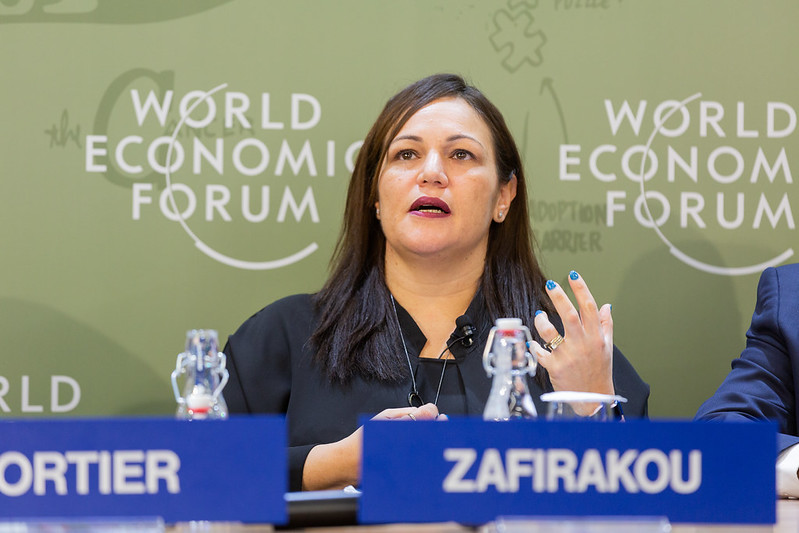
Jobs Reset Summit Day 3: Education, Skills and Lifelong Learning
17m 18s
The transcript highlights key discussions from the World Economic Forum's Jobs Reset Summit, exploring themes such as the importance of creativity in education, the shift towards a sustainable economy, and the need for upskilling and reskilling in the workforce. Emphasis is placed on addressing the global digital education divide exacerbated by the pandemic and integrating creativity into curriculums to equip learners with essential skills. Leaders and policymakers are urged to strategically review education systems and workforce skills to prepare for the future world of work. The importance of supporting female workers, creating new job opportunities, and adapting to evolving job market trends, such as sustainable work and tech jobs, is also underlined throughout the discussions.
Transcription
2840 Words, 16592 Characters
I'm really hoping this pandemic has helped to raise a profile of teachers where the ones
who are creating the futures of any country. Welcome to the great reset, a podcast from
the World Economic Forum that looks at how we can build a cleaner, fairer smarter world
after Covid-19. It's October 22nd. Day three at the Jobs Reset Summit, where experts
from around the globe are discussing education, skills and lifelong learning.
Creativity should be embedded in absolutely every aspect of our curriculums.
As Covid-19 disrupts the education of children all over the world, we'll hear from an award-winning
teacher on how to equip the next generation for a world of work in constant flux.
The beauty of teaching creativity is that what you're actually doing is enabling your learners
to have transferable skills and if we're not doing that, then we're just failing them.
And we'll have highlights from day two at the Summit to which looked at work, wages and job creation.
The jobs that drives sustainable living will be at the centre of the 21st century.
19th century was marked by the industrial economy. 20th century is marked by the knowledge economy.
The 21st century will be marked by the sustainable economy.
You can follow the Jobs Reset Summit Live at weforum.org and across social media using the #jobsreset.
Subscribe to the great reset wherever you get your podcasts and please take a moment to like,
rate and review us. I'm Robin Pomeroy, digital editor at the World Economic Forum and with daily
coverage of the Jobs Reset Summit, this is the great reset. Later in the episode we'll hear
from an award-winning teacher about the one skill she says will future-proof our children as they
head into an increasingly unpredictable jobs market. But first, my colleague Linda LaCena
picked out some of the highlights of day two of the Jobs Reset Summit. The theme was work,
wages and job creation, speaking on that and on the impact of the pandemic, Guy Rider,
Director General of the International Labour Organization. I think it's absolutely vital
that we have this discussion about jobs not after we've solved the health emergency
but right now because we're going to have to build forward from a very very dark place.
That's Guy Rider, Director General of the International Labour Organization,
speaking on day two of the Jobs Reset Summit, he and other leaders discussed the urgent need
to face work challenges head on, especially in a year that's seen hundreds of thousands of global
job losses. Day two's theme was work, wages and job creation and leaders spoke to how the world of
work could be reinvented to meet new needs after the pandemic. Geraldine Matchett, Co-CEO of Royal DSM,
for instance, envisions a holistic world of work, one that values contributions both in and out of the
office. There has been an increasing separation between the value of work and the value of everything
else that we do in our lives. And if you think about it, it's been very much that either you ain't
or you're out. You know, either you're completely focused on work, but then you normally have issues
taking care of the family, of society, of communities, etc. or you're out of work. And it's been extremely
polarized. Now, if we think of a change of mindset in what is work actually about, it's also about
valuing the contribution that humans bring not only when they work, but the family contribution,
the community contribution, even the environmental contribution. And therefore, they need to be a
different mindset around what do humans actually bring and where do they bring it in society?
This holistic human approach means a greater focus on people and also on the planet.
CVJ Akumar, chief executive officer of HCL Technologies, sees sustainable work as the work of the
future. The jobs that drive sustainable living will be at the center of the 21st century.
I do believe this segment will grow enormously. Like 19th century was marked by the industrial
economy. 20th century is marked by the knowledge economy. And I firmly believe the 21st century
will be marked by what I call as a sustainable economy. And technology and tech companies
have a huge role to play to create these new jobs in the intersection of climate change and
public services, as well as in consumer products.
Key to bringing humanity and sustainability in the workplace, however, means providing protections
for female workers who often double as both employees and full-time caretakers.
Saudi Azahidi, managing director of the World Economic Forum, spoke the particular stresses
women face returning to the workforce. Even though women are in the workforce in much larger
numbers than ever before, in both advanced and emerging markets, they happen to be the ones that
take on most of the burden of care responsibilities. Providing more flexibility and care for workers,
particularly women, along with re-skilling and up-skilling, the labor force is crucial to the
recovery process. Saudi, I explain more. There needs to be focus on the people that are hurting
the most. There needs to be more conditionality built in so that it's not simply support for wages,
but there is a game plan in place to re-skill and up-skill workers. And then third, this is the moment
for investing in the markets and jobs of tomorrow. This is the moment to start building out the
investments that we need for those 97 million new jobs to come through. Now, that's just the views of
the heads of HR and heads of strategy that are responding to us. But there's much more to be done
that can be part of government incentives for creating that better future. Creating a better
future also means making sure developing countries aren't left out of the conversation.
Hans Paul Berkner, chairman of Boston Consulting Group, said developing countries face
particular challenges when it comes to up-skilling and re-skilling their workforces and their needs
have to be taken into account. You know, in South Asia, in Africa, in Latin America, 70, 80, 90 percent
of the jobs are in form of, you know, and even more, you know, than are in small and mid-sized
companies. And so I think, you know, we have, on the one hand, you know, a very, very extreme
effort in investing in people and investing in security and learning and so forth. And the other
hand, we have enormous amount of insecurity. And I think, unfortunately, you know, in our discussion
about, you know, home offers and, you know, how things going to be different after the pandemic,
we focus too much on the developed world and on the top companies and what they can offer
to top talent. But we need to really see how we can really help. And that's also a job, of course,
of the larger companies in the developing countries in South Asia, in Africa, Latin America,
and so forth, to really create more jobs, to make sure that more people are getting training.
And that more people are really getting into formal jobs that allow them also step-by-step
to build good living and more security. The future of work can also mean new opportunities.
Current projections estimate that the job market could absorb 150 million new tech jobs
just in the next five years. Stephen Cotton, the General Secretary of the International Transport
Workers' Federation, urges leaders and workers to see tech as an ally and not a foe.
It has to be that confidence that rescaling the investment in people to create opportunities,
opportunities that will ensure that it's a long-term life of work. Of course, we recognise that
technology is going to change the culture of work and what task we do today will change over time,
and it's good that technology can help us. But if technology is seen as a threat and we start
in a conflict, then we won't be able to deal with the issue. Stephen Cotton of the International
Transport Workers' Federation, ending that roundup of highlights from the jobs reset summit,
compiled by Linda LaCena, who has this news of her own podcast. The World Economic Forum
has a brand new podcast, Meet the Leader, where the world's top leaders share how they're tackling
the world's toughest challenges. This week's leader, Brian Moynihan, the CEO of Bank of America,
he helped spearhead a set of new metrics that help companies measure how they're doing well for society.
We were able to put together with the big four accounting firms, a set of metrics that define
how to make progress on stakeholder campus. What we're trying to do is to help basically implement
solve these great problems of world-based. He'll explain why they're important and how he tackles
any long-term goals. You have to create good energy and good action, not energy and action.
He'll also share why creativity is critical for leaders and how leaders should act in a crisis.
All that and more on this week's Meet the Leader available on Spotify, Apple Podcasts,
and wherever you get your favorite podcast. Thanks for that, Linda, and you can get
information on all our podcasts at www.ref.ch/podcast. Now to today's interview. Andrea Zaffireko is a
teacher in the North London borough of Brent. That's one of the poorer parts of the English capital,
and one that is extremely multicultural with an estimated 130 languages spoken there.
In 2018, she won the Million Dollar Global Teacher Prize, which is awarded by the Varky Foundation every
year, seeking to improve the standards of education for underprivileged children. She spoke to the
World Economic Forum ahead of the summit. Here's Linda again. Linda, what did Andrea Zaffireko
have to say? First, Andrea talked about how the pandemic has worsened and deepened the global
digital divide. We now know exactly what's taking place, exactly what our young people have at home.
Students who have got access can engage and receive an education, but those who can't and don't
have access for whatever reason, financial reason, or parental engagement and support, they will
not benefit at all. And sometimes it's really shocking to know that there is nothing. That's been
the hardest thing, the inequality is so evident now, it's apparent, it's raw, and it hurts. When
I say they have access, what I mean is that they have either devices or they have opportunities
to engage in resources, to ed tech resources, or they have the infrastructure, so maybe broadband.
You know, many, many schools think, okay, that family's got a laptop, well actually that family's
got a laptop, and it's a very old laptop, and it doesn't support the software which the school is
using, or maybe there's lots of siblings there who are using the same laptop. Despite these gaps,
Andrea has reason to be optimistic, seeing the chance to revisit curriculums, upskill
at different life stages, and even find a new appreciation for educators. I think that, indeed,
there is something that's going to be good coming out of this. I think that good opportunities
and creative opportunities and moments will take place. Schools will have to think about what curriculums
they have. Schools will have to think about how their teachers teach and what they are teaching,
or whether it's now relevant for the new world that we now have come, and it's come straight as
a brick wall in front of us now. And what is really important is that we don't go back to how it was
before, that we use this time, this reset time to really look, review, change, and have a really
good understanding of what we want our futures to be like in our countries. It's quite fascinating now
to really look at which jobs, which vocations are considered as now being important, or have really
helped to save lives. So the nurses on the front line, the delivery workers, the people who actually
we can't live without. I think there will be now conversations that will take place where people
will have to force and to be held accountable to what actually is a good job, and how much we should
really pay particular employees and particular areas. If anything, I'm really hoping that this pandemic
has helped to raise a profile of teachers, helped countries and ministries of education to acknowledge how hard
we work, and how we are committed to our young people. I mean, teachers, we are the ones who are really
inspiring the futures. We're the ones who are creating the futures of any country. They're in our
classrooms. We are there. We are committed to our young people. We're committed to environments,
and I'm really hoping that there are a lot of learning has happened. Entrepreneurship is going to
grow because people are now finding ways of upskilling themselves and changing what they're doing,
changing what they know, learning new things so that they can find a place in this new society,
so that they can find a way forward to live, to function, to feed their own families.
According to Andrea, to prepare students for the real future they'll be facing, a creative
curriculum should be integrated into every single school subject. Here's why. Creativity should be
embedded in absolutely every aspect of our curriculums at all ages. The beauty of having creative
curriculums and teaching creativity is that what you're actually doing is enabling your learners to
have transferable skills, and that means that we're giving them the opportunity to succeed. If we're
not doing that, then we're just failing them. Again, it's those skills that we're talking about,
resilience, mastery, collaboration. This is what they need in order to thrive in absolutely any
profession which they choose. Creativity is all about finding opportunities to collaborate,
so we're engaging with conversations, sharing ideas, sharing products. Lots of opportunities to
question. There's also the aspect of discipline. Discipline is all about mastering a technique,
trying again, just not letting them give up and making sure that they commit to this journey,
and that they see it through. For young people, that's the hardest. Persistence is absolutely
hard, but once you crack that, you're on a winner. What we have learnt from existing in this COVID
world is that the people who will succeed are the ones who are creative. The ones who are thinking
up new ideas, the ones who are questioning the status quo, the ones who are really
solution focused, and the ones who are resilient, and that is why we need these skills in our
workforces. She leads us with a special message for leaders and policy makers. If I was to have a
magic wand, I would make sure that I would encourage everyone in powerful positions just to
stop, review, think about where they want their countries to go, how successful they want their young
people to be, how skilled you want them to be, and the only way we can do that is just by pausing,
because we've really got now a great opportunity to review, to rethink, and I don't see as a negative,
I see this as a positive. Now, as a tunnel, we can prepare things for our future in a really robust,
strategic way, and, you know, let's be brave, let's be bold, and let's just do it.
That was Andrea Zafaraku, a global teacher prize winner. Come back tomorrow. As we talk to
new and women executive director who's even in Longbukuka, as she talks about how the COVID-19
pandemic has pulled women out of the labor market. The majority of the people who have lost jobs
are women. The ILO estimates that two deaths of the jobs that will be lost and not recovered
are women's jobs. She reminds us that if key steps aren't taken, some women might never return
to the office, and when it comes to opportunity, a woman's place might only be in the home.
And we say that women can also work from home. We must not find a situation where it's only women
will end up working from home, because they have to do home work as well as the office work
in the home. So let's say offices that can just be in another locker room. The place is where men
only go. From Zilin Malambo and Guka, the head of UN Women, Linda will be back with that
interview and the latest highlights tomorrow, the fourth and final day of the jobs reset summit.
You can follow the action live at www.weform.org and across social media, Facebook, Instagram,
LinkedIn, TikTok, YouTube, and on Twitter using the handle @wf and the hashtag #jobsreset.
Thanks to Linda Lassina, to Kiera Kelly, Sybil Pennera, and to Gareth Nolan for help making
these daily podcasts. Thanks to you for listening. For now, from me, Robin Pomeroy, at the World Economic Forum.
Goodbye.
Podcast Summary
Key Points:
The World Economic Forum's Jobs Reset Summit focuses on education, skills, and lifelong learning post-Covid-1
Emphasis on creativity in education for equipping the next generation with transferable skills.
Discussion on work challenges, wages, job creation, and the shift towards a sustainable economy.
Importance of upskilling, reskilling, and providing protections for female workers.
Future job market trends, including the rise of sustainable work and tech jobs.
Urgency to address the global digital divide in education highlighted by the pandemic.
Calls for integrating creativity into curriculums to foster transferable skills and resilience.
Advocacy for a strategic review of education systems and workforce skills by leaders and policymakers.
Summary:
The transcript highlights key discussions from the World Economic Forum's Jobs Reset Summit, exploring themes such as the importance of creativity in education, the shift towards a sustainable economy, and the need for upskilling and reskilling in the workforce. Emphasis is placed on addressing the global digital education divide exacerbated by the pandemic and integrating creativity into curriculums to equip learners with essential skills. Leaders and policymakers are urged to strategically review education systems and workforce skills to prepare for the future world of work.
The importance of supporting female workers, creating new job opportunities, and adapting to evolving job market trends, such as sustainable work and tech jobs, is also underlined throughout the discussions.
FAQs
Teaching creativity and embedding it in curriculums can equip learners with transferable skills to succeed in any profession.
Sustainable work is seen as crucial for the 21st century, driving a shift towards a sustainable economy.
Developing countries face challenges in investing in people and providing security and learning opportunities for formal jobs.
Female workers often juggle both employment and caretaking roles, necessitating more flexibility, care, and up-skilling opportunities.
Creativity enables learners to develop skills like resilience, mastery, collaboration, and discipline that are crucial for success in various professions.
Chat with AI
Loading...
Pro features
Go deeper with this episode
Unlock creator-grade tools that turn any transcript into show notes and subtitle files.
 PodcastTranscript AI