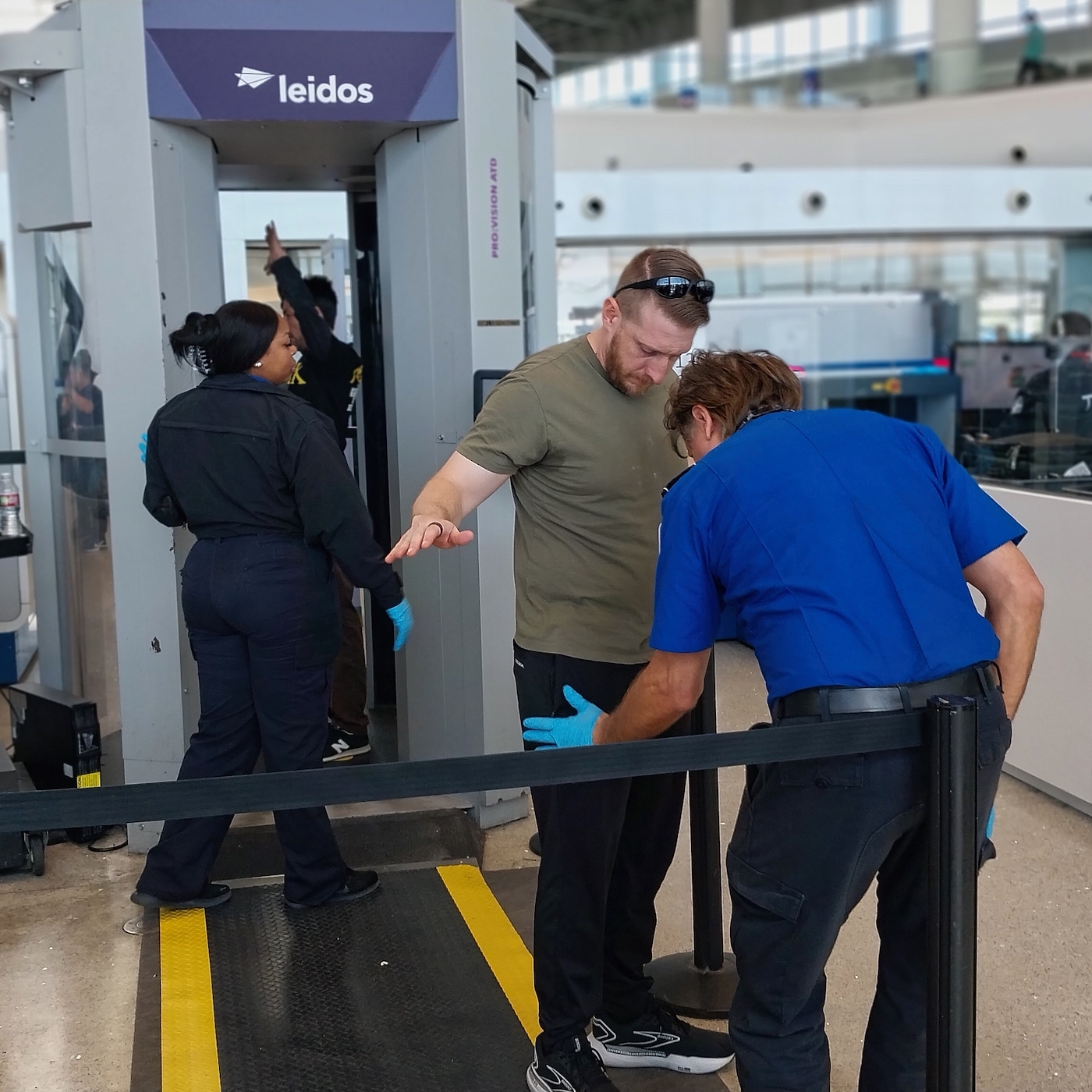
Welcome to Left Right and Center everybody. I'm David Green. We should say we are starting this show on time this week, but this is going to be a show about delays and more delays and more delays. And I'm not just talking about TSA checkpoints at airports around the United States, but also a delay by the government itself to agree on ending this partial shutdown of the Department of Homeland Security that's gone on now since Valentine's Day. Homeland Security workers are hurting. Travelers are beyond fed up with the disastrous situation at U.S. airports. And we cannot continue to keep this critical Department unfunded. That is the voice of Republican Senate Majority Leader John Thune who does sound very worried about this and really wanting to do something about it. And yet as we record this show on Thursday, Republicans are very much caught in the middle. Democrats, it seems, have held firm for weeks now on their demands that the Department of Homeland Security will get funding, but only with reforms to immigration enforcement and tactics used by ICE officers. They've also offered to fund DHS departments like TSA separately. That is an idea though that the GOP rejected. On the other side of this, you have President Trump himself saying no to any DHS funding bill that does not include the Save America Act. That is an unrelated overhaul of our federal elections. The negotiating a deal. I guess they're getting fairly close, but I think any deal they make. I'm pretty much not happy with it. Pretty much through water all over that, didn't he? So we're going to take a step back here, because when we look at these weeks of negotiations, it has allowed Democrats, at least from my perspective, to unite around the issue of immigration. And it has put a spotlight on how this is becoming a liability for Republicans, especially as we head into these midterm elections. So let's talk about that. We have Moe Lathie here on the left and Sarah Isker on the right. And there are a lot of Americans who are, I even have a friend this morning who said his whole family is thinking about canceling upcoming travel plans because they don't want to wait in airport lines for three, four, five hours. But Moe, congressional Democrats seem to still be acting like there's nothing to lose here. Talk me through that strategy in this moment for them. Ice accountability is important. It's important. Democrats are important to most voters. Getting TSA lines shorter is also important to most voters. Democrats right now are feeling pretty confident because they keep putting forward a plan to do both, right? They have now at nine times, 10 times, said split ice off from the rest of DHS. We are ready to vote with you to fund all of it, except for ice, which by the way is already funded. And so ice agents are getting paid while TSA agents are in. So Democrats feel like they've got a strong hand because they could say we're ready to fund TSA. We're ready to put all those people back to work and shorten these lines. And then let's have a separate conversation about ice. Republicans aren't going for that. And that's why Democrats feel pretty good because the polling shows that Americans tend to blame the Republicans more for the shutdown than Democrats, which by the way is not what polling usually shows. Polling usually shows that the out party that forces the shutdown usually gets blamed. Right now it's not showing that people I think get what Democrats are trying to do because they also care about ice. And so for a party that, you know, my party does not often show an iron clad ability to state unified and sure of itself. It seems pretty unified and sure of itself right now. Well, Sarah, I mean, I we've talked some in recent weeks about how this bringsmanship, you know, between the two parties during a shutdown or something usually plays out. I mean, this one feels maybe distinct in a way because you do have a lot of Americans, according to polls sort of, you know, on the side of Democrats, not in massive numbers, but at least seeming like they don't love ISIS behavior in recent months. They're not blaming Democrats for keeping these delays at airports going. And it seems like we have Republicans on the hill realizing that. I mean, that they're the ones who seem to be putting in more work to come up with some kind of compromise. And I look at that coupled with a White House official advising House Republicans recently to stop emphasizing mass deportations like it has immigration suddenly become a liability for the Republican party. And we weren't even looking. Didn't even see it coming in a way. Okay, there's a lot going on here that I think we need to separate out various pieces. Republicans on the hill are once again not fully politically aligned with Donald Trump, meaning Donald Trump's politics where he actually is fine dragging this out is not in the interest of Republicans who are facing midterm elections. So I think you see some space, some gap between where Hill Republicans are and where the Trump administration is. And that's not a new thing. I mean, that we've seen that before at times. Not new at all, but it goes to this like lame duck status, right? At what point did I think Donald Trump hurts them more than helps them? There's also though the fact of how this happened, which I don't think many people totally understand. So in the big beautiful bill, ice was fully funded. And so what we're talking about now is this fight over TSA funding basically and not ice funding. What Democrats want is not to defund ice or to lower funding for ice. It is substantive policy differences about masking, wearing their names, recordings, stuff like that, which are would normally be just legislative, right? You have some bill that says ice agents cannot be masked when doing blah, blah, blah, they must use judicial warrants. But they're trying to put this into a funding fight because they need TSA lines to be long so that anyone will care about this. What makes this kind of remarkable, I think, is that the politics should be hurting Democrats. But to your point, David, it's not. And that tells us something about, I think, to your point where the American people are on interior immigration enforcement. Now, when we talk about who this will politically advantage in the midterms, it helps when Democrats hurt Republicans, right? It helps Democrats for Republican brand to go down. But only to the extent that they are a viable alternative. And what we've seen so far in all of these elections is that each party is really good at convincing voters that the other side sucks. But what they're not good at is actually having popular positions themselves, being a viable alternative themselves. And you know, the Democratic Party should be the party of popular policies. And then they get railed on by progressives that are like, no, it's important to stand for X, Y, and Z, even if we lose elections. And you're like, okay, then I guess keep losing elections. It will not help Democrats to bring down Republican approval numbers if they are not more popular than Republicans. And when you actually dig into these numbers, overall, what is happening is that people are leaving both parties and droves for the first time in American history. More people identify as independence. And it's why someone like me is sitting back and kind of giggling, if you will, about all the gerrymandering and all of the fights over when ballots can be turned in. Because these people have no idea who their voters are anymore. The parties are realigning and they are losing altitude very, very quickly. Well, Mo, Sarah raises a really, a really interesting point. I'm curious where you are on this because, you know, your party a few months ago we were talking about was doing well in part because they had sort of grabbed the narrative on the economy. I mean, that's how we saw some pretty big races turn blue. Suddenly we're sitting here saying that your party is doing well because they've got the American people, maybe behind them on internal immigration things like ice. But if we're not going to actually get to the substance of those questions and we're just sort of in a moment where people are angry about airport lines, it feels like we should be looking for that moment for your party to get back to the more economic message. And that's going to require kind of staying unified to manage this messaging to avoid the trap that Sarah is talking about. I mean, to basically, you know, tear the Republican party down, take advantage of their vulnerability right now, but never find that positive message that will actually matter this fall. Yeah, Democrats are doing a better job than they have in a while of framing the opposition. They've come a long way since like just saying Trump is dangerous, Trump is dangerous, Trump is dangerous. This is this is more. We haven't done a good job on either side of that equation for quite some time. I mean, Trump is a fascist as our rallying call in 2024 was a disastrous approach. Right. So they have done a much better job of framing the opposition and how Donald Trump and Republicans are hurting them on core issues to them on immigration for the first time in like what a decade more voters right now in polling say they trust Democrats on the issue of immigration than they do Republicans. That's remarkable. Democrats have been far better this last year in making the negative case against
Trump and Republicans, and that's helping them right now. But at some point, they do need to step up and say, here's the alternative. Sarah, I just want to dig in more to what we're seeing from this president. I think about ICE being deployed to these more than a dozen airports throughout the country to quote unquote, help with these backups. What is he doing at a moment when you have a lot of Americans feeling like ICE and their immigration tactics were too harsh? I mean, we saw the killings of Renee Good and Alex Predey and Minnesota. And there have been a reaction to that among a lot of Americans. Like, is he trying to say like ICE can have a presence in places in our country and not be as violent as you were seeing them? I wouldn't have the same question if he had sent the National Guard to airports, which he hinted that he might do this week. But like sending ICE and doubling down on ICE having a bigger, more visible role in our country, help me understand that. I think he wants to make clear what the fight is about, right? If Democrats want to hold up airport lines because they want ICE agents to stop wearing masks, Donald Trump wants ICE agents at the airport showing that they're an important part of our law enforcement. By the way, fun fact. In the last 10 days, I've been in Logan Airport, LaGuardia Airport, Jacksonville Airport, Salt Lake City Airport, Reagan National. There've been no lines. Yeah, LA LA hasn't been bad either. It's, but Austin, Texas was terrible. I mean, it's a number of airports and hobby airport in Houston was like, I'm seeing the reporting. I'm not saying the reporting's false, but it is interesting that this is not a universal problem. So like when you mentioned someone talking about canceling their spring break or a family vacation, please don't do that. I have one friend who told me they had seen ICE agents at an airport actually doing some of the work. If you're in an airport and would otherwise be waiting in a four hour line and miss your flight and ICE agents are the reason that you're able to go on your family vacation, that's not a crazy political move to make when you think about it that way. Mo, is there an argument too that, I mean, especially when we're in a war that feels like it might be increasing the risk of terrorism or country to have a greater law enforcement presence at airports, especially at a moment where at some of these airports, there are long lines and there are hundreds of people who are sort of in a large public space and potentially very vulnerable. Much like the war in Iran, I don't know why they're there, right? Like they haven't articulated a rationale. Well, to help with security is what the president said. We don't have to believe what he's saying. Okay. So he said that once and then we've heard other like the reality is notwithstanding the anecdote, Sarah just told most of the reporting says the ICE agents are just standing there. They are not actually doing anything to move the lines more quickly. Sometimes on their phones, I've seen some video because they are not trained on the equipment that the TSA agents who are trained on, they are standing there in their uniforms, sometimes with masks, sometimes not holding their weapons. That's not doing anything to move the lines quicker. So why exactly are they there? If the president said I'm deploying armed agents to these airports because we are at war and we want to increase security, like that's an argument to have, but that's not what he's doing. He's sending ICE specifically, not the National Guard to protect security during wartime. He's sending ICE to stand there and essentially not do anything because they are not trained to. But there's, it's just the wrong mission. We're going to talk in a few minutes about where else we might be seeing ICE deployed and what we think about that. But before we take a break, I want to tell you that we love engaging with each other, me, Mo, Sarah, but also all of you across the aisle, maybe across your kitchen tables. If you have something to say about this week's topics, join the left, right and center community conversation. We are on substack. We'll send you a weekly inbox reminder to hone up on the show and get to the conversation with one another. Join in on the latest discussion at kcrwlrc.substack.com one more time that is kcrwlrc.substack.com and we'll be back with more left-right and center in just a moment. Now news and politics are moving awfully fast. It can feel overwhelming to say the least. I'm Evan Osnos, a staff writer for The New Yorker. On the political scene podcast, we slow things down to understand how power really operates in Washington, D.C. and what it means for you. My co-hosts, Jane Mayer and Susan Glasser and I have decades of reporting experience. Every Friday we have conversations with insiders and experts to understand the forces remaking America. Join us Fridays for the Washington Roundtable from the political scene. On Mondays and Wednesdays, you can also hear insightful episodes from our New Yorker colleagues David Remnick and Tyler Fogget, available wherever you get your podcasts. We're back with more left right and center. I'm David Green with Sarah Isger on the right and Moa Lacey. On the left, we were talking about ICE. I want to turn now to the state of our elections in 2026 because this year you're going to be casting your votes in ways that might feel very different. Just like at airports as we were talking about, ICE is a part of this conversation as well. It's one thing to have ICE agents doing whatever they're doing at airport terminals. There is a growing concern that ICE agents might be part of a force of federal law enforcement officers who are having around polling sites this fall. First off, let's clearly state that this is against federal law to use them in this way, quote, "Unless such force be necessary to repel armed enemies of the United States." End quote. Curious what you think of that in a moment, Sarah. The law is absolutely clear. Anyway, this is an idea that President Trump first mentioned to prevent voter fraud. This is Trump in a 2020 interview with Sean Hannity from Fox News. We're going to have everything. We're going to have sheriffs and we're going to have law enforcement and we're going to have hopefully U.S. attorneys and we're going to have everybody in attorney generals. And then recently you had Trump's former aide, Steve Bannon, bringing up this idea. White House Press Secretary Caroline Levitt was asked about it by reporters last month. Steve Bannon recently said, quote, "We're going to have ICE surround the polls come November. Is that something that the President is considering?" That's not something I've ever heard the President consider now. You're in T to be American public that ICE will not be around polling locations or voting locations in November. I can't guarantee that an ICE agent won't be around a polling location in November. I mean, that's frankly a very silly hypothetical question. But what I can tell you is I haven't heard the President discuss any formal plans to put ICE outside of polling locations. Sarah, could the President put ICE at polling locations as part of our voting in this country according to federal law if they're not repelling an armed enemy? So there's going to be all of this gray area, right? Stations of ICE agents at a polling place would trigger the statute you're talking about. If ICE agents are working on a law enforcement operation or a tip that they receive that has them at or near a polling location, right? That's going to be a totally different situation. What I think we will see in the weeks closer to when early voting starts are lots of potential lawsuits for injunctions to ensure that ICE cannot be deployed to polling locations. And then you're going to see another problem, which is that federal judges are bound by something called the Purcell Principle. And it's this idea that federal judges should not be involved in changing the rules for elections within close to an election. But that's really about state rules. It's about state choices. And here we'll have a federal officer. I mean, it's going to be a legal mess is my point. In Moe, the legal mess, I feel like, might be a win for President Trump because he has very often questioned the results of our elections in ways that would benefit him based on no facts and shot down by courts repeatedly. But a legal mess over how our elections operate and just raising questions in American's mind about security and the sanctity of this process. I feel like in itself could be a political win for this president. Am I wrong? I mean, it wasn't in 2020. I mean, look, it depends on what his political objective is, right? If it is to continue to sow division and spread conspiracies in order to fire up his base, I guess, but the broader electorate has already shown us that they're not buying it. So I don't know if it is a political win for him in the traditional sense of the word. It does, however, absolutely allow this sense of electoral chaos to fester. That is something he seems that he is on.
board with. And it, look, it also does raise the question about voter intimidation and voter fear. If people see armed agents, particularly from an agency that now has a proven track record of opening fire on American citizens, does that deter people from going to the polls? So, you know, maybe that's where his political win comes from is by just, you know, keeping certain people away from the polls. It's not a good thing. It's not a good look. It's not necessary. We all know that there is no widespread voter fraud that requires this type of militarized response. So, you know, it's not necessary yet. It gives him more fodder for the base and maybe scares people from voting. But Sarah, let's explore as a little more. I mean, during his confirmation hearing to become Secretary of Homeland Security, Mark Wayne Mullen was asked about deploying federal agents, including ICE to election sites. He said it was possible. He couched it as an issue of security. If there is a threat, a specific threat, say it's an adjus community, and there is a threat that's specific to that, to that polling area, then we will work with local law enforcement. There'll be, there'll be a reason for us to be there, and it'll be known why we're there. Okay, I mean, that's interesting, Sarah. I mean, again, we're going down to hypotheticals here. But if we get to the fall, and there's a particular group that is being intimidated and told not to come out and vote because of who they are, is what what Senator Mullen said right there, Secretary Mullen, like a, a reasonable justification to bring out some law enforcement to protect certain groups at election sites, and they're right to vote. Of course, and we've done that plenty of times in the past. You know, this was during the civil rights era and endless times since then. The question is, in our really heightened polarized era, will people trust that? And how will it affect voting behavior? And will people then not trust the results of an election? Because they believe that X number of people weren't allowed to vote, or the vote was suppressed. This is the same with voter fraud and voter suppression. I think both are massively overblown, and they're used to undermine faith in the outcome of elections without much evidence. And you'll notice that it's quite bipartisan. Both sides like to undermine the outcome of elections when they don't win, because then they'd have to grapple with why they lost, what about their message didn't appeal to voters. And so if you're an activist in either side, you don't want to have to say this position I took was unpopular. We need to change that position. You'd much rather say, no, no, the position that I'm advocating for, what I stand for is popular. It's the election that is rigged. And both sides have used that rhetoric for a decade now. One moment, I think that gets us to the central question for me. Like, it's a matter of clarity and clear messaging to the American people. Like, you have brought this up repeatedly in recent weeks about the war in Iran. Like, the American people have not given a clear articulation for the justification. And so it's hard for us to debate that. Like, to me, I feel like Mark Wayne Mullin there presented a hypothetical where it was like if there's a specific group that is being threatened, federal law enforcement should protect their right to vote. But I don't feel like we're in any position to have a sense of trust from people in power in our country right now to make it clear that that's what's happening and not something like election intimidation, some of the things that you're talking about. It's really just a lack of clarity and a clear message to the American public about what's happening. It's deeper than just this isn't a messaging problem, right? This isn't a lack of clarity or clarification. This is, and Sarah and I, I think, are in full alignment on this. One of the biggest cancers on our democracy right now is the complete and total breakdown of trust in all institutions and frankly in one another. And this is a great example of the use of power to a road trust in one another. That is, it is being weaponized to a road trust in one another. Sarah's right. Yeah, we have deployed law enforcement in the past to protect the rights of voters. National Guard being present to help ensure integration of schools back in the 1950s, right? Like we have done that. But there it but a majority of the country does not trust this administration's rationals for this or its motives. And he's used us to so distrust between communities. And so until we figure out how to get back to that, you know, we're going to keep seeing this. Are you listening to left right and center from KCRW talking to Moe Lathian, Sarah is good. We've been we've been talking about our elections and potentially the presence of ice at polling sites and and why that may or may not be legal and what the actual justification would be I want to talk about this in a different way because another item in the news has been voting by mail nearly one in three Americans cast their ballot in this way in the last election. But this past week the US Supreme Court heard arguments in a case that challenged when votes could be tallied. A Republican led lawsuit focused on a Mississippi law that says ballots can still be counted if they're delivered up to five days after election day. Fourteen other states have similar rules on the books. The justices seem skeptical of keeping those laws intact. Sarah, I guess my question I mean Mississippi's Republican party is, you know, one of the parties that brought forth this challenge what's in it for Republicans to do away with this five day grace period. I mean, mail and vote is used by people across the political spectrum. It sounds it sounds undemocratic to not count votes. If say the postal service is doing their doing their work and delivering mail late. But what what is behind this? I think it's actually a mistake to think of this as a partisan battle because this is Mississippi, a deeply red state. This solicitor general for Mississippi is defending the law. This is the same person who argued the DOBS case defending Mississippi's law in that case against the Mississippi Republican party and the US solicitor general. So this is an intra Republican fight right now. And so to your point of like, who's it going to benefit? Nobody. I don't think this is a partisan benefit. I think it is simply deciding what the rules are in advance. The question for the Supreme Court is not whether this is good or bad policy. The question is whether when the Congress 150 years ago said that election day would be the Tuesday after the first Monday and November, whether that means that it's not just that votes have to be cast on that day, but that votes have to be received on that day. And one of the examples that they gave, which I think will change your mind, David, or at least make you realize this is maybe a more complicated question. When a state like Mississippi says you have to cast your ballot on election day, but then you can stick it in the mail on election day or hand it to your neighbor, etc, who can turn it in for you or give it to FedEx or UPS. It doesn't have to be a government person or program that you give it to as long as it's received up to five days later. Imagine a scenario where the day after the election, you learn something about a candidate, the candidate that you voted for and you've changed your mind now. You don't like that candidate anymore. So you tell your neighbor, hey, never mind, throw away my ballot. I don't want you to turn it anymore. Was election day then really Tuesday? If you can still change the number of votes that are cast or change whether you turn in your ballot up to five days later. And what's the limiting principle? What if a state passed a law that said as long as ballots are received two months later, we will still count it. And then you have your ballot on election day. You, you know, check out like who you're going to vote for. And then you see the poll returns that night. And then you decide whether to actually turn in your ballot up to two months later. So there are real problems with this and there's a reason to think that Congress meant election day had to be consummated. That was the the word that the lawyer on behalf of the Republican Party of Mississippi used, that the election has to be consummated on election day. Not just that you cast your vote, but that in fact, you have to turn in your vote on election day. But in terms of who this is going to help on some partisan side, I don't think anyone. As long as everyone knows the rules, if you vote by mail, you need to vote many days early or you can vote in person. But like we've already seen, you know, if you vote by mail and turn it in five days early, maybe the post office will be too late and it won't get there in time. If you turn it, if you're in Mississippi and you vote by mail and mail your ballot on election day, it could still not arrive in the five day window. And on the six day it arrives, Mississippi throws your ballot away if it's not there. So I don't think this is fair or unfair to anyone. I think it's just we need to decide what the rules are and decide whether Congress, the only job this Supreme Court is doing is deciding whether Congress made those rules already. A couple of things. I hear you on some of the interesting substance here, although I mean a lot of these mail and ballot rules say they have to be postmarked by election day, which I think makes some of the timing questions interesting. But I hear you, there's interesting stuff to work out. I just wonder like wasn't it a tactic here to bring this up in a red state?
like California would have just been seen. It's like, okay, there's a partisan thing between Republicans and Democrats. Wasn't it actually like a deeper manipulative move to bring this up in a red state to make it seem like it's a really important thing that we have to work out substantively even though there might be some partisan motivations here. You truly don't see this as a partisan fight. -The parties have realigned so much as anything. I think this will hurt Republicans more than Democrats or at least has the potential to. The fact that Mississippi passed this law just four years, five years ago now, tells you that Mississippi doesn't think that it's partisan, that it helps Democrats over Republicans, right? A red state with a red governor and a red legislature are the ones that created this law in the first place. Look, the argument comes down to, did Congress say everything has to be done on election day or did Congress not care and is leaving this to the states? In which case, a state can say it has to be postmarked by election day, a state can say it just has to be turned in five days later. Like the postmarked thing is actually not relevant really to this case because it's, did Congress decide this for everyone or is Congress going to let states experiment with when ballots have to be turned in? I think as a policy matter, I would vote that ballots have to be cast and turned in by election day. But I have to tell you, as a legal matter, I kind of think maybe Congress didn't speak to this and that maybe states are allowed to have whatever rules they want. And then Congress can change that. That's the other beautiful thing about all of these very contentious cases that the Supreme Court heard this past week, whether it's on when ballots can be turned in or the remain in Mexico policy. If Congress doesn't like how the Supreme Court rules in these cases, it can change all of this tomorrow. We just have to put the pressure on Congress to actually do that instead of railing against the Supreme Court because all they're doing is trying to figure out what Congress actually intended. Mo, I want to hear what Donald Trump said about this. I mean, he admitted that he has voted by mail before, but he said he just hates it. I hate mail in ballots. I've won with mail in ballots, but I hate mail in ballots because basically it's a way of cheating. I'm just interested here because the Supreme Court having this substantive debate about the law that Sarah just articulated, then you have this president throwing in the word cheating. I mean, I think the partisanship may be Sarah's persuading me that maybe this could actually end up hurting Republicans when it comes to who's using mail and voting these days. But again, we come back to the president being able to seize this moment and take advantage of it. He didn't just say he's voted in the past. He voted by mail this year. He voted by mail literally last week in that special election in Florida where we ended up seeing a Democrat flipping the state legislative seat that represents Mar-a-Lago. I mean, look, I don't dispute anything Sarah said about the legal question in this specific case. I think having court cases that tighten rules make sense. But let's not mistake the bigger political question here. This is a president who feels for one reason or another that casting doubt on elections benefits him. He believes that casting doubt on mail in ballots specifically benefits him. And so that is going to be the conversation that we are having. Politically, this is so boneheaded because what they end up doing is dissuading their own voters from casting mail in ballots while Democrats are out there encouraging people to vote by mail. Mail in voting has worked well in blue states. It has worked well in purple states. One of the states where it works remarkably well is Utah, a Ruby red state. And so it's just more evidence of a president who wants people to think the system is rigged. And then we'll fan the flames through the court system and beyond. And that's bad for politics. And it's bad for his own party's politics. All right, Moan Ceyron, I will be right back. We're going to get to some of your questions before we wrap up the show. Stay with us. We'll have more left, right and center in just a sec. All right, we're back with more left, right and center. I'm David Green with Moelaithy on the left. And Sarah Izger on the right. I just want to wrap up with the conversation we were having. I mean, the Supreme Court is not going to issue. It's rulings on cases like this one over a mail-in voting until the summer like June or July. And then of course, the elections a few months after that. You brought up the Purcell principle, Sarah, which Justice Kavanaugh brought up during some of these hearings. The idea that the courts shouldn't change voting rules close to an election. And I think about what we saw recently in the Texas primary. 12,000 Dallas voters showed up to the wrong polling places after officials changed voting locations. I just a really basic question. Like, what advice do both of you have for people who are just living their own lives and are thinking like, I'm going to be able to vote this November because I vote. And it's a midterm. They want to cast their balance in the most friction, freeway possible. Like, should they be keeping up with all of these headlines and changes? Can they count on just being able to vote the way they normally do? I mean, that's why I worry about all of a lot of people who just have busy lives and want to do their democratic duty this fall. So my advice is to vote in person. It's quite easy and to just carve out those few minutes to do it. Hopefully, take your kid with you because that's always a fun parent-child, you know, citizenship thing to hand down. If you have time, I mean, a lot of people don't have time. I love doing that too. That's right. As far as all of where you should vote and when you should vote, I guess my advice is wait until we get closer and then look it up on your local websites and actually do the research each time. Or listen to our show. We'll do a review for people. We'll summarize. We're going to vote. We will not tell you where your precinct is. But, you know, as the congressional districts have moved and stuff, your precinct could move because of that, having nothing to do with any of these court cases. So precincts move, days of early voting change, all of that. So tune in, you know, in September, go to your local county's website, type in your address. It'll tell you where to vote. Moe your advice? Exactly the same advice. At least on that last part, I'm not going to tell people that they should vote in person because people have lives and they may choose not to. I take my kid to the polling place sometimes on election day, sometimes early vote in person early vote, and sometimes we sit there together and fill out my mail ballot together. But, you know, vote in whatever way makes sense to you and works in your life, but do the research when you get closer to find out when and where and how. If you're good at mail it in, make sure you understand in your state, your local, what the deadline is. Some places it has to be, you know, postmarked by election day. If you want to vote early, make sure there's stories about people who were able to vote early in a specific location for one election, finding out that the state changed the rules for the next election. You got to do the work and it's annoying. I miss the days when I just knew where my polling place was and that was reliable. We're not living in that era now. Well, let me tell you both this. Apparently some of our listeners are listening to our advice and taking our advice, which is very heartening and wonderful, because we got a question from a listener who took our advice and was really making an effort to better understand people in her circle who are on the other side of the political aisle, which is awesome. But she asked us for some more coaching. Hi, David. This is Nancy from New York. I took your advice from a recent show and had a conversation this week with relatives from the Midwest, Hulene Waywright. They're in their 40s with good jobs and kids about to start college. They're disillusioned with all government and all politicians at this point, mainly for one big reason, taxes. They want to know why their taxes keep going up when politicians talk constantly about the tax cuts that have been put in place. How would you answer them? I love this. Focusing on an issue, actually asking people in your life questions about what's on their minds. This is the more this happens in our country, the better. But I will get off my soapbox. Mo, what should Nancy say to her relatives who say that they're just fed up with all politicians because taxes are too high? I love this and I love her approach. Because what the thing that's incredibly clear is that she didn't have this conversation in the spirit of a debate or an argument that she was trying to win. And I think this is so key when you're talking to people in your lives that you care about because the other, the people you're talking to aren't wrong about what they're feeling, about what they're experiencing and about why the system doesn't feel like it's working for them. To start with empathy, not from a place of persuasion. In this specific case, on this specific question, ask them what they actually care about. Do they care about schools? Do they care about roads? Do they care about health care? Do they? What are the things that they think government actually could do in their lives and ask them a series of questions? Are these the things you care about? You might find that you've got some comments.
more common ground than you expect on some of those. The goal is not to win the argument. The goal is not to make them a Democrat. It's to keep them engaged and to think about things the way you think they should be thought about. And maybe you can do the same in return. Second, everything most said. If I, you know, we're trying to have a conversation about why they're so frustrated about that, of course, I would add in, are you voting in primaries for Congress and for your state-elected officials and making sure to vote for the person who's talking about taxes and not just your tax rate, but also where your taxes are going. You know, if I were a Democratic relative and wanted to convince them to, you know, join my side, I'd ask, are you frustrated about not seeing enough benefit for your tax dollars? And if I were just trying to lower my tax rate, I might ask, what are you willing to cut? So I think those would all elicit really interesting answers from people. Nancy, I would just add, I hope you offer kind of or planned offer to them how you're feeling about, you know, taxes and whether you think they're too high and affordability and what's important in your life when it comes to money and finances and things that you want to afford. Because I think like getting away from just thinking in your mind like, oh, this is my family on the right and I'm on the left and we're so different. Like there could be a lot of things that you share when it comes to fears in your life or things that you, you can't afford. And I think the door can really open to talking about politics when you establish that some of the things that you're worried about or concerned about or disillusioned by are actually very similar. We have one more question from a listener and this one was directed at you, Sarah Isger. Here it is. Hi, my name is Amy from Wisconsin. I have a question for Sarah. Have you ever considered running for president? You seem very informed but also not corrupt, which is really appealing right now. And this is coming from me, a very progressive woman. If you have what platform do you think you'd run on? Bye. Bye. I think she just wrote your slogan for you informed but not corrupt. Inform? That's all. Anyone needs at this point. That's enough. That's how sad things are done. Okay. I would be a terrible candidate for one really important reason. There's many reasons but one of them is really important. I cannot tell you how bad I am with donors and maybe that goes to your corrupt point but I am incapable of making people feel special just because they made a lot of money or inherited a lot of money. And literally on the Carly campaign, Carly at various points would ask me to just leave. It was better off not having me in the room. Carly for your interest. And not to be in the meeting with donors because you're going to mess this up. My resting beef face said it all. I have no poker face. You will know immediately upon meeting me whether I think you are an interesting person. That is not a good skill for a candidate to have or a poker player or actually many other places in life. However, it's, you know where you stand. In terms of what my platform would be if there were like magic one day, my platform would be to shrink the presidency and make Congress do its job. I would just, I would be cutting not government necessarily but just like the powers of the president, like all these emergency powers. No. And all the redundant agencies like what does the Federal Trade Commission do that for instance the Department of Justice and its antitrust division and its fraud division that they don't do? No. It would be a very unpopular platform with nearly everyone across the partisan spectrum. And between that and everyone thinking that I hate them, I think I would not do very well. >> So what I love about Sarah, no, I would never run for president. I would never run for president. But let me read to my 10 point plan. Does he have your vote, Mo? >> Hell no, I know her too well. There's no way I would vote for her. I love her to death. But there's no way I would vote for her. And one thing I do feel confident though is that with you as president, wildlife protection would be a serious thing. >> When I was at the Department of Justice and we would have these like, you know, down times before a meeting, there was one particular former prosecutor and I that would just sit in the corner of the room and talk about all of the resources we would put towards people who abuse animals. We would lobby Congress to change the laws on those things. There would be huge task force just roaming the country, lots of resources would go to this. You should know, Mo, that when I was at DOJ, the press releases that got the priority were the eels smuggling, the glass eels would always get priority press release placements. So that all the DOJ reporters would have to know what was happening to the glass Elvers, which are the baby eels that were being smuggled. I do think it would be cool to have a president who could do a spot on screech out impersonation. That would be a hoot. >> That would be, that might overcome your inability to engage donors. Maybe that would be the sign that you were uncomfortable in a donor meeting. Like if a donor is clearly you just screech out to avoid the tension you've had. Ask people you don't like for money. >> Perfect. >> Yeah. Nancy, Amy, those were great questions. Please keep sending them. We love doing this. We love talking about your questions and being in relationship with all of you listening. If you have a question, just record a voice memo like Amy and Nancy did. Keep it to around 30 seconds if you can. Just give us your first name and where you're calling from. And here is the address.
[email protected]. That's
[email protected]. Okay, we're going to go to our left right and center, Rance and Ray, as before we go. I am heavily caffeinated today. So I'm going to just start because it's about mine is about coffee. I realize I am holding an insulated coffee mug that has coffee that was made about five hours ago. And I am still loving every sip. And this is one of the most polarizing issues I think in our society. There are a lot of people who think that I'm crazy for enjoying like hours old coffee. I think it's great. And there's something I even enjoy about it more. I think that like having fresh coffee because it's like this coffee is on a journey with me through the day. It's like a friend, a companion. I remember I made it this morning. Maybe it's getting a little more bitter now because we're five hours in, but it's a relationship. And so I am going to stand in defense of hours old coffee. Sorry. I'm just trying to process the notion of having a relationship with your coffee. Yeah. In that way. It's a friend. I mean, this has been with me. I'm showing you on camera since the morning. You know, I don't drink caffeine. That's a problem. It makes me go a little bit nuts. I'm already sort of naturally caffeinated. So I don't really, I don't understand any of this. Okay. My rave is that I was just in Utah. And I don't want to get all your comments about how this was a bad idea, but I drove to the great Salt Lake and tasted it. Why is that a bad idea? Who would say that's a bad idea? I don't, maybe someone's going to say that like there's, you know, algae in the lake or something. I don't care. It was, it's worth any risk because it is four times saltier than the ocean. And I really wanted to know what that would taste like. And instead of just pouring salt into a glass of water, I wanted to taste the great Salt Lake. What did it taste like? It's so much saltier than the ocean. You guys, it really was a mind blowing amount of salty water. Huh. Leo Durant, our producers writing me saying like, isn't the dust a health hazard? Isn't that why people don't actually do what you just did? Are you, have you got any health effects? I'm fine. I mean, I didn't drink a cup of it like drinking salt water in general is a bad idea. I just wanted to taste it. You just took a sip. Yeah, I bent over. I walked over the little rocks. I got over there and I had some. Okay. And it was so beautiful and salty and I really had the best time. Well, we have set you up with old coffee and highly salted water that may or may not be a health hazard. Where are you going? Yeah, nowhere, even close to either of you. So, but I've got to rape. So, you know, a lot of news this week about the big social media trial. Jerry found meta and YouTube liable for designing their platforms to add to a young woman, damage her mental health, big damages. This could be big text, big tobacco moment. And it's prompted all sorts of conversations again about how technology is tearing us apart. I'm going to rave about one specific piece of technology that is pulling us together. There is a single bright yellow phone booth on a sidewalk near Boston University. Okay. There's a sign on it that says call a boomer. You pick up the receiver. There's no coin needed, no app, no algorithm. And it immediately rings a phone in a senior housing complex in Reno, Nevada, where on that end, the sign says call a zoomer. A 77 year old retired hospital worker named Ivonne picked it up one day just to say hello. Her advice for the college students in Boston, one word study, a Boston student called nobody picked up in Reno. So he left a voicemail that said, I hope you see an interesting dog or eat something delicious. The company that's behind it also set up phones connecting San Francisco and Abilene Texas, not across generations. This one was across the political divide. Same idea. You just pick it up and talk to someone who's not like you. So at a time when we're all contemplating how bad social media is, how it's dividing us, tearing us apart, making us worse, somebody built a phone booth.
to prove that connection can be good. - More of that, I love that. I think that we all might be in Boston later this year for an event, I say we go take a field trip or doing our show to the phone booth. - Type a live show in the phone booth. - Oh yes, at least record our conversation in the phone booth. This is the plan, I love this. Thank you both so much. Also want to shout out the great team who puts left, right, and center together. The show is produced by Leo Durand. Our executive producer is Arnie Saiple. The show is recorded and mixed by Nick Lampone, Todd M. Simon, composer, theme music, and left right and center is a co-production of KCRW and fearless media. And we are distributed by PRX, Somme David Green. We will be back next week with more left right and center. I do hope you join us. (upbeat music) - Download and subscribe at kcrw.com/LRW. See the KCRW app or wherever you find podcasts. Left right and center is produced and distributed by KCRW. (upbeat music) - From PRX.
 PodcastTranscript AI