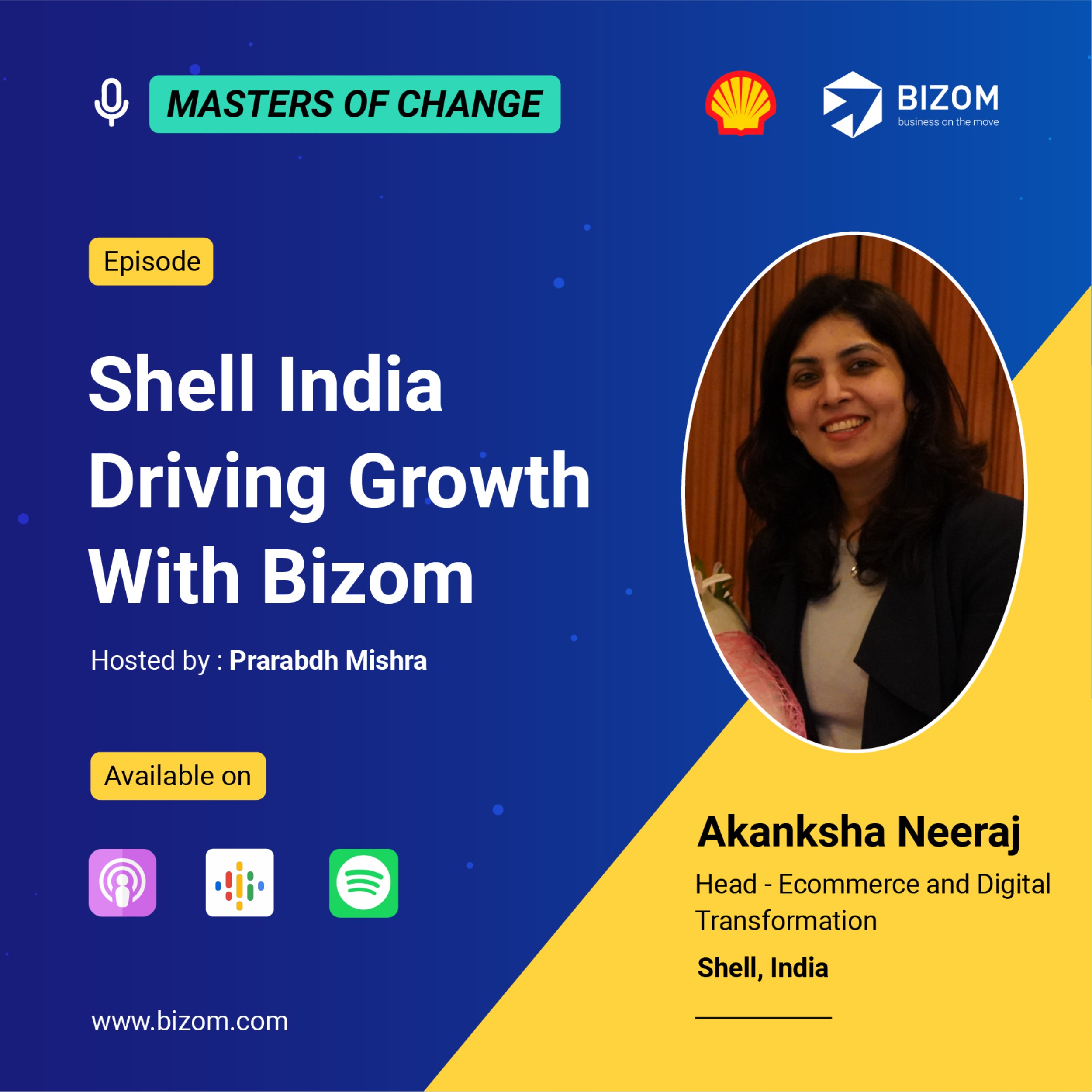
The podcast features Akansha Neelaj from Shell Lubricants India discussing digital transformation and the partnership with Bizom. She highlights the importance of digital transformation for Shell, challenges faced in leveraging technology for growth, strategies for successful change management, response to COVID-19 including tele-DSR implementation, achievements in digital transformation, and future plans for sales transformation at Shell India. Akansha emphasizes the team's commitment to driving business results through experimentation, learning, optimization, and problem-solving with digital solutions.
Transcription
3878 Words, 21885 Characters
Welcome to the podcast series on Masters of Change, Conversations with Changemakers.
We are in an off-the-cuff conversation with digital transformation leaders, sales leaders,
who bought across positive change in their organizations creating value and promoting growth.
Today, we have Akansha Neelaj, head of e-commerce and digital transformation
for Shell Lubricants India. She has been a part of Shell India for more than 12 years,
wearing various hats. A career marketer, she experienced local, regional and global markets.
She is passionate about bringing customer-centric and differentiated proportions.
Akansha, welcome to the podcast. Thank you so much, Prarab. Really happy and it's a pleasure to
be a part of this podcast series and really looking forward to an engaging conversation.
All right. So, our association obviously is very strong. Shell and Bizom goes a long,
long way. But what were you looking for in an RTM digitization partner when you came across us?
Sure. So, I think one was when we looked at the solution stack that you were able to provide.
What we really felt was that even though you had solutions which, you know, FMCGs would have deployed
and I would, you know, very honestly say that FMCG organizations would be easily four to five
years ahead of us in this journey. You definitely had those learnings from people who are experts
in this space. So, there was definitely something that we could repurpose from your learnings and
redeploy in our space. So, I think that was definitely there. And the kind of solutions
that you had and the understanding that the team brought in, you know, not just from a digital
perspective, but from real market understanding. And you know, what are the challenges that a
value chain member, whether it is a distributor, whether it is a distributor sales rep, whether it
is a retailer, he faces and therefore building solutions that addresses their pain points. I
think those were some of the things that we really, that I would say really worked in favor of Bizom
and helped us really, you know, decide that that is the right organization for us to partner with.
For a global energy brand like Shell, what role digital transformation plays and how much emphasis
is given to it? Okay. So, as part of the digital strategy for Royal Dutch Shell, which, you know,
encompasses Shell's businesses across whether it's upstream, downstream and whatever we are trying to
do across the globe, the way the digital strategy has been defined is that digital is going to play
a role in either bringing in efficiencies in our current businesses and transforming them
or using digital as a way to create new differentiated value propositions.
And thirdly, it's about using digital again as a way to create an alternate value stream
and drive sustainable revenue. Interesting to know. My follow up question would be,
what challenges did you have in leveraging technology for plant growth in an ever-changing
market like India before Bizom? The foremost challenge, Prarabd, I would say is that
if you were to look at Shell, it's a traditional oil and gas company which is now transitioning
into being an energy player. Now, if you look at ourselves versus much more tech-enabled companies,
I think one was the digital capability and understanding in terms of what is the role
that technology can play in helping us drive a business objective. So, I think the foremost
challenge was in terms of getting that buy-in from the leadership. And once that was there,
having the right people to find the right solutions that could help us solve a business problem.
Because initially, when we started on this journey, the focus was more on the solution
rather than the problem that we were trying to solve. And what we ended up doing was creating
multiple platforms with data sitting everywhere, with data hygiene being at, I would say,
less than 50%. And just focusing on the rollout and not really the value that the organization
was trying to derive out of it. And that is the change that me along with my team have been
trying to bring in since the last two years with the rollout of Bizom in our organization.
Okay. So, there's a bit of perception about change management being a lengthy and cumbersome
process. How did you plan and execute your migration?
Because firstly, I don't think it's a perception, it is truth, right? So, in any digital transformation
journey, the biggest roadblock or challenge that one has to face is around change management.
Now, how did we manage it? I would say we also learned along the way. And if you would have
seen my experience, I am no digital expert. I'm a marketer, I understand business, but I have also
relied on my team who are experts in this space and relied on partners like you to give me that
understanding of the digital space. So, how did we drive this change management was always starting
with the business objective, like I said, right? Whosoever is the stakeholder that we are talking
to? And it always starts, I think I would say first with the sales team. And that's the
discussion that we always have with them that you are our champions, you are our change agents.
It's not just the owners of the digital team to drive that change. You are the ones who are
basically the face of our organization. If you are convinced, we are sure the channel partner
would also be convinced. So, I think one was in terms of really showing them the big picture.
This is what we are trying to achieve. It is not just about rolling out a distributor management
system. It is about getting the insights and having a data-based meaningful conversation
with your channel partner. And of course, you will have a motley brew. There will be all kinds of
people. There will be early adopters. There will be laggards. And then you find people who are
early adopters and then can be your ambassadors in that journey. And then you take them along
in other conversations when you're having with another region where you think it's lagging behind
and you say, "Look at this account manager. He's been able to drive XYZ change in his territory."
And similarly, when we're talking to the channel partner, we really worked hard and I would really
commend Bizom team here because there were a lot of challenges, the initial teething issues, right?
How are you making sure that you are providing a seamless experience to the actual end user?
Because we might have a vision that I'm trying to achieve XYZ, but if my distributor or my channel
partner or his agent who does the billing every day is facing technical glitches or he's not
finding it very user-friendly is going to fall flat. So we really worked hard. I would say the
initial three, four months just went in going distributor by distributor and understanding
that is he comfortable with the new platform that we have built in. There were some changes.
There were some improvements that we kept on doing and then we will go back to them and ask them,
"Are you happy with it now?" And then again, he'll become my ambassador for the rest of the
channel communities. I would say it was a step-by-step process turning people into our ambassadors
and using them to drive change with the rest of the community. Yeah, everyone believes technology
can facilitate growth, but to actually do it is a different story. How did you happen to do it so
well? Okay, I'm not sure whether I've done it so well or not and I'm not a technology expert,
but whatever little success that we have seen, I think the way me and my team have approached
any technology solution is to first test it on three parameters. First is, does this technology
serve any business objective? What is the needle that I'm trying to move? What is the KPI that I
will measure the success on? So I think that is one thing that has to be very clear and backed by
a business case. Second is, what is the customer pain point that I'm addressing and how will he
be better off after using this technology versus where he is today? Because if the customer says,
"I was better off before using the technology," then it's going to fall flat right from day one.
And I think the third is, how friendly the platform is to the end user? Because as organizations,
you might have a vision, you might want to launch the best of the solutions, but till the time you
don't put yourself in the shoes of the actual user, test the technology and see how easy or
cumbersome it is, then I don't think anything will help succeed that particular technology
solution. So I would say, these are the three parameters that we consistently test every new
technology, every new innovative idea on. And that's the approach that we've been using and
we continue to use. So digitization change takes a lot of efforts. Organizations we work with,
we take a lot of pride in the fact that we make this step, this phase easy for them. Anything
you want to share with respect to our implementation and account management team?
No, absolutely. I mean, it's been a fantastic support that the implementation team,
the account management team, has been providing. And I would say it's pretty much like an extended
team. And we rely on your expertise rather than having so many people in-house. And I would say
you've been like constant partners over the last two years in a digitalization journey. It would
not have been possible to reach where we are without your support. And even if I were to take
an example, when we first we launched, we rolled out Bizon with our indirect automotive channel,
which is very similar to the FMCG indirect channel. But then when we tried to replicate it for our
industrial business, we realized that the software was more fit for purpose for the FMCG space.
And we had to do a lot of improvisations, because there was a lot of noise that started coming in
from the B2B space that this is not the right software you're trying to fit in an FMCG software.
But I think the support that the Bizon team provided that, okay, we will make it happen,
right? Anything is possible. We do understand that we might not have it done it for any other
industrial business, but we are happy to do it for you. And there were a lot of developments,
customizations that you made in the software to make sure that it works for the business that
we were trying to roll it out in. And today, we have reached a pretty healthy level of adoption
in the industrial business as well. So that's just one of the examples and the tele-DSR example
that I gave you in terms of proactively helping us, even the one-view one. So when we started off,
the data visualization platform was very basic. And my team, Kanika, I would like to really
highlight her name because she really worked along with the Bizon team in updating and upgrading the
whole visualization piece so that it becomes very user-friendly for my internal stakeholders.
So I think the support has been fantastic and we look forward to that continued support as
we move along in this journey. We work with a lot of organizations and we know that leaders today
want a single source of truth, a real-time view, which can help them take more informed decisions,
can give them better clarity with respect to what is happening on the field.
Any such thing you want to talk about with respect to Shell India?
Absolutely. And I would say that is the role that Bizon is playing for us. Because like I said
earlier, in our initial journey, there were multiple platforms where the data was not talking
to each other. The data accuracy was very less. And even though there was a lot of data, nobody
was looking at it. The decisions were still based on gut. They were based on anecdotal
evidences. They were based on who could wield more power over the another. And that is not really
the right way to do business. And I think that's the role that Bizon has been able to play. The
last two years, I think more than the rollout, one is of course the change management and moving
from an earlier platform to the new platform. That was of course, there was one team that was
dedicatedly working on it. But there was another work stream which was working on ensuring that the
right data is there, the right dashboards are there. And all the conversation is moving from
Excel based on anecdotal evidences to a single source of truth. So today, we've reached a level
where in Shell, we have a system of dialo-milo-vilo, which is day in the life of, week in the life
of, and month in the life of. So it's basically the reviews that we have. And today, we've reached a
place in the indirect channel where the dialos, violos, and milos are happening on Bizon. So
whether it's a conversation happening internally within the sales team, or it is a conversation
happening with the distributor, we just refer to one single source of truth. Not only that,
even our distributor incentives and our entire sales variable pay is dependent on the Bizon data.
So then you can imagine the level of effort that has really gone in terms of making it
the ultimate source of truth for us. Akanksha, what changes in the life of various stakeholders?
Do you see, because of the initiatives you have taken, ranging from distributors to maybe sales
leadership? So I'll start with Shell internally. So for our channel team and for our sales team,
the day starts with Bizon dashboards. They will look at what is the YTD, MTD, or for that particular
day, what is the secondary performance for their territory, for their distributor, for their DSR.
And there could be different KPIs. So we've also linked the primary G-SAP system to Bizon now.
So we also see how the primary is getting converted into secondary, right? How many DSRs
are there in the market? How many unbuilt outlets are there? So all of that information is something
that my sales team is kind of spending or starting their day with. And all the conversations,
all the reviews are dependent on the Bizon data. So I think that's a very significant change.
If I go to the channel partner, my distributor rise because he invests a lot of money in having
multiple DSRs. Earlier, he had no visibility of the kind of productivity that his DSRs were
able to produce in the market. Now, the kind of visibility that he has, he even has real-time
visibility, right? At a particular point of time, where is the DSR in the market? How much time is
a particular DSR spending in the market? How many outlets is he covering? How many of them has he
converted? I'll just give you a very interesting case study. So we started with a concept of a
skill-will matrix, which I think is followed in other markets, in other organizations as well.
But it is about really checking whether the DSR or the feet on street has the right skill
and the right will. If he has the right will, he will cover more outlets. If he has the right skill,
he will convert more outlets, right? And then we kind of created a two-by-two matrix and we
plotted our DSRs. And you could drill it down to any level. You could start at a national view
and you could drill it down to a distributor level. Where are his DSRs in that two-by-two matrix?
And depending on where they were, then our learning team or our network capability team
would work with those DSRs in ensuring if it's a skill problem, then they will give them the
right training. If it's a will problem, we have to make sure that he has the right beat and the
right number of outlets tacked to him. So in the last one year, with this kind of focus,
we have seen that if we have been able to reduce a quadrant four, I would say, is the
area that we've picked up. Low skill, low will. And we've been able to bring it down by one-third.
So most of those DSRs have now moved to quadrant one. So that has kind of doubled.
So this is just one interesting case study of how the BISOM data and the data, the real-time
visibility of data has helped us in really driving a productivity in the market.
So COVID-19 hit everyone unprepared, but few organizations like yours did very well in adapting
to it. What steps did you take as a response to COVID-19?
So I think when the first wave hit and there was that draconian lockdown that everybody
refers to, which I think was still required that time, but nevertheless, the economy kind
of completely plunged and everybody was stuck at home. And that was like the worst period in
when you look at the business charts, there was a complete dip. The DSRs were sitting at home,
distributors were ready to lay off because they were not getting any revenue news.
And then we had a connect with the BISOM team to understand how is it that other organizations
are adapting to this. And it was very interesting to see that you guys had introduced this tele-DSR
functionality, which was something which was very relevant for that particular point of time.
And we turned it around, I think quickly within a month, within a week or so, where we said that
okay, all the DSRs who are sitting at home, the retailers are still there. Don't lose touch
with your customer. Don't let that gap of one or two months come in. Stay connected. So earlier,
what they would do is they may not have the mobile numbers of all the retailers. If they had,
they would use a notepad and then they will, you know, input it into the BISOM as if it was
getting very cumbersome. So we ensured that the tele-DSR functionality was a part of the regular
beat. So the only difference was that rather than stepping out into the market, they would
start with the tele-DSR, they would know, you know, these are the numbers that I have to call.
So it was pretty much like a virtual beat covering, which really helped us drive the coverage and
stay connected with our customers. And we continue to use that in second wave. And even today,
what we've done is that there is a sense that we did through which we were able to triple
our universe in BISOM. And we ensured that every outlet was attached to a DSR.
And then since we have limited DSRs and it was not possible to physically visit
all the outlets because we had, you know, tripled the universe, we said we want to augment the
physical visits with the tele-DSR. And what that really helped us in achieving is that our coverage
has doubled. And in that coverage, 25% of that coverage is achieved through tele-DSR. So what
it really helps me is in building that pipeline. And then of course, it is, it then depends on
the scale and the overall proposition that you're offering in terms of converting. So I would say
that was a very timely, agile and innovative introduction that we were able to do during
COVID times. So Akansha, you and your team have achieved quite a few things. What is one achievement
you are really proud of? If I were to just pinpoint on one achievement, it would be that today,
India has become a benchmark when it comes to any regional connects, when it comes to any global
connects. Whatever we have done, whether it is in the space of data hygiene, whether it is in the
space of digitizing our value chain, whether it is in the space of, you know, launching innovations
like tele-DSR or what we are trying to do with ARS, we are way ahead of what other markets are doing
or even thinking about. So the speed with which we are experimenting, we are learning, we are
optimizing and also driving business results. That is something that I'm really proud of.
I'm really proud of my team for having given their 200 percent, for having that external focus,
for ensuring that digital not just becomes, you know, a technology in itself, but it becomes
a solution to a problem. And that is something that I'm really proud of.
Good to know. So I have just final question. What's next for Shell India with respect to your
sales transformation journey? There is a lot more to achieve, I would say. There's a pyramid that
you guys only had shared with us in terms of, you know, digitization journey for organizations
which starts from putting in the basics to assisted selling to, you know, inspired selling.
I would say right now we are in the basics and now we want to move into the assisted and the
inspired selling part of it, which is now the adoption is there. What more can I do to assist
my DSR in improving his productivity, in improving his coverage, whether it is through, you know,
using database algorithms, whether it is through dynamic beat planning, whether it is through
the merchandising solutions, you know, those are some of the things that we will be focusing on,
or there's another interesting piece that we are piloting with you guys, which is in the
auto replenishment space that bases the secondary and the inventory level. Can we, you know,
auto replenish the orders? So I think those are some of the things that we will moving into,
which I would say will go into the assisted and the inspired selling part of it. But yeah,
there's a long way to go. Bizom is a retail intelligence platform providing end-to-end
supply chain automation for CPG brands. We take pride in being the fastest growing retail tech
solution trusted by 500 plus brands globally. Presently, we operate in 15 plus industries
spread across 25 plus countries, where we are assisting 7.5 million retailers every day.
Bizom uses a 360-degree outcome-driven approach for retail strategizing consisting of different
intelligent retail solutions, each focusing on digitization, optimization, and expansion.
Thanks for tuning in. You were listening to the podcast series, Masters of Change - Conversations
with Chainmakers. To know more about Bizom and how it can help your organization drive faster
outcomes, please visit our website, Bizom.com. Thank you.
Podcast Summary
Key Points:
Akansha Neelaj, head of e-commerce and digital transformation at Shell Lubricants India, discusses digital transformation and partnership with Bizom.
Importance of digital transformation for Shell, emphasizing efficiencies, new value propositions, and revenue streams.
Challenges faced by Shell in leveraging technology for growth in India prior to partnering with Bizom.
Strategies for successful change management, involving stakeholder engagement and addressing user needs.
Shell's response to COVID-19, including implementing tele-DSR functionality to stay connected with customers.
Achievements of Shell India in digital transformation, leading in data hygiene, value chain digitization, and innovations like tele-DSR.
Future plans for Shell India's sales transformation journey.
Summary:
The podcast features Akansha Neelaj from Shell Lubricants India discussing digital transformation and the partnership with Bizom. She highlights the importance of digital transformation for Shell, challenges faced in leveraging technology for growth, strategies for successful change management, response to COVID-19 including tele-DSR implementation, achievements in digital transformation, and future plans for sales transformation at Shell India. Akansha emphasizes the team's commitment to driving business results through experimentation, learning, optimization, and problem-solving with digital solutions.
FAQs
The solution stack provided by Bizom, expertise in FMCG space, and solutions addressing pain points influenced the partnership decision.
Digital transformation at Shell focuses on efficiency, value propositions, and revenue streams across the business.
Challenges included digital capability, leadership buy-in, focusing on solutions over problems, and data management.
Change management was driven by focusing on business objectives, involving stakeholders like sales teams, and turning early adopters into ambassadors.
Shell India focused on aligning technology with business objectives, addressing customer pain points, and ensuring user-friendliness of platforms.
Shell India introduced tele-DSR functionality to stay connected with customers, tripled their universe in Bizom, and used tele-DSR to augment physical visits.
Chat with AI
Loading...
Pro features
Go deeper with this episode
Unlock creator-grade tools that turn any transcript into show notes and subtitle files.
 PodcastTranscript AI