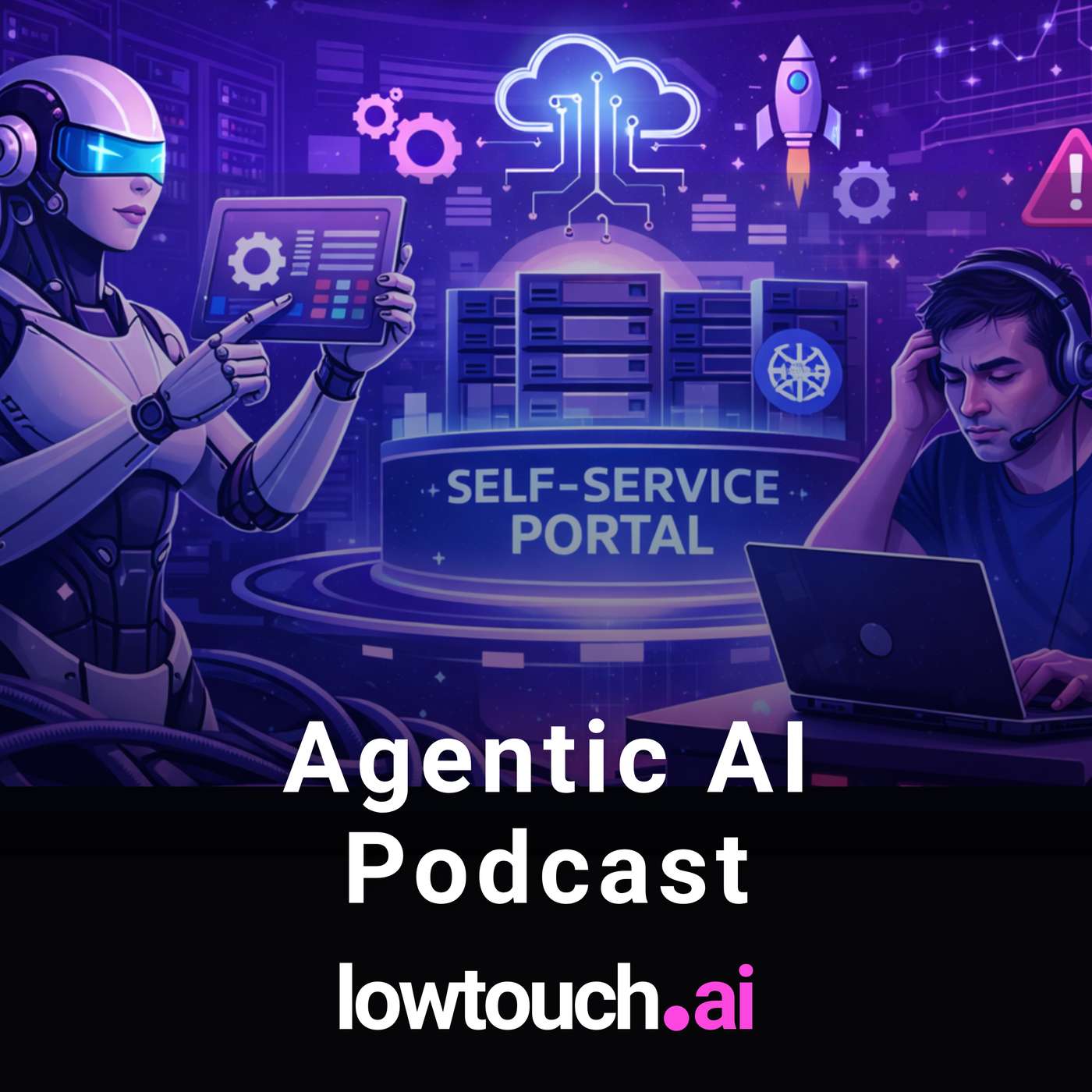
AI Powered Self-Service Platforms: Reducing DevOps Bottlenecks | Agentic AI Podcast by lowtouch.ai
13m 56s
The podcast discusses the paradox of DevOps teams becoming bottlenecks in modern enterprises despite their role in enabling digital speed. Challenges include skills shortages, legacy architectures, and manual processes like environment provisioning, which lead to delays, shadow IT, and alert fatigue. The solution is a shift from traditional, rigid automation to AI-powered self-service platforms, such as Internal Developer Platforms (IDPs). These platforms use natural language interfaces and intelligent layers to interpret user intent, dynamically adapt to changes, and enforce policies through guardrails. They enable faster deployments, automated troubleshooting, and context-aware approvals, reducing downtime and manual effort. The future points toward autonomous, self-healing systems, though governance and data privacy remain critical. Adoption should start with targeted pilots, focusing on high-value tasks to prove ROI and transform team culture from reactive firefighting to strategic innovation.
Welcome back to the Agentegei podcast. Today we're tackling a a massive paradox that's sitting right at the heart of the modern enterprise. Right. It's about the unsung heroes of the digital world, the DevOps teams. They're the ones keeping the lights on, you know, making sure your app doesn't crash. But here's the paradox. The very people tasked with enabling speed are well, they're increasingly becoming the biggest bottleneck. It is a fascinating contradiction, isn't it? We have more tools, more automation than ever. And yet developer velocity, the actual speed we can ship new features is often grinding to a halt. That's it. It's what the industry is starting to call the hidden cost of DevOps. Exactly. And we're not just talking about a slow server here or there. This is a systemic drag on the entire business. I was looking at some industry metrics and the stakes are just they're incredibly high. Something like what 33% of organizations are citing skills, shortages of major challenge. They literally can't find enough people who understand this stuff. And it gets worse. On top of that skills gap, you've got another 29% pointing to legacy architectures making everything harder. Oh, wow. So you have a shortage of experts and the ones you do have are trying to manage these incredibly complex, often outdated systems. It's a pressure cooker. You can see how that leads to frustration. You get developer frustration, reliability issues and frankly, team around just erodes under the weight of constant firefighting. Firefighting is the perfect word for it. Feels like ops teams are just running from one blaze to another, never getting the chance to actually build fireproof buildings. Exactly. But today we're going to talk about the pivot, removing away from the old way of doing things, this ticket based operations model and looking at the rise of AI powered self service platforms. This is the game changer. And I want to be really clear for everyone listening. This is not just about writing better scripts. This is a fundamental shift from rigid static tools to on demand intelligent systems that actually understand intent. This is a genetic AI really entering the DevOps space. I love that distinction. We're going to drill down on that. But before we get to the solution, I want to fully unpack the pain. Let's define the friction. Where exactly are these bottlenecks happening? It's a good question because for a lot of decision makers, DevOps is just a black box that money goes into. Yeah, exactly. But if you look inside that box, the friction is everywhere. The classic example is environment provisioning. Okay. Let's say you're a developer, you've written some great code, you want to test it. You need a staging environment, basically a sandbox that looks like the real world standard stuff. In a traditional setup, you have to file a ticket and then you wait and you wait and you wait some more exactly. You might wait for days and why? Because someone on the ops team who is already overworked has to manually configure everything, the server, the database, the networking. And in the meantime, that developers what, twiddling their thumbs or worse, context switching to another project, which just kills their flow. It completely destroys their flow precisely. Then you have access requests, security reviews that's sitting cues for days. And this leads to a really dangerous phenomenon we see all the time called shadow. I know this one. That's when developers get so impatient waiting for permission that they just what's been up their own servers on a corporate credit card and bypass security entirely, which is a nightmare for compliance. But it happens because the right way just takes too long. People want to get their jobs done. Of course. Then you have CICD complexity and finally alert fatigue. The systems are screaming with so much data logs, metrics, errors that the ops team just can't tell the signal from the noise. It sounds exhausting. Like you need a PhD just to figure out why your page is going off. It is. And it all leads to this tribal knowledge trap. The tribal knowledge trap. Is that where like only one person knows how to fix the really weird bug? Yes. It's the Dave knows how that server works problem. Manual one books rely on specific people knowing specific works. If Dave is on vacation or if Dave quits, the whole organization is in trouble. Exactly. It makes onboarding a nightmare and scaling impossible. You can't clone Dave. So we've established the current state is brittle, slow and held together by human glue. Let's talk about the solution. Yeah. You mentioned this shift from automation to intelligence. I feel like we use automation for everything. How is this different from just a really good terraform script? That is the million dollar question. Traditional automation tools like Ansible Terraform is powerful, but it is rigid. It executes a predefined script. It does exactly what you tell it to do step by step. OK. But if the context changes, say a cloud provider changes an API or a server is under a load, the script didn't account for the script breaks. It's like a train on a track. If the track is blocked, the train stops. It can't steer around the obstacle. Perfect analogy. AI driven self service is like an off road vehicle with a GPS and a driver. It uses learning algorithms to interpret intent. It understands the goal. Oh, OK. So if the standard path is blocked, the AI can adapt, retry or ask for more information. It's dynamic. And this is where internal developer platforms or IDPs come in. Right. IDPs are the vehicle for all this. And IDP provides a unified interface. So instead of a developer needing to know how to log into AWS, configure a VPC, manage security groups, they just go to the IDP. It's a single portal. OK. But I can hear the nervous ops managers listening right now thinking, wait, you're just letting developers push buttons. That sounds like chaos. And that is the common fear. But self service, when it's done right, actually increases control. It's not about removing rules. It's about embedding them. We call it guard rails. So the platform itself enforces the security and compliance policies automatically. Exactly. The platform teams stops being the department of no and they become noise. Like they shift from being gatekeepers to enablers. They design the highway and set the speed limits, but they stop driving every single car. That is a crucial mindset shift. OK. I want to look under the hood. What is the architecture of one of these AI platforms actually look like? It's not just chat GPT glued to a server. Right. No, definitely not. Please don't do that. If we look at the principles from groups like, say lowtouch.ai or the Google SRE handbooks, there are really four specific layers that make these agentic platforms work. OK. Walk us through them. Layer one. Layer one is the interface layer. This is moving away from complex forms with a hundred drop downs that nobody understands. We are moving toward natural language processing and LP. So a user can just chat with the system. Right. You type set up a new database cluster for the marketing project. Simple as that. No check boxes. Just plain English. Exactly. But that request has to go somewhere. So that leads to the intelligence layer. This is the brain. It uses LLM's large language models to process that intent. But it's not just the words. It uses context engines to look at the user's profile, the system state. It's understanding the who, what, and why exactly. And it uses policy reasoning to ask, is this person allowed to have a database? What size in what region? Once it decides what to do, it passes that to the automation layer. Whether rubber meets the road. This layer integrates with those infrastructure as code tools, terraform, Pallumi, and uses agentic AI runbooks to execute these complex sequences. So AI tells the script what to do. It provides the parameters for the code. Yes. And finally, and this is critical, you have the observability and feedback loop. The system watches itself logs metrics. They all feed back into the AI. So we learned it learns if a deployment fails, it understands why. It optimizes future interactions based on real data. That's what turns it from a static tool into an adaptive learning system. Let's make this real. Let's walk through some scenarios. What does this look like on a Tuesday morning when things are getting crazy? Let's start with that staging environment. Okay. Scenario one, the staging environment, old world, file a ticket, you wait three days, right, agente AI world. The developer opens a chat window and says, I need a staging environment for the new payment gateway feature in behind the scenes. The AI detects the intent. It checks the policy. Okay, payment team. They're allowed these resources. It checks the budget. Then it triggers the automation layer to provision everything. And within minutes, it replies, your environment is ready. Here are the credentials. Minutes, not days. That's pure velocity. Huge velocity. Now let's up the stakes. Scenario two, the rollback, it's Friday afternoon, you deploy code, the site crashes, the absolute nightmare scenario. Every engineer's worst fear. Usually this is just panic. Frantic phone calls digging through logs with an AI platform. The system observes the error rate spiking. The AI analyzes the logs, correlates the spike with the recent deployment and identifies the issue. So it finds the cause. It finds the cause and crucially, it can execute a safe rollback automatically to the last known good state. It stops the bleeding. Down time goes from hours to seconds. Incredible. What about troubleshooting? Not a full crash, but just weirdness. The app feels slow. This is AI ops. Let's say there's a latency spike. A human has to look at 10 different dashboards. An AI can look at all those data streams at once. It correlates the metrics, pin points, the cause, hey, the specific query is locking the database and suggests a fix. It's like a detective that can read a million pages of evidence in a second. Exactly. And the final one is context-aware approvals. Instead of waiting for a manager to click approve, the AI validates the role and risk dynamically. So if a senior engineer asks for read access to a log file during an incident, the AI grants it immediately because the context justifies it. But if a junior intern asks for root access to the production database at 3 a.m. The AI says absolutely not and flags it for security.
It's intelligent gating. It is. And this brings us to where this is all going. We're in the self-service phase now. But the trajectory is toward autonomous platforms. Autonomous. That sounds big. And maybe a little scary. What does the agentic future look like? Well, we're moving toward agents that handle multi-step workflows independently. Not just responding, but proactively managing the system. We're talking about self-healing, self-optimizing systems. So a system that doesn't just fix a break, but notices performances degrading and tunes itself. Without a human ever touching it. That changes the human role entirely, doesn't it? What do we do? We move to AI/OP supervision. We oversee the intelligent systems. We become the pilots watching the autopilot, not the mechanics turning the wrench. And honestly, we have to. The complexity of modern systems is just growing too fast for manual management. It sounds great, but let's be honest about the challenges. We can't just hand the keys to the AI and walk away. Absolutely not. Governance is the biggest challenge. You have the risk of over-automation and then of course model hallucinations. Right. The AI, confidently making a terrible decision. Like deleting a database because it thought it was a test file. Exactly. If an LLM hallucinates a configuration that opens a security hole, that's a disaster. That is why human and the loop is non-negotiable for high-stakes scenarios. For a destructive action, the agent must get approval. And what about data privacy? We're feeding these models all our logs are secrets. A massive concern. This is where the concept of private AI becomes critical. You can't just dump your enterprise data into a public chatbot. We're seeing a rise in things like the private AI appliance or private VPC approaches. I saw this in the notes on low-touch.ai's model. The idea that the automation happens securely on-site in your own cloud. Exactly. It ensures complete data control. The AI agents run inside your perimeter that data never leaves your control. For enterprise adoption, that's the only way to go. So if I'm a CTO listening to this and I'm realizing my team is drowning in tickets, how do I get started? It feels overwhelming. Don't try to boil the ocean. Don't build sky-nut on day one. Start by assessing your bottlenecks. Find the pain. Where's your team spending the most time waiting? Start there. Start there. Pilot an IDP with some AI interpretations. Maybe that environment provisioning use case. It's high-value, high-frequency, and relatively low-risk. Focus on AI literacy within your platform team. And remember, the goal is to free up innovation time. Start with the routine tasks. Prove the value, then expand. It's a journey, not a switch you flip. No. But you do need to start walking the path. So let's bring this all home. We started by talking about the unsung hero paradox. And the key takeaway is that these are structural flaws, not individual failings. If your DevOps team is slow, it's because the structure of modern operations is broken. AI-powered platforms are the structural fix. And the ROI isn't just saving money. It's faster velocity, reduced burnout, improved reliability. It changes the nature of the work. We are moving from a world of firefighting to a world of strategic advantage. I love that. Putting down the firehose and picking up the architectural blueprints. So the question isn't if you'll adopt agentic AI and DevOps. But how fast you can do it to stop these hidden costs from eating your competitive edge. That's the reality. The bottleneck is the new battleground. I want to leave our listeners with one final thought. We've talked a lot about the technology, the process. But I want you to think about the culture of your engineering team. Imagine a world where your smartest engineers are never interrupted by a ticket. Where their curiosity is the only limit to their speed. Could your team build if the friction simply vanished? That's the promise here. A very powerful vision. Thank you so much for breaking all this down with us today. My pleasure. My end to our listeners, keep asking questions. And we will see you on the next Egenic AI podcast.
Podcast Summary
Key Points:
DevOps teams, while essential for maintaining digital operations, have paradoxically become bottlenecks, slowing developer velocity despite advanced tools and automation.
Key challenges include skills shortages, legacy system complexity, manual processes like environment provisioning and access requests, alert fatigue, and over-reliance on tribal knowledge.
The solution involves shifting from rigid, ticket-based automation to AI-powered self-service platforms (like Internal Developer Platforms) that use natural language, intent interpretation, and dynamic adaptation to streamline workflows.
AI-driven platforms enhance control through embedded guardrails, enabling proactive management, faster troubleshooting, and autonomous operations while maintaining security and compliance.
Adoption requires starting with high-pain, low-risk use cases, ensuring strong governance and data privacy (e.g., via private AI), and fostering a cultural shift from firefighting to strategic innovation.
Summary:
The podcast discusses the paradox of DevOps teams becoming bottlenecks in modern enterprises despite their role in enabling digital speed. Challenges include skills shortages, legacy architectures, and manual processes like environment provisioning, which lead to delays, shadow IT, and alert fatigue. The solution is a shift from traditional, rigid automation to AI-powered self-service platforms, such as Internal Developer Platforms (IDPs).
These platforms use natural language interfaces and intelligent layers to interpret user intent, dynamically adapt to changes, and enforce policies through guardrails. They enable faster deployments, automated troubleshooting, and context-aware approvals, reducing downtime and manual effort. The future points toward autonomous, self-healing systems, though governance and data privacy remain critical.
Adoption should start with targeted pilots, focusing on high-value tasks to prove ROI and transform team culture from reactive firefighting to strategic innovation.
FAQs
It refers to the contradiction where DevOps teams, tasked with enabling speed, become bottlenecks due to factors like skills shortages and legacy systems, slowing down developer velocity despite increased automation.
Bottlenecks include slow environment provisioning requiring manual ticket-based processes, lengthy access requests and security reviews, CI/CD complexity, and alert fatigue from overwhelming system data.
Traditional automation is rigid and executes predefined scripts, while AI-driven self-service uses learning algorithms to interpret intent, adapt to changes, and dynamically handle obstacles like API updates or system load.
An IDP is a unified interface that allows developers to request resources (e.g., staging environments) via natural language, embedding security and compliance rules as guardrails to enable self-service without chaos.
The layers include: an interface layer for natural language input, an intelligence layer using LLMs to interpret intent, an automation layer to execute tasks, and an observability/feedback loop for continuous learning and adaptation.
Examples include provisioning staging environments in minutes instead of days, automatically rolling back failed deployments to reduce downtime, and using AI ops to troubleshoot issues like latency spikes by analyzing multiple data streams.
Chat with AI
Loading...
Pro features
Go deeper with this episode
Unlock creator-grade tools that turn any transcript into show notes and subtitle files.
 PodcastTranscript AI